



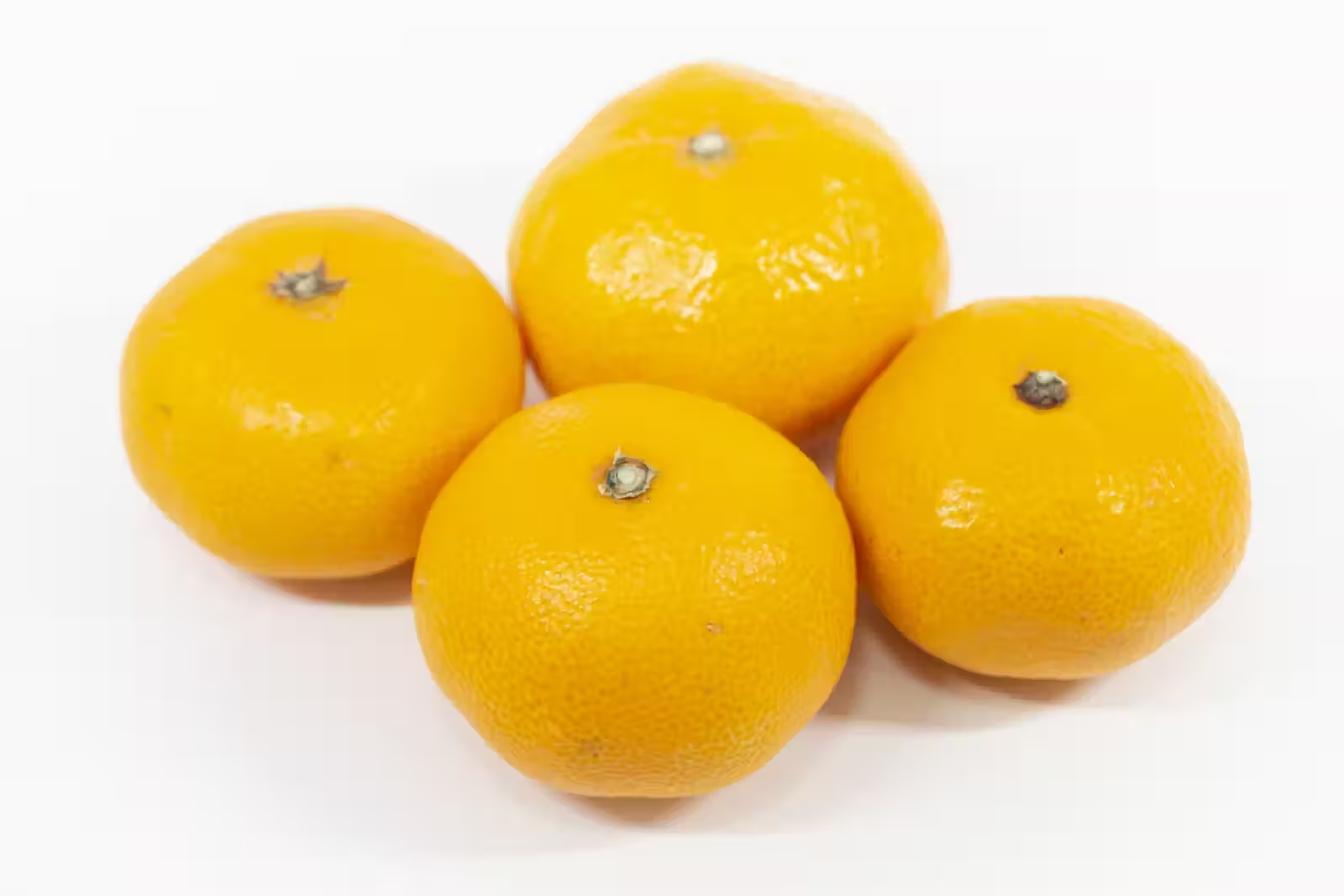
Mie Nanki Mikan (三重南紀みかん) is a Japanese mandarin orange from the southern tip of Mie Prefecture. Growers there ship citrus in almost every month of the year, which is rare in Japan. The brand covers Unshu mandarins from three towns on the Pacific coast: Kumano City (熊野市), Mihama (御浜町), and Kiho (紀宝町).
Most travelers meet Japanese mikan in Wakayama or Ehime. Yet this quiet corner of the Kii Peninsula, the mountainous cape south of Osaka and Nagoya, sends out some of the earliest field-grown mikan in the country. So the first boxes leave while summer heat still lingers, and that timing shapes the flavor.
What Is Mie Nanki Mikan?
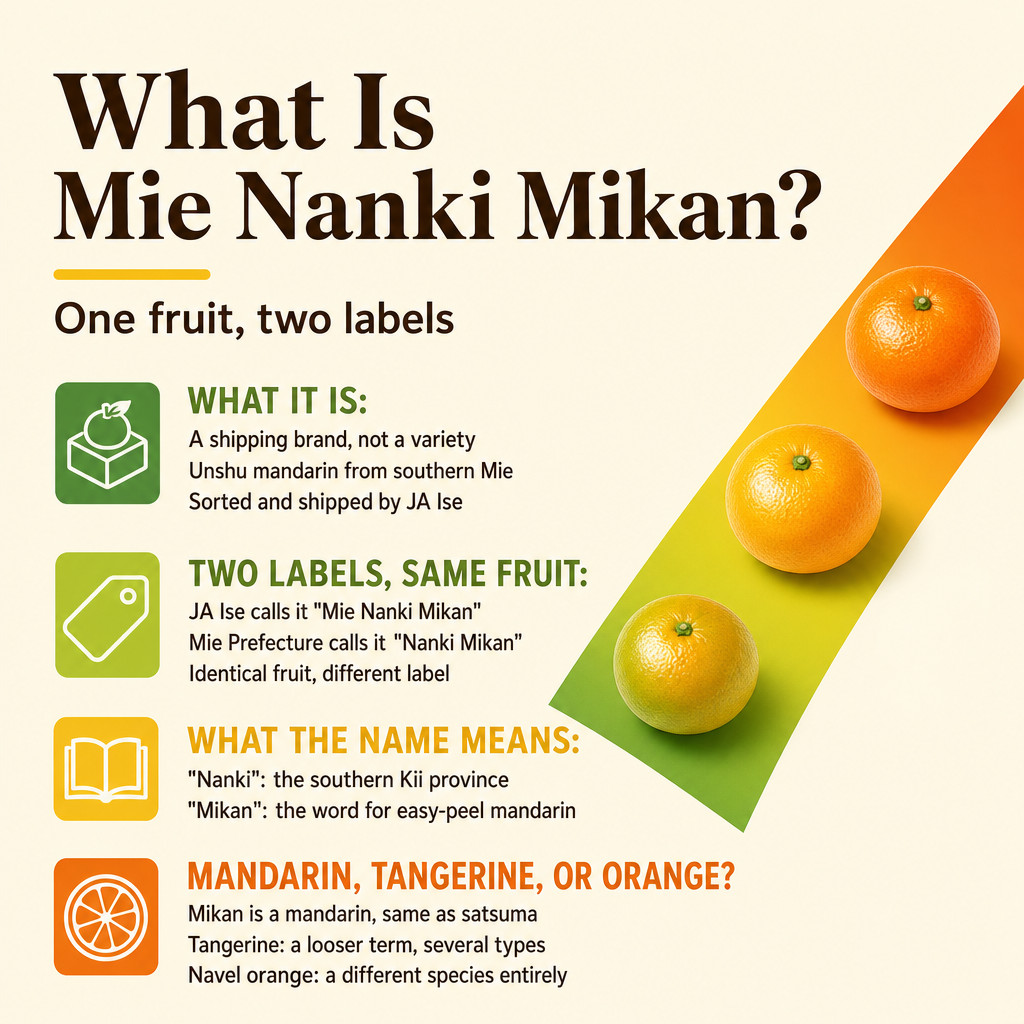
Mie Nanki Mikan is not a botanical variety. Instead, it works as a shipping brand for Unshu mandarin (Citrus unshiu) grown in the far south of Mie. JA Ise, the local agricultural co-operative, sorts and ships the crop. Most of it reaches supermarkets around Nagoya, in the area Japan calls Chūkyō.
Two Labels That Sound Almost the Same
The naming trips people up, so the two labels are worth separating. JA Ise ships fruit from the three towns as “Mie Nanki Mikan”. Mie Prefecture, meanwhile, certifies fruit from the same area under its official Mie Brand program as “Nanki Mikan”. The fruit is identical. Only the label changes, depending on who is speaking.
The Meaning Behind the Name
“Nanki” refers to the southern half of the old Kii province. Today the word stretches across southern Wakayama and the bottom edge of Mie. “Mikan” is simply the everyday Japanese word for a small, easy-peel mandarin. Put the two together, therefore, and the name says exactly what sits in the box.
Mandarin, Tangerine, or Orange?
Botanically, mikan is a mandarin. Western shops sell the same species under the label satsuma mandarin, so the two names describe one fruit. Tangerine, meanwhile, is a looser trade term that covers several mandarin types at once. A navel orange belongs to a different species, which is why it needs a knife. For the wider national picture, our guide to mikan in Japan covers varieties and growing regions in more depth.
Where Does Mie Nanki Mikan Come From?
Mie Prefecture and the Nanki Region
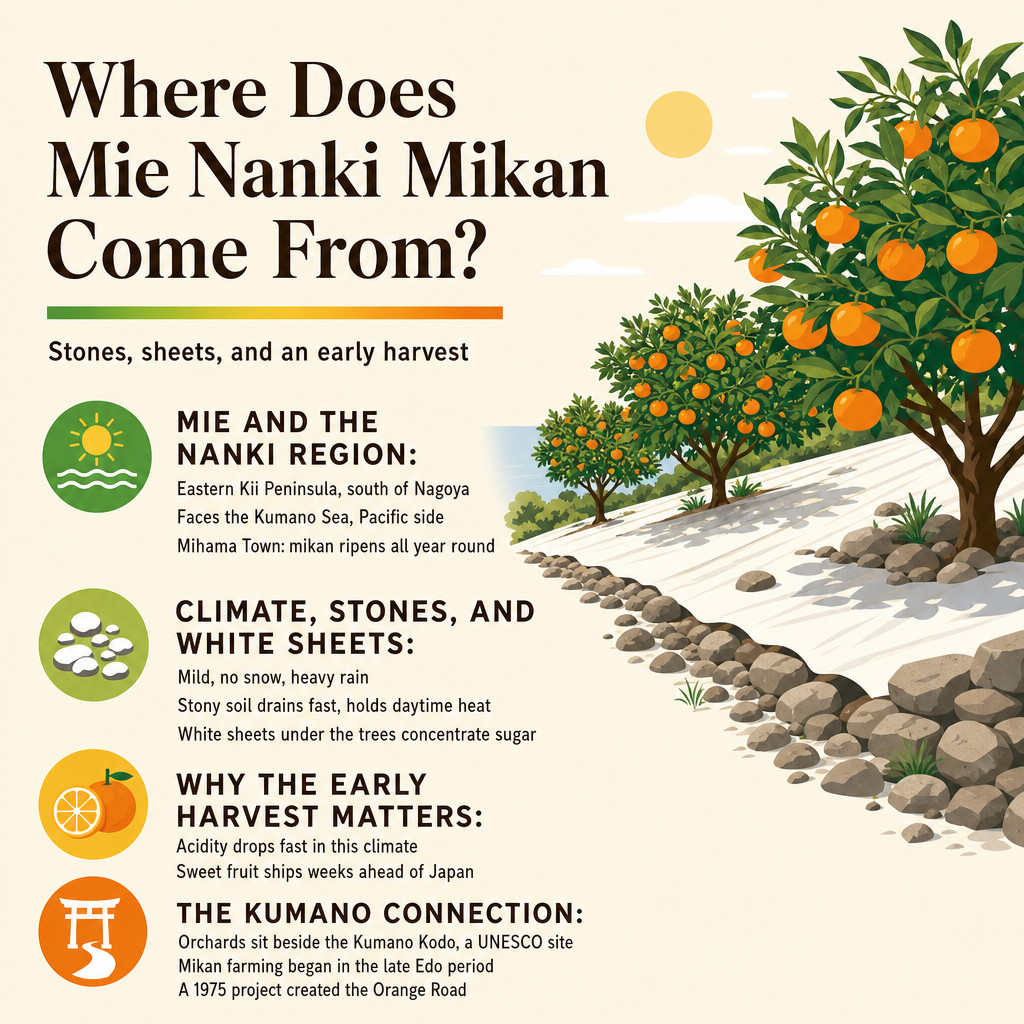
Mie occupies the eastern flank of the Kii Peninsula, south of Nagoya. Ise Grand Shrine and Matsusaka beef come from the northern half of the prefecture. The citrus district lies much further down, facing the Kumano Sea on the Pacific side. Mihama Town describes itself, fairly enough, as the town where mikan ripens all year round.
Farming here faces the same pressure as much of rural Japan. Mihama Town reports that grower numbers are falling as the population ages. So the town now runs training and consultation programs for people who want to take over an orchard.
Climate, Stones, and White Sheets
Snow almost never falls here. Mihama Town records an annual average of 17.6°C and around 2,300 mm of rain. Normally that much rain would water down the fruit. However, the ground is full of small stones, so rainfall drains away quickly. Those same stones hold daytime heat, which keeps night temperatures from dropping sharply.
Farmers add one more trick. They spread white plastic sheets across the ground under the trees, blocking rain and tightening the water supply. As a result, sugar concentrates while acidity fades earlier than in other regions.
Why the early harvest matters: acidity drops fast in this climate, so southern Mie can ship sweet fruit weeks ahead of most of Japan. Mie Prefecture credits that head start for the high market prices the region commands.
The Kumano Connection
The orchards sit beside the Kumano Kodo pilgrimage routes, a UNESCO World Heritage site. Mihama Town traces the oldest local record of wild tachibana citrus back roughly three centuries. Mikan farming itself began later, near the end of the Edo period, after varieties arrived from Wakayama.
Expansion came in 1975, when a national farmland development project opened new orchards across the hillsides. That project also produced the Orange Road, a stretch of road with citrus fields running along both sides. Unlike many Japanese citrus regions, Mihama has few steep terraces, so much of the picking happens on gentle slopes.
What Does It Taste Like?
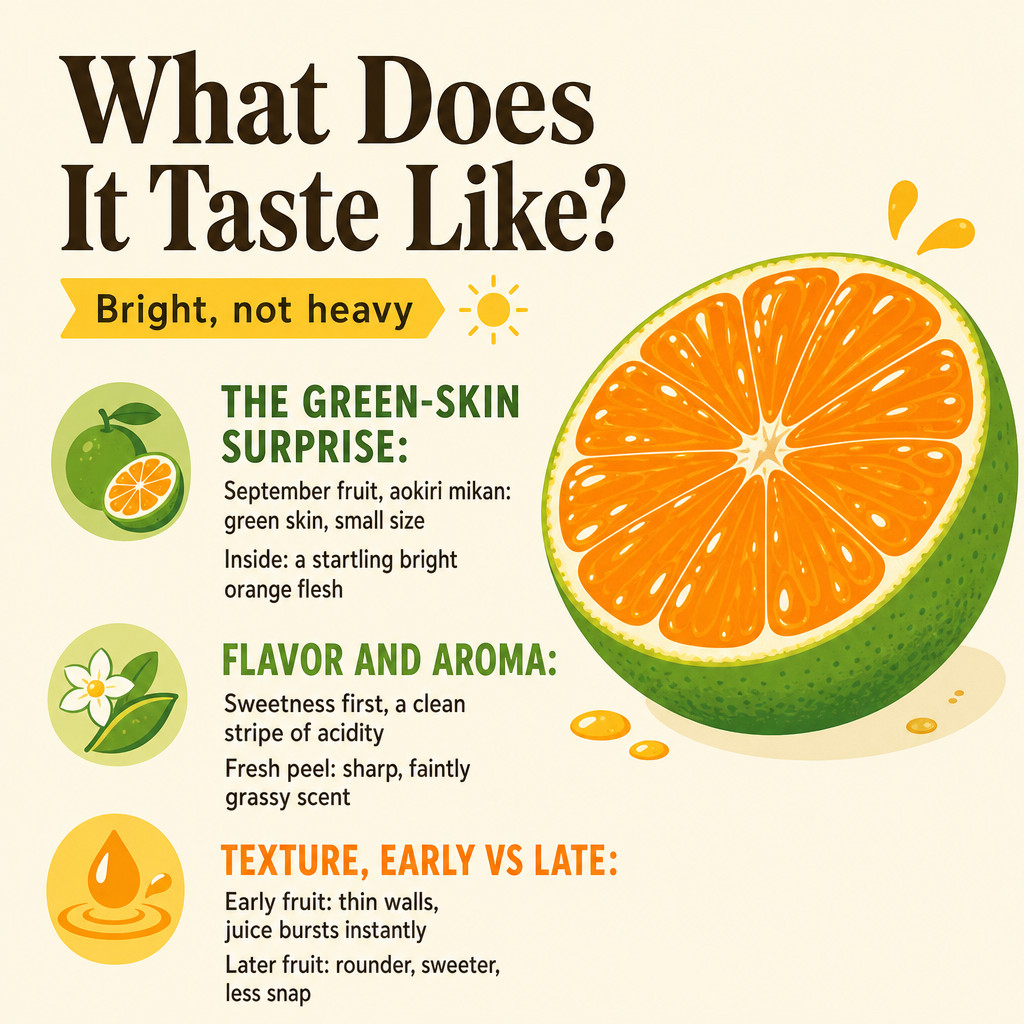
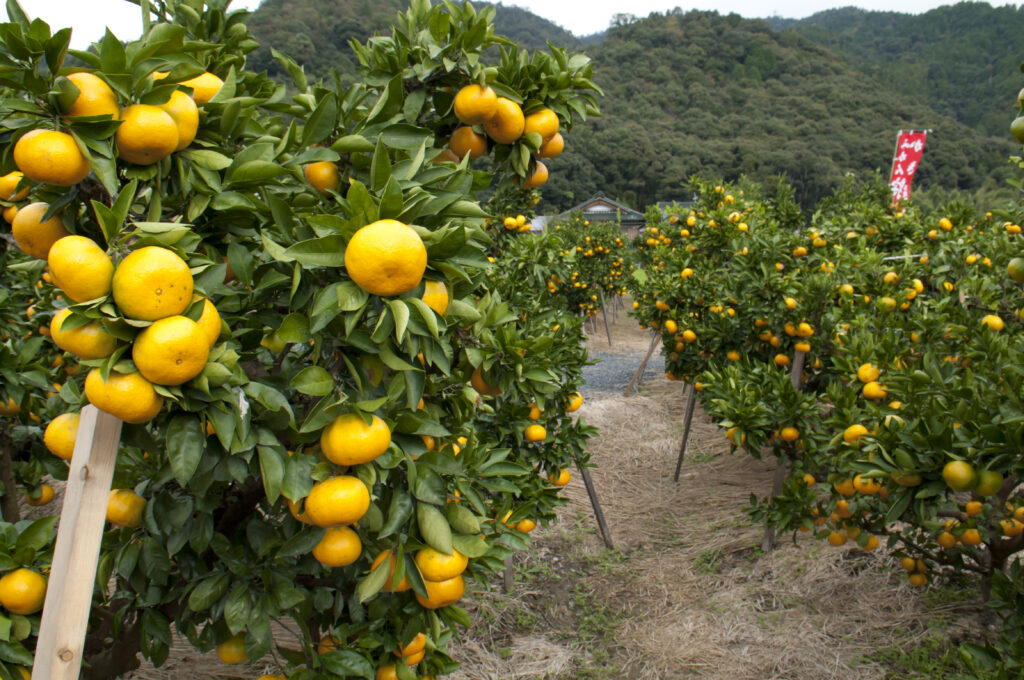
Early-season fruit looks unripe. The skin stays green, the size runs small, and I hesitated the first time someone handed me one. Then I peeled it, and the flesh underneath glowed a startling orange. Locals call this September fruit aokiri mikan, meaning roughly “green-cut mikan”.
The flavor is bright rather than heavy. Sweetness arrives first, followed by a clean stripe of acidity that clears quickly. Aroma, however, is the part most people underestimate. Fresh peel throws off a sharp, faintly grassy citrus scent, particularly in September fruit.
Texture matters as well, particularly in the early fruit. Segment walls are thin, so juice releases the instant you bite down. Later fruit turns rounder and sweeter, though it gives up some of that early snap. Which one is better? Honestly, I still cannot decide, and locals argue about it every single season.
Season and Harvest Calendar
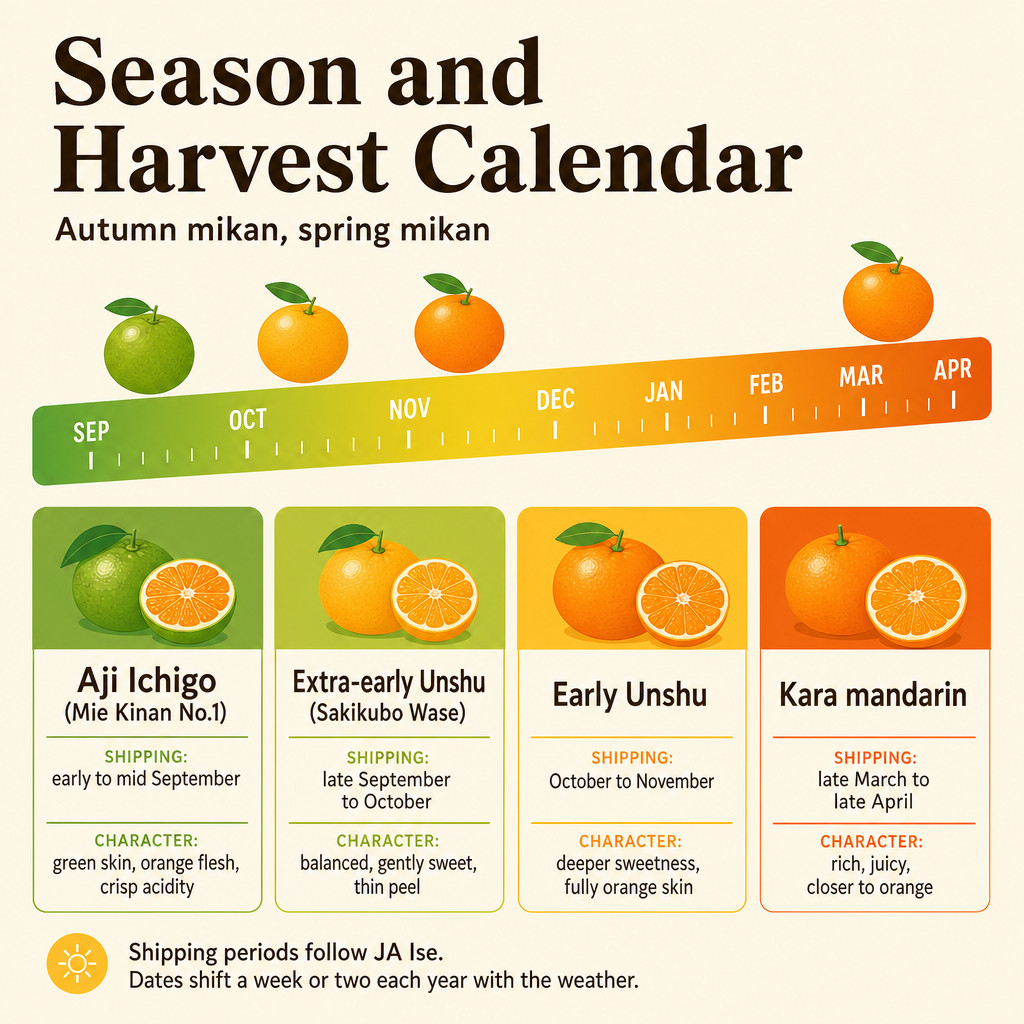
Southern Mie runs an unusually long citrus calendar. Autumn brings the early mandarins, while spring belongs to a completely different fruit. Because of that split, locals talk about “autumn mikan” and “spring mikan” as two separate things.
| Type | Shipping period | Character |
|---|---|---|
| Aji Ichigo (Mie Kinan No.1) | Early to mid September | Green skin, orange flesh, crisp acidity |
| Extra-early Unshu (Sakikubo Wase) | Late September to October | Balanced, gently sweet, thin peel |
| Early Unshu | October to November | Deeper sweetness, fully orange skin |
| Kara mandarin | Late March to late April | Rich, juicy, closer to orange |
JA Ise describes Aji Ichigo as the earliest open-field Unshu mandarin shipped in Japan. Supply is tiny, though. Mihama Town notes that it circulates for only about three weeks, so blinking at the wrong moment costs you a year.
Kara mandarin works differently. It is a cross between Unshu mandarin and King mandarin, introduced to Japan in the 1950s. Growers skip the white sheets here and let winter rain wash the acid out slowly. They also bag each fruit, since Kara handles cold poorly. That patience explains the deep, almost tropical sweetness in April.
The Brand Names You See on the Box
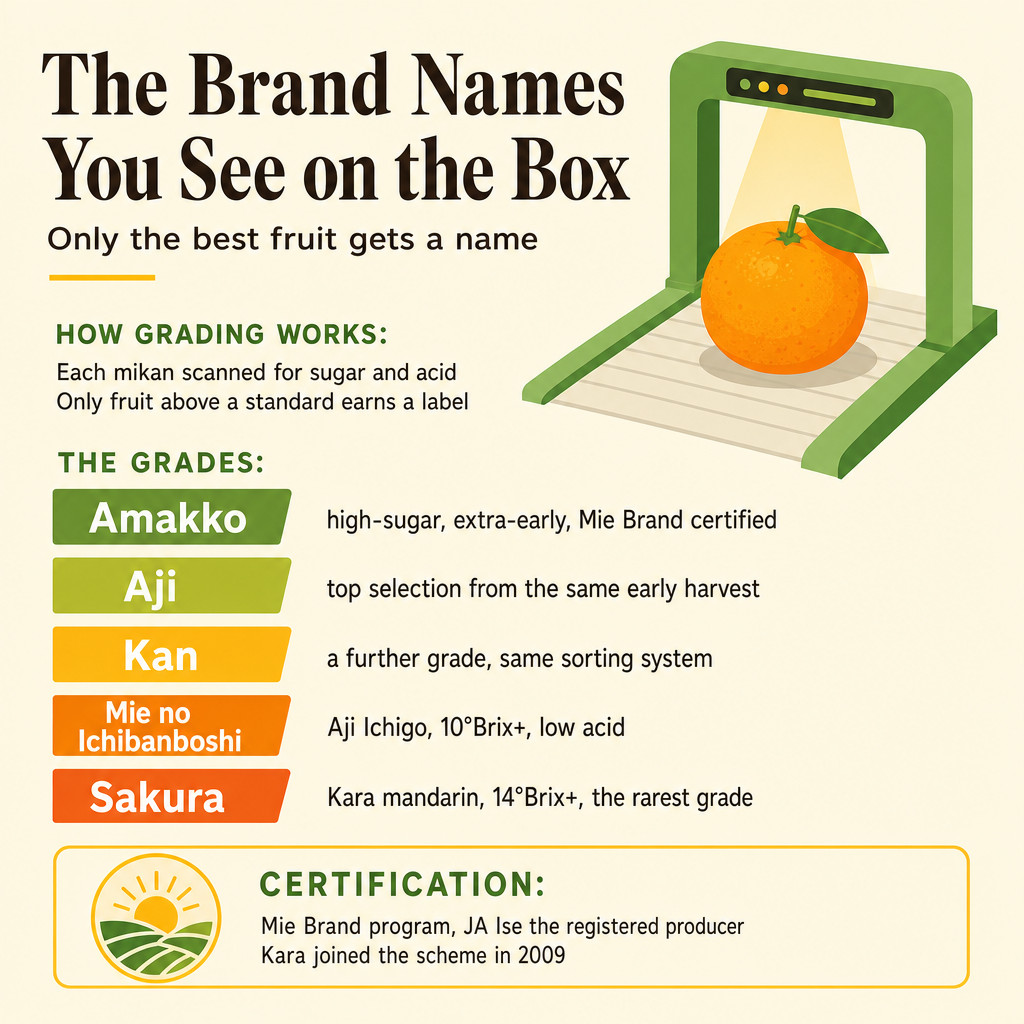
Not every fruit earns a name. JA Ise scans each mikan with a non-destructive sugar and acid sensor, then sorts by the reading. So only fruit that clears a set standard carries a premium label.
- Amakko (あまっこ): high-sugar extra-early fruit, also certified under the official Mie Brand program.
- Aji (味): a top selection from the same early harvest, likewise Mie Brand certified.
- Kan (柑): a further grade sold through the same sorting system.
- Mie no Ichibanboshi (みえの一番星): Aji Ichigo that clears 10 degrees Brix, acidity of 1.1 or below, and appearance checks.
- Sakura (さくら): Kara mandarin at 14 degrees Brix or above with acidity of 1.1 or below, the rarest grade.
Mie Prefecture certified the fruit under its Mie Brand program with JA Ise as the registered producer, and Kara joined the scheme in 2009. The co-op also reviews its selection standards each year and publishes its pest-control records online. That is unusual transparency for a farming co-operative.
How to Eat Mie Nanki Mikan
Fresh, and Nothing Else
Peel it, eat it, repeat. The inner membrane needs no removal, and seeds almost never turn up. Some people also chew the white pith, since it carries fiber and a little bitterness. Others, though, pull every thread away first, which starts a small argument at most family tables.
Desserts and Drinks
Home cooks squeeze the juice over jelly or stir it into a winter highball. Shops in citrus areas also sell mikan soft serve through the season. Dried peel works in tea as well, though the flavor turns noticeably bitter.
Mikan and the Kotatsu
Winter in Japan carries one stubborn image. A kotatsu, which is a low table with a heater underneath and a thick blanket over it, plus a bowl of mikan within arm’s reach. Nobody plans the scene, yet it repeats in millions of homes. Kara arrives far too late for that ritual, so people eat it under cherry blossoms instead.
Nutrition and Health Benefits
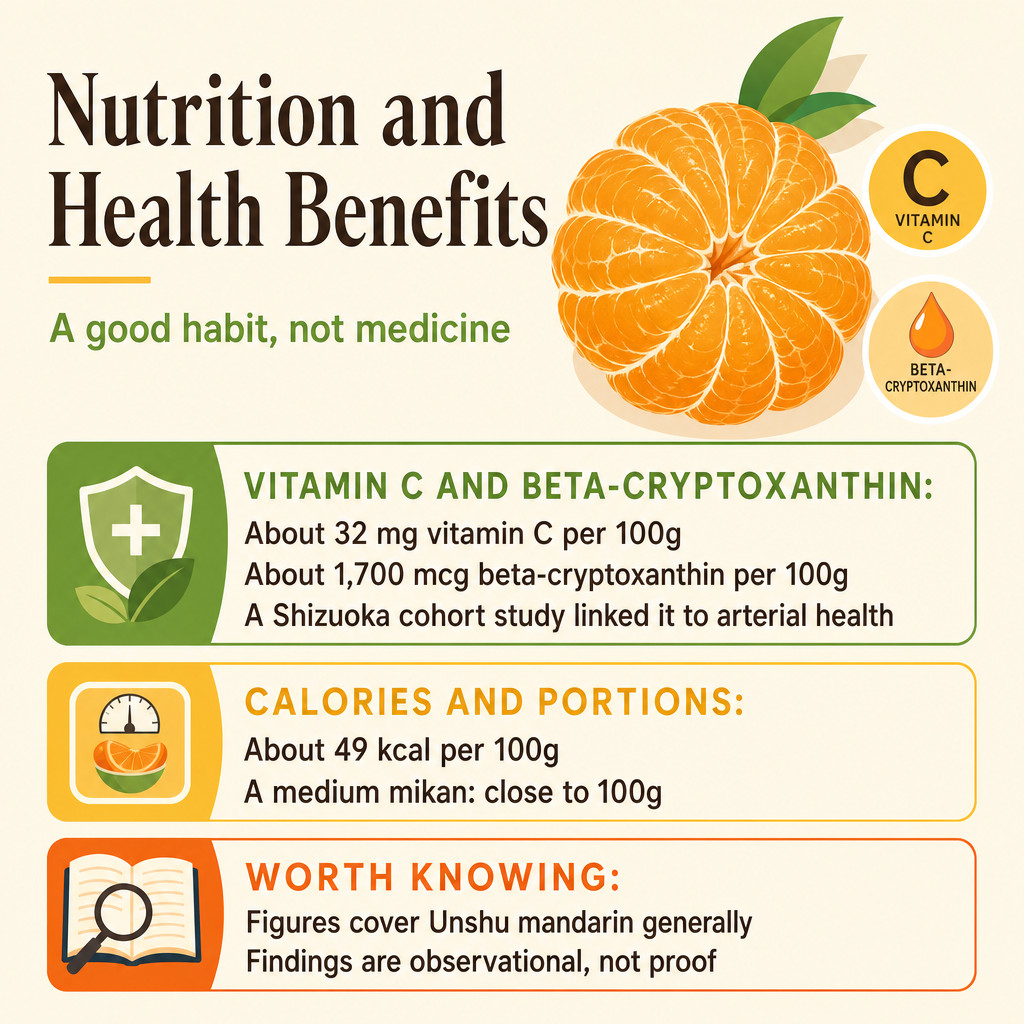
Vitamin C and Beta-Cryptoxanthin
Japan’s official food composition tables list about 32 mg of vitamin C per 100 g of raw Unshu mandarin, eaten with the thin segment membrane. The orange pigment comes largely from beta-cryptoxanthin, at roughly 1,700 micrograms per 100 g. Both figures cover Unshu mandarin generally, not this brand specifically.
Researchers have studied that pigment for years. A long-running cohort study in Mikkabi, Shizuoka, linked higher blood levels with a lower risk of arterial stiffening. Still, observational findings are not proof. The authors themselves called for further trials, so treat mikan as a good habit rather than medicine.
Calories and Portions
The same tables list about 49 kcal per 100 g. A medium mikan weighs close to 100 g, so the count stays modest. That is one reason the fruit sits on Japanese tables all winter without anyone thinking twice about it.
Mie Nanki Mikan vs Other Japanese Citrus
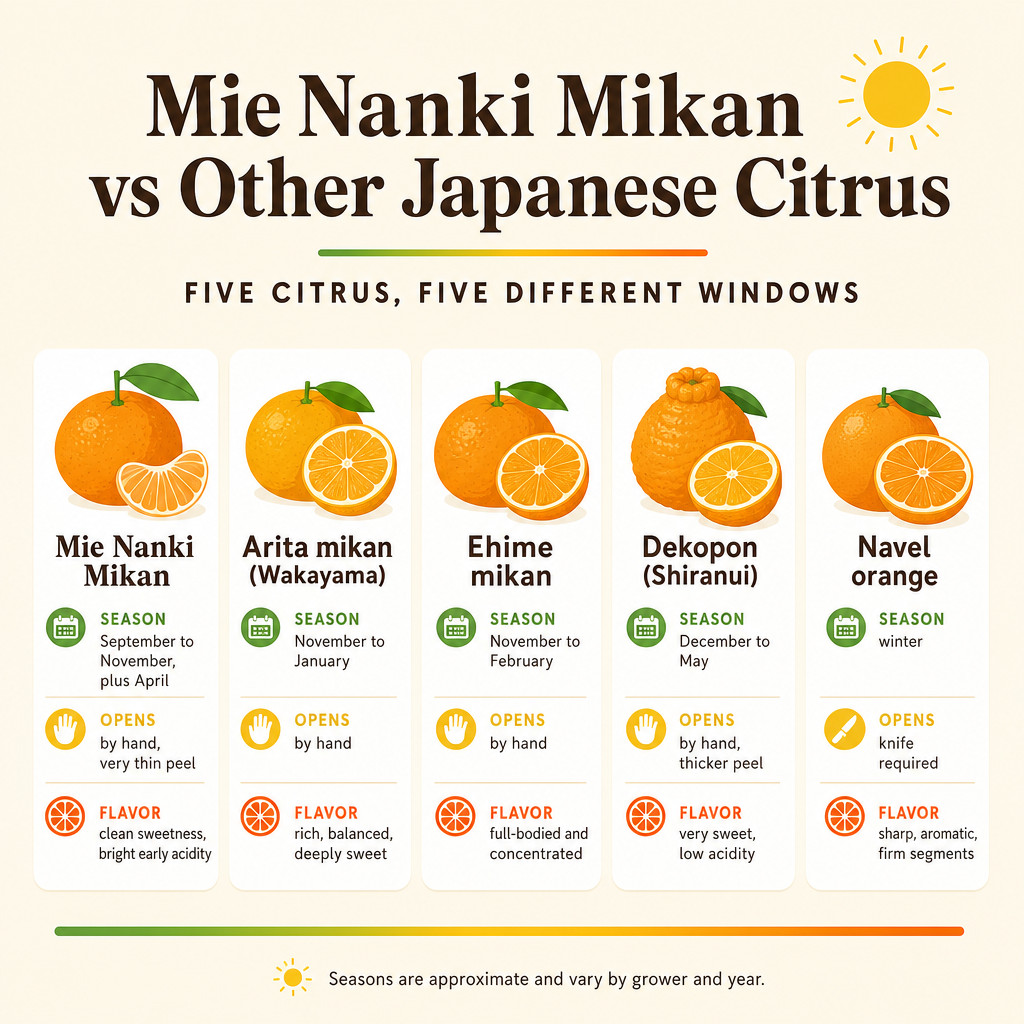
| Fruit | Peak season | How you open it | Flavor profile |
|---|---|---|---|
| Mie Nanki Mikan | September to November, plus April | By hand, very thin peel | Clean sweetness, bright early acidity |
| Arita mikan (Wakayama) | November to January | By hand | Rich, balanced, deeply sweet |
| Ehime mikan | November to February | By hand | Full-bodied and concentrated |
| Dekopon (Shiranui) | December to May | By hand, thicker peel | Very sweet, low acidity |
| Navel orange | Winter | Knife required | Sharp, aromatic, firm segments |
Mikan vs Satsuma Mandarin
These are the same fruit with two names. Western markets borrowed “satsuma” from the old Satsuma domain in Kagoshima. Japan, meanwhile, simply says mikan. So if a label in your local shop reads satsuma mandarin, you already know the taste.
Mikan vs Tangerine and Orange
Tangerine describes a broad group rather than one variety. Mikan sits inside that group, though it peels far more easily than most. An orange is a different species with thick rind and firm segments. Because of that structure, an orange keeps longer but demands more effort.
Mie vs Wakayama and Ehime
Wakayama, Ehime, and Shizuoka lead national output by a wide margin. In the 2021 crop year, those three plus Kumamoto and Nagasaki accounted for roughly 70 percent of Japan’s mikan harvest, according to agriculture ministry figures cited by Mihama Town. Mie ships far less, so the name rarely travels abroad. Timing is where southern Mie wins instead. While Arita mikan peaks in midwinter, Nanki fruit has already finished, and the region has moved on to spring citrus.
Where to Buy Mie Nanki Mikan
Buying It in Japan
Supermarkets around Nagoya stock the brand from September, since JA Ise ships mainly to that market. Closer to the orchards, roadside stations called michi no eki and local farm shops are worth checking during harvest. Ask for Aji Ichigo in September if you want the earliest fruit, because it moves through the market in about three weeks.
Online Shops and Overseas Availability
JA Town, the co-operative network’s own online shop, lists seasonal boxes including Kara from JA Ise. Stock is seasonal, so ordering early helps. Outside Japan, however, fresh citrus faces strict quarantine rules in most countries. JA Ise has exported to Thailand since 2010, yet you will rarely spot the brand elsewhere. Buying it inside Japan remains the realistic option.
Storage at Home
Ideally, choose a cool, dry spot away from heaters and direct sun. Japanese households usually stack the fruit stem side down, which protects the softer shoulder. Also, open the box and check the bottom layer every few days. One spoiled mikan spreads mold to the fruit around it quickly.
A Local Specialty Worth Carrying Home
Fruit gifting runs deep in Japanese culture. A neat box of graded mikan reads as thoughtful without feeling extravagant, which is exactly why the grade names on the lid matter. Anyone receiving one in Japan will understand the signal immediately.
Southern Mie also rewards a slower trip. The prefecture gives you Matsusaka beef, Ise ebi spiny lobster, and the famously soft noodles of Ise udon. For a broader route through the region, our Kansai food guide maps out the rest.
Conclusion
Mie Nanki Mikan will never outsell Wakayama or Ehime. That was never the point. This is a small production zone that found its own advantage in stones, rain, and timing, then built a calendar nobody else could copy.
If you travel through Japan in September, look for green-skinned mandarins with a Mie label. They look wrong and taste right. Then come back in April, and the same three towns hand you something completely different.
Mie Nanki Mikan FAQ
What is Mie Nanki Mikan?
Mie Nanki Mikan is a shipping brand of Japanese mandarin orange from southern Mie Prefecture. Growers in Kumano City, Mihama, and Kiho produce it. The fruit is Unshu mandarin, the same species Western shops call satsuma mandarin. JA Ise sorts it with sugar and acid sensors before shipping.
Why is the peel still green in September?
Because the fruit ripens inside before the skin colors. Southern Mie loses acidity early, so growers can pick while the peel remains green. The flesh underneath is already orange and sweet. Locals call this early fruit aokiri mikan, and it is a seasonal treat rather than a mistake.
When is Mie Nanki Mikan in season?
The autumn season opens in early September with Aji Ichigo, an unusually early variety. Extra-early and early Unshu mandarins follow through October and November. Spring then brings Kara mandarin, shipped from late March into late April. Dates move by a week or two each year, depending on the weather.
What is Kara mandarin, the spring mikan?
Kara is a cross between Unshu mandarin and King mandarin, introduced to Japan in the 1950s. The fruit stays on the tree through winter while rain gradually reduces its acidity. Growers bag each fruit, since the variety dislikes cold. The result tastes richer and closer to an orange than autumn mikan.
Is mikan the same as satsuma mandarin, and is it seedless?
Yes, the two words point to one fruit. English-speaking markets adopted “satsuma” from the old Satsuma domain in Kagoshima, while Japan says mikan. Unshu mandarins also carry virtually no seeds, and the peel comes away by hand in seconds. Even small children manage the whole process without help.
How is it different from Wakayama or Ehime mikan?
Timing separates them more than anything else. Southern Mie harvests weeks earlier, thanks to a warm, rainy climate and stony, fast-draining soil. Wakayama and Ehime peak in midwinter with richer fruit from a much larger production base. Mie also offers spring Kara mandarin, which most regions cannot ripen well.
Can you buy Mie Nanki Mikan outside Japan?
Rarely, unfortunately. Fresh citrus faces tight quarantine rules in most importing countries, and rules differ by destination. JA Ise has shipped to Thailand since 2010, yet wider export remains limited. Buying inside Japan through supermarkets, local farm shops, or JA Town online is the practical route.
References
- Mie Prefecture, Mie Brand: Nanki Mikan (Surveyed: August 2026)
- JA Ise, Specialty Products of the JA Ise Area (Surveyed: August 2026)
- Mihama Town Promotion Council, A Little-Known Mikan Region: Mihama, Mie (Surveyed: August 2026)
- Mie Prefecture Tourism Federation, Kanko Mie: Nanki Mikan (Surveyed: August 2026)
- Ministry of Education, Culture, Sports, Science and Technology, Standard Tables of Food Composition in Japan (Food Composition Database) (Surveyed: August 2026)
- Nakamura M., Sugiura M., Ogawa K., Ikoma Y., Yano M., Serum β-cryptoxanthin and β-carotene derived from Satsuma mandarin and brachial-ankle pulse wave velocity: The Mikkabi cohort study, Nutrition, Metabolism and Cardiovascular Diseases, 2016 (Surveyed: August 2026)
- JA Town, Kara Mandarin from JA Ise (Surveyed: August 2026)
- Photo credit: ©Mie Prefecture Tourism Federation, Kanko Mie
Related Articles
- Mikan (みかん) (Surveyed: August 2026)
- Yuzu (柚子) (Surveyed: August 2026)
- Kaki (柿) Japanese Persimmon (Surveyed: August 2026)
- Matsusaka Beef (松阪牛) (Surveyed: August 2026)
- Ise Ebi (伊勢海老) (Surveyed: August 2026)
- Ise Udon (伊勢うどん) (Surveyed: August 2026)
- The Complete Kansai Food Guide (Surveyed: August 2026)
- Japanese Fruit Collection (Surveyed: August 2026)
- Japan Food Guide (Surveyed: August 2026)




Comments