




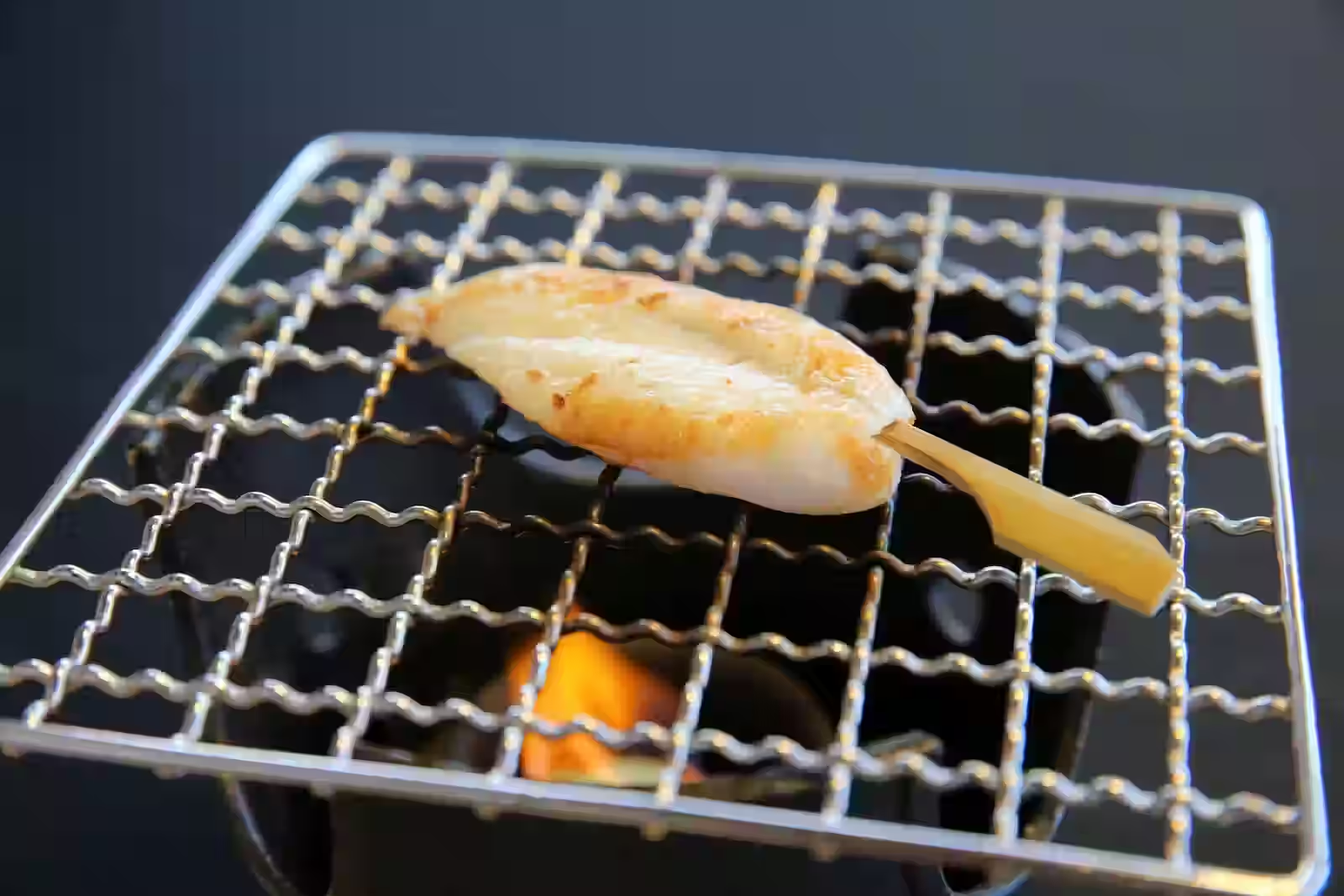
Sasa kamaboko, also called sasakama, is a leaf shaped grilled Japanese fish cake from Sendai in Miyagi Prefecture. Makers grind white fish into a seasoned paste, press it flat, then grill each piece until the surface browns lightly. For many visitors, this is the Sendai fish cake they first notice at station souvenir counters.
Quick answer: Sasa kamaboko is a grilled fish cake made from seasoned white fish paste, shaped like a bamboo leaf. People eat it as a snack, a souvenir, or a sake pairing. The taste is mild, slightly sweet, and springy, with a light toasted aroma that fades once the piece cools.
Miyagi treats it as everyday food, while travellers usually meet it boxed and chilled. Those two versions taste noticeably different, and the gap is worth understanding before you spend money. If you only want to buy some as a souvenir, skip ahead to where to buy it and how to store it.
Sasa Kamaboko at a Glance
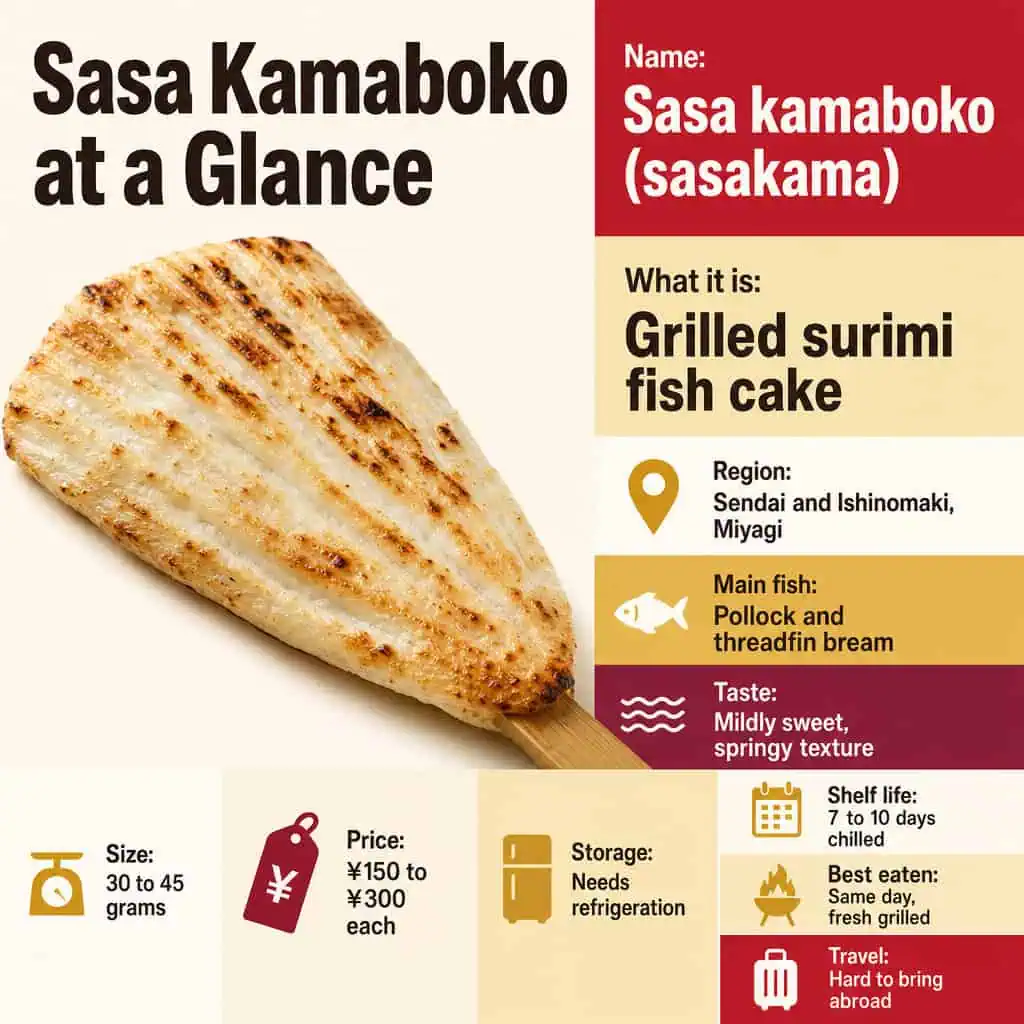
| Japanese name | 笹かまぼこ (sasa kamaboko), often shortened to sasakama |
| What it is | Grilled fish cake made from surimi, a paste of ground white fish |
| Home region | Sendai and Ishinomaki, Miyagi Prefecture, Tohoku |
| Main fish | Alaska pollock and threadfin bream; premium grades add kichiji rockfish |
| Taste and texture | Mildly sweet, gently savoury, springy rather than crumbly |
| Typical size | About 30 to 45 grams per piece |
| Price guide | Roughly ¥150 to ¥300 per piece; gift boxes from about ¥1,500 |
| Needs refrigeration | Yes, for almost all fresh products |
| Shelf life | Around 7 to 10 days chilled, depending on the maker |
| Best eaten | Same day if freshly grilled; otherwise within the printed date |
| International travel | Usually difficult, since chilled packs and customs rules both interfere |
Prices and shelf life above reflect maker information surveyed in July 2026. Both change, so check the label before committing to a large box.
What Is Sasa Kamaboko?
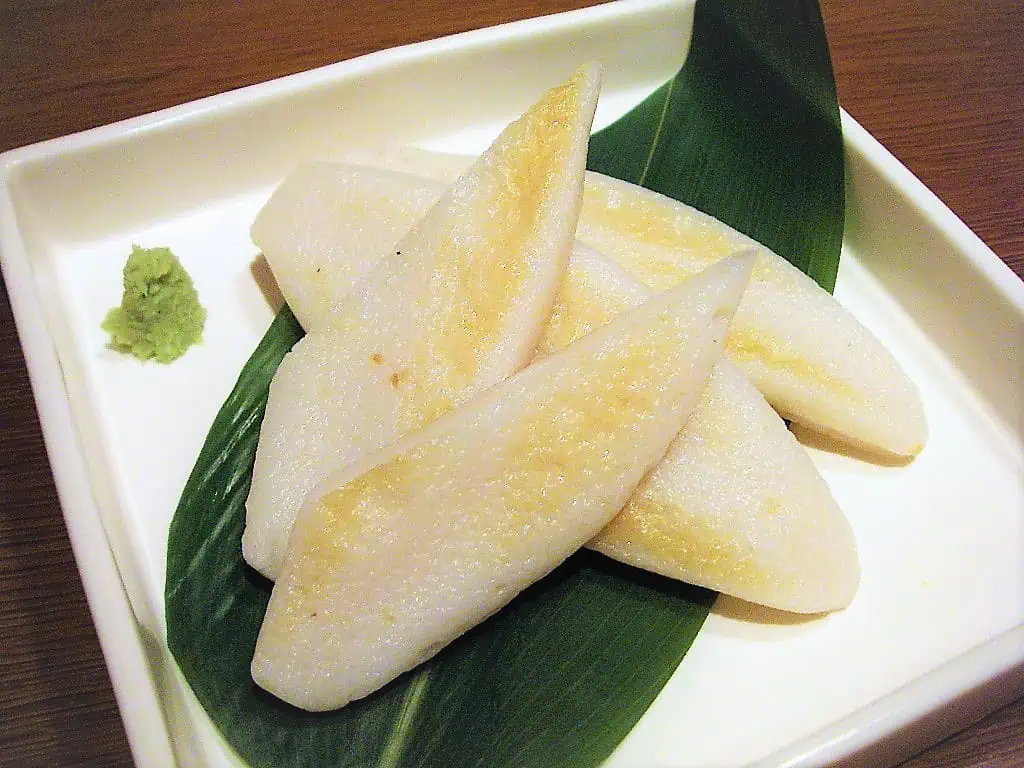
Sasa kamaboko is a regional style of grilled kamaboko from Miyagi, recognised by its bamboo leaf shape, springy texture, and light toasted aroma.
A Working Definition
Producers begin with surimi, which simply means fish flesh ground into a smooth paste. They season it, press it into shape, then grill it over direct heat rather than steaming it. Grilling is the detail that separates this style from most other kamaboko.
Because each piece stays thin, it cooks in minutes and picks up a light toasted flavour. For the wider family of Japanese fish paste products, our kamaboko guide covers the basics.
Why It Looks Like a Bamboo Leaf
Sasa means bamboo grass, and the outline really does resemble a leaf. Yet the shape came long before the name. Early makers flattened the paste with their palms, so pieces ended up wide in the middle and tapered at both ends.
Nothing green touches the fish, despite what the name suggests. Several other Japanese foods use sasa more literally, including sasazushi from Nagano, which wraps rice in an actual bamboo leaf, and sasa dango from Niigata. Here the word describes the silhouette only.
What Does Sasa Kamaboko Taste Like?
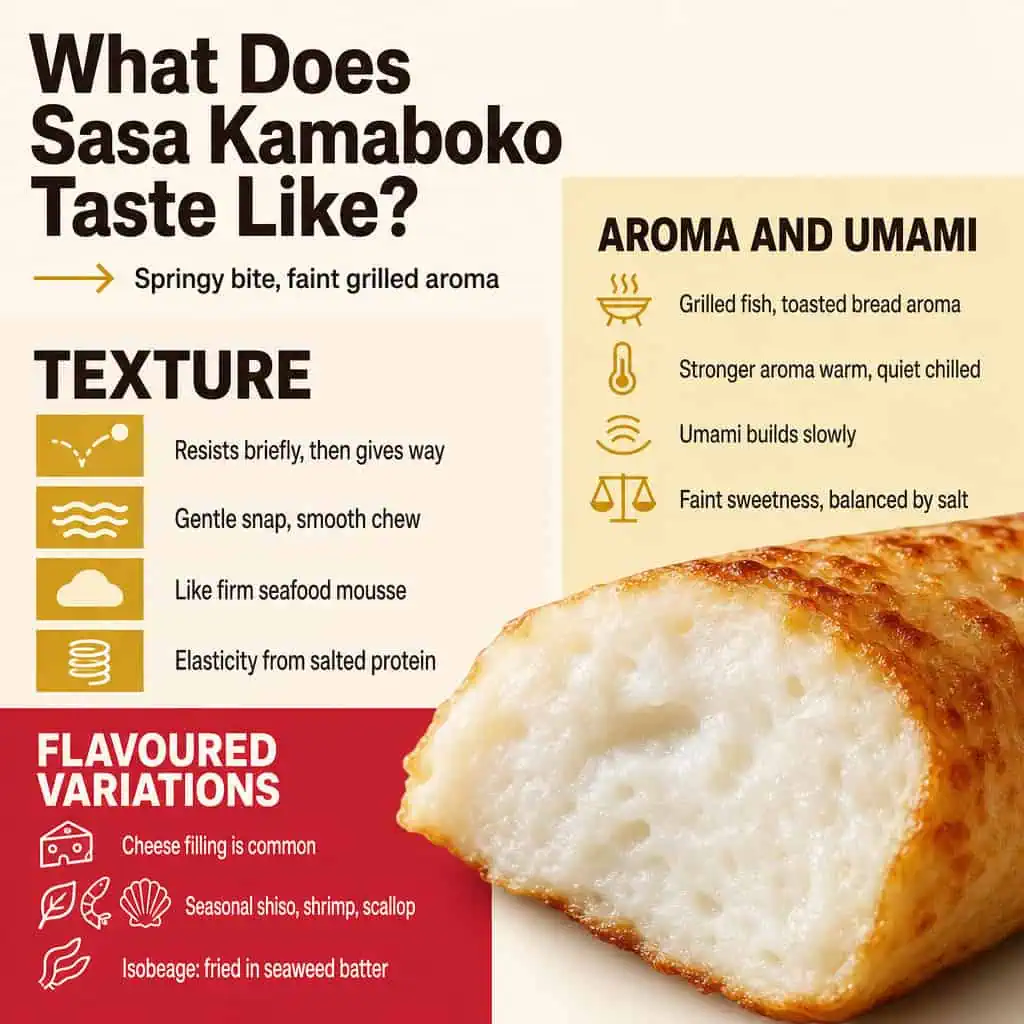
Sasa kamaboko tastes mild and lightly sweet, with a springy bite and a faint grilled aroma that fades as the piece cools.
Texture Comes First
Texture leads the whole experience. Bite in, and the cake resists briefly before giving way. There is a gentle snap, then a smooth, moist chew that never turns crumbly.
Western readers often expect something like a breadcrumb fish cake, which sets up the wrong impression. Think closer to a firm seafood mousse, dense and clean, with nothing falling apart in your hand. That elasticity comes from salted protein rather than from binders.
Aroma and Umami
The aroma sits somewhere between grilled fish and lightly toasted bread. Warm pieces release it immediately, while chilled ones stay noticeably quiet. Umami builds slowly instead of arriving all at once.
Sweetness appears too, faint and slightly milky, with salt holding the balance. I still cannot decide whether the plain grade beats the flavoured versions. Some days one wins, some days the other does, and that indecision is oddly part of the fun.
Flavoured Variations
Cheese fillings appear everywhere now, and they work better than purists admit. Shiso, shrimp, negi, and scallop turn up seasonally. Fried variants exist as well, including isobeage, where the cake goes into a green laver batter before hitting oil.
How to Eat Sasa Kamaboko
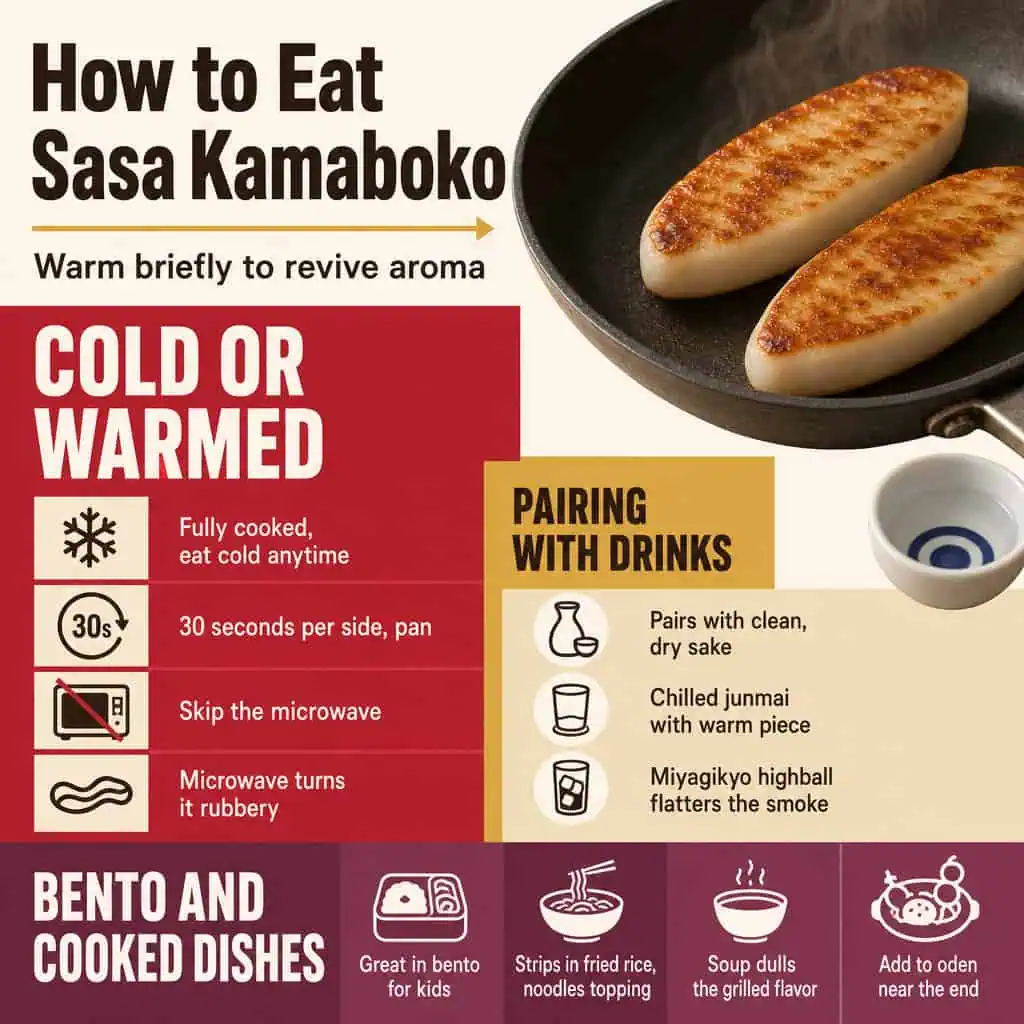
Sasa kamaboko can be eaten cold, but it tastes best warmed briefly in a dry pan or toaster oven, which revives the grilled aroma.
Cold from the Bag, or Warmed
Every pack arrives fully cooked, so you can eat it cold straight away. Plenty of locals do. However, thirty seconds per side over low heat changes the smell completely.
Skip the microwave. Trapped steam makes the cake tough and slightly rubbery, and this is the single most common mistake newcomers make.
Pairing with Sake and Local Drinks
Miyagi brews clean, dry sake, so the pairing feels almost automatic. Try a chilled junmai beside a warmed piece. Rice sweetness meets fish sweetness without either side fighting for attention.
Beer obviously works too. Sendai also produces whisky at the Miyagikyo distillery, and a light highball flatters the smoky edge. Our Sendai food guide maps where to line these up in one evening.
In Bento and Cooked Dishes
Sliced sasa kamaboko fills out a bento nicely, especially for children. Cut it into strips for fried rice, or lay it over noodles as a topping. It holds up in soup as well, though long simmering dulls the grilled character.
Hot pot fans can treat it like any other fish cake in oden. Add it near the end rather than at the start.
Where to Buy Sasa Kamaboko in Sendai
The easiest places to buy sasa kamaboko are Sendai Station, Sendai Airport, downtown maker shops, and factory shops in Sendai or Ishinomaki.
Shops in Central Sendai
Downtown Sendai offers plenty of choices, from covered arcade shops to department store food halls. Several counters grill pieces to order while you wait. Watching that process, then eating the result on the spot, is half the appeal of buying a Sendai fish cake in person.
Station and Airport Counters
Sendai Station concentrates most of the souvenir trade in one busy corridor, and Sendai Airport stocks the major brands as well. Prices there match the city shops closely. Chilled packs generally last a week or so, which matters if your trip continues elsewhere.
Useful Japanese Phrases at the Counter
- Kore o hitotsu kudasai. One of these, please.
- Atatakai no wa arimasu ka? Do you have a warm one?
- Horeizai o onegai shimasu. Please add an ice pack.
- Nannichi mochimasu ka? How many days will it keep?
- Komugi wa haitte imasu ka? Does it contain wheat?
Ordering Online
Nearly every producer ships within Japan through its own website. Rakuten and Amazon Japan list the main names too, usually as gift assortments. International shipping remains rare, since these products need constant refrigeration.
Best Sasa Kamaboko Brands
Abe Kamaboko Ten, Kanezaki, and Shiraken dominate the Miyagi souvenir shelves, and each one suits a different kind of buyer. Between them they account for most of the Sendai fish cake a visitor is likely to encounter.
Abe Kamaboko Ten
Abe Kamaboko Ten opened in Sendai in 1935 and, by its own account, gave the product its modern name. The company still runs shops in the city centre. Its bite sized versions with shrimp, shiso, or cheese make painless gifts for coworkers.
Abe also sells hyoutan-age, a fish cake dipped in sweet batter and deep fried on a stick. Traditionalists regard it as street food rather than proper kamaboko, though it remains popular with families and visitors.
Kanezaki
Kanezaki started in 1947 and built its whole identity around sasa kamaboko. Its premium Tairyobata line skips preservatives, starch, egg white, and chemical seasoning. Instead the company uses kichiji surimi, a house made kichiji fish sauce, and a coarse salt drawn from seawater at Mangokuura in Ishinomaki.
Kanezaki states that it was the first sasa kamaboko maker to obtain HACCP certification. Its Sasakama-kan complex in Wakabayashi Ward also runs hands on grilling sessions, which suit families with time to spare.
Shiraken Kamaboko
Shiraken works out of Ishinomaki, a fishing port about an hour east of Sendai, and describes more than a century of production there. Its pollock surimi comes from fish processed on board and frozen at sea. Unusually, the company adds kichiji to every product in its range.
Gokujo Sasa, the top grade, tastes distinctly sweeter and more aromatic than a supermarket piece. Eat one plain before you reach for soy sauce.
Other Names Worth Knowing
Beyond the big three, several regional makers have loyal followings. Sasanao, Matsushima Kamaboko Honpo, Bajo Kamaboko Ten, and Takeda no Sasakamaboko all appear in Miyagi souvenir guides. Buying one piece from two or three of them costs very little and teaches more than any description can.
Which Sasa Kamaboko Should You Buy?
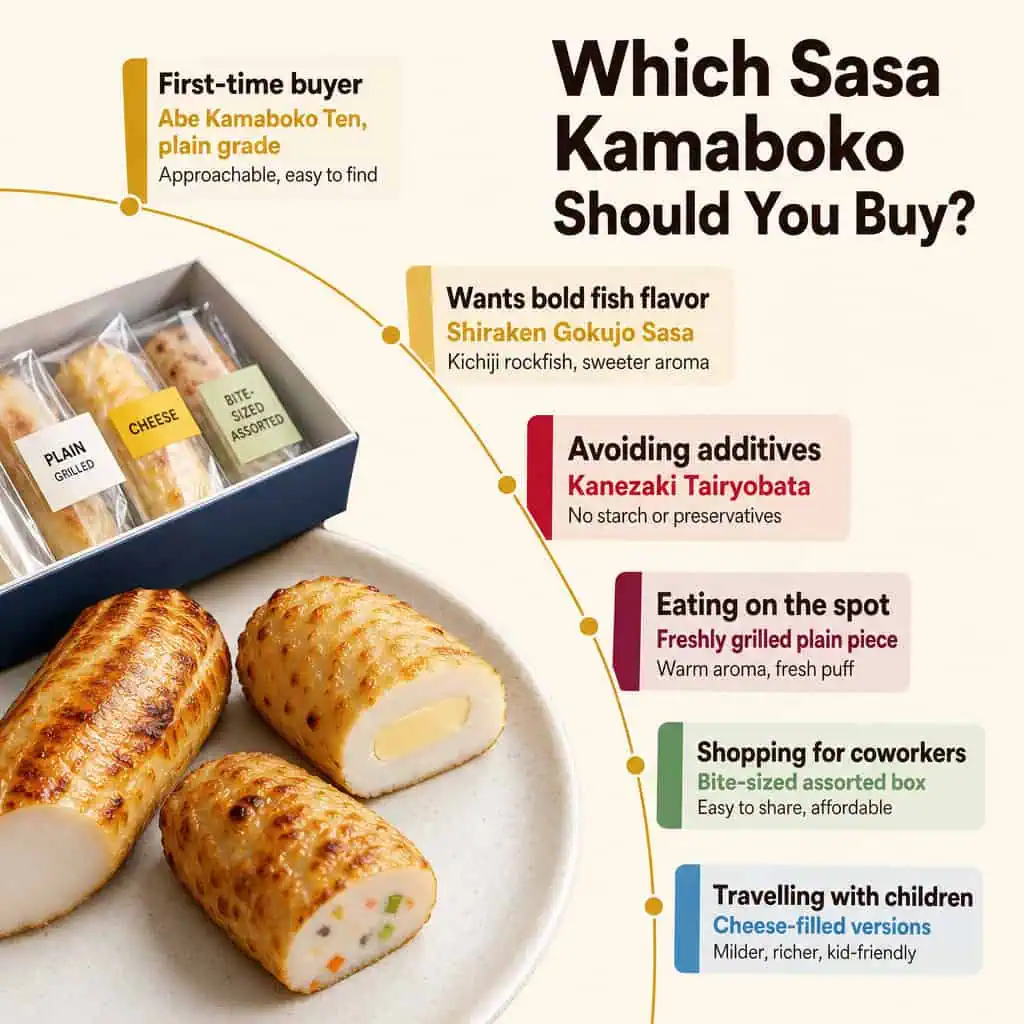
Choose by purpose rather than by reputation, because the main makers each solve a different problem.
| If you are… | Buy this | Why |
|---|---|---|
| A first time buyer | Abe Kamaboko Ten, plain grade | Broad range, easy to find, approachable flavour |
| After the strongest fish flavour | Shiraken Gokujo Sasa | Kichiji in every product, sweeter and more aromatic |
| Avoiding additives | Kanezaki Tairyobata | No starch, egg white, preservatives, or chemical seasoning |
| Eating on the spot | Freshly grilled plain piece | Warm aroma and puff that chilled packs cannot match |
| Shopping for coworkers | Bite sized assorted box | Easy to share, several flavours, keeps the price sensible |
| Travelling with children | Cheese filled versions | Milder and richer, and reliably popular |
For a first visit, start with one freshly grilled plain piece before buying anything boxed. If the texture suits you, move to a small assortment covering plain, cheese, and a premium fish grade. Large single flavour boxes are the riskiest purchase, so leave those until a second trip.
Sasa Kamaboko vs Other Japanese Fish Cakes
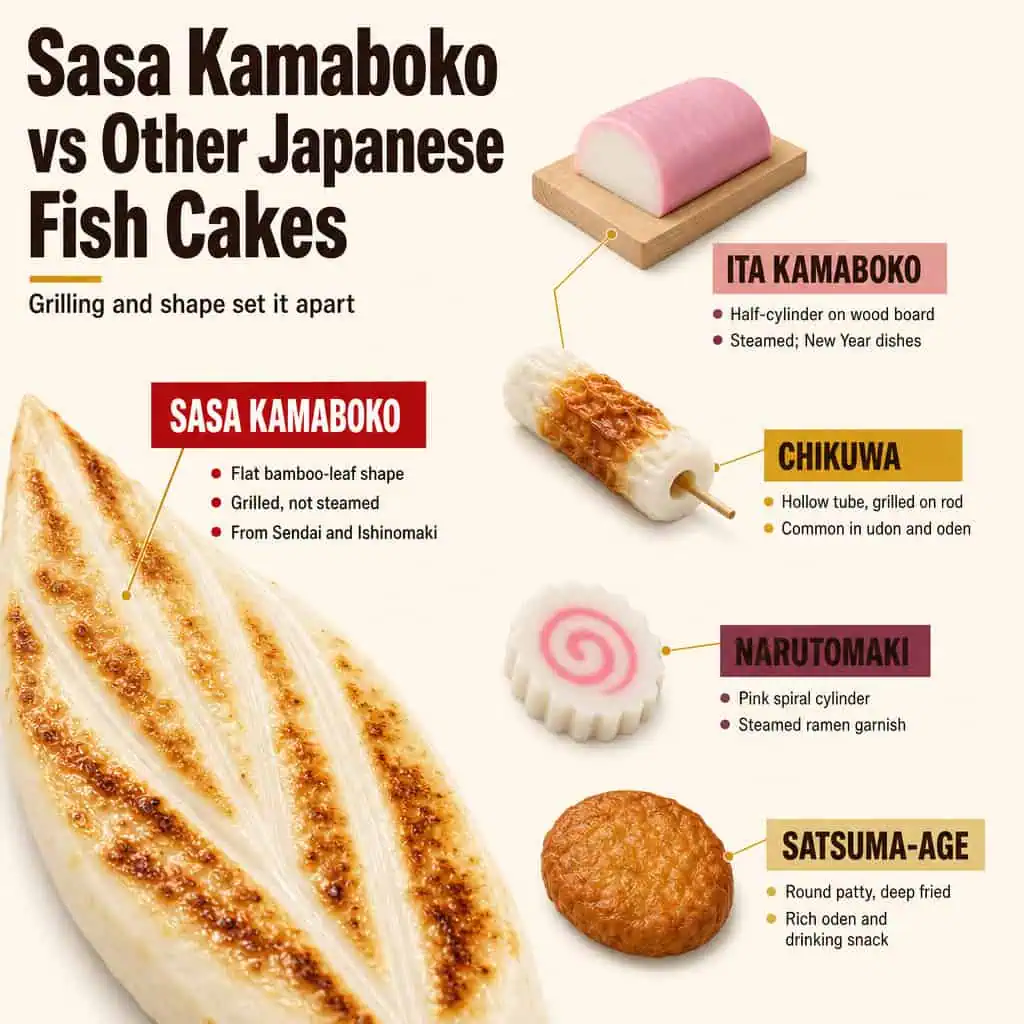
The main difference between regular kamaboko and sasa kamaboko is cooking method and shape. Regular kamaboko is usually steamed on a wooden board, while sasa kamaboko is flat, bamboo leaf shaped, and grilled. That grilling gives it a firmer bite and a light toasted aroma.
Comparison Table
| Product | Shape | Cooking method | Regional association | Typical use |
|---|---|---|---|---|
| Sasa Kamaboko | Flat bamboo leaf | Grilled | Sendai and Ishinomaki, Miyagi | Snack, souvenir, sake pairing |
| Ita Kamaboko | Half cylinder on a wooden board | Steamed | Nationwide; Odawara is best known | New Year dishes, sliced cold |
| Chikuwa | Tube with a hollow centre | Grilled around a rod | Nationwide; Tottori consumes the most | Udon, oden, stir fries |
| Narutomaki | Cylinder with a pink spiral | Steamed | Nationwide; named after the Naruto whirlpools | Ramen garnish |
| Satsuma-age | Round or oval patty | Deep fried | Kagoshima, Kyushu | Oden, drinking snack |
What the Differences Mean in Practice
Steamed kamaboko tastes softer and cleaner, because no flame ever touches it. Chikuwa brings a hollow centre and a stronger roasted note. Narutomaki exists largely for visual effect in a ramen bowl, and its flavour stays deliberately quiet.
Satsuma-age goes into hot oil, so it eats richer and heavier. Sasa kamaboko lands between those extremes. Grilled but never fried, it keeps the fish itself in the foreground.
Ingredients and How It Is Made
Producers grind white fish with salt into an elastic paste, press it into the leaf shape, then grill it for a few minutes on each side.
The Fish Behind the Paste
Flounder started the tradition, though supply shifted over the last century. Today most makers rely on suketoudara, known in English as Alaska pollock, plus itoyoridai or threadfin bream. Premium grades add kichiji, a deep water rockfish that Miyagi cooks prize for its sweetness and fat.
Beyond fish, the ingredient list stays short. Salt, sugar, mirin, and egg white handle nearly everything. Some brands include starch for a softer bite, while others refuse it and print that refusal on the front of the pack.
Grinding, Salting, and Shaping
Workers fillet the fish, rinse the flesh repeatedly, and strip out fat and blood. Next they grind it together with salt. That single step matters more than most people realise.
Salt dissolves muscle protein, so the paste turns sticky and elastic instead of merely wet. Artisans then portion it and press each portion into the leaf outline. Machines handle volume production, yet several Sendai shops still shape their top grade pieces by hand.
The Grill and the Puff
Grilling moves fast, usually over gas burners or charcoal. Surfaces brown, steam inflates the centre like a small pillow, and staff flip each piece at exactly the right moment. A few seconds decide whether the colour reads golden or scorched.
After cooling, packers seal the cakes and chill them for transport. Vacuum packs travel well, although the texture loosens a little. Fresh off the grill, it tastes noticeably more aromatic and lively than a chilled pack.
History of Sasa Kamaboko
Sasa kamaboko began in Meiji era Miyagi as a way to use surplus flounder, and a Sendai shop gave it the modern name during the Showa era.
A Solution to Surplus Fish
Boats working the coast between Yuriage and Kinkasan landed enormous hauls of flounder, and the town could not absorb them. Ice was scarce, refrigeration barely existed, and trucks had not arrived yet. Someone ground the surplus into paste, flattened it by hand, and grilled it on skewers.
Accounts differ on the details, and no single origin story is universally accepted. Kibun Foods dates the flounder gluts to roughly 1902 and 1903, while other sources place the invention in the early Meiji years. Credit also splits between Sendai kamaboko shops and the fishermen on the beaches.
How the Name Was Settled
For decades nobody agreed on what to call it. Shops used kinoha kamaboko, meaning leaf, alongside tenohira kamaboko, meaning palm, and a few said bero kamaboko, which translates roughly as tongue. Abe Kamaboko Ten, founded in 1935, then marketed it as Sendai’s famous sasa kamaboko, borrowing the image from the Date clan crest of bamboo leaves and sparrows.
Since Date Masamune founded Sendai itself, that reference carried real weight locally, and the rest of the industry gradually followed. Some industry sources describe Sasakama as a trademark associated with Kibun Foods and with members of the Miyagi Prefecture Kamaboko Cooperative Federation. The same sources mark 7 July as Sasakama Day, since Tanabata decorations use bamboo.
From Local Snack to National Souvenir
Kibun Foods launched nationwide sales in 1967, which widened the audience considerably. Supermarkets across Japan soon stocked a version year round. Still, most people connect the real thing with Miyagi and nowhere else.
Then came March 2011. The earthquake and tsunami struck a sector whose factories sat almost entirely on the coast, so production stopped across the prefecture. Recovery took years, and several makers rebuilt with tighter food safety systems and broader distribution.
Nutrition, Allergens, and Dietary Notes
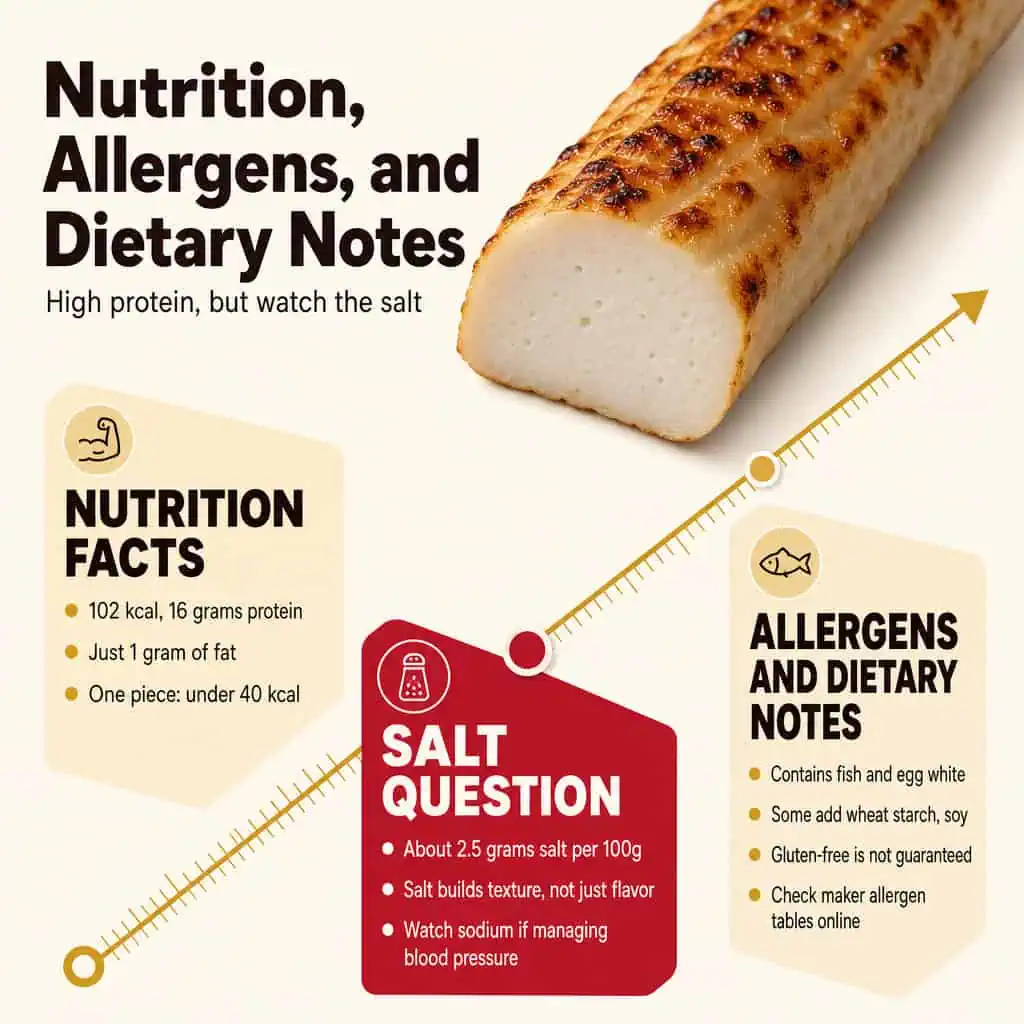
Per 100 grams, grilled kamaboko provides about 102 kcal, 16.2 grams of protein, and 1.0 gram of fat, alongside roughly 2.5 grams of salt equivalent.
What the Official Figures Say
Japan’s Standard Tables of Food Composition list sasa kamaboko under yakinuki-kamaboko, meaning grilled kamaboko. Steamed kamaboko sits lower by comparison, at 95 kcal with 12.0 grams of protein per 100 grams. A single 35 gram piece therefore delivers roughly 5 to 6 grams of protein for under 40 calories.
As a convenience snack, it offers relatively high protein for its calorie count, although sodium deserves attention. Individual products vary as well, so the panel on the pack always beats a general table.
The Salt Question
Salt is the genuine drawback. Makers need it to develop texture, not merely flavour, so sodium runs higher than the low fat numbers suggest. The composition tables put steamed kamaboko at about 2.5 grams of salt equivalent per 100 grams, and grilled types land in a similar range.
Two or three pieces make a reasonable snack. Anyone managing blood pressure should treat a whole box as an occasional pleasure rather than a daily habit.
Allergens and Dietary Restrictions
Fish is unavoidable, and egg white appears in many recipes. Certain products also contain wheat starch or soy based seasoning, so labels deserve a careful look. Gluten free eaters therefore cannot assume safety from the ingredient category alone.
Fortunately, the major makers publish allergen tables on their websites, and counter staff can usually point to the relevant line. Two minutes of checking saves a lot of guesswork.
Storage, Freezing, and Travel Tips
Keep chilled packs below 10°C and eat them within the printed date, usually seven to ten days from production.
- Finish an opened pack the same day, because the cut surface dries quickly.
- Freezing works for roughly a month, though the texture loosens after thawing.
- Thaw in the refrigerator overnight instead of on the counter.
- Ask the shop for an ice pack, called horeizai, if you face a long train ride.
- Check customs rules before flying home, since many countries restrict fish products.
Common Mistakes to Avoid
Most disappointments come from reheating badly, buying too much too early, or ignoring the refrigeration requirement.
- Microwaving it, which traps steam and turns the texture rubbery.
- Buying a large box before tasting one warm piece at a counter.
- Leaving packs in a hotel room instead of a fridge.
- Assuming every product is gluten free without reading the label.
- Adding soy sauce before tasting a premium grade plain.
- Packing it for an international flight without checking customs rules.
Conclusion
Why It Still Defines Sendai
Sasa kamaboko began as a way to avoid wasting fish, which is a very ordinary origin. Somehow that ordinariness turned into an identity. Alongside gyutan and zunda mochi, it forms the trio that Sendai shows visitors first.
What to Do Next
Buy one warm piece before you buy a box, because the two barely taste alike. Then compare a plain grade against a kichiji version if your budget allows. Finally, decide whether the premium tier justifies the gap, since locals disagree about that too.
Miyagi rewards curious eaters generally, from autumn harako meshi to winter oysters. Our wider Tohoku food guide puts the region in context if you are planning a longer trip.
Sasa Kamaboko FAQ
What does sasa kamaboko mean?
Sasa means bamboo grass, while kamaboko refers to Japanese fish cake. The name describes the bamboo leaf shape rather than an ingredient, so no bamboo goes into the product. Miyagi makers adopted the term during the Showa era. Packages often shorten it to sasakama.
What is sasa kamaboko made of?
It is usually made from white fish surimi, salt, sugar, mirin, and egg white, though recipes vary by producer. Alaska pollock and threadfin bream dominate the raw material supply. Premium grades add kichiji, a prized deep water rockfish. Some brands include starch, while others advertise that they leave it out.
What is the difference between kamaboko and sasa kamaboko?
Kamaboko names the whole category of Japanese fish paste products, while sasa kamaboko names one regional style from Miyagi. Standard kamaboko usually arrives steamed on a wooden board. The Sendai version meets a grill instead, which adds colour, aroma, and a firmer bite. Shape differs too, since sasa kamaboko is flat and leaf like.
Is sasa kamaboko served hot or cold?
Either works, since every pack arrives fully cooked and ready to eat. Chilled packs need no preparation at all. Warming a piece for thirty seconds per side in a dry pan brings out a stronger grilled aroma. Avoid the microwave, because trapped steam turns the texture rubbery.
How much does sasa kamaboko cost?
Single grilled pieces at Sendai counters generally run about ¥150 to ¥300. Premium grades with kichiji cost more, and boxed gift sets usually start near ¥1,500. Prices differ by maker and change over time, so confirm at the shop. These figures reflect maker information surveyed in July 2026.
Where can I eat freshly grilled sasa kamaboko?
Look for maker owned shops in central Sendai and inside Sendai Station, where staff grill to order. Kanezaki’s Sasakama-kan in Wakabayashi Ward also lets visitors grill their own piece. Ishinomaki has counters attached to local factories. Freshly grilled pieces taste noticeably better than chilled packs.
Which brand should a first time buyer choose?
Abe Kamaboko Ten suits newcomers, since its range is broad and its shops are easy to find. Kanezaki appeals if you prefer a firmer style without starch or egg white. Shiraken rewards anyone willing to pay more for kichiji flavour. Buying one piece from each makes a cheap and genuinely useful tasting.
How long does it keep, and can I freeze it?
Chilled packs usually stay good for seven to ten days from production, depending on the maker. Always follow the printed date rather than a rule of thumb. Freezing extends life to roughly a month, but the texture loosens on thawing. Thaw in the refrigerator overnight for the best result.
Is sasa kamaboko gluten free?
Not reliably, so treat every product as uncertain until you read the label. Many recipes use only fish, salt, sugar, mirin, and egg white, which contain no gluten. Others add wheat starch or soy based seasoning. Major makers publish allergen tables online, and counter staff can check for you.
Can I take sasa kamaboko out of Japan?
Rules depend entirely on your destination, and many countries restrict processed fish products. Check your own customs regulations before packing any. Refrigeration is another obstacle, because chilled packs degrade over a long journey. Shelf stable versions travel better when you can find them.
About This Guide
Food in Japan writes regional food guides for English speaking readers. Tasting notes here come from eating sasa kamaboko at Sendai counters and from boxed products bought in the city. Historical, nutritional, and manufacturing details come from the government, industry, and maker sources listed below. We checked prices, shelf life, and product details in July 2026.
References
- Ministry of Agriculture, Forestry and Fisheries (MAFF), Sasa Kamaboko no Isobeage, Miyagi Prefecture, https://www.maff.go.jp/j/keikaku/syokubunka/k_ryouri/search_menu/menu/sasa_kamaboko_no_isobeage_miyagi.html (Accessed July 2026)
- Ministry of Education, Culture, Sports, Science and Technology (MEXT), Food Composition Database, Yakinuki-kamaboko, item 10380, https://fooddb.mext.go.jp/details/details.pl?ITEM_NO=10_10380_7 (Accessed July 2026)
- Ministry of Education, Culture, Sports, Science and Technology (MEXT), Food Composition Database, Mushi-kamaboko, item 10379, https://fooddb.mext.go.jp/details/details.pl?ITEM_NO=10_10379_7 (Accessed July 2026)
- Ministry of Education, Culture, Sports, Science and Technology (MEXT), Standard Tables of Food Composition in Japan, Eighth Revised Edition, 2023 supplement, https://www.mext.go.jp/content/20230428-mxt_kagsei-mext_00001_011.pdf (Accessed July 2026)
- Abe Kamaboko Ten, Company History, https://www.abekama.co.jp/history (Accessed July 2026)
- Kanezaki Co., Ltd., Company Information, https://www.kanezaki.co.jp/information/ (Accessed July 2026)
- Kanezaki Co., Ltd., Sasa Kamaboko Product Page, https://www.kanezaki.co.jp/items/sasakamaboko.html (Accessed July 2026)
- Shiraken Kamaboko Co., Ltd., Corporate Information, https://www.shiraken.co.jp/corporate/ (Accessed July 2026)
- Kibun Foods Inc., Origin and History of Sasakama, https://www.kibun.co.jp/brand/sasakama/history/index.html (Accessed July 2026)
- National Federation of Kamaboko Manufacturers Cooperative Associations, Kamaboko Encyclopedia, https://www.zenkama.com/ (Accessed July 2026)
- Sendai Tourism, Convention and International Association, Travel Sendai, https://www.sendai-travel.jp/ (Accessed July 2026)
- Park, J. W. (Ed.). (2013). Surimi and Surimi Seafood (3rd ed.). Boca Raton: CRC Press. (Surveyed: July 2026)
- Okada, M. (1992). History of surimi technology in Japan. In T. C. Lanier & C. M. Lee (Eds.), Surimi Technology (pp. 3–21). New York: Marcel Dekker. (Surveyed: July 2026)
- Lanier, T. C., Carvajal, P., & Yongsawatdigul, J. (2005). Surimi gelation chemistry. In J. W. Park (Ed.), Surimi and Surimi Seafood (2nd ed.). Boca Raton: CRC Press. (Surveyed: July 2026)
- CiNii Research, National Institute of Informatics, academic literature on kamaboko and surimi gel properties, https://cir.nii.ac.jp/ (Accessed July 2026)
Related Articles
- Kamaboko (蒲鉾) (Surveyed: July 2026)
- Chikuwa (ちくわ) (Surveyed: July 2026)
- Satsuma-age (さつま揚げ) (Surveyed: July 2026)
- Oden (おでん) (Surveyed: July 2026)
- Gyutan (牛タン) (Surveyed: July 2026)
- Zunda Mochi (ずんだ餅) (Surveyed: July 2026)
- Harako Meshi (はらこ飯) (Surveyed: July 2026)
- What to Eat in Sendai: 20 Must-Try Foods (Surveyed: July 2026)
- Tohoku Food Guide (Surveyed: July 2026)
- Discover Tohoku: 11 Japanese Foods You Need to Taste (Surveyed: July 2026)




Comments