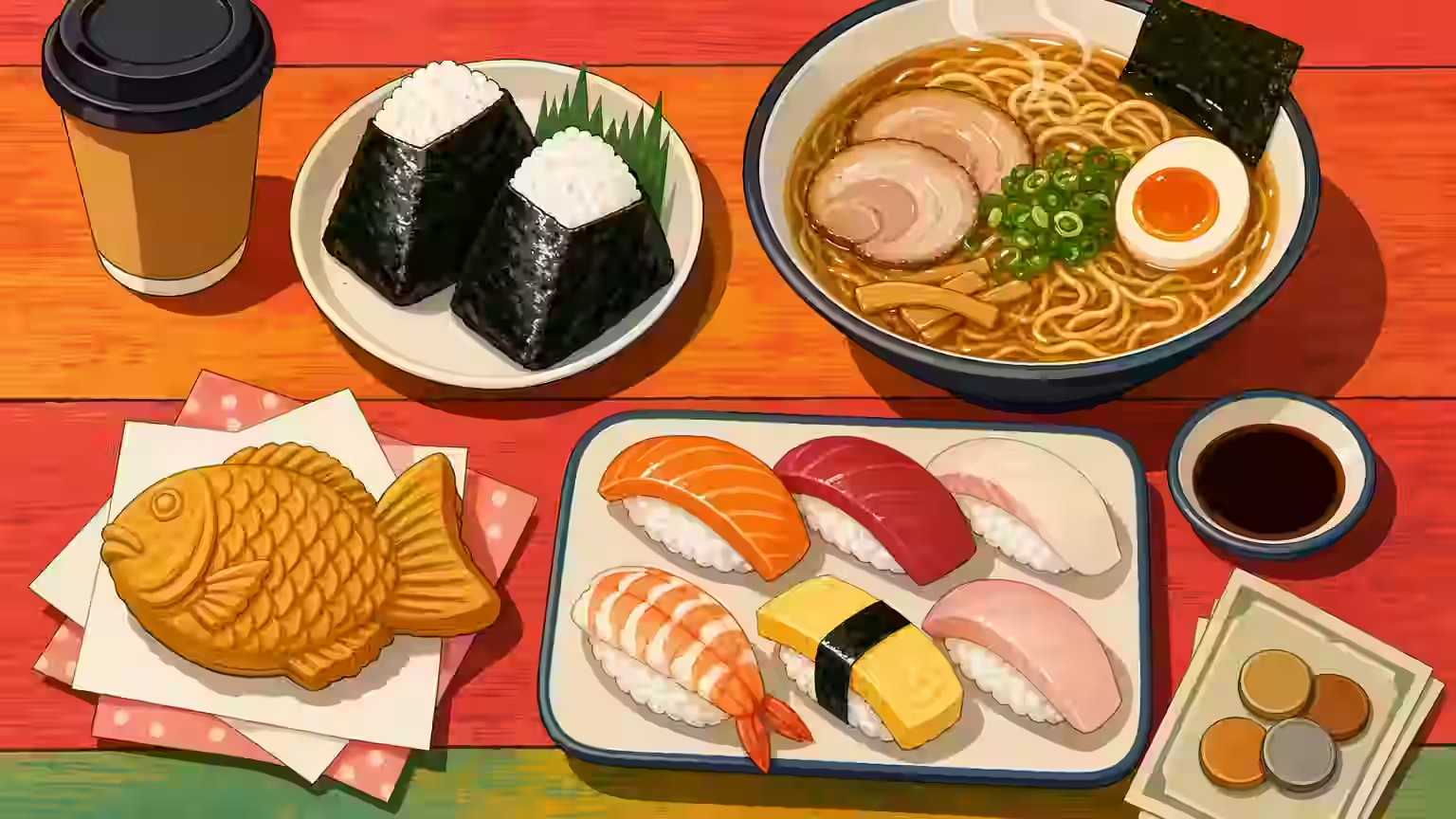
In some major North American cities, a restaurant ramen meal can approach $30 once tax, tip, and maybe a side or a drink reach the check. In Japan, the same budget can stretch across a whole day. Breakfast, a proper restaurant lunch, an afternoon sweet, and a sit-down sushi dinner all fit inside it, if you choose carefully.
This is not a survival challenge or a ramen-only diet. Instead, it is what an ordinary day of eating actually costs, priced against current menus rather than memory.
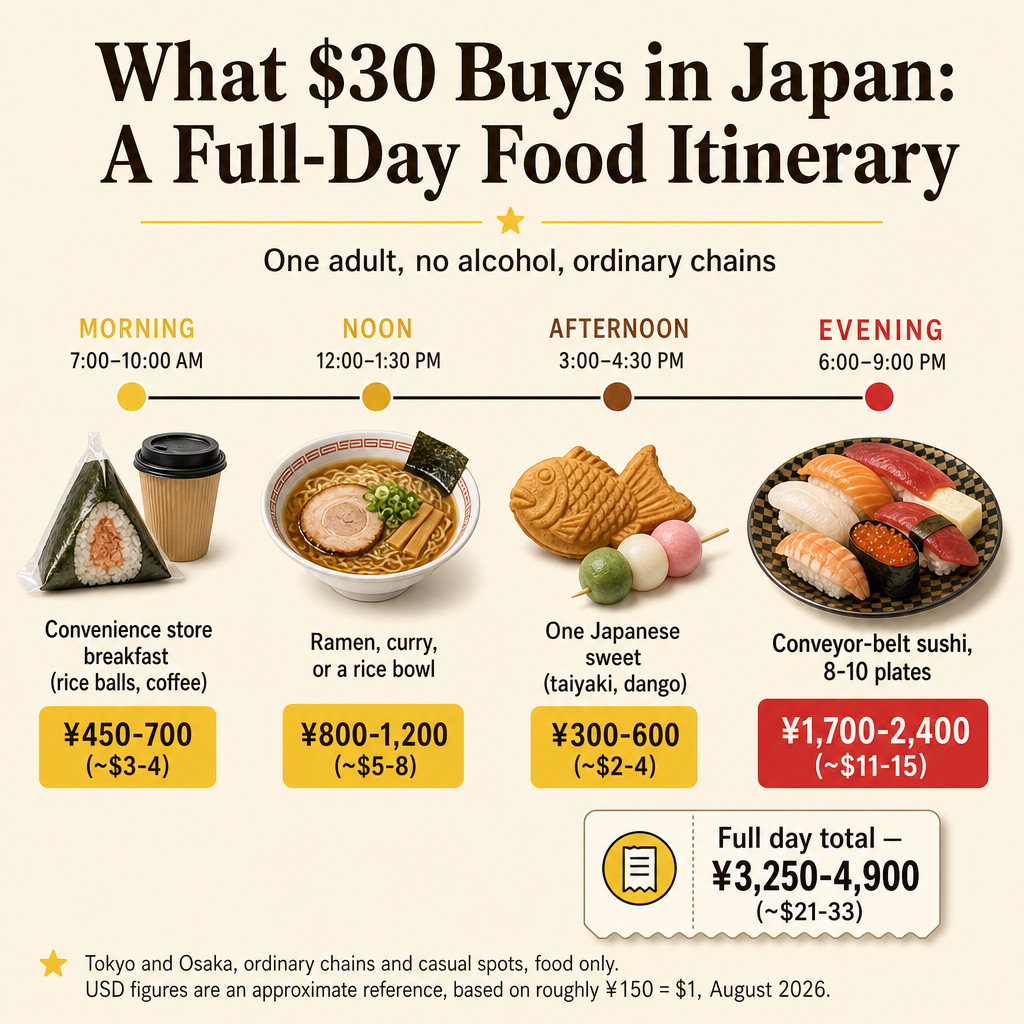
Quick answer: a carefully planned day of casual eating in Japan can cost about ¥3,250 to ¥4,900. That covers a convenience-store breakfast, an inexpensive restaurant lunch, one Japanese sweet, and a conveyor-belt sushi dinner. At the exchange rate used for this article, the total is roughly $20 to $30, although choosing the top of every range can push it slightly higher.
TOC
Why Japan Feels Surprisingly Affordable to American Travelers
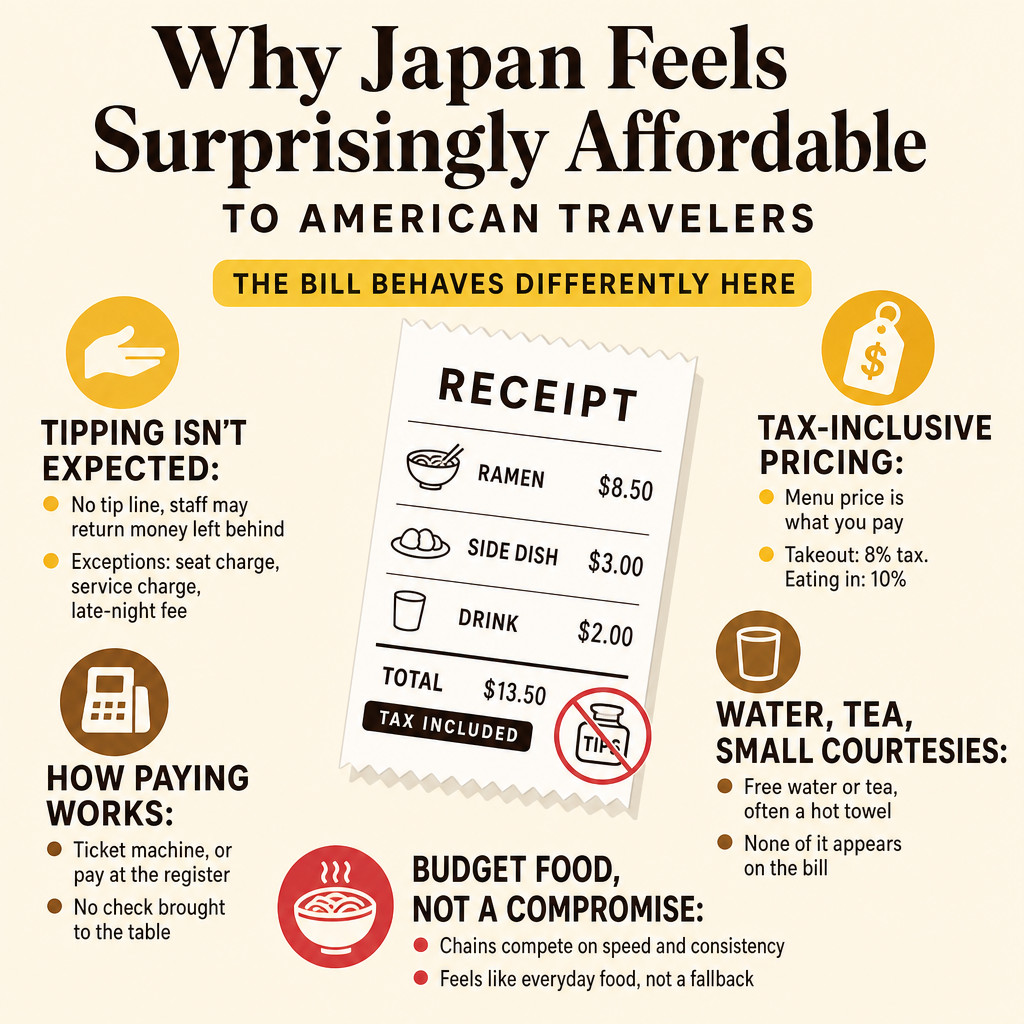
Part of the answer is the exchange rate. Yet the bigger part is structural, because Japanese restaurant bills behave differently from American ones. Fewer things get added at the end.
Tipping Is Generally Not Expected
At ordinary restaurants in Japan, nobody expects a tip. Receipts carry no tip line, and staff will often chase you down anyway to return money you left behind. So the mental math many Americans run at the end of a meal simply does not apply.
Some places do add charges, though. Izakaya often bill a small seat charge with a starter dish, called otoshi. Hotels, upscale restaurants, and certain bars may add a service charge. Late-night surcharges exist too, and Ichiran, for one, applies one between 10 p.m. and 6 a.m. So ask or check the menu if you want to avoid a surprise.
Tax-Inclusive Pricing Makes Budgeting Easier
Japanese businesses must show consumer prices with consumption tax included. Therefore the number on the menu is usually close to what you pay. One wrinkle exists: takeout food carries an 8 percent rate, while eating in carries 10 percent. Some shops post both prices side by side, which explains those two numbers you keep seeing.
Water, Tea, and Small Courtesies
Complimentary water or tea arrives at many casual restaurants without asking. Plenty of places also hand over a hot or cold towel before the meal begins. None of it appears on the bill, though. That alone shaves several dollars off a day compared with ordering drinks at every stop.
How Paying Actually Works
Many casual restaurants run on a ticket machine by the door. You choose your dish, pay first, then hand the printed ticket to the kitchen. Others take payment at the register on your way out, not at the table. Either way, nobody brings you a check to sign, which removes the step where American diners normally calculate a tip.
Budget Food Rarely Feels Like a Compromise
Here is the part that surprises people most. Budget dining in Japan often feels like a normal part of everyday food culture rather than a last resort. Chains compete hard on consistency and speed, while small noodle shops and set-meal restaurants serve straightforward food without the cost of formal dining.
What $30 Buys in Japan: A Full-Day Food Itinerary
Before the numbers, a few ground rules. Otherwise the totals mean very little.
One adult, standard appetite, no alcohol.
Ordinary chains and casual restaurants, not tourist-district pricing.
Food only, so lodging and transport sit outside this figure.
Workable in Tokyo and Osaka, though city-center branches run higher.
Yen figures come first, because dollar conversions move daily.
Breakfast: Convenience Store Favorites
¥450 – ¥700about $3 to $4
Japanese convenience stores sit closer to compact food shops than to the roadside model many Americans picture. Rice balls, egg sandwiches, hot croquettes, yogurt, and decent coffee all live under one roof, usually within a block of wherever you are staying.
Prices have climbed, however. Rice prices and seaweed costs pushed convenience-store onigiri to roughly ¥180 to ¥230 after revisions in early 2026. Coffee held up better, with Seven-Eleven’s regular size at ¥140 and rivals between ¥150 and ¥160. Two rice balls and a coffee therefore land near ¥550, or about $3.50.
Lunch: Ramen, Curry, or a Rice Bowl
¥800 – ¥1,200about $5 to $8
Lunch is where the value gets obvious, although ramen deserves a warning first. Government retail price survey data put the national average for a standard bowl at ¥742 in May 2026. That average hides an enormous spread, however, and travelers rarely eat at the average.
Beef bowls run cheaper still. At the three big chains, a regular gyudon costs roughly ¥460 to ¥500, tax included, after Sukiya raised its price in July 2026. Similarly, curry rice, udon, soba, and a teishoku set meal all sit in that territory. A set meal usually brings a main dish, rice, miso soup, and pickles together, which makes it the best value on most menus.
Why Ramen Prices Vary So Much
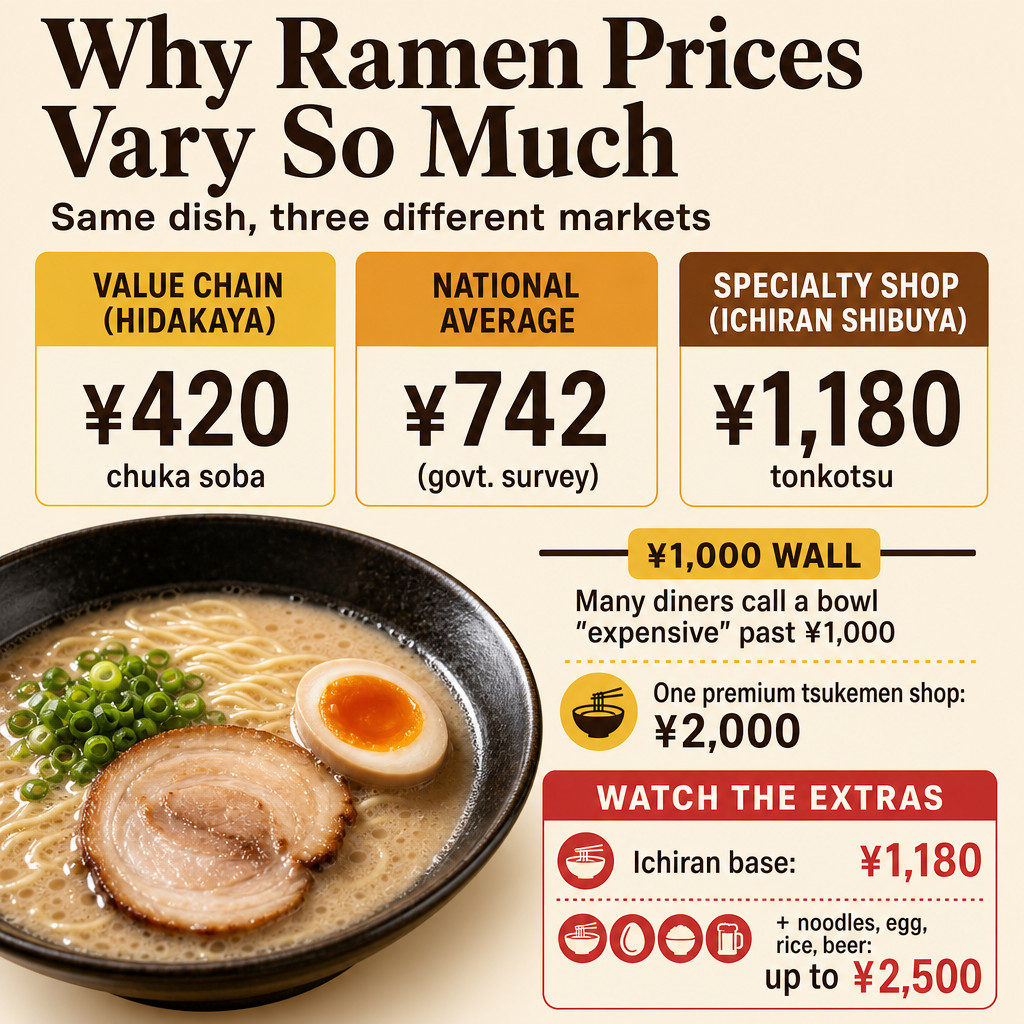
Japanese ramen writers describe the market splitting into three tiers: value chains, ordinary bowls near ¥1,000, and specialty shops. Rising ingredient and labor costs explain part of the gap. The rest comes from location, preparation time, ingredients, portion size, and the operating model behind each shop.
Tier
Example
Price
Value chain
Hidakaya, standard chuka soba
¥420 (raised from ¥390 in December 2024)
National average
Government retail price survey
¥742 (May 2026)
Specialty shop
Ichiran Shibuya, tonkotsu ramen
¥1,180 (August 2026)
Specialty price checked on the company site in August 2026. Chain and average figures carry their own reference dates.
Shops also watch a psychological “¥1,000 wall”, since many diners start calling a bowl expensive above that line. Premium tsukemen restaurants sit well beyond it, with one Chiba shop reported at ¥2,000 in 2025. So a value chain and a famous specialty shop can sit two blocks apart at very different prices, and neither one is a rip-off.
Watch the extras: at Ichiran Shibuya the bowl costs ¥1,180, then extra noodles add ¥210, a seasoned egg ¥160, rice ¥300, and a draft beer ¥650. That is ¥2,500 before you notice. The base price is rarely the problem, since the additions do the damage.
Afternoon: One Japanese Sweet
¥300 – ¥600about $2 to $4
Skip this and you will miss half the point of eating in Japan. Taiyaki, the fish-shaped cake filled with sweet red bean paste, is the classic choice. Dango, dorayaki, matcha soft serve, and melon pan also work.
Most of these come from permanent shops rather than street carts, so “street food” is a loose translation. Prices swing widely between a neighborhood stand and a famous shop with a queue outside. Treat this range as a typical spread rather than a fixed menu price.
Dinner: Conveyor-Belt Sushi
¥1,700 – ¥2,400about $11 to $15
The era when nearly every plate cost ¥100 has largely ended, although the format survives. Entry-level plates at suburban branches of the major chains still begin around ¥110 to ¥120 including tax, while city-center branches price higher. Premium cuts like fatty tuna, meanwhile, sit on their own tier.
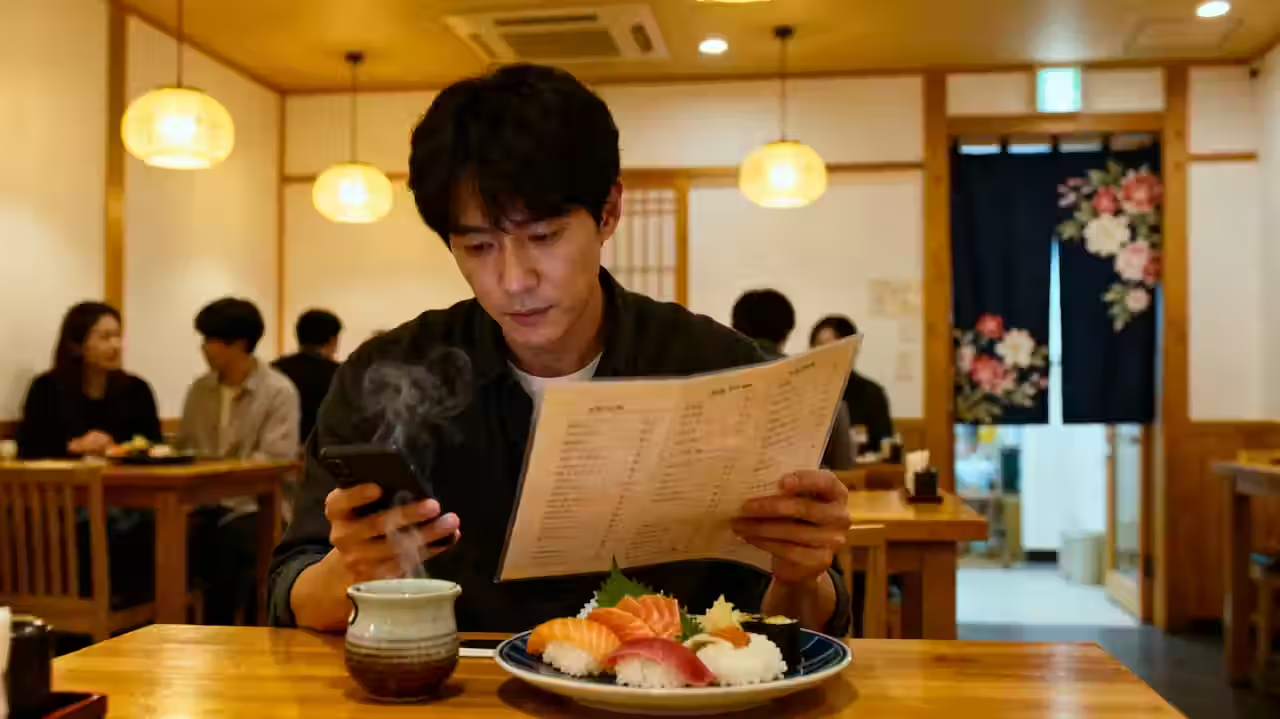
Mix cheap and mid-tier plates and the budget may cover around 8 to 10 plates, enough for a moderate meal for many diners. One honest warning, though: portions across Japan generally run smaller than American ones, so a big eater should plan on a little more than these ranges. Add miso soup or steamed egg custard and you drop a plate or two. Usually tablets handle ordering, and many chains offer English screens, so the language barrier stays low.
If You Would Rather Go to an Izakaya
An izakaya is a wonderful night out, but treat it as an upgrade rather than a swap. Because of the seat charge, the small dishes, and a drink or two, totals climb quickly. Budget closer to ¥3,000 to ¥4,000 per person depending on how much you drink. Groups sharing plates generally get better value than solo diners.
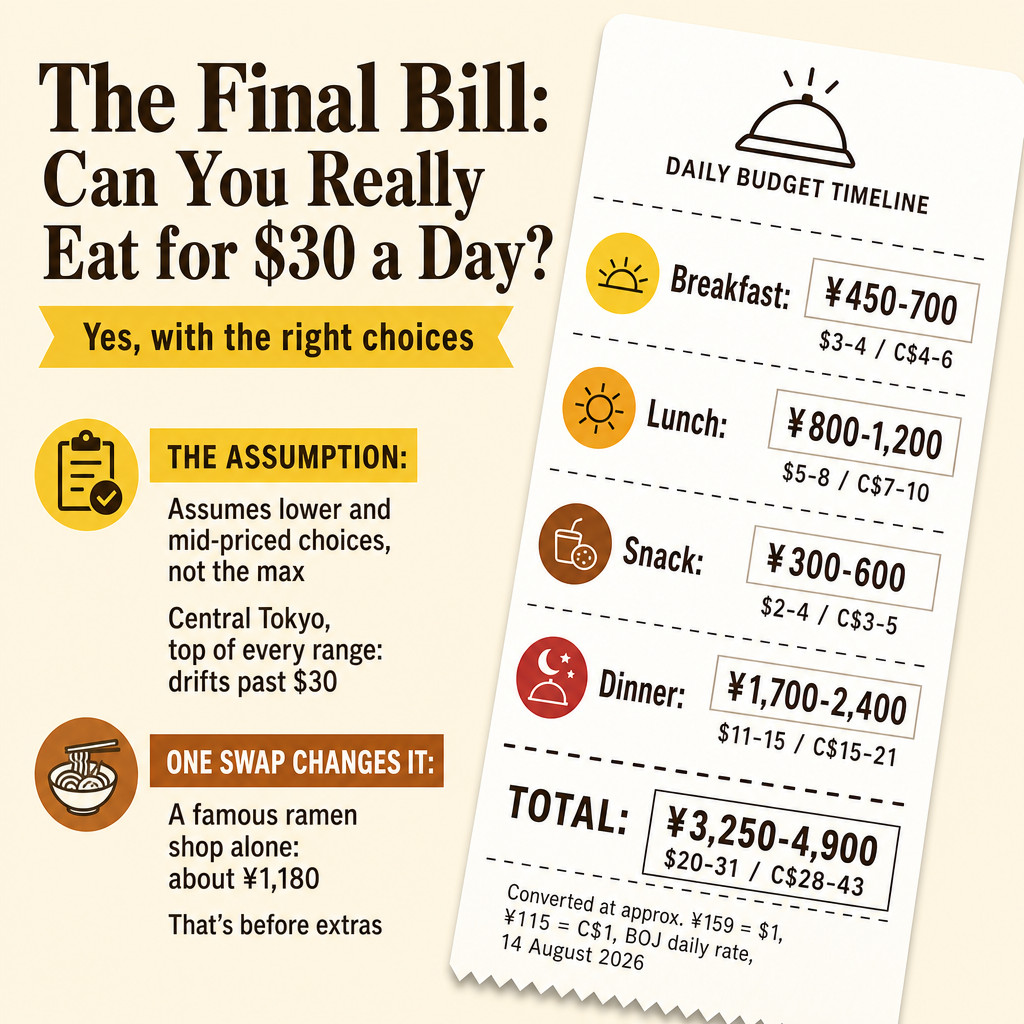
The Final Bill: Can You Really Eat for $30 a Day?
Meal
Cost in yen
USD
CAD
Breakfast
¥450 – ¥700
$3 – $4
C$4 – C$6
Lunch
¥800 – ¥1,200
$5 – $8
C$7 – C$10
Snack
¥300 – ¥600
$2 – $4
C$3 – C$5
Dinner
¥1,700 – ¥2,400
$11 – $15
C$15 – C$21
Total
¥3,250 – ¥4,900
$20 – $31
C$28 – C$43
Chain and convenience-store figures reflect published menu prices as of August 2026. Snack and izakaya figures are typical ranges. Converted at roughly ¥159 per US$1 and ¥115 per C$1, using Bank of Japan daily rates for 14 August 2026, rounded for readability.
The $30 itinerary assumes a mix of lower and mid-priced choices rather than the maximum price in every category. Take the top of every range in central Tokyo and the total drifts slightly past $30. Swap in a famous ramen shop and lunch alone runs about ¥1,180 before extras.
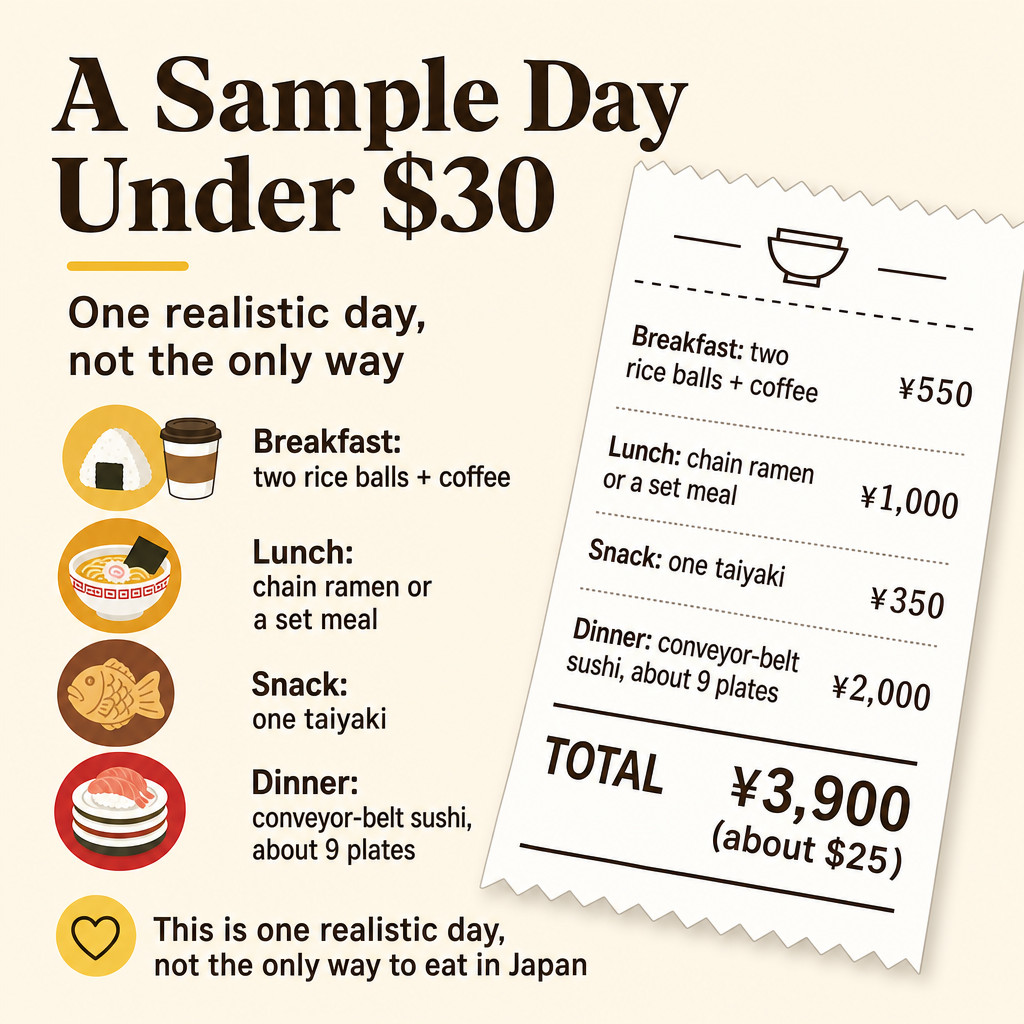
A Sample Day Under $30
Ranges are useful, yet a single concrete order answers the question faster. Here is one combination that works.
Breakfast: two rice balls and a convenience-store coffee ¥550
Lunch: a chain ramen or a set meal ¥1,000
Snack: one taiyaki ¥350
Dinner: conveyor-belt sushi, around 9 plates ¥2,000
Total¥3,900, about $25
This is one realistic day, not the only way to eat in Japan.
How We Checked These Prices
We reviewed tax-inclusive menu prices from major convenience stores, restaurant chains, and official store pages in August 2026. Yen is the base currency here, and dollar figures are rounded. Independent restaurants and regional branches set their own prices, so treat every number as a reference point rather than a quote.
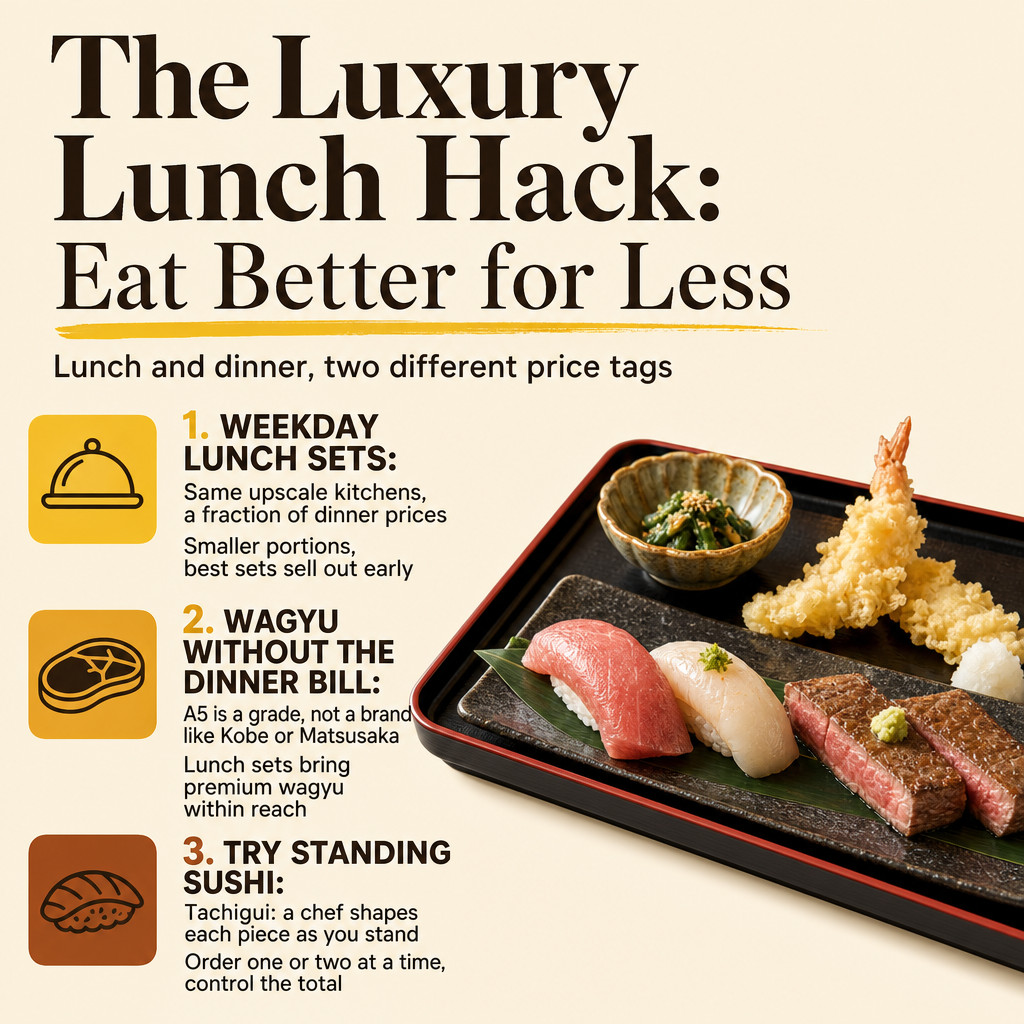
The Luxury Lunch Hack: Eat Better for Less
This is the trick worth saving. Japanese restaurants often price lunch and dinner as two different businesses, and the gap can be enormous.
Look for Weekday Lunch Sets
Some upscale yakiniku, sushi, tempura, and eel restaurants offer weekday lunch sets at a fraction of their evening prices. Hotel restaurants do the same. Portions run smaller, naturally, and the cheapest sets often sell out early. Still, it remains the single most effective way to eat above your budget.
Wagyu Without the Luxury Dinner Bill
A quick clarification first, because the labels confuse almost everyone. A5 describes a grade, covering yield and meat quality. Kobe beef, Matsusaka beef, and Omi beef are regional brands. An A5 grade does not automatically mean a famous brand, and vice versa.
Even so, lunch sets at grilled-beef restaurants can bring premium wagyu within reach. Check the cut, the origin, and the gram weight before ordering, since portions are often modest. Comparable wagyu experiences in major U.S. cities generally cost considerably more.
Try Standing Sushi
Tachigui means standing and eating. At standing sushi counters, a chef shapes each piece in front of you while you eat on your feet. Because many shops let you order one or two pieces at a time, you control the total exactly. It costs far less than a seated sushi restaurant, and the pace suits a busy sightseeing day.
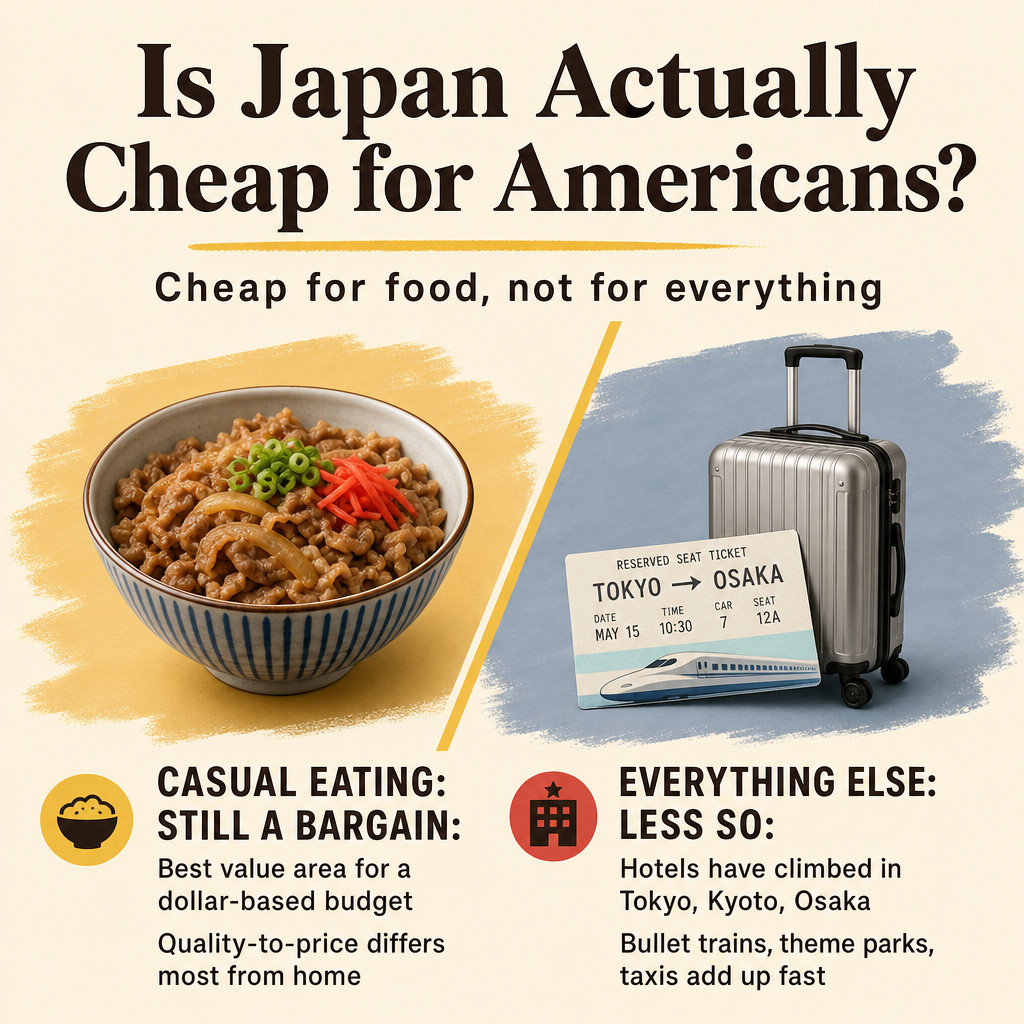
Is Japan Actually Cheap for Americans?
For everyday eating, yes, it often feels that way. For everything else, the picture gets more complicated.
Hotel rates in Tokyo, Kyoto, and Osaka have climbed in recent years. Bullet train tickets between cities also cost real money. Similarly, theme park admission, taxis, and tourist-district restaurants can match or beat American prices. Japan is not uniformly inexpensive, and pretending otherwise sets travelers up for a nasty budgeting surprise.
Casual dining is one of the clearest areas where visitors still find strong value. That is where a dollar-based budget goes furthest, and where the quality-to-price balance differs most from what visitors know at home.
How to Keep Your Japan Food Budget Under $30
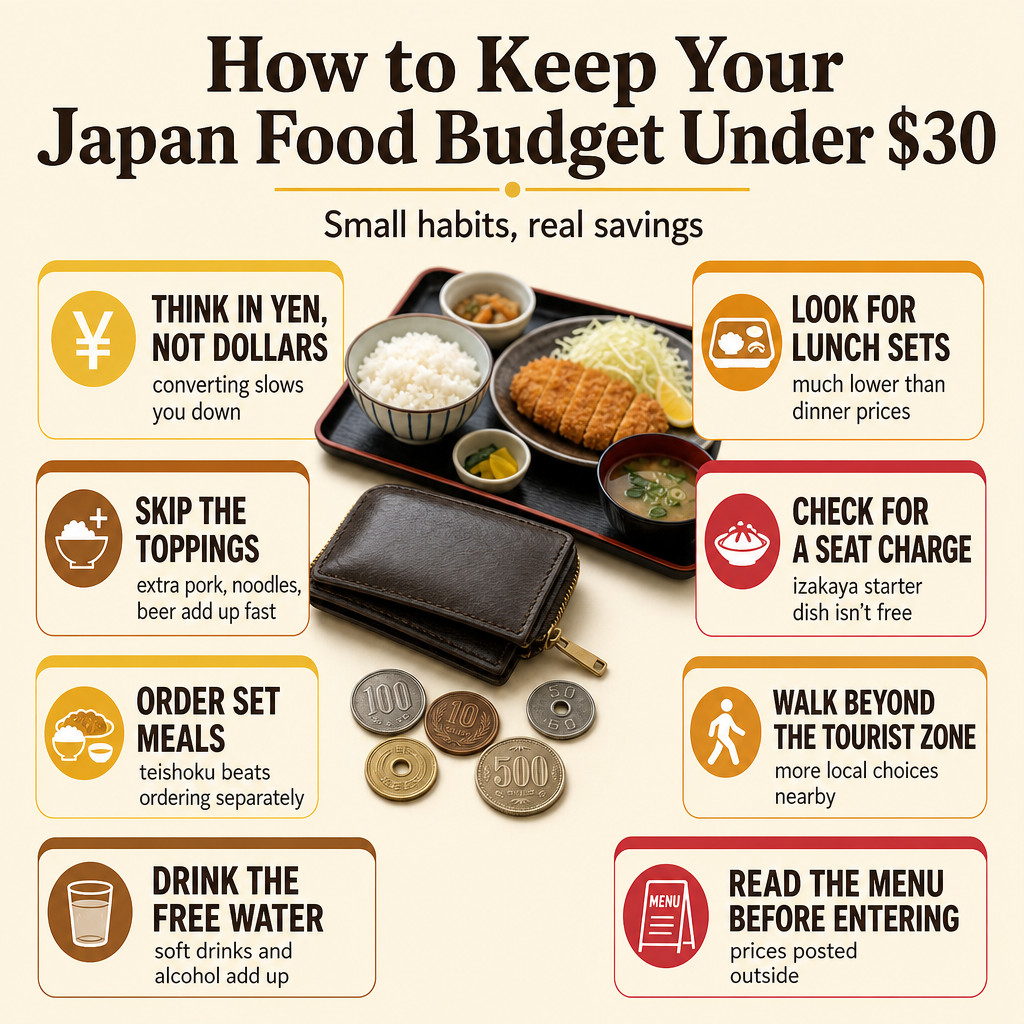
Think in yen, not dollars. Converting every price slows you down and hides how much you have actually spent.
Look for lunch sets. Some restaurants offer simpler daytime menus at much lower prices than their dinner courses.
Skip the toppings. Extra pork, a second helping of noodles, and a beer can double a ramen bill.
Check for a seat charge at izakaya. The small starter dish is not free, though it is usually only a few hundred yen.
Order set meals. A teishoku bundles main, rice, and soup at a better price than ordering separately.
Check streets beyond the tourist zone. A short walk often reveals more local choices, although this varies by neighborhood.
Drink the free water. Soft drinks and alcohol are where casual meals quietly get expensive.
Read the menu before entering. Most restaurants post prices outside, and ticket machines show everything up front.
One more practical note. Card acceptance keeps expanding, although small shops, ticket machines, and family-run restaurants may still want cash. Carrying a few thousand yen saves awkward moments.
Final Thoughts
Japan’s real advantage is not simply that food costs less. It is that travelers can find variety, care, and consistency at prices that stay accessible. Affordable food is not outside Japanese food culture either. Rather, it is one of the ways that culture shows up in daily life, through noodle counters, set meals, convenience stores, and neighborhood chains.
In many American cities, $30 vanishes over one meal. In Japan, with a little planning, it becomes an entire day of food worth remembering. Start with our Japan food guide if you want to build a route around specific dishes, or browse Japanese food by type to find your priorities first.
Planning a trip? Save this guide and send it to whoever is arguing about the budget. You can also follow Food in Japan on X for regional specialties and practical dining tips.
FAQ About Food Prices in Japan
How much should I budget for food per day in Japan?
Three tiers help here. Careful casual dining runs roughly ¥3,250 to ¥4,900, or about $20 to $31. Comfortable everyday eating, with a nicer dinner and a drink, sits closer to ¥6,000 to ¥9,000. Premium dining moves well beyond that. The $30 figure assumes casual restaurants chosen deliberately.
Can you really eat for $30 a day in Tokyo?
Yes, though it takes intention. Convenience stores, noodle shops, rice-bowl chains, and conveyor-belt sushi keep you inside the range. Cafés, bars, hotel restaurants, and tourist-district menus push you outside it fast. Central Tokyo branches also price higher than suburban ones, so location matters as much as the dish.
Do you tip at restaurants in Japan?
No, tipping is not expected at ordinary restaurants. Also, do not leave cash on the table, since staff will usually return it. Pay at the register in most casual places, or at the ticket machine before you sit down. Hotels, tours, and some international services set their own rules, so follow whatever they state.
Is convenience-store food actually good in Japan?
Good enough that locals eat it daily, which is the honest test. Stock turns over quickly, while hot and chilled items sit side by side, and seasonal or regional products appear constantly. Quality varies by chain and item, naturally. Still, a convenience-store breakfast in Japan is a reasonable meal rather than a fallback.
Are food prices higher in Tokyo and Kyoto?
Often, especially near major stations, temples, and shopping districts. Chain restaurants help, because their pricing stays relatively consistent nationwide, with some city-center surcharges. Walking a few streets away from a landmark can expand the range of lower-priced options. Smaller cities and suburbs remain noticeably cheaper across the board.
Are credit cards accepted at inexpensive restaurants?
Increasingly yes, though not universally. Chains, convenience stores, and conveyor-belt sushi nearly always take cards and mobile payment. Small independent shops, older ticket machines, and some noodle counters still run on cash. Keeping a few thousand yen on hand avoids the one meal where it matters.
Ryo Iwa is the founder and editor of foodinjapan.org. Born and raised in Japan, he writes from regional travel, market visits, and Japanese-language primary sources that rarely reach English readers, including brewing institute publications and industry glossaries. Where a figure cannot be traced to a source, the article says so.
He has been a Google Maps Local Guide for over 10 years, with more than 1,800 reviews and over 41,000 photos viewed hundreds of millions of times. He previously spent two decades as an IT consultant in Japan, the US, and the UK.












Comments