




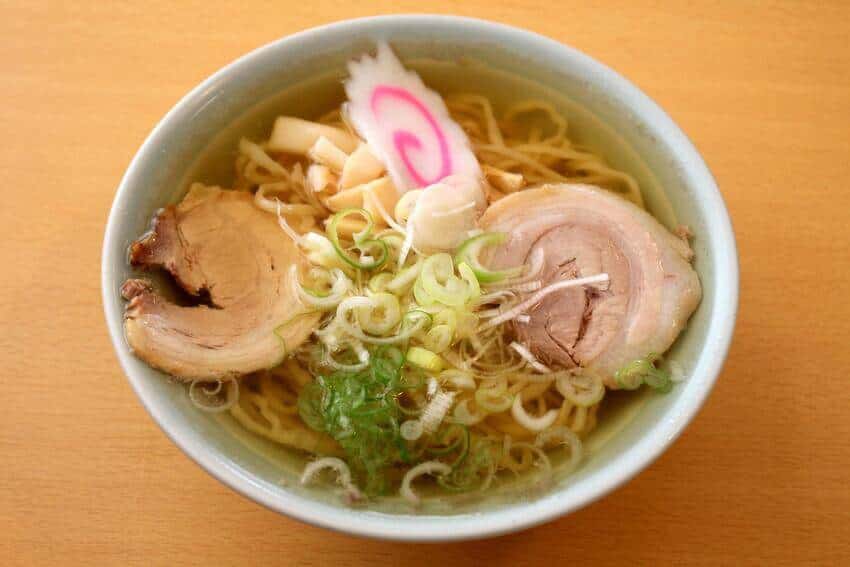
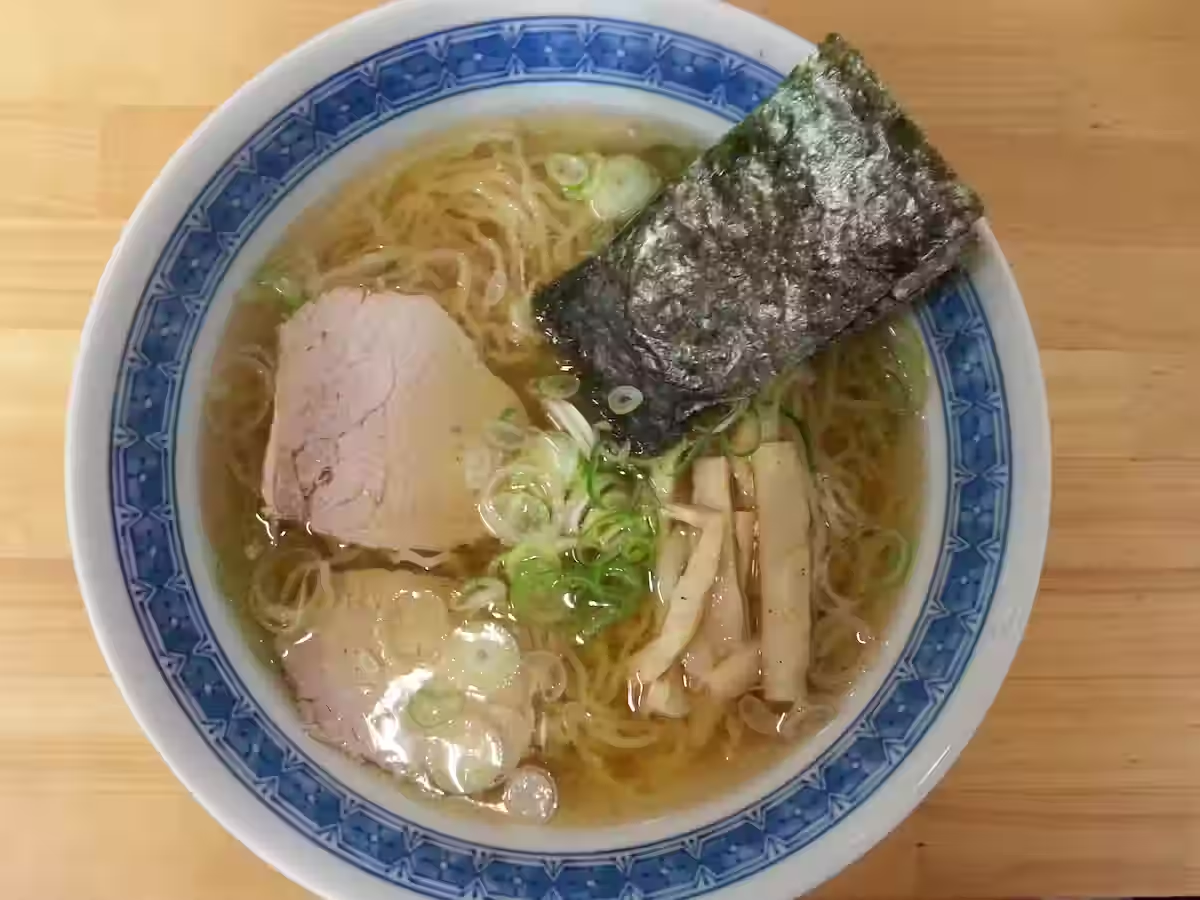
Sano ramen (佐野ラーメン) is a local noodle specialty from Sano City in Tochigi Prefecture, within about 70 kilometers of Tokyo. It pairs a clear soy sauce broth with aodake-uchi noodles, which makers press with a long green bamboo pole. Because of that method, the noodles come out flat, wavy, and slightly uneven. That irregularity defines their texture.
Its uneven noodles create a varied bite, while the light broth keeps the flavor clean. The style grew alongside Sano’s textile industry, and it still belongs to the city’s everyday food culture.
What Is Sano Ramen?
Sano ramen is a regional noodle style from Sano City in Tochigi Prefecture. It combines a light, usually soy-seasoned broth with flat, wavy noodles. Makers traditionally press the dough with a long bamboo pole, so the strands have irregular widths and a springy bite.
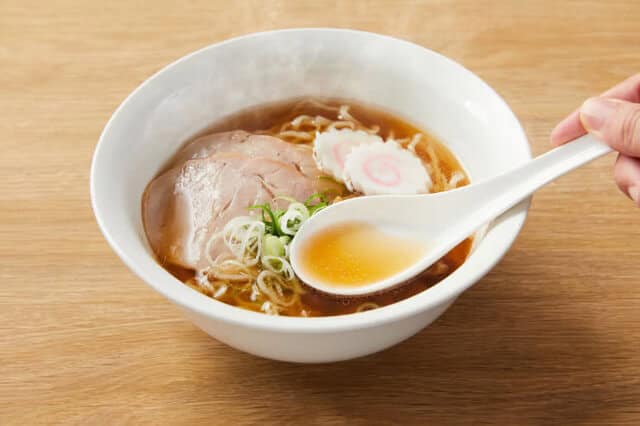
- Origin
- Sano City, Tochigi Prefecture, Japan
- Noodle shape
- Flat, wavy, irregular width and thickness
- Noodle texture
- Soft yet springy, with a varied bite
- Broth
- Usually clear and soy-seasoned; stock varies by shop
- Typical toppings
- Chashu, menma, green onion, naruto
- Flavor profile
- Light to medium-bodied, savory, with a relatively clean finish
- Price range
- Roughly 660 to 900 yen for a standard bowl, based on local listings from 2023 to 2026
- Best for
- Diners who prefer lighter ramen and handmade noodles
Key features at a glance
- Origin: Sano City in southern Tochigi, a former textile town
- Aodake-uchi noodles: dough pressed with a green bamboo pole, then cut by hand
- Clear soy sauce broth: the most common seasoning, though some shops also serve salt, miso, or sesame
- Common toppings: chashu, menma, green onion, and naruto fish cake
- Sensory profile: gentle soy aroma and noodles that slide, then bounce
- Common side dish: gyoza, served at many shops
What Does Sano Ramen Taste Like?
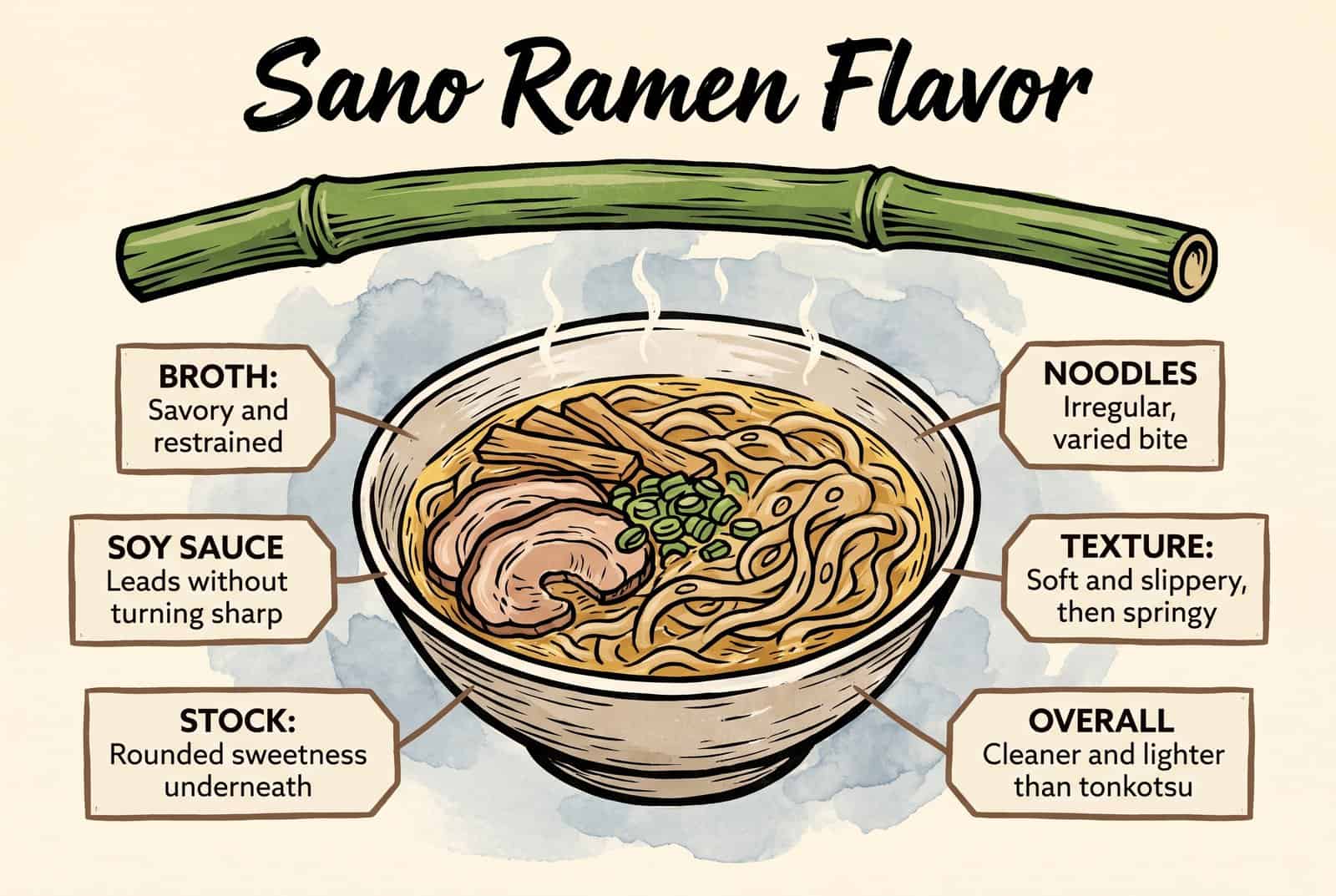
The broth tastes savory and restrained. Soy sauce leads without turning sharp, while the stock adds a rounded sweetness underneath. Some shops deepen it with dried sardines or kelp, while others add a little back fat. Compared with rich tonkotsu ramen, it usually leaves a cleaner, lighter impression. The Sano Ramen Society describes the flavor as light enough to eat every day.
The noodles define the dish. Because their shape is irregular, they create a varied bite and carry the light broth well. One strand feels soft and slippery, and the next pushes back with a springy chew. The Shin-Yokohama Ramen Museum even compares some hand-cut versions to the slippery feel of wonton wrappers. The pale broth may look understated, but the changing noodle texture keeps each bite distinct.
How Aodake-Uchi Noodles Are Made
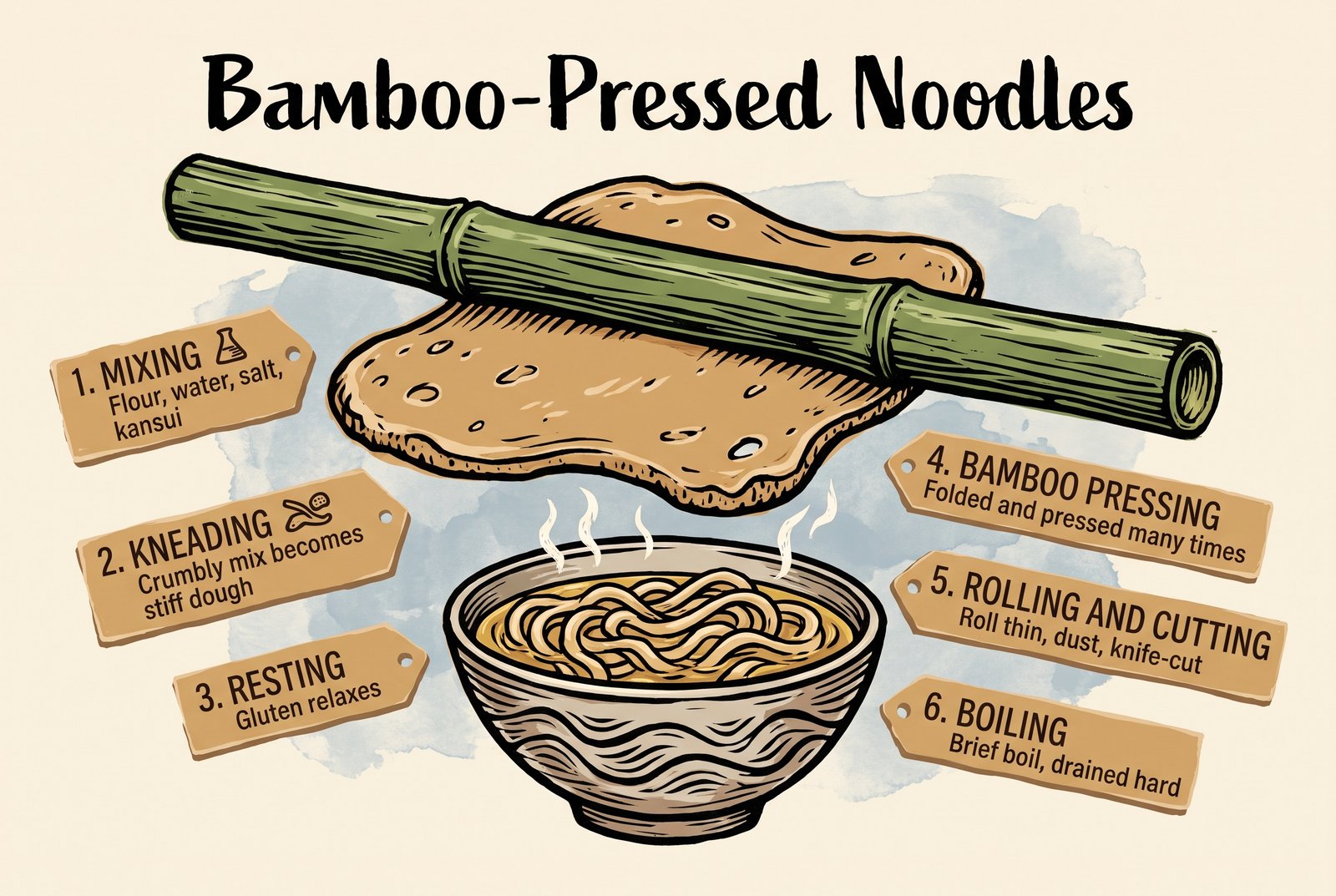
Aodake-uchi (青竹打ち) means green bamboo pressing. First, noodle makers fix one end of a thick bamboo pole and sit or lean on the other. Then, using their body weight, they press, knead, and stretch the dough in long passes. Some English sources call this “striking,” but nobody hits the dough repeatedly.
- Mixing. Makers combine wheat flour, water, salt, and kansui (alkaline water). According to the Shin-Yokohama Ramen Museum, hand-pressed Sano dough holds roughly 45 to 50 percent water.
- Kneading. Next, the crumbly mix comes together into a stiff, slightly sticky mass.
- Resting. The dough rests so the gluten relaxes. Most shops keep their exact timing private.
- Bamboo pressing. Makers fold the sheet and press it again, many times over. Over time, repeated pressing develops the dough and contributes to its uneven thickness.
- Rolling and cutting. After that, makers roll the sheet thin, dust it with starch, fold it, and cut it with a knife.
- Boiling. Because of the high water content, the noodles cook quickly. Shops boil them briefly and drain them hard.
Not every shop presses by hand today. In fact, the Sano Ramen Society states that some members use machine-made noodles. Still, the handmade version remains the reference point. At Morita-ya Sohonten, local guides note that diners can often watch the pressing from the shop, depending on the time of visit.
Sano Ramen Ingredients
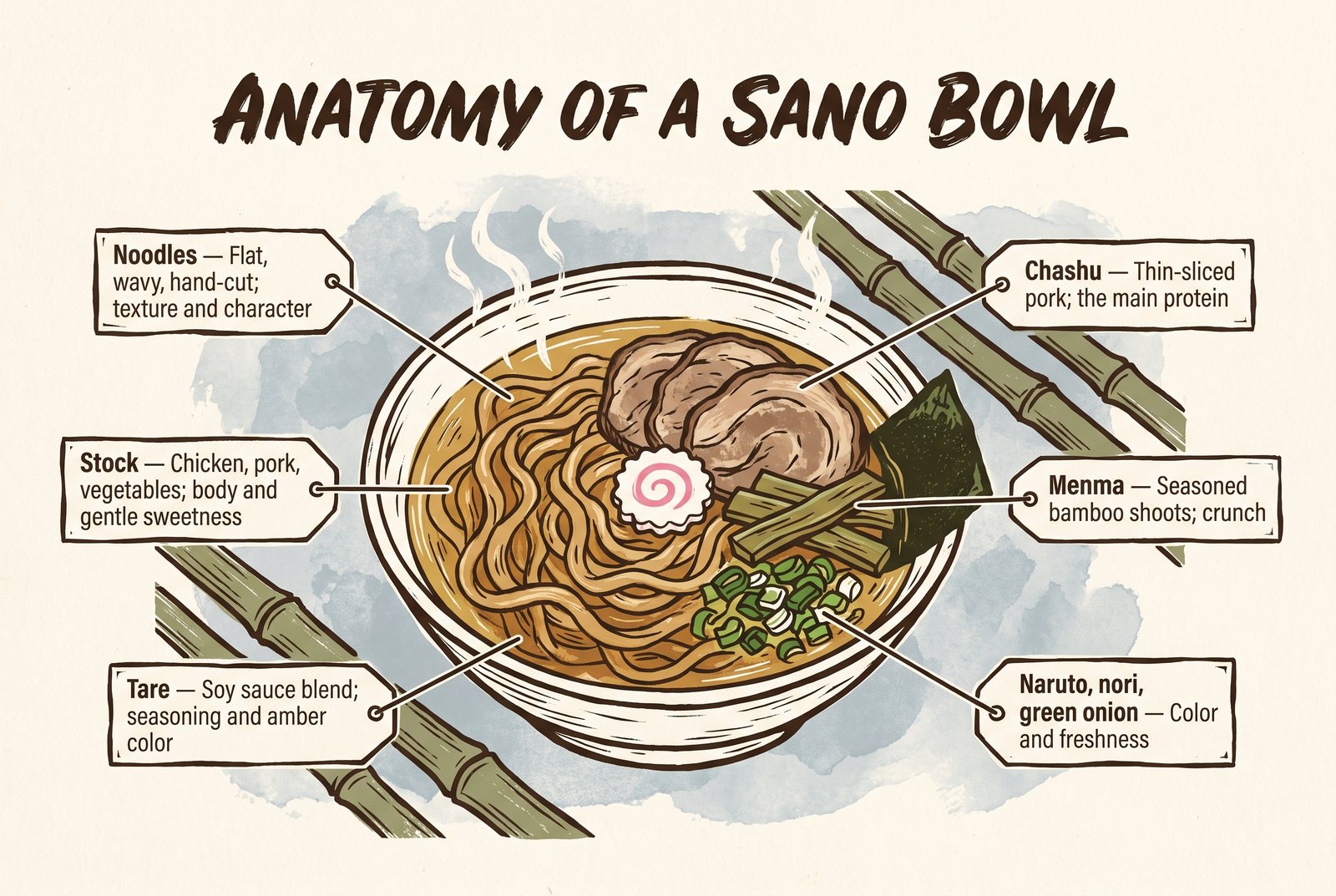
Recipes differ by restaurant lineage, so treat the table below as a common pattern rather than a rule.
| Component | Typical form | Role in the bowl |
|---|---|---|
| Noodles | Flat, wavy, hand-cut, high hydration | Texture and character |
| Stock | Chicken, pork, vegetables, or a mix | Body and gentle sweetness |
| Tare | Soy sauce blend | Seasoning and amber color |
| Chashu | Pork, sliced thin | The main protein |
| Menma | Seasoned bamboo shoots | Crunch |
| Naruto, nori, green onion | Fish cake, seaweed, chopped negi | Color and freshness |
Cooks commonly prepare the broth with chicken bones, pork bones, and vegetables. As a result, its clean flavor supports the noodles without overpowering them. Soy sauce is the seasoning, not the stock, so two soy sauce ramen can taste quite different underneath.
Local tourism materials also credit Sano’s water for the broth’s clarity. The best-known source, Izuruhara Benten-ike, lies in the north of the city. In 1985, Japan’s Environment Agency, now the Ministry of the Environment, included it in its list of 100 Famous Waters. Whether each shop uses that spring is hard to confirm, so it is safer to say Sano simply has good groundwater.
Sano Ramen History
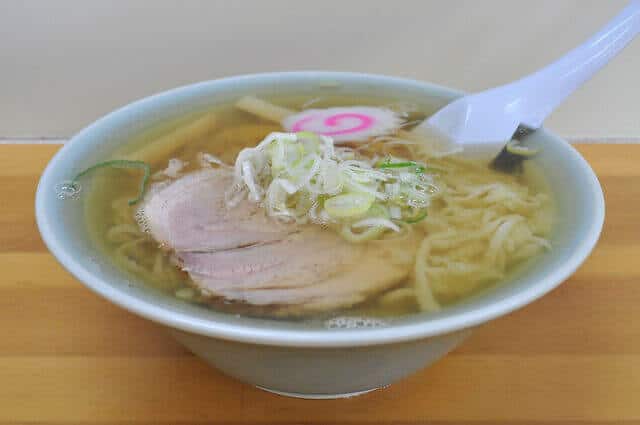
The story begins in the Taisho era, around the 1910s. At that time, according to Tochigi’s tourism association, a Chinese cook introduced bamboo-pressed noodles. The Shimotsuke Shimbun, citing the Sano Ramen Society, also says he taught the method to a local cook. That cook later opened his own shop.
Some accounts name the shop and give 1930 as its opening year. These details come from oral history rather than documents, so treat them as tradition, not confirmed fact.
A textile town that ate by delivery
By the early Showa era, textiles drove Sano’s economy. Even so, the city of about 50,000 people had close to 160 ramen shops, according to the Sano Ramen Society. Factory workers, many of them women, had limited time to cook. So ramen delivery gave their households a quick meal, and the dish became part of daily life.
Later, in 1988, local shop owners formed the Sano Ramen Society (佐野らーめん会) to share the city’s ramen more widely. According to the Japan Food Journal, the city’s tourism association and chamber of commerce backed the group from the start. Today it publishes a shop map and promotes February 25 as Sano Ramen Day.
- 1910sA Chinese cook teaches bamboo-pressed noodles to a local cook, according to local tradition.
- Early ShowaClose to 160 shops serve a textile town; delivery becomes routine.
- 1961 and 1976Morita-ya opens in 1961, and Oguraya follows in 1976.
- 1988Shop owners found the Sano Ramen Society.
- 2019The society counts 67 member shops.
Sano Ramen vs Kitakata Ramen and Tokyo Shoyu Ramen
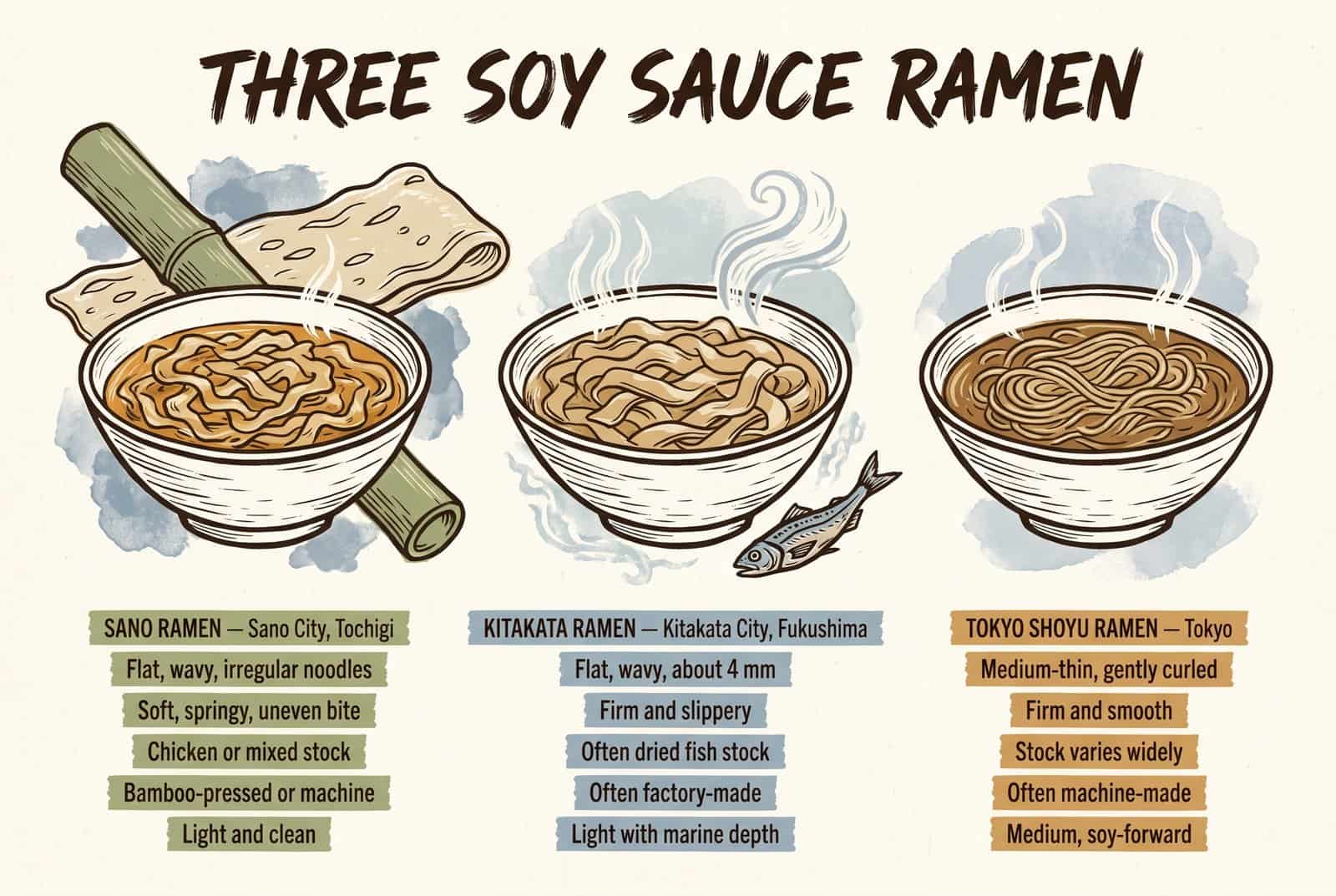
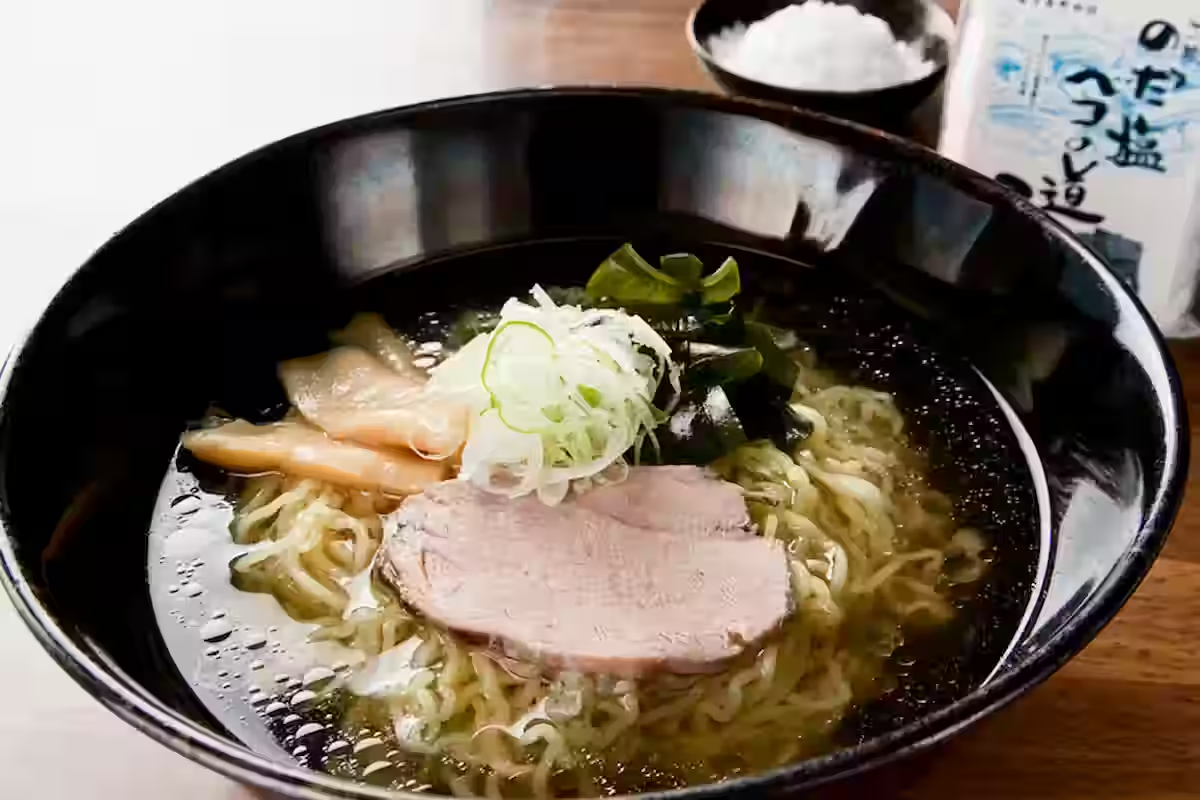
Sano ramen and Kitakata ramen from Fukushima look alike at first glance. Both use flat, wavy noodles in a light soy sauce broth. However, the table shows common tendencies, although individual shops vary in every region.
| Feature | Sano ramen | Kitakata ramen | Tokyo shoyu ramen |
|---|---|---|---|
| Origin | Sano City, Tochigi | Kitakata City, Fukushima | Tokyo |
| Noodle shape | Flat, wavy, irregular | Flat, wavy, about 4 mm wide | Medium-thin, gently curled |
| Texture | Soft and springy, uneven bite | Firm, slippery | Firm, smooth |
| Stock | Often chicken or mixed animal stock | Frequently includes dried fish | Varies widely |
| Common production | Bamboo-pressed or machine | Often factory-produced | Often machine-made |
| Flavor weight | Light, clean | Light with marine depth | Medium, soy-forward |
For background, our guide to Japanese shoyu ramen explains how tare and stock work together. For a clear salt-based bowl, Hakodate ramen is a useful comparison. Finally, the Tochigi Food Guide covers the prefecture’s other traditional foods.
How to Get to Sano from Tokyo
Sano City lies roughly 80 to 100 minutes from Tokyo by train or highway bus, depending on the route. Because timetables change, check current schedules on the operators’ official sites before you go.
First, take the Ryomo limited express from Asakusa to Tatebayashi, about 60 minutes. Then ride the Tobu Sano Line to Sano, about 16 minutes.
First, ride the Shinkansen or Utsunomiya Line to Oyama. Then change to the JR Ryomo Line for Sano Station.
JR buses run from Tokyo and Shinjuku to the terminal beside Sano Premium Outlets in about 90 minutes.
Leave the Tohoku Expressway at Sano-Fujioka. After that, parking is easy, since most shops have free lots.
Planning your stop
Popular shops sit in different parts of the city, so they are rarely within walking distance of each other. Morita-ya is near Sano Station, Men-ya Yousuke near Tajima Station, and Banri near the outlets. Oguraya, however, lies far to the north and is difficult to reach without a car or taxi.
- 10:30 Arrive at Sano Station and walk about 13 minutes to Morita-ya, or ride one stop to Tajima for Men-ya Yousuke.
- 10:45 Join the line before the 11:00 opening.
- 12:30 After lunch, visit Sano Yakuyoke Daishi temple near the station or head to the outlet mall.
- 15:00 Return to Tokyo by train or highway bus.
Choose either Morita-ya or Men-ya Yousuke as your main lunch stop. Attempting both is realistic only on a quiet weekday with short queues.
Where to Eat Sano Ramen
These four shops cover different styles and areas of Sano City. Note that the prices below come from recent local listings rather than a single official source, so small differences are likely.
| Shop | Standard ramen | Chashu-men | Gyoza | Price status |
|---|---|---|---|---|
| Men-ya Yousuke | 880 yen | 1,320 yen | 390 yen (3) | Recently listed (2026 local guide) |
| Morita-ya Sohonten | About 800 yen | About 1,300 yen | Not served | Recently listed (2026 visitor guide) |
| Oguraya | 660 yen | 825 yen | 473 yen | Recently listed (2023 to 2025) |
| Banri | About 800 yen | Not confirmed | Not confirmed | Price not confirmed |
Exact prices were available for some shops only. Approximate figures come from recent restaurant or local listings and may not match the current menu.
Men-ya Yousuke Honten (麺屋ようすけ 本店)
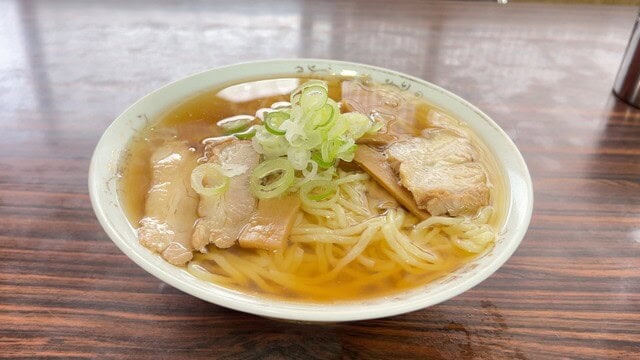
Yousuke opened in 2012 and represents the newer generation of Sano shops. The shop describes its bowl as a light chicken-based soup with firm bamboo-pressed noodles, while reviewers also mention pork and beef in the stock. Its gyoza have chewy wrappers. According to Tochigi’s tourism association, weekend waits at the main shop can exceed 100 groups, so a numbered call system manages the line.
Hours, prices, and closing days may change; check the restaurant’s official account before visiting.
Morita-ya Sohonten (森田屋総本店)
Open since 1961, Morita-ya keeps a two-item menu: ramen and chashu-men. You order and pay first, then wait for a table. The noodles are thick, flat, and uneven, while the soup runs a little darker than at newer shops. In other words, this is the bowl for anyone curious about the older style.
Hours, prices, and closing days may change; check the restaurant’s official account before visiting.
Oguraya (おぐら屋)
Oguraya opened in 1976 and seats more than 130 people in a southern European-style building on Route 293. Reviewers describe a clear, golden broth and soft, uneven noodles. The shop is also known for its large gyoza, and it sits near Izuruhara Benten-ike, the spring pond mentioned above.
Hours, prices, and closing days may change; check the restaurant’s official account before visiting.
Banri (手打ちラーメン 万里)
Banri moved in November 2020 to a building a few minutes’ walk from Sano Premium Outlets. According to local listings, the kitchen presses its noodles each morning and simmers chicken and pork for about four hours. Strands vary noticeably in width, so each mouthful differs a little. Even on weekdays, a short wait is common.
Hours, prices, and closing days may change; check the restaurant’s official account before visiting.
How to Order Sano Ramen
Menus are short. Most first-time visitors order the standard ramen, which shows the noodles and broth clearly. Chashu-men adds a full layer of pork, whereas a large serving (omori) adds noodles. For a side, most people choose gyoza.
- Sano ramen hitotsu onegaishimasu
- One Sano ramen, please.
- Gyoza mo onegaishimasu
- Gyoza too, please.
- Niku nashi wa arimasu ka?
- Do you have one without meat?
Queue systems differ. Yousuke uses a ticket machine and calls numbers, whereas Morita-ya takes payment at the counter first. Elsewhere, staff may ask you to write your name on a list. Join the end of any line, and do not hold places for absent friends unless staff allow it. Smaller shops often prefer cash, so carry enough for the meal.
Vegetarian, Halal, and Allergy Notes
A standard bowl is not vegetarian, because the stock uses chicken and pork bones. Also, the tare, aroma oil, and toppings may contain fish or other animal ingredients. So removing the chashu does not change the broth. Do not treat any bowl as halal or vegan unless the restaurant explicitly confirms it. Similarly, diners with allergies should ask about the broth, tare, toppings, noodles, and shared equipment.
Sano Ramen Recipe: A Home Version
Without a bamboo pole, a heavy rolling pin and repeated folding come closest. Even then, the result imitates aodake-uchi rather than reproducing it. This recipe uses 45 percent hydration, at the low end of the range for hand-pressed shop dough, because wetter dough is hard to handle without a pole.
Ingredients (serves 2)
Noodles
- 200 g bread flour
- 90 ml cold water
- 2 g fine salt
- 2 g baked baking soda, or liquid kansui used at the manufacturer’s ratio for 200 g flour
- Potato starch for dusting
Tare
- 80 ml soy sauce
- 30 ml mirin
- 30 ml sake
- 1 tsp sugar
Broth
- 5 g kombu
- 2 liters water
- 600 g chicken carcass or wings
- 300 g pork shoulder in one piece
- 1 onion, green tops of 1 leek, 20 g ginger, 3 garlic cloves
Toppings and equipment
- Menma, green onion, naruto, nori
- Stockpot, skimmer, rolling pin, knife, food thermometer
Instructions
- Steep the kombu. Soak the kombu in the cold water for 30 minutes. Then heat slowly and remove it just before the water boils.
- Simmer the broth. Next, add the chicken, pork, and aromatics. Bring to a boil, skim well, and keep a bare simmer for 2 hours so the broth stays clear.
- Make the tare and chashu. After 60 minutes, lift out the pork. Simmer it gently in the tare ingredients for 20 minutes, until a thermometer shows a safe internal temperature for pork. Afterward, cool it in the liquid.
- Mix and rest the dough. Dissolve the salt and alkali in the water, then rub it into the flour until it forms coarse crumbs. Press into a stiff mass, wrap, and rest for 1 hour.
- Fold and roll. Roll the dough flat, fold it in three, turn it, and roll again. Repeat 8 to 10 times, leaning your weight into the pin, until the sheet is about 2 mm thick.
- Cut. Dust with starch, fold loosely, and cut strands 2 to 4 mm wide, varying the width slightly.
- Assemble. The strained stock should yield about 1.0 to 1.2 liters, so heat 700 ml and reserve the rest. Put 30 ml of tare in each bowl. Then add noodles boiled for 2 to 3 minutes, pour in the broth, and finish with toppings.
Storage and food safety
- Store broth and noodles separately. Refrigerate broth for up to 3 days or freeze it for a month.
- Also, cool leftovers promptly and refrigerate them within two hours.
- Reheat broth until steaming hot throughout, following your local food-safety guidance.
- Cook noodles fresh for each serving.
Sano Ramen: Final Thoughts
In short, Sano ramen comes down to a clear soy sauce broth and irregular aodake-uchi noodles. Both grew up in a Tochigi city that once fed its mill workers by delivery. The broth stays quiet, while the noodles carry the character. If you plan a day trip from Tokyo, choose one shop and arrive before opening. Before you leave, check its latest hours.
Sano Ramen FAQ
- How is Sano ramen different from Kitakata ramen?
-
Both use flat, wavy noodles in a light soy sauce broth. Traditional Sano noodles are bamboo-pressed and hand-cut, while Kitakata shops often use factory noodles. Kitakata broth also frequently includes dried fish.
- How much does Sano ramen cost?
-
Local listings from 2023 to 2026 put a standard bowl at roughly 660 to 900 yen. Chashu-men usually costs a few hundred yen more. Several shops are listed as cash only, so bring some with you.
- How do I reach Sano from Tokyo?
-
Take the Tobu limited express from Asakusa to Tatebayashi, then change to the Tobu Sano Line. Alternatively, ride a highway bus to the terminal beside Sano Premium Outlets. Either way, allow roughly 80 to 100 minutes.
- Can vegetarians eat Sano ramen?
-
Standard bowls are not vegetarian, because the stock uses chicken and pork. We could not find a Sano shop that lists a fully vegetable broth. Ask each restaurant directly before visiting.
- Do I need to line up?
-
At well-known shops, usually yes, especially on weekends. Lines often form before the 11:00 opening, and shops close once noodles or soup run out. So arriving early on a weekday is the safest plan.
- Can I take Sano ramen home as a souvenir?
-
Yes, boxed Sano ramen sets are sold, including a Men-ya Yousuke version made by a noodle maker. Some shops also sell take-home items, and Yousuke lists frozen gyoza and chashu to go. Check storage instructions before a long trip.
- What is Sano Ramen Day?
-
February 25 is Sano Ramen Day. On that day, member shops of the Sano Ramen Society offer special services, according to Tochigi’s tourism association. Details change each year, so check the society’s website.
References
- Sano Ramen Society – Official website (Accessed September 2026)
- Sano City Tourism Association – Sano Ramen (Accessed September 2026)
- Tochigi Prefecture Tourism Association – Sano Ramen (Accessed September 2026)
- Shimotsuke Shimbun – Sano Ramen and the City’s Industry (Accessed September 2026)
- Shin-Yokohama Ramen Museum – Regional Ramen: Sano Ramen (Accessed September 2026)
- Tobu Railway – Access to the Ryomo Area (Accessed September 2026)
- Sano Ramen Navi – Men-ya Yousuke Honten (Accessed September 2026)
- Sano Ramen Society – Member page: Men-ya Yousuke (Accessed September 2026)
- Morita-ya Sohonten – Official website (Accessed September 2026)
- Sano Ramen Society – Member page: Oguraya (Accessed September 2026)
- Tochigi Prefecture Tourism Association – Men-ya Yousuke Honten (Accessed September 2026)
- Sano City Tourism Association – Oguraya (Accessed September 2026)
- Hot Pepper Gourmet – Men-ya Yousuke shop page (Accessed September 2026)
- Tochinavi – Morita-ya Sohonten (Accessed September 2026)
- Tochinavi – Banri (Accessed September 2026)
- Japan Food Journal (Nissyoku) – Regional Report: Sano Ramen Society (Accessed September 2026)
- Japan Food Journal (Nissyoku) – Local Ramen in Depth: Sano Ramen (Accessed September 2026)
- Kubota Menyu – Sano Ramen Men-ya Yousuke Boxed Set (Accessed September 2026)
- J-STAGE – Fukutome, N. and Takashima, M. (2024), The Evolution and Classification of Ramen in Japan (Accessed September 2026)
Related Articles
- Kitakata Ramen (喜多方ラーメン) (Surveyed: September 2026)
- Shoyu Ramen (醤油ラーメン) (Surveyed: September 2026)
- Hakodate Ramen (函館ラーメン) (Surveyed: September 2026)
- Utsunomiya Gyoza (宇都宮餃子) (Surveyed: September 2026)



Comments