



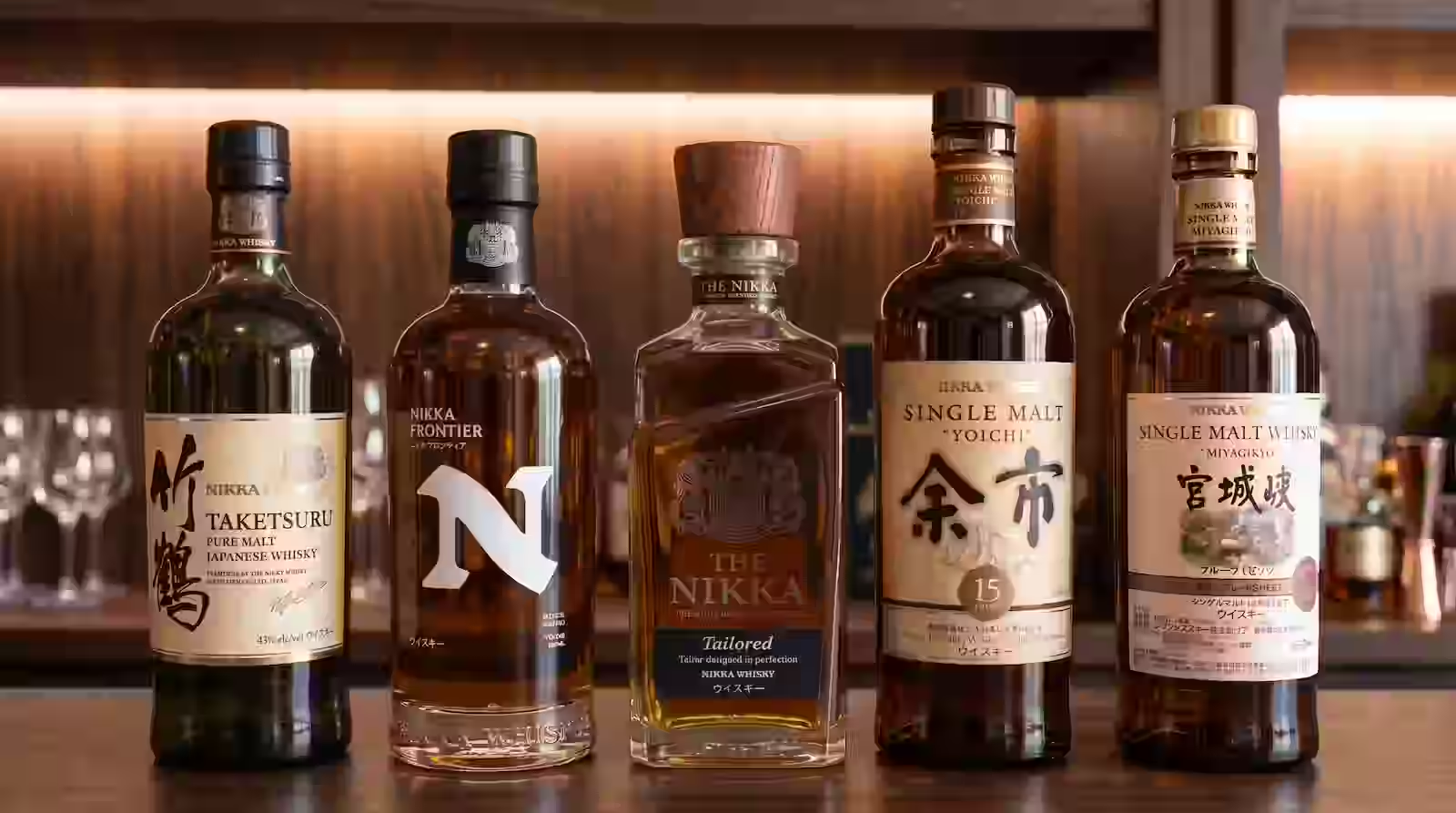
Nikka Whisky is a Japanese whisky producer founded by Masataka Taketsuru in 1934. It makes whisky at two very different distilleries. Yoichi sits on the cold coast of Hokkaido, and Miyagikyo in a wooded valley near Sendai. This guide compares the two and helps you choose a bottle by flavor, price band, and serving style.
Some people spell it “Nikka whiskey,” but the company itself uses “whisky,” and so does this article.
What Is Nikka Whisky?
Nikka Whisky is a Japanese whisky producer founded in 1934 and now part of the Asahi Group. It operates the Yoichi and Miyagikyo distilleries, which produce contrasting styles: bold and smoky at Yoichi, soft and fruity at Miyagikyo. Its best-known labels include Taketsuru Pure Malt, From the Barrel, Single Malt Yoichi, and Single Malt Miyagikyo.
Quick Facts
- Japanese name
- ニッカウヰスキー (Nikka Uisukī)
- Founder
- Masataka Taketsuru (1894 to 1979)
- Founded
- 1934, as Dai Nippon Kaju
- Group
- Asahi Group, alcoholic beverage business
- Distilleries
- Yoichi (Hokkaido, 1934) and Miyagikyo (Sendai, 1969)
- Main styles
- Single malt, Coffey grain, blended, and pure malt
- Notable bottles
- Taketsuru Pure Malt, From the Barrel, Single Malt Yoichi, Single Malt Miyagikyo, Black Nikka
- Spelling
- Whisky, as on the label
- Founded in 1934 by Masataka Taketsuru
- Two distilleries: Yoichi (Hokkaido) and Miyagikyo (Sendai)
- Main contrast: smoky and powerful versus floral and fruity
- Grain whisky made in Coffey stills since 1963
- Beginner picks: Single Malt Miyagikyo, Black Nikka Clear, or From the Barrel with water
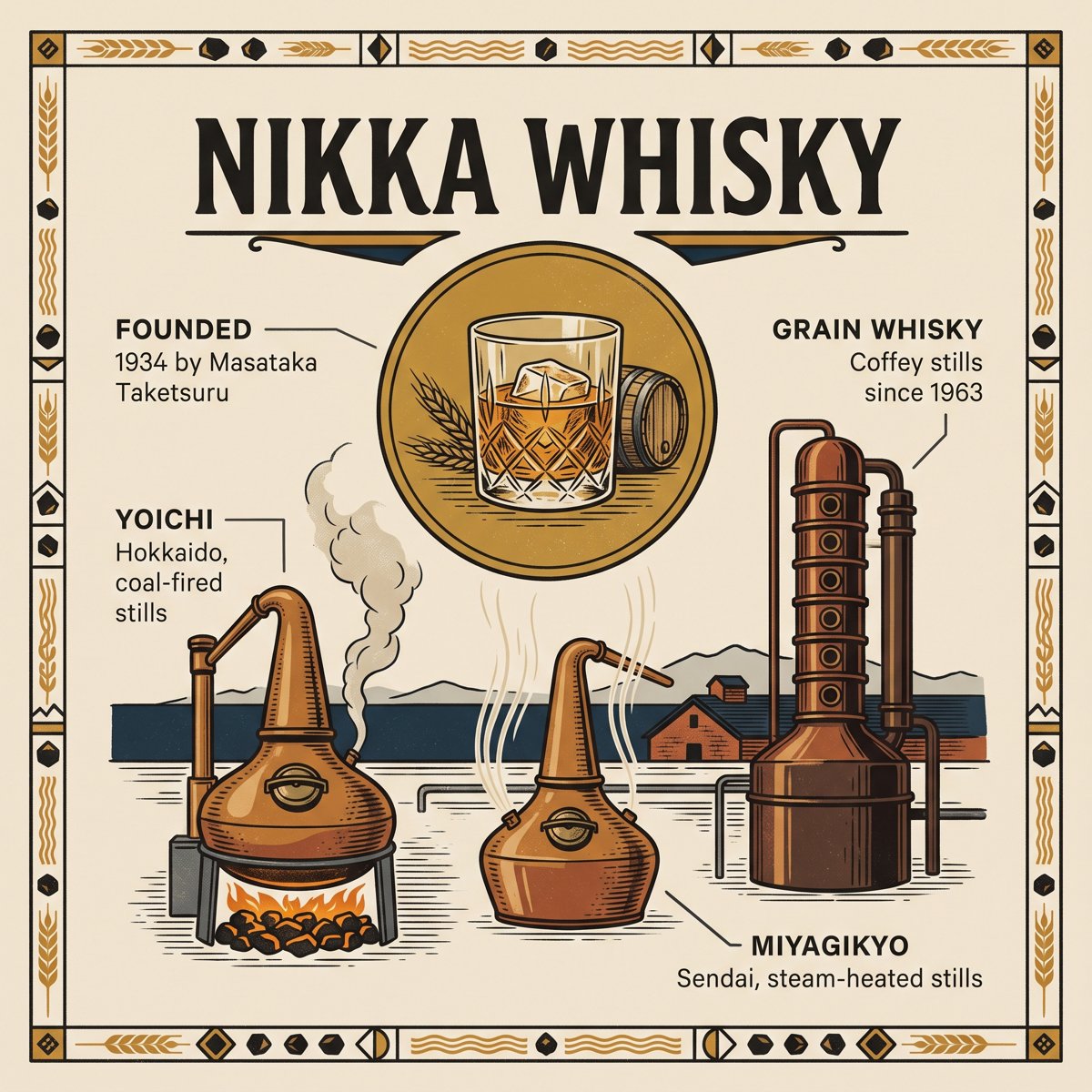
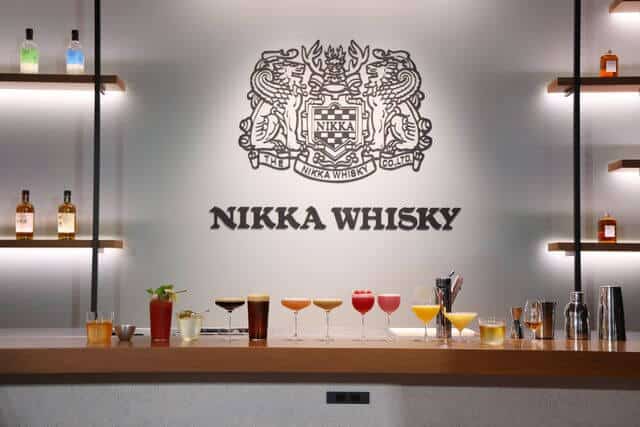
The company helped shape Japan’s whisky industry through its two distilleries and its production methods. It still runs coal fires under the stills at Yoichi. It also distills grain whisky in a Coffey still, a design from the 1830s. These production choices shape the brand’s flavor range, together with fermentation, cask selection, maturation, and blending.
Where the Name “Nikka” Comes From
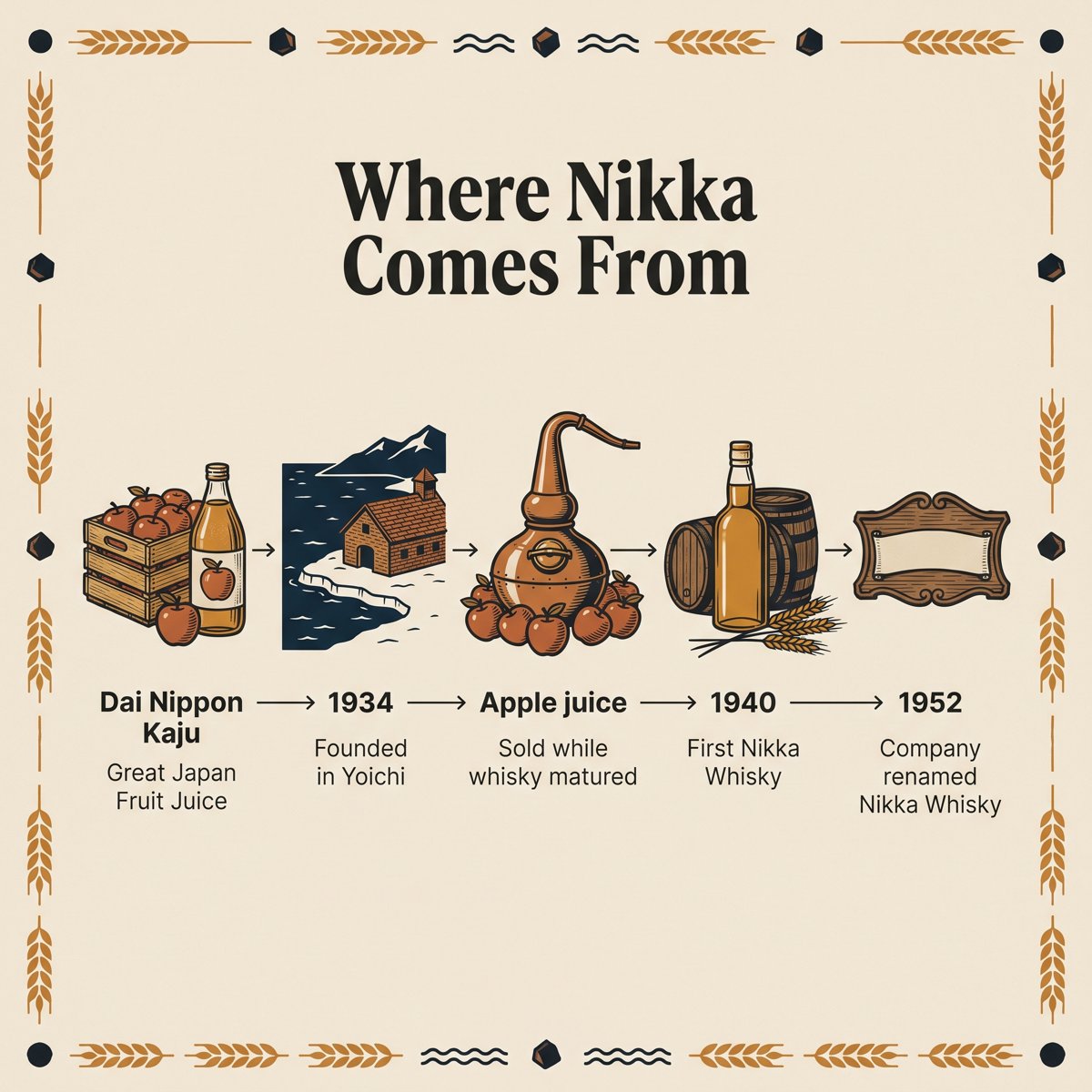
The company formed the name “Nikka” from the abbreviated Japanese name of Dai Nippon Kaju, or “Great Japan Fruit Juice.” Taketsuru founded that company in 1934. While his first spirit matured, the firm sold apple juice and other apple products to stay afloat. In 1940, it released its first whisky under the Nikka Whisky name. Then, in 1952, it adopted Nikka Whisky as the company name.
One more detail puzzles many visitors. The Japanese spelling, ニッカウヰスキー, uses ヰ, an old katakana character that modern Japanese no longer uses. You will sometimes read that it stands for a well. Nikka’s own materials do not explain it that way, so we treat that story as unconfirmed.
Who Was Masataka Taketsuru?
Masataka Taketsuru was born in 1894 in Takehara, Hiroshima, the third son of a sake-brewing family. In December 1918, he traveled to Scotland and enrolled as an auditing student at the University of Glasgow.
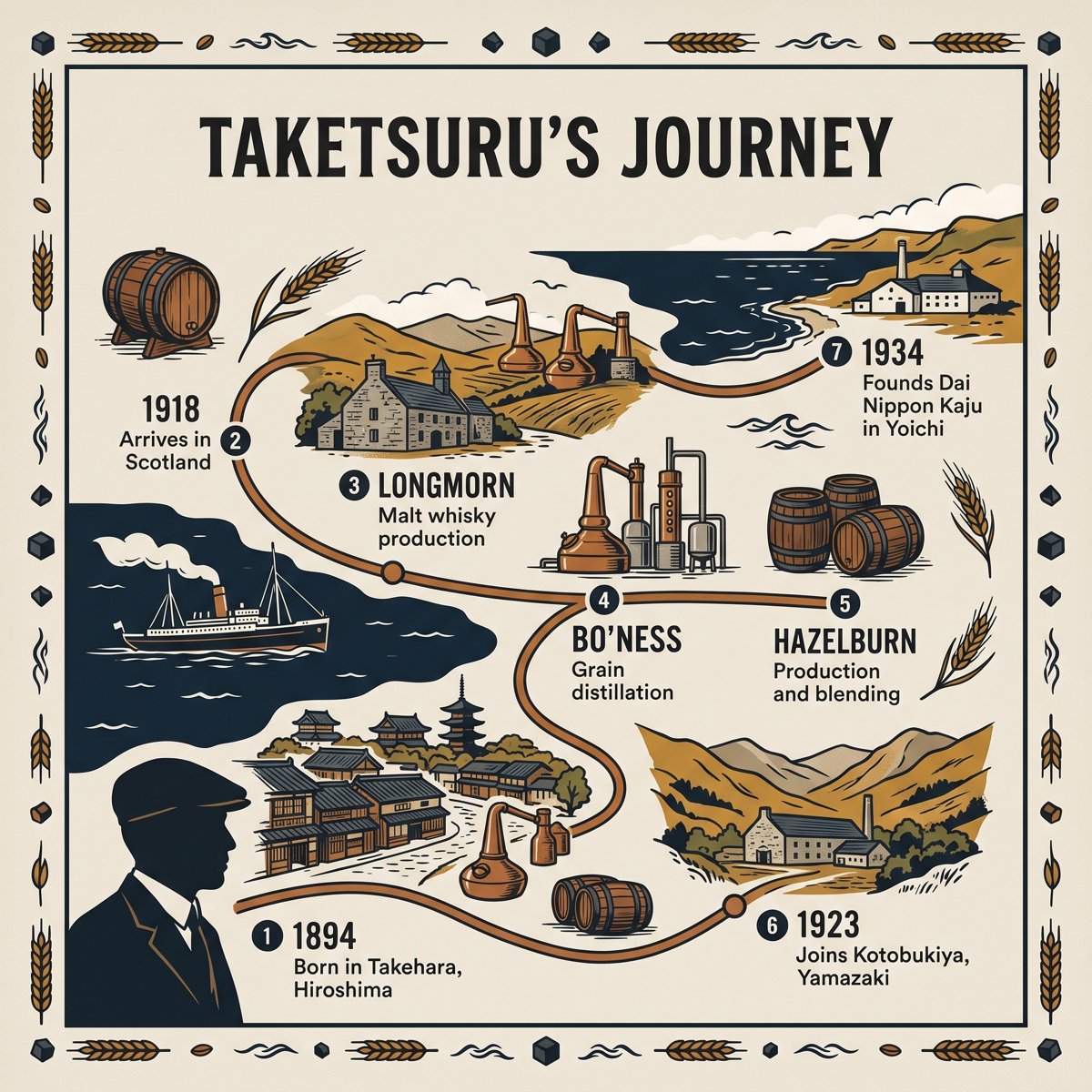
More important, he worked inside distilleries. By Nikka’s account, he learned malt whisky production at Longmorn. At Bo’ness he studied grain distillation in a continuous still. Then at Hazelburn in Campbeltown, he learned both production and blending.
He joined Kotobukiya, the forerunner of Suntory, in June 1923. There he supervised the construction and early operation of the Yamazaki distillery, Japan’s first malt whisky distillery, completed in 1924.
He left in March 1934 and founded Dai Nippon Kaju in Yoichi four months later. Nikka calls him the “Father of Japanese Whisky,” and the 2014 NHK drama Massan was inspired by his life. He died in 1979, at 85.
Nikka Whisky History: A Timeline
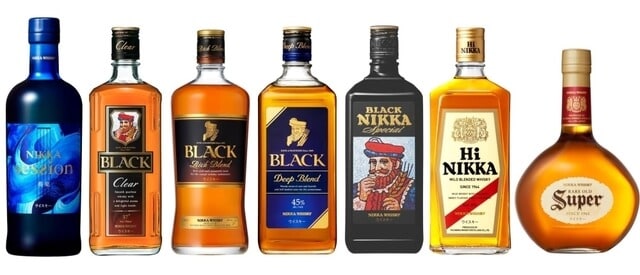
The dates below come from Nikka’s official company history. We have added the cultural property designation from the government side as well.
- 1918Taketsuru arrives in Scotland to study whisky making.
- 1923He joins Kotobukiya and goes on to oversee the Yamazaki distillery.
- 1934He founds Dai Nippon Kaju in July. The Yoichi plant is completed in October.
- 1940The first Nikka Whisky goes on sale.
- 1952The company renames itself Nikka Whisky.
- 1963A Coffey still is installed. Black Nikka, blended with Coffey grain, follows in 1965.
- 1969The Miyagikyo Distillery is completed near Sendai.
- 1985From the Barrel is launched.
- 2001Yoichi Single Cask 10 Years Old takes the top score at the Best of the Best competition, by Nikka’s account.
- 2022Japan designates ten buildings at Yoichi Distillery as Important Cultural Properties.
- 2024Nikka marks its 90th year and launches Nikka Frontier.
Meaning Behind the Nikka Emblem
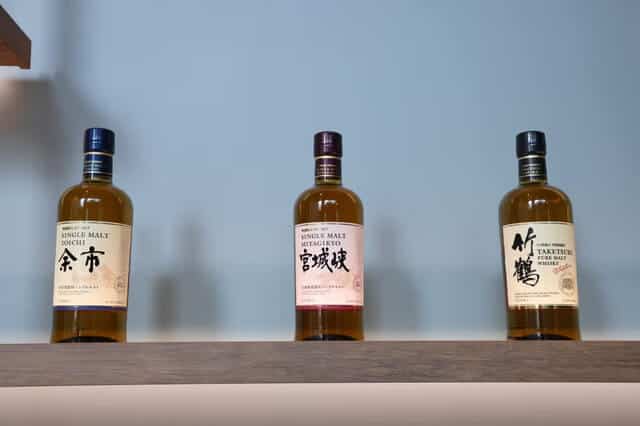
At first glance, the emblem looks like the crest of a British noble family. Look closer, though.
According to Nikka, the two guardian figures are komainu, the lion-dogs that stand at Japanese shrines. The helmet in the center is a samurai kabuto. Around the name runs a checkered pattern, a traditional Japanese motif. Nikka sums up the idea as Western dress with a Japanese spirit.
Where Is Nikka Whisky Made? Yoichi vs Miyagikyo
Yoichi Distillery in Hokkaido makes rich, powerful, often smoky malt. Coal-fired stills with downward lyne arms, the pipes that carry vapor off the top of the still, give it weight. Miyagikyo Distillery in Sendai makes a softer, floral, fruit-led malt, using steam-heated stills with upward lyne arms. Miyagikyo also houses Nikka’s Coffey stills for grain whisky.
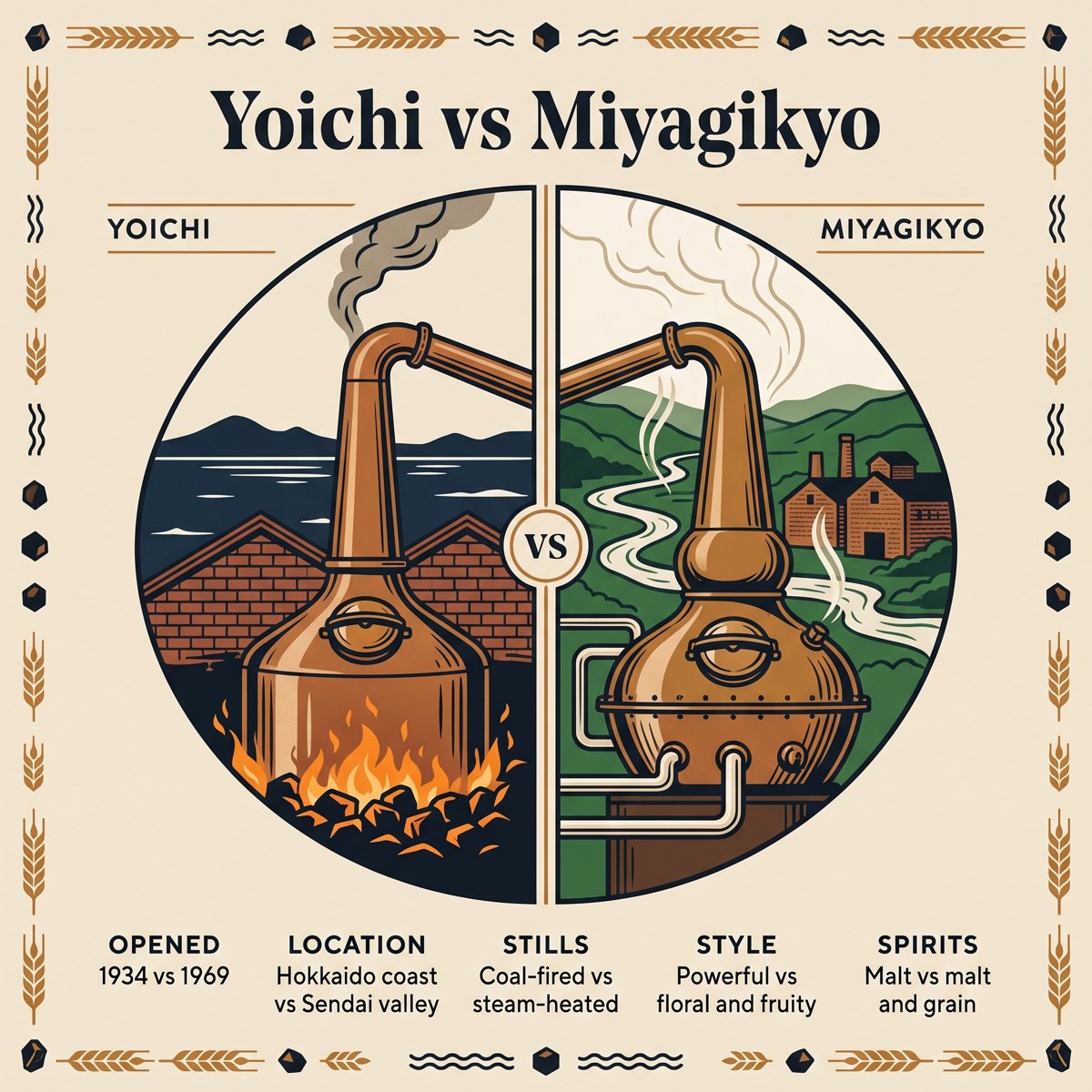
| Yoichi | Miyagikyo | |
|---|---|---|
| Location | Yoichi, Hokkaido, on the Sea of Japan coast | Aoba Ward, Sendai, Miyagi, in a river valley |
| Opened | 1934 | 1969 |
| Pot stills | Straight head, downward lyne arm, coal-fired | Bulge type, upward lyne arm, steam-heated |
| Official character | Powerful and full-bodied, with a tradition of peat (smoky fuel used to dry the malt) | Floral, fruity, gentle, and soft |
| Spirits distilled on site | Pot-distilled malt spirit | Pot-distilled malt spirit and Coffey-still grain spirit |
Yoichi Distillery
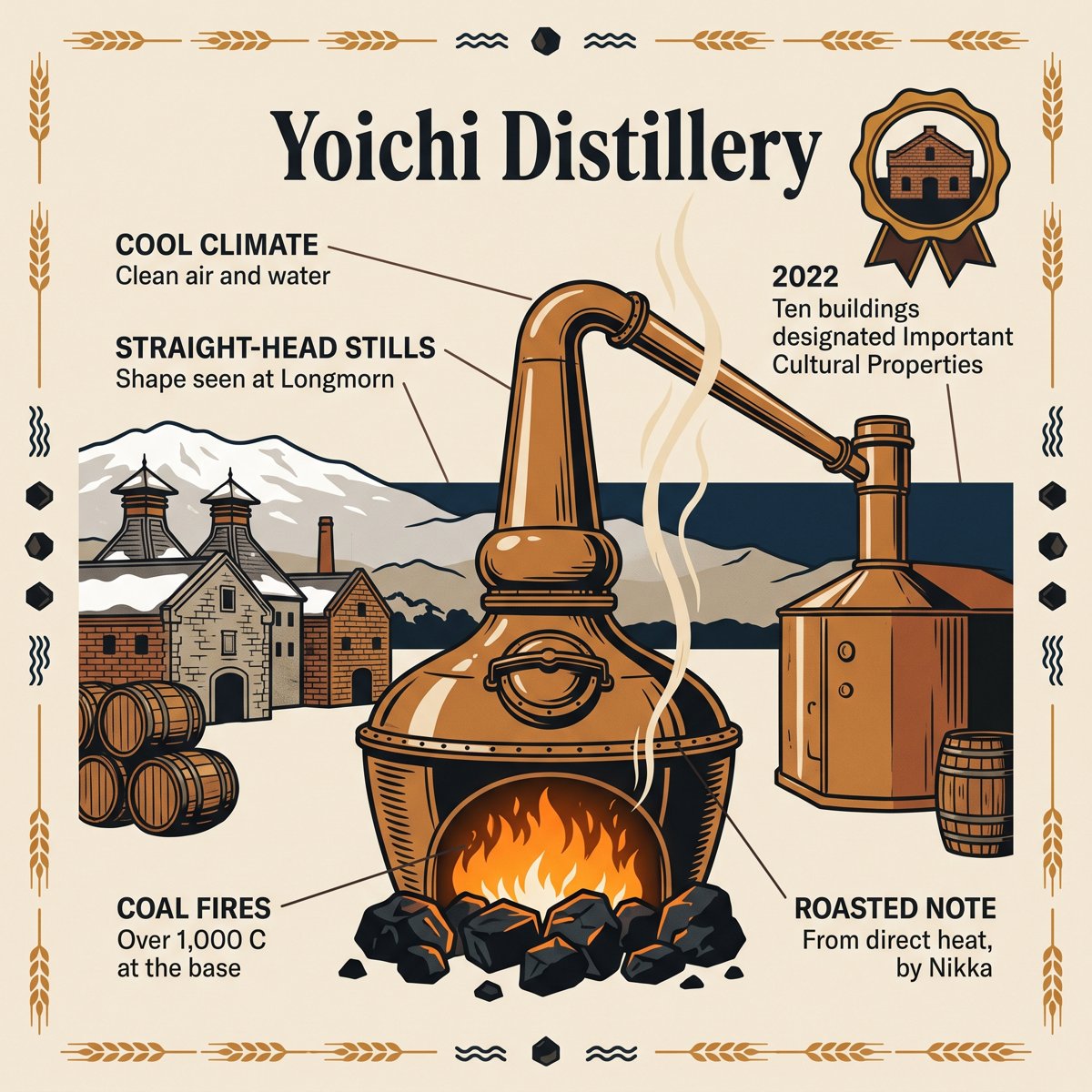
Taketsuru chose Yoichi because its cool climate, clean air, and water reminded him of Scotland. The stills here follow the straight-head shape he saw at Longmorn. Coal fires that exceed 1,000°C still heat their bases. Nikka says that direct heat adds a roasted note to the spirit.
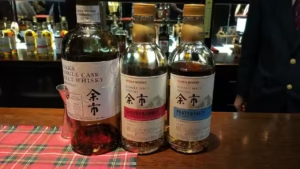
The result is a malt with real weight. Nikka itself says that Yoichi malt carries a scent of the sea. For bottle details, see our guide to Yoichi whisky.
The site is also a piece of industrial history. In 2022, Japan designated ten of its early buildings, including warehouses and the old office, as Important Cultural Properties. That is a higher status than the “registered” category often cited for the site.
Miyagikyo Distillery
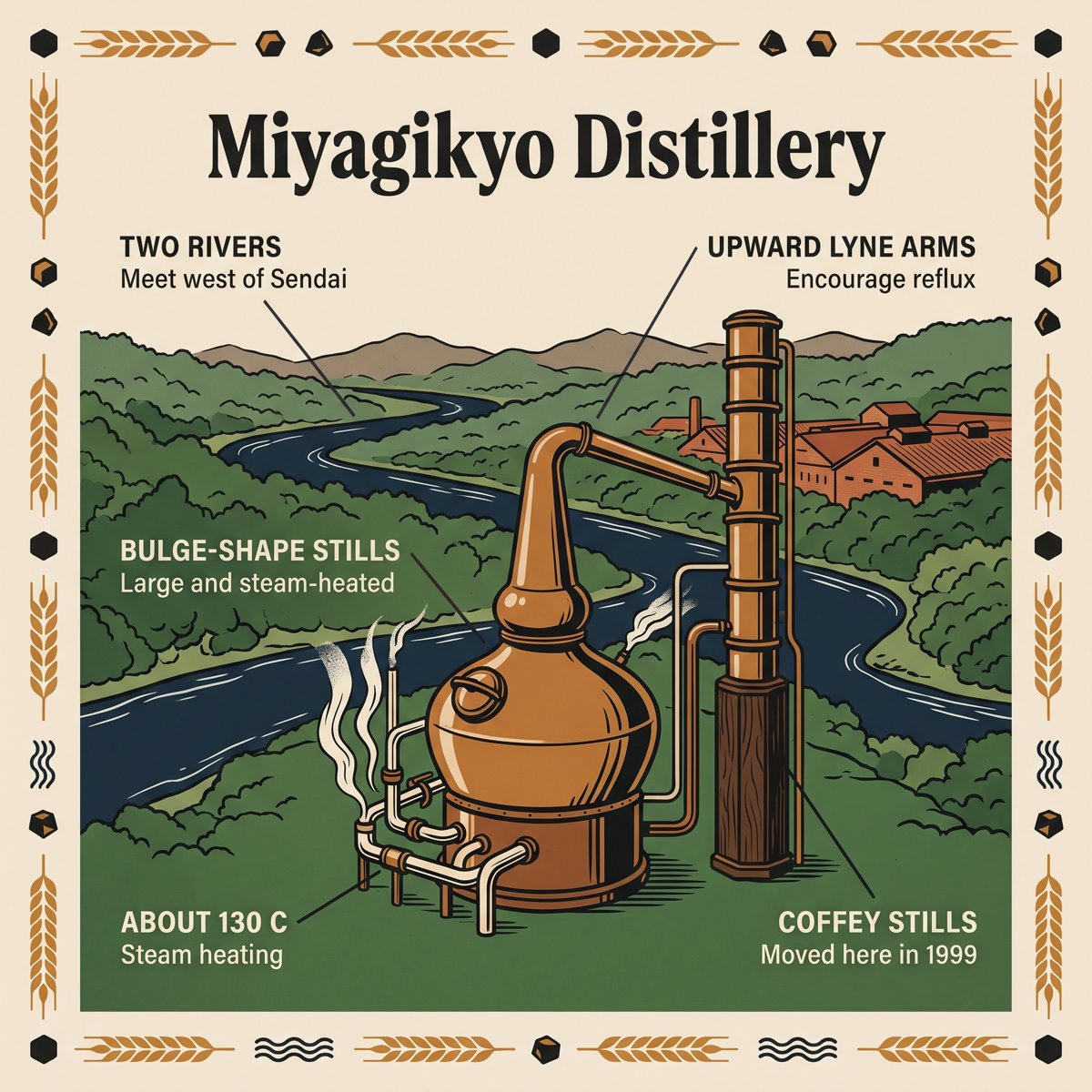
Miyagikyo sits where two rivers meet in the hills west of Sendai. Its stills are large, bulge-shaped, and heated by steam at around 130°C. The upward lyne arms encourage reflux, so lighter vapors carry over. Nikka describes the malt as floral, fruity, gentle, and soft.
For a closer look at the bottles, read our guide to Miyagikyo whisky.
Miyagikyo is also home to the Coffey stills. Nikka first installed one at its Nishinomiya plant in 1963 and moved the stills here in 1999. So the site has two production roles: pot-distilled malt spirit and Coffey-still grain spirit.
How Nikka Whisky Is Made
Nikka makes two base spirits. Malt whisky comes from malted barley, distilled twice in copper pot stills. Grain whisky comes from corn and other cereals, distilled in a continuous still. Both age in wooden casks, and blenders then combine them.
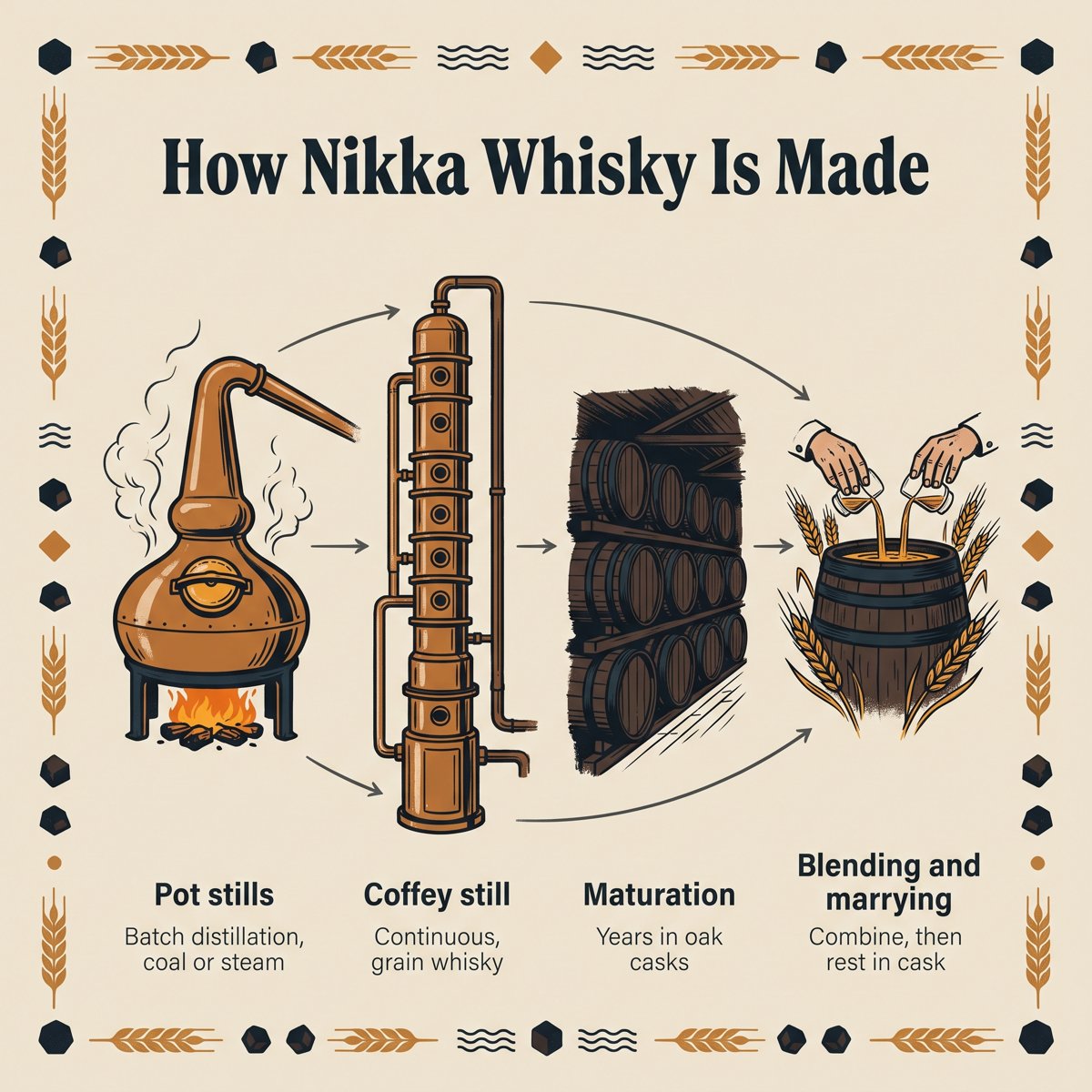
- Pot stills: Batch distillation. Yoichi fires them with coal, while Miyagikyo uses steam.
- Coffey still: A continuous still associated with its inventor, Aeneas Coffey, from around 1830. The name has nothing to do with coffee. Nikka says it leaves more of the grain’s own aroma and sweetness than modern column stills.
- Maturation: Years in oak casks, where color, vanilla, and wood notes develop.
- Blending and marrying: Blenders combine malts and grains, then let the blend rest in cask again so the flavors settle.
Is Nikka Whisky Japanese Whisky?
Nikka is a Japanese producer, but the label question is more precise than that. In 2021, the Japan Spirits and Liqueurs Makers Association introduced a voluntary labeling standard for “Japanese whisky,” with a transition period for existing products until March 2024. It requires mashing, fermentation, and distillation in Japan. It also requires at least three years of cask aging in Japan and bottling at 40% or more.
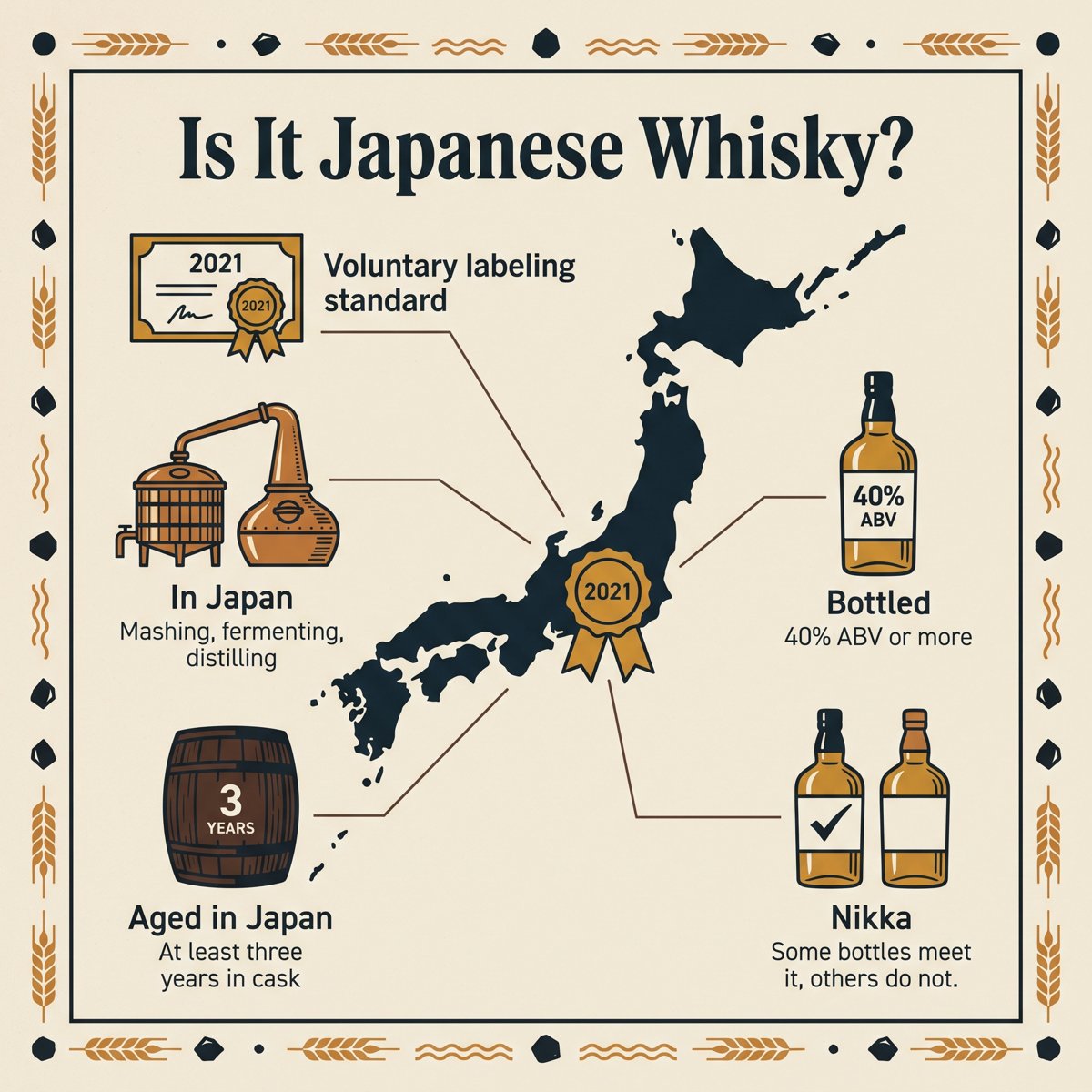
Nikka states that its lineup includes bottles that meet the standard and others that do not. Some blends use whisky made overseas. Therefore, check each product page if the label matters to you.
Popular Nikka Whisky Types and Bottles
What does Nikka Whisky taste like? That depends on the bottle and the distillery behind it. Single Malt Yoichi leans smoky and full, while Single Malt Miyagikyo leans fruity and soft. Blended whisky such as From the Barrel sits in between, and Coffey Grain is sweet and gentle.
There is no single “best Nikka Whisky,” because the right bottle depends on your taste and budget. The table below compares the bottles most people weigh against each other.
Bottle Comparison and Flavor Spectrum
| Bottle | Type | Flavor profile | ABV / size | Price band | Try it |
|---|---|---|---|---|---|
| Taketsuru Pure Malt | Pure malt (Yoichi and Miyagikyo malts) | Balanced, fragrant, easy to drink | 43% / 700 ml | High | Neat or with a little water |
| Nikka From the Barrel | Blended, bottled at high strength after marrying | Rich, full, and spicy | 51.4% / 500 ml | Mid | With water or in a highball |
| Single Malt Yoichi | Single malt | Powerful, peaty, with a touch of brine | 45% / 700 ml | High | Neat or on the rocks |
| Single Malt Miyagikyo | Single malt | Floral, fruity, soft | 45% / 700 ml | High | Neat or mizuwari (with water) |
| Nikka Coffey Grain | Grain whisky | Sweet, honeyed, creamy | 45% / 700 ml | Mid | On the rocks or with dessert |
| Nikka Frontier | Malt-forward blend, non-chill filtered (not cold-filtered, so more flavor compounds remain) | Smoky, malty, ripe fruit, oak | 48% / 500 ml | Low to mid | Highball |
| Black Nikka Clear | Blended | Light and clean | 37% / 700 ml and other sizes | Low | Highball or mizuwari |
Specifications checked on official Nikka and Asahi product pages in October 2026. Price bands are relative, because suggested retail prices were not shown on those pages, and we have not surveyed store prices. Availability and prices change by region and retailer, and Taketsuru Pure Malt is currently listed as a limited-quantity release.
Flavor spectrum (approximate guide)
- Black Nikka Clear
- Coffey Grain
- Single Malt Miyagikyo
- Taketsuru Pure Malt
- From the Barrel
- Nikka Frontier
- Single Malt Yoichi
A single axis cannot show sweetness, smoke, and weight at once. Treat this as a rough order, not a ranking.
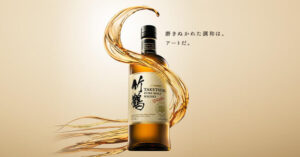
Taketsuru Pure Malt
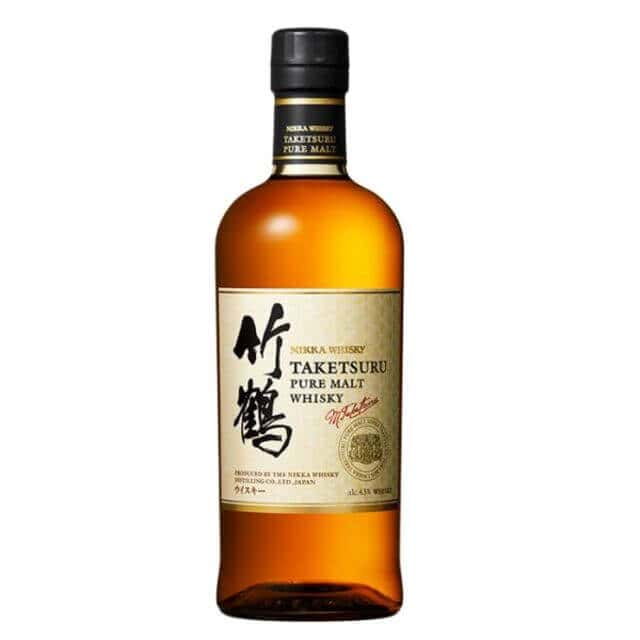
Nikka’s blenders combine selected malts from Yoichi and Miyagikyo to create a balanced aroma and flavor. “Pure malt” is Nikka’s term for a whisky made only from malt whiskies from more than one distillery. The category is commonly called blended malt whisky.
It carries the founder’s name, so it tends to be the bottle people buy as a gift. Note that Asahi’s product page currently lists it as a limited-quantity item.
Nikka Coffey Grain
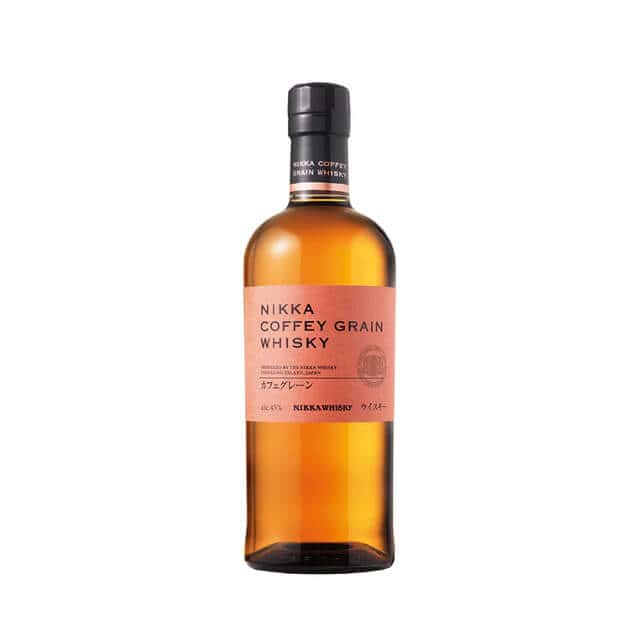
Some sources call it “Cafe Grain,” but the correct name is Coffey Grain, after the still. It is a grain whisky with a honey-like, creamy mouthfeel and a clean finish. It suits readers who want to taste grain whisky as a style of its own, not only as part of a blend.
Nikka From the Barrel and Nikka Frontier
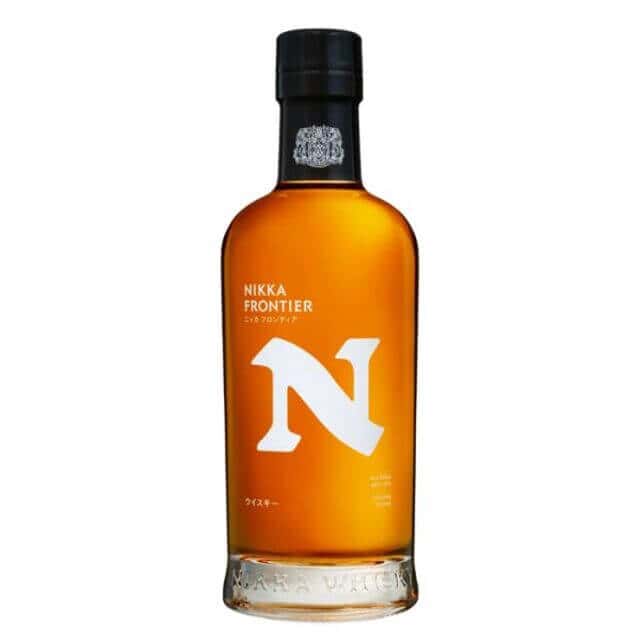
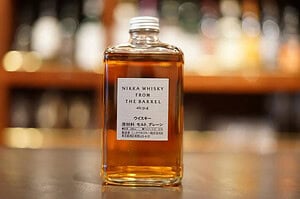
From the Barrel has been on sale since 1985. Nikka blends matured whiskies, returns them to casks for several months of “marrying,” and bottles the result at 51.4% in a squat 500 ml bottle. The blend uses some imported whisky.
Our separate article on Nikka From the Barrel goes deeper. Frontier is the newer sibling, launched for the 90th anniversary in 2024. It builds on heavily peated Yoichi malt, and Nikka describes it as smoky and malty with ripe fruit and oak.
Nikka also produces several other well-known whiskies, including Super Nikka, on sale since 1962, and the Black Nikka range. Choose among these bottles according to your preferred flavor, serving style, and budget.
How to Choose a Nikka Whisky
Which Nikka Whisky is best for beginners? Single Malt Miyagikyo is the fruity, gentle choice. Black Nikka Clear is the easy pick for an affordable highball. Taketsuru Pure Malt gives a balanced introduction, if you can find it.
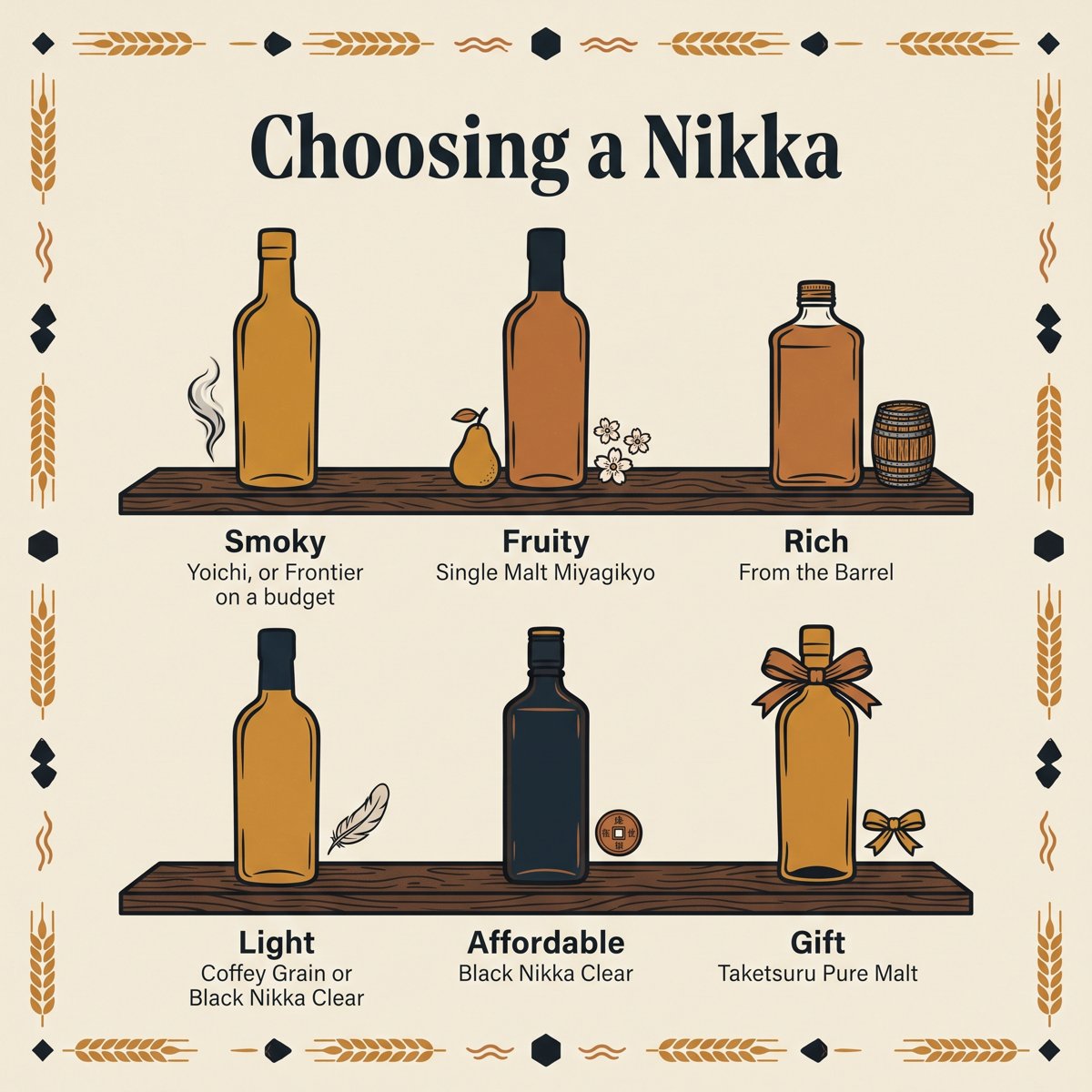
From the Barrel is richer and stronger, at 51.4%, so add water at first.
- Smoky: Single Malt Yoichi, or Nikka Frontier on a budget
- Fruity: Single Malt Miyagikyo
- Rich: Nikka From the Barrel
- Light: Nikka Coffey Grain, or Black Nikka Clear
- Affordable: Black Nikka Clear
- Gift: Taketsuru Pure Malt, if you can find it
How does Nikka compare with its older rival? Suntory Whisky dates to 1899 and Shinjiro Torii. Nikka began in 1934 with Taketsuru, who had managed Suntory’s Yamazaki distillery.
Both sit within the wider world of Japanese whisky, but their house styles differ. Nikka tends toward bolder, peatier malts at Yoichi.
How to Drink Nikka Whisky
The ratios below follow Nikka’s own serving guide. They are starting points, not rules, so adjust to taste.
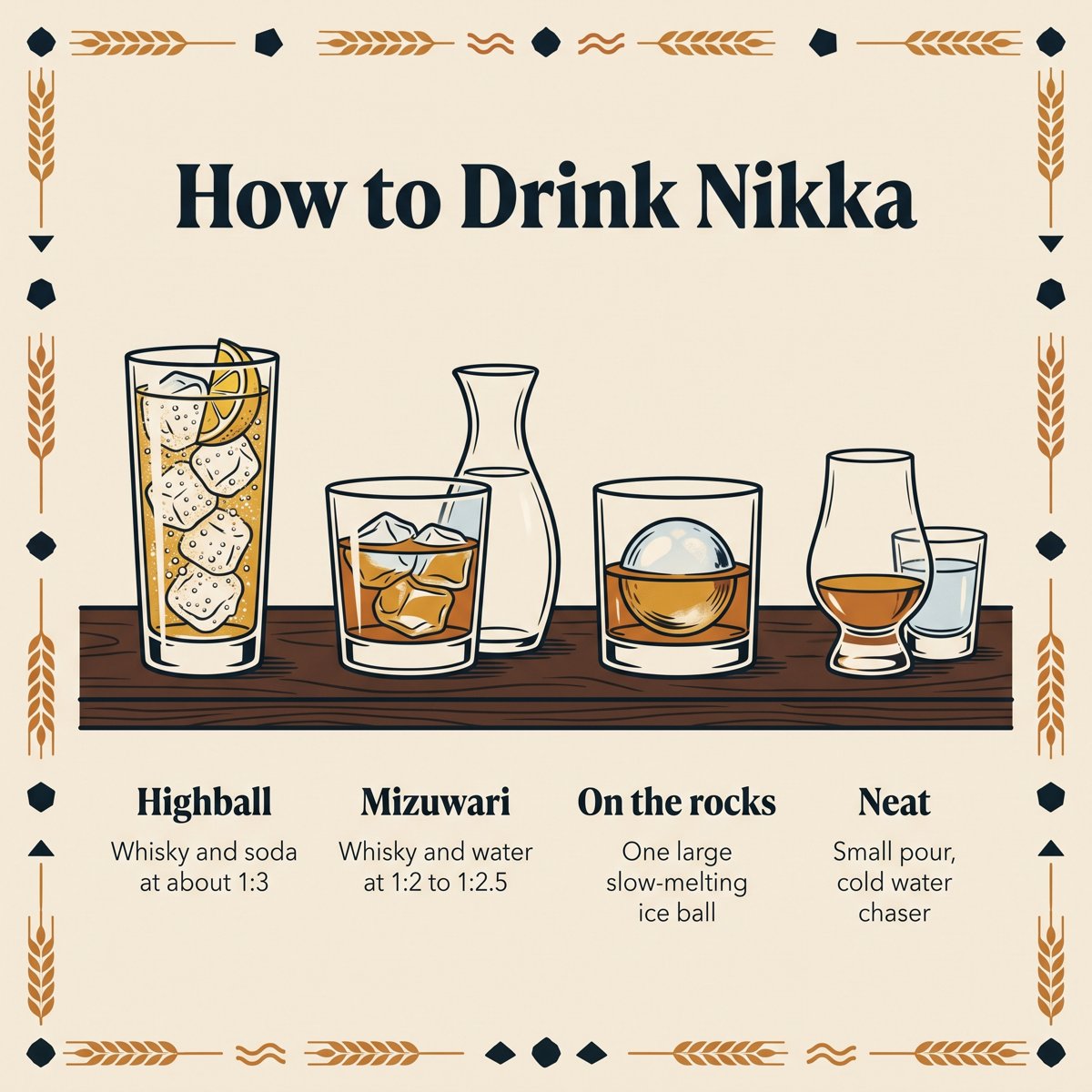
Highball
Fill a tall glass with ice, add whisky, then chilled soda at about 1:3. Stir once. Frontier and Black Nikka Clear shine here.
Mizuwari
Whisky and water at about 1:2 to 1:2.5, over ice. This Japanese style suits dinner, and it flatters Miyagikyo.
On the rocks
Use one large, slow-melting ice ball. Good for Coffey Grain and Yoichi.
Neat
Pour a small measure and keep a glass of cold water as a chaser. Try Taketsuru Pure Malt this way first.
Food Pairing Ideas
These are suggestions worth trying, not rules. Smoky Yoichi stands up to grilled meat, including a seared cut of Hida beef. Fruity Miyagikyo works with lighter dishes such as grilled fish or chicken. Sweet Coffey Grain, meanwhile, pairs well with desserts and chocolate.
Where to Buy Nikka Whisky in Japan
Nikka Whisky prices run lowest for the Black Nikka range and highest for aged and limited bottles. We did not find suggested retail prices on the official product pages, so this article gives price bands rather than figures.
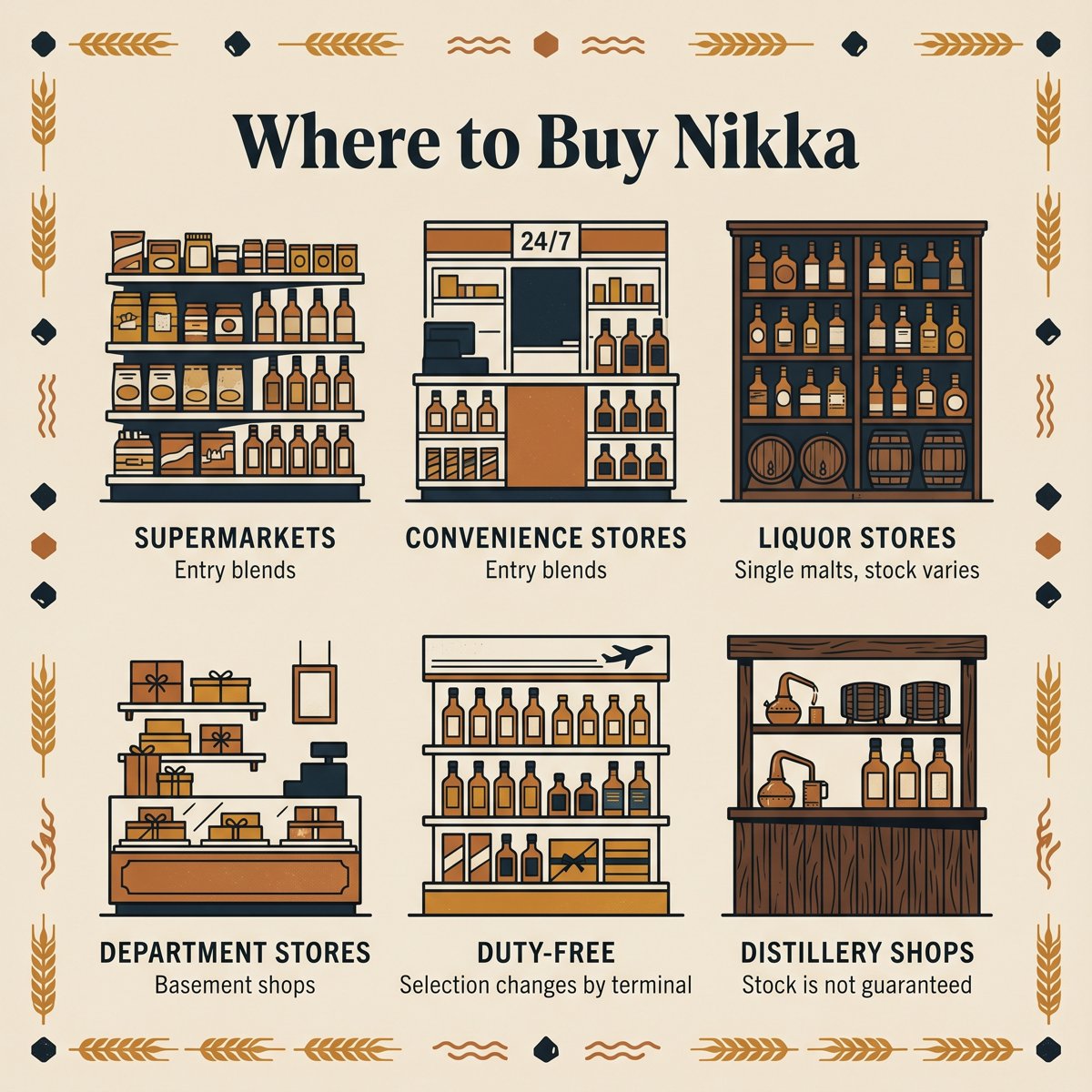
Entry blends appear on supermarket and convenience store shelves. Liquor stores and department store basements may carry the single malts, although stock varies. Airport duty-free shops sometimes stock From the Barrel and Taketsuru, but selection changes by terminal.
Distillery shops are useful places to look for standard and distillery-exclusive bottles, but stock is not guaranteed. Prices and purchase limits may vary, so check the official visitor information before your trip. Whatever the shop, expect limited bottles to sell out, and be wary of resale prices far above retail.
Nikka Whisky Distillery Tours
Both distilleries welcome visitors. For Yoichi, Nikka’s access page lists about 35 minutes by train from Sapporo to Otaru, then about 30 minutes to Yoichi, with few trains on the second leg. From Yoichi Station, the distillery is a five-minute walk. Guided tours need advance reservations, and a tasting follows the tour.
Drivers and visitors under 20 receive soft drinks instead. Miyagikyo lies about 40 minutes by car from Sendai Station. A free shuttle runs from Sakunami Station on the JR Senzan Line on a published schedule, so check the timetable first.
Both sites close over the New Year period and on a few maintenance days. We checked these details in October 2026. Opening hours and tour formats change, so book through the official site before you travel.
Summary
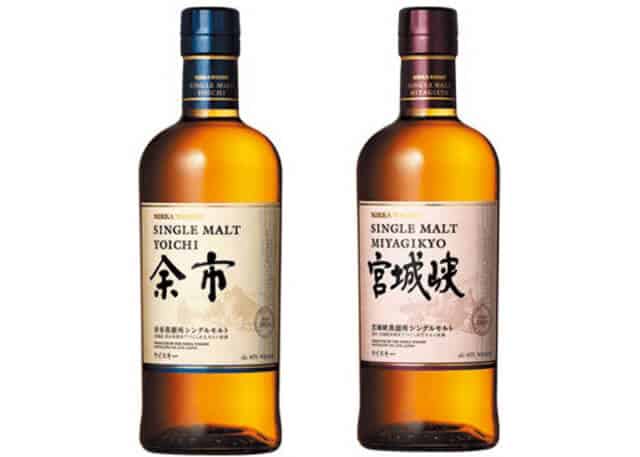
Nikka Whisky is really two distilleries in one brand. Yoichi gives you coal fire, peat, and weight. Miyagikyo gives you flowers, fruit, and softness, plus the grain whisky that holds the blends together. Start with Miyagikyo or a highball of Black Nikka Clear, then decide which direction you prefer.
If your itinerary allows, a visit to either distillery makes the contrast easier to grasp. Yoichi shows coal-fired malt production, while Miyagikyo shows both malt and Coffey-still grain.
Nikka Whisky FAQ
Company and Distilleries
- Where is Nikka Whisky from?
-
It comes from Japan. Masataka Taketsuru founded the company in Yoichi, Hokkaido, in 1934. A second distillery opened near Sendai in 1969. The head office moved to Yoichi in 2022.
- Who owns Nikka Whisky?
-
Nikka is part of the Asahi Group’s alcoholic beverage business. It integrated its sales with Asahi Breweries in 2001. Even so, it runs its own distilleries and keeps its own house style. Asahi’s product pages carry the official specifications for each bottle.
- What is the difference between Yoichi and Miyagikyo?
-
Yoichi makes rich, powerful, often smoky malt in coal-fired stills. Miyagikyo makes softer, floral, fruity malt in steam-heated stills, and it also runs the Coffey stills for grain whisky. See the comparison table above for the details.
- Can you visit the Nikka distilleries?
-
Yes, both Yoichi and Miyagikyo accept visitors. Guided tours at Yoichi require a reservation, and a tasting follows. Check the official pages for current hours and closing days before you go.
Buying and Drinking
- How do you pronounce Nikka?
-
Say “NEEK-ka,” with a short pause before the “k” sound. The Japanese name is ニッカ, where the small ッ marks that pause. The full name, ニッカウヰスキー, adds “uisukī,” the Japanese rendering of whisky.
- Which Nikka Whisky is best for beginners?
-
Single Malt Miyagikyo is a gentle, fruity starting point. For a lower price, try Black Nikka Clear in a highball. From the Barrel is richer and bottled at 51.4%, so it suits beginners best with a splash of water.
- Where can I buy Nikka Whisky in Japan?
-
Supermarkets and convenience stores sell the Black Nikka range. Liquor stores, department stores, and airport duty-free shops may carry the single malts and From the Barrel, subject to stock. The distillery shops are worth checking, although stock is not guaranteed.
- Is all Nikka Whisky “Japanese whisky”?
-
No. The company says some bottles meet the industry’s labeling standard and others do not. Single Malt Yoichi and Single Malt Miyagikyo are marked as compliant on their product pages, while From the Barrel uses some imported whisky. Check each product page for the current status.
References
- Nikka Whisky – History (Accessed October 2026)
- Nikka Whisky – The Founder: Masataka Taketsuru (Accessed October 2026)
- Nikka Whisky – Yoichi Distillery (Accessed October 2026)
- Nikka Whisky – Miyagikyo Distillery (Accessed October 2026)
- Nikka Whisky – Nikka Coffey Grain (Accessed October 2026)
- Nikka Whisky – Nikka Frontier (Accessed October 2026)
- Nikka Whisky – How to Enjoy Whisky (Accessed October 2026)
- Nikka Whisky – Standards for Labeling “Japanese Whisky” (Accessed October 2026)
- Asahi Breweries – Single Malt Yoichi Product Information (Accessed October 2026)
- Asahi Breweries – Nikka From the Barrel Product Information (Accessed October 2026)
- Asahi Group Holdings – Main Group Companies (Accessed October 2026)
- Japan Spirits and Liqueurs Makers Association – Standards for Labeling Japanese Whisky (Accessed October 2026)
- Agency for Cultural Affairs – Council Recommendation on Designation of Important Cultural Properties, November 2021 (Accessed October 2026)
- National Tax Agency – Prevention of Drinking by People Under 20 (Accessed October 2026)
- Society for Biotechnology, Japan – 室岡義勝 (2015), Public Lecture: The Whisky Life of Masataka Taketsuru, Seibutsu-kogaku Kaishi 93(5) (Accessed October 2026)
Related Articles
- Japanese Whisky (日本のウイスキー) (Surveyed: October 2026)
- Suntory Whisky (サントリーウイスキー) (Surveyed: October 2026)
- Nikka From the Barrel (ニッカ フロム・ザ・バレル) (Surveyed: October 2026)
- Miyagikyo Whisky (宮城峡) (Surveyed: October 2026)
- Yoichi Whisky (余市) (Surveyed: October 2026)
- Hida Beef (飛騨牛) (Surveyed: October 2026)



Comments