


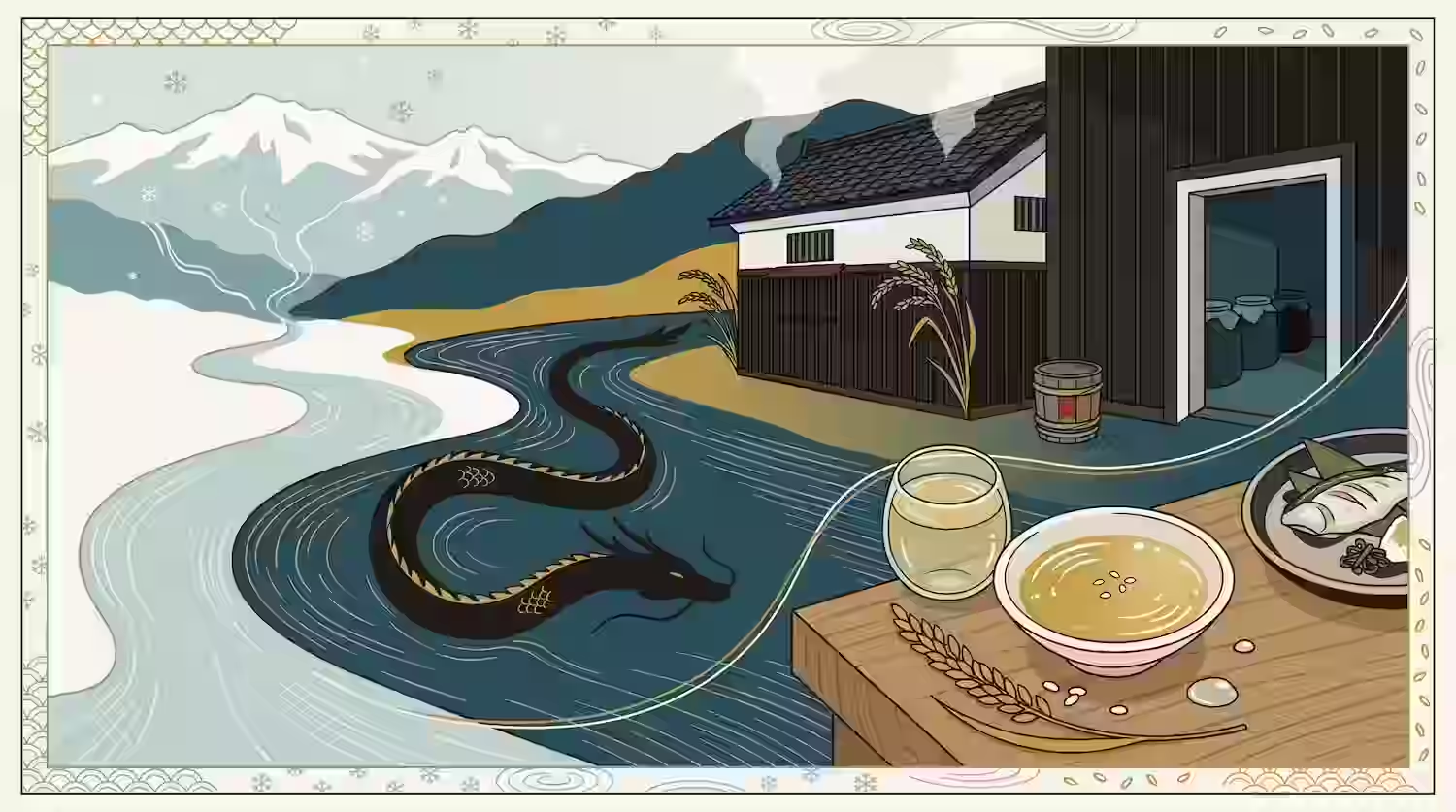
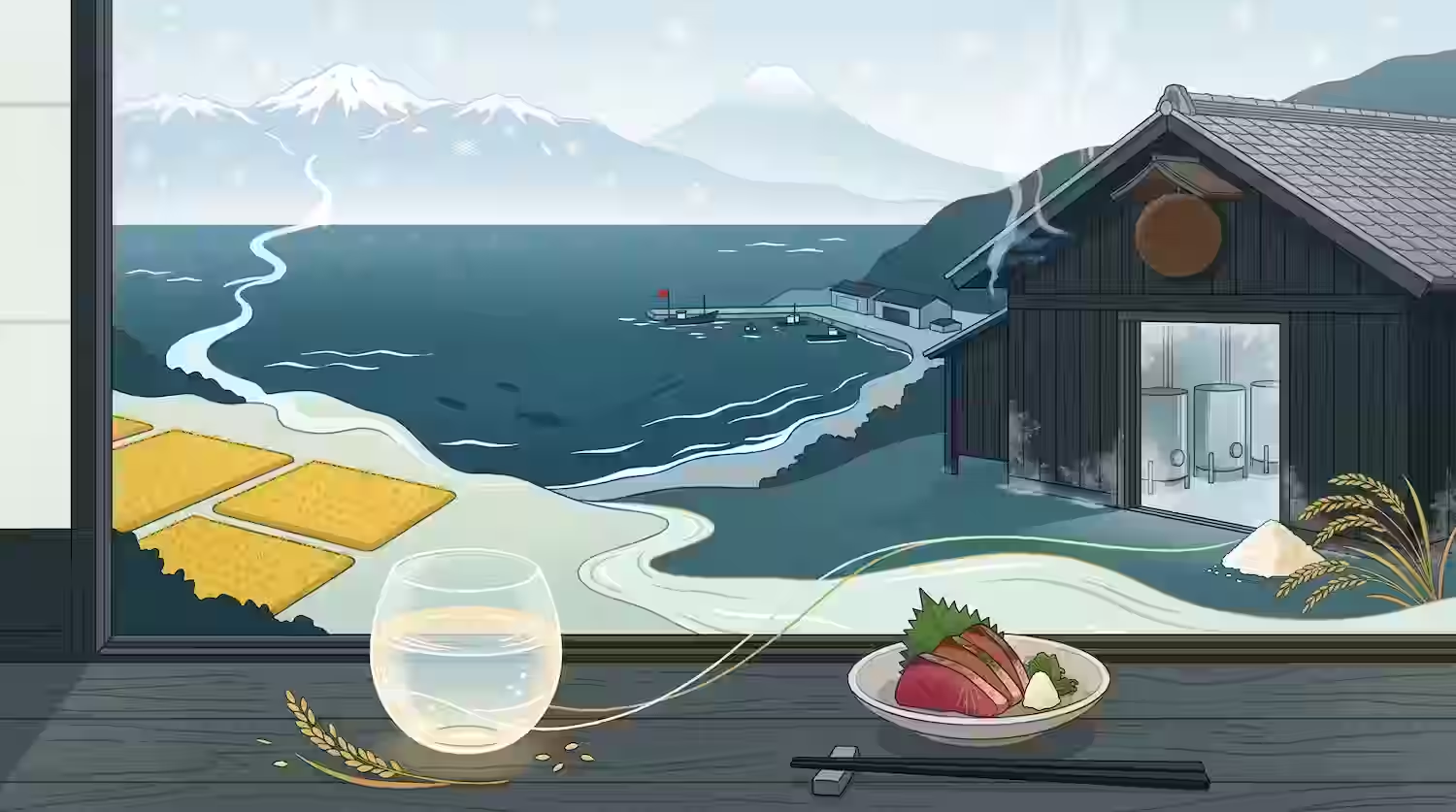

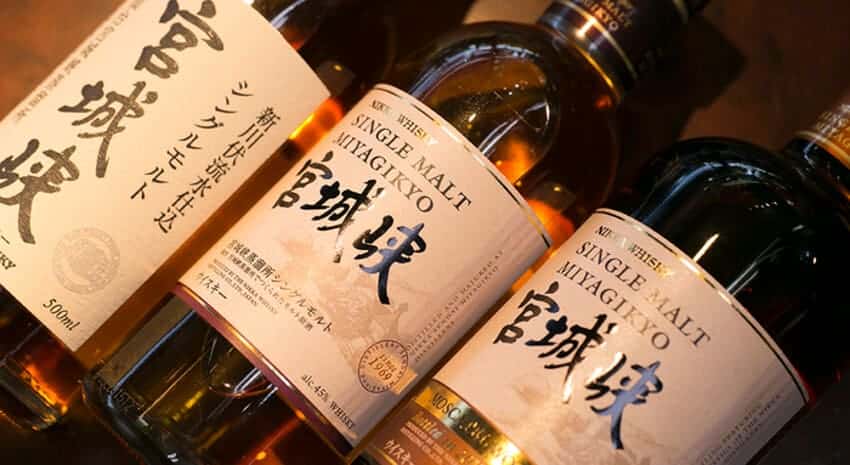
Pour a glass of Miyagikyo whisky and the first impression is often orchard fruit. Apple, pear and soft vanilla usually arrive before any trace of smoke. Nikka Whisky makes this single malt in a forested valley near Sendai. It suits drinkers who prefer elegance over intensity and fruit over smoke.
Masataka Taketsuru envisioned Miyagikyo as a contrast to Yoichi whisky. The distillery creates a gentler, fruitier whisky in the mountains of Miyagi Prefecture. This guide covers its taste, history, production, bottles, prices, serving ideas, and how to visit the distillery.
Miyagikyo Whisky at a Glance
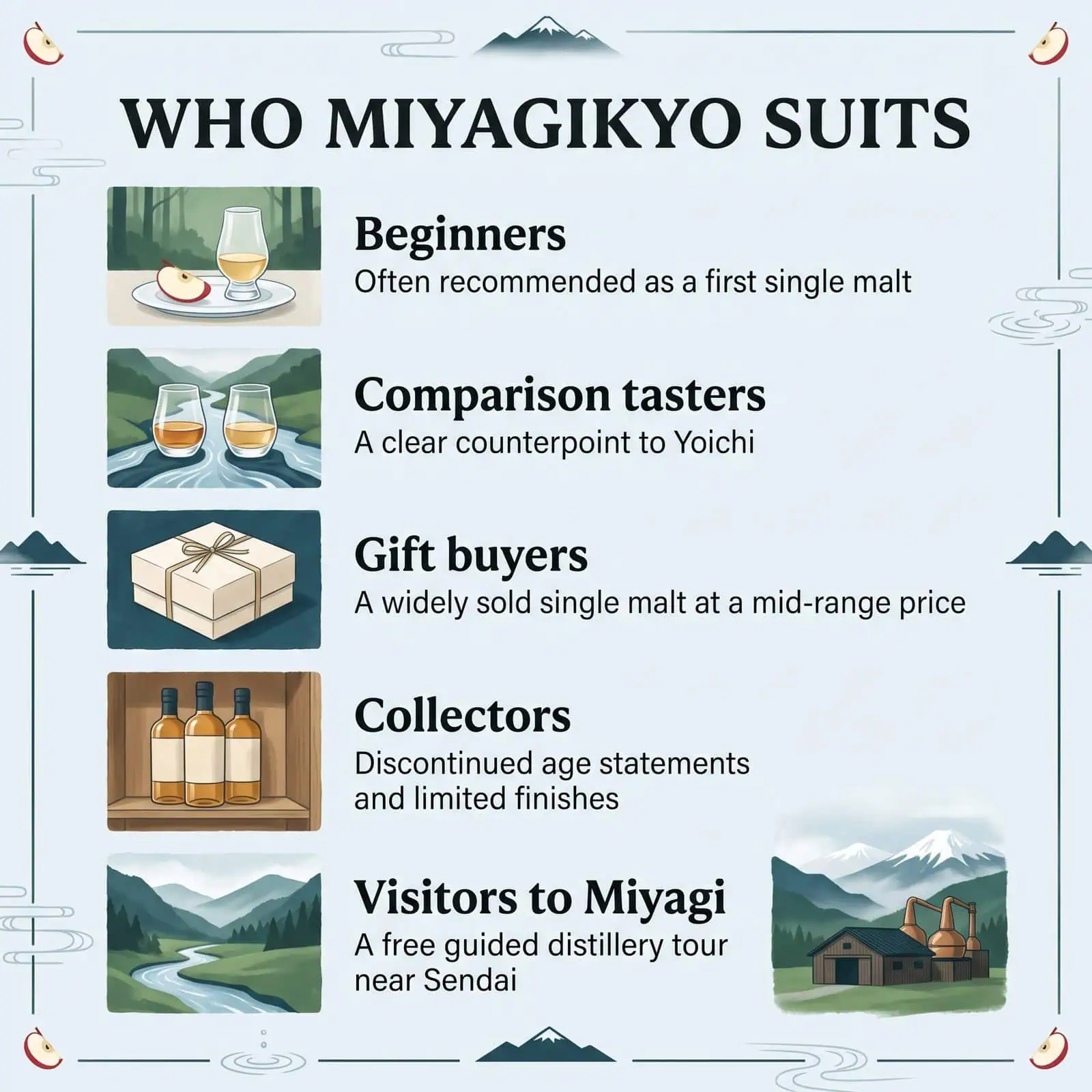
Miyagikyo is a fruity Japanese single malt made by Nikka Whisky in Sendai, Miyagi Prefecture. Nikka distills it at Miyagikyo Distillery, which sits in a wooded valley where two rivers meet. Expect apple, pear, vanilla and soft malt, with very little smoke.
Quick Facts
- Producer
- Nikka Whisky (Asahi Group)
- Distillery
- Miyagikyo Distillery, Aoba Ward, Sendai
- Region
- Miyagi Prefecture, Tohoku, Japan
- Style
- Japanese single malt whisky
- ABV
- 45% (core bottle)
- Bottle size
- 700 ml
- Flavor
- Apple, pear, vanilla, dried fruit, malt and gentle oak
- Availability
- Core bottle sold year-round; a limited 10 Year Old returned in 2026
Last checked: October 2026
Who It Suits
- Beginners: often recommended as a first single malt, since heavy peat is absent.
- Comparison tasters: a clear counterpoint to coal-fired Yoichi.
- Gift buyers: a widely sold Japanese single malt at a mid-range price.
- Collectors: discontinued age statements and limited finishes.
- Visitors to Miyagi: a free guided distillery tour near Sendai.
What Does Miyagikyo Whisky Taste Like?

Miyagikyo whisky tastes soft, fruity and gently sweet, with almost no smoke. Nikka describes apple and pear on the nose, plus soft vanilla from the casks. On the palate, dried-fruit sweetness and malt take over. Then a mild oak finish fades quietly, so the whisky feels light rather than heavy.
Of course, every glass is a little different. The notes below are typical impressions, based on Nikka’s official description and common tasting language.
Nose
Orchard fruit leads, with a floral lift and a soft, creamy vanilla edge.
Palate
Dried-fruit sweetness meets cereal-like malt on a round, silky body rather than a crisp one.
Finish
Gentle oak and a light bitter edge linger, while a faint wisp of peat may appear.
With Water
A few drops calm the alcohol, and the aroma often turns softer and more floral.
Is it too gentle? Honestly, some drinkers feel that way at first. Fans of heavily peated Scotch may even find the first sip a little shy. However, that restraint is the point. Many drinkers also find the fruit aromas more noticeable after a few minutes in the glass.
So, is Miyagikyo smoky? Not really, because the core bottle shows only a whisper of peat. The 2021 Miyagikyo Peated was the clear exception, since Nikka built it entirely from peated malt whisky.
Miyagikyo vs Yoichi: Nikka’s Two Single Malts
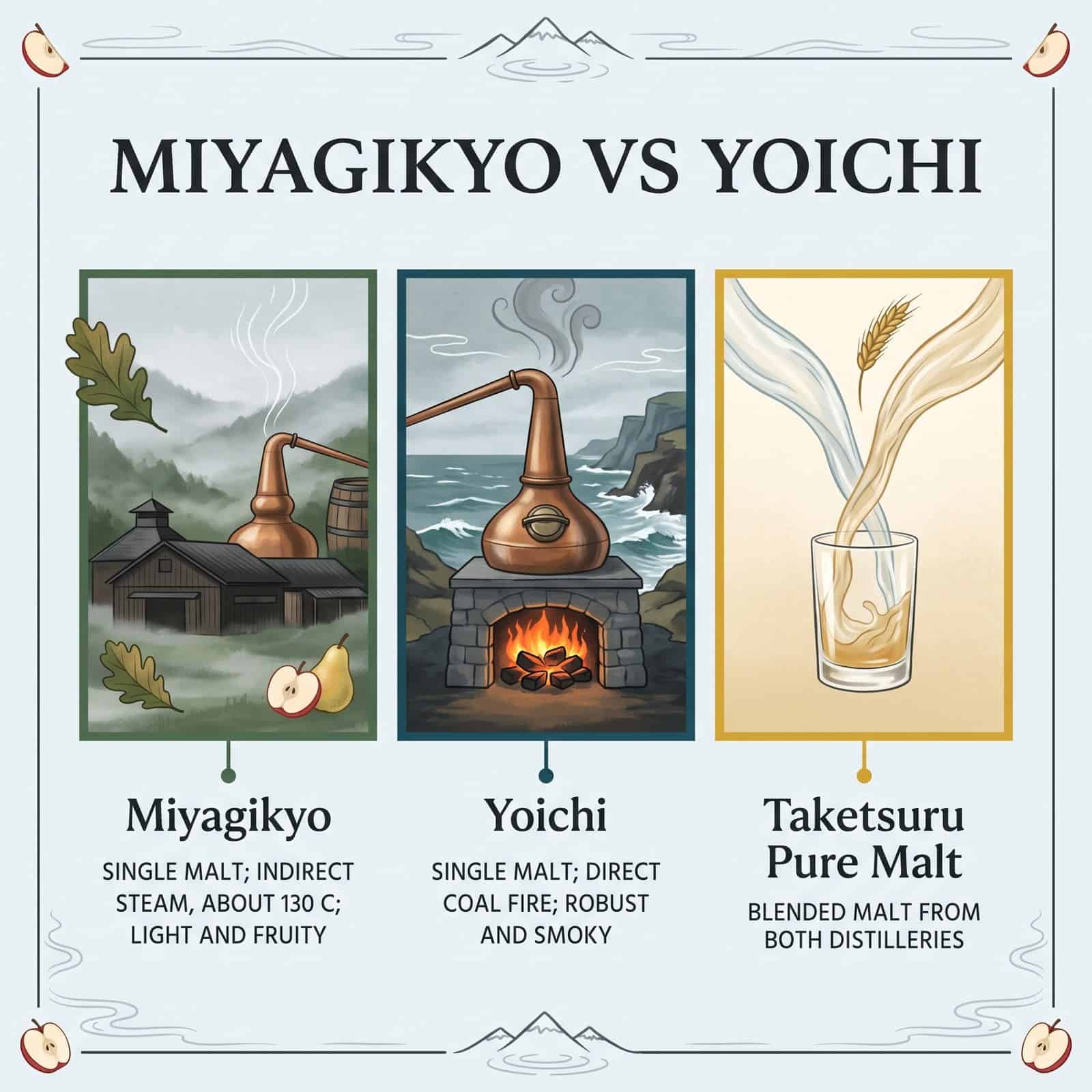
Miyagikyo is light, floral and fruity, while Yoichi is robust, smoky and coastal. Miyagikyo Distillery heats its stills with indirect steam at around 130°C. In contrast, Yoichi Distillery uses direct coal-fired distillation, and Nikka says the coal fire itself exceeds 1,000°C.
Taketsuru Pure Malt sits between the two. It is a blended malt, so Nikka combines malt whiskies from both distilleries instead of using just one. If you want to taste the contrast yourself, pour all three side by side.
| Miyagikyo | Yoichi | Taketsuru Pure Malt | |
|---|---|---|---|
| Type | Single malt | Single malt | Blended malt |
| Distillation | Indirect steam, about 130°C | Direct coal fire | Malts from both styles |
| Fruitiness | High | Medium | Medium to high |
| Smoke | Very light | Pronounced | Light to moderate |
| Body | Light to medium | Full | Medium |
| Best for | Beginners and fruit lovers | Peat fans | Drinkers who want balance |
Style comparison based on Nikka’s official descriptions. These are general impressions, not lab data.
Some writers loosely compare Miyagikyo to lighter Lowland-style malts and Yoichi to more robust Highland-style whiskies. Still, both are distinctly Japanese, shaped by their own stills, water and weather. For the smoky side of the story, browse our Yoichi whisky articles.
Miyagikyo vs Yamazaki and Hibiki
Drinkers also compare Miyagikyo with Suntory’s Yamazaki and Hibiki, since all three lean toward elegance rather than heavy peat. Yamazaki is also a single malt, and its tasting notes range widely. Retailers describe the Distiller’s Reserve with red fruit from wine casks, while other notes mention dried fruit and spice.
Hibiki Japanese Harmony, by contrast, is a blended whisky. Suntory lists rose, lychee, honey, candied orange peel and white chocolate in its notes. Put simply, Yamazaki often leans toward dried fruit, spice and wine-cask notes, while Miyagikyo focuses more on orchard fruit. Hibiki, meanwhile, aims for floral, honeyed balance. Our Suntory whisky guide covers both brands in more detail.
If You Drink Scotch, Start Here
Many overseas readers think in Scotch terms, so here is a rough style guide. It compares broad styles, not exact flavors.
- Fans of light, fruity Speyside malts such as Glenlivet or Glenfiddich should start with Miyagikyo.
- If you like coastal, peated island malts such as Talisker, then try Yoichi instead.
- Heavily peated Islay malts such as Lagavulin also point toward Yoichi.
- For a bit of both, Taketsuru Pure Malt is a sensible middle ground.
History of Miyagikyo Whisky
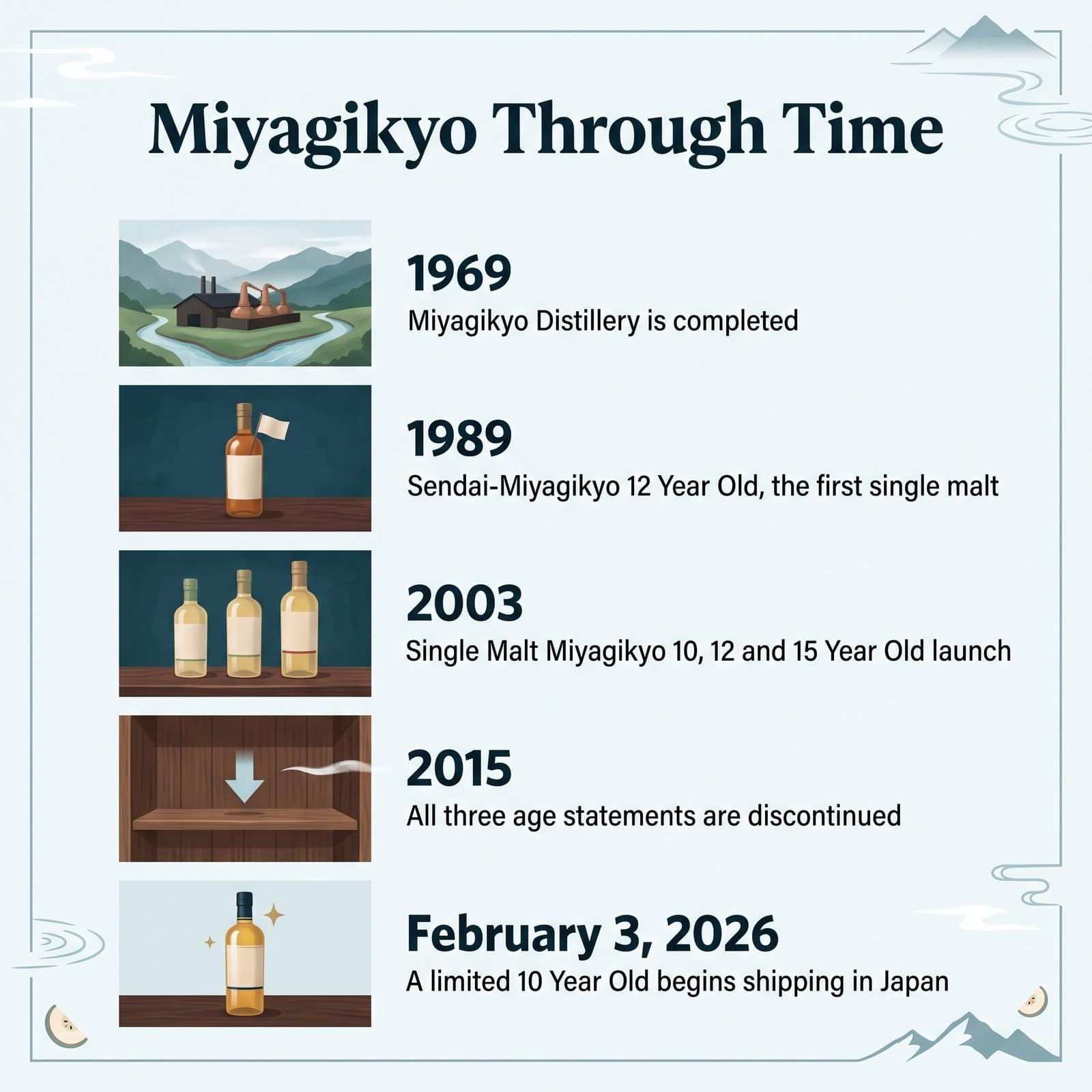
Nikka completed Miyagikyo Distillery in 1969 to make a lighter, fruitier malt than Yoichi. Taketsuru chose a Sendai valley where two rivers flow, and the first Miyagikyo single malt followed in 1989.
Why Nikka Built a Second Distillery

Nikka’s story began in 1934 at Yoichi, Hokkaido. During the 1960s, however, demand for whisky climbed in Japan, and Nikka needed more malt. Taketsuru also wanted contrasting Japanese malt styles for blending. He therefore searched for a second distillery site.
According to Nikka, the team chose a quiet valley in Sendai to nurture a character unlike Yoichi. Two streams, the Hirose River and the Nikkawa River (新川), flow through the area. Nikka also tells a well-known story about that choice. Taketsuru tasted whisky mixed with Nikkawa River water and then resolved to build there.
The name, written 宮城峡 in Japanese, ends with the character 峡, meaning gorge or ravine. Thus the name points to the valley setting. Still, Miyagikyo works as a proper name rather than a literal translation.
From 1969 to the First Single Malt
Nikka’s official history records Miyagikyo Distillery as completed in 1969. At first, though, Miyagikyo Distillery had no mature spirit of its own. Collector accounts describe a commemorative Old Nikka bottle from that year. Reportedly, it combined Yoichi malt with grain whisky from Nishinomiya. These details come from collectors rather than Nikka’s official records.
Taketsuru died in 1979 at age 85, ten years after the distillery’s completion. A decade later, Nikka launched Single Malt Sendai-Miyagikyo 12 Year Old. It is the earliest Miyagikyo single malt in the company’s official timeline. Then, in 1999, Nikka moved its Coffey stills to Miyagikyo Distillery.
In 2003, Nikka introduced Single Malt Miyagikyo 10, 12 and 15 Year Old. Later, the Japanese whisky boom drained aged stock. As a result, Nikka discontinued all three age statements in 2015 and relaunched a non-age-statement bottle. That bottle remains the core expression today, and you can read more in our Nikka company profile.
How Miyagikyo Whisky Is Made
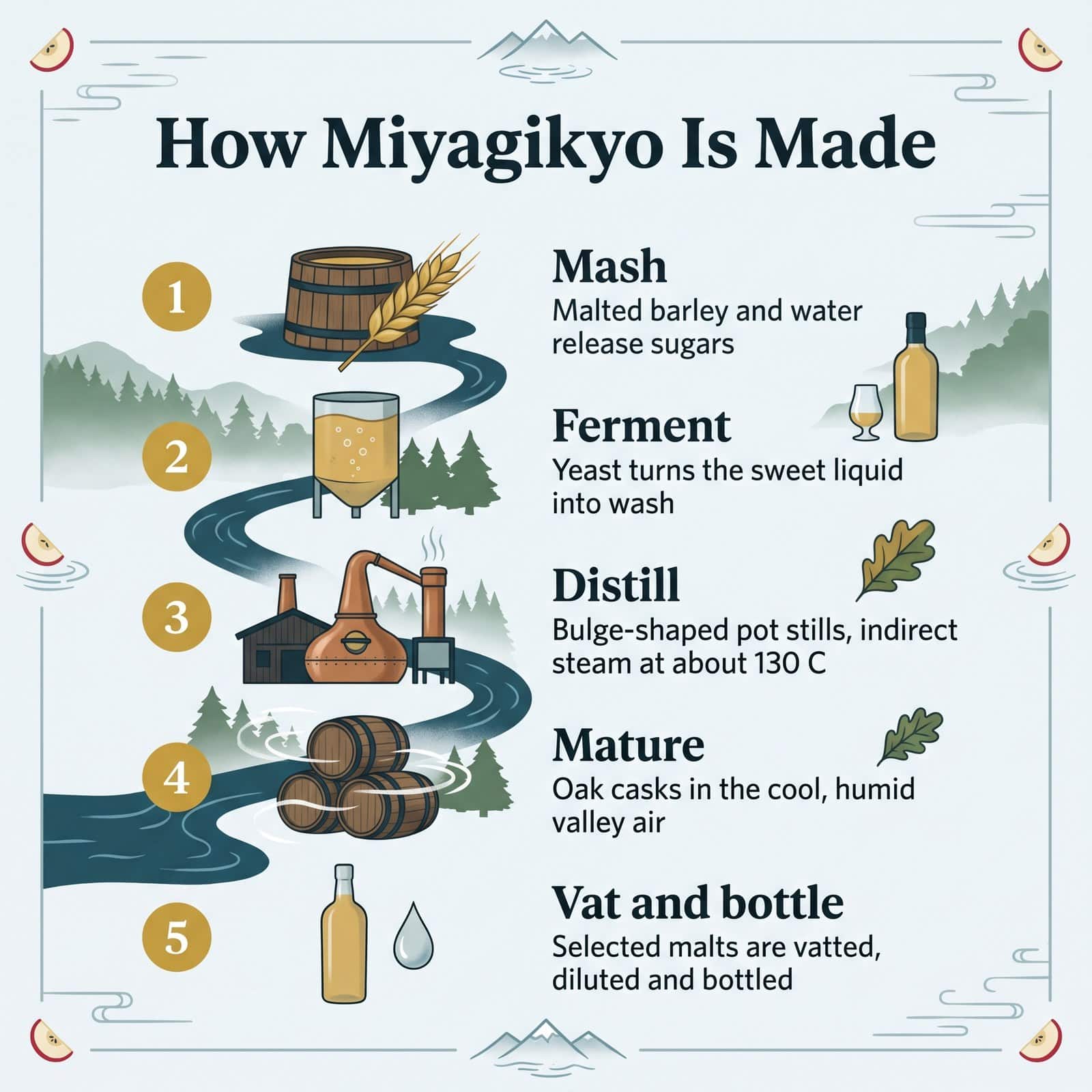
Where is Miyagikyo whisky made? Nikka makes it at Miyagikyo Distillery in Aoba Ward, Sendai, Miyagi Prefecture. The distillery stands in a wooded valley in Sendai, between the Hirose and Nikkawa rivers. Its water, climate and natural setting support whisky production.
Water, Mashing and Fermentation
Production starts with malted barley. First, workers mash the malt with water to release sugars. Next, they add yeast, which turns the sweet liquid into a beer-like wash. Nikka draws its brewing water from the underground flow of the Nikkawa River. Water matters, but no single factor creates the flavor on its own.
Fermentation also shapes fruitiness. Distilling scientists link apple, pear and banana aromas to esters, which yeast produces during fermentation. That helps explain why distillers watch this stage so closely.
Bulge Stills and Indirect Steam
How does indirect steam heating help? The distillery heats its pot stills with indirect steam. This method helps create Miyagikyo’s refined aroma and mellow character. According to Nikka, the steam stays at around 130°C, so the spirit distills slowly and gently.
Still shape matters too. Miyagikyo uses large bulge-shaped pot stills with ascending lyne arms. Because of that design, heavier vapors fall back and distill again, a process called reflux. Consequently, a lighter and cleaner spirit reaches the condenser. Yoichi, by contrast, uses straight-headed stills over direct coal fire.
Copper plays a quieter role. A 2011 study in the Journal of the Institute of Brewing found that copper in pot stills helps control sulfury, meaty aromas. Similarly, a 2022 review by Akira Wanikawa and Toshikazu Sugimoto traced where sulfur compounds form and fall during whisky production.
Maturation, Vatting and Bottling
After distillation, Nikka fills the new make spirit into oak casks. Mist from the rivers keeps the valley air humid, which helps slow the drying of casks during long aging. Later, blenders vat selected malt whiskies together, dilute them with water, and bottle the result.
Keep one distinction in mind. Miyagikyo Distillery also produces grain whisky in its Coffey stills. However, Single Malt Miyagikyo contains only malt whisky from this one distillery. Cask types also vary between batches, so no bottle necessarily contains every cask style.
Why Is Miyagikyo So Fruity?
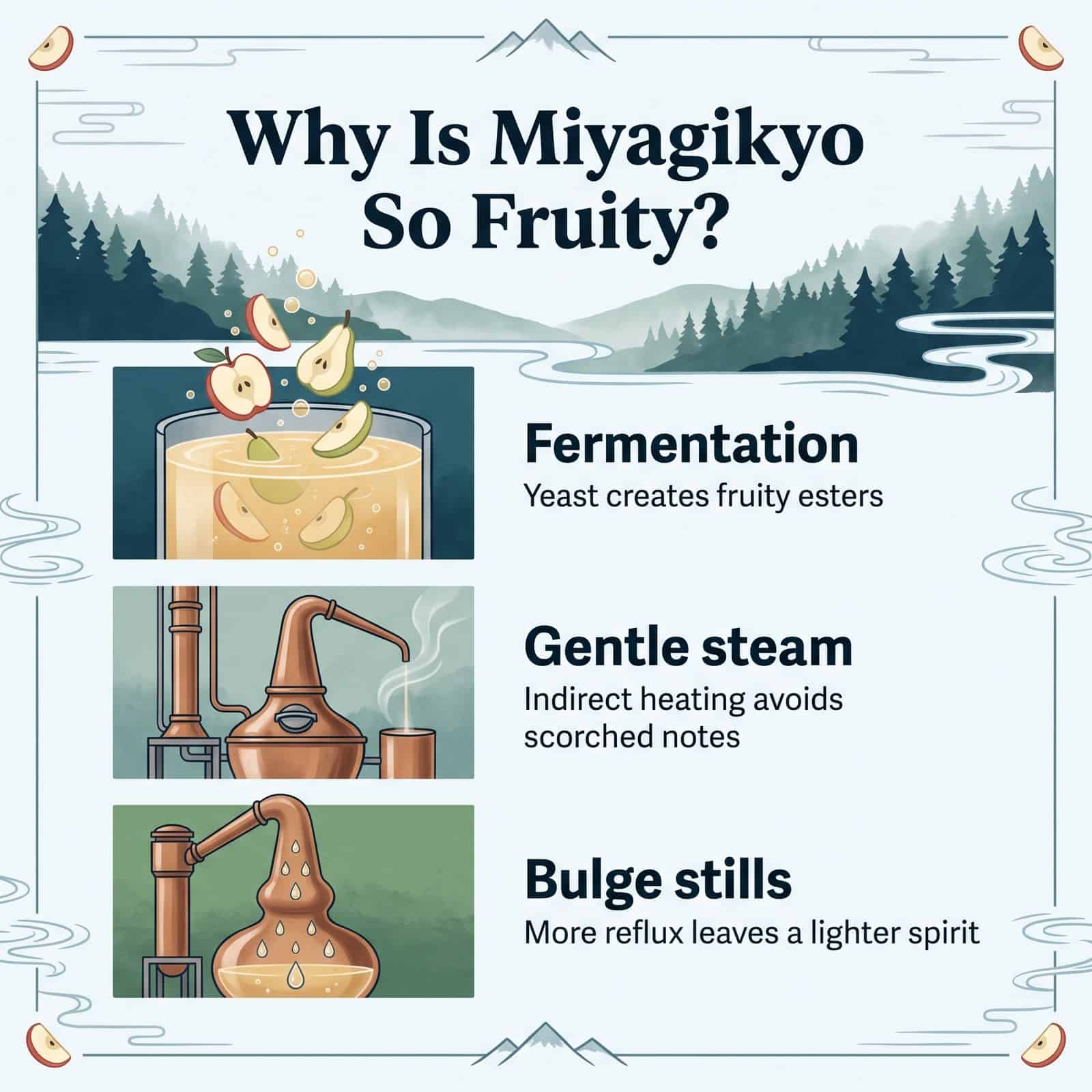
No single trick explains it. Instead, several steps push in the same direction. First, fermentation creates fruity esters. Next, gentle steam heating avoids the scorched, roasted notes that direct fire can add. Finally, the bulge-shaped stills increase reflux, so heavier compounds fall back and a lighter spirit remains.
The core bottle also shows very little peat, which leaves room for the fruit. Taken together, these choices explain why Miyagikyo tastes so different from Yoichi, even though one company makes both.
Single Malt Miyagikyo: Current Core Bottle
Single Malt Miyagikyo is Nikka’s current core expression. It is a non-age-statement single malt, bottled at 45% ABV in 700 ml and sold year-round. As of October 2026, Asahi lists a suggested retail price of 7,000 yen before tax, or 7,700 yen with tax.
The producer also states that it meets the Japanese whisky labeling standard of the Japan Spirits & Liqueurs Makers Association. That standard is an industry rule, not a law. Even so, it gives shoppers a useful signal about where and how the whisky was made.
Without an age statement, Nikka can draw on malts of different ages. The profile therefore stays bright and fruity rather than deeply woody. Start with it neat, and then add a few drops of water. Because the fruit is so clear, it also holds up well in a highball with cold soda.
Where does it sit in the market? At about 7,700 yen with tax, it costs well above everyday Japanese blends, yet far below aged limited releases. That makes it a good weekend bottle rather than a rare treasure. It also works as a gift for someone who enjoys gentle, fruity spirits.
Is the Current Bottle Worse Than the Old Age Statements?
Not necessarily, because the bottles aim at different things. An age statement guarantees that the youngest whisky inside spent at least that many years in cask. The non-age-statement bottle, by contrast, lets Nikka balance younger and older malts.
Longer aging usually brings deeper oak, dried fruit and spice. Younger components, meanwhile, tend to keep the fruit fresh and bright. So the old 12 and 15 Year Old suit drinkers who want depth. The current bottle, however, suits those who want lively fruit.
Other Rare Miyagikyo Whiskies
Is Miyagikyo whisky still available? Yes, the core non-age-statement bottle remains in regular production. In contrast, the original 10, 12 and 15 Year Old bottles ended in 2015. Meanwhile, a new limited 10 Year Old began shipping in Japan on February 3, 2026, after Asahi postponed its first release date.
| Expression | ABV | Bottles | Official price | Status | Asking range |
|---|---|---|---|---|---|
| Single Malt Miyagikyo (NAS) | 45% | Not limited | ¥7,000 + tax | Core bottle | ¥6,000 to ¥7,700 |
| Limited 10 Year Old (2026 release) | 45% | 9,000 Japan, 9,000 overseas | ¥12,000 + tax | Limited | ¥26,000 to ¥35,000 |
| Original 10 Year Old (2003 to 2015) | 45% | Not published | ¥4,500 + tax | Ended 2015 | ¥30,000 to ¥45,000 |
| 12 Year Old (2003 to 2015) | 45% | Not published | ¥7,000 + tax | Ended 2015 | ¥45,000 to ¥69,000 |
| 15 Year Old (2003 to 2015) | 45% | Not published | ¥10,000 + tax | Ended 2015 | ¥88,000 to ¥158,000 |
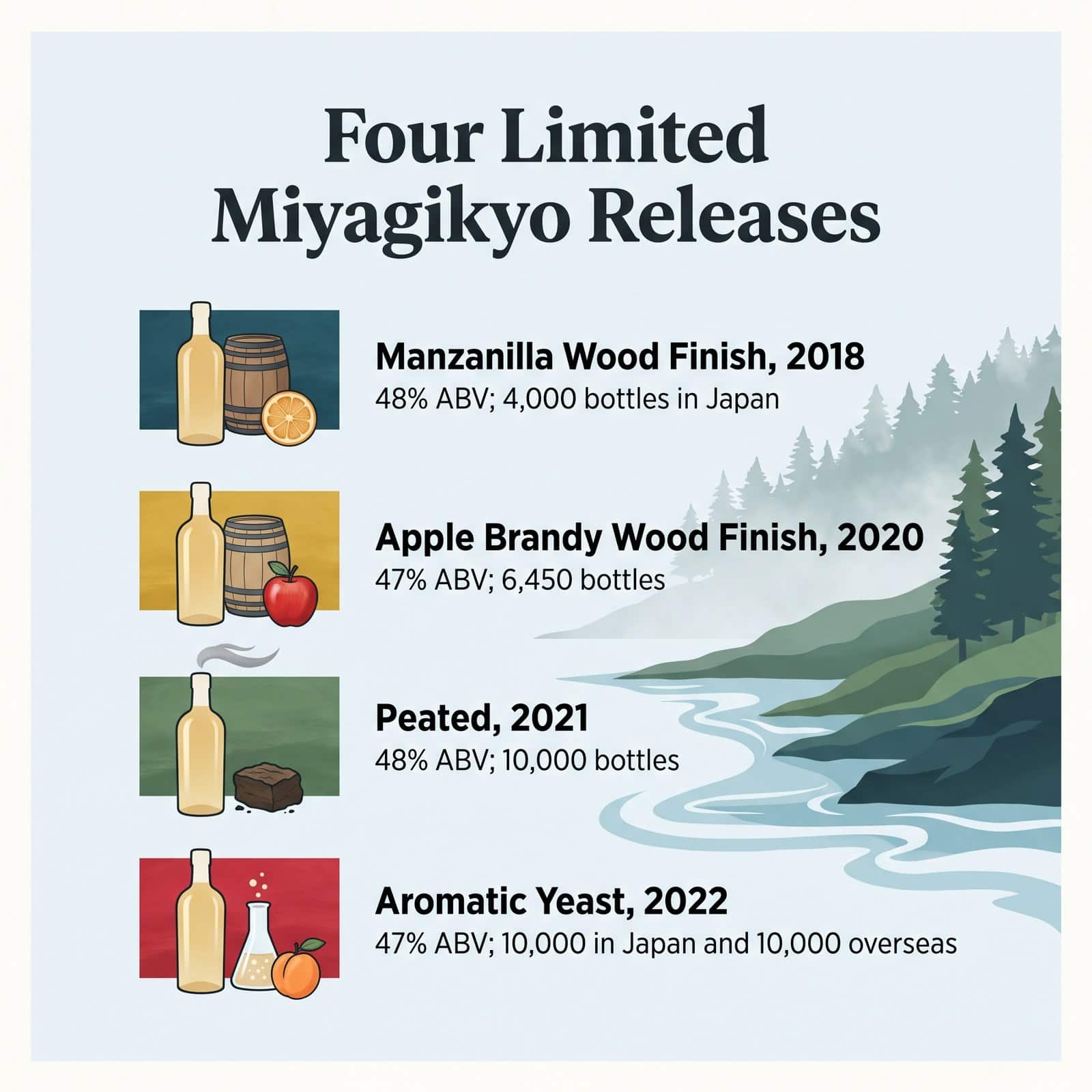
| Manzanilla Wood Finish (2018) | 48% | 4,000 Japan | ¥15,000 + tax | Sold out | ¥35,000 to ¥50,000 |
| Apple Brandy Wood Finish (2020) | 47% | 6,450 | ¥15,000 + tax | Sold out | ¥36,000 to ¥48,000 |
| Peated (2021) | 48% | 10,000 | ¥20,000 + tax | Sold out | ¥30,000 to ¥45,000 |
| Aromatic Yeast (2022) | 47% | 10,000 Japan, 10,000 overseas | ¥20,000 + tax | Sold out | ¥27,000 to ¥48,000 |
Official prices are suggested retail prices before consumption tax. Asking ranges are tax-inclusive prices listed by Japanese retailers and resellers, checked in October 2026.
Note: These figures represent asking prices, not auction results or appraisals. Actual transaction prices may be higher or lower, and they change quickly.
Before You Buy
Collector premiums: discontinued age statements often cost many times their original price. Compare several listings, and never treat one asking price as the market value.
Why Have Miyagikyo Prices Risen?
Global demand for Japanese whisky rose sharply in the 2010s. Whisky must mature for years before bottling, however, so supply is slow to expand even when demand jumps. Nikka therefore retired its age statements in 2015. In 2019, Asahi also announced new warehouses at Miyagikyo to lift storage capacity by about 40%.
Even so, whisky laid down after that still needs years in cask. As a result, aged bottles remain scarce. The 2026 10 Year Old also sold as a limited release, split between Japan and overseas markets.
Single Malt Miyagikyo 10 Year Old
Nikka launched this expression in 2003. Drinkers value its elegant apple and malt aromas. The first edition ended in 2015, at an original price of 4,500 yen before tax. The 2026 edition, on the other hand, is a separate limited release. Asahi describes apple, citrus, soft vanilla and a bittersweet finish, priced at 13,200 yen with tax.
Single Malt Miyagikyo 12 Year Old
The 12 Year Old ran from 2003 until 2015 at 7,000 yen before tax. Fans remember fruit, honey and a bittersweet, woody finish. Nikka lists International Spirits Challenge gold medals for it in 2010, 2013 and 2014. Its name echoed the 1989 Sendai-Miyagikyo 12 Year Old, the first single malt from the distillery. Today, you will mostly find it through resellers and auctions.
Single Malt Miyagikyo 15 Year Old

This was the former flagship age-statement expression. It launched in 2003 at 10,000 yen before tax and ended in 2015. Collectors usually describe a richer profile, with dried fruit, vanilla and deeper oak. Since so few sealed bottles remain, it now draws the highest asking prices in the range.
Miyagikyo Manzanilla Wood Finish (2018)
Nikka finished this edition for 18 months in casks that had held Manzanilla sherry for 50 years. Asahi described dried fruit, coconut and milk-chocolate aromas with a gently bitter finish. Nikka released 4,000 bottles in Japan at 48% ABV.
Miyagikyo Apple Brandy Wood Finish (2020)
This bottle marked 100 years since Masataka and Rita Taketsuru married. Nikka gave the whisky about six more months in casks that had aged apple brandy for at least 28 years. Only 6,450 bottles appeared, at 47% ABV. The price was 15,000 yen before tax, or 16,500 yen with tax.
Miyagikyo Peated (Nikka Discovery 2021)
Unusually for Miyagikyo, this release used only peated malt whisky. As a result, smoke played a much bigger role than in the core bottle. Nikka bottled 10,000 at 48% ABV for 22,000 yen with tax.
Miyagikyo Aromatic Yeast (Nikka Discovery 2022)
This Discovery release put yeast-driven aromas up front. Asahi described ripe apricot, rich fruit, soft malt and moderate peat. Nikka released 10,000 bottles in Japan and another 10,000 overseas, both at 47% ABV. In Japan, it cost 22,000 yen with tax.
Miyagikyo Whisky Price and Where to Buy

Three Kinds of Price
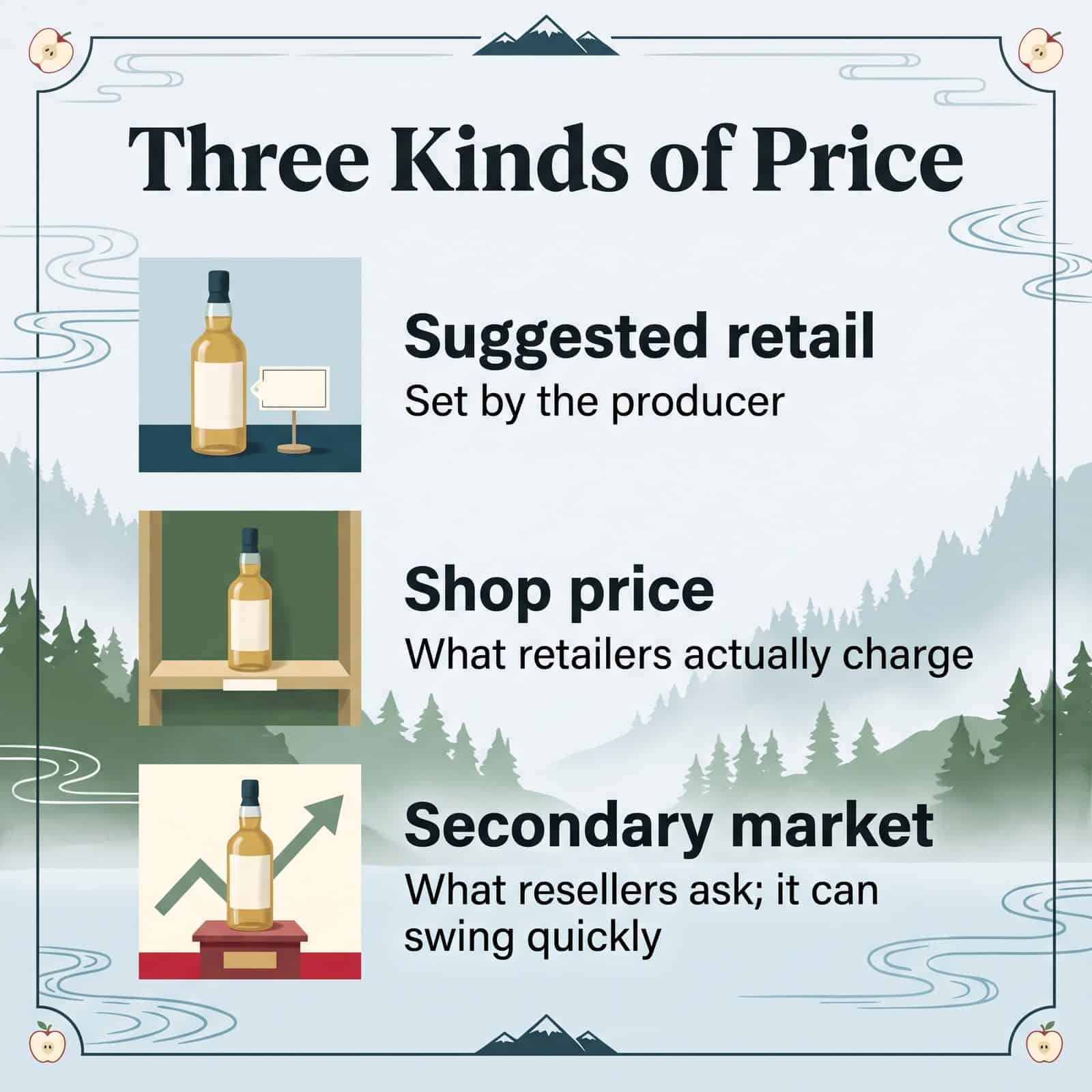
Prices fall into three groups, and mixing them up causes confusion. First, the official suggested retail price comes from the producer. Second, shop prices show what retailers actually charge. Third, secondary-market prices reflect what resellers ask, so they can swing quickly.
As of October 2026, the core bottle carries a suggested price of 7,700 yen with tax. Japanese shops list it at roughly 6,000 to 7,700 yen when it is in stock. Rare bottles are a different story, because their value depends heavily on condition and history.
Where to Buy Miyagikyo Whisky
- Shops in Japan: department stores, large liquor chains and shops near Sendai Station often stock the core bottle.
- The distillery: the gift shop sells Nikka bottles, though stock and purchase limits vary.
- Airport duty-free: selection changes often, and Nikka has sold a travel-retail Miyagikyo Grande at some airports.
- Online retailers: Amazon and Rakuten list current and rare bottles, so compare prices with the official figure first.
- Auctions and overseas sellers: these are often the only route to discontinued bottles.
Rare-Bottle Buying Checklist
- Label quality: look for sharp printing and a correct Japanese back label.
- Capsule and seal: reject torn film, leaks or signs of resealing.
- Fill level: a low level can signal evaporation through the cork.
- Original box: a box adds value and also supports provenance.
- Seller history: prefer licensed shops with long, clear records.
- Return policy: make sure you can return a damaged or doubtful bottle.
- Provenance and storage: ask how and where the bottle was kept.
International buyers should also check alcohol-import rules, duties and shipping limits before ordering. Many carriers refuse to ship spirits across borders. And remember that Japan’s legal drinking age is 20, while your home country’s rules apply once you leave.
Disclosure: The buttons below are affiliate links. If you buy through them, Food in Japan may earn a small commission at no extra cost to you.
How to Drink Miyagikyo Whisky

How should you drink Miyagikyo whisky? Start neat, then add water a little at a time. Dilution softens the alcohol heat, so the apple and vanilla notes come forward.
Four Ways to Serve It
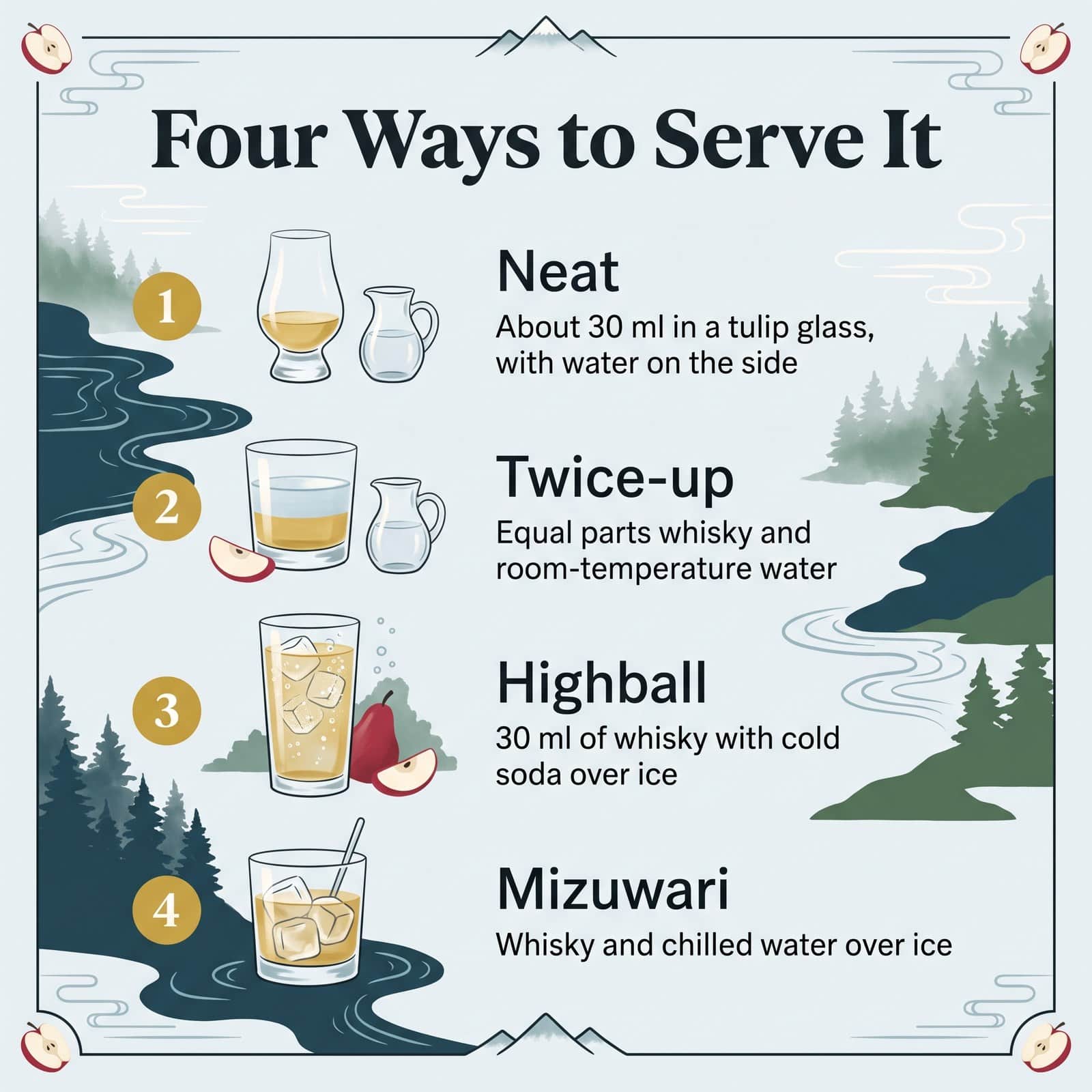
- Neat: pour about 30 ml into a tulip-shaped glass, and keep water on the side.
- Twice-up: mix equal parts whisky and room-temperature water without ice, as blenders often do when nosing.
- Highball: add 30 ml of whisky to a glass full of ice, then top with 90 to 120 ml of cold soda.
- Mizuwari: mix the whisky with chilled water over ice, following the steps below.
Simple Mizuwari Steps
This is our practical serving suggestion rather than an official Nikka recipe. Feel free to adjust the ratio to taste.
- Put three large ice cubes in a glass.
- Pour in 30 ml of Miyagikyo, then stir to chill it.
- Add 60 ml of chilled soft water, stir lightly, and wait about 30 seconds.
Why Glass Shape Matters
A tulip-shaped tasting glass has a wide bowl and a narrow rim. The bowl lets aromas rise, while the rim gathers them toward your nose. Consequently, delicate fruit notes are easier to catch than in a straight tumbler.
Food Pairings: Miyagikyo and the Flavors of Miyagi
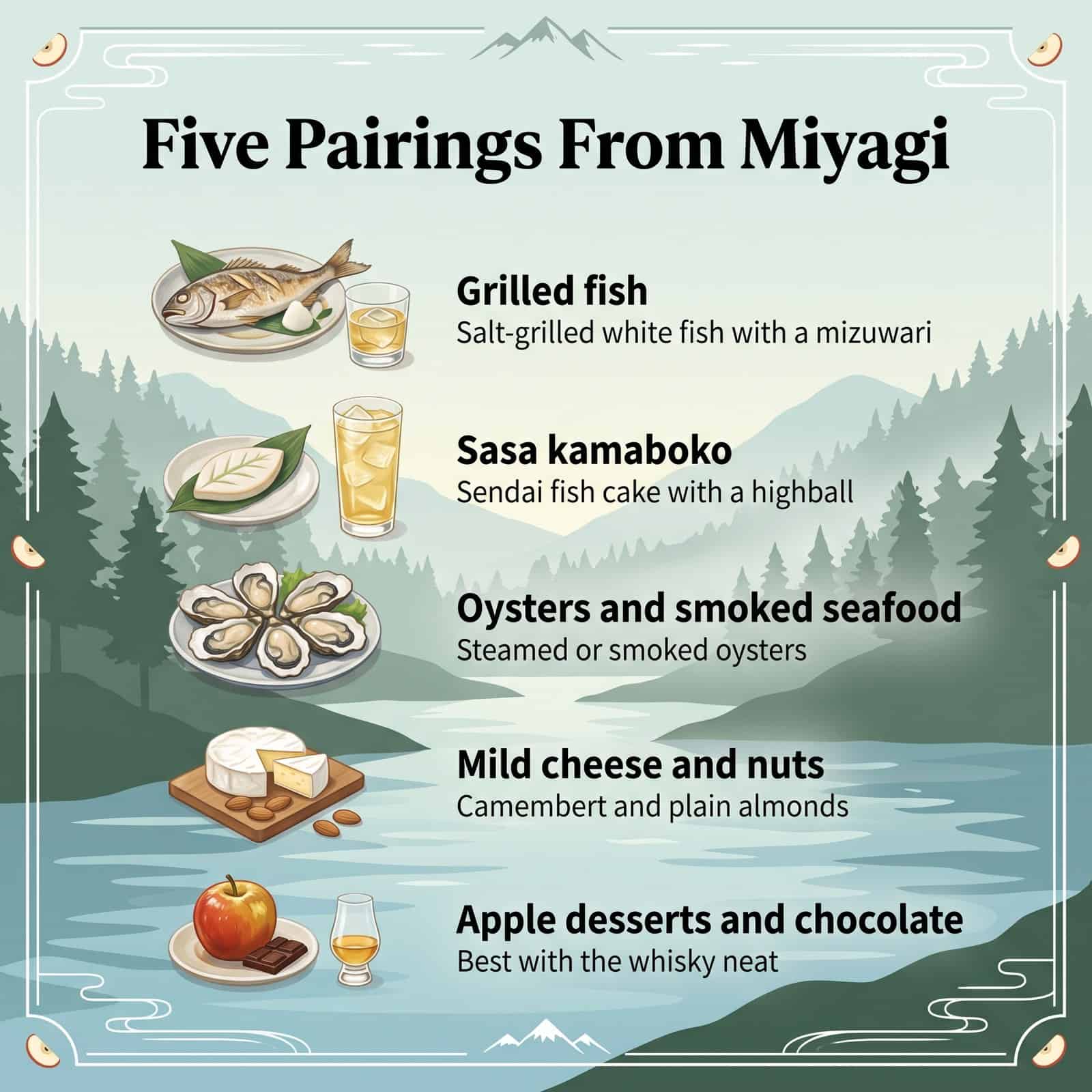
Because Miyagikyo carries fruit rather than heavy smoke, it rarely buries delicate food. Light salt in seafood also lifts the malt’s sweetness. Meanwhile, a mizuwari or highball lowers the alcohol, so the drink matches the gentle weight of Japanese dishes. These pairings fit nicely with the foods and drinks of Miyagi.
- Grilled fish: salt-grilled white fish suits a mizuwari.
- Sasa kamaboko: Sendai’s leaf-shaped kamaboko fish cake goes well with a highball.
- Oysters and smoked seafood: steamed or smoked oysters meet the malt’s soft sweetness.
- Mild cheese and nuts: Camembert and plain almonds echo the vanilla and oak.
- Apple desserts and chocolate: baked apple, apple pie or milk chocolate echoes the fruit and vanilla, best with the whisky neat.
Planning a trip? Our guide to what to eat in Sendai lists more local dishes worth trying before or after a distillery visit.
Visiting Miyagikyo Distillery
Can you visit Miyagikyo Distillery? Yes, and the guided tour costs nothing. The official name is Nikka Whisky Sendai Miyagikyo Distillery, at Nikka 1, Aoba Ward, Sendai. We last checked the details below in October 2026, so please confirm them on the official site before you go.
Tours, Hours and Tastings
Nikka runs guided tours of about 70 minutes, with roughly 50 minutes of touring and up to 20 minutes of tasting. However, every group of one to nine people must book by the previous day. Without a booking, you can still enter the visitor center, paid tasting bar, gift shop and warehouse exhibit.
The visitor center opens from 9:00 to 16:00, and the gift shop from 9:15 to 16:15. Nikka lists closures in mid-August and from late December to early January. Maintenance can also close parts of the distillery. Only guests aged 20 or older may taste, and drivers may not drink.
Tour Reservations
Book ahead: reserve online or by phone by the day before. Walk-in visitors cannot join the guided tour. Schedules may change, so check the official site.
How to Get There from Sendai
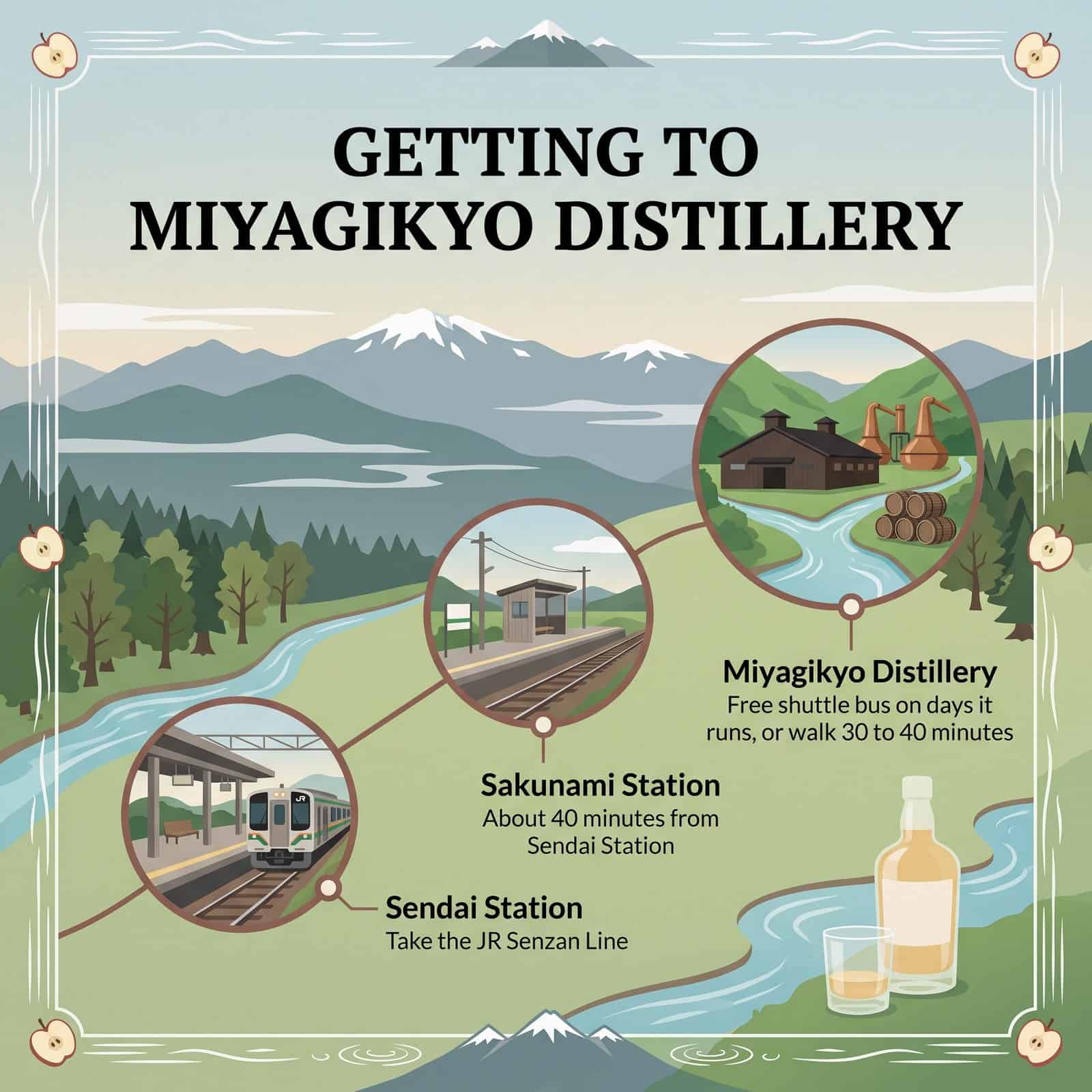
Take the JR Senzan Line from Sendai Station to Sakunami Station, a ride of about 40 minutes. From there, use Nikka’s free shuttle bus on days when it runs. Otherwise, the walk takes about 30 to 40 minutes. Taxis do not usually wait at Sakunami Station, so book one in advance.
Also note that Nikka warns there are no restaurants close to the distillery, so eat beforehand. Driving is possible, but drivers cannot join the tasting. If you plan to drink, the train is the better choice.
How Is Miyagikyo Regarded Internationally?
Miyagikyo has a solid competition record, according to Nikka’s own awards list. At the World Whiskies Awards, the non-age-statement Single Malt Miyagikyo won Best Japanese Single Malt (non age) in 2009, 2012 and 2013. The 12 Year Old, meanwhile, took International Spirits Challenge gold in 2010, 2013 and 2014.
More recently, Nikka lists ISC gold medals for the Peated and Grande editions in 2022, and for Aromatic Yeast in 2023. In 2015, the same competition also named Nikka Distiller of the Year, recognizing both Yoichi and Miyagikyo. Awards are not everything, of course. Still, they show that judges outside Japan have rated the distillery highly for years.
Conclusion: Is Miyagikyo Whisky Worth Buying?
Miyagikyo whisky earns its place as Nikka’s fruity, gentle single malt. If you enjoy elegant, lighter Speyside-style whiskies, it is likely the easier Nikka single malt to appreciate. Choose the standard bottle if you like apple, pear and vanilla more than smoke. It works neat, with water or in a highball, and it is still easy to find in Japan.
On the other hand, drinkers who seek smoke and maritime character will probably prefer Yoichi. Taketsuru Pure Malt suits drinkers who want a bit of both. Collectors chasing the old 10, 12 or 15 Year Old, meanwhile, should budget for steep premiums and inspect every bottle.
Where next? Read our Japanese whisky guide for the wider picture, or check verified retailers for the current bottle.
Drink Responsibly
Please enjoy whisky only if you are of legal drinking age, and never drink before driving.
Miyagikyo Whisky FAQ
Taste and Style
- What does Miyagikyo whisky taste like?
-
Miyagikyo tastes soft, fruity and lightly sweet. Nikka describes apple and pear aromas, soft vanilla, dried fruit, malt and gentle oak. The texture feels smooth, and the finish stays mild. Heavy smoke rarely appears in the core bottle.
- Is Miyagikyo whisky smoky?
-
No, the core bottle shows only a faint trace of peat. Nikka designs Miyagikyo to highlight fruit and floral aromas instead. The 2021 Miyagikyo Peated was the main exception. If you want clear smoke, try Yoichi.
- Is Miyagikyo good for beginners?
-
Yes, many beginners find it an easy first single malt. Its fruit-forward profile feels friendlier than heavily peated whisky. At 45% ABV it still carries some heat, so add water or soda if needed. A highball makes an especially gentle start.
Comparisons and Standards
- What is the difference between Miyagikyo and Yoichi?
-
Miyagikyo is lighter and fruitier, while Yoichi is fuller and smokier. Miyagikyo Distillery uses bulge-shaped stills heated with indirect steam at around 130°C. Yoichi, by contrast, uses straight-headed stills over direct coal fire. Tasting both side by side shows the contrast clearly.
- What Scotch whisky is closest to Miyagikyo?
-
No Scotch matches it exactly, but light, fruity Speyside malts are the closest reference point. Fans of Glenlivet or Glenfiddich often find Miyagikyo easy to like. Peaty island and Islay malts, on the other hand, point toward Yoichi. Treat this as a rough style guide rather than a flavor match.
- Does Miyagikyo meet the Japanese whisky standard?
-
Yes, Asahi states that Single Malt Miyagikyo meets the Japanese whisky labeling standard of the Japan Spirits & Liqueurs Makers Association. The association set this voluntary standard in 2021, and it took full effect in April 2024. It is an industry rule rather than a law. Even so, it confirms the whisky was distilled, aged and bottled in Japan under set conditions.
Drinking, Buying and Visiting
- How should you drink Miyagikyo whisky?
-
Try it neat first, then with a little water. A twice-up serve, a mizuwari or a highball also works well. Water softens the alcohol and lifts the fruit. For neat tasting, use a tulip-shaped glass.
- Why are Miyagikyo 10, 12 and 15 Year Old bottles expensive?
-
They cost more because Nikka stopped making them in 2015. Strong global demand drained aged stock during the Japanese whisky boom. Collectors now compete for the remaining bottles. The 2026 limited 10 Year Old, however, is a separate and newer release.
- Can you visit Miyagikyo Distillery?
-
Yes, you can visit, and the guided tour is free. You must book it by the day before. The tour lasts about 70 minutes, including a tasting for guests aged 20 and over. Before you travel, check the official site for closures.
- Where can you buy Miyagikyo whisky?
-
You can buy the core bottle at Japanese liquor shops, department stores and major online retailers. The distillery gift shop also sells Nikka products. Rare bottles, by contrast, usually appear only through resellers and auctions. Always check the seller, the bottle’s condition and your local import rules.
- How long does an opened bottle of Miyagikyo last?
-
An opened bottle stays drinkable for a long time, because high-proof spirits resist spoilage. However, air in a half-empty bottle slowly dulls the aroma over months. Keep it upright, tightly closed and away from sunlight and heat. Once the level runs low, try to finish it within several months.
References
- Nikka Whisky – Nikka Whisky’s History (Accessed October 2026)
- Nikka Whisky – Yoichi and Miyagikyo Single Malts (Accessed October 2026)
- Nikka Whisky – Sendai Miyagikyo Distillery (Accessed October 2026)
- Nikka Whisky – Miyagikyo Distillery Tour Reservations (Accessed October 2026)
- Asahi Breweries – Single Malt Miyagikyo Product Information (Accessed October 2026)
- Asahi Breweries – Single Malt Miyagikyo 10 Years Old Limited Release (Accessed October 2026)
- Nikkan Kogyo Shimbun (PR TIMES) – Asahi Breweries Release on Yoichi and Miyagikyo Manzanilla Wood Finish (Accessed October 2026)
- Impress Gourmet Watch – Yoichi Non-Peated and Miyagikyo Peated Limited Release (Accessed October 2026)
- Impress Gourmet Watch – Yoichi and Miyagikyo Aromatic Yeast Limited Release (Accessed October 2026)
- Impress Gourmet Watch – Miyagikyo 10 Years Old Release Postponement (Accessed October 2026)
- The Whisky Shop – Miyagikyo Apple Brandy Wood Finish Listing (Accessed October 2026)
- Japan Spirits & Liqueurs Makers Association – Standards for Labeling Japanese Whisky (Accessed October 2026)
- National Tax Agency Japan – Japanese Whisky Symposium Report (Accessed October 2026)
- Scotch Whisky Research Institute – Harrison, B., Fagnen, O., Jack, F., & Brosnan, J. (2011). The Impact of Copper in Different Parts of Malt Whisky Pot Stills on New Make Spirit Composition and Aroma. Journal of the Institute of Brewing, 117(1), 106–112 (Accessed October 2026)
- MDPI Molecules – Wanikawa, A., & Sugimoto, T. (2022). A Narrative Review of Sulfur Compounds in Whisk(e)y. Molecules, 27(5), 1672 (Accessed October 2026)
- Harpers Wine & Spirit – Scientists Uncover Source of Tropical Malt Whisky Flavours (Accessed October 2026)
- Nikka Whisky – Awards (Accessed October 2026)
- Japan Spirits & Liqueurs Makers Association (Kyodo News PR Wire) – Japanese Whisky Logo Mark Announcement (Accessed October 2026)
- Nihon Shokuryo Shimbun – Asahi to Add Whisky Warehouses at Miyagikyo Distillery (Accessed October 2026)
- House of Suntory – Hibiki Japanese Harmony (Accessed October 2026)
- The Whisky Exchange – Suntory Yamazaki Distiller’s Reserve (Accessed October 2026)
Related Articles
- Yoichi Whisky (Surveyed: October 2026)
- Nikka Whisky (ニッカウヰスキー) (Surveyed: October 2026)
- Nikka Taketsuru (ニッカ竹鶴) (Surveyed: October 2026)
- Suntory Whiskey (サントリーウイスキー) (Surveyed: October 2026)
- Nikka From the Barrel (Surveyed: October 2026)
- Japanese Single Malt and Five Whisky Traditions (Surveyed: October 2026)
- Kamaboko (蒲鉾) (Surveyed: October 2026)
- What to Eat in Sendai: 20 Must-Try Foods (Surveyed: October 2026)




Comments