



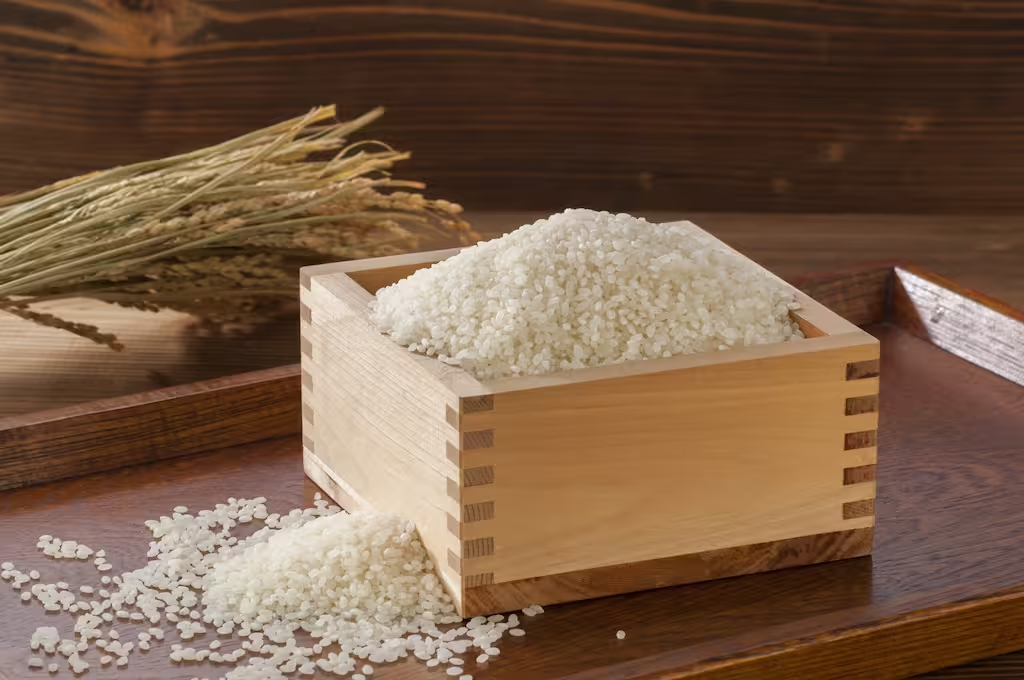
Japanese rice is short-grain Japonica rice, grown and eaten across Japan, with plump and rounded grains. Because it carries a high share of amylopectin starch, Japanese short-grain rice cooks up glossy, moist, and lightly sticky, with a mild sweetness. Cooks use it for everyday bowls, sushi, onigiri, donburi, curry, and bento.
This guide walks through the main varieties, the cooking method, what the official nutrition data actually shows, and where to buy the grain outside Japan. We also cover storage, the mistakes that ruin a pot, and the long history behind it. Along the way, a few stubborn myths get cleared up.
Short answer. Japanese rice is a short-grain Japonica rice with plump grains, a subtle sweetness, and a lightly sticky texture once cooked. People eat it as the base of everyday meals, and also use it for sushi, onigiri, donburi, curry, and bento.
What is Japanese rice?
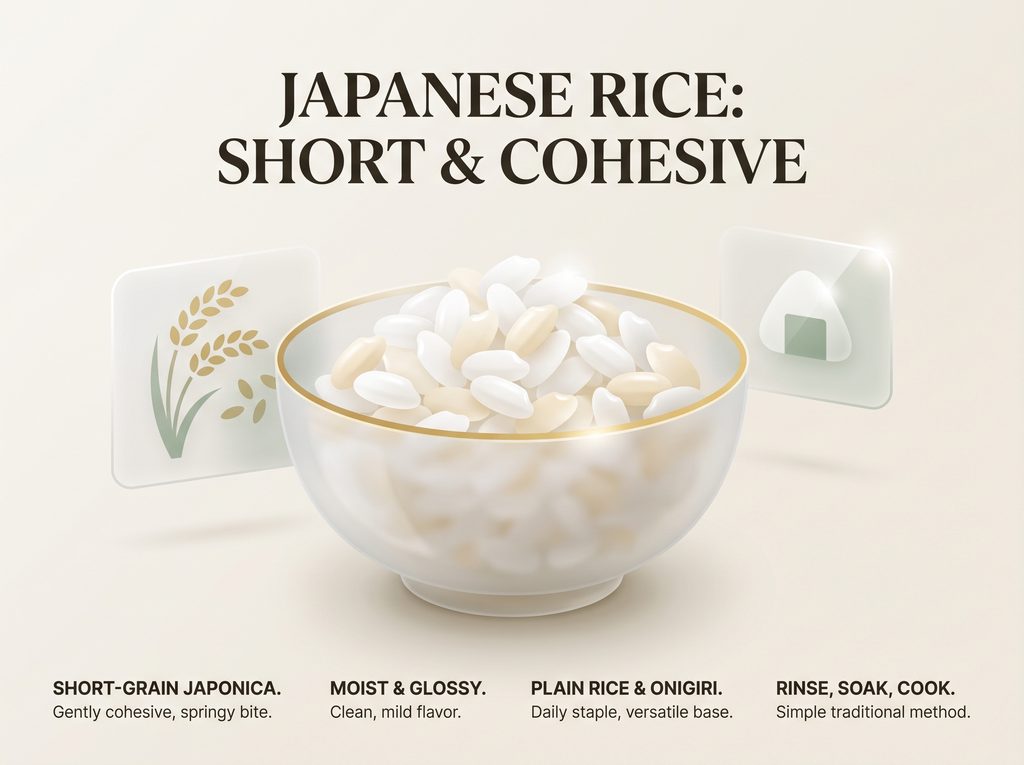
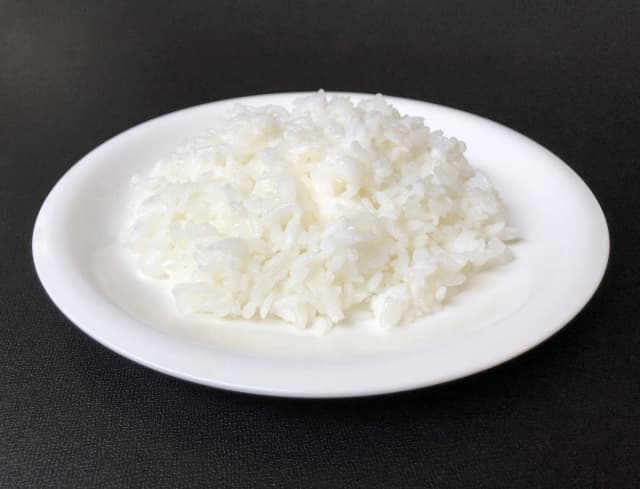
Japanese rice refers to the short-grain Japonica cultivars that farmers grow in Japan and households cook every day. The grains look almost round, clearly stubbier than long-grain types. Amylopectin, the branched starch that dominates this rice, makes the cooked grains cling gently to each other. Therefore chopsticks lift a tidy mouthful, and the rice never collapses into paste.
| At a glance | Japanese rice |
|---|---|
| Grain category | Short-grain Japonica (Oryza sativa subsp. japonica) |
| Typical grain length | Around 5 mm, and only slightly longer than it is wide |
| Cooked texture | Moist, glossy, gently cohesive, with a springy bite |
| Flavor | Clean and mild, with sweetness that builds as you chew |
| Main cultivars | Koshihikari, Hitomebore, Hinohikari, Akitakomachi, Nanatsuboshi |
| Best uses | Plain rice bowls, sushi, onigiri, donburi, curry, bento |
| Basic cooking method | Measure, rinse, drain, soak, cook, then rest and fluff |
| Storage | Airtight and cool for raw grain; freeze cooked rice in portions |
Uruchimai and mochigome
Uruchimai (粳米) is ordinary non-glutinous table rice, and it fills the bowl at nearly every Japanese meal. Mochigome (もち米) is glutinous rice, whose starch is almost entirely amylopectin, so it cooks dense and chewy. Cooks keep mochigome for mochi, sekihan, and wagashi sweets rather than daily meals.
Sushi rice is not a variety
Sushi rice is cooked uruchimai seasoned with rice vinegar, sugar, and salt. Chefs call the seasoned result shari or sumeshi, and the seasoning happens after cooking, never before. Overseas, however, bags marked “sushi rice” usually hold uncooked short-grain rice, often Calrose grown in California. That grain works perfectly well. Still, the label describes a use rather than a cultivar, so check the variety name on the back.
Flavor and texture
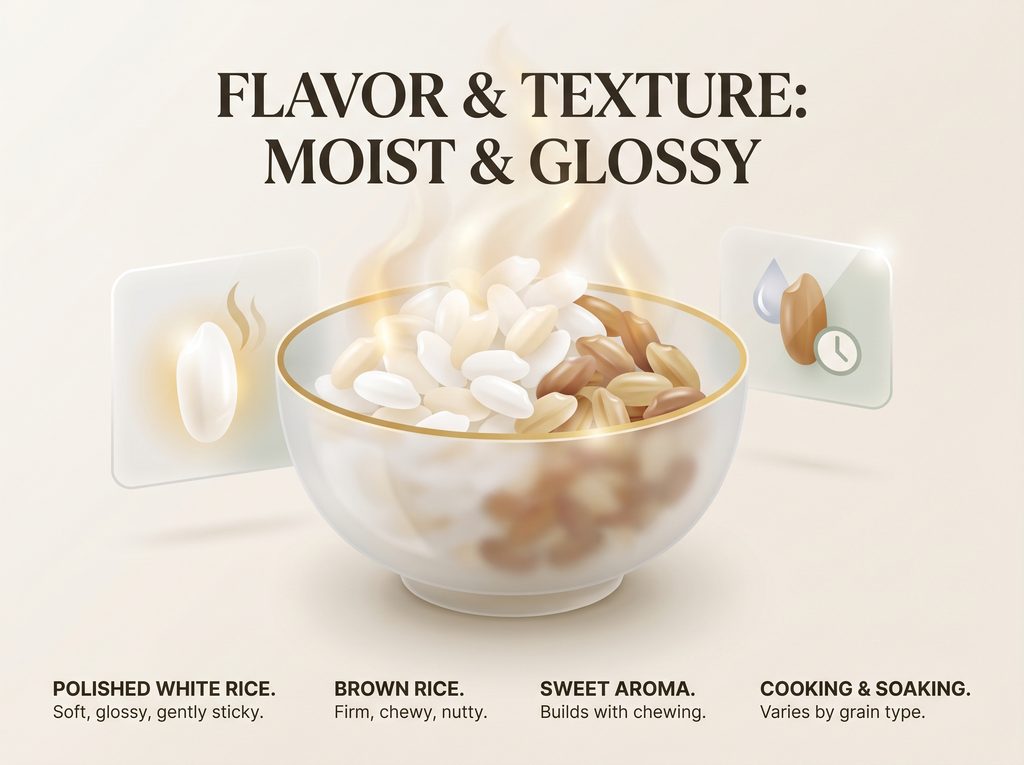
Freshly cooked rice has a subtle, sweet aroma. In Japanese homes and restaurants, that aroma reflects centuries of culinary tradition. Japanese short-grain rice cooks into moist, cohesive grains with mild sweetness. Long-grain jasmine and basmati rice usually cook into drier, more separate grains. The difference is starch behavior rather than quality, so neither style is better in the abstract.
Properly cooked Japanese rice looks glossy and feels slightly sticky. Each grain remains intact while the center stays soft. As the rice cools, the grains firm up and turn chewier, which is exactly why onigiri hold together in a lunchbox. Brown rice behaves differently again. Its bran layer blocks water, so it needs a longer soak and tastes distinctly nutty.
| Attribute | Polished white rice (hakumai) | Brown rice (genmai) |
|---|---|---|
| Aroma | Faintly sweet and milky | Nutty and grassy |
| Sweetness | Mild, and it builds while chewing | Muted behind the bran flavor |
| Texture | Soft, glossy, gently sticky | Firm, chewy, more separate |
| Soaking need | Around 30 to 60 minutes | Several hours, sometimes overnight |
| Best use | Sushi, onigiri, donburi, plain bowls | Grain bowls, set meals, salads |
Editor’s cooking note. Our editor cooked two rice-cooker cups of Niigata Koshihikari in Tokyo, soaked for 45 minutes in a standard cooker. Lifting the lid, the steam smelled faintly of sweet corn and warm milk. The surface looked wet and reflective rather than dull, and single grains held their shape under the paddle. Sweetness arrived late, after several chews. That late sweetness is the part most people miss when they skip the resting step.
Japanese rice varieties
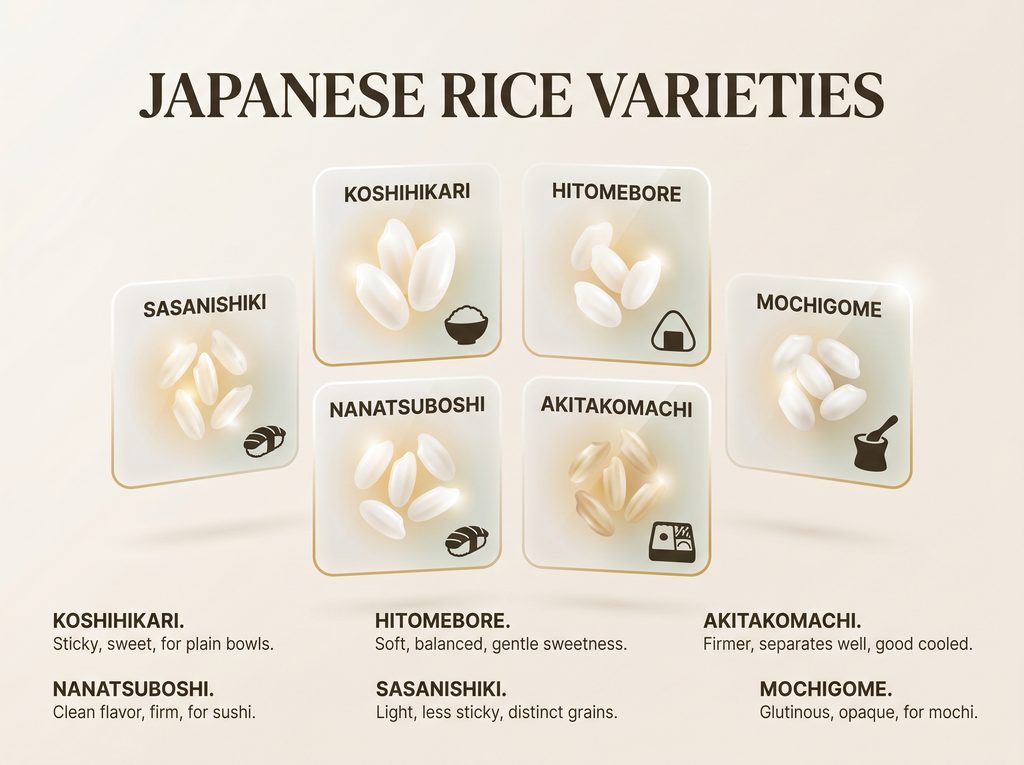
Japan registers far more cultivars than any shopper will ever meet. For the 2026 crop year, the Ministry of Agriculture, Forestry and Fisheries listed 940 origin-and-variety brands for non-glutinous rice inspection, covering 319 distinct cultivars. In practice, though, five names carry most of the market. Planting shares below come from the Rice Stable Supply Support Organization survey of the 2024 crop.
Koshihikari (コシヒカリ)
Breeders crossed the parent lines in Niigata during the 1940s, and Fukui finished the selection work. Japan registered the cultivar in 1956, and it still dominates the fields. In the 2024 crop year it covered 32.6 percent of the non-glutinous planted area. Cooked grains taste noticeably sweet and turn quite sticky. Because that stickiness holds a shape well, it suits plain bowls, onigiri, and donburi. Our Koshihikari rice guide covers the regional differences in more depth.
Hitomebore (ひとめぼれ)
Miyagi Prefecture released Hitomebore in 1991, from a cross between Koshihikari and Hatsuboshi. It held 8.4 percent of planted area in 2024, second nationally. The texture sits softer and more balanced than Koshihikari, with gentler stickiness and a quieter sweetness. Consequently it makes an easy, forgiving table rice for anyone new to short-grain cooking. It also shapes into neat rice balls. See our Hitomebore rice profile for the breeding background.
Akitakomachi (あきたこまち)
Akita Prefecture registered Akitakomachi in 1984, and it reached 6.7 percent of planted area in 2024. Grains cook slightly firmer, and they separate more readily than Koshihikari. Producers and prefectural guides both highlight that it eats well after cooling, which explains its reputation for bento. Cooled texture still depends on how you store the rice, so test a batch yourself before committing. Our Akitakomachi rice page has the full story.
Nanatsuboshi (ななつぼし)
Hokkaido breeders released Nanatsuboshi in 2001, and it now leads the island’s paddies. Nationally it took 3.4 percent of planted area in 2024, fifth place. Flavor reads clean and restrained rather than sweet, while the grains cook up slightly firm and glossy. Sushi counters in Sapporo use it constantly for exactly that reason. If you want a sweeter, stickier Hokkaido grain instead, try Yumepirika.
Sasanishiki (ささにしき)
Miyagi Prefecture released Sasanishiki in 1963, and for decades it rivaled Koshihikari. Severe cold damage in the 1990s cut its acreage sharply, yet it survives as a specialist choice, still ranking third within Miyagi. It cooks lighter and less sticky, so the grains stay distinct on the palate. Sushi chefs value precisely that restraint, since the rice does not fight the fish. Our Sasanishiki rice article explains the revival.
Mochigome (もち米)
Glutinous rice sits apart from every cultivar above. It cooks dense, opaque, and chewy, and it never substitutes for daily rice. Farmers planted about 3.5 percent of Japan’s paddy area with mochigome in 2024. Steaming and pounding turn it into mochi, while steaming alone gives okowa and sekihan.
Which Japanese rice variety should you choose?
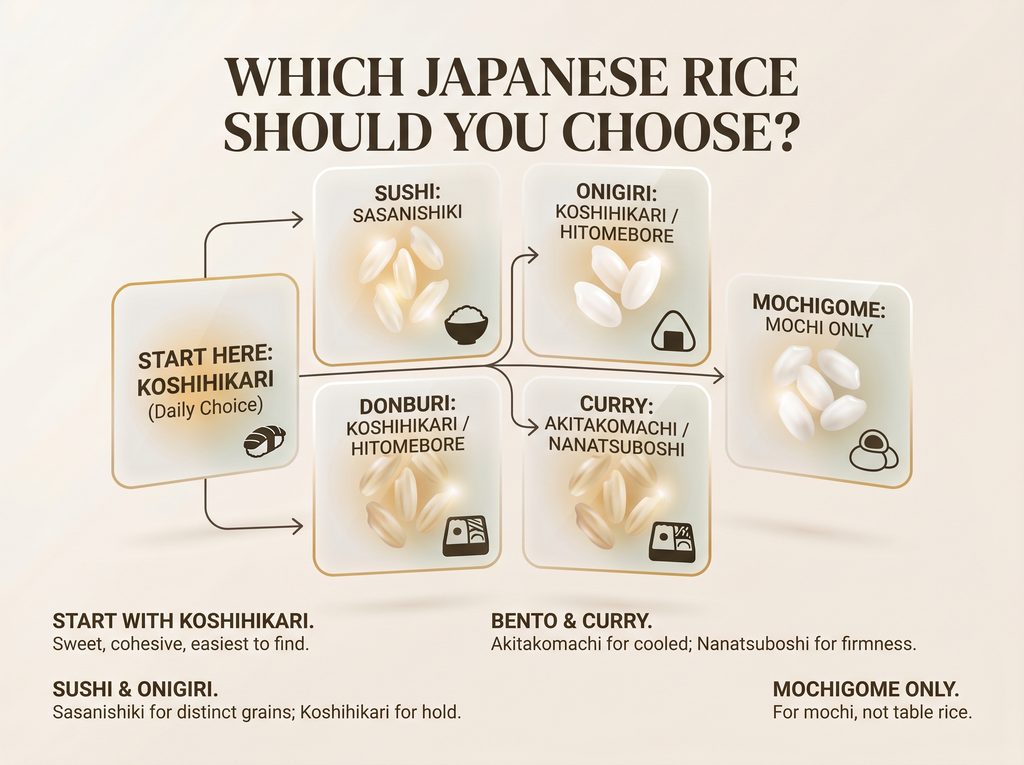
Start with Koshihikari. It handles almost every everyday dish, and it is the easiest Japanese variety to find abroad. Switch to something else only when a specific dish asks for it.
Koshihikari works as a broad daily choice because of its sweetness and strong cohesion. Sasanishiki goes the other way, with grains that separate more easily, which makes it a reasonable sushi option. Akitakomachi earns its bento reputation once you confirm how it behaves cooled in your own kitchen. Hitomebore reads as a soft, balanced table rice. Mochigome, meanwhile, belongs only to mochi and similar preparations.
Best Japanese rice by dish
- Sushi: Sasanishiki first, with Koshihikari as the widely available fallback
- Onigiri: freshly cooked short-grain Japonica, ideally Koshihikari or Hitomebore
- Donburi: Koshihikari or Hitomebore, since sauce needs grains that hold together
- Japanese curry: Akitakomachi or Nanatsuboshi, which stay a little firmer under sauce
- Bento: Akitakomachi, long recommended for rice eaten at room temperature
- Fried rice: day-old cooked rice, preferably Sasanishiki or Nanatsuboshi
- Ochazuke: any uruchimai, though Sasanishiki keeps grains distinct under hot tea
- Mochi: mochigome only, with no table-rice substitute
A quick checklist before you buy
- Do you prefer soft grains, or firm ones?
- Will you eat the rice warm, or cooled in a lunchbox?
- Do you need strong cohesion, for onigiri or hand-formed sushi?
- Are you making mochi? If so, buy mochigome instead of table rice.
Japanese rice compared with jasmine, basmati, and Calrose
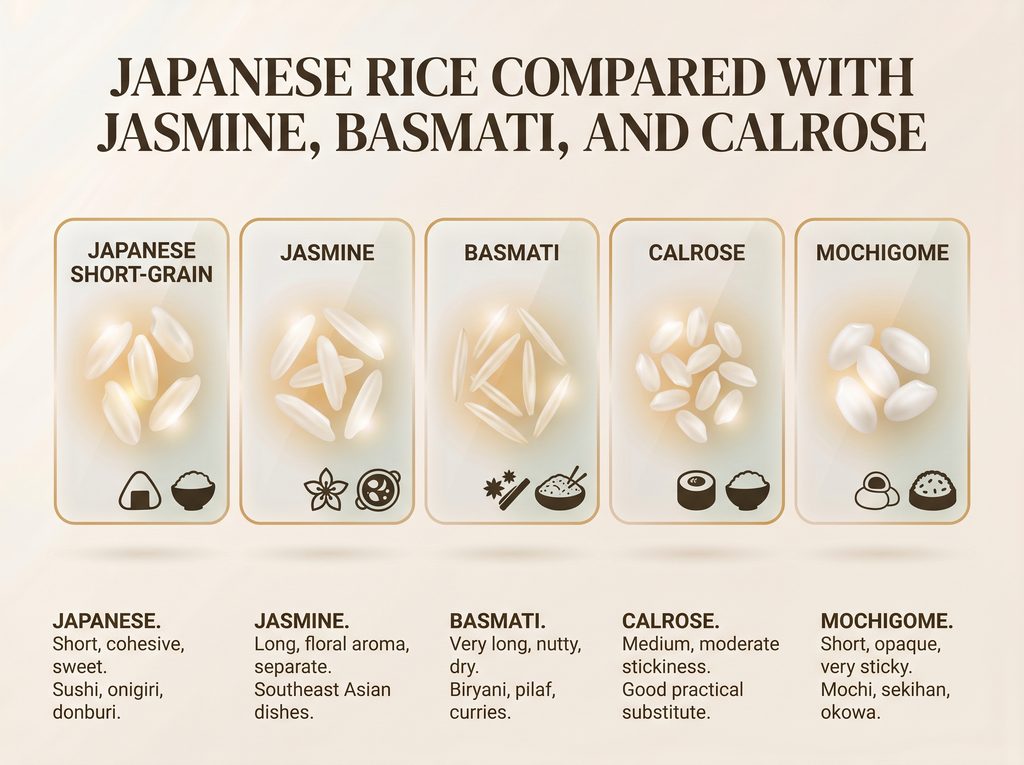
Japanese short-grain rice cooks moist and cohesive, with a clean, mild sweetness. Jasmine rice is a long-grain type with a floral aroma, and it cooks drier and more separate.
| Rice type | Grain length | Starch behavior | Stickiness | Aroma | Best uses | Substitute for Japanese rice? |
|---|---|---|---|---|---|---|
| Japanese short-grain Japonica | Short | High amylopectin, low amylose | Moderate and cohesive | Faintly sweet | Plain bowls, sushi, onigiri, donburi | The reference point |
| Jasmine | Long | Higher amylose | Low, grains stay separate | Floral and pandan-like | Thai and Southeast Asian dishes | Poor for sushi and onigiri |
| Basmati | Long and slender | High amylose | Very low, fluffy and dry | Nutty and distinctly perfumed | Biryani, pilaf, curries | Not suitable for shaped rice |
| Calrose | Medium | Japonica-type starch | Moderate | Neutral | Sushi, rice bowls, everyday meals | Good practical substitute |
| Mochigome | Short and opaque | Almost pure amylopectin | Very high, dense and chewy | Sweet and starchy | Mochi, sekihan, okowa | Never a substitute |
How to cook Japanese rice
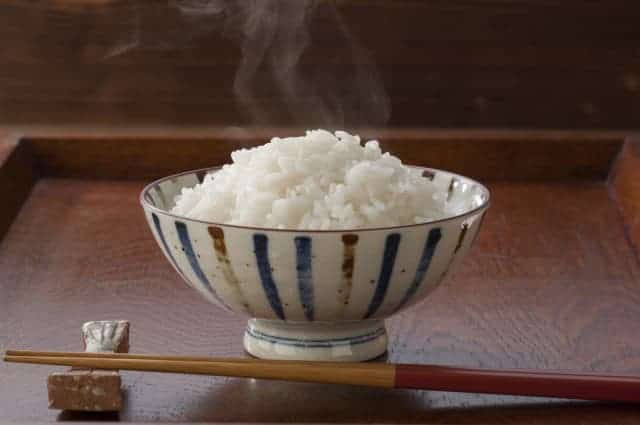
Measure by weight whenever you can. One Japanese rice-cooker cup, or gō, holds 180 ml, which works out to roughly 150 g of uncooked short-grain rice. A US cup holds 240 ml instead, so the two units are not interchangeable. Pick one system and stay with it throughout a recipe.
Japanese rice cooking water ratio
No single water ratio is correct for every pot. As a starting point, use about 1.1 to 1.2 times the dry weight of the rice in water. For 150 g of rice, therefore, that means roughly 165 to 180 g of water. The right figure shifts with the cultivar, the age of the crop, the soaking time, and your equipment. Manufacturer instructions and the inner-pot markings always take priority over any number printed here.
The six basic steps
Weigh the rice, or count rice-cooker cups. Two cups, about 300 g, feeds three to four people as a side.
Cover the rice with cold water, stir once, and pour it off quickly. Dry grain absorbs water fastest at first contact, so speed matters here. Then wash gently three or four more times, until the water runs cloudy rather than milky.
Tip the rice into a strainer and let it sit for a few minutes. Draining evenly stops pockets of extra water from forming later.
Add the measured water and rest the rice for 30 to 60 minutes. Soaking lets moisture reach the center of each grain, which gives a more even texture. Brown rice needs several hours instead.
Run the white-rice program, or bring the pan to a boil and then drop the heat. Keep the lid closed throughout.
Leave the rice covered for about 10 minutes, so steam finishes the job. Afterwards, cut down with a damp paddle and turn the rice from the bottom up. Fluffing releases trapped steam without crushing the grains.
Using a rice cooker
If your inner pot carries graduated markings, use them and ignore the ratio above. Those lines already account for the machine’s program. Add rinsed rice first, then fill to the matching line, and choose the white-rice setting. Many cookers soak automatically, so an extra soak can leave the rice soft. Check the manual before adding one.
Using a covered saucepan
A heavy pan with a tight lid works well. Bring the soaked rice and water to a boil over medium heat, which takes around five minutes. Next, lower the heat to its minimum and cook for about 12 minutes. Turn off the burner and leave the pan covered for 10 more minutes. The lid does real work here, since it traps the steam that finishes cooking. Resist lifting it to peek, because each look costs heat and moisture.
Troubleshooting a bad batch
| Problem | Likely cause | Immediate correction | Next-batch adjustment |
|---|---|---|---|
| Too hard | Not enough water, too little soaking, or the lid came off early | Sprinkle over a little hot water, cover, and steam briefly on low heat | Add slightly more water and extend the soak |
| Mushy | Too much water, or an overlong soak | Spread the rice gently to release steam, and avoid repeated stirring | Reduce the water a little next time |
| Dry or crumbly | Rice sat uncovered after cooking | Cover immediately, then rest for a few minutes | Fluff, then keep the lid on until serving |
| Scorched base | Heat stayed too high, or the pan is thin | Lift the upper rice out without scraping the bottom | Use a heavier pan and a lower simmer |
| Excessively sticky | Under-rinsed grain, or a very low-amylose cultivar | Fluff thoroughly to let surface moisture escape | Rinse more carefully, or switch to a firmer variety |
Popular Japanese rice dishes
Once you can cook the grain properly, the rest of the repertoire opens up. Our archive of traditional Japanese rice dishes goes wider, but these five appear on most tables.
Onigiri (おにぎり)
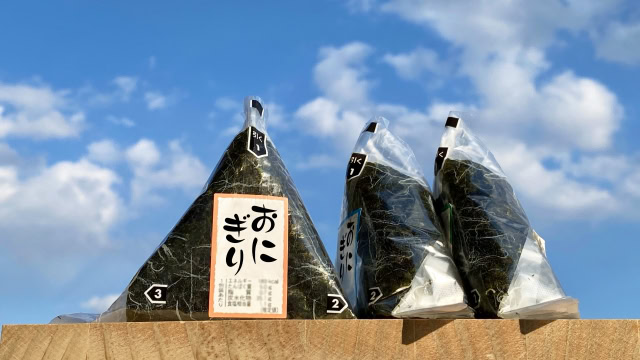
Hand-formed and usually filled with umeboshi, grilled salmon, or tuna mayonnaise, Japanese onigiri rice balls are the country’s portable meal. Warm rice shapes far more easily than cold rice, so form them soon after cooking. Salt on the palms both seasons the surface and keeps grains from sticking.
Donburi (丼)
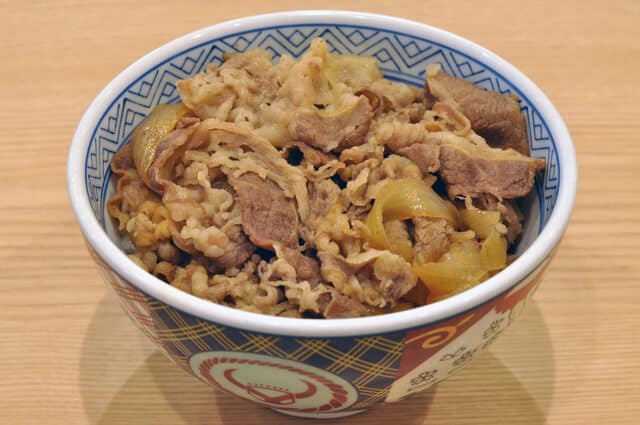
Donburi covers any bowl of rice under a topping, from simmered beef in gyudon to breaded pork in katsudon. Sauce soaks downward, so the rice needs enough cohesion to stay recognizable. That is why softer, stickier cultivars suit these bowls best.
Ochazuke (お茶漬け)
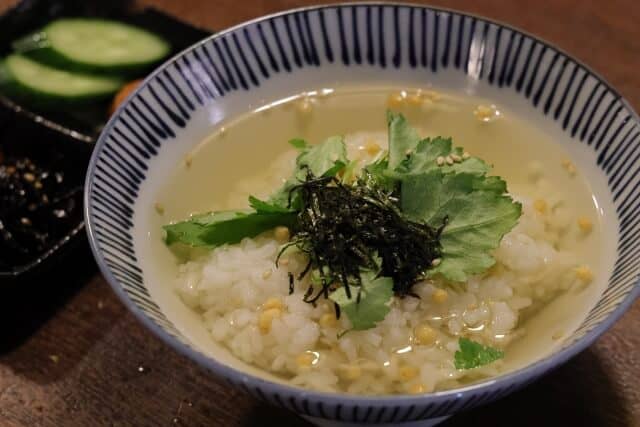
Pour hot green tea or dashi over a bowl of rice, then add nori, umeboshi, or salted salmon. Simple as it looks, ochazuke rewards good rice, since the liquid strips away everything else. A sprinkle of furikake works as a shortcut.
Takikomi gohan and okayu
Takikomi gohan cooks seasonal ingredients together with the rice in seasoned dashi, so the flavor reaches every grain. Chestnuts arrive in autumn, bamboo shoots in spring. Okayu, by contrast, is a slow rice porridge eaten during illness or on cold mornings. It looks plain, yet the texture demands real attention to the water.
Japanese rice nutrition: white rice vs brown rice
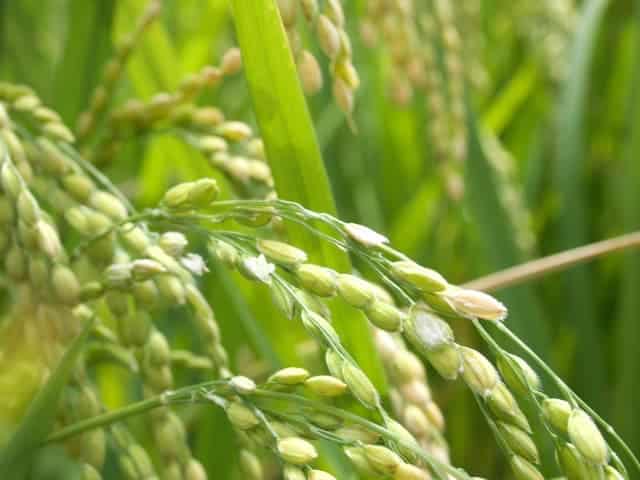
Calories and macronutrients
Swapping white rice for brown rice barely moves the calorie count. Per 150 g serving of cooked rice, the Japanese food composition tables give 234 kcal for polished white rice and 228 kcal for brown rice. That gap is small, so choosing brown rice purely to cut calories makes little sense. The real differences sit among the minerals and B vitamins.
| Nutrient (per 150 g cooked) | Cooked white rice | Cooked brown rice |
|---|---|---|
| Energy (kcal) | 234 | 228 |
| Protein (g) | 3.8 | 4.2 |
| Fat (g) | 0.5 | 1.5 |
| Carbohydrate (g) | 55.7 | 53.4 |
| Dietary fiber (g) | 2.3 | 2.1 |
| Potassium (mg) | 44 | 143 |
| Magnesium (mg) | 11 | 74 |
| Phosphorus (mg) | 51 | 195 |
| Iron (mg) | 0.2 | 0.9 |
| Manganese (mg) | 0.53 | 1.56 |
| Vitamin B1 (mg) | 0.03 | 0.24 |
| Niacin (mg) | 0.3 | 4.4 |
| Folate (µg) | 5 | 15 |
Dataset: Standard Tables of Food Composition in Japan, 2020 (Eighth Revised Edition), 2023 supplement, published by MEXT. Food codes 01088 for cooked well-milled non-glutinous rice and 01085 for cooked brown rice. The tables publish values per 100 g edible portion. Figures above multiply those values by 1.5 for a 150 g serving, then round to the same decimal place. Accessed September 2026.
Reading the fiber column carefully
The fiber row looks strange, and it deserves an explanation. In the Eighth Revised tables, analysts measured white rice with the AOAC 2011.25 method, which captures resistant starch. Brown rice, however, still carries a value from the older modified Prosky method. Consequently the two fiber figures come from different methods and cannot be compared directly. Brown rice is not lower in fiber than white rice in reality.
What the numbers do and do not show
Brown rice generally provides more fiber and retains more micronutrients than polished white rice. Magnesium, potassium, phosphorus, vitamin B1, and niacin all sit several times higher, because milling removes the bran and germ that hold them. Beyond that measured difference, this article makes no health claims. Rice fits differently into different diets, and readers managing diabetes, kidney disease, or any other condition should speak with a qualified healthcare professional.
Japanese rice history
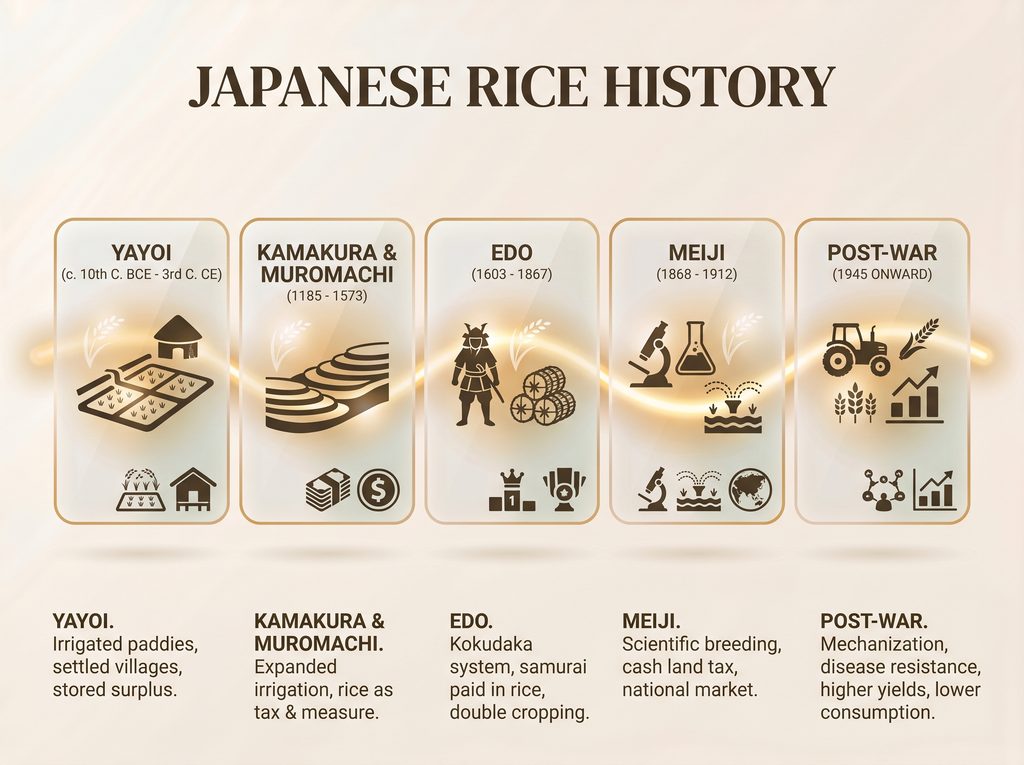
Communities adopted wet-rice cultivation during the Yayoi period through routes connected to the Korean Peninsula and the Asian mainland. Archaeological work in northern Kyushu places the earliest irrigated paddies somewhere between the 10th and 8th centuries BCE, considerably earlier than the textbook date of about 300 BCE. That chronology still draws debate among specialists, so treat the range as a range. Charred grains from Yayoi sites include both tropical and temperate japonica types.
Wet-rice cultivation supported more settled communities and changed agricultural production. Villages stored surplus grain, and stored grain created inequality. By the medieval period, farming communities expanded irrigation systems during the Kamakura and Muromachi eras, and terraced fields spread across hillsides. Rice then doubled as currency. Officials measured land in koku, the volume of rice notionally feeding one person for a year.
A five-stage timeline
| Period | Approximate dates | Agricultural development | Social effect |
|---|---|---|---|
| Yayoi | c. 10th century BCE to 3rd century CE | Irrigated paddy fields reach northern Kyushu, then spread east | Settled villages, stored surplus, and early social ranking |
| Kamakura and Muromachi | 1185 to 1573 | Communities expand irrigation networks and terraced fields | Rice becomes tax, wage, and measure of land value |
| Edo | 1603 to 1867 | Land reclamation, better tools, and wider double cropping | The kokudaka system ranks domains and pays samurai in rice |
| Meiji | 1868 to 1912 | Scientific breeding, new irrigation technology, cash land tax | Rice enters a national market economy |
| Post-war | 1945 onward | Land reform, mechanization, disease-resistant cultivars | Yields climb while per-person consumption falls |
From the Meiji land tax to modern breeding
The Meiji government replaced rice tribute with a cash land tax in 1873, which pulled farming into the wider economy. After 1945, land reform handed plots to tenant farmers, and mechanical planters and harvesters followed. Agricultural researchers developed new varieties to improve yields and disease resistance, and Koshihikari emerged from that programme in 1956. Japan reached rice self-sufficiency, then watched demand slide as diets diversified.
Rice in Japanese culture
Shinto shrines still offer rice, rice wine, and rice cakes to the kami. Otaue Matsuri, the rice-planting festivals held each early summer, survive in many rural communities, and the ritual planting is genuinely done by hand. Households echo that logic in miniature at New Year, when kagami mochi sits on the family altar. The grain carries meaning, not just calories.
Gohan and the shape of a meal
Gohan can mean cooked rice or a meal, depending on the context. Asking someone out to gohan means dinner, while asking for more gohan means another bowl. That double sense shows up in the structure of the meal as well. Ichiju-sansai, one soup and three dishes, arranges everything around a central bowl of rice, and the side dishes stay relatively salty so the plain rice balances them.
Local identity in a bag of rice
Prefectures compete hard over rice. Yamagata backs Tsuyahime, Hokkaido promotes Yumepirika, and Niigata guards the Koshihikari name closely. Supermarket bags therefore advertise prefecture, cultivar, and sometimes the individual grower. Many urban families still have relatives farming somewhere, and autumn brings boxes of new-crop rice from the countryside. That annual delivery, more than any festival, is where the connection stays alive.
Where to buy Japanese rice
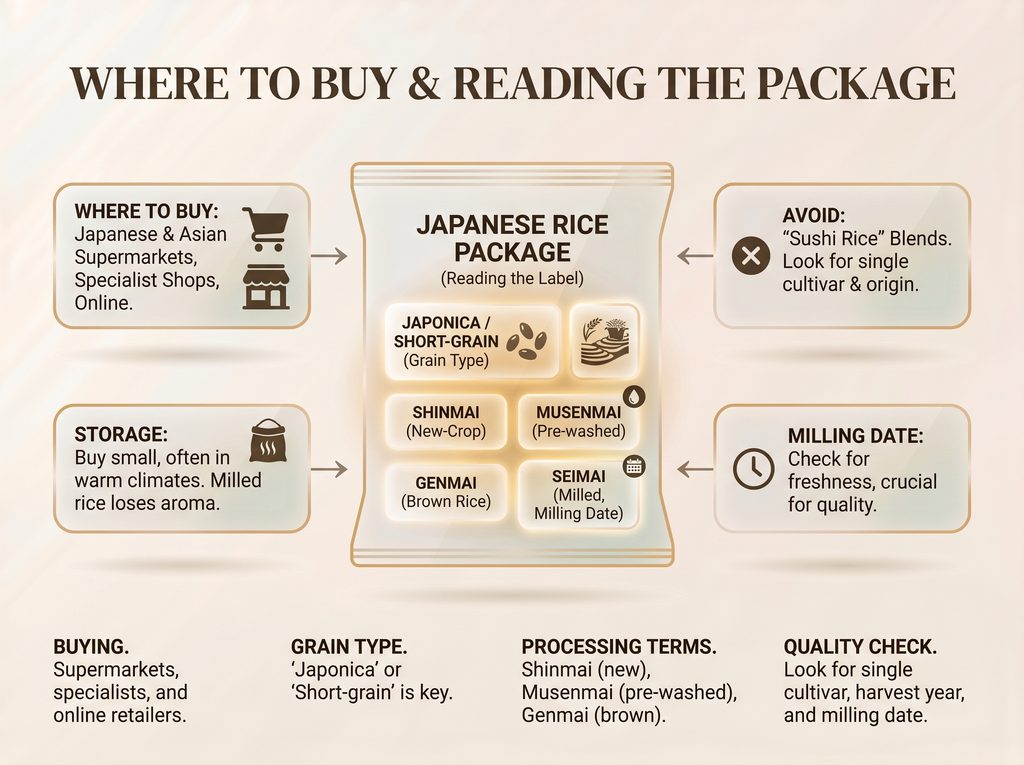
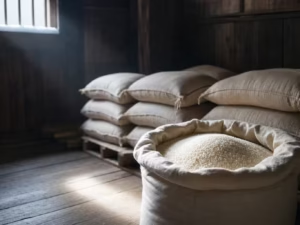
Japanese supermarkets are the obvious first stop, followed by Asian grocery stores, specialist rice shops, and reputable online retailers. Specialist shops often mill to order, which matters more than most shoppers expect. Online sellers cover the rest, although shipping costs bite on heavy bags.
Reading the package
- Japonica / short-grain: the grain type, and the single most useful word on the bag
- Shinmai (新米): new-crop rice from the current harvest year
- Musenmai (無洗米): pre-washed rice that needs no rinsing
- Genmai (玄米): brown rice, with the bran layer still on
- Seimai (精米): milled rice, usually with a milling date printed nearby
Look for a single named cultivar rather than a blend, plus the harvest year, the milling date, and the country of origin. A bag marked only “sushi rice” tells you almost nothing, so turn it over. In warm or humid climates, buy small and often, because milled rice loses aroma within weeks.
How to store Japanese rice
Uncooked rice
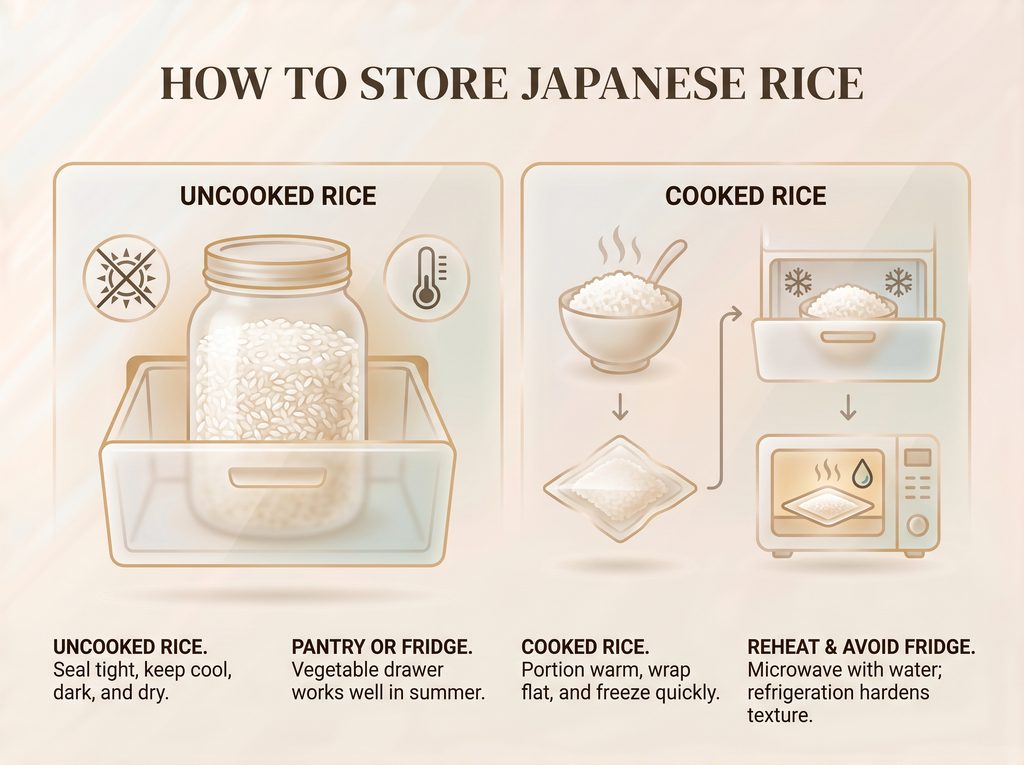
Transfer the grain into a sealed food-safe container as soon as you open the bag. Keep it away from heat, sunlight, moisture, and strong odors, since milled rice absorbs smells readily. A cool pantry works, and in summer many Japanese households simply use the vegetable drawer. Storage life depends entirely on conditions, so trust your nose rather than a fixed number of months.
Cooked rice
Portion the rice while it is still warm, then wrap each portion flat and let it cool briefly before freezing. Flat packets freeze and reheat faster, which protects texture and limits the time the rice spends at room temperature. Reheat in a microwave with a light sprinkle of water, covered, so the steam rehydrates the grains. Refrigeration hardens rice noticeably, therefore freezing gives better results for anything beyond a few hours.
Rice facts worth knowing
Rice supplied per person in Japan, fiscal 2024. The figure measures supply rather than measured intake.
Source: MAFF Food Balance Sheet, 2024
Origin-and-variety brands on the official inspection list, covering 319 distinct cultivars.
Data: MAFF inspection list, 2026 crop year
Koshihikari’s share of the non-glutinous rice planted area in Japan.
Survey: Rice Stable Supply Support Organization, 2024 crop
Selected countries by rice production
Japan sits well outside the top ten growers, which surprises many visitors. Figures below count paddy rice, meaning rough grain before milling, so they run higher than milled-rice statistics.
| Rank | Country | Paddy rice (million tonnes) |
|---|---|---|
| 1 | India | 265.1 |
| 2 | China | 255.2 |
| 3 | Bangladesh | 57.2 |
| 4 | Indonesia | 54.7 |
| 5 | Viet Nam | 42.7 |
| 6 | Thailand | 34.3 |
| 7 | Myanmar | 24.7 |
| 8 | Philippines | 19.8 |
| 9 | Cambodia | 11.6 |
| 10 | Pakistan | 11.0 |
| 11 | Brazil | 10.8 |
| 12 | Japan | 10.4 |
Data: FAOSTAT production statistics, 2022 reference year, paddy (rough) rice basis. Accessed September 2026.
Where to taste great rice in Tokyo
Koharubiyori Tokyo (小春日和TOKYO)
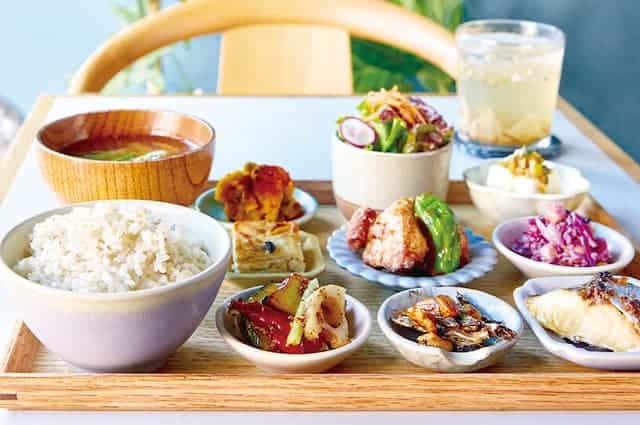
| Area | Tomigaya, Shibuya, Tokyo |
| Rice specialty | Lightly milled Akitakomachi, served at about five percent bran |
| Typical rice option | Choice of semi-polished rice or brown rice with set meals |
| Price guidance | Mamezara set meal listed at 1,760 yen |
| Nearest access | Yoyogi-Koen and Yoyogi-Hachiman stations |
| Official source | koharubiyoritokyo.com |
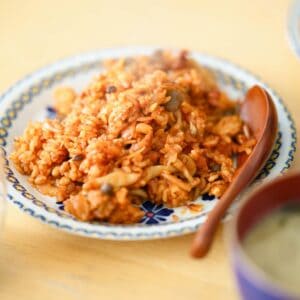
The milling level is the point here. Because the kitchen leaves part of the bran intact, the rice keeps a faint nuttiness that fully polished grain loses. Ordering both options side by side teaches the difference faster than any description. Vegan and gluten-free set meals are available too.

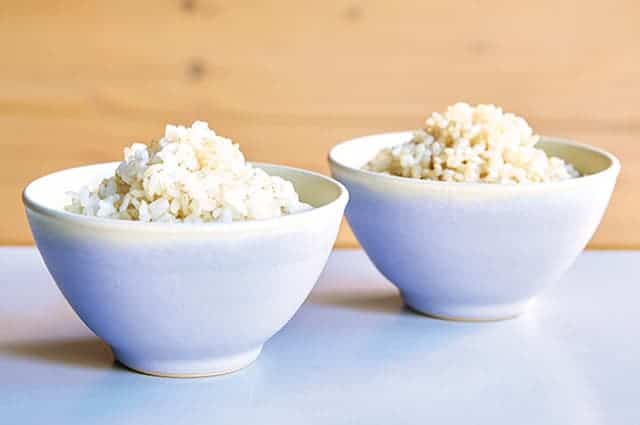
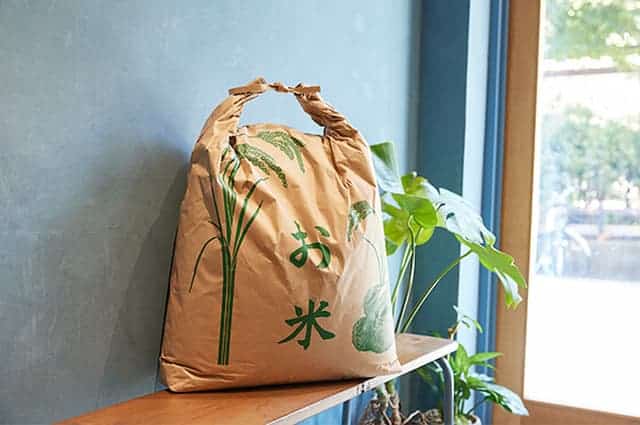
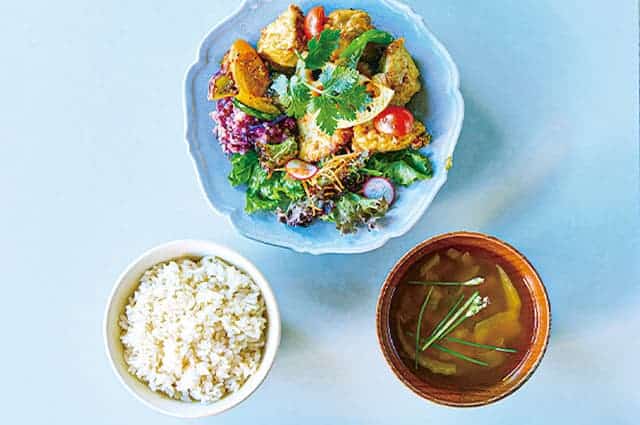
Image source: ODAKYU VOICE
Kome Fuku (米福)
| Area | Ebisu-Nishi, Shibuya, Tokyo |
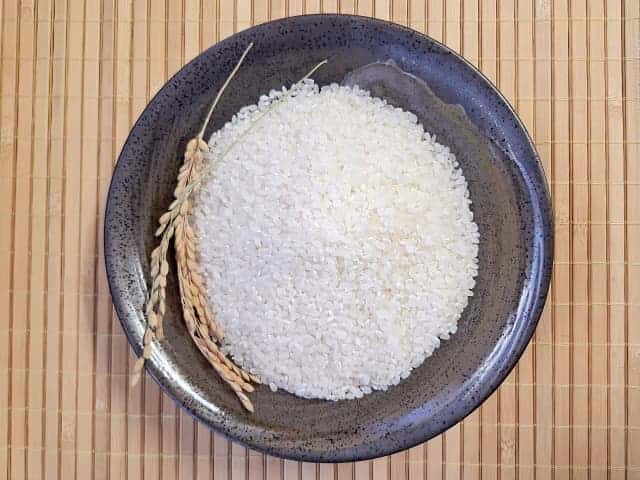
| Rice specialty | Extended soaking, reported at up to 24 hours, before cooking |
| Typical rice option | Set meals built around freshly cooked rice |
| Price guidance | Lunch and dinner sets; check current prices on the official site |
| Nearest access | Ebisu Station, west side |
| Official source | ebisu-komefuku.com |
Long soaking is the kitchen’s signature, and it shows in the finish. Grains arrive plump and glossy, with moisture running right through to the center rather than sitting on the surface. Water choice matters to the chefs as well, since hard water changes how rice absorbs. It is a useful counterpoint to the milling-focused approach above.
Conclusion
Pick one action this week. Buy a bag of single-cultivar short-grain Japonica rice, or compare two varieties side by side, or simply weigh your rice and water and cook one careful batch. Any of the three will teach you more than another article. Keep the three categories straight while you shop: uruchimai is everyday table rice, mochigome is glutinous rice for mochi, and sushi rice is cooked rice seasoned with vinegar, sugar, and salt. Get the measuring and the resting right, and good rice mostly takes care of itself.
Japanese rice FAQ
Is Japanese rice the same as sushi rice?
No. Sushi rice is cooked rice seasoned with rice vinegar, sugar, and salt, so it describes a preparation rather than a cultivar. Japanese rice, by contrast, is the raw short-grain Japonica grain itself. Overseas packages labeled sushi rice usually hold uncooked short-grain rice, often Calrose. Check the variety name on the back before you judge the bag.
Why is Japanese rice sticky?
Short-grain Japonica rice holds a high proportion of amylopectin, the branched starch that turns gluey when heated. During cooking, that starch leaches onto the grain surface and binds neighboring grains loosely together. Glutinous mochigome takes the same principle much further, since its starch is almost entirely amylopectin. Ordinary table rice therefore sticks gently, while mochigome turns genuinely dense and chewy.
What is the best Japanese rice for sushi?
Sasanishiki suits sushi because its grains separate more cleanly, whereas Koshihikari is sweeter and stickier. Sushi rice should hold a shape without turning pasty once vinegar goes in, and looser grains manage that better. Koshihikari still works well, and it is far easier to find abroad. Either way, cook it slightly firmer than you would for a plain bowl.
What rice is best for onigiri?
Use freshly cooked short-grain Japonica rice, shaped while it is still warm. Warm grains bind readily, so the rice ball holds without compression that turns it dense. Koshihikari and Hitomebore both work especially well, thanks to their cohesion. If you plan to eat it hours later, Akitakomachi keeps a pleasant texture once cooled.
Can I use jasmine rice instead of Japanese rice?
Not for sushi or onigiri, since jasmine rice will not hold a shape. It is a long-grain type with higher amylose, so the cooked grains stay dry and separate. Its floral aroma also competes with delicate Japanese seasoning. For a close substitute, look instead for Calrose or any medium-grain Japonica rice.
Should I soak Japanese rice before cooking?
Yes, as a general rule, because soaking gives a more even texture. Water needs time to reach the center of each grain, and rice cooked without that step often stays chalky inside. Thirty to sixty minutes suits white rice, while brown rice wants several hours. One exception applies: many modern rice cookers soak automatically, so check your manual first.
Where can I buy Japanese rice?
Try Japanese supermarkets, Asian grocery stores, specialist rice shops, and reputable online retailers. Specialist shops often mill to order, which preserves aroma far better than long-shelved bags. Look for a named cultivar, the harvest year, and a milling date on the package. Where imported Japanese rice is expensive, California-grown Koshihikari or Calrose makes a sensible alternative.
How should I store cooked Japanese rice?
Portion it while warm, wrap each portion flat, and freeze it promptly. Flat packets chill and reheat quickly, which protects both texture and food safety. Reheating works best in a covered microwave dish with a light sprinkle of water. Refrigeration hardens the starch noticeably, so freezing beats the fridge for anything beyond a few hours.
References
- Ministry of Agriculture, Forestry and Fisheries, Origin and variety brands for agricultural inspection, https://www.maff.go.jp/j/seisan/syoryu/kensa/sentaku/ (Surveyed: September 2026)
- Ministry of Agriculture, Forestry and Fisheries, Expanding rice consumption (米の消費拡大について), https://www.maff.go.jp/j/syouan/keikaku/soukatu/attach/pdf/kome-syouhi_siryou-103.pdf (Surveyed: September 2026)
- Ministry of Agriculture, Forestry and Fisheries, Outline of the Food Balance Sheet, https://www.maff.go.jp/j/tokei/kouhyou/zyukyu/gaiyou/ (Surveyed: September 2026)
- Rice Stable Supply Support Organization, Rice variety planting trends for the 2024 crop year, https://www.komenet.jp/pdf/R06sakutuke.pdf (Surveyed: September 2026)
- MEXT Food Composition Database, Cooked well-milled non-glutinous rice, item 01088, https://fooddb.mext.go.jp/details/details.pl?ITEM_NO=1_01088_7 (Surveyed: September 2026)
- MEXT Food Composition Database, Cooked brown rice, item 01085, https://fooddb.mext.go.jp/details/details.pl?ITEM_NO=1_01085_7 (Surveyed: September 2026)
- MEXT, Standard Tables of Food Composition in Japan, 2020 (Eighth Revised Edition), https://www.mext.go.jp/a_menu/syokuhinseibun/mext_01110.html (Surveyed: September 2026)
- Kagawa Nutrition University Press, Dietary fiber values for cooked rice in the Eighth Revised composition tables, https://eiyo21.com/blog/fd_vol30/ (Surveyed: September 2026)
- Food and Agriculture Organization of the United Nations, Agricultural production statistics 2010 to 2023, FAOSTAT Analytical Brief 96, https://www.fao.org/statistics/highlights-archive/highlights-detail/agricultural-production-statistics-2010-2023/en (Surveyed: September 2026)
- Japanese Journal of Archaeology, The spread of rice agriculture during the Yayoi Period, https://www.jjarchaeology.jp/contents/pdf/vol006/6-2_109.pdf (Surveyed: September 2026)
- Evolutionary Human Sciences, Japan considered from the hypothesis of farmer and language spread, https://www.ncbi.nlm.nih.gov/pmc/articles/PMC10427481/ (Surveyed: September 2026)
- Koharubiyori Tokyo, Official website, https://koharubiyoritokyo.com/ (Surveyed: September 2026)
- Kome Fuku Ebisu, Official website, https://www.ebisu-komefuku.com/ (Surveyed: September 2026)
Related Articles
- Koshihikari Rice (Surveyed: September 2026)
- Hitomebore (Surveyed: September 2026)
- Akitakomachi (Surveyed: September 2026)
- Sasanishiki (Surveyed: September 2026)
- Yumepirika (Surveyed: September 2026)
- Onigiri (Surveyed: September 2026)
- Mochi (Surveyed: September 2026)
- Furikake (Surveyed: September 2026)
- Japanese Rice Dishes (Surveyed: September 2026)
- The Five Great Rice Meals of Japan (Surveyed: September 2026)




Comments