





Most people have heard of Kobe beef. Yet far fewer know the name behind it. Tajima beef is the original — the cattle breed and regional standard from which Kobe, Matsusaka, Omi, and many other prestigious wagyu labels all descend. In fact, if you’ve ever eaten world-class Japanese wagyu, there’s a real chance it started in Hyogo Prefecture, in a green mountain valley where these cattle have roamed for over a thousand years.
So what exactly is Tajima beef? And, more importantly, why does it matter?
What Is Tajima Beef?
Tajima beef, or 但馬牛 (Tajima-gyu), comes from purebred Japanese Black cattle raised in Hyogo Prefecture. More specifically, it originates from the Tajima region, a mountainous area in the northern part of the prefecture, bordered by the Sea of Japan.
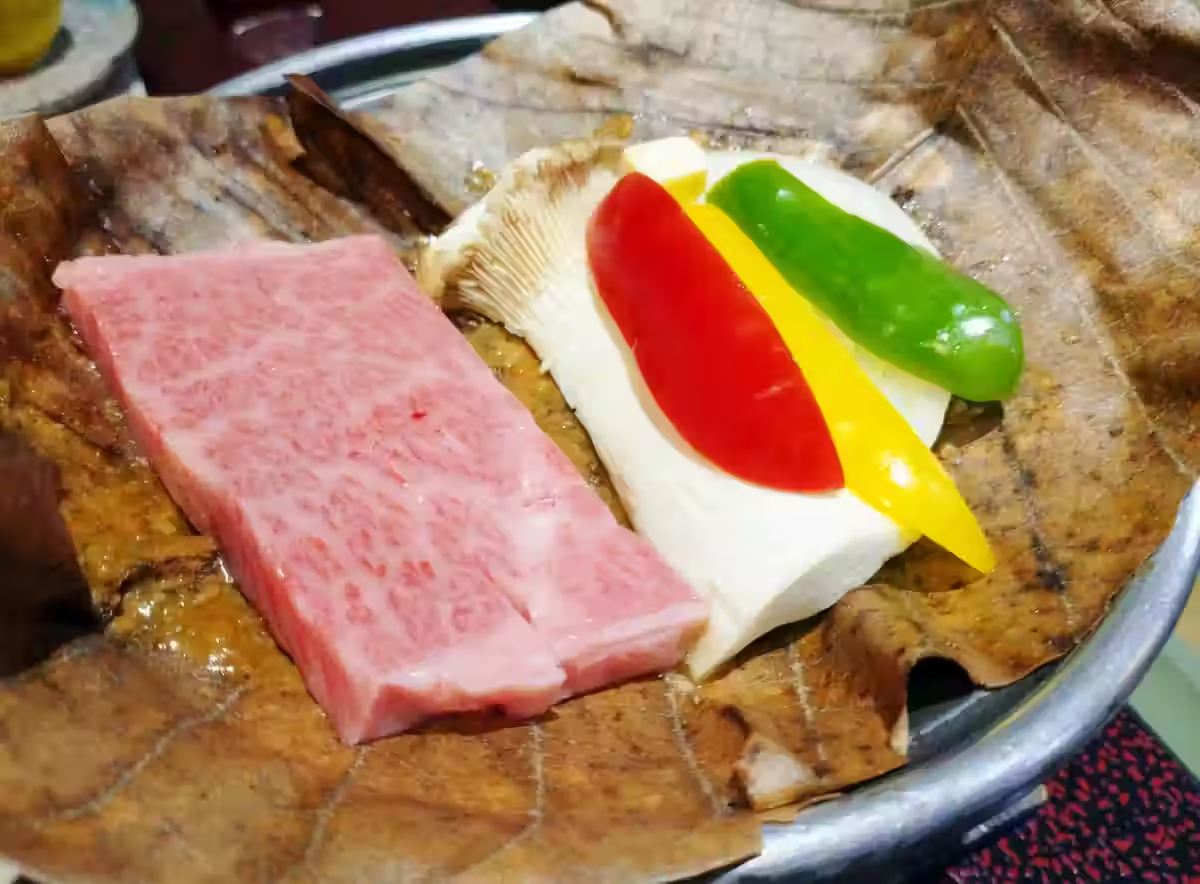
These cattle are smaller than most Western breeds. Moreover, they grow more slowly than typical beef cattle. That slower growth, however, is almost the point. Their bodies store fat differently, depositing it in fine, intricate streaks within the muscle itself. This intramuscular fat, called shimofuri in Japanese, is the defining quality of great wagyu. And in Tajima cattle, it develops with exceptional consistency.
To be certified as Tajima beef today, the animal must be born and raised entirely within Hyogo Prefecture. Furthermore, it must be a purebred Japanese Black with a Beef Marbling Standard (BMS) score that typically falls between 3 and 5. When the BMS reaches 6 or higher — and other strict conditions are also met — the meat qualifies for the Kobe beef label. In short, think of Kobe beef as the top tier within Tajima beef, not a separate category entirely.
For a broader look at Japanese wagyu and how different regional brands compare, that context helps clarify where Tajima fits.
Tajima Beef vs Kobe Beef: What’s the Real Difference?
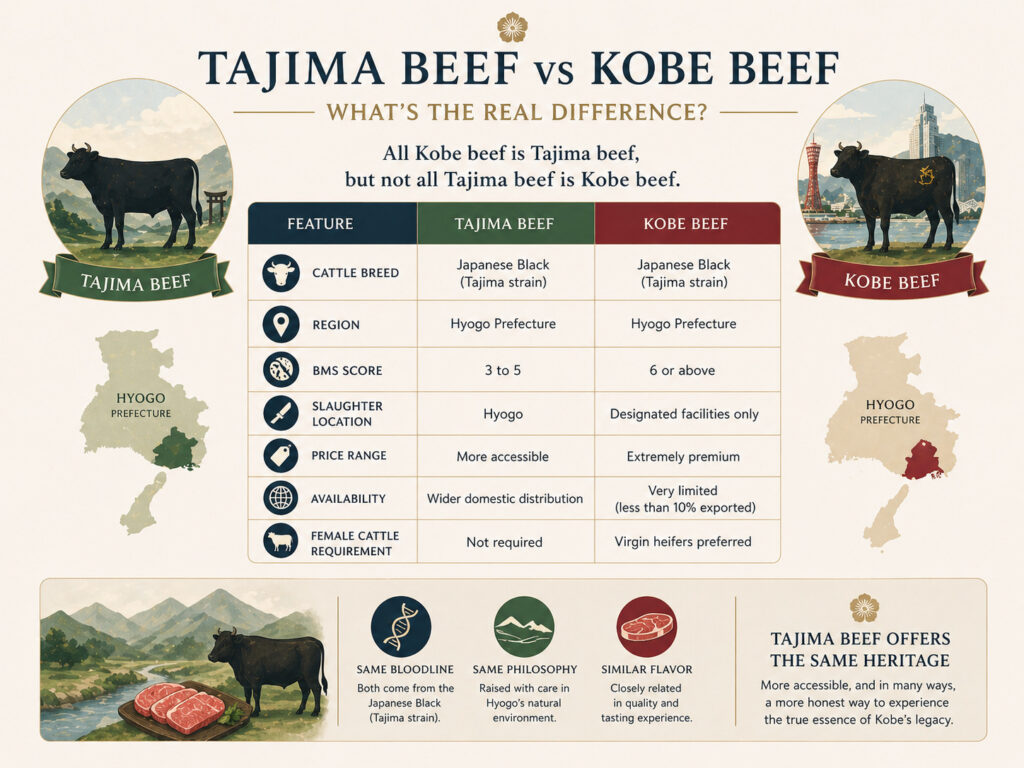
This is the question most people want answered. The short version: all Kobe beef is Tajima beef, but not all Tajima beef is Kobe beef.
The comparison table below shows the key distinctions:
| Feature | Tajima Beef | Kobe Beef |
|---|---|---|
| Cattle breed | Japanese Black (Tajima strain) | Japanese Black (Tajima strain) |
| Region | Hyogo Prefecture | Hyogo Prefecture |
| BMS score | 3 to 5 | 6 or above |
| Slaughter location | Hyogo | Designated facilities only |
| Price range | More accessible | Extremely premium |
| Availability | Wider domestic distribution | Very limited (less than 10% exported) |
| Female cattle requirement | Not required | Virgin heifers preferred |
Tajima beef gives you the same genetic foundation as Kobe — the same bloodline, the same farming philosophy, the same landscape. As a result, the flavor profile is closely related. Nevertheless, Tajima beef is more accessible, and in many ways, it’s a more honest way to experience what Hyogo cattle actually taste like without the intense price premium attached to the Kobe brand.
Tajima Beef Flavor: Umami, Marbling, and Balance
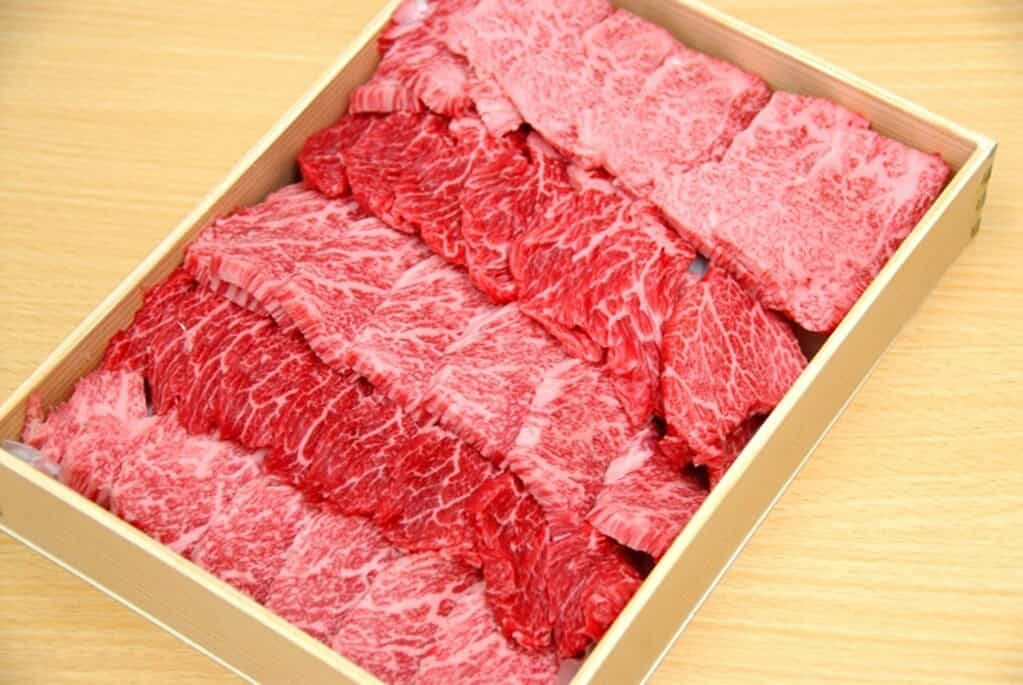
What does Tajima beef taste like? It’s a fair question, and the answer takes a little nuance.
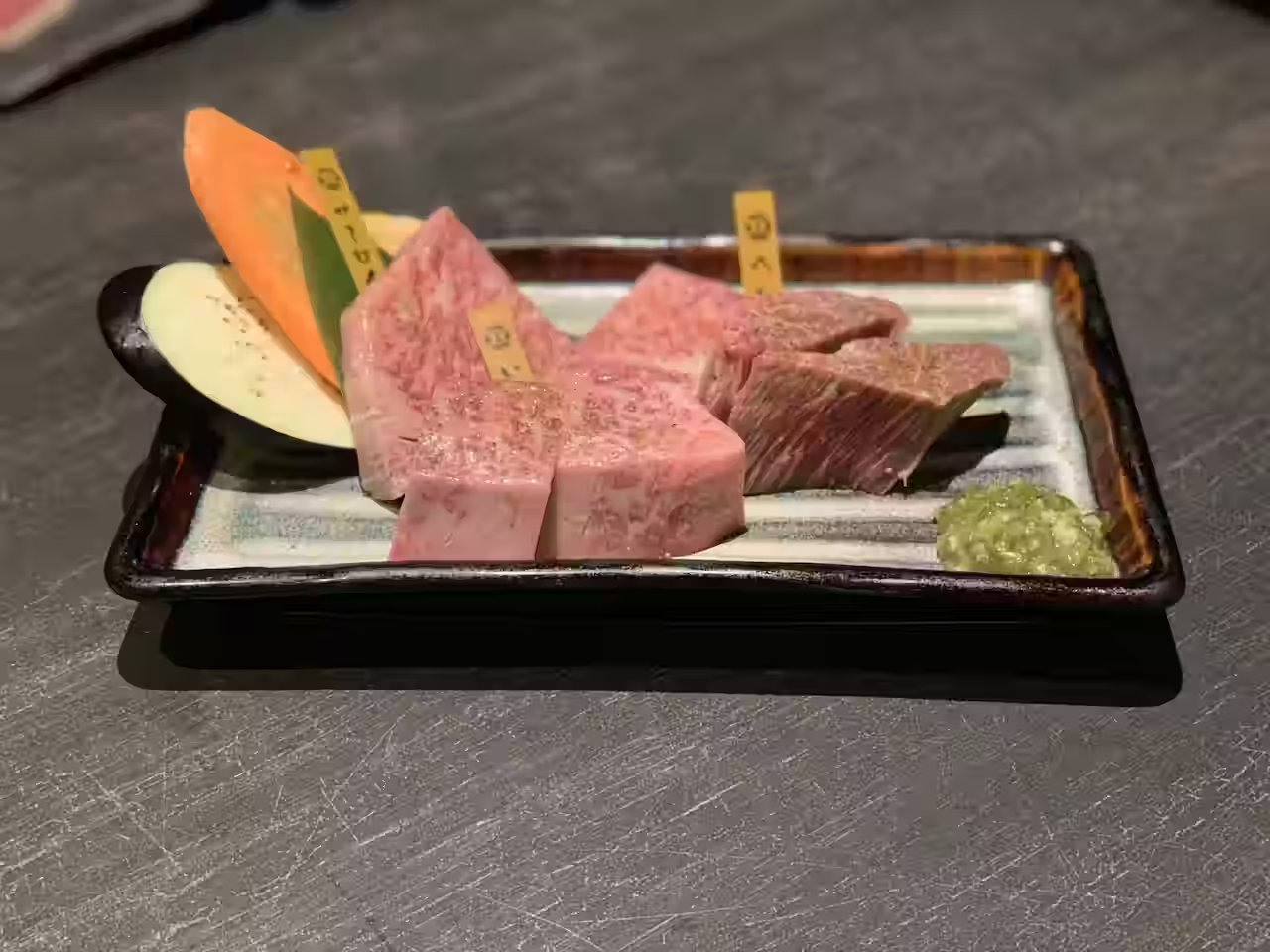
The fat in Tajima cattle is unusually fine. It distributes evenly through the meat, and when heat hits it, it melts quickly — coating the palate rather than sitting heavy. The result is a sensation that’s rich without feeling greasy. Buttery, but with structure underneath.
Beyond the texture, the umami is remarkably deep. There’s a sweetness to it that surprises people unfamiliar with high-grade Japanese wagyu. Moreover, because the fat has a relatively low melting point, even a light sear is enough to transform a thin slice completely.
That said, Tajima beef is not about excess. In other words, it’s not the kind of meat you’d eat as a large steak. Instead, small portions, simply prepared, let the flavor speak most clearly.
History and Origins of Tajima Cattle
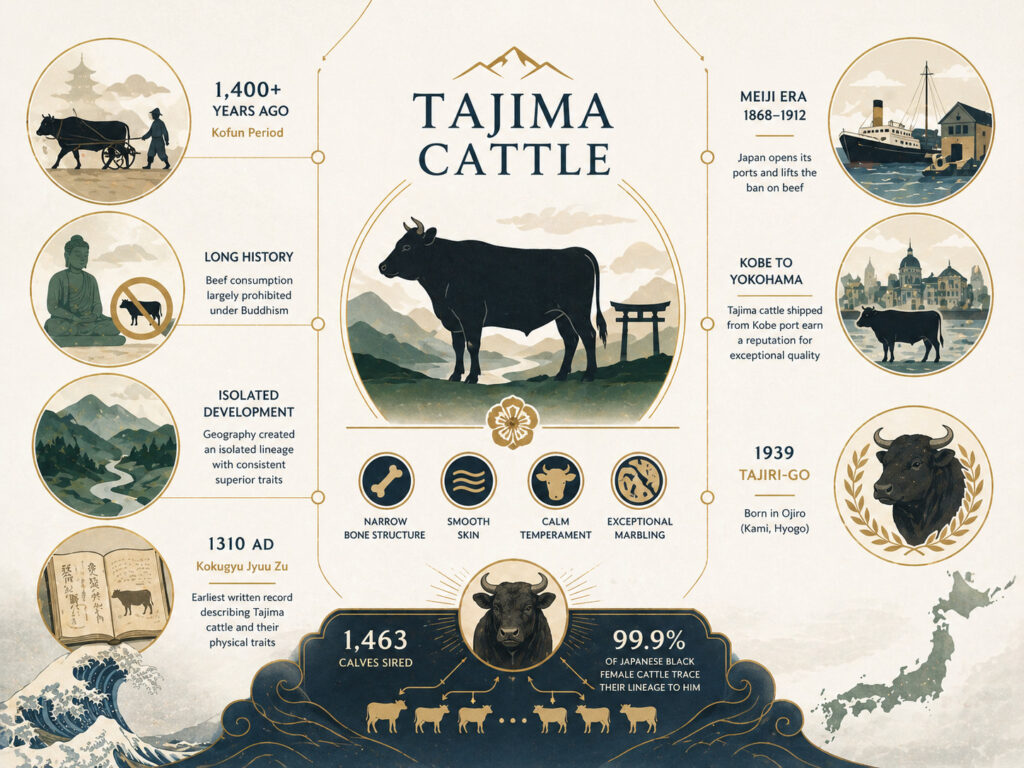
The story of Tajima beef is, in many ways, the story of Japanese wagyu itself.
Cattle arrived in Japan during the Kofun period, roughly 1,400 to 1,700 years ago. Initially, they were working animals — plowing fields, hauling goods, pulling the carts of Heian-era aristocrats. Furthermore, eating beef was largely prohibited under Buddhist influence for much of Japanese history.
Meanwhile, the Tajima region’s geography helped shape a uniquely isolated lineage. The northern mountains of Hyogo acted as a natural barrier, and trading routes into the area remained limited for centuries. As a result, local cattle bred within a closed genetic pool, gradually developing consistent traits: narrow bone structure, smooth skin, calm temperament, and a remarkable capacity for marbling.
The earliest written record describing Tajima cattle dates to 1310 AD, in a manuscript called Kokugyu Jyuu Zu. Notably, it lists specific physical traits — narrow bones, smooth body shape, wide mouth — that remain recognizable in the breed today.
The modern chapter began in the Meiji era (1868–1912). Japan opened its ports, lifted the ban on beef consumption, and suddenly wagyu entered a new era. Consequently, cattle from Hyogo, shipped from Kobe port to foreign communities in Yokohama, gained an early reputation for exceptional quality. That reputation eventually hardened into the Kobe beef brand we recognize today.
Perhaps the most consequential moment came in 1939. A bull named Tajiri-go was born in the remote Ojiro district of Kami in northern Hyogo. Over his 15-year life, he sired 1,463 calves, and his genetic influence spread rapidly across Japan. Today, a remarkable 99.9% of all registered Japanese Black female cattle in the country trace their lineage back to him. In essence, Tajima genetics became the backbone of all premium wagyu in Japan.
Tajima Beef Today: Recommended Cuts and Cooking Methods
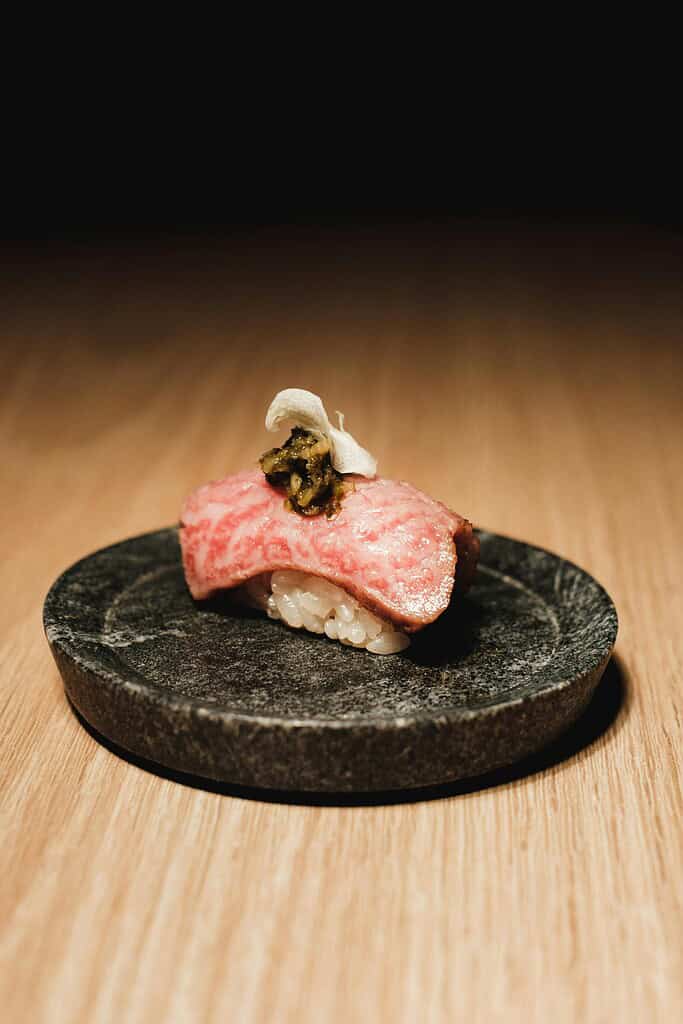
Tajima beef is best experienced in Hyogo Prefecture itself. Kansai food culture centers around refined, careful preparation, and Tajima beef fits naturally into that philosophy.
Popular cuts to look for:
- Sirloin (サーロイン): Classic choice for teppanyaki. The marbling shows most visually here.
- Ribeye (リブロース): Rich, flavorful, slightly more intense than sirloin.
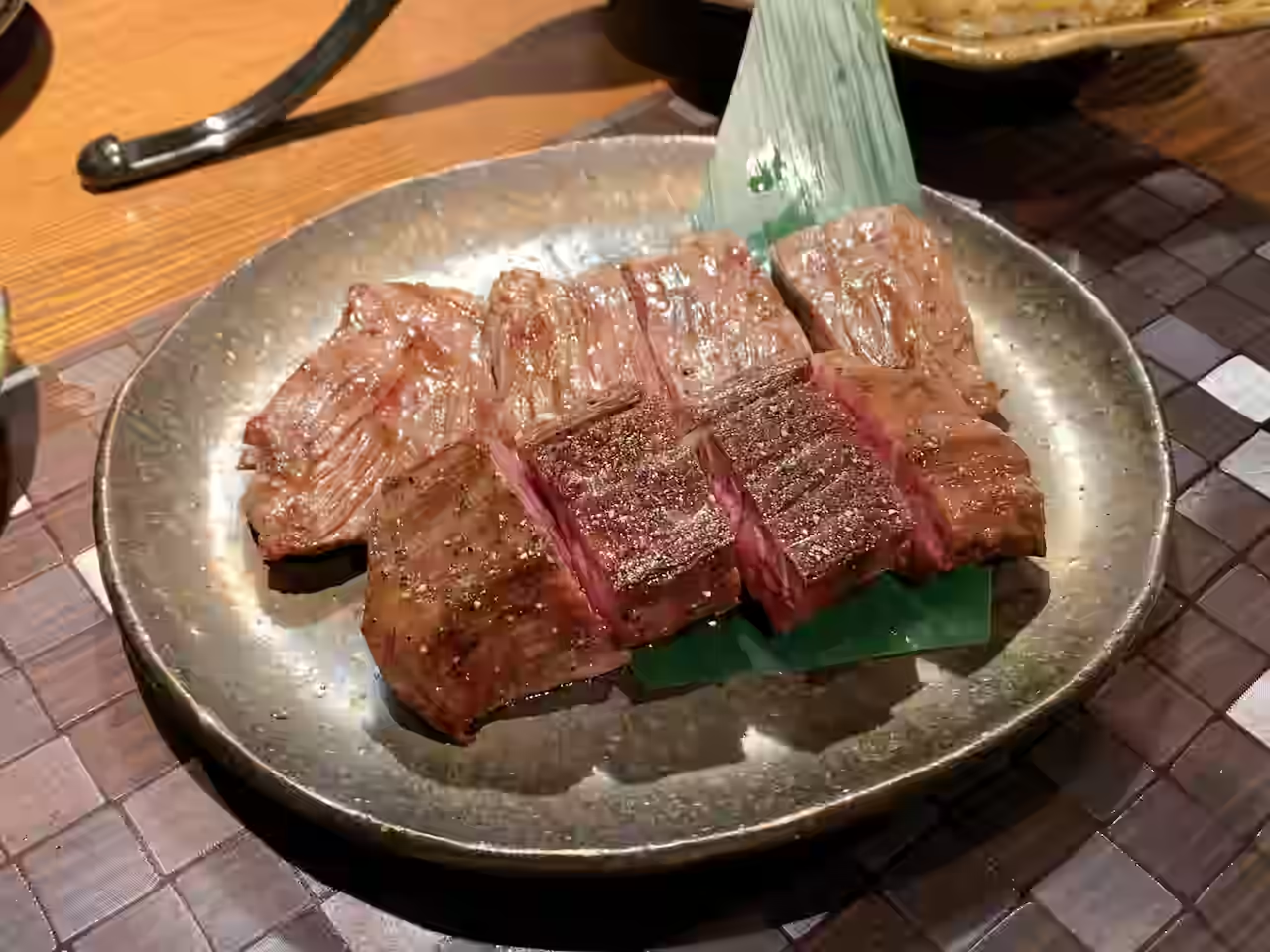
- Short rib (カルビ): Great for yakiniku grilling. Fat renders beautifully over charcoal.
- Tenderloin (ヒレ): Leaner than other cuts, but still tender and delicate.
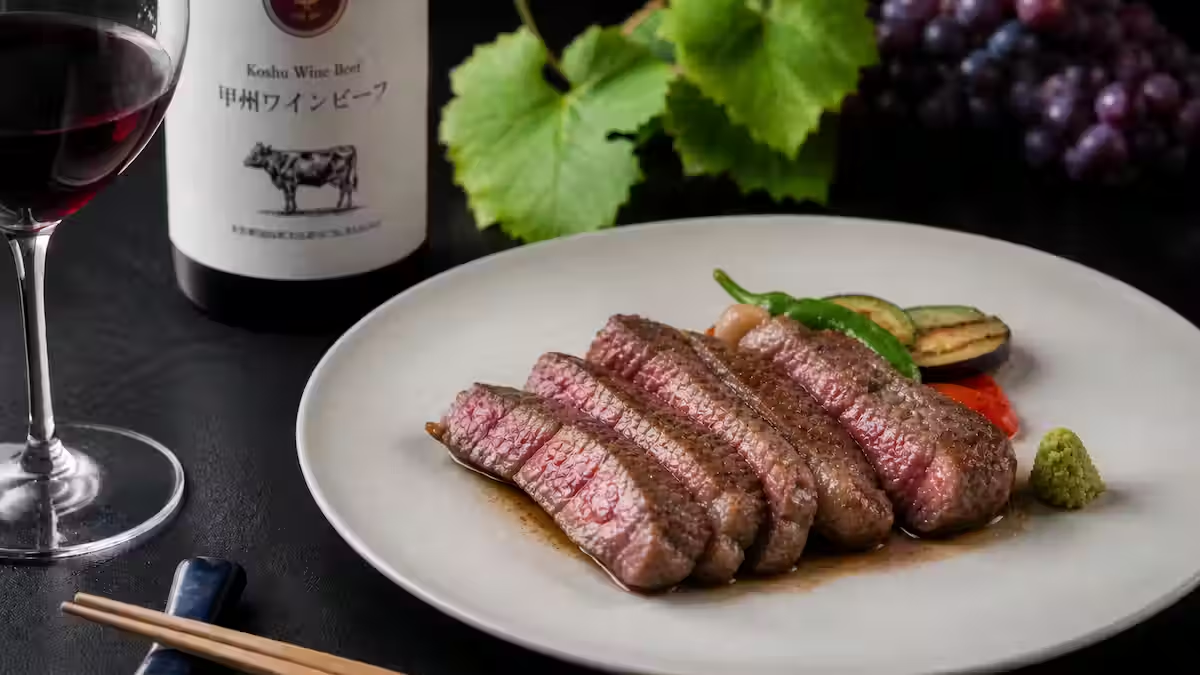
For cooking at home, a few things matter. First, use a very hot, dry pan — no oil needed, as the fat renders immediately. Then cook thin slices quickly, and let the meat rest briefly before eating. Above all, avoid overcooking. High-grade Tajima beef wagyu is usually served rare to medium-rare.
Alternatively, shabu-shabu and sukiyaki are equally excellent approaches. Thinly sliced wagyu needs only seconds in hot broth to cook through, and the fat blooms beautifully into the liquid.
Where to Find Tajima Beef in Japan
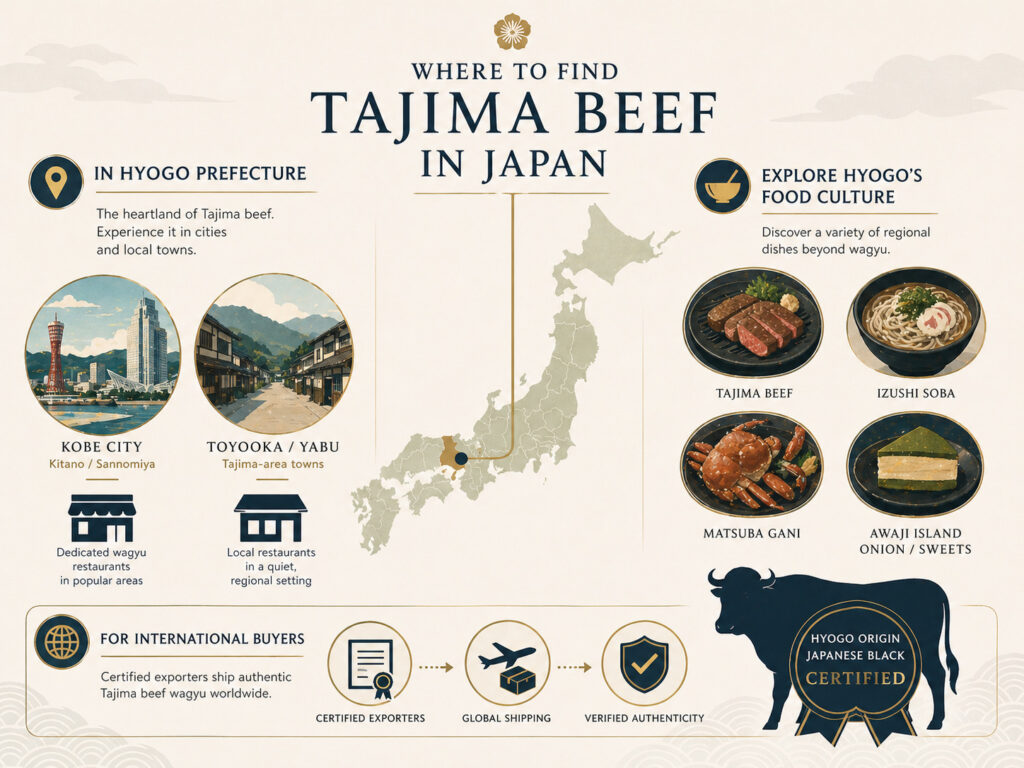
Hyogo Prefecture is the most obvious answer. Kobe City, for instance, has dedicated wagyu restaurants throughout Kitano and Sannomiya. However, Tajima-area towns like Toyooka and Yabu also offer local restaurants serving the beef in a quieter, more regional setting.
Beyond the restaurants, you can also explore Hyogo’s broader food culture — the prefecture has a surprising range of regional dishes worth discovering alongside wagyu.
For international buyers, a growing number of certified exporters now ship authentic Japanese Tajima beef wagyu overseas. In particular, the Tajima Wagyu organization has partnered with Hyogo Prefecture to create verified purchasing channels for global consumers. Always look for certification that confirms the Hyogo origin and Japanese Black breed status.
Why Tajima Beef Deserves Its Own Recognition
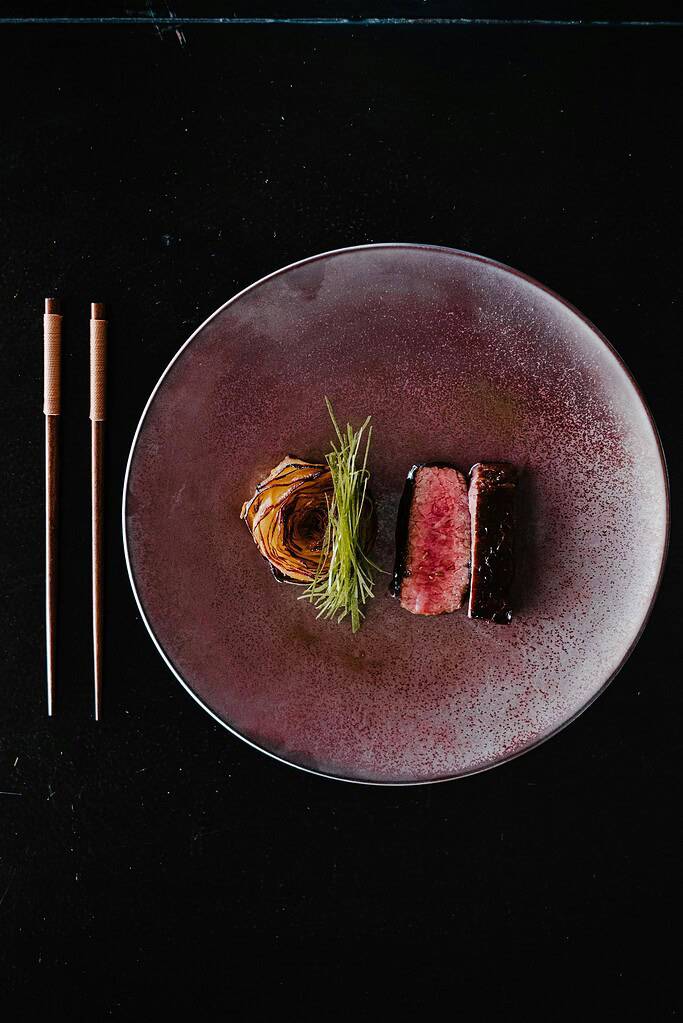
Kobe gets the headlines. That’s understandable — its brand story is compelling and its standards are exceptional. Yet Tajima beef as a category deserves to be understood on its own terms.
It’s older. More importantly, it’s the actual source. Without Tajima cattle, there is no Kobe beef, no Matsusaka beef, no Omi beef. Ultimately, the genetics that made Japanese wagyu famous around the world trace back to the same mountain valleys in northern Hyogo where Tajima cattle still graze today.
If you’re curious about Japanese wagyu more broadly and want to understand what separates one brand from another, starting with Tajima beef wagyu is the right approach. Indeed, it puts everything else in context.
This is where the story begins.
Tajima Beef FAQ
What is Tajima Beef?
It is a premium Wagyu beef from Hyogo Prefecture. Farmers raise the purebred cattle in stress-free environments. Food lovers know it for its intense marbling and rich umami flavor.
Where does Tajima Beef come from?
This high-quality meat originates from the mountainous Tajima region in northern Hyogo Prefecture. Local farmers have protected this pure bloodline carefully for centuries.
What does Tajima Beef taste like?
It delivers a rich, buttery, and deeply savory flavor. The texture feels incredibly tender and melts instantly in your mouth. Diners often compare it to eating a luxurious, savory butter.
Where can I eat Tajima Beef in Japan?
You will find the best cuts right in Hyogo Prefecture. Famous areas include Kinosaki Onsen and Kobe City. High-end steakhouses in Tokyo and Osaka also serve this premium meat daily.
How much does Tajima Beef cost?
A steak dinner typically costs between 10,000 and 30,000 yen per serving. Prices vary greatly depending on the restaurant and the specific cut you select.
Is Tajima Beef vegetarian or vegan friendly?
This ingredient consists entirely of beef. Vegans and vegetarians cannot eat this specific product, though they can easily order plant-based side dishes at the same restaurants.
What are the main ingredients in Tajima Beef dishes?
The main ingredients in a classic steak dinner include the premium beef, sea salt, and garlic. The highly marbled meat gives the dish its distinctive melt-in-your-mouth richness.
Can I cook Tajima Beef at home?
Yes, you can easily cook it at home. Premium butchers and luxury department stores stock these high-quality cuts. Home cooks grill the meat perfectly with just a hot pan and a little salt.
What is the difference between Tajima Beef and Kobe Beef?
The main difference involves the grading system. All Kobe Beef comes strictly from Tajima cattle, but inspectors only award the famous “Kobe” title to the meat meeting the highest marbling standards.
Is Tajima Beef popular outside Japan?
It enjoys massive popularity outside Japan under the broader “Wagyu” brand. High-end diners order it enthusiastically at premium steakhouses in North America, Europe, and Asia. This luxury ingredient successfully delights meat lovers all over the world.
References
- Wagyu Master Europe, “TAJIMA BEEF | Excellent Meat from Hyogo Prefecture” (2023): https://www.wagyu-master.eu/products/tajimabeef.html
- Nippon.com, “The Roots of Wagyu: From Local Cattle to Global Brand” (2026): https://www.nippon.com/en/japan-topics/b12201/
- WAMI Japan, “Tajima Wagyu: The Kobe Beef that Started a Global Craze” (2023): https://wami-japan.com/article/2405/
- Michelin Guide, “What Is Tajima Wagyu?” (2017): https://guide.michelin.com/en/article/features/what-is-tajima-wagyu




Comments