





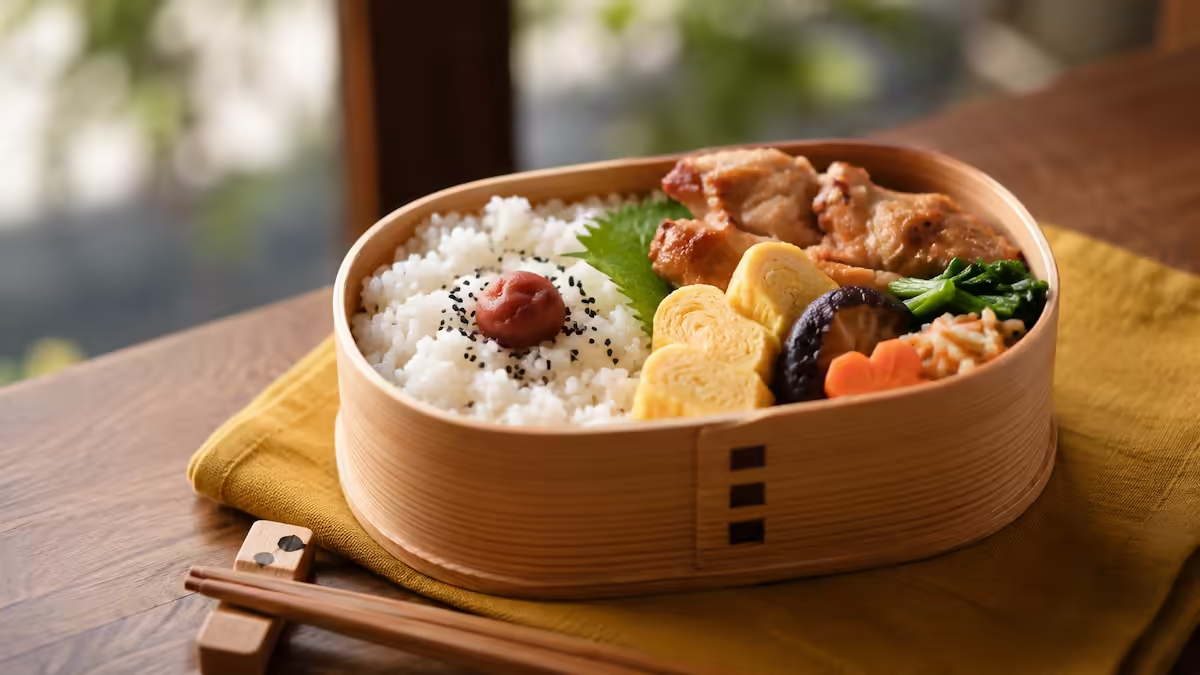
Bento (弁当) is more than a packed lunch. It is a daily ritual practiced by millions of Japanese people at home, at school, and on long train journeys. Open a bento box and you typically find rice, protein, and side dishes arranged with balance and care. Whether you pick one up at a train station or unwrap one made from scratch that morning, it reveals something genuine about Japanese food culture.
What Is Bento?
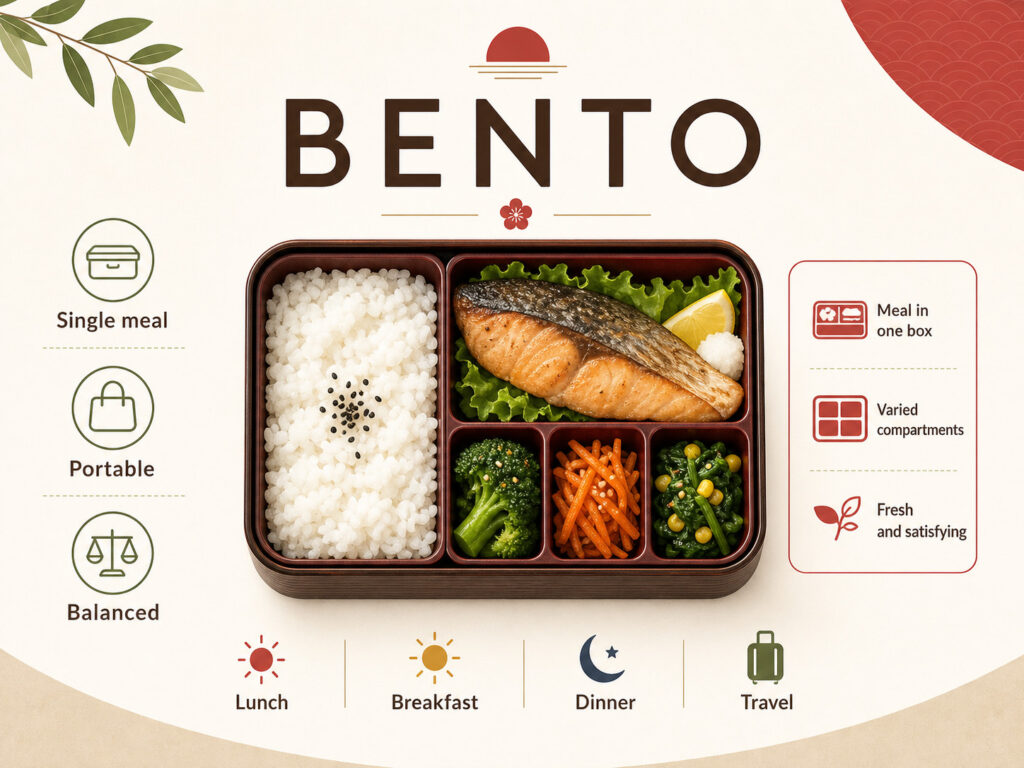
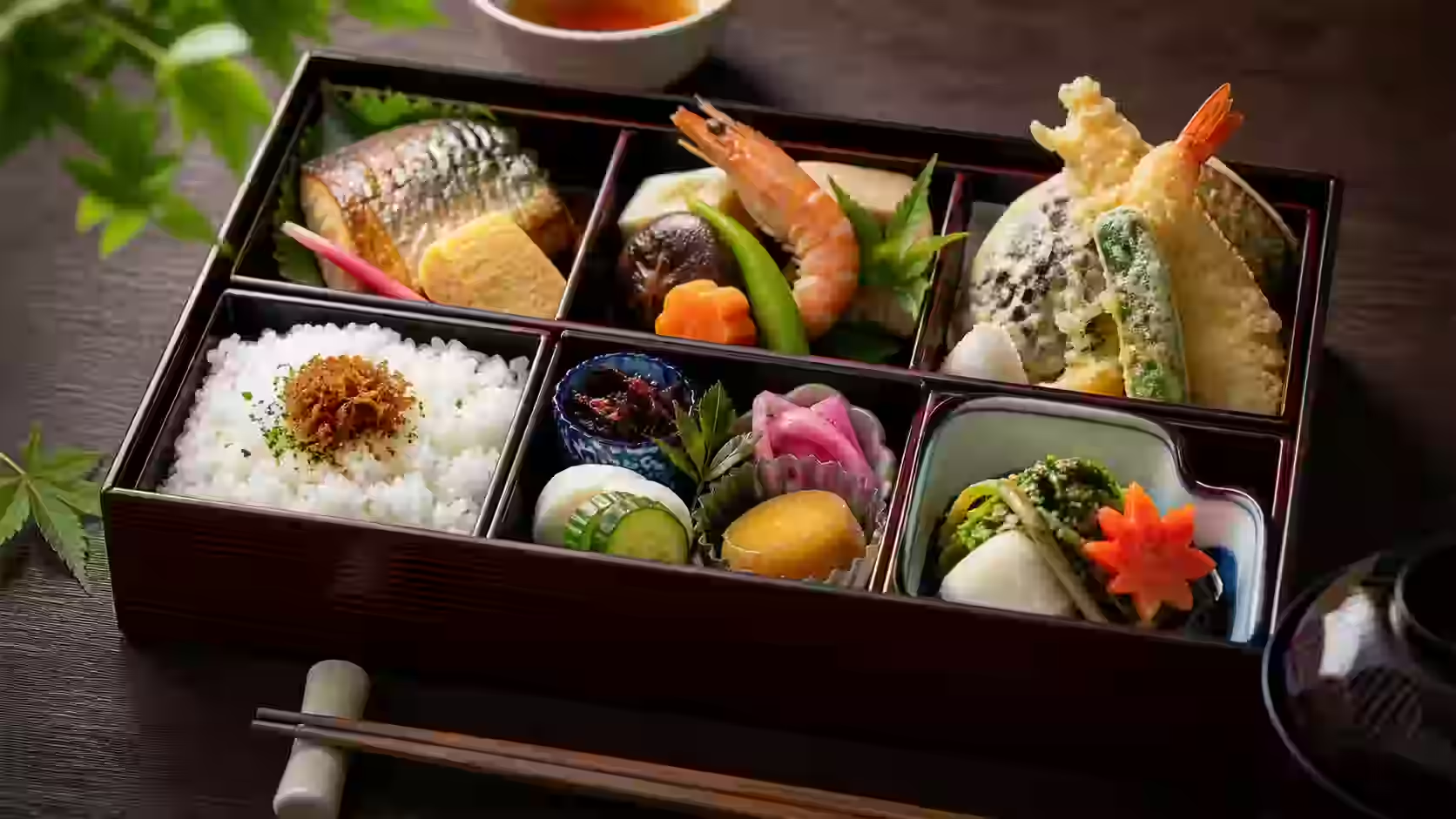
A bento is a single-portion Japanese meal packed in a box, usually with divided compartments. The box typically holds steamed white rice, a protein such as grilled fish or fried chicken, and two or three vegetable side dishes. The compartments keep flavours separate and help maintain visual balance.
The word “bento” (弁当) appears in Japanese records from the Azuchi-Momoyama period in the 16th century. At that time, it referred to something prepared in advance for later use. Over the following centuries, the concept grew from simple field rations into a culturally significant and endlessly varied food form.
It is worth noting that it is not only a lunch item. Many people eat it as breakfast, a light dinner, or a travel meal. The format is flexible. However, the core idea stays consistent: a balanced, portable, self-contained meal in one container. Another question visitors often ask is whether a Japanese bento is simply a lunch box. Technically, yes. In practice, though, the range is enormous. A ¥400 konbini option and a ¥4,000 depachika box both qualify. What separates them is craft, ingredients, and intention.
A Brief History of Bento in Japan
Japan has carried portable food for a long time. During the Kamakura period (1185-1333), farmers and travellers packed hoshi-ii — cooked and dried rice stored in small bags for fieldwork or journeys. It was humble food. Even so, the idea of a portable self-contained meal was already firmly established.
By the Edo period (1603-1868), lacquered wooden boxes appeared and packed meals became part of urban culture. Vendors sold makunouchi bento (幕の内弁当) during intermissions at kabuki theatre performances, containing rice, grilled fish, pickles, and tamagoyaki. The name “makunouchi” means “between the acts,” which gives you a sense of how naturally they fitted into the rhythm of daily social life.
A pivotal moment came in 1885. The first ekiben reportedly went on sale at Utsunomiya Station in Tochigi Prefecture — two onigiri (おにぎり) wrapped in bamboo leaf for one sen each. In time, ekiben spread to train stations across the country and became inseparable from travel culture. Post-war Japan brought further change. Schools that lacked cafeteria facilities required children to bring their own meals, and the handmade school lunch box became a cultural institution. Meanwhile, convenience stores standardised these packed meals as a national staple from the 1970s onward. Today, the format exists at every price point imaginable. That long arc from dried rice in a bag to artisan department store boxes is, in its own way, remarkable.
Main Types of Bento in Japan
Japan has no single definitive format for a bento. In fact, the variety reflects the country’s regional diversity and everyday creativity. Here are the main types you will encounter.
Homemade Bento (お弁当)
Homemade bento is the most personal form. Each morning, parents in Japan often prepare one for their child before school. Many working adults make their own, and partners sometimes pack them for each other. A typical box includes rice, tamagoyaki (rolled egg), a protein, and colourful vegetables. Visual balance matters here. Green, yellow, red, and white all have a place. For context on how school lunch culture fits into Japanese food education, our Japanese Food Education: A Comprehensive Guide to School Lunches article is a useful read.
Ekiben (駅弁)
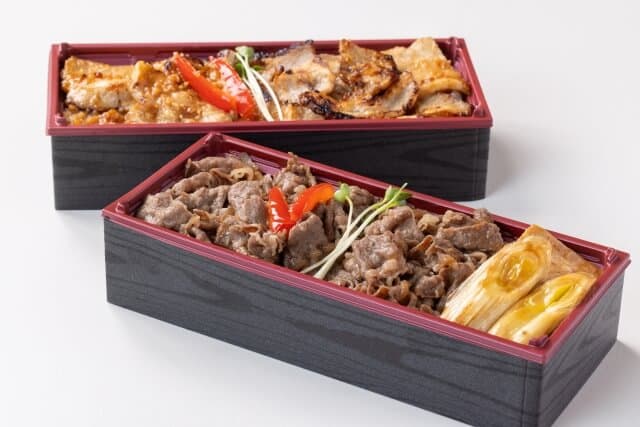
Ekiben are bento sold at train stations, typically using regional ingredients as their defining feature. Each prefecture produces its own version, and finding a good ekiben before boarding the Shinkansen is a small pleasure many travellers look forward to. Some ekiben come in decorative ceramic or wooden containers that work well as souvenirs. Well-known examples include the Shumai Bento (シウマイ弁当) from Kiyoken in Yokohama and the Hakodate Yakitori Bento (函館 焼き鳥弁当) from Hokkaido. For a full overview, see our Eki ben (駅弁) guide.
Nori Bento (海苔弁当)
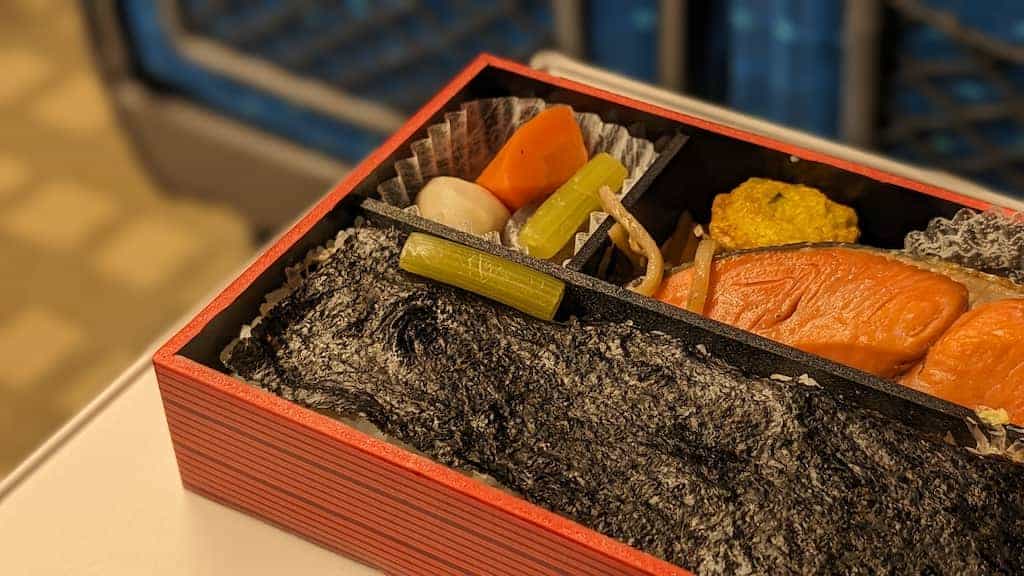
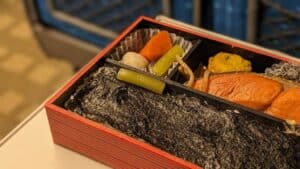
Nori bento is one of Japan’s most enduring budget classics. Rice sits underneath a sheet of soy-seasoned nori seaweed, then pairs with white fish, chikuwa tempura, and kinpira burdock root. The umami from the soy-soaked nori against the rice is simple and deeply satisfying. Moreover, it remains one of the most affordable and widely available options in Japan. Our dedicated Nori Bento (海苔弁当) article covers the history and variations in full.
Konbini Bento and Depachika Bento
Convenience store meals, known as konbini bento, offer the widest access. Chains such as 7-Eleven, FamilyMart, and Lawson produce fresh options daily, starting from around ¥400-600. The quality is consistently good for the price. At the other end of the scale, premium boxed meals from department store food basements can cost ¥1,500 to ¥5,000. These often feature premium ingredients, elegant packaging, and limited daily production. If you plan a long train journey, our Depachika Guide: Exploring the Food Basements of Japanese Department Stores explains why these basement food halls are worth the detour.
Bento vs Ekiben vs Convenience Store Bento
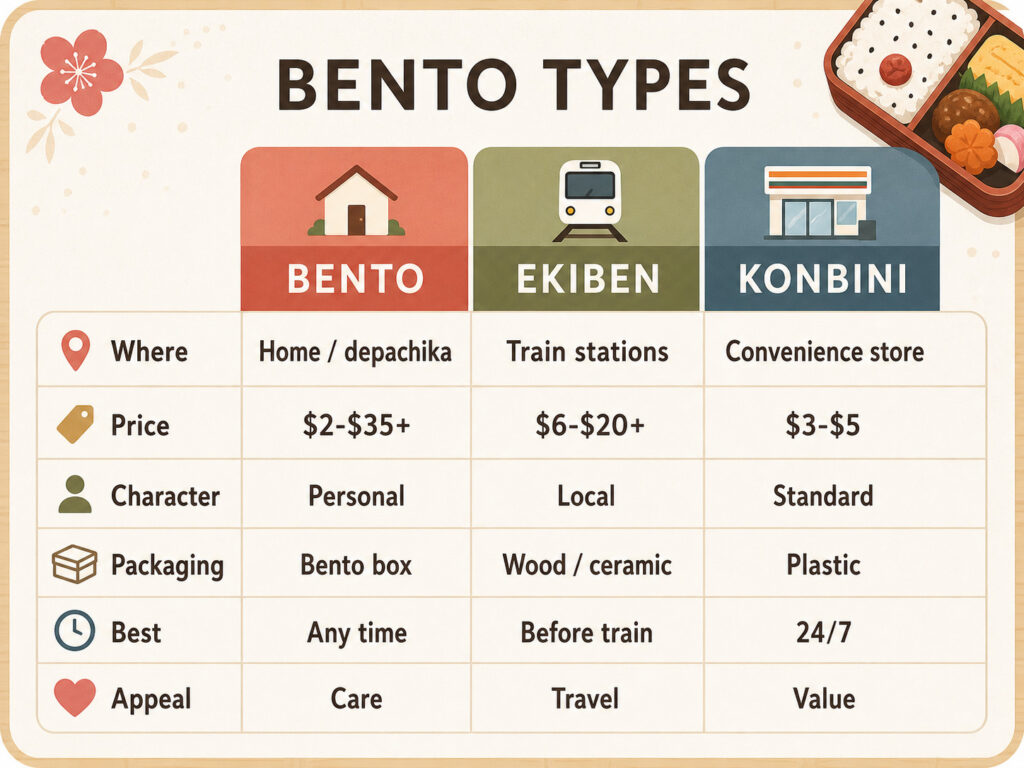
Not all bento are the same, and the differences matter when deciding what to buy. The table below summarises the three main categories most visitors and residents encounter.
| Category | Bento (General / Homemade) | Ekiben (駅弁) | Konbini Bento |
| Where sold | Made at home; also depachika | Train stations only | Convenience stores |
| Price range | ¥300 (homemade cost) to ¥5,000+ | ¥800–¥3,000+ | ¥400–¥700 |
| Regional character | Varies by household | Strong (local ingredients) | Standardised nationwide |
| Packaging | Personal bento box | Often wooden or ceramic | Plastic, uniform design |
| Best time to buy | Anytime (homemade: morning) | Before boarding the train | Anytime, 24 hours |
| Main appeal | Personalisation and care | Regional identity and travel | Convenience and value |
That said, the boundaries between categories often blur. An ekiben sold inside a department store basement is technically both ekiben and depachika bento. A konbini bento eaten on a station platform starts to feel like an ekiben experience. These categories are useful guides, not rigid definitions. Use them as a starting point rather than a strict rulebook.
Where to Buy Bento in Japan
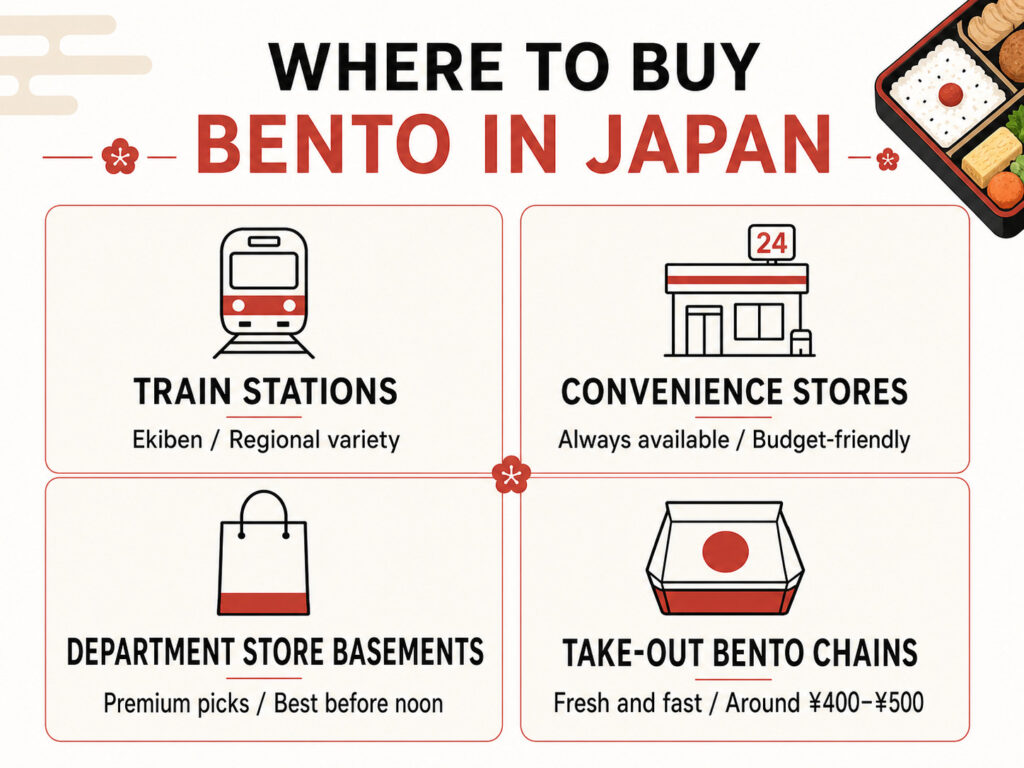
Japan makes it easy to find bento almost anywhere. Here are the main options depending on your location and budget.
Train Stations
Major stations like Tokyo Station and Shin-Osaka Station have dedicated ekiben shops with dozens of regional varieties on display. Smaller regional stations often carry one or two local bento sold at a single counter near the ticket gates. Arriving a little early gives you proper time to choose. Furthermore, Tokyo Station’s ekiben speciality floor (on the first basement level) stocks bento from prefectures across Japan in one place — a remarkable convenience for those short on travel time.
Convenience Stores (Konbini)
Convenience stores represent the most accessible bento source in Japan. New stock arrives multiple times a day, and the selection rotates seasonally. The evening discount — typically 20-30% off before closing time — is a well-known habit among students and budget travellers. Popular chains include 7-Eleven Japan, FamilyMart, and Lawson. Each chain has its own strengths; 7-Eleven is generally considered the strongest for hot meal quality.
Department Store Food Basements (Depachika)
If budget allows, depachika bento from stores like Isetan, Takashimaya, or Mitsukoshi represents the premium end of the market. Specialist vendors set up bento counters in the food basement and produce limited quantities each day. Some sell out by early afternoon. As a result, arriving before noon gives you the best selection. Our Depachika Guide covers what to expect in detail, including how to navigate the different stalls.
Take-Out Bento Chains
Chains such as Hotto Motto operate nationwide and offer freshly made bento at modest prices, with rotating menus and seasonal specials. These work well for daily lunches and are a reliable choice when time is short. Prices typically start around ¥400-¥500 for a basic meal.
Why Bento Matters in Japanese Food Culture
Bento is not simply convenient food. It carries meaning. A handmade bento communicates care, effort, and attention in ways that words often do not. Japanese parents wake early to pack bento for their children. The arrangement, colour variety, and individual contents all carry implicit messages about relationship and effort. In that sense, bento functions as a quiet form of emotional expression.
Moreover, bento reflects several core Japanese food values at once: balance between components, awareness of the season, and the belief that visual presentation is part of the meal itself. Kyaraben (character bento), where rice and side dishes form cartoon characters or animals, represents an extreme version of this attention to presentation. However, it grows from the same root as the simplest homemade box — the idea that what you pack deserves thought.
From a practical standpoint, bento also naturally encourages portion balance. The divided compartments limit each food type to a reasonable serving. Including rice, protein, and vegetables in one compact box creates nutritional variety without requiring deliberate planning. For travellers, meanwhile, bento offers an edible window into regional identity. The ingredients inside an ekiben from Toyama differ fundamentally from one originating in Kagoshima. In this respect, eating through regional bento during a train journey through Japan is one of the most rewarding and underrated ways to understand the country’s food geography.
Conclusion
Bento is one of those things that seems simple until you look closely. Then it reveals centuries of food culture, regional identity, practical creativity, and quiet care. For visitors to Japan, trying different types — a konbini bento during a quick lunch break, an ekiben on the Shinkansen, a depachika bento before a long journey — is one of the most accessible and genuinely rewarding ways to engage with Japanese food.
There is no single right bento. There is only the one that fits the moment. That flexibility is probably what has kept the format relevant for several centuries, and why it shows no signs of changing anytime soon.
Want to explore specific types of bento further? Check out our guides to Eki ben (駅弁), Nori Bento (海苔弁当), and Shumai Bento (シウマイ弁当) for more detail on Japan’s most beloved bento traditions.
FAQ
What is the difference between bento and ekiben?
Bento is a broad term for any single-portion Japanese packed meal. Ekiben is a specific sub-category: bento sold at train stations (eki means station, ben is short for bento). The key difference is context and regional focus. Ekiben use locally sourced ingredients unique to each region, and sellers design them for travel. In contrast, a regular bento can contain anything and come from any setting. All ekiben are bento, but most bento are not ekiben.
Are convenience store bento in Japan worth buying?
Yes, genuinely. Japanese konbini bento regularly surprise first-time visitors with their quality. Convenience store food development teams in Japan operate at a level comparable to mid-range restaurants in other countries. The rice quality, seasoning balance, and freshness are all consistently good. For a quick, affordable, and satisfying meal — especially between ¥400 and ¥600 — konbini bento is one of the better choices available in Japan. The evening discount (typically around 7-8pm) makes them even better value.
What do Japanese people typically put in a homemade bento?
A typical homemade bento in Japan contains steamed white rice, a protein such as karaage (fried chicken), grilled fish, or hamburger steak (hambagu), and two or three side dishes. Common side dishes include tamagoyaki (sweet rolled egg), broccoli with sesame, kinpira burdock root, and cherry tomatoes or cucumber slices. The goal is colour variety across the box — green, yellow, red, and white — because visual balance signals nutritional balance. Many home cooks also add a small portion of pickled vegetables for flavour contrast.
How much does bento cost in Japan?
Prices vary widely depending on type and location. Convenience store bento typically costs ¥400-¥700. Take-out bento chain bento ranges from ¥400-¥600. Ekiben at train stations usually runs ¥800-¥3,000 depending on ingredients and packaging. Depachika bento from department store food basements can reach ¥1,500-¥5,000 for premium options. As a general rule, the higher the price, the more specialised the ingredients and the more refined the presentation. However, a ¥500 konbini bento on a busy weekday is by no means a lesser meal — context matters.
Can vegetarians find bento in Japan?
It requires some effort, but options exist. Most standard bento contains fish sauce, dashi, or meat, so reading labels carefully is important. That said, many depachika bento counters in major cities now offer vegetable-focused or tofu-based bento. Some convenience stores label bento with allergen and ingredient information. Additionally, homemade bento is naturally adaptable — any standard recipe works well with vegetables, tofu, or egg substitutions. Asking at specialty natural food stores or vegetarian restaurants for takeout bento is also a reliable approach in larger cities.
References
- Japan National Tourism Organization https://www.japan.travel/en/guide/experience-japans-local-ekiben-culture/ (Surveyed: June 2026)
- Wikipedia — Bento https://en.wikipedia.org/wiki/Bento (Surveyed: June 2026)
- Wikipedia — Ekiben https://en.wikipedia.org/wiki/Ekiben (Surveyed: June 2026)
Related Articles
- Eki ben (駅弁) (Surveyed: June 2026)
- Nori Bento (海苔弁当) (Surveyed: June 2026)
- Shumai Bento (シウマイ弁当) (Surveyed: June 2026)
- Japanese Food Education: A Comprehensive Guide to School Lunches (Surveyed: June 2026)
- Depachika Guide: Exploring the Food Basements of Japanese Department Stores (Surveyed: June 2026)
- Hakodate Yakitori Bento (函館 焼き鳥弁当) (Surveyed: June 2026)




Comments