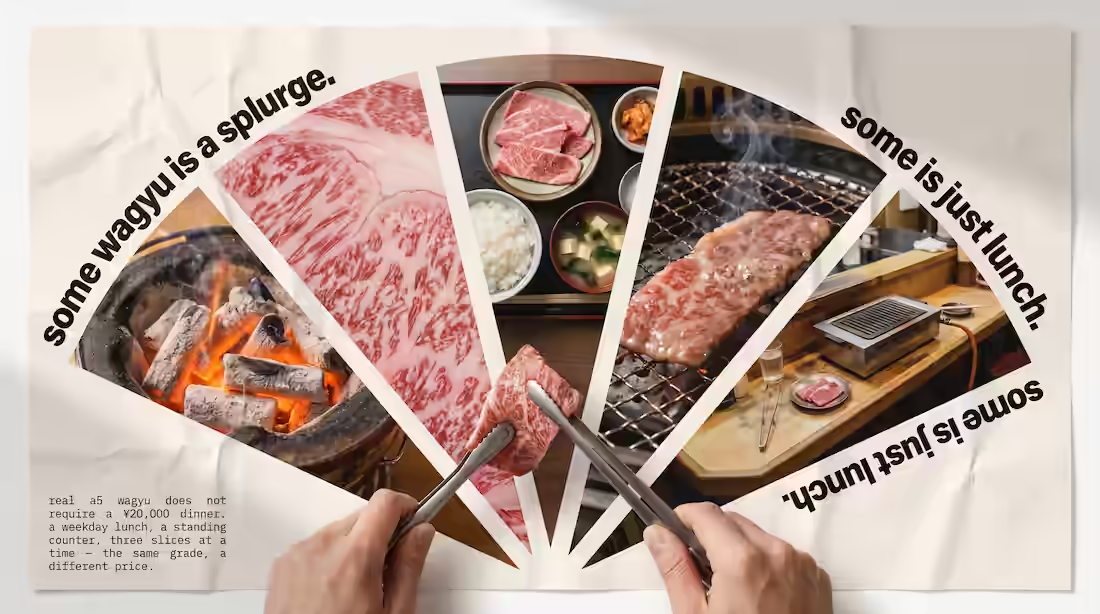
You are standing outside a Tokyo yakiniku shop, and the lunch board reads “A5 Wagyu set, ¥2,980.” Is it genuinely A5, or is there a catch? A5 is the highest combination in Japan’s beef carcass grading system, although it describes a grade rather than a breed or a regional brand. Either way, you can eat the real thing for well under $35.
This guide covers where to go, what to order, how much to budget, and how to spot genuine A5 behind clever menu wording. However, the cheapest routes rarely look like the ones travel magazines photograph.
TOC
Quick Answer: The Cheapest Ways to Eat A5 Wagyu in Japan
Yes, you can eat real A5 Wagyu in Japan for under $35. The three easiest routes are a weekday Wagyu yakiniku lunch, a standing yakiniku counter that sells beef one slice at a time, and a small tasting portion at a steak or yakiniku restaurant. Budget roughly ¥2,500 to ¥5,000 per person, depending on the city, the cut and the meal period.
What “under $35” means here
About ¥5,000 or less per person, before drinks
Realistic sweet spot
¥2,500–¥3,500 for a full Wagyu lunch set
Cheapest entry point
Standing yakiniku, where single slices start at a few hundred yen
Best time of day
Weekday lunch, typically 11:00–14:00
What A5 actually is
A grading result, not a brand and not a place name
What A5 is not
A synonym for Kobe beef or Matsusaka beef
If you want the short version, here is how the four restaurants covered later in this guide compare.
Best for guaranteed A5: Hitori Yakiniku Misono, Ikebukuro
Best for ordering one slice at a time: Jiromaru, Ogikubo and Noge
Best for nationwide convenience: Yakiniku Like, although it does not disclose a grade
Best for certified Kobe beef: Steak Land Kobe-kan, although Kobe beef is not always A5
A Note on Prices and Exchange Rates
One note before you plan anything. Exchange rates move constantly, so treat every foreign-currency figure below as an approximation rather than a quote. At the rates we checked on 28 August 2026, ¥5,000 sat near $31 USD, C$43 and £23. Canadian and British readers should therefore aim lower in yen than American readers do.
Yen prices move too. Every figure below reflects the menus published on 28 August 2026, and Japanese restaurant prices have risen noticeably in recent years. Beef pricing in particular responds quickly to feed costs, energy costs and inbound tourist demand, so a set that costs ¥3,280 today may well cost more by the time you visit. Treat these numbers as reference points, then confirm the current menu before you travel.
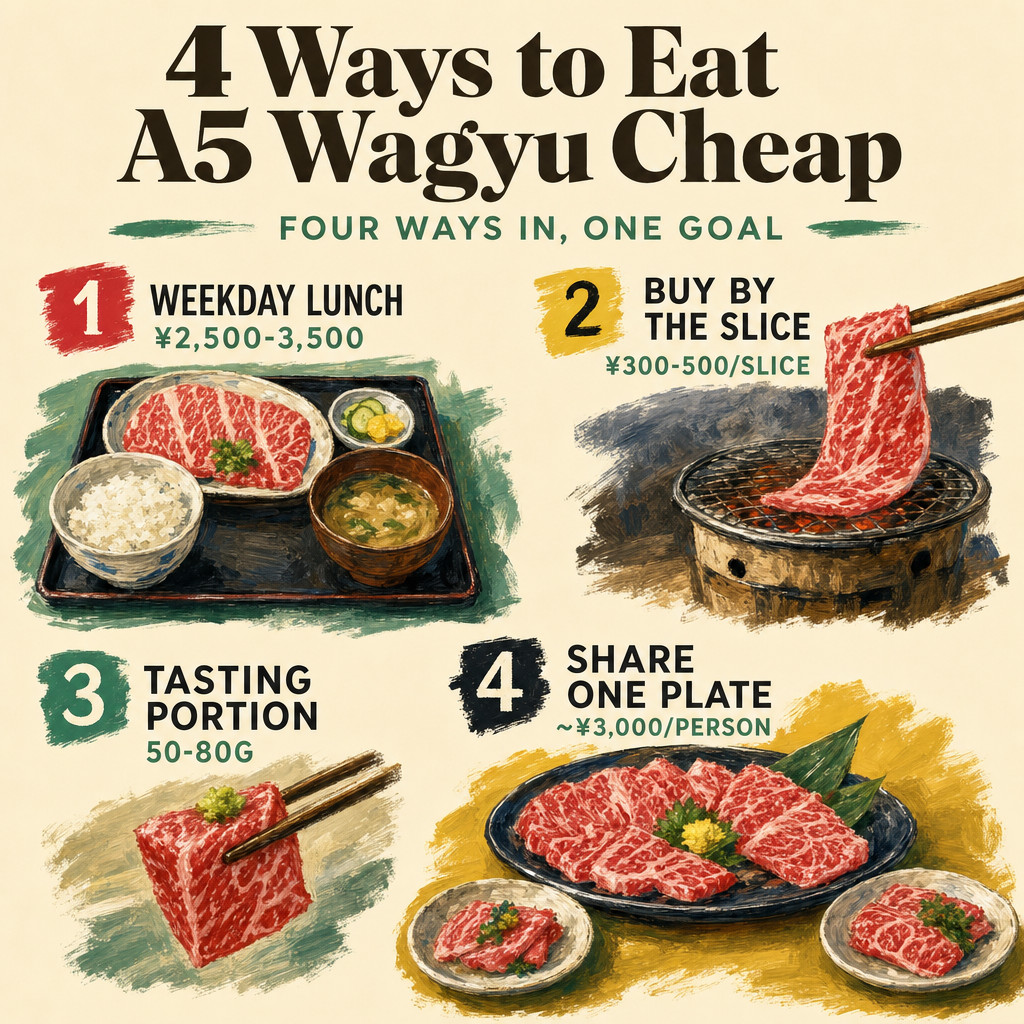
Option 1: Order a Weekday Wagyu Yakiniku Lunch
Lunch remains the single easiest way to eat premium Wagyu cheaply. Some premium restaurants offer smaller weekday lunch sets at substantially lower prices than their dinner menus, because the portion shrinks and the kitchen turns tables faster. Rice, soup and a small salad usually come included, which pushes the perceived value up further.
Still, read the wording closely. A set labelled “Kuroge Wagyu lunch” promises Japanese Black cattle, not a specific grade. Only a menu that explicitly identifies a cut as A5 is claiming that particular item is A5, and a printed claim is not the same as independent proof. For stronger verification, ask whether the restaurant can show a grading certificate or an individual identification number.
Cheaper sets also tend to include a smaller weight of the graded beef, so check the gram count before you decide whether the deal genuinely works for you.
A5 Wagyu yakiniku lunch set
¥2,500–¥3,500
approx. $16–$22 USD / C$22–C$30 / £12–£16
Option 2: Try Standing Yakiniku and Buy by the Slice
Standing yakiniku shops sell beef the way a sushi counter sells nigiri, one piece at a time. Because you control every order, you also control the bill precisely. The format works particularly well for solo travellers, and equally well for couples who want to compare five cuts instead of committing to one large plate.
Tachigui Yakiniku Jiromaru, the best-known chain in this category, advertises meat from ¥30 per slice with A5 Wagyu around ¥300, and its menu changes daily. Do watch the extras, though. Rice, drinks, kimchi and tax add up quickly, and a “cheap” counter visit can quietly reach ¥3,000 once you order a beer and a bowl of rice.
A4/A5 Wagyu by the slice
¥300–¥500 per slice
approx. $2–$3 USD
Option 3: Order a Small A5 Tasting Portion
Plenty of steakhouses and yakiniku restaurants offer 50g, 60g or 80g portions specifically for guests who want a taste rather than a meal. Order one of those instead of a 200g steak. Heavily marbled A5 delivers far more fat per bite than an ordinary sirloin, so a small serving satisfies many diners more than they expect.
Look for menu terms such as tasting portion, Wagyu comparison, or three-cut assortment. Pairing one lean cut with one marbled cut works especially well, because the contrast teaches you more about Wagyu than either piece would alone.
Option 4: Share One Premium Plate
Travelling with someone? Order a single A5 assortment for the table, then fill the rest of the meal with rice, vegetables, soup and standard-grade beef. Two people can split one ¥4,000 Wagyu plate and still walk out at roughly ¥3,000 each including sides. Consequently, you get the A5 experience without paying A5 prices for every mouthful.
Sample A5 Wagyu Meals for Three Budgets
Abstract price ranges help less than actual orders. Below are three realistic combinations, built from the kinds of menus you will meet in Tokyo, Osaka and Kobe. However, these are illustrative budget models rather than fixed menus at any specific restaurant, and actual portions, side dishes and prices vary by shop. Screenshot whichever one matches your budget.
¥2,000 Budget: A Few Slices and a Bowl of Rice
Three or four slices of A5 Wagyu
One bowl of rice
Soup or kimchi
Water or free tea
This works best at a standing counter. You will not leave full, but you will taste genuine A5 for roughly the price of a bowl of ramen in central Tokyo.
Estimated total
¥1,500–¥2,000
approx. $9–$13 USD / C$13–C$17 / £7–£9
¥3,500 Budget: A Complete Wagyu Lunch
An A5 Wagyu yakiniku lunch set
Rice, soup and salad included
One or two extra slices of a rarer cut
Free tea or water
Many travellers find this tier the best value of the three. Additionally, lunch sets typically arrive within ten minutes, which suits a packed sightseeing day.
Estimated total
¥3,000–¥3,500
approx. $19–$22 USD / C$26–C$30 / £14–£16
¥5,000 Budget: A Proper A5 Tasting
Three cuts of A5 Wagyu
Beef tongue or skirt
Rice
Kimchi or namul
One drink
Here the point shifts from eating cheaply to comparing cuts intelligently. Because you are ordering three different pieces, you learn what marbling actually does to texture. This tier still lands under $35 for American readers, although Canadian and British readers will find it sits slightly above their own $35 or £20 line.
Estimated total
¥4,000–¥5,000
approx. $25–$31 USD / C$35–C$43 / £18–£23
Where to Eat Affordable A5 Wagyu and Premium Japanese Beef
Restaurant listings age badly, and Wagyu listings age worse than most. We checked each of the four below against official company sources on 28 August 2026. Crucially, only two of them guarantee A5, so each heading states the grade situation up front. Even so, confirm hours and prices on the restaurant’s own site before you travel across a city for lunch.
Jiromaru: A4 or A5, Varying Daily (Ogikubo and Noge)
Jiromaru pioneered the standing Wagyu counter, and its own site still promises A4 and A5 beef from ¥30 a slice with a menu that rotates daily. Importantly, the chain has shrunk. Only the Ogikubo and Noge branches appear on the official store list today, because the Dogenzaka branch in Shibuya closed in July 2025 and several earlier Tokyo locations closed before that.
Older travel articles still list Shinjuku, Shibuya and Akihabara addresses. Ignore them. Ogikubo sits about twenty minutes west of Shinjuku on the JR Chuo Line, so treat it as a small detour rather than a spontaneous stop.
Areas
Ogikubo (Suginami, Tokyo) and Noge (Naka Ward, Yokohama)
Why it is budget-friendly
Single-slice ordering, so no need to commit to a full plate of one cut
Stated grade
A4 and A5, varying daily
Recommended order
Three or four cuts, plus rice
Reservations
Not accepted; the chain states it cannot hold meeting spots
Misono opened in 2016 beside the west exit of Ikebukuro Station and built its whole model around solo diners. The shop buys A5 Japanese Black cattle whole rather than by the cut, which lets it list roughly 55 individual cuts and sell each of them one slice at a time. Every seat gets its own grill, so nobody negotiates over the shared surface.
The restaurant says its whole-carcass purchasing and direct sourcing keep prices below those of many conventional A5 restaurants. Lunch service runs a narrow window around midday, whereas dinner stretches late into the night. Consequently, an early lunch visit tends to be the cheapest and quietest way in.
Area
Nishi-Ikebukuro, Toshima Ward, Tokyo
Why it is budget-friendly
Whole-carcass buying, single-slice ordering
Stated grade
A5 Japanese Black
Recommended order
A mixed assortment, then one rare cut on its own
Format
Counter seats, one grill per person
Checked
28 August 2026
Yakiniku Like: Kuroge Wagyu, Grade Not Disclosed (Nationwide)
Yakiniku Like runs a fast-food take on solo yakiniku, with one smokeless grill per seat and multilingual menus in most branches. Its Wagyu Premium 4 platter of four Japanese Black cuts comes with rice, soup and kimchi from ¥3,280 including tax. Rice refills stay free from opening until 17:00, which quietly improves the value of any set.
Note the wording carefully, because this is a useful teaching example. The chain markets that platter as Kuroge Wagyu, meaning Japanese Black cattle, and it does not publish a grade. Therefore treat Yakiniku Like as reliable, convenient Wagyu rather than as guaranteed A5. For a first-night meal near your hotel, that trade-off usually feels fair.
Areas
Branches across Japan, including Shinjuku, Shimbashi, Ueno and Asakusa
Why it is budget-friendly
Fast-food pricing, no service charge, sets from ¥890
Stated grade
Kuroge Wagyu; grade not published
Recommended order
Wagyu Premium 4 set from ¥3,280
Languages
Japanese, English, Korean and Chinese menus
Reservations
Not accepted at any branch
Checked
28 August 2026
Steak Land Kobe-kan: Certified Kobe Beef, Not Necessarily A5 (Sannomiya)
If you want certified Kobe beef rather than generic A5, Sannomiya offers the cheapest realistic entry point in Japan. Steak Land Kobe-kan lists a Kobe beef steak lunch at 150g for ¥3,500 including tax, served with salad, grilled vegetables, rice, miso soup, pickles and coffee. Lunch runs from 11:00 to 14:00 only.
Read the grade question carefully here. The restaurant identifies this lunch as certified Kobe beef, yet it does not advertise the meat as A5. Kobe beef can qualify at A4, B4, A5 or B5, so do not assume that the ¥3,500 lunch is A5.
Dinner options using Kobe beef cost considerably more, although portions and included dishes differ from the lunch set. The ¥3,500 lunch is therefore the clearest budget entry point. Arrive early, though, because queues form quickly once the counter fills, particularly on weekends and during holiday periods.
Area
Kitanagasa-dori, Chuo Ward, Kobe, one minute from Sannomiya
Why it is budget-friendly
Lunch-only pricing on certified Kobe beef
Stated grade
Certified Kobe beef; also cheaper Wagyu and non-branded sets
Recommended order
Kobe beef steak lunch, 150g, ¥3,500
Watch for
Lunch service runs 11:00–14:00 only
Official site
steakland-kobe.jp
Checked
28 August 2026
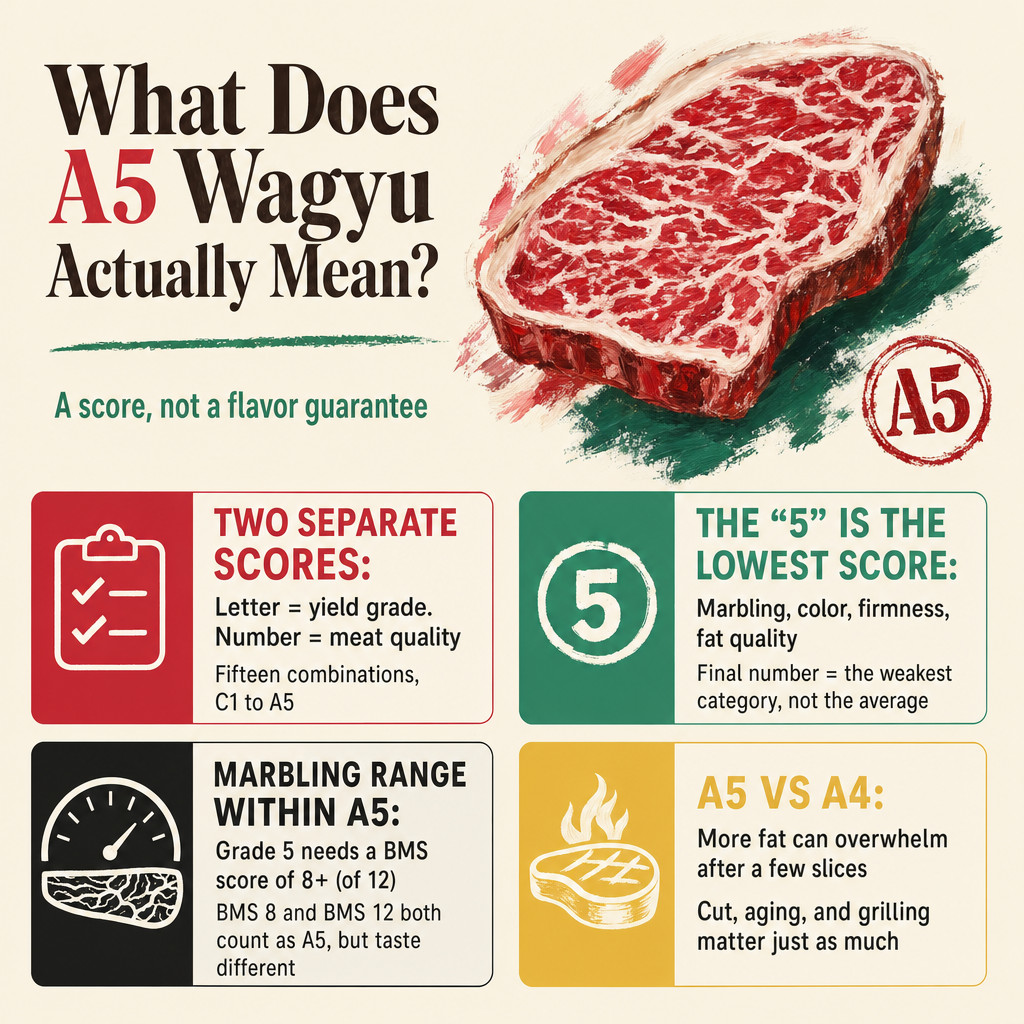
What Does A5 Wagyu Actually Mean?
Infographic explaining A5 Wagyu grading, marbling, and quality standards in Japan.
Japan’s Meat Grading Association scores every carcass on two separate axes, then prints both results together. Our guide to the Wagyu ranking system walks through every sub-criterion in detail. The letter describes yield. The number describes meat quality. Fifteen combinations exist in total, running from C1 at the bottom to A5 at the top.
The “A” Is a Yield Grade
Graders measure the ribeye area, the thickness of the belly, the thickness of the subcutaneous fat and the chilled carcass weight, then run those four figures through a fixed formula. A score of 72 or above earns an A. Scores between 69 and 72 earn a B, and anything under 69 earns a C.
In other words, the letter tells you how much saleable meat the butcher can recover from the carcass. It says nothing about flavour. For diners, therefore, the number is usually the more relevant half of the label.
The “5” Is a Meat Quality Grade
Graders judge four separate qualities, and the rule that follows surprises many readers. The final number equals the lowest of the four scores, not the average. One weak category therefore drags the whole carcass down, however spectacular the marbling looks.
Quality item
What graders look at
Marbling
Fat distribution in the ribeye, scored on the BMS scale
Meat colour and lustre
Colour matched against the BCS reference standard
Firmness and texture
How tight and fine-grained the muscle appears
Fat colour and quality
Fat colour matched against the BFS reference standard
For marbling specifically, grade 5 requires a BMS score of No.8 or higher on a twelve-point scale. Grade 4 starts at No.5. That gap matters when you eat, because BMS 8 and BMS 12 both count as A5 while tasting noticeably different.
Worth knowing: the grading standard applies to every carcass regardless of breed, age or sex, apart from calves. A5 is therefore a score, not a guarantee that the animal was Wagyu at all. In practice, A5 beef sold to travellers as premium Wagyu is usually Japanese Black, yet the grade alone does not establish the breed.
Is A5 Always Better Than A4?
On paper, yes. At the table, not necessarily. A5 carries substantially more intramuscular fat, and that richness overwhelms some diners after four or five slices. Some diners deliberately order A4 when they plan a long meal, because the leaner balance lets them keep eating.
Beyond the grade, the cut matters enormously. So does the thickness of the slice, the ageing, and how well you grill it. If your budget stretches to two orders, try one A4 and one A5 side by side. Honestly, that comparison teaches you more in five minutes than any article can.
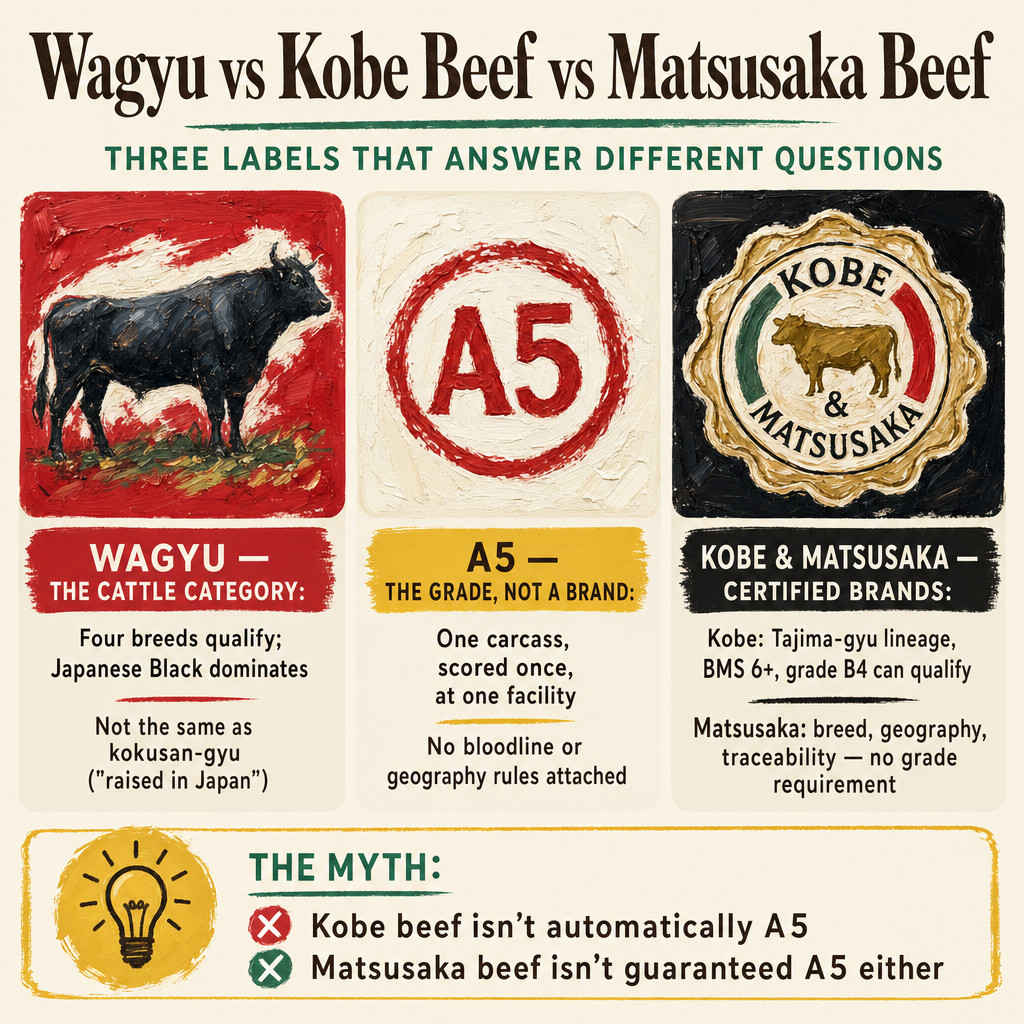
Wagyu vs. Kobe Beef vs. Matsusaka Beef
Travellers conflate these three constantly, and restaurants rarely correct them. Getting the distinction straight protects your budget, because branded beef costs far more than equally graded unbranded beef.
Wagyu
The cattle category
A5
The grading result
Kobe and Matsusaka
Certified regional brands
Wagyu Is a Cattle Category
Four breeds qualify as Wagyu: Japanese Black, Japanese Brown, Japanese Shorthorn and Japanese Polled. Japanese Black dominates the market and accounts for essentially all the heavily marbled beef you will meet. Meanwhile, a completely separate label, kokusan-gyu or domestic beef, simply means the animal was raised in Japan. Breed and origin play no part in that second term.
Menus sometimes blur the two. If a set costs suspiciously little and says kokusan-gyu, you are probably looking at domestic beef rather than Wagyu.
A5 Is a Grade, Not a Brand
A5 describes how one carcass scored on one day at one facility. Kobe and Matsusaka, by contrast, describe production systems with their own bloodline rules, geographic boundaries and certification paperwork. A farm cannot apply for A5 status, whereas it must apply and qualify to sell under a regional brand.
Kobe Beef Is a Certified Regional Brand
The Kobe Beef Marketing and Distribution Promotion Association certifies Kobe beef, and the rules apply in two stages. First an animal must qualify as Tajima-gyu, which requires Hyogo bloodlines, Hyogo rearing by registered producers, and slaughter within the prefecture.
Only a subset of that Tajima-gyu then becomes Kobe beef. The animal must be a virgin cow or a steer, must reach yield grade A or B with quality grade 4 or above, must score BMS No.6 or higher, and must fall inside a defined carcass weight band.
The myth this kills: Kobe beef is not automatically A5. Quality grade 4 clears the bar, and yield grade B qualifies too. A B4 carcass can legitimately be Kobe beef, while an A5 carcass from Miyazaki cannot. Grade and brand run on entirely separate tracks.
Restaurants that genuinely serve it register with the association and display a bronze statue at the entrance. If a menu says “Kobe-style,” you are reading marketing rather than certification.
Matsusaka Beef Follows Different Rules Entirely
Matsusaka beef, by comparison, defines itself through breed, sex, geography and traceability rather than through grade. The official definition requires a Japanese Black virgin cow registered in the Matsusaka Beef Individual Identification Management System, whose longest and final fattening period took place inside the designated Matsusaka production area. Calves must enter that area by twelve months of age.
Notice what the definition omits. No minimum grade appears anywhere in it, so Matsusaka beef carries no guarantee of A5 either. A stricter sub-category called Tokusan Matsusaka Ushi adds a long-fattening requirement, though it remains rare and expensive.
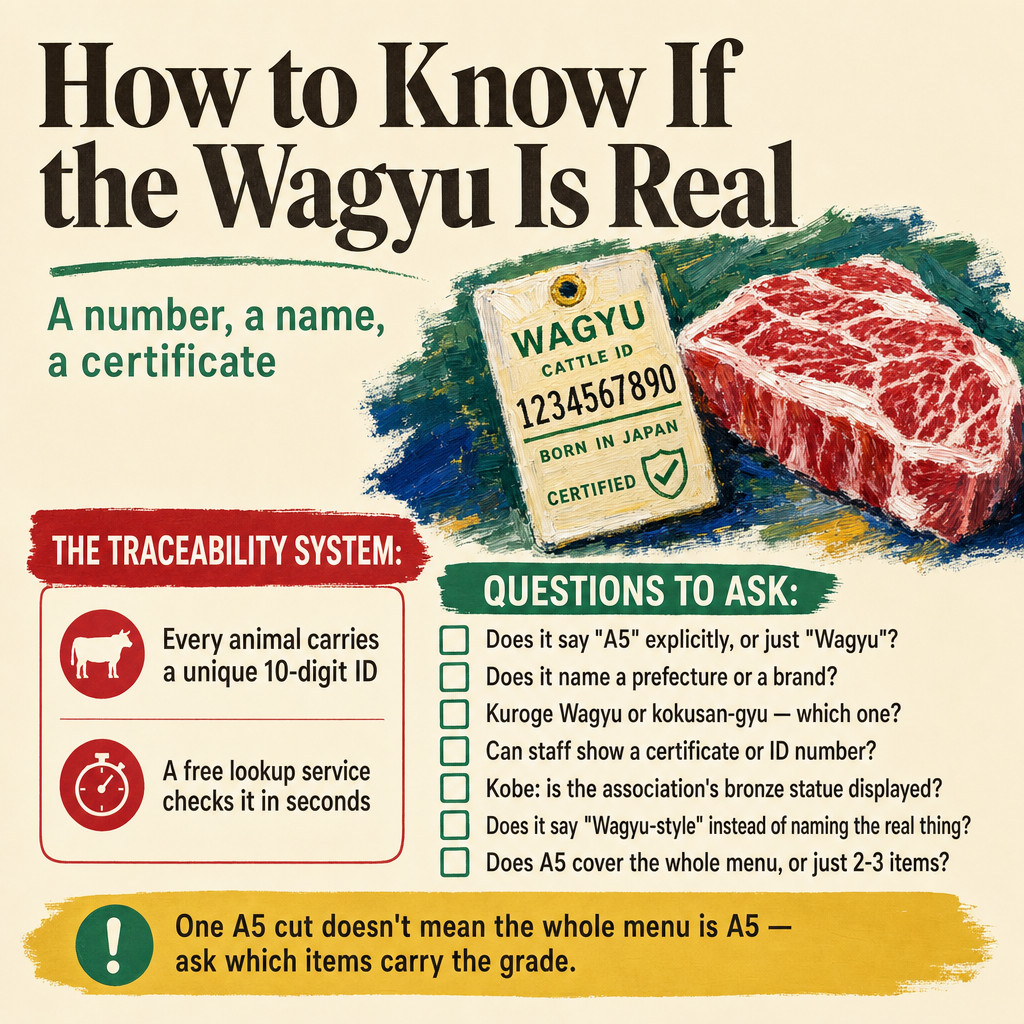
How to Know If the Wagyu Is Real
Cheap A5 makes people suspicious, and reasonably so. Fortunately Japan gives consumers unusually strong verification tools, and you can use most of them from your phone while you wait for the grill to heat.
Under the beef traceability law, every animal raised in Japan carries a unique ten-digit identification number on ear tags, and that number follows the meat through carcass, primal and retail stages. The National Livestock Breeding Center publishes a free lookup service, so a number printed on a certificate or a menu can be checked against the national database in seconds.
Does the menu print “A5” explicitly, or only “Wagyu”?
Does it name a prefecture or a brand?
Does it distinguish Kuroge Wagyu from kokusan-gyu?
Can staff show a certificate or an individual identification number?
For Kobe beef, does the shop display the association’s bronze statue?
Does the wording say “Wagyu-style” or “Kobe-style” rather than naming the real thing?
Does the A5 label cover the whole menu, or only two or three items?
Read this line twice: a restaurant serving one A5 cut does not necessarily serve A5 beef in every dish on its menu. Mixed sourcing is normal and perfectly legal. Ask which specific items carry the grade.
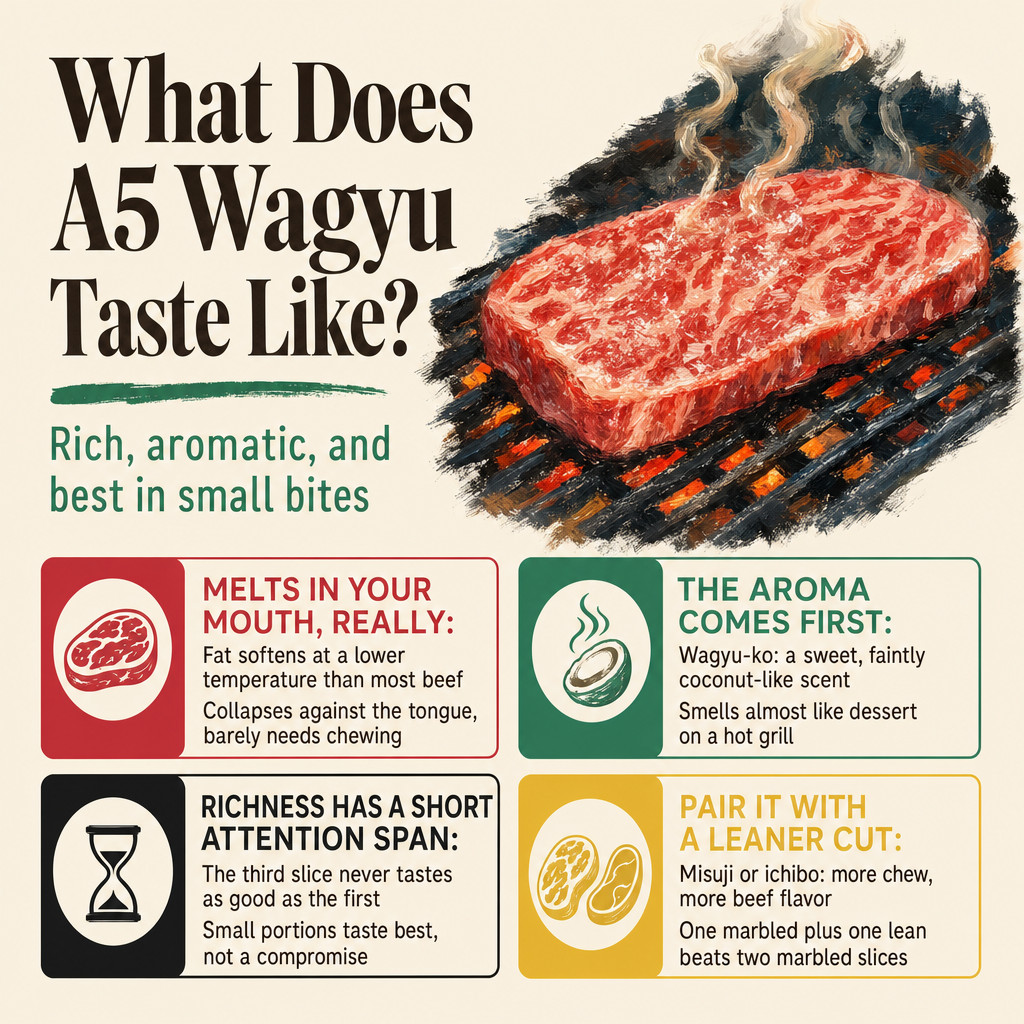
What Does A5 Wagyu Taste Like?
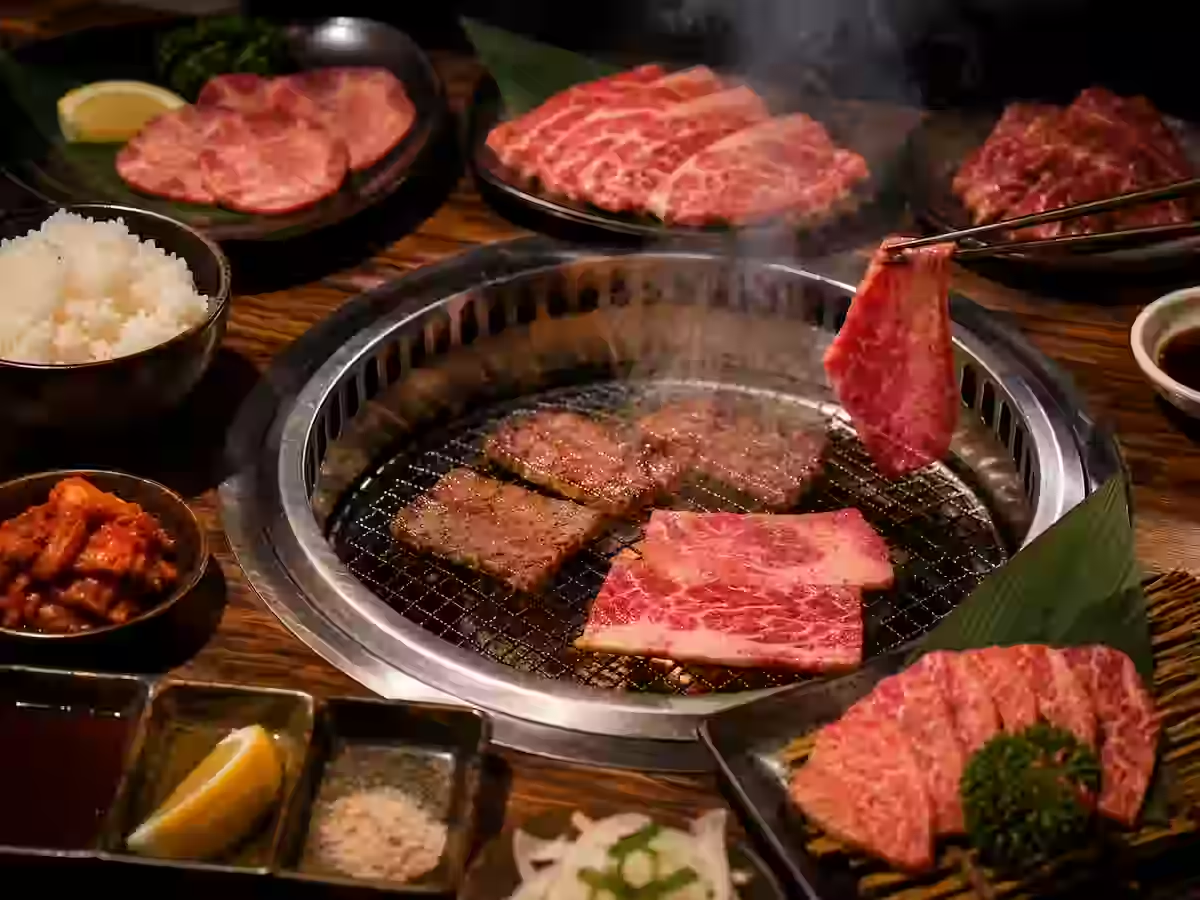
Describing A5 accurately is harder than it sounds, partly because the marketing language around it has drifted so far from the eating experience. The famous “melts in your mouth” line is not wrong, though. Intramuscular fat in heavily marbled Wagyu softens at a lower temperature than most beef fat, so the slice genuinely does start collapsing against your tongue rather than requiring much chewing.
The aroma arrives first, and it is the part nobody warns you about. Well-marbled Japanese Black releases a sweet, faintly coconut-like scent when it hits a hot grill, and Japanese specialists call this wagyu-ko, the Wagyu aroma. It smells almost like dessert. Then the texture registers: silky, dense, and much softer than a good ribeye.
Here is where I hesitate slightly, and I would rather say so than oversell. Richness that spectacular has a short attention span. My third slice never tastes as astonishing as my first, and by the fifth I usually want rice, kimchi, or something sharp to reset my palate. That is precisely why the small-portion strategy in this guide works so well. You are not settling for less by ordering three slices instead of three hundred grams. Frankly, you are ordering the amount that tastes best.
Leaner cuts behave differently. Misuji from the shoulder and ichibo from the rump give you beef flavour with grain and chew, and they reward slower eating. Pairing one of those with one marbled slice produces a far better meal than two marbled slices ever will.
How to Order Yakiniku in Japan
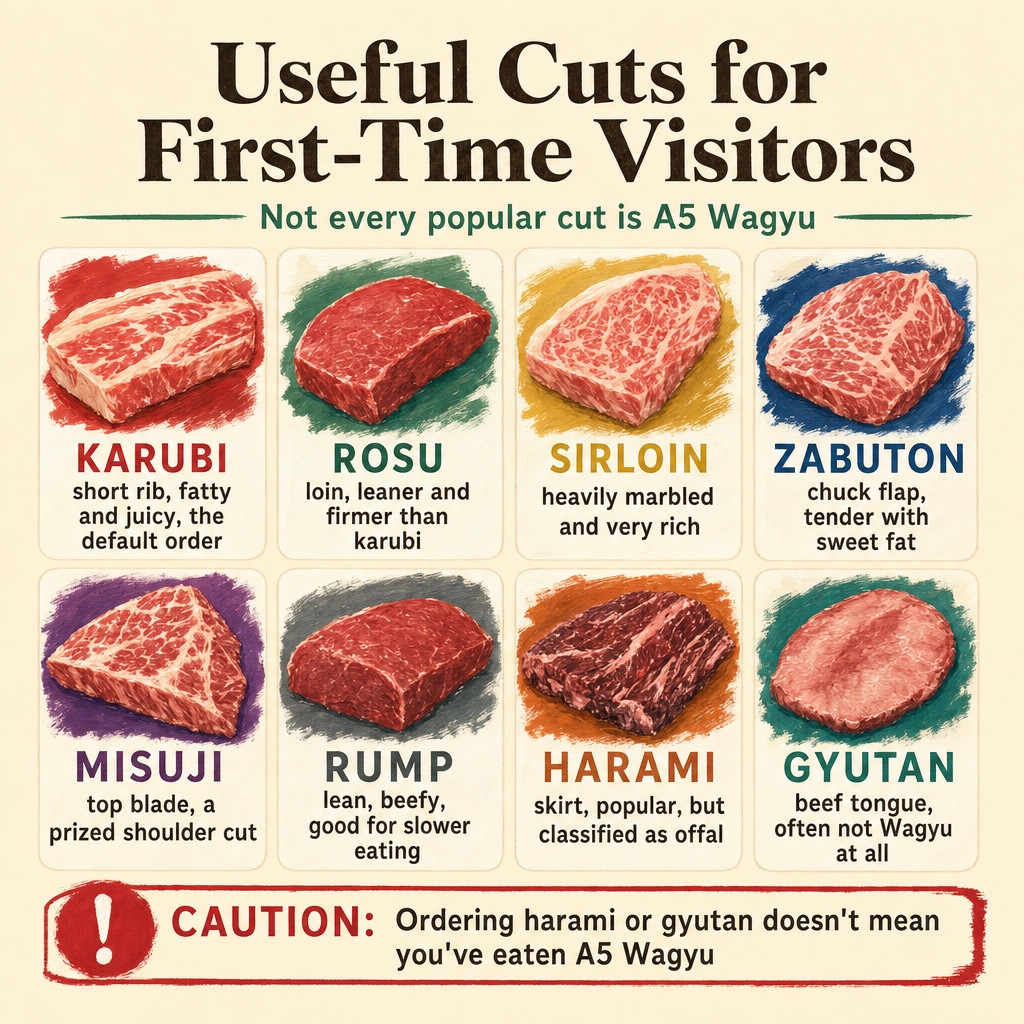
Yakiniku menus list cuts rather than dishes, which confuses first-time visitors more than the language barrier does. Learning eight names solves most of the problem.
Useful Cuts for First-Time Visitors
A chart showing various Wagyu beef cuts recommended for first-time visitors to Japan.
Cut
What to expect
Karubi
Short rib, fatty and juicy, the default yakiniku order
Rosu
Loin, leaner and firmer than karubi
Sirloin
Heavily marbled and very rich
Zabuton
Chuck flap, tender with sweet fat
Misuji
Top blade, a prized cut from the shoulder
Rump
Lean, beefy and good for slower eating
Harami
Skirt, hugely popular but classified as offal
Gyutan
Beef tongue, often imported rather than Wagyu
Two of those deserve a warning. Harami sits in the offal category under Japanese classification, and gyutan frequently comes from non-Japanese cattle even in excellent Wagyu restaurants. Ordering either one does not mean you have eaten A5 Wagyu, whatever the rest of the menu promises.
Useful Japanese Phrases
English
Romaji
Japanese
Is this A5 Wagyu?
Kore wa A5 ranku no wagyu desu ka?
これはA5ランクの和牛ですか?
Can I order a single slice?
Ichi-mai kara chumon dekimasu ka?
1枚から注文できますか?
Which cut do you recommend?
Osusume no bui wa dore desu ka?
おすすめの部位はどれですか?
Is rice included?
Gohan wa tsuite imasu ka?
ご飯は付いていますか?
Is tax included?
Zeikomi desu ka?
税込みですか?
Just one person, please.
Hitori desu.
1人です。
Staff at budget yakiniku counters rarely speak much English, yet they respond warmly to any attempt. Pointing at the menu while saying the phrase works fine.
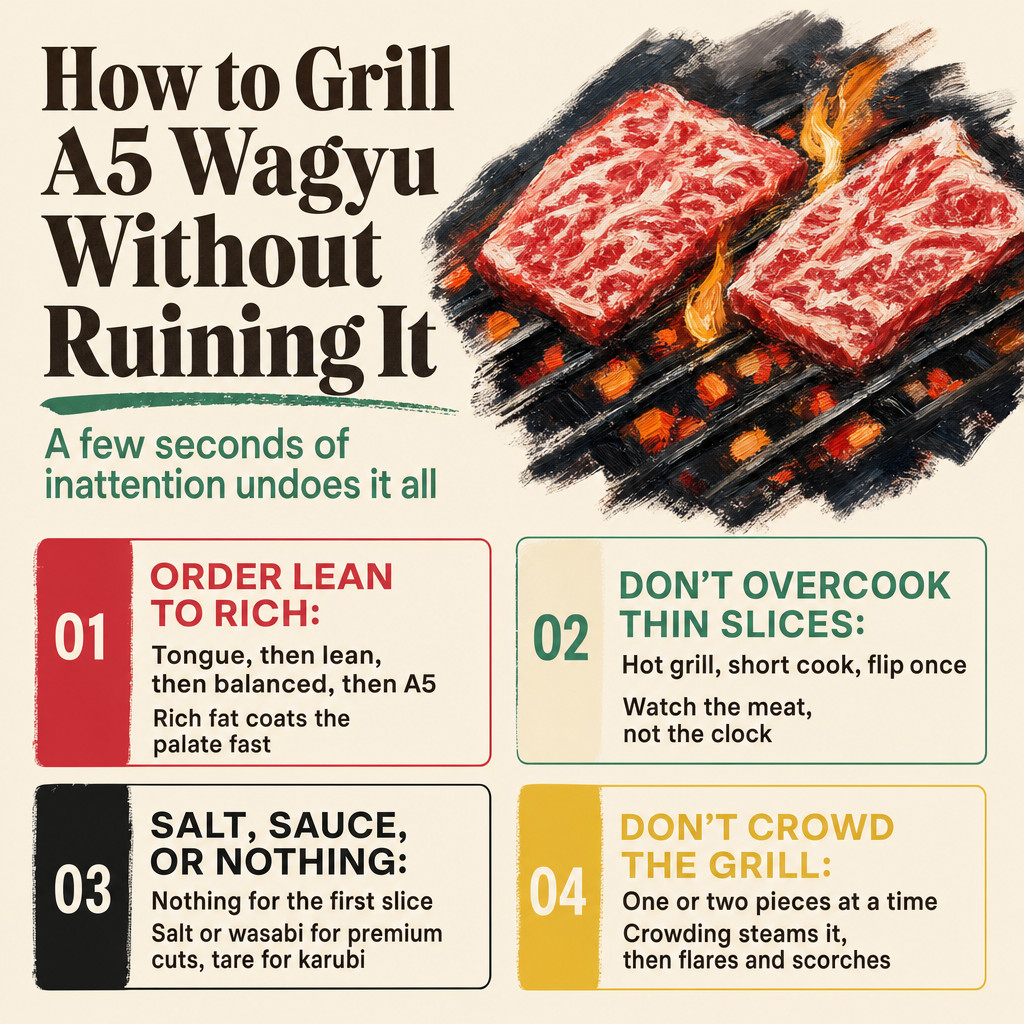
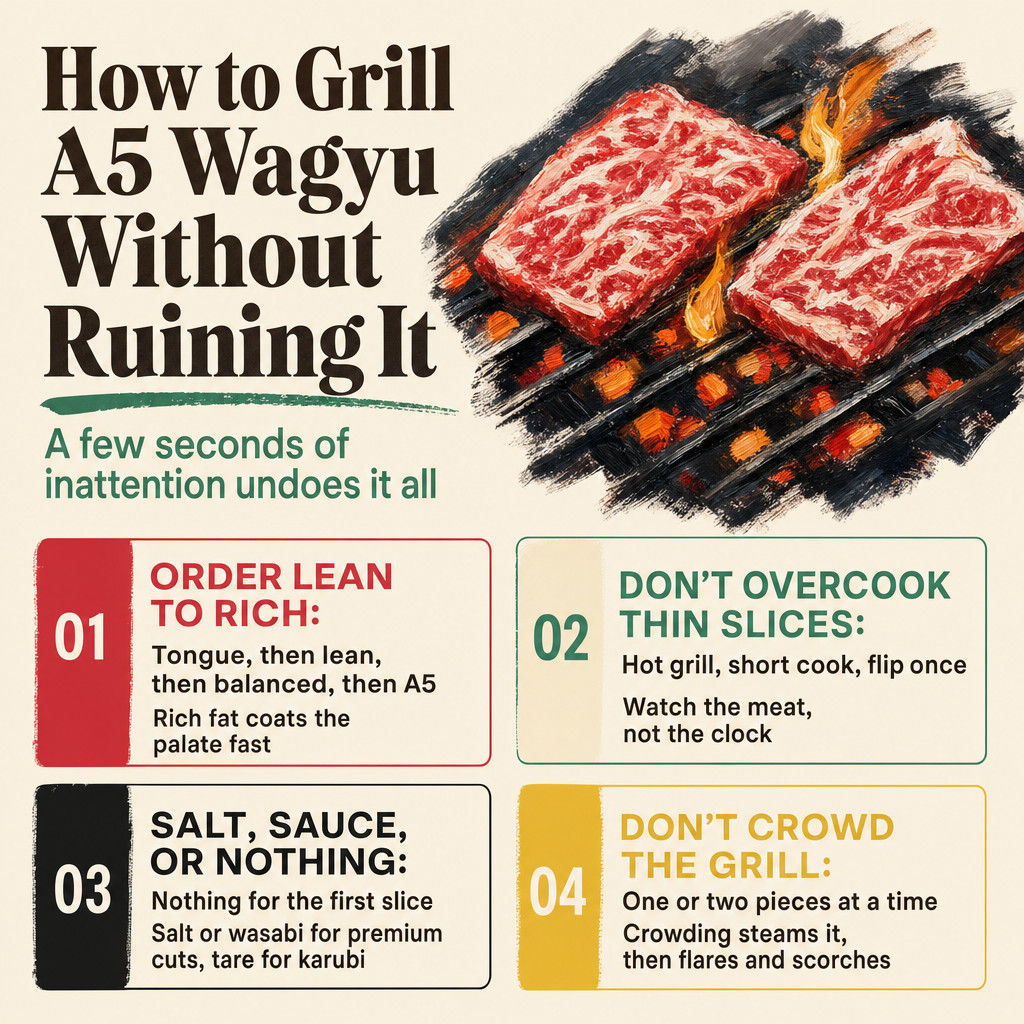
How to Grill A5 Wagyu Without Ruining It
At yakiniku you usually cook the beef yourself, so a few seconds of inattention can undo the value of an expensive cut. Four habits prevent almost every common mistake.
Start With the Leanest Cuts
Order roughly in this sequence: tongue, then lean cuts, then balanced cuts, then heavily marbled A5, then sauce-marinated meat and offal. Rich fat coats your palate quickly, and once that happens the delicate flavour of a lean cut simply disappears. Additionally, sauce-marinated beef leaves residue on the grill that burns and taints whatever follows.
Do Not Overcook Thin Slices
Wait until the grill is properly hot before the first slice goes on
Treat thin Wagyu as a short cook rather than a long sear
Move the slice if dripping fat sends up flames
Flip once, then stop fussing with it
Follow the restaurant’s instructions where the staff give any
Precise timings mislead, because thickness, grill temperature and each restaurant’s handling method vary considerably. Watch the meat rather than the clock. Follow any instructions the staff give, and cook each slice thoroughly enough to eat safely rather than counting seconds.
Salt, Sauce, or Nothing?
Nothing: ideal for the very first slice, when you want the beef alone
Salt or wasabi: best for lean and premium cuts, since it sharpens sweetness without masking it
Tare sauce: suits karubi and anything you plan to eat over rice
Lemon: traditional with beef tongue
Cook One or Two Pieces at a Time
Crowding the grill drops its surface temperature and steams the meat instead of searing it. Worse, A5 sheds fat rapidly, so a crowded grill flares up and scorches everything at once. Two slices at a time keeps you in control and keeps each piece at its best moment.
Common Mistakes That Make Cheap Wagyu Expensive
Almost every budget blowout we hear about traces back to the same handful of errors. None of them involve the beef itself.
Ordering three or four drinks, which can double a ¥2,500 meal
Overlooking otoshi, the small compulsory appetiser some restaurants charge for
Missing a service charge that applies only after a certain hour
Adding large quantities of non-A5 beef without checking the running total
Arriving fifteen minutes before lunch service ends
Assuming weekend prices match weekday prices
Assuming a limited daily set can be reserved in advance
Confusing tax-exclusive and tax-inclusive pricing
Expecting certified Kobe beef to cost the same as unbranded A5
Failing to check whether a famous shop has closed or moved
Mistaking a per-slice price for a per-plate price
That last one catches travellers constantly at standing counters. A menu reading ¥380 usually means one slice, so a casual order of six cuts lands well above expectations.
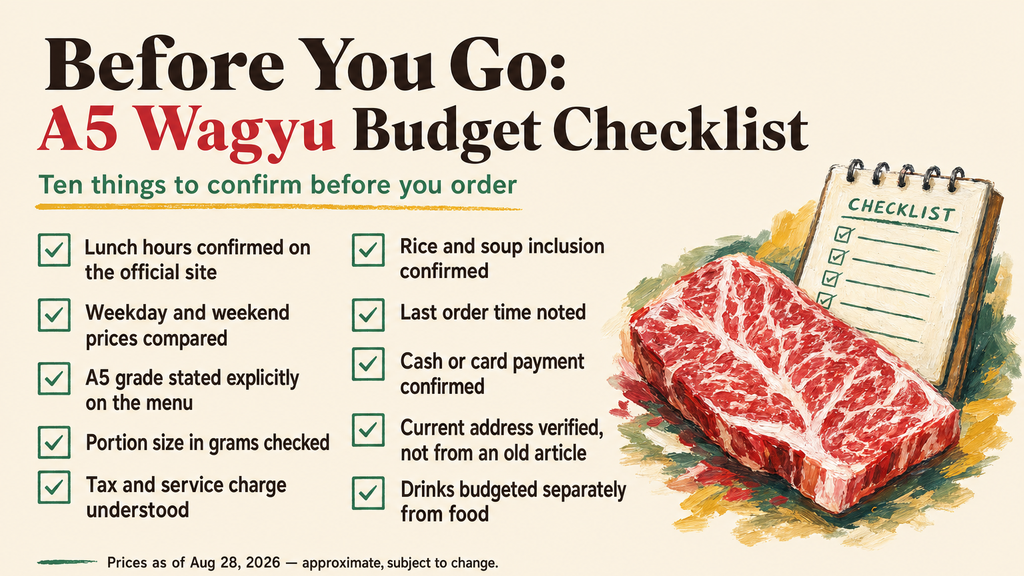
Before You Go: A5 Wagyu Budget Checklist
Lunch hours confirmed on the official site
Weekday and weekend prices compared
A5 grade stated explicitly on the menu
Portion size in grams checked
Tax and service charge understood
Rice and soup inclusion confirmed
Last order time noted
Cash or card payment confirmed
Current address verified, not copied from an old article
Drinks budgeted separately from food
Is Cheap A5 Wagyu Worth It?
For a first encounter, absolutely. A ¥3,000 lunch tells you whether you actually enjoy heavily marbled beef before you commit ¥20,000 to a tasting course, and plenty of visitors discover they prefer A4 or a leaner cut once they try both. That knowledge alone justifies the meal.
Set your expectations correctly, though. Budget A5 delivers a genuine taste of the real thing, not a large volume of it, and the cheapest routes trade comfort for price. You will stand at a counter, or eat quickly at lunch, or share one plate between two people. Meanwhile, the beef on your grill carries exactly the same grade as the beef in the ¥20,000 room upstairs.
Skip the brand names unless a specific one matters to you personally. Prioritise comparing two or three cuts over filling up on one. Above all, check the current menu before you go, because Wagyu prices and Wagyu restaurants both change faster than travel articles do.
A5 Wagyu FAQ
Can I really eat A5 Wagyu in Japan for under $35?
Yes, and you have several routes to choose from. Weekday lunch sets, small tasting portions and standing yakiniku counters all bring a full meal in around ¥2,500 to ¥5,000. At recent exchange rates that range sits comfortably under $35 USD. Canadian and British readers should aim nearer ¥4,000 to stay inside the same figure in their own currency.
Is all Wagyu in Japan A5?
No, and the assumption costs travellers money. Japan’s grading system produces fifteen possible combinations, and A5 represents only the top one. Restaurants sell A3 and A4 Wagyu constantly, often at much better value. Check the menu wording rather than assuming that the word Wagyu implies the top grade.
Is A5 Wagyu the same as Kobe beef?
No. A5 describes a grading result, whereas Kobe beef describes a certified regional brand with its own bloodline, geography and paperwork requirements. Kobe beef qualifies at quality grade 4 or above and accepts yield grade B, so a B4 carcass can legitimately carry the name. Equally, an A5 carcass raised outside Hyogo never qualifies as Kobe beef.
Is a ¥3,000 Wagyu lunch fake?
Not necessarily. Restaurants routinely cut lunch prices to fill seats, shrink the portion, or use less fashionable cuts from the same animal. Standing counters go further by removing table service entirely. However, confirm that the menu says A5 explicitly, because many cheap sets use ungraded Kuroge Wagyu instead.
How much A5 Wagyu should I order?
Start smaller than instinct suggests. For a first tasting, consider around 60g to 100g, or three to four slices at a standing counter. A5 is highly marbled and can feel considerably richer than an ordinary steak. You can always order more once you know how your palate responds.
Can solo travellers eat yakiniku in Japan?
Easily, and the solo format has grown enormously in recent years. Standing yakiniku counters, single-seat grill chains and counter-style shops all cater specifically to one-person dining. Several of the restaurants covered above build their entire seating plan around it. Dining alone at these restaurants is entirely normal.
Should I book a Wagyu lunch in advance?
It depends on the restaurant, so check first. Limited-quantity lunch sets frequently sell out well before the kitchen closes, yet many discounted sets remain walk-in only precisely because they are discounted. Standing yakiniku shops generally do not take bookings at all. Arriving shortly after opening solves the problem in most cases.
Is A4 Wagyu worth trying instead?
Definitely, and many regular Wagyu eaters prefer it. A4 still carries substantial marbling, yet the slightly leaner balance suits longer meals and larger portions. It also costs noticeably less than A5 at the same restaurant. Ordering one slice of each makes an excellent low-cost experiment.
Are yakiniku lunch prices available on weekends?
Often not. Many restaurants restrict their cheapest sets to weekdays, and some suspend lunch service entirely on Sundays and public holidays. Others keep the menu but drop the discount. Always check the current opening hours and lunch menu on the restaurant’s own website before you travel.
How can I verify that beef is genuinely Japanese Wagyu?
Ask for the individual identification number. Japan’s beef traceability law assigns every domestically raised animal a unique ten-digit number, and the National Livestock Breeding Center lets anyone search that number online for free. Certificates in Wagyu restaurants and butcher shops usually print it clearly. For Kobe beef specifically, look for the association’s bronze statue at the entrance as well.
Price and currency note: all yen prices come from the restaurants’ official menus as published on 28 August 2026. Japanese food prices have been rising, so menus may change without notice. Foreign-currency amounts are approximate and serve only as a travel-budget guide, since exchange rates and card conversion fees vary. Exchange-rate estimates checked: 28 August 2026.
Ryo Iwa is the founder and editor of foodinjapan.org. Born and raised in Japan, he writes from regional travel, market visits, and Japanese-language primary sources that rarely reach English readers, including brewing institute publications and industry glossaries. Where a figure cannot be traced to a source, the article says so.
He has been a Google Maps Local Guide for over 10 years, with more than 1,800 reviews and over 41,000 photos viewed hundreds of millions of times. He previously spent two decades as an IT consultant in Japan, the US, and the UK.















Comments