



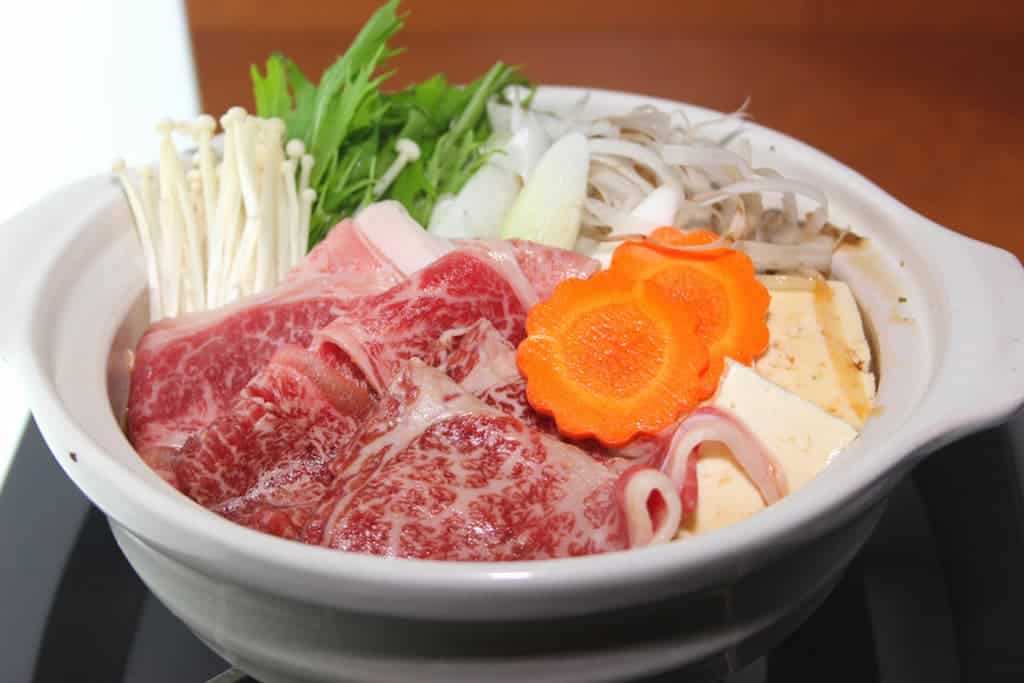
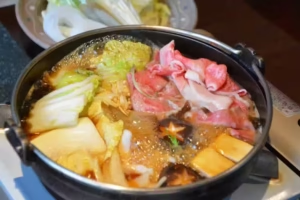
A shallow iron pan arrives at the table, and a dark, sweet-smelling sauce begins to bubble around thin slices of beef. This is Kanto-style sukiyaki (関東風すき焼き), the eastern style of one of Japan’s best-known beef hot pots, most closely associated with Tokyo. Its secret is warishita, a sauce that cooks mix before the meal starts.
This guide explains how the style works and how it differs from the Kansai version. It also gives a home recipe, the costs we could confirm, and four long-running restaurants in Tokyo. If you have eaten sukiyaki before and found it different from descriptions elsewhere, this east-west split is probably why.
What Is Kanto-Style Sukiyaki?
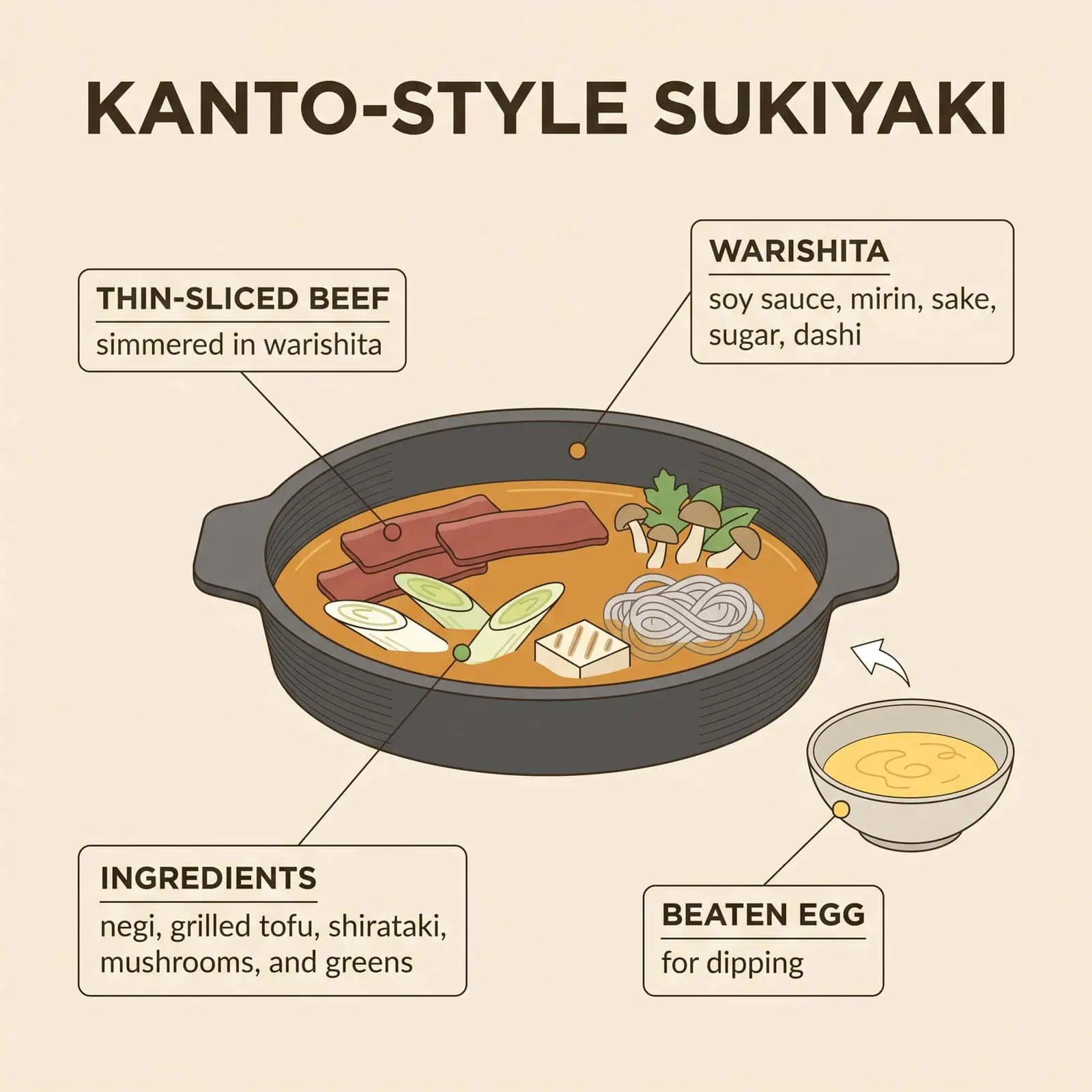
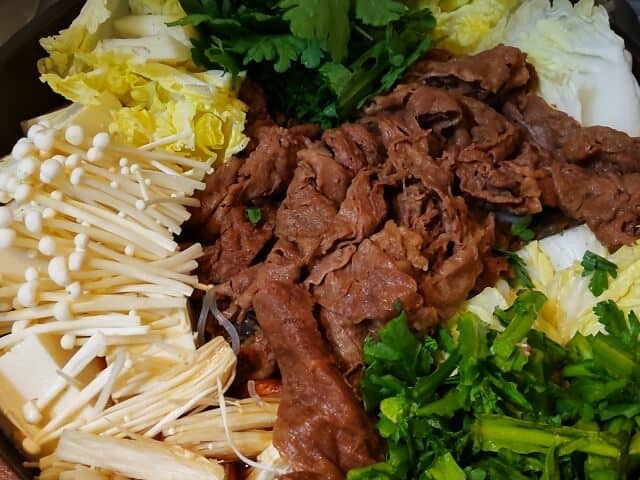
Kanto-style sukiyaki is a Tokyo-area beef hot pot cooked in pre-mixed warishita sauce. Diners simmer thinly sliced beef, tofu, vegetables, and shirataki noodles together in the pan. They then dip each cooked piece in beaten raw egg before eating.
Kanto-Style Sukiyaki Quick Facts
- Japanese name
- 関東風すき焼き (Kantō-fū sukiyaki)
- Region
- Kanto, the area around Tokyo in eastern Japan
- Key feature
- Ingredients simmer in warishita, a pre-mixed sweet soy sauce
- Main ingredients
- Thinly sliced beef, negi (Japanese leek), grilled tofu, shirataki noodles, mushrooms, and greens
- How to eat it
- Dip each piece in beaten egg, with rice on the side
- Roots
- Gyunabe, the beef pot of Meiji-era Yokohama and Tokyo
The dish belongs to nabemono, the family of Japanese hot pot dishes that people cook and share at the table. Families often serve it for celebrations because it feels festive yet remains easy to prepare at the table. For the wider picture, including beef brands and regional history, see our complete sukiyaki guide. It is also a fixture of Tokyo food culture.
Kanto vs Kansai Sukiyaki
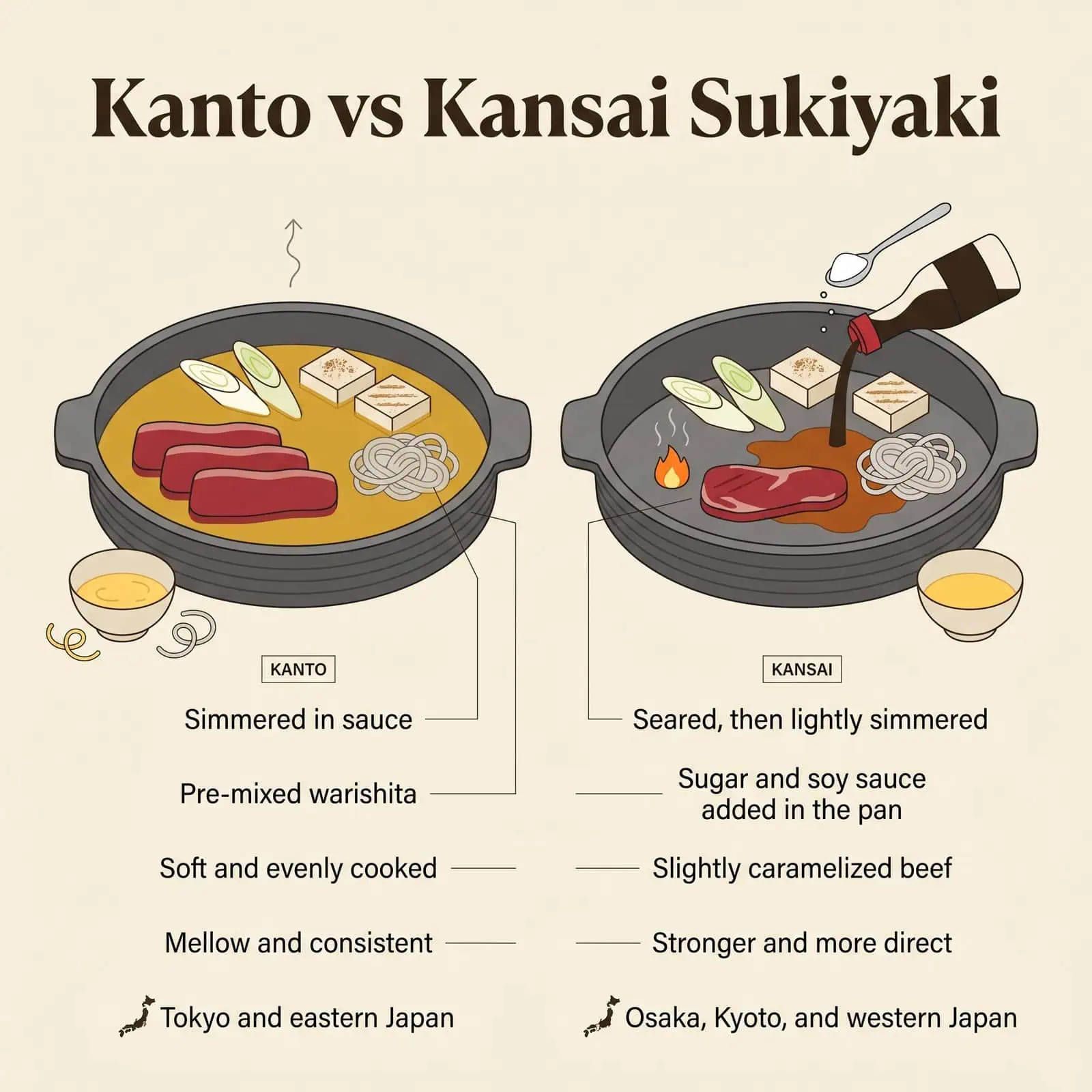
The cooking method is the clearest difference between Kanto and Kansai sukiyaki. Kanto simmers ingredients in warishita, while Kansai sears beef before adding seasonings. Kansai, meanwhile, is the western region around Osaka and Kyoto. Both versions use similar ingredients, and both usually end with a beaten egg dip.
| Point | Kanto-style | Kansai-style |
|---|---|---|
| Cooking method | Simmered in sauce | Seared, then lightly simmered |
| Seasoning | Pre-mixed warishita | Sugar and soy sauce added in the pan |
| Texture | Soft and evenly cooked | Slightly caramelized beef |
| Flavor | Mellow and consistent | Stronger and more direct |
| Home region | Tokyo and eastern Japan | Osaka, Kyoto, and western Japan |
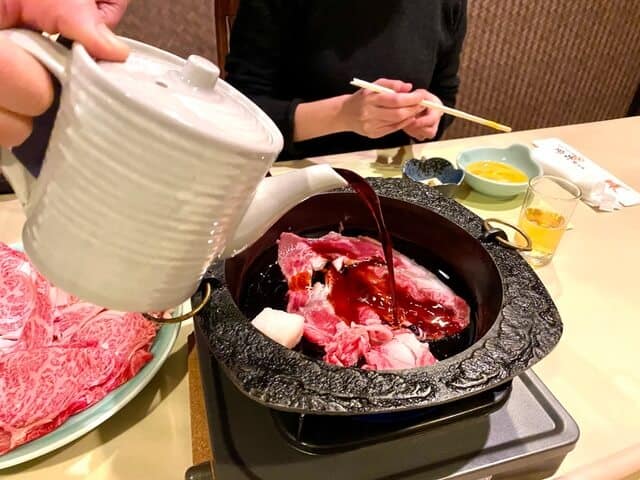
However, each region uses a different cooking process before serving the dish with egg. Our guide to Kansai-style sukiyaki covers the western method in full.
Do Tokyo Sukiyaki Restaurants Always Simmer the Beef?
No, and this point confuses many visitors. Japan’s agriculture ministry (MAFF) describes simmering in warishita as the usual home method in Kanto. However, it also notes that many long-established Tokyo restaurants now sear the beef in melted fat first. The table above therefore shows a tendency, not a strict rule.
What Is Warishita?
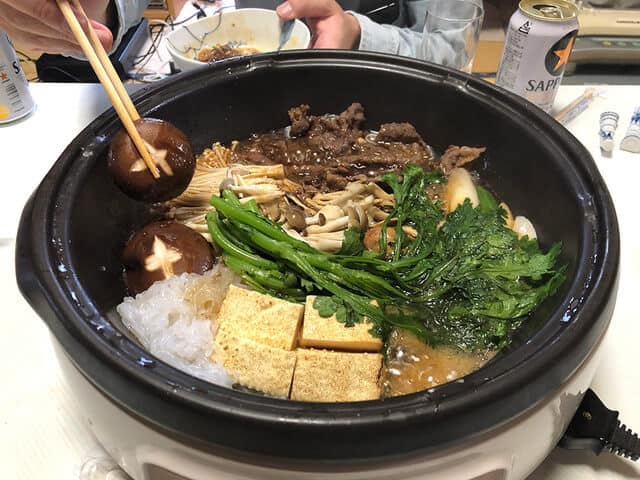
Warishita (割り下) is a pre-mixed cooking sauce. It combines soy sauce, mirin, and sake, as well as sugar and dashi stock. Warishita gives Kanto-style sukiyaki its characteristic sweet-savory flavor. It also lets the ingredients simmer in a consistent seasoning.
Because the sauce is ready in advance, every piece in the pan tastes consistent. The pre-mixed sauce also helps restaurants produce the same flavor for every table. Recipes differ by household and shop, though, so no single official ratio exists. Some are sweeter, while others taste sharper and saltier.
What Does Kanto-Style Sukiyaki Taste Like?
Kanto-style sukiyaki tastes sweet-savory and rich, with plenty of umami. The soy sauce and mirin in the warishita give the sauce a deep, rounded sweetness. Then, as beef fat melts into the pan, the flavor grows fuller. Meanwhile, the tofu and shirataki soak up the sauce, and the leek turns soft and sweet.
The beaten egg then adds a mild egg coating. It cools the beef slightly and softens the sauce’s sweetness and saltiness. The sauce does get stronger as it reduces, so the last bites can taste intense. Some people find that too much, and a splash of water fixes it.
Kanto-Style Sukiyaki Recipe
Here is how to make Kanto-style sukiyaki in five steps: prepare, mix the warishita, sear, simmer, and serve with egg. The recipe uses pre-mixed warishita but briefly sears the first slices of beef. That hybrid method is now common at many Tokyo restaurants. For a simpler home-style version, skip the searing and add the beef once the warishita simmers.
Recipe Overview
Contains: beef, soy, wheat, and egg. Dashi may also contain fish, so check product labels. Times are approximate and vary with the pan, the heat source, and the beef.
Equipment You Need
A shallow cast-iron sukiyaki pan is traditional, because it holds heat steadily. However, any heavy skillet or shallow frying pan works. Avoid deep pots, since they make the ingredients hard to reach. At the table, a portable gas burner keeps the pan simmering. Otherwise, cook on the stove and carry the pan over.
Sukiyaki Ingredients
Beef and warishita define the dish, while the other sukiyaki ingredients vary by household and season. For example, the list below is a common set for two people.
| Ingredient | Amount | Preparation |
|---|---|---|
| Thinly sliced beef | 250 g (9 oz) | Keep chilled until cooking |
| Beef fat or neutral oil | 1 to 2 tsp, enough to coat the pan | None |
| Negi (Japanese leek) | 1 stalk | Slice diagonally, 1 cm (1/2 in) thick |
| Yaki-dofu (grilled tofu) | 150 g (5 oz) | Cut into 4 cubes |
| Shirataki noodles | 100 g (3.5 oz) | Rinse, blanch 1 minute, drain |
| Shiitake mushrooms | 4 | Remove stems |
| Shungiku (chrysanthemum greens) | 75 g (2.5 oz) | Cut into 5 cm (2 in) lengths |
| Eggs for dipping | 2 | Crack just before eating |
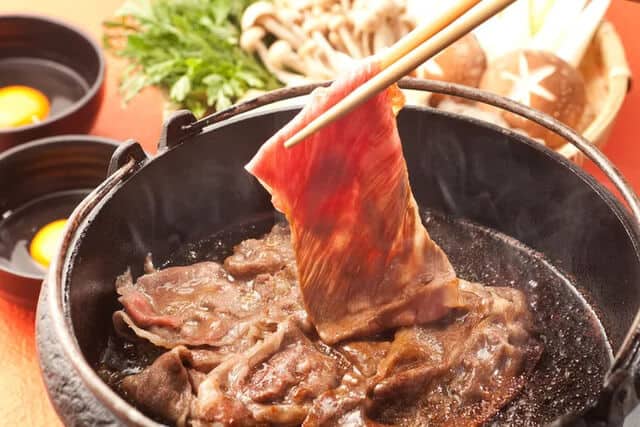
Sukiyaki Warishita Ratio
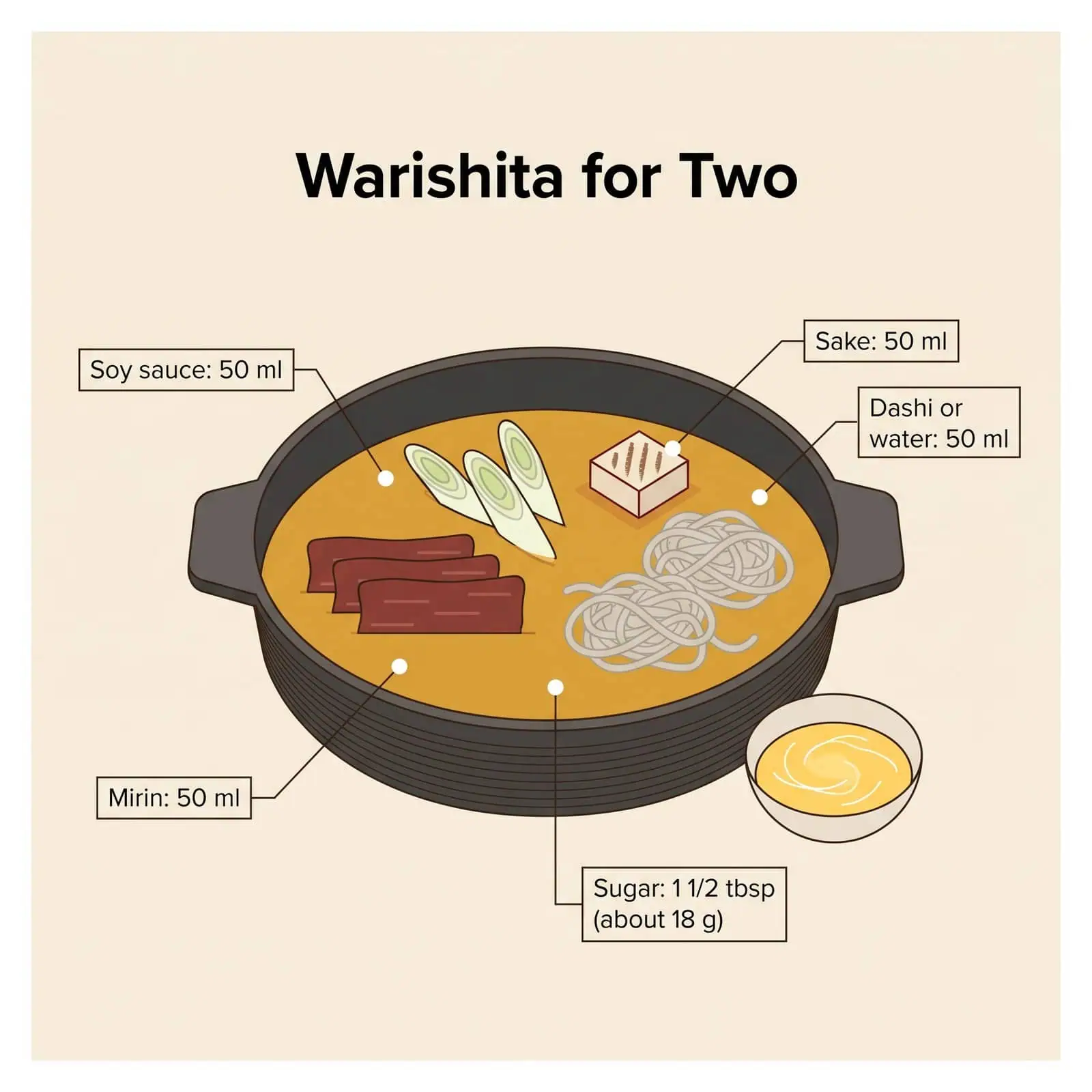
Our sukiyaki warishita ratio follows the Tokyo recipe that MAFF publishes: equal parts soy sauce, mirin, sake, and dashi. Sugar then sweetens the mix. We reduced the published sauce quantities to a practical batch for two diners. US measures are rounded, so use milliliters for the most consistent result.
| Ingredient | Amount |
|---|---|
| Soy sauce | 50 ml (3 tbsp plus 1 tsp) |
| Mirin | 50 ml (3 tbsp plus 1 tsp) |
| Sake | 50 ml (3 tbsp plus 1 tsp) |
| Dashi or water | 50 ml (3 tbsp plus 1 tsp) |
| Sugar | 1 1/2 tbsp (about 18 g) |
Cooking Steps
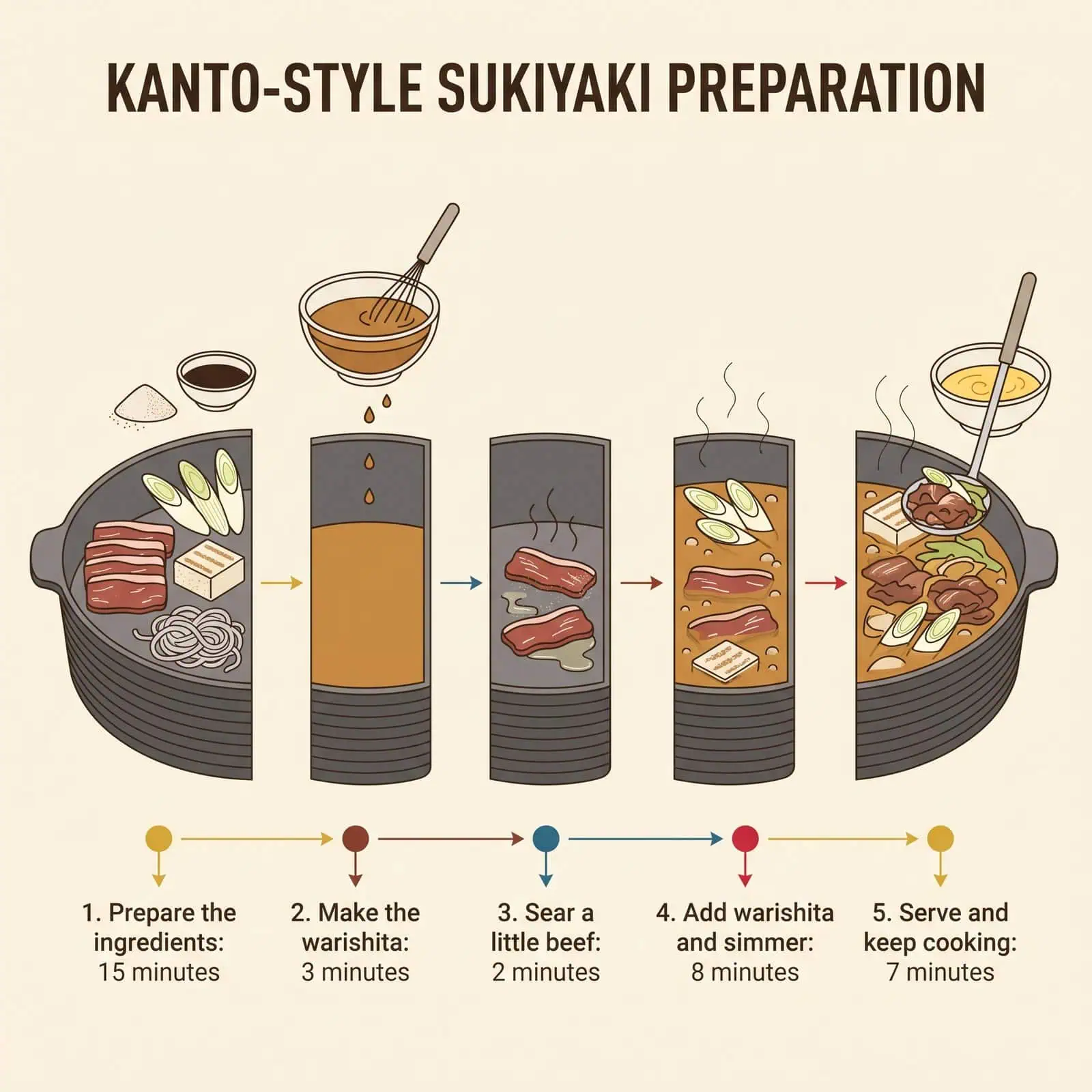
Cut and arrange everything on a plate, following the table above. Do this first, so the beef does not overcook while you organize the table.
First, combine the soy sauce, mirin, sake, dashi, and sugar in a small saucepan. Stir until the sugar dissolves, then turn off the heat. Do not reduce the sauce.
First, melt the beef fat in the pan. Then sear a few slices briefly, just until the surface changes color. Do not cook the beef through during searing. It must finish cooking in the simmering warishita before you eat it.
Then pour in about half of the warishita. Next, add the leek, tofu, shirataki, and mushrooms in separate groups. Simmer gently until the leek softens, and add the greens last.
First, serve one bowl of lightly beaten egg to each diner. Afterward, add more beef and the remaining warishita in small batches. You may not need all of the sauce, so add it only when the pan looks dry. If the flavor turns too strong, thin it with a little water or dashi.
How to Eat Sukiyaki
- First, beat one egg in your own small bowl.
- Then lift a cooked piece from the pan with serving chopsticks.
- Finally, dip it in the egg and eat it while it is hot, with rice alongside.
Ingredient Substitutions
| Japanese ingredient | Substitute | What changes |
|---|---|---|
| Negi | Leek or large scallions | Leek is milder and cooks more slowly |
| Shungiku | Spinach or watercress | Spinach is milder, watercress more peppery |
| Yaki-dofu | Firm tofu | Softer, so it breaks more easily |
| Shirataki | Other konjac noodles | Similar texture |
| Wagyu | Well-marbled ribeye or chuck | Firmer bite and less melting fat |
Common Mistakes
- Overcooking the beef: thin slices cook quickly, so remove them once no raw areas remain.
- Reducing the warishita too far: a hard boil concentrates salt, so keep the heat gentle.
- Overcrowding the pan: cook small batches instead, because a packed pan cooks unevenly.
One common tip also needs a caveat. Many cooks keep shirataki noodles away from the beef, believing they toughen it. However, a comparison test commissioned by the Japan Konjac Association found no such effect. Instead, cooking time and marbling mattered more.
Vegetarian Alternative
This is an adaptation, not a traditional Kanto dish. Replace the beef with grilled tofu, king oyster mushrooms, and shiitake, and sear them in plant oil. In addition, use kombu (kelp) dashi instead of fish-based stock. Check the labels on soy sauce, mirin, and dashi if you need a strictly vegetarian meal.
Leftovers and Storage
Japan’s health ministry advises moving leftover food into clean, shallow containers so it cools quickly. It also recommends reheating leftovers thoroughly, to at least 75°C (167°F). As an extra precaution, keep sauce from the pan separate, and never pour it back into unused warishita. Official guidance gives no fixed number of days for sukiyaki, so discard anything that seems doubtful.
The Raw Egg Dip: Is Raw Egg Required?
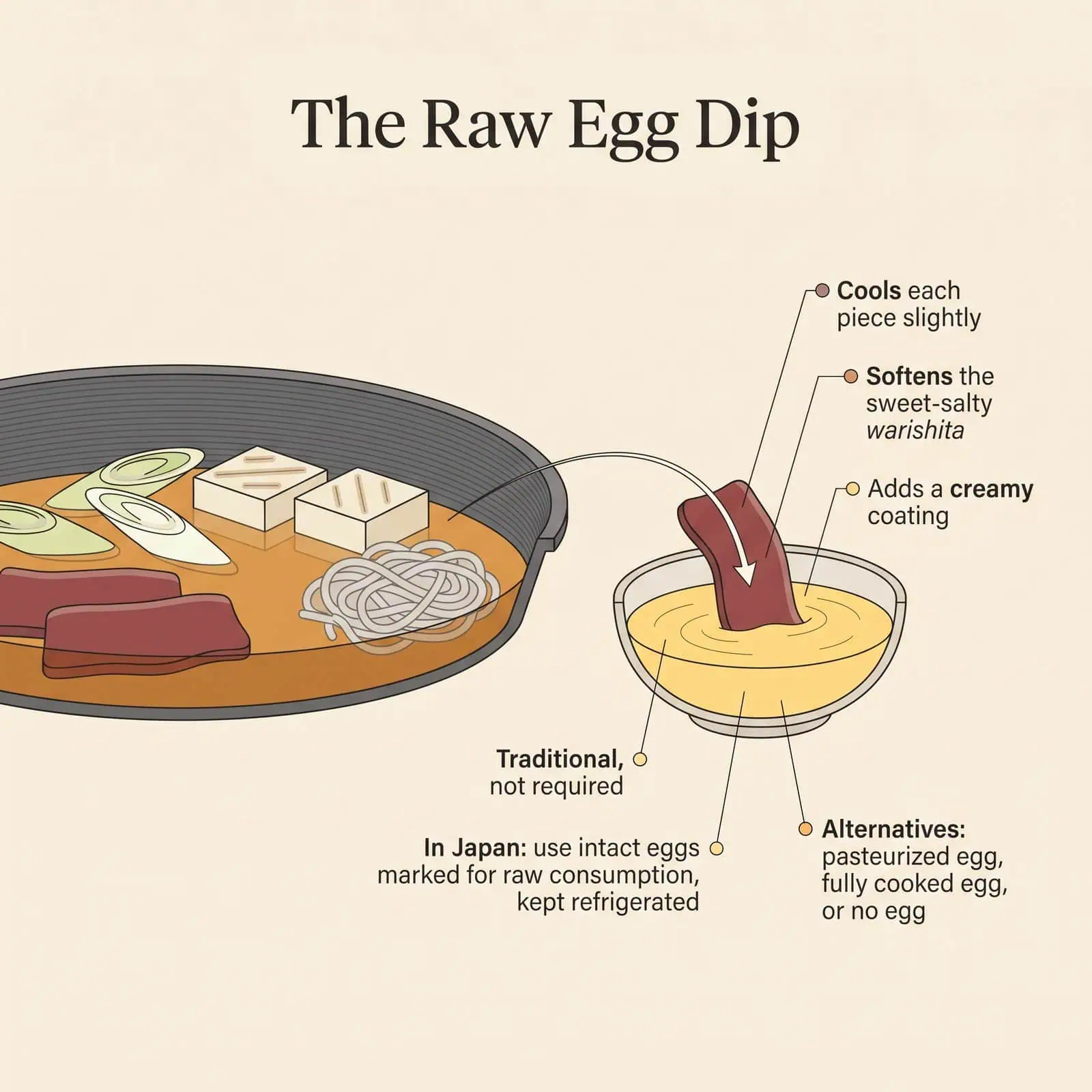
No, raw egg is traditional but not required. First-time visitors may be surprised that diners dip the cooked ingredients in raw beaten egg. Raw egg cools each piece slightly and softens the concentrated sweet-salty flavor of the warishita. It also adds a creamy coating that other serving methods do not reproduce easily.
Japan has hygiene and labeling rules built around eating eggs raw. However, raw eggs are not risk-free. In Japan, use intact eggs marked 生食用 (for raw consumption), keep them refrigerated, and eat them before the stated date. Older adults, children aged two or younger, pregnant people, and anyone with reduced immunity should avoid raw egg. Outside Japan, choose pasteurized eggs where available, and follow your local food-safety advice. A fully cooked egg, or no egg at all, also works.
What Cut of Beef Is Best?
No single cut is objectively best, so choose by taste and budget. Marbling matters most, because the fat melts into the warishita. Ask for very thin slices that cook within seconds. Our wagyu beef guide explains the premium options.
| Preference | Cut | Note |
|---|---|---|
| Rich and marbled | Ribeye | Cook very briefly |
| Tender and refined | Sirloin | Add in small batches |
| Balanced and affordable | Chuck or shoulder loin | Slice thinly |
| Leaner | Round | Do not simmer for long |
A Short History of Kanto-Style Sukiyaki
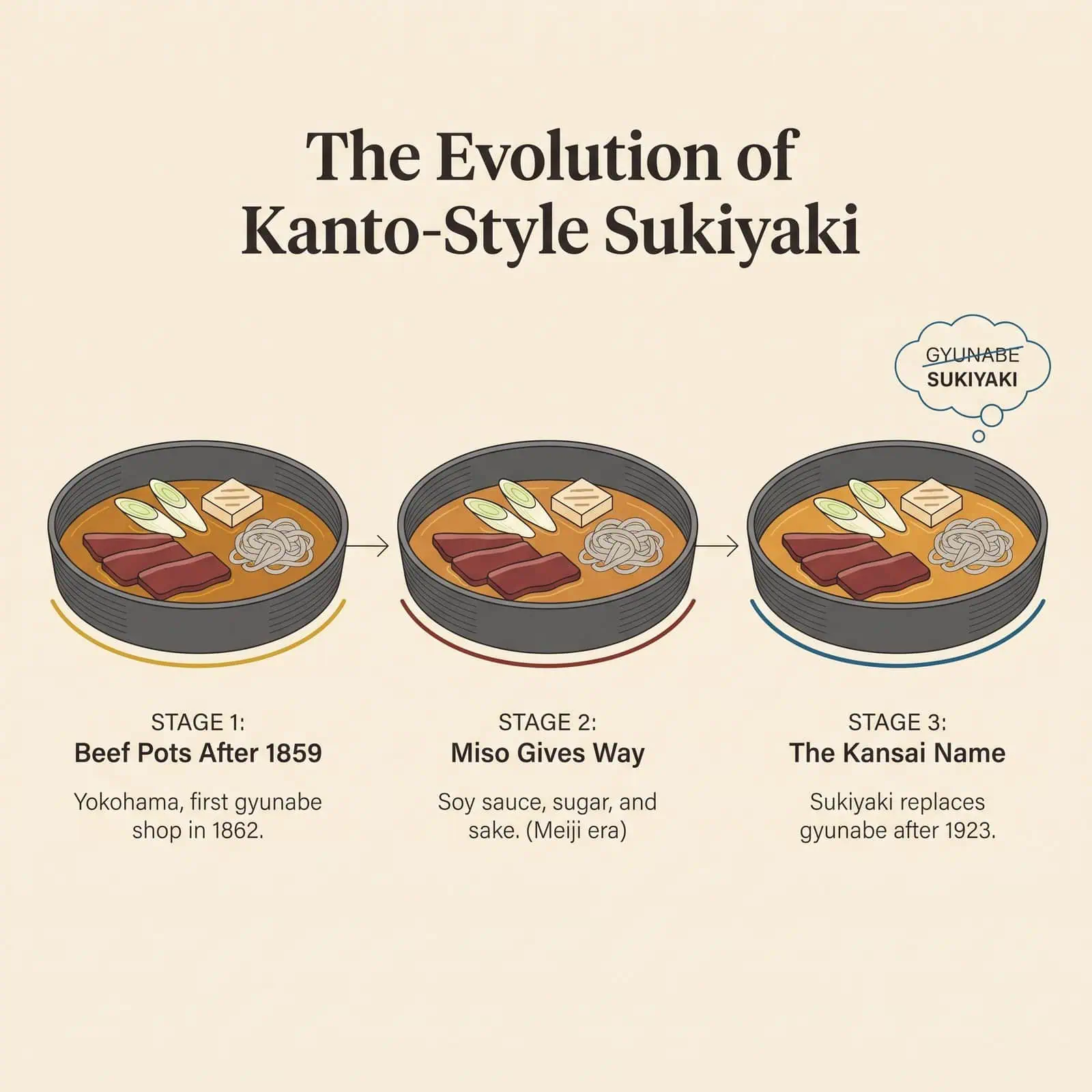
Kanto-style sukiyaki developed through three major stages. Each one left a mark on the dish that Tokyo eats today.
Stage 1: Beef Pots After 1859
Yokohama Port opened in 1859. The foreign settlement then created new demand for beef, which helped commercial meat eating spread in the port city. Soon, restaurants began selling gyunabe, a beef pot. According to MAFF, the owner of a Yokohama tavern called Isekuma opened the first gyunabe shop in 1862. The dish then spread to Tokyo.
Stage 2: From Miso to Soy Sauce
At first, MAFF explains, cooks used miso to soften the smell of the meat. Beef quality improved during the Meiji era (1868–1912). As a result, the miso-based beef pot began to change. Soy sauce, sugar, and sake took over, and tofu and shirataki joined the pan.
Stage 3: A New Name After 1923
Tokyo people still called the dish gyunabe in the early 1900s. Then the Great Kanto Earthquake of 1923 closed most of the city’s beef-pot shops. Afterward, according to MAFF, the Kansai name sukiyaki spread to Kanto and replaced the older word. The warishita-based method remained common in Kanto homes, however, even as many restaurants adopted a sear-first approach.
Where to Eat Kanto-Style Sukiyaki in Tokyo
People often ask for the best sukiyaki in Tokyo, but no single restaurant is objectively best. The right choice depends on budget, location, and meat style. The four below are long-running specialists, and we grouped them by purpose rather than rank.
| Restaurant | Area | Style | Price range | Reservation |
|---|---|---|---|---|
| Ningyocho Imahan | Ningyocho | Heritage setting | Lunch from ¥5,940, dinner from ¥9,900 | Online or phone |
| Sukiyaki Kappo Hiyama | Ningyocho | Private-room courses | Lunch from ¥10,000, dinner from ¥13,000 | Online |
| Asakusa Imahan | Asakusa | Lower-priced lunch set | Lunch set ¥5,390 | Check official site |
| Ishibashi | Akihabara | Thick-cut wagyu, cooked for you | Check by phone | Recommended, by phone |
Ningyocho Imahan Main Shop: For a Heritage Setting
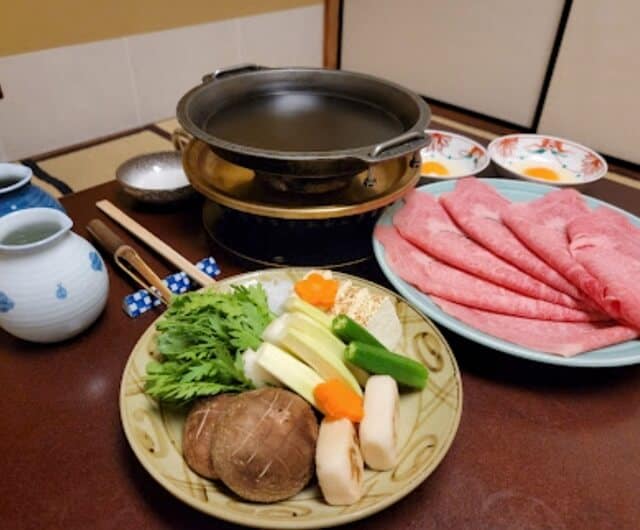
The company began as a gyunabe shop in 1895. Its Ningyocho shop opened in 1952 and became independent in 1956. Lunch sukiyaki starts at ¥5,940, while dinner sukiyaki starts at ¥9,900. In addition, the menu lists a 12% service charge. You can also reserve online or by phone.
- Address: 2-9-12 Nihonbashi Ningyocho, Chuo-ku, Tokyo
- Phone: 03-3666-7006
- Hours: Weekdays 11:00–15:00 and 17:00–22:00. Weekends and holidays 11:00–22:00 (last order 21:00)
- Website: Ningyocho Imahan
- Note: Details are subject to change. Check the official website before visiting
Sukiyaki Kappo Hiyama: For Private-Room Dining
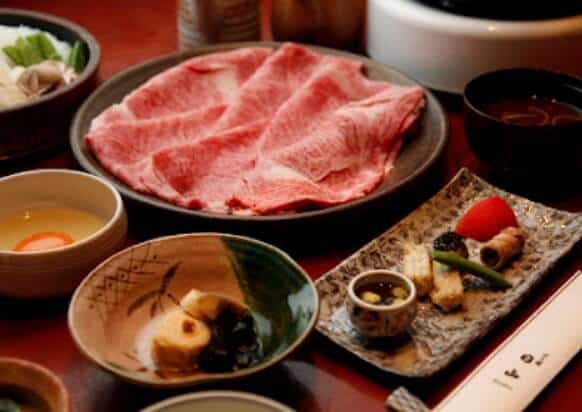
Hiyama serves sukiyaki as set courses in private rooms. Lunch courses run from ¥10,000 to ¥23,000, while dinner courses run from ¥13,000 to ¥26,000. A 10% service charge also applies on top. The restaurant closes on Sundays, and it charges in full for same-day cancellations.
- Address: 2-5-1 Nihonbashi Ningyocho, Chuo-ku, Tokyo
- Phone: 03-3666-2901
- Hours: Lunch 11:30–14:30 (last order 13:30). Dinner 17:00–21:30 (last order 20:00). Closed Sundays
- Website: Sukiyaki Kappo Hiyama
- Note: Details are subject to change. Check the official website before visiting
Asakusa Imahan: For Lunch Near Senso-ji
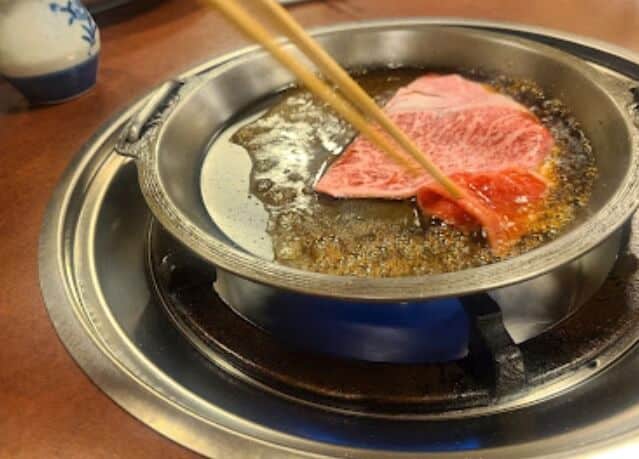
Asakusa Imahan also dates its founding to 1895. Its Kokusai-dori main shop lists a sukiyaki lunch set at ¥5,390, which suits a sightseeing day in Asakusa. Dinner sets cost considerably more, and the shop revised its main menu in March 2026. Therefore, check the official menu before you go.
- Address: 3-1-12 Nishi-Asakusa, Taito-ku, Tokyo
- Phone: 03-3841-1114
- Hours: 11:30–21:30 (last order 20:30). Afternoon seating may pause
- Website: Asakusa Imahan
- Note: Details are subject to change. Check the official website before visiting
Ishibashi: For Thick-Cut Wagyu Cooked at the Table
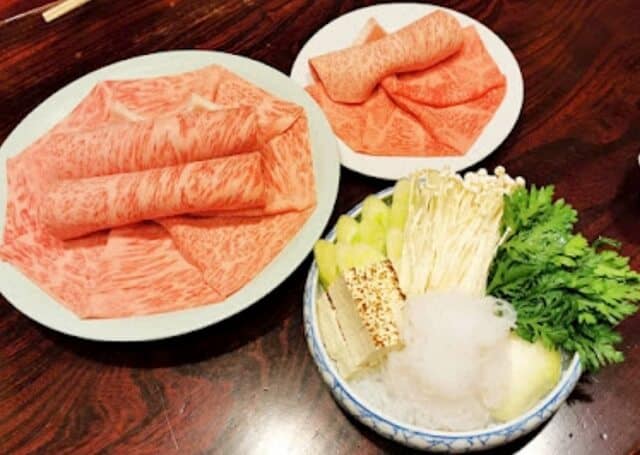
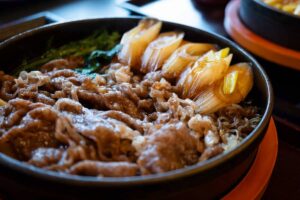
Ishibashi has served sukiyaki near Akihabara since 1879, according to the Chiyoda tourism site. The proprietress or attendants cook large, thick slices of wagyu in Japanese-style rooms. Restaurant staff therefore control the timing for the beef and vegetables. However, it opens for weekday dinner only. We found no published prices, so ask when you call.
- Address: 3-6-8 Sotokanda, Chiyoda-ku, Tokyo
- Phone: 03-3251-3580
- Hours: Monday to Friday 17:00–21:30 (last order 20:00). Closed weekends and holidays
- Note: Details are subject to change. We found no official website, so call to confirm
Sukiyaki Cost in Tokyo
Sukiyaki cost in Tokyo depends mainly on the beef and the time of day. We cannot give a citywide average, because no reliable figure exists. Instead, here are the published prices at the specialists above, checked in October 2026.
- Lunch at a specialist: from ¥5,390 at Asakusa Imahan and ¥5,940 at Ningyocho Imahan.
- Dinner at an established restaurant: from ¥9,900 at Ningyocho Imahan.
- Premium branded-beef course: up to ¥26,000 for the Matsusaka beef dinner course at Hiyama.
Service charges vary by restaurant. Ningyocho Imahan adds 12%, and Hiyama adds 10%. Asakusa Imahan sets its own conditions, so check its menu. These prices are subject to change, so check each official website. At home, the beef grade decides most of the bill.
Final Thoughts
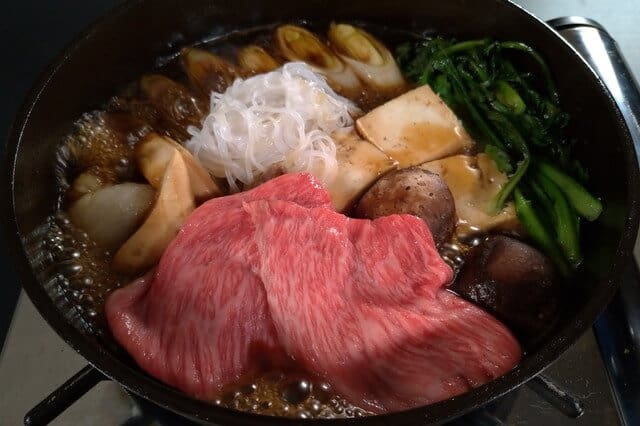
Kanto-style sukiyaki rests on one idea: mix the sauce first, then let everything simmer in it. That generally makes it easier for beginners to keep the seasoning consistent. If you plan to cook at home, start with the warishita ratio above and adjust the sugar next time. If you plan to eat in Tokyo, pick a restaurant by budget and book ahead.
Curious about the lighter cousin? Our shabu-shabu guide shows how sukiyaki and shabu-shabu differ.
Kanto-Style Sukiyaki FAQ
Cooking Questions
- Can I make sukiyaki without a special pot?
-
Yes. A shallow frying pan or a cast-iron skillet works well, because the dish needs only a little liquid. Heavy pans hold heat more evenly, which helps the sauce simmer gently. If you have no tabletop burner, cook on the stove and bring the pan to the table.
- Does warishita contain alcohol?
-
Yes, traditional warishita usually contains mirin and sake. Heating reduces some of the alcohol, but you should not assume all of it disappears. To avoid alcohol, use an alcohol-free mirin-style seasoning and replace the sake with water or dashi. The flavor will differ slightly.
- Is Kanto-style sukiyaki gluten-free?
-
Not usually, because standard soy sauce contains wheat. For a gluten-free version, use tamari or soy sauce labeled gluten-free. Also check the labels on mirin, dashi, and any bottled warishita. In restaurants, ask before ordering, since kitchens rarely change the house sauce.
- Can I reuse leftover warishita?
-
Only the unused portion. Sauce that has touched raw beef, egg, or chopsticks should stay separate from the fresh batch. Therefore, pour out only what you need during the meal. Keep the untouched warishita in a clean, covered container in the refrigerator.
History and Cost
- Is gyunabe the same as sukiyaki?
-
Not exactly. Gyunabe was an early beef pot linked to the spread of beef eating in Yokohama and Tokyo. Early versions used miso, according to MAFF. It is better seen as a predecessor of the Kanto style than as another name for every modern recipe.
- Is sukiyaki expensive in Tokyo?
-
It can be at specialist restaurants. In October 2026, lunch sets at the shops we checked started at ¥5,390, and dinner started at ¥9,900. Premium courses reached ¥26,000, and service charges may apply. However, prices change, so check each official website.
References
- Ministry of Agriculture, Forestry and Fisheries, Our Regional Cuisines – Sukiyaki (Beef hot pot), Tokyo (Accessed October 2026)
- Ministry of Agriculture, Forestry and Fisheries, Uchi no Kyodo Ryori – Sukiyaki, Tokyo (Japanese edition) (Accessed October 2026)
- Ministry of Agriculture, Forestry and Fisheries, Uchi no Kyodo Ryori – Gyunabe, Kanagawa (Accessed October 2026)
- City of Yokohama, Port and Harbor Bureau – History of the Port of Yokohama: Maps and Chronology (Accessed October 2026)
- National Diet Library Collaborative Reference Database (Yokohama Central Library) – Reference Case on the First Gyunabe Shop in Japan (Accessed October 2026)
- AgriKnowledge (Chikusan no Kenkyu, Yokendo) – Matsuo, Y. (2015). Bunken ni Miru Gyunabe to Sukiyaki no Rekishi ni Tsuite, 69(9), 835–840 (Accessed October 2026)
- Ministry of Health, Labour and Welfare – Notice on Revised Standards for Eggs, 1998 (Accessed October 2026)
- Japan Food Hygiene Association – Hygienic Handling of Eggs (Accessed October 2026)
- Ministry of Health, Labour and Welfare – Preventing Food Poisoning at Home (Accessed October 2026)
- Ministry of Agriculture, Forestry and Fisheries – Smart Use of the Refrigerator (Accessed October 2026)
- Japan Konjac Association – The Belief That Shirataki Toughens Sukiyaki Beef Was a Misunderstanding (2017) (Accessed October 2026)
- Ningyocho Imahan – Ningyocho Main Shop Menu (Accessed October 2026)
- Ningyocho Imahan – History of Ningyocho Imahan (Accessed October 2026)
- Hiyama Group – Sukiyaki Kappo Hiyama Tokyo (Accessed October 2026)
- Asakusa Imahan – Kokusai-dori Main Shop News (Accessed October 2026)
- Visit Chiyoda – Ishibashi (Accessed October 2026)
Related Articles
- Sukiyaki (すき焼き) (Surveyed: October 2026). A complete guide to ingredients, history, and regional styles.
- Kansai Style Sukiyaki (関西風すき焼き) (Surveyed: October 2026). The western method, which sears beef and seasons it in the pan.
- Shabu-Shabu (しゃぶしゃぶ) (Surveyed: October 2026). Thin beef swished in light broth, then dipped in sauce.
- Gyunabe (牛鍋) (Surveyed: October 2026). The Meiji-era beef pot associated with Yokohama.
- Shirataki (しらたき) (Surveyed: October 2026). The konjac noodles used in the pan.
- Yaki Tofu (焼き豆腐) (Surveyed: October 2026). Grilled tofu that holds its shape in hot pots.
- Fukaya negi (深谷ネギ) (Surveyed: October 2026). A well-known Japanese leek from Saitama.
- Japanese Hot Pot (Surveyed: October 2026). More nabe dishes from across Japan.



Comments