



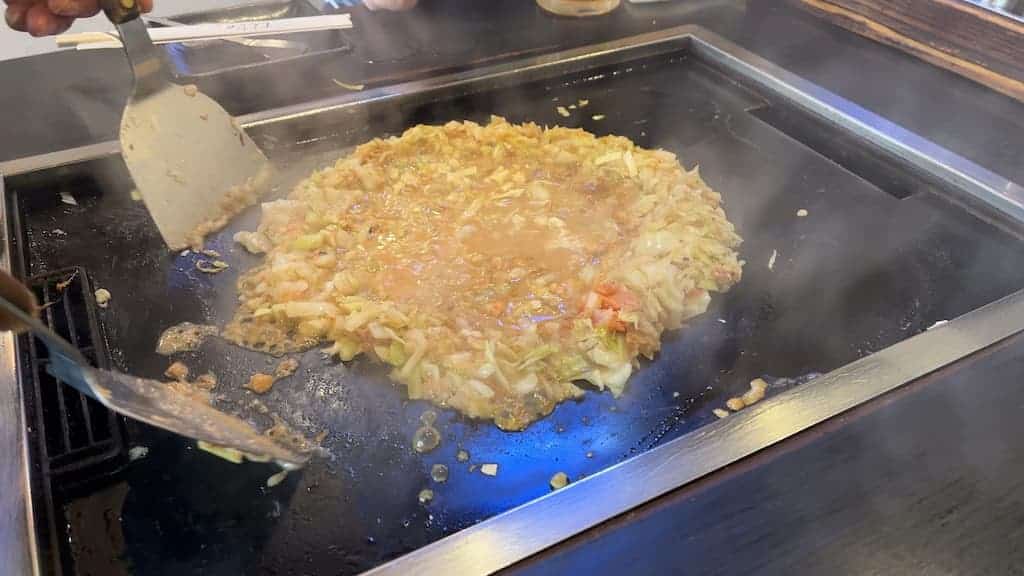
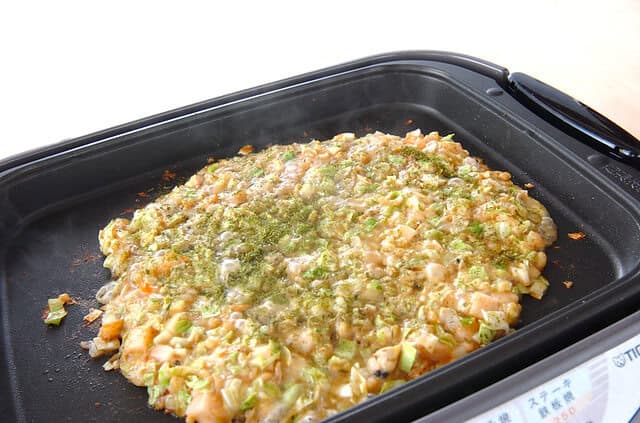
Monjayaki (もんじゃ焼き) is a Tokyo griddle dish made with finely chopped cabbage and a thin, savory batter. Unlike okonomiyaki, it stays soft and gooey as it cooks, developing a crisp layer underneath. Then diners eat it straight from the teppan griddle with small metal spatulas.
Its name is widely linked to mojiyaki, or “letter grilling,” in which people wrote on a hot plate with flour batter. Today, most visitors try it on Tsukishima Monja Street, a shopping road lined with monja shops near central Tokyo.
- Japanese
- もんじゃ焼き (monja for short)
- Origin
- Tokyo’s shitamachi (old downtown); Tsukishima in Chuo City is the best-known area today
- Texture
- Soft and gooey on top, crisp underneath
- Main ingredients
- Finely chopped cabbage, thin flour batter with dashi and Worcestershire sauce, toppings such as dried shrimp or squid
- Cooking surface
- Teppan griddle, usually built into the table
- Eating utensil
- Hagashi (はがし), a small metal spatula
- Typical price
- About 930 to 2,000 yen per order at the shops below (checked September 2026)
- Best-known location
- Tsukishima Monja Street, near Tsukishima Station
What Is Monjayaki?
Monjayaki is a Tokyo teppan dish made with finely chopped cabbage, toppings, and a thin batter of flour, dashi, and Worcestershire sauce. Cooks fry the solids, form a ring, and pour the batter inside. Diners then eat it directly from the griddle with small metal spatulas.
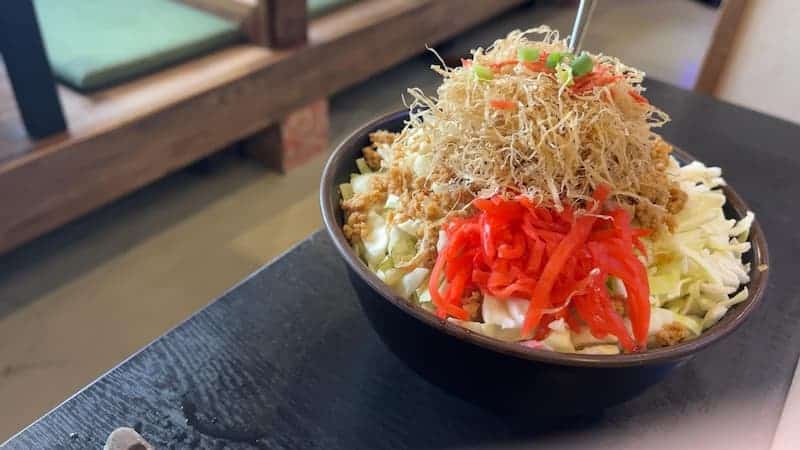
This Japanese griddle dish uses a much thinner batter than okonomiyaki. The batter stays fluid on the griddle and gradually develops a gooey texture. Regional versions may use different names, seasonings, and toppings, but the cabbage ring and the small spatula stay the same.
A Dish Built for Sharing
Monjayaki belongs to Tokyo’s shitamachi, the old working-class neighborhoods near the rivers and bay. For decades, children there bought it at dagashiya, small candy shops that kept a hot plate in the corner. It was cheap, fun, and slightly messy.
That communal feel never left. Even now, friends sit around one griddle, take turns chopping, and argue gently about when to stir. Honestly, the cooking is half the meal. Over time, the dish moved from candy shops to restaurants serving adults. Today, Tsukishima is the place most people associate with it.
What Does Monjayaki Taste Like?
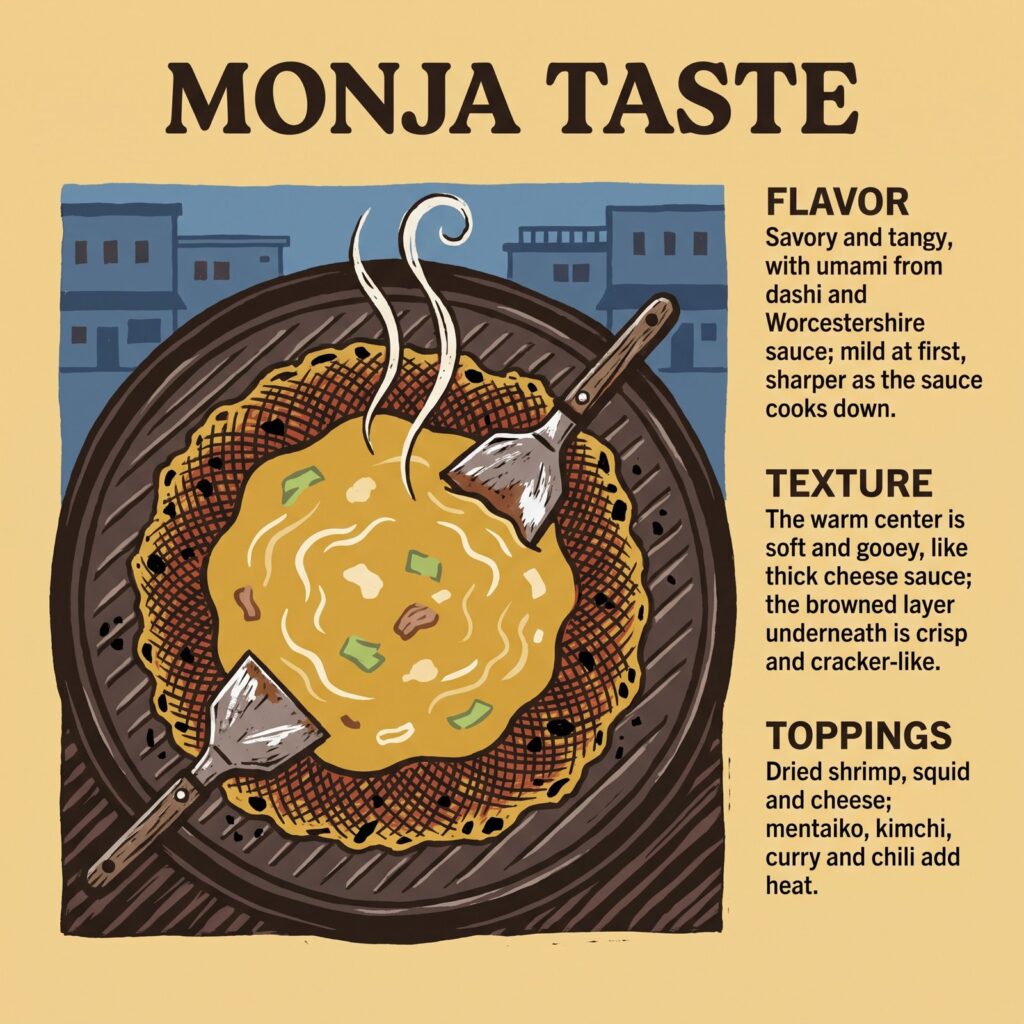
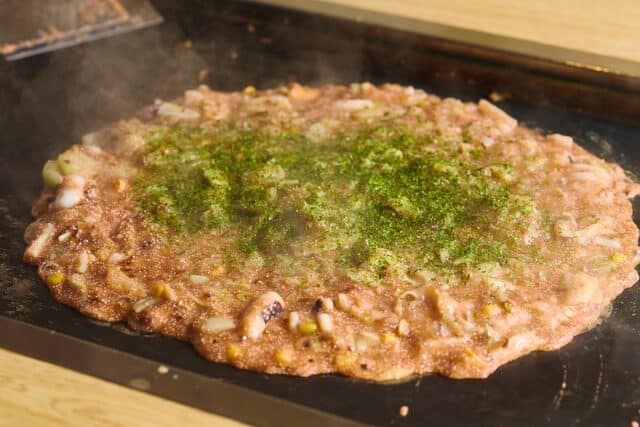
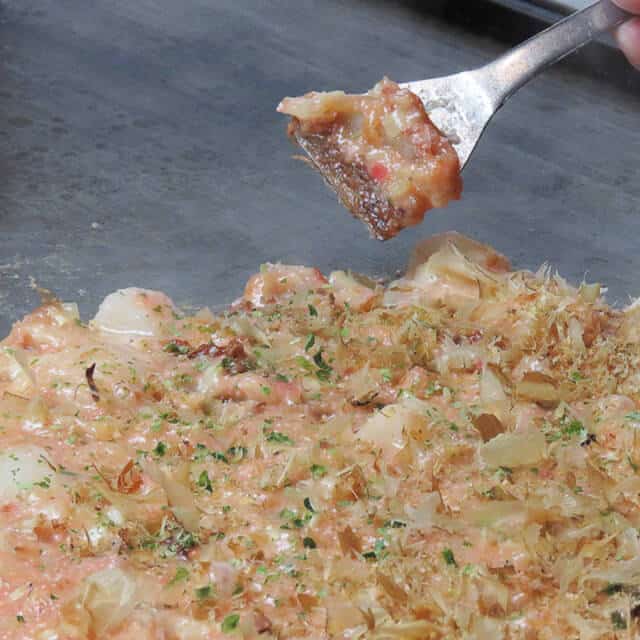
Monjayaki tastes savory, tangy, and rich in umami from dashi and Worcestershire sauce. The center stays gooey while the bottom becomes crisp. Toppings set the final flavor, from briny dried shrimp to creamy cheese.
Flavor
At first, the bite can taste mild. As the liquid cooks off, the sauce concentrates into a sharp, salty tang, softened by sweet cabbage. Dashi adds a quiet seafood depth underneath, so it is closer to a savory snack than a sweet pancake.
Texture
Its texture changes as it cooks. The warm center feels soft and cohesive, a little like thick cheese sauce. Meanwhile, thin patches near the edge dry out first. The browned layer underneath adds a toasty, cracker-like crunch, and that contrast is the point of the dish.
Popular Varieties
Traditionally, monja uses dried shrimp, dried squid, and tenkasu (tempura bits). Modern menus also add mentaiko (spicy cod roe), mochi, and cheese, a combination found at many shops. Standard monjayaki is savory rather than hot. However, mentaiko, kimchi, curry, and chili toppings can raise the heat.
How to Eat Monjayaki
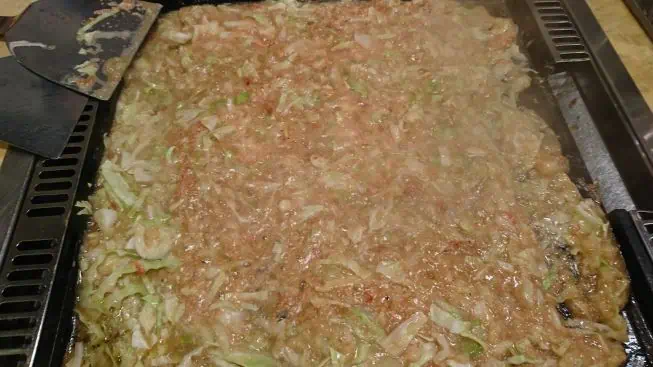
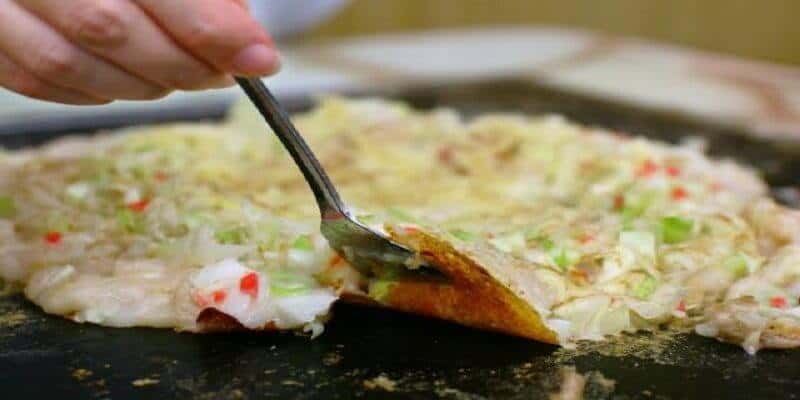
Diners eat monjayaki by scraping small cooked portions from the outer edge with a hagashi. They press the spatula briefly against the griddle so the underside crisps. Then they lift the bite straight to their mouth, without using a plate.
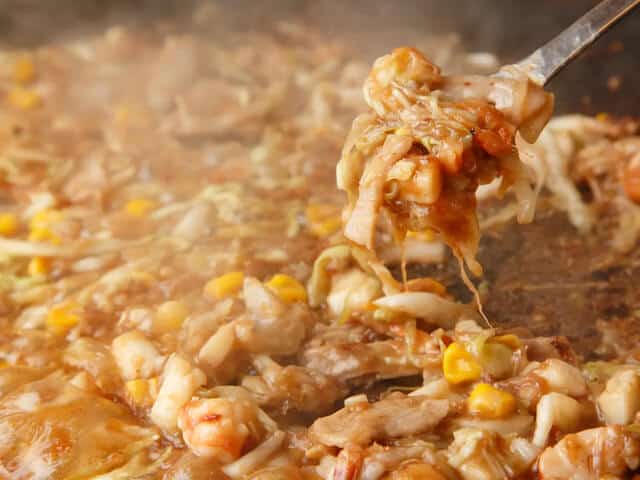
- Wait for the batter to cook. The center should bubble steadily and thicken, and then the spread-out batter needs a few more minutes on the heat. At restaurants, staff will tell you when it is ready.
- Hold the hagashi flat. Grip it like a small knife, with the blade almost level to the griddle.
- Press and scrape. Push a small amount against the hot plate for a few seconds, then slide it off.
- Work from the edge inward. The edges cook first, so start there and leave the center a little longer.
Making Crispy Okoge
Okoge (おこげ) means the browned layer that sticks to the griddle. For more of it, spread a thin patch of batter and leave it alone for a minute or two. After that, scrape it up while it sizzles. However, some shops call the same crust senbei, after the rice cracker. Others save senbei for a thin, fully crisped round, so do not worry about using the “right” word.
Monjayaki vs Okonomiyaki
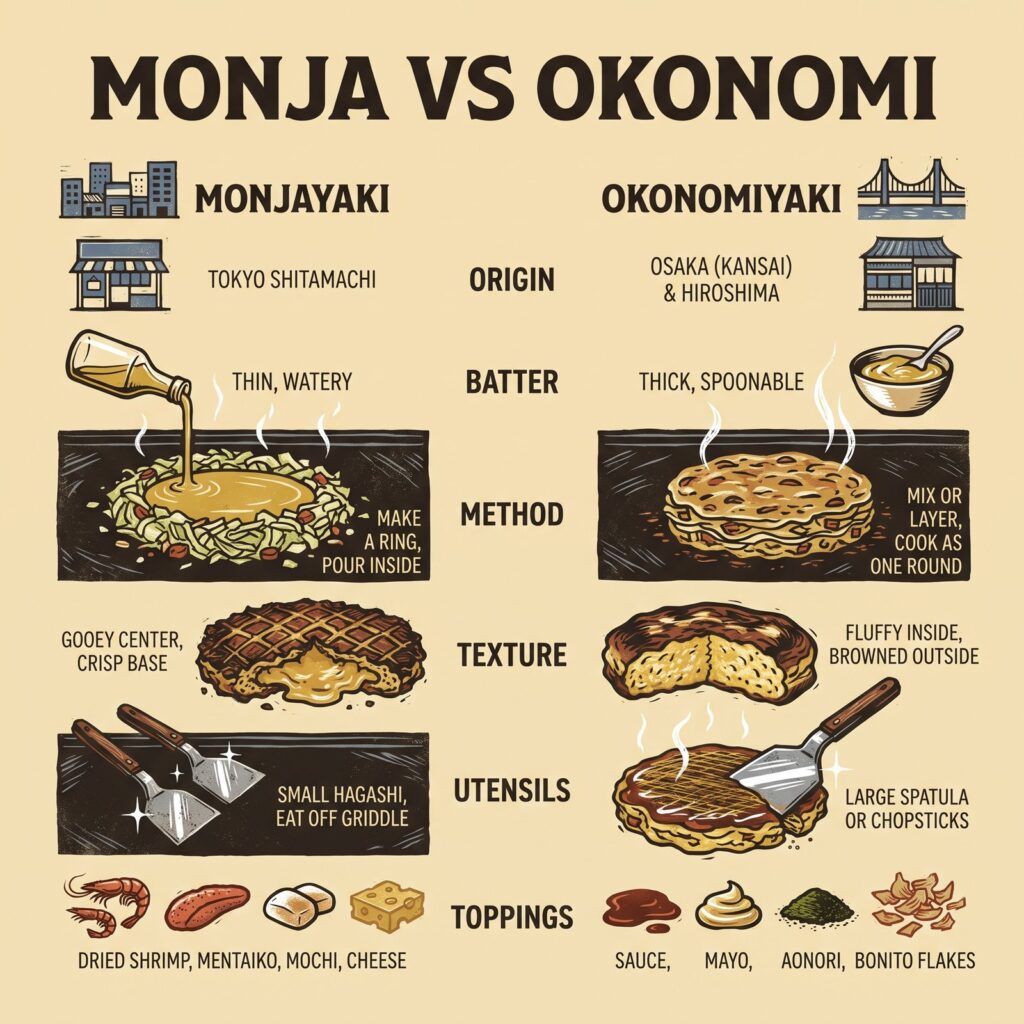
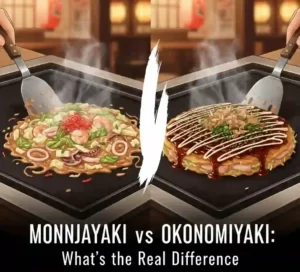
Both dishes share cabbage, flour, and a teppan, yet they eat very differently. Okonomiyaki is a thick pancake from Kansai and Hiroshima, whereas monjayaki is a loose Tokyo batter you never flip. For the full breakdown, read our guide to monjayaki vs okonomiyaki differences.
| Feature | Monjayaki | Okonomiyaki |
|---|---|---|
| Origin | Tokyo shitamachi | Osaka (Kansai) and Hiroshima |
| Batter | Very thin and watery | Thick and spoonable |
| Cooking method | Fry solids, make a ring, pour batter inside | Mix or layer, then cook as one round |
| Texture | Gooey center, crisp base | Fluffy inside, browned outside |
| Utensils | Small hagashi spatula, eaten off the griddle | Large spatula or chopsticks |
| Typical toppings | Dried shrimp, squid, mentaiko, mochi, cheese | Sauce, mayonnaise, aonori, bonito flakes |
If you enjoy comparing styles, our guides to Kansai-style okonomiyaki and Hiroshima-style okonomiyaki show how the regional versions differ. Osaka’s green-onion cousin, negiyaki, is another teppan dish worth a look.
Where to Eat Monjayaki in Tsukishima
Tsukishima Monja Street is the nickname for Nishinaka-dori, a shopping street about 400 meters long. It starts right outside Tsukishima Station. Guides count more than 50 monja shops along it and in nearby lanes. In addition, the Tsukishima Monja Promotion Association lists about 50 member shops on its website.
- Station: Tsukishima Station on the Tokyo Metro Yurakucho Line and Toei Oedo Line
- Exit: Exit 7 opens onto Nishinaka-dori, the street known as Monja Street
- Orientation: The street runs west from the exit, and banners mark its sections one to four
- Information: The association’s information center sells meal tickets and hands out maps
- Waiting: Popular shops fill up on weekends and holidays; reservations help for groups
- Before you go: Hours and closing days vary, so check each shop’s official page on the day
We picked the three shops below for different needs: help for first-timers, a retro setting, and a long history. Restaurant details were checked against official websites and published listings in September 2026.
Monja Kura (もんじゃ 蔵)
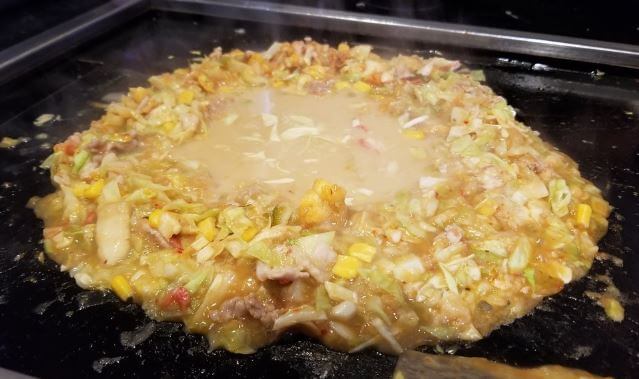
Kura is one of the busiest shops on the street, and its storehouse-style front is easy to spot. Besides classic monja, the menu includes cream-sauce versions and a large seafood special. The printed menu also explains each cooking step, which helps first-timers.
Information checked: September 2026.
Tsukishima Monja Daruma (月島もんじゃ だるま 月島本店)
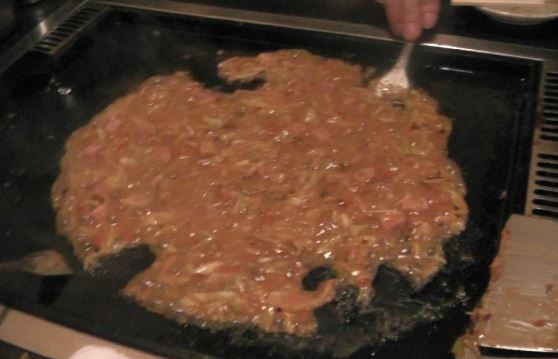
Daruma occupies a renovated old house, and according to the shop, the building is around 80 years old. Inside, it keeps a downtown feel with a long list of sake and shochu. Best of all, staff will cook for you on request, which takes the pressure off.
Information checked: September 2026.
Monja Kondo Honten (もんじゃ 近どう 本店)
Guidebooks date Kondo to 1950 and say it began in a corner of a dagashiya. Even now, it still serves an old-fashioned monja alongside newer flavors. On weekdays, though, it opens only in the evening.
Information checked: September 2026.
Other Tokyo Monjayaki Restaurants
Asakusa Rokumonsen (浅草六文銭)
Rokumonsen has served monja in Asakusa since 1980, a short walk from Senso-ji. So it suits travelers who want monja without a separate trip to Tsukishima. Its Camembert monja arrives with a whole wheel of cheese. Also, the staff will explain cooking if you ask.
Information checked: September 2026.
Vegetarian, Gluten-Free, and Allergen Notes
Vegetarian monjayaki is possible, but check carefully. For example, traditional dashi may contain bonito, and seafood toppings are common. Ask for kombu or plant-based stock where available. Rokumonsen in Asakusa, for instance, lists a vegetable monja on its official menu.
For a vegan version, though, removing meat is not enough. Check the dashi, Worcestershire sauce, mayonnaise, cheese, tenkasu, and the shared cooking surface. Standard batter contains wheat, and ordinary Worcestershire sauce or shared griddles may also be a concern. Do not treat any version as gluten-free unless the shop confirms every ingredient and surface.
Allergen notice: monjayaki may contain wheat, fish, shrimp, squid, shellfish, soy, dairy, egg, and sesame. Cross-contact on shared griddles is common, so tell staff about allergies before ordering.
Easy Monjayaki Recipe
We adapted this monjayaki recipe from a home version by the Tsukishima Monja Promotion Association. Japan’s Ministry of Agriculture, Forestry and Fisheries publishes it. The ingredients and the 230°C griddle setting follow that source. The equipment list, troubleshooting tips, and some timing notes are our own additions. It serves two or three people as a shared snack.
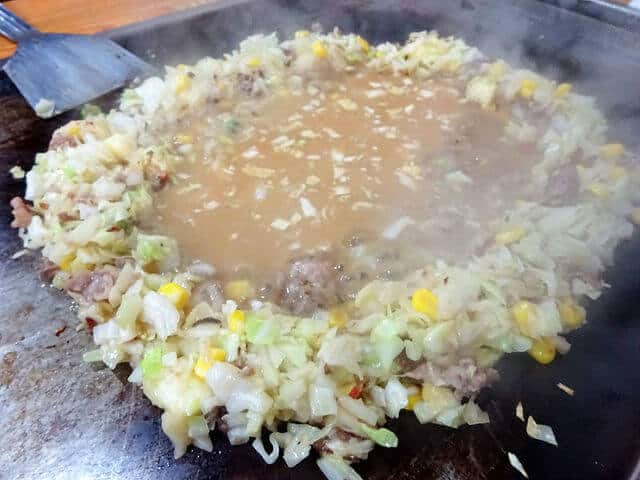
Monjayaki Ingredients
| Ingredient | Amount | Notes |
|---|---|---|
| Cabbage | 300 g | Weighed before chopping; cut into short strips |
| Dried squid (surume strips) | 1 tbsp | Optional; adds saltiness |
| Dried shrimp | 1 tbsp | Sakura ebi or small dried shrimp |
| Tenkasu (tempura bits) | 1 pinch (about 5 g) | Adds body and crunch |
| Water | 350 ml | Or unsalted dashi |
| Wheat flour | 30 g | Plain or cake flour |
| Granulated dashi | 1 tsp | Skip if using liquid dashi |
| Worcestershire sauce | 2 tbsp | Adjust to taste |
| Vegetable oil | 1 tbsp | For the griddle |
| Aonori, bonito flakes, pepper | To taste | Optional finishing toppings |
In this recipe, the liquid-to-flour ratio is roughly 12:1 by weight. That is why the batter looks like thin soup rather than pancake batter. It thickens only on the griddle.
Equipment
Gather a griddle or large skillet, two cooking spatulas, and small hagashi spatulas, plus a mixing bowl and a whisk. Also, if the griddle sits on the table, put heat-resistant protection under it.
How to Make Monjayaki
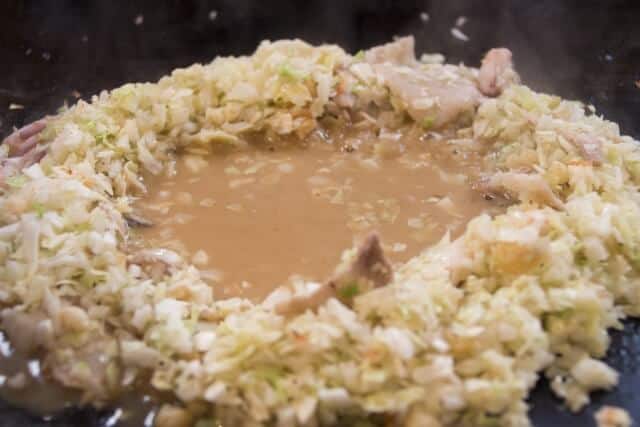
- Heat the griddle. Set it to about 230°C and preheat for several minutes. A drop of water should sizzle and skitter at once. Meanwhile, whisk the water, flour, and dashi, then stir in the Worcestershire sauce. Place the cabbage and toppings on top of the batter in the bowl without mixing them in.
- Fry the solids. Oil the griddle. Then lift the cabbage and toppings out of the bowl, leaving the liquid behind. Fry them for 3 to 4 minutes until the cabbage softens.
- Chop as you go. Use both spatulas to chop the cabbage finely right on the griddle, since smaller pieces make a tighter wall.
- Shape the dote. Next, push everything into a ring about 20 cm across, with a clear hollow in the middle. This dote (土手) works like a small embankment.
- Pour the batter. Pour the liquid into the center. If the ring is small or starts to leak, pour in two or three batches. Cook for about 2 minutes, until the batter bubbles and thickens.
- Spread and finish. Finally, mix everything together and spread it thin. Cook for another 3 to 4 minutes, until the surface loses its shine and the bottom browns. Add aonori and bonito flakes, then eat with hagashi.
Troubleshooting
| Problem | Likely cause | Fix |
|---|---|---|
| Batter leaks | Ring too thin or uneven | Push cooked cabbage into the gap; do not add raw flour |
| Mixture stays watery | Griddle not hot enough | Raise the heat and wait for steady bubbling |
| Bottom burns | Heat too high or spread too thin early | Lower the heat slightly and keep spreading evenly |
| No crispy layer forms | Too much stirring | Leave a thin patch untouched for a minute or two |
| Cabbage remains firm | Pieces too large or fried too briefly | Chop finer and fry a little longer before shaping |
Safety at the Table
- Place a tabletop griddle on a stable, level surface, and keep hands, sleeves, and children away from the hot plate.
- Do not eat the batter raw. Follow the recipe’s cooking times: let the center bubble and thicken, then spread it and cook for several more minutes. A soft texture is normal, but the batter still needs to heat through fully.
- Cook raw pork, squid, shrimp, and shellfish fully before diners start scraping portions.
- Use separate utensils for raw ingredients and for eating.
Monjayaki Glossary
- Teppan (鉄板)
- A flat iron griddle, often built into the table
- Dote (土手)
- A ring-shaped embankment of cooked cabbage
- Hagashi (はがし)
- A small metal spatula for eating
- Okoge (おこげ)
- The crisp, browned layer on the griddle
- Senbei (せんべい)
- A cracker-like crust; usage varies by shop
- Tenkasu (天かす)
- Crunchy tempura bits
- Dashi (だし)
- Japanese stock, often from kelp and bonito
- Dagashiya (駄菓子屋)
- A small, cheap candy and snack shop
Can You Make Monjayaki at Home?
Yes, monjayaki works at home without a restaurant teppan. In fact, an electric hot plate is the easiest choice, because everyone can eat from it at the table. The Ministry of Agriculture’s recipe page notes that a home hot plate works fine.
| Surface | Pros | Cons |
|---|---|---|
| Teppan griddle | Even heat, best okoge | Rare in home kitchens |
| Electric hot plate | Table-side cooking, steady temperature | Smaller surface; set to high |
| Cast-iron pan | Strong heat, good crust | Heavy; eaten at the stove |
| Nonstick frying pan | Easy to clean | Weaker crust; avoid metal spatulas |
With a nonstick pan, however, use a silicone or wooden spatula to protect the coating. You may get less okoge, but the flavor still holds up well.
History of Monjayaki
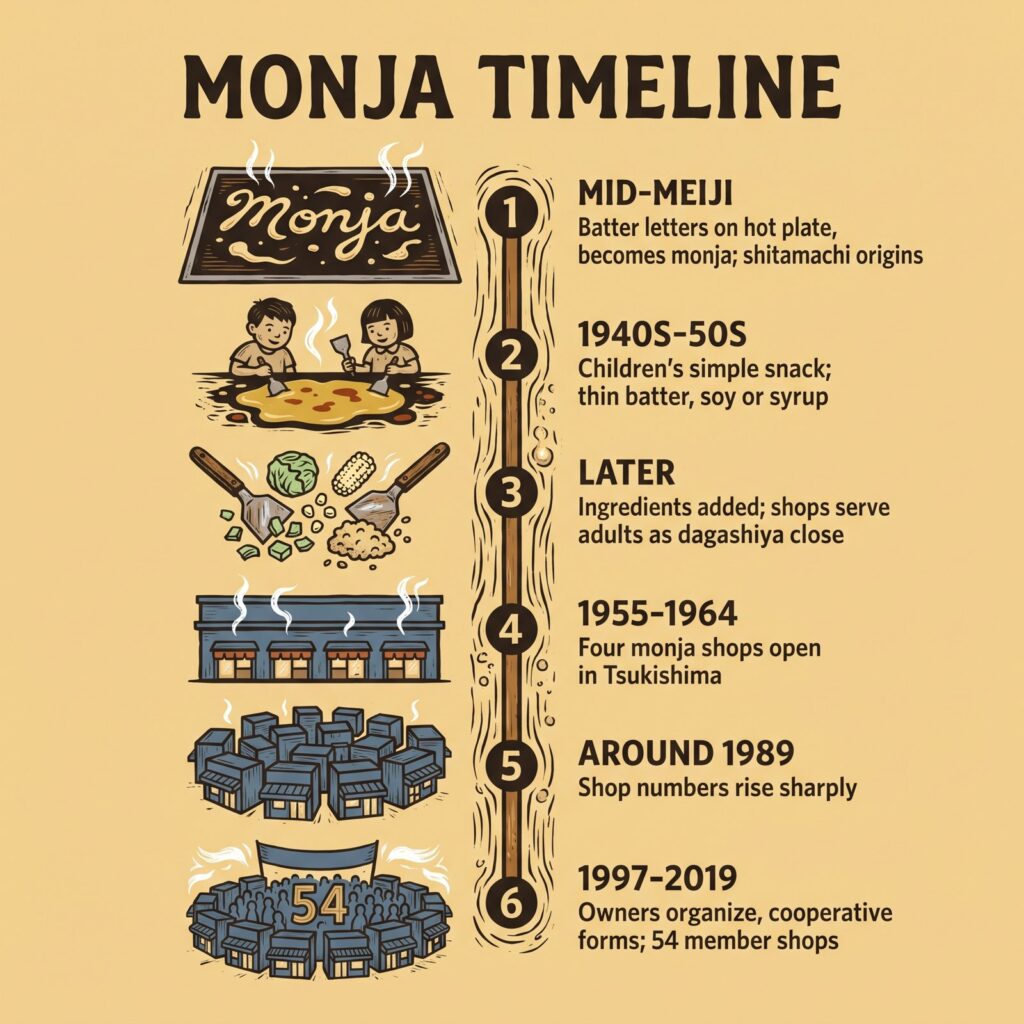
The Ministry of Agriculture, Forestry and Fisheries explains the name through mojiyaki. People wrote letters on a hot plate with batter, so they called it “letter grilling.” Gradually, moji became monji and then monja. The Tsukishima Monja Promotion Association says the dish developed in Tokyo’s shitamachi from the mid-Meiji period. Even so, how closely old mojiyaki matches today’s dish is hard to document.
By comparison, the postwar story is clearer. According to the ministry, children widely enjoyed a simple version from around the late 1940s into the 1950s. It used thin flour batter with soy sauce or syrup. As Japan’s economy grew, cooks added cabbage, corn, and tempura bits.
Then the dagashiya began closing, and a few shops kept the taste alive as food for adults with drinks. Interestingly, Tsukishima’s monja street is newer than many visitors assume. According to the association, the area had only four monja shops in the Showa 30s (1955 to 1964). Their number rose sharply around the start of the Heisei era in 1989.
In April 1997, owners of 28 shops formed the group that later became the association. Later, it became a cooperative in September 2002. By June 2019, it had 54 member shops run by 34 companies.
Monjayaki Outside Tokyo
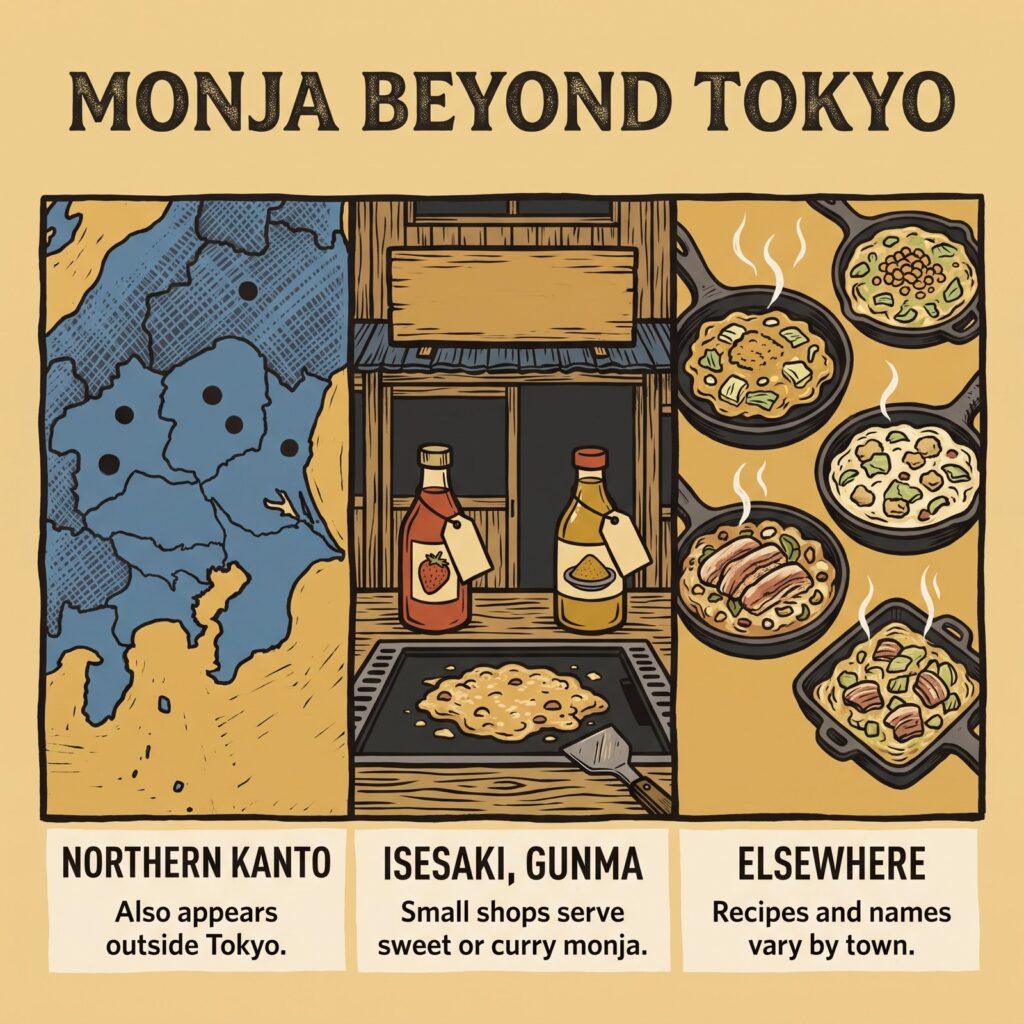
Monjayaki also appears outside Tokyo, especially in the northern Kanto region. In Isesaki, Gunma Prefecture, small candy shops still serve isesaki monja for a few hundred yen. For example, some local shops sweeten it with strawberry syrup or season it with curry powder. Elsewhere, recipes and names vary, so treat each town’s version on its own terms.
Monjayaki Videos
Monjayaki: Final Thoughts
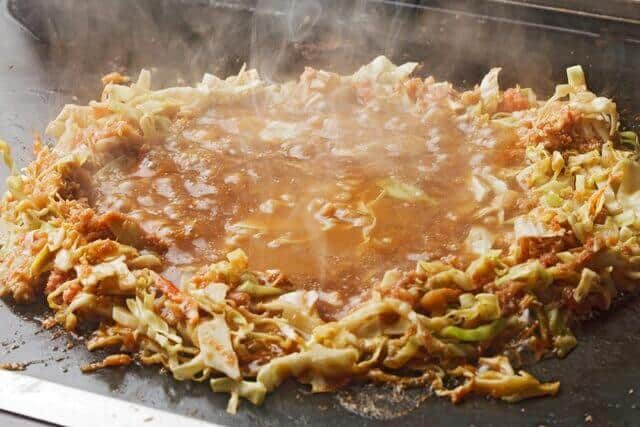
Few dishes make dinner this social. Build the dote, wait for the bubbles, and fight politely over the okoge. Try it on Tsukishima Monja Street or on a hot plate at home. Either way, about twenty minutes is enough to see why Tokyo still loves it.
Monjayaki FAQ
- Is monjayaki fully cooked?
-
Properly cooked monjayaki is soft but fully heated. Let the center bubble and thicken, then spread it and cook a few more minutes. Also, cook any meat or seafood fully before eating.
- Why is monjayaki runny?
-
Monjayaki uses much more liquid than flour, so it stays soft rather than setting into a firm pancake. In the recipe above, the liquid-to-flour ratio is roughly 12:1 by weight.
- Can you make monjayaki without a teppan?
-
An electric hot plate or a heavy skillet works well at home. Cast iron gives the best crust. With nonstick pans, use a wooden or silicone spatula.
- What is the difference between okoge and senbei?
-
Both words describe the crisp layer that forms on the griddle. However, some shops use senbei for a thin, fully crisped round. Usage varies by restaurant.
- Is there vegetarian monjayaki?
-
Some shops list vegetable versions, but the dashi may contain bonito. Ask for kombu or plant-based stock. Shared griddles also cook meat and seafood.
- Why is Tsukishima famous for monja?
-
Tsukishima’s shopping street gathered many monja shops from around 1989 onward. Today, the local association lists about 50 member shops. The street begins at Exit 7 of Tsukishima Station.
- How is monjayaki different from okonomiyaki?
-
Okonomiyaki is a thick pancake that holds its shape. Monjayaki, by contrast, uses a thin batter that stays gooey on the griddle. You never flip it.
References
- Ministry of Agriculture, Forestry and Fisheries – Our Regional Cuisines: Monjayaki, Tokyo (history and 2 to 3 serving recipe) (Accessed September 2026)
- Ministry of Agriculture, Forestry and Fisheries – Regional Dishes for Children: Monjayaki (Accessed September 2026)
- Tsukishima Monja Promotion Association – Official Website and Association History (Accessed September 2026)
- Ministry of Agriculture, Forestry and Fisheries – Our Regional Cuisines: Monja yaki (English) (Accessed September 2026)
- Mitsubishi Estate Residence – Tsukishima Monja Street (Accessed September 2026)
- ANA Japan Travel Planner – Tsukishima Monja Street (Accessed September 2026)
- Asakusa Rokumonsen – Monjayaki Menu (Accessed September 2026)
- Asakusa Rokumonsen – Store Information (Accessed September 2026)
- Gurunavi – Tsukishima Monja Daruma Main Store (Accessed September 2026)
- Hot Pepper Gourmet – Tsukishima Monja Daruma Main Store Menu (Accessed September 2026)
- Mapple – Tsukishima Monja Shops: Kura and Kondo (Accessed September 2026)
- Mapple – Isesaki Monja Shops (Accessed September 2026)
- Centers for Disease Control and Prevention – Say No to Raw Dough (Accessed September 2026)
- MLIT Kinki Regional Development Bureau – Kumagai, M., Konamon Food Culture, symposium material (PDF) (Accessed September 2026)
Related Articles
- Monjayaki vs Okonomiyaki (Surveyed: September 2026)
- Okonomiyaki (お好み焼き) (Surveyed: September 2026)
- Negiyaki (ねぎ焼き) (Surveyed: September 2026)
- Konamon (粉もん) (Surveyed: September 2026)




Comments
List of comments (4)
Thanks for this! I never knew what Monjayaki was and this is very informative!
thank you for reading!!
If you have something you want to know about Japanese food.
feel free to ask! 🙂
The savory aroma must be amazing when the batter hits the hot grill. It is fascinating how a dish with such a runny texture can pack so much deep umami flavor.
Thank you! It really is. The moment the batter hits the hot grill, the aroma fills the air, and as it cooks, the ingredients come together to create a rich, savory umami that’s hard to resist. It’s one of the things that makes this dish so special!