




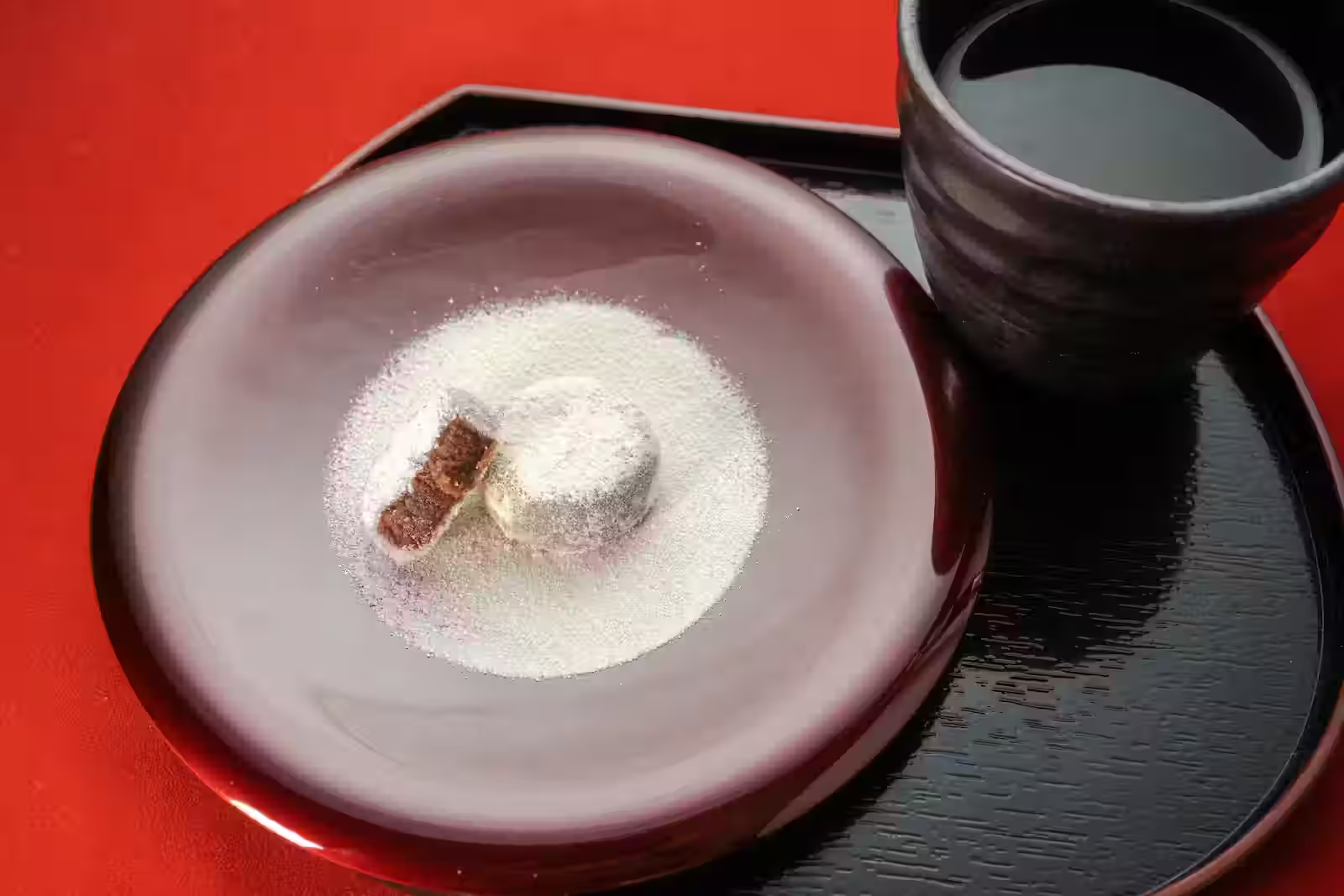
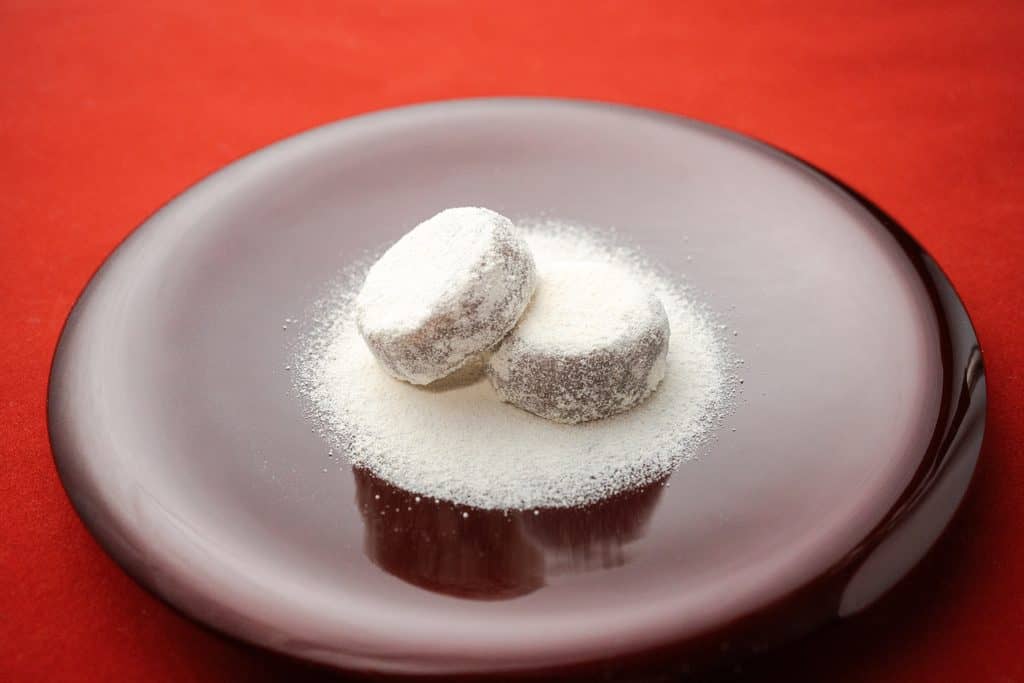
Seki no To (関の戸) is a bite-sized Japanese sweet from Seki-juku, an old post town in Kameyama, Mie Prefecture. One small shop wraps smooth red bean paste in gyuhi, a soft rice dough, then dusts the whole thing in wasanbon sugar. That pale coating is really the point. Locals say it stands for snow settling on the Suzuka mountains, which rise behind the town.
This wagashi has been made along the old Tokaido highway since the Edo period. So it is a sweet with an address, and the address still matters.
What Is Seki no To?
Basically, Seki no To is a mochi-type confection roughly the size of a large marble. Inside sits koshi-an, namely a strained paste of red azuki beans. Around that goes gyuhi, then over everything comes a heavy dusting of fine white sugar. Kameyama City, which certifies the sweet under its local brand scheme, describes it in exactly those terms too.
- Japanese name 関の戸, usually romanized as Seki no To, Sekinoto or Seki-no-To
- Where Seki-juku, specifically in Kameyama City, northern Mie Prefecture
- Category Wagashi, namely traditional Japanese confectionery
- Core parts Koshi-an, gyuhi and, above all, Awa wasanbon sugar
- Maker Fukagawaya Mutsudaijo, which produces only this sweet
How to say it
Say it as seh-kee-no-toh, with no stress worth worrying about. “Seki” is the town, while “to” means door or gate. Written English varies, so you will meet Sekinoto and Seki-no-To as well. All three, however, point to the same box.
One shop, one sweet
Here is the part that certainly surprises most visitors. Fukagawaya makes Seki no To and nothing else, and it says so plainly on its own site. Flavored versions exist, including one dusted with locally grown Kameyama tea and another using brown sugar. Still, the base sweet has not changed.
What Is Seki no To Made Of?
Three components do all the work, although none of them hide behind the others.
- Koshi-an Red azuki beans cooked with sugar, then strained until no skins remain
- Gyuhi A softer relative of mochi, made from glutinous rice, then kept pliable with sugar
- Wasanbon A fine traditional sugar from Awa, namely the old name for Tokushima
Why gyuhi is not quite mochi
Both start from glutinous rice, so the confusion is fair. Gyuhi, however, carries far more sugar, and that sugar keeps it soft for days. Plain mochi hardens quickly by comparison. Because the wrapper stays thin and yielding, the bean paste leads rather than the rice.
The sugar that makes the snow
Wasanbon comes only from a limited area of Kagawa and Tokushima on Shikoku, where growers cultivate a slender cane called chikuto. Producers press and knead the raw sugar repeatedly on a tray, so that process gives the sugar its name. The grain ends up very fine, and the sweetness fades cleanly instead of clinging.
Ingredients and allergen labeling can change without notice, though. Anyone avoiding wheat, dairy, eggs or particular additives should read the current package or ask the shop directly, rather than relying on any article.
What Does Seki no To Taste Like?
The first impression is basically powder. Wasanbon melts almost immediately on the tongue, so the sweetness arrives before any texture does. Then the gyuhi gives way, and the bean paste follows underneath.
Koshi-an tastes rounder and earthier than most people expect from a red bean sweet. Because the skins are strained out, nothing feels grainy. The whole thing is sweet, certainly, though the finish clears faster than a Western confection of similar size.
Size matters here more than it sounds. One piece takes two bites at most, so it suits a cup of bitter tea perfectly. Eat three in a row, however, and the sweetness starts to build.
Seki no To Compared with Other Mochi Sweets
Photographs often make several Japanese sweets look interchangeable. So the table below separates them.
| Point | Seki no To | Daifuku | Akafuku |
|---|---|---|---|
| Wrapper | Gyuhi, thin and soft | Mochi, thicker | None, paste sits outside |
| Bean paste | Koshi-an, inside | Usually anko, inside | Koshi-an, on top |
| Outer coating | Wasanbon sugar | Starch or rice flour | None |
| Size | One or two bites | Around 4 cm across | Small, hand-shaped |
| Home region | Seki-juku, Mie | Nationwide | Ise, Mie |
So the sugar coating is the quickest tell. For wider context, see our further guides to daifuku and to Akafuku mochi, which comes from the Ise side of the same prefecture. Our wagashi guide also covers the category as a whole.
The History Behind the Sweet
Founded in the age of the third shogun
Kameyama City gives the founding year as 1642, during the Kan’ei era. Fukagawaya itself describes more than 370 years of trading, dating the shop to the time of Tokugawa Iemitsu, the third shogun. Those two statements do not line up perfectly, so treat the exact year with a little caution. Either way, the shop clearly predates almost everything else on the street.
From daimyo travelers to the imperial court
The shop’s own account, meanwhile, runs like this. Feudal lords moving along the Tokaido took to the sweet, and word eventually reached the court in Kyoto. Fukagawaya then became a supplier to Omuro Gosho, the imperial residence at Ninna-ji temple, and received the title Mutsudaijo. That name still sits beside the shop’s own on the sign today.
Worth a look outside. Mie’s tourism authority notes that Fukagawaya’s ann-kanban, a hanging wooden shop sign, is the only one still in place along the old highway. Travelers in the Edo period generally used signs like it to work out where they were.
A recipe held still on purpose
Fukagawaya also states that it keeps the Edo-period proportions and methods unchanged. That claim is common in Japanese confectionery, admittedly, and it is hard for any visitor to verify. What can be checked is narrower, yet more telling. The shop has stayed with one product, in one town, for a remarkably long time.
Seki-juku, the Post Town That Shaped It
Seki-juku was the forty-seventh post town when counting from Nihonbashi in Edo, now Tokyo. Travelers stopped here before tackling the Suzuka Pass, so the town handled a constant stream of feudal processions and Ise pilgrims. Roads branched here too, with the Ise Betsukaido leaving to the east and the Yamato Kaido to the west.
Kameyama City reports that the national government then selected Seki-juku as an Important Preservation District for Groups of Traditional Buildings in December 1984. It still remains the only Tokaido post town with that status. The protected area stretches about 1.8 kilometers between the eastern and western junctions, so it covers 25 hectares.
Around two hundred old townhouses also survive there, built between the Edo and Meiji periods. Fukagawaya stands in Nakamachi, namely the working center of the post town. So the sweet is not merely sold in a historic district. Instead it grew out of the traffic that district was built to serve.
How to Eat and Serve It
Green tea is the obvious partner, since the shop describes the sweet as a tea confection. Matcha works best if you have it, since the bitterness cuts straight through the wasanbon. Sencha or roasted hojicha also do the job.
- Serve it at room temperature, because chilling stiffens the gyuhi.
- Eat it whole, or else halve it whenever you want to see the cross-section.
- Keep a napkin nearby, since the sugar dusts everything it touches.
- Pour the tea first, then unwrap, so the sugar stays dry.
- Offer two per person rather than a plateful, because the sweetness accumulates.
At a formal tea gathering, a small wooden pick usually handles the cutting. At home, honestly, fingers are fine.
Where to Buy Seki no To
At the shop in Seki-juku
The main shop sits on the old highway in Nakamachi, specifically in Seki-machi, Kameyama. Its published hours run from 9:30 to 18:00, with Thursdays closed unless the day falls on a public holiday. One line on the shop’s site deserves attention, though. Selling continues only until the day’s batch runs out.
JR Seki Station is roughly a ten-minute walk away, namely on the Kansai Main Line. Because service is infrequent, check timetables before committing to a train.
Boxes, prices and online orders
Fukagawaya also lists boxes of six, ten and fourteen pieces, plus decorated gift boxes. Online retailers were showing a six-piece box at around ¥650 in August 2026, which is roughly US$4 at ¥160 to the dollar. Prices shift, however, so confirm the current figure and any delivery charge before ordering.
What to check before you go
- Current opening hours, plus the weekly closing day
- Whether stock is likely to remain later in the day
- Accepted payment methods, since small shops may prefer cash
- Delivery areas, if you plan to order rather than visit
- The best-before date printed on the box
Does It Work as a Souvenir?
Rather well, and for practical reasons. The pieces are individually wrapped, the boxes are flat, and gift packaging is standard too. Kameyama City also certifies the range under its own brand scheme, which gives the box a recognized local standing.
Shelf life is obviously the limiting factor. Gyuhi-based sweets keep longer than plain mochi, yet they are still fresh confectionery rather than dry biscuits. Check the printed date, and treat the sweet as something to hand over soon after buying.
Taking food across borders is another matter entirely. Import rules differ by country, since some destinations restrict foods containing certain plant or animal products. Check your own customs authority before packing sweets, since airport confiscation is a poor end to a trip.
Other Foods to Try in Mie
Mie stretches from industrial ports in the north, whereas the south holds shrine towns and oyster beds. Seki-juku sits at the northern end, namely near the Suzuka mountains.
- Akafuku mochi, namely the red bean sweet tied to Ise Jingu
- Akafuku gori, its shaved-ice summer version
- Ise udon, especially soft noodles in a dark sauce
- Matsusaka beef, one of Japan’s great wagyu brands
If sweets are your focus, our rakugan guide explains more about wasanbon, while the Japanese snacks guide sets wagashi beside everyday treats. Our Kansai food guide then covers the wider region.
Is Seki no To Worth the Detour?
Taken alone, it is a small sugared sweet, and nobody would call it dramatic. Taken in place, however, it reads differently. You buy it in a preserved post town, from a shop that has made nothing else for centuries, under a sign that once told travelers where they were.
Seki-juku fits easily into a day trip between Nagoya and Kyoto. Walk the old street first, buy a box before the batch sells out, then eat one with green tea while the mountains are still in view.
Seki no To FAQ
What is Seki no To made of?
Koshi-an, gyuhi and wasanbon sugar basically make up the whole sweet. Koshi-an is strained red azuki paste, while gyuhi is a soft, sugar-rich relative of mochi. Awa wasanbon from Tokushima then forms the white coating. Check the current package, however, if you need full ingredient details.
Where does Seki no To come from?
It comes from Seki-juku, namely a preserved post town in Kameyama City, Mie Prefecture. Seki-juku was also the forty-seventh stop on the old Tokaido highway. The sweet has been made there since the Edo period. Northern Mie, meanwhile, sits between Nagoya and the Kansai region.
Is Seki no To the same as mochi?
Not quite, although the two are related. The wrapper is gyuhi, which carries much more sugar than ordinary mochi and therefore stays soft longer. That difference shows in the bite, since gyuhi yields rather than stretches. The coating of wasanbon also sets it apart visually.
What should you drink with it?
Green tea suits it best, and matcha suits it especially well. Bitterness balances the wasanbon, so the sweetness does not linger. Sencha and hojicha both work whenever matcha is unavailable. Coffee is less successful, since the roast tends to overwhelm the bean paste.
Where can you buy Seki no To?
The main shop stands on the old highway in Seki-juku, namely about ten minutes on foot from JR Seki Station. Online ordering is also available through the maker and several retailers. Selling ends when the day’s batch runs out, however. Arriving earlier in the day is therefore safer.
How much does a box cost?
Online retailers listed a six-piece box at roughly ¥650 in August 2026, so about US$4 at ¥160 to the dollar. Boxes of ten and fourteen are also sold, along with decorated gift boxes. Prices and packaging obviously change over time. Confirm the current listing and delivery cost before you order.
How should it be stored?
Keep the box at room temperature, then away from heat and direct sunlight. Refrigeration firms up the gyuhi and dulls the texture, so avoid it unless the label says otherwise. Follow the best-before date printed on the package. Fresh confectionery like this rewards eating sooner rather than later.
References
- Fukagawaya Mutsudaijo, Seki no To, Official Site (Accessed August 2026)
- Kameyama City, Kameyama Brand Certified Product: Seki no To Series (Accessed August 2026)
- Kameyama City, Features of the Seki-juku Townscape (Accessed August 2026)
- Agency for Cultural Affairs, Kameyama City Seki-juku Preservation District (Accessed August 2026)
- Kameyama City, Forty Years Since Seki-juku’s Preservation District Designation (Accessed August 2026)
- Kanko Mie, Mie Prefecture Official Tourism Site, Fukagawaya Seki no To Honpo (Accessed August 2026)
- Kagawa Prefectural Products Association, Wasanbon Sugar (Accessed August 2026)
Related Articles
- Wagashi: Its History, Aesthetics, and Cultural Significance (Surveyed: August 2026)
- Daifuku (大福) (Surveyed: August 2026)
- Anko Mochi (あんこ餅) (Surveyed: August 2026)
- Rakugan (落雁) (Surveyed: August 2026)
- Japanese Snacks Guide: Wagashi, Dagashi and Traditional Sweets (Surveyed: August 2026)
- Akafuku (赤福) (Surveyed: August 2026)
- Ise Udon (伊勢うどん) (Surveyed: August 2026)
- Matsusaka Beef (松阪牛) (Surveyed: August 2026)
- The Complete Kansai Food Guide (Surveyed: August 2026)




Comments