


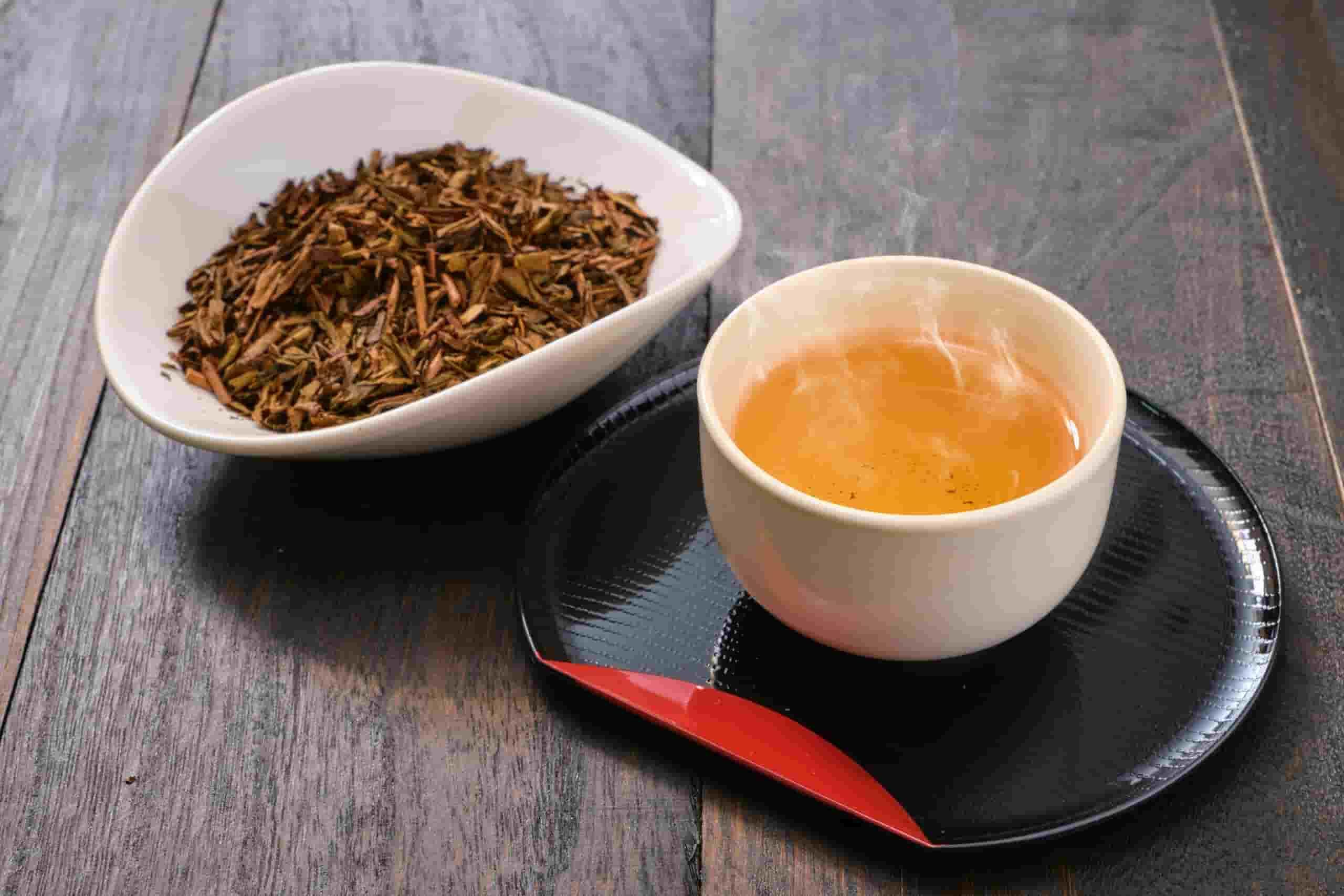

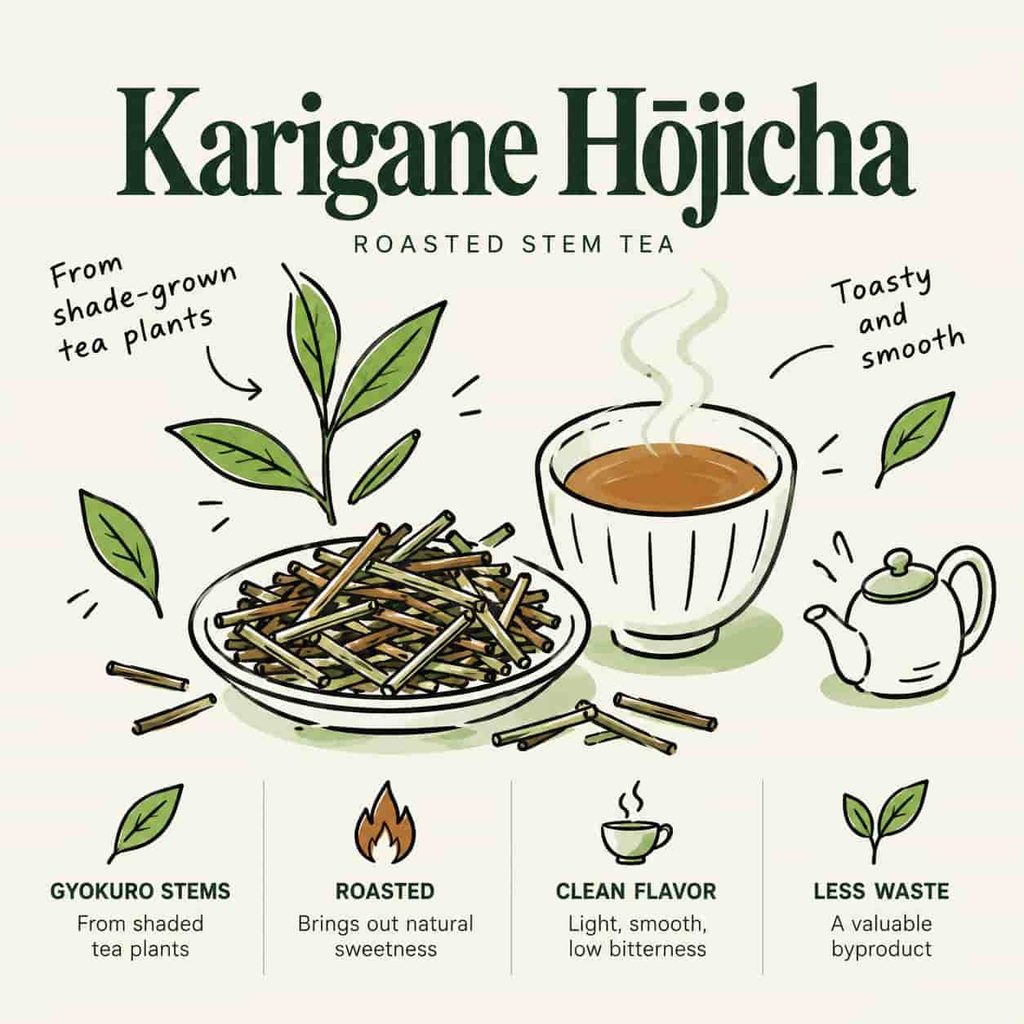
Karigane Hōjicha (雁が音ほうじ茶) is a roasted Japanese tea. Producers make it from karigane: the stems, stalks, and leaf veins they sort out while processing gyokuro and other high-grade, shade-grown tea. It starts from gyokuro-grade plants, not ordinary sencha or bancha. That gives it a natural sweetness and depth of umami that most other roasted teas don’t have. Roasting then adds a warm, toasty layer on top of that base.
Tea drinkers already prize karigane before anyone roasts it. It’s a premium stem tea, not a leftover to throw away. Tea shops and growers especially value versions from Uji and Wazuka, in Kyoto Prefecture, and from Shizuoka’s Asahina district. Roasting turns that same stem tea into karigane hōjicha, an even gentler tea you can drink all day.
This guide covers what karigane hōjicha is and how producers make it. It also explains how the tea compares with plain karigane, kukicha, and other roasted teas such as Kaga Bōcha and Kyobancha. It also covers flavor, caffeine, brewing, and buying. For the tea plant its stems come from, see the complete Gyokuro guide. For the wider stem-tea and roasted-tea family it belongs to, see the complete Bancha guide.
What Is Karigane Hōjicha?
From Gyokuro Byproduct to Prized Stem Tea
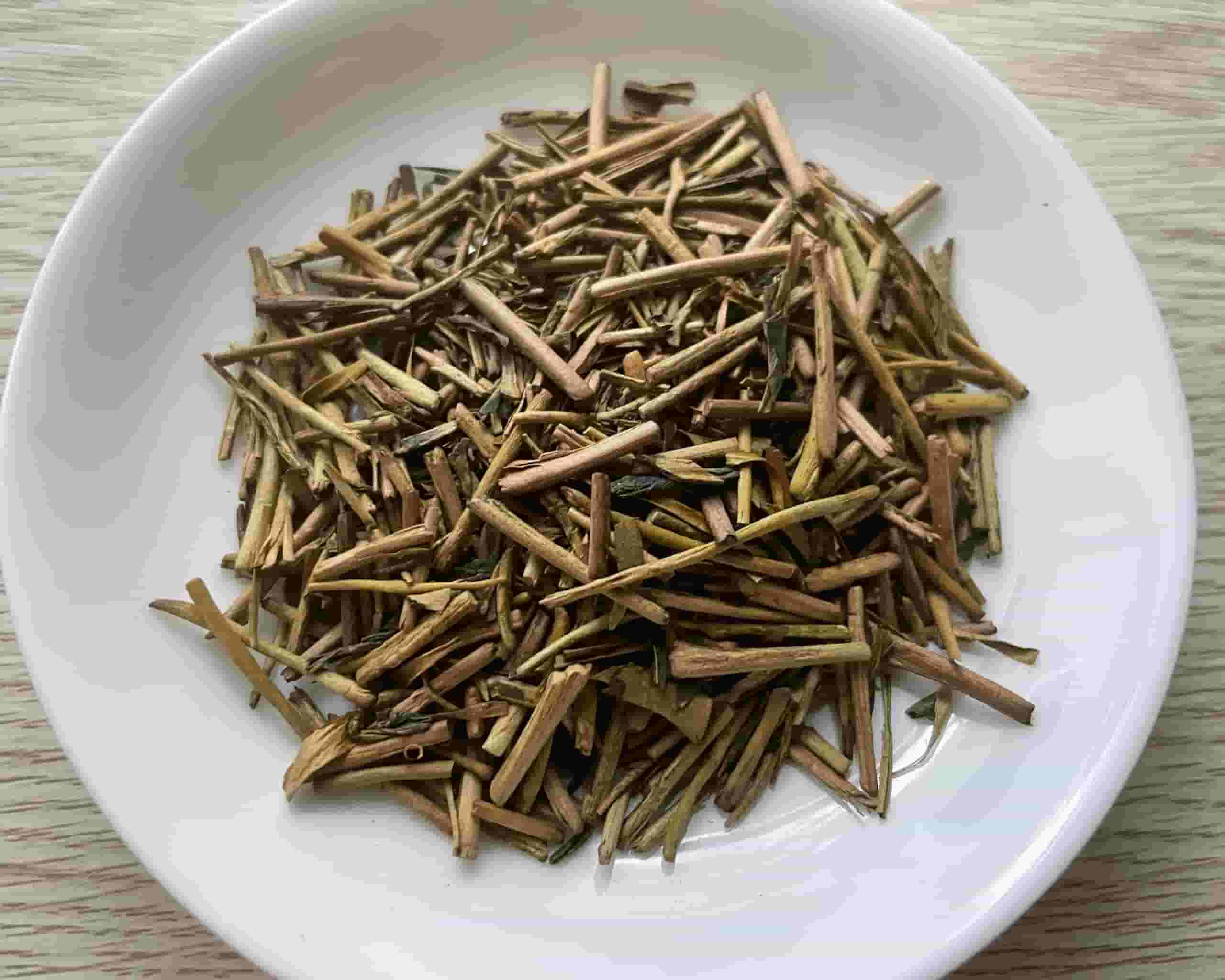
When producers process gyokuro, or another shade-grown tea such as kabusecha, they don’t use every part of the picked plant. A sorting stage separates the tender leaf from the stems, stalks, and leaf veins running through it. The leaf goes on to become the finished tea. The sorted-out stems and stalks, called karigane, usually make up only about 5 to 10 percent of what comes off the bush. That doesn’t make karigane waste, though. Its flavor stands on its own. Producers sell it as its own tea instead of blending it back in or throwing it away.
Sorting karigane by hand used to be slow, careful work. Women called cha-yori-san, or tea-sorting women, once separated stem from leaf by eye. They could manage only around 5 to 10 kilograms an hour. Mechanical sorters, which appeared around 1940, raised that figure to roughly 100 kilograms an hour. That leap in speed is a large part of why karigane became widely available instead of staying a rare, time-consuming curiosity.
What the Name Means
“Karigane” (雁が音) translates roughly as “the call of a wild goose.” One story behind the name pictures migrating geese resting on a branch or piece of driftwood floating at sea. Pale stems drift and curl in a cup of brewing tea, and people likened that motion to the same image. The poetic name stuck. “Hōjicha” describes a process, not a fixed grade of leaf. It comes from the verb hōjiru, meaning to roast. Put together, karigane hōjicha simply means roasted karigane: tea stems from gyokuro-grade plants that have gone through a roasting pan instead of staying green.
In parts of Kyushu, the same style of stem tea, sorted from shaded plants, sometimes goes by a different regional name: shiraore, meaning roughly “white fold.” Once roasted, that Kyushu-style stem tea is essentially the same product as karigane hōjicha from elsewhere in Japan. It just carries a different local name.
How Karigane Hōjicha Is Made
Karigane hōjicha shares its raw material with gyokuro, then splits off in its own direction at the sorting and roasting stage.
Growers shade the tea plant before harvest, the same practice they use for gyokuro and kabusecha. Shading builds up amino acids in the leaf and softens its bitterness. After picking, producers steam, roll, and dry the leaf much like any other high-grade green tea.
A sorting stage separates tender leaf from the stems, stalks, and leaf veins running through the batch. That leaf goes on to become gyokuro or kabusecha. The sorted material is karigane, usually around 5 to 10 percent of what came off the bush.
Producers roast the sorted stems at a moderate heat, often around 150°C, until they turn a deep golden brown. That heat caramelizes natural sugars stored in the stem tissue. The result is a toasty, faintly sweet aroma that people often compare to roasted grain or chestnut.
Stems roast differently from flat leaves. A fibrous structure inside them carries sugars and amino acids through the plant, and it also spreads heat more evenly during roasting. That’s part of why karigane hōjicha often tastes rounded and mellow rather than sharply toasted. Roast depth still varies by producer. Some keep the roast light to preserve more of karigane’s original umami and sweetness, closer to a green tea in body. Others roast further for a deeper, more classic hōjicha character.
Karigane Hōjicha vs. Karigane, Kukicha, and Other Roasted Teas
Karigane hōjicha sits at a specific point inside a much larger family of Japanese stem teas. The table below compares it with the tea it’s roasted from, and with kukicha, the broader category it belongs to.
Karigane hōjicha is also easy to confuse with two other roasted teas in this series, even though all three are roasted stem or leaf teas. Kaga Bōcha, a specialty of Kanazawa, roasts stems from ordinary sencha rather than gyokuro. Its floral note comes from a specific regional roasting tradition, not from the plant’s grade. Kyobancha isn’t a stem tea at all: it’s Kyoto’s large, unrolled bancha leaf, steamed and roasted whole. What sets karigane hōjicha apart from both is its raw material: stems from the same shaded, high-grade plants grown for gyokuro.
Flavor and Aroma
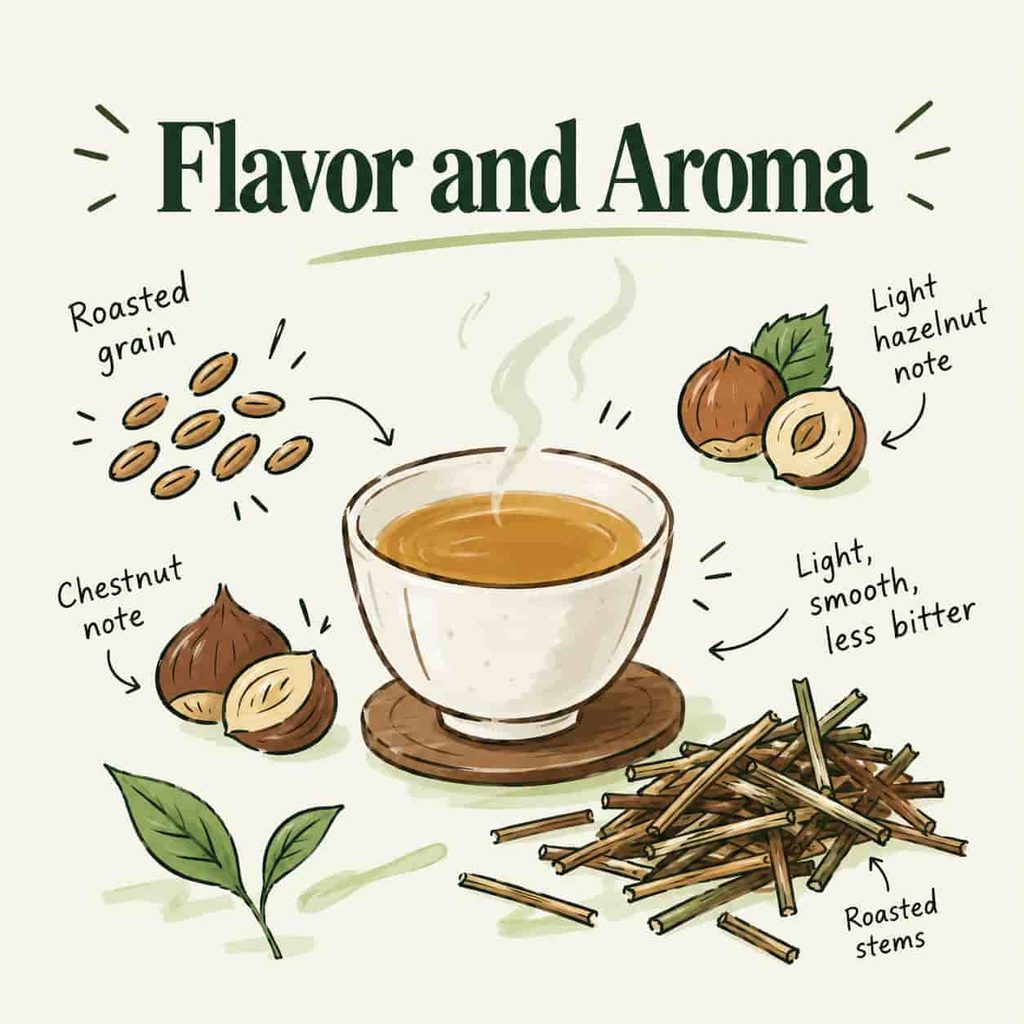
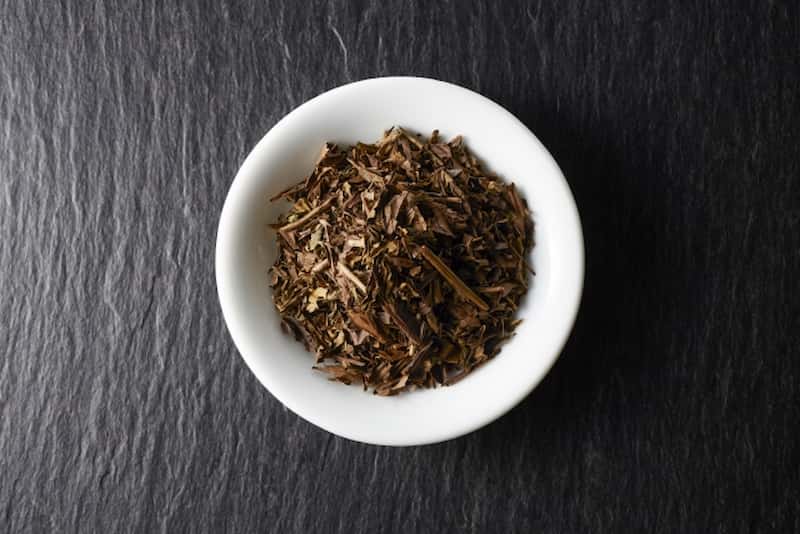
Karigane hōjicha’s aroma leans toward roasted grain, chestnut, and sometimes a light hazelnut note. It has none of the sharper smokiness you’d find in a tea like Kyobancha. The brewed liquor comes out a warm golden brown, noticeably lighter than the deep reddish-brown of a strongly roasted leaf hōjicha.
Much of that gentleness starts before anyone roasts the tea. Tea stems store a large share of the plant’s L-theanine, an amino acid behind savory sweetness and umami. That’s because L-theanine converts into catechins as it moves up into leaf tissue exposed to sunlight. Stems sit more sheltered, so they hold onto more of it. Karigane starts from a shaded, high-grade plant to begin with. That gives it even more natural sweetness and less astringency than ordinary kukicha made from unshaded sencha or bancha stems. Roasting adds a caramelized, toasty layer on top of that base rather than covering it up. That’s why karigane hōjicha tends to taste rounder and less bitter than most other roasted teas. Its stems also tend to hold up for a third infusion while still giving flavor, a little longer than plain kukicha typically manages.
Karigane Hōjicha and the Kukicha Family
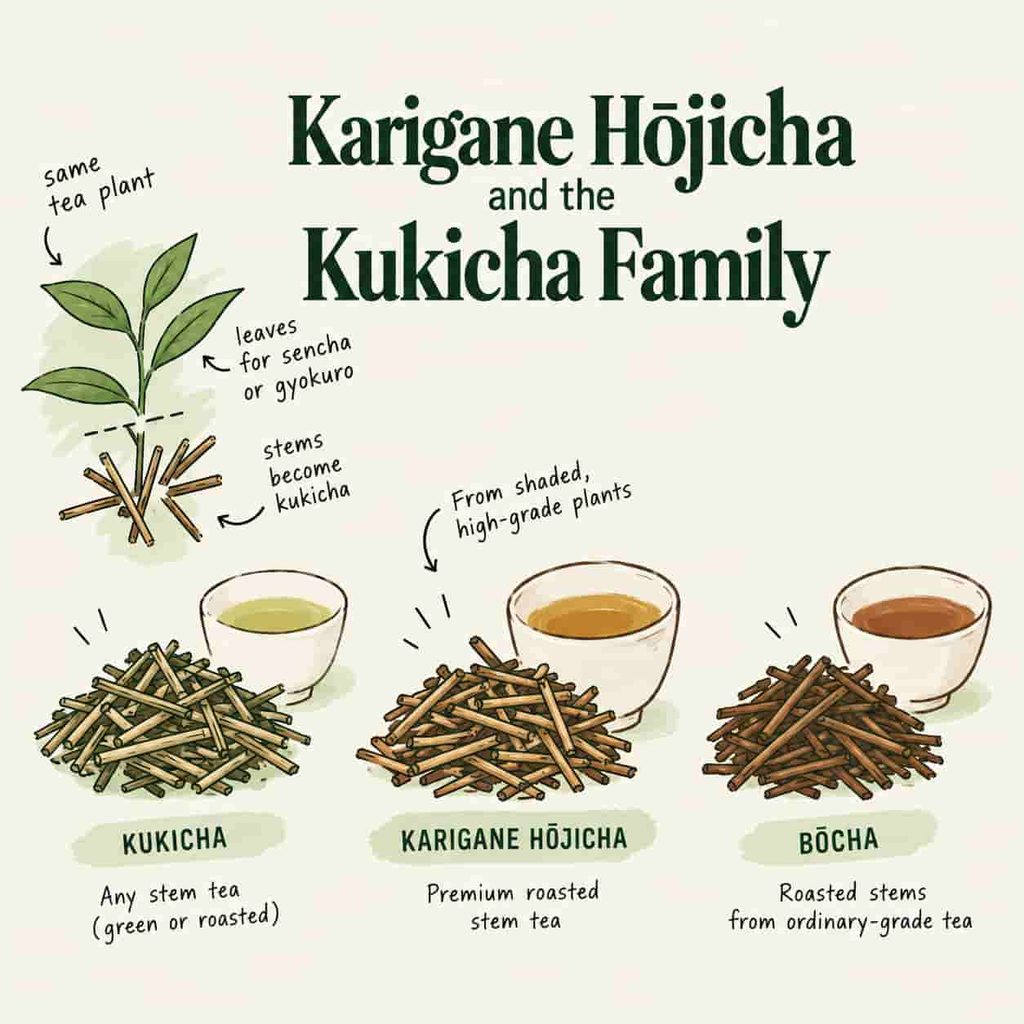
Kukicha, or twig tea, is the broad category that karigane belongs to. Any tea made mainly from stems, stalks, and leaf veins counts as kukicha. That’s true whether it stays green or gets roasted afterward. Producers often label roasted, ordinary-grade kukicha as bōcha. Think of karigane hōjicha as the premium tier of that same idea. It’s roasted stem tea, but it starts from gyokuro or other shaded, high-grade plants instead of standard sencha or bancha.
That distinction matters more for flavor than it might seem. A roasted kukicha made from ordinary sencha stems can still taste pleasant. It just won’t carry the same depth of umami or natural sweetness that comes from gyokuro’s shading. Producers and tea shops sometimes label a tea “karigane hōjicha” instead of just “kukicha hōjicha” or “bōcha.” That more specific name usually points to the higher-grade origin. Japan uses the leftover parts of the tea plant in several regional roasted and fermented styles. For the fuller picture, see the complete Bancha guide.
Caffeine and Who Should Try Karigane Hōjicha
Tea stems generally contain less tannin and caffeine than the leaves on the same plant. That holds true even when the plant is a gyokuro cultivar, shaded specifically to boost flavor compounds. It’s mainly a matter of plant structure rather than variety: stems simply store less of both compounds than leaf tissue does. Karigane hōjicha inherits that lower baseline from its stem origin, before anyone ever roasts it. Many producers also say roasting lowers caffeine further still. This guide can’t say for certain how much of that effect comes from roasting itself, rather than from the stem’s already lower starting point.
Its low bitterness and mellow character have earned roasted stem teas like this a long-standing reputation in Japan. People see them as gentle, easygoing drinks, comfortable for children and older family members. That reputation is a matter of tradition and taste rather than a medical claim. Karigane hōjicha still contains caffeine and isn’t caffeine-free. Anyone who needs to avoid caffeine entirely, or who is deciding whether to serve it to an infant, should check with a doctor first.
How to Brew Karigane Hōjicha at Home
Karigane hōjicha is one of the more forgiving Japanese teas to brew. It’s already roasted, and its sturdy stems don’t turn bitter in hot water the way a delicate leaf tea like fine sencha or gyokuro can.
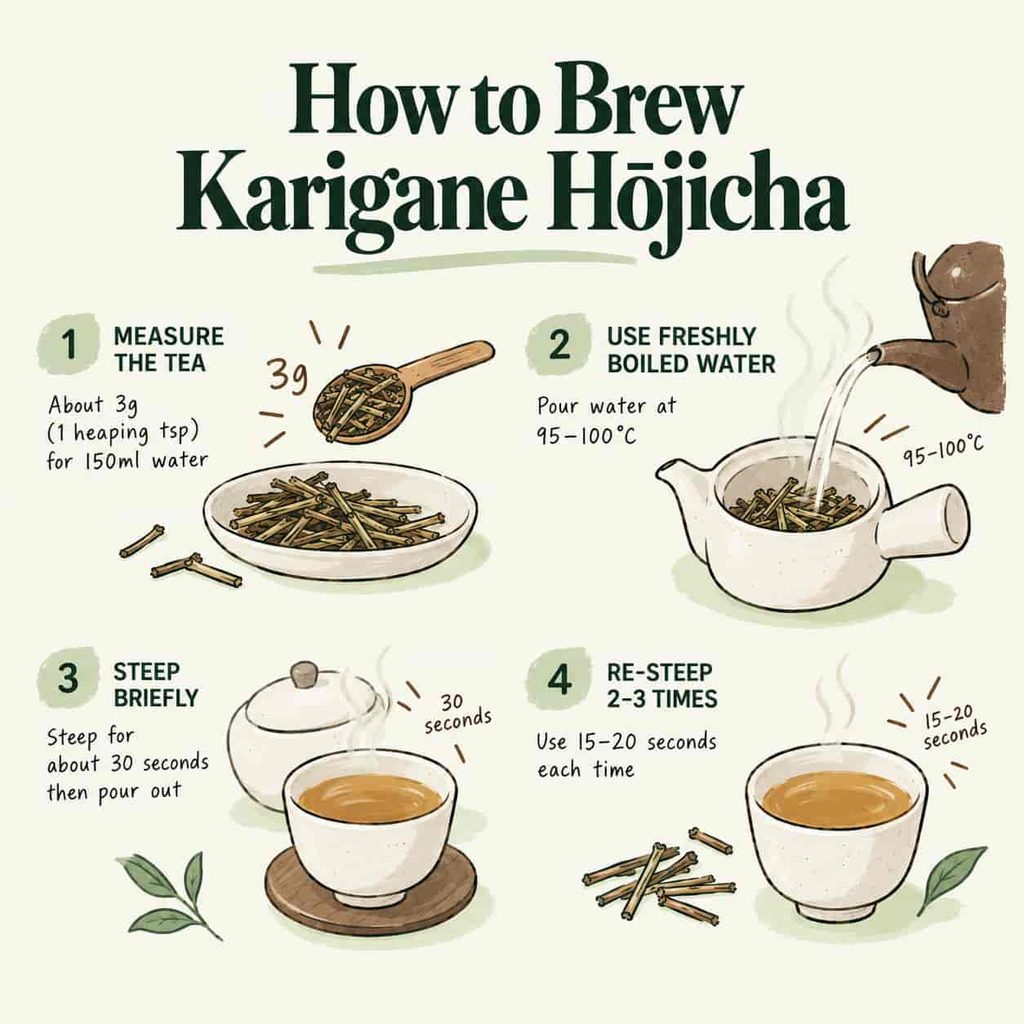
Use about 3g of karigane hōjicha, roughly one heaping teaspoon, for every 150ml of water. Scale up evenly for a larger pot.
Pour water close to a full boil, around 95 to 100°C. Unlike gyokuro, which needs cooler water to avoid bitterness, karigane hōjicha’s roasted stems tolerate high heat well. They need that heat to release their aroma fully.
Steep for about 30 seconds on the first infusion. Pour the tea out completely rather than leaving it on the stems. That keeps the aroma bright instead of letting it turn flat.
Shorten each following steep to about 15 to 20 seconds, using freshly boiled water each time. Karigane’s stems generally hold their flavor through a second and third infusion. That’s a little longer than plain kukicha usually manages.
Choosing and Buying Karigane Hōjicha
Sellers sometimes use “karigane hōjicha,” “kukicha hōjicha,” and “bōcha” loosely for similar-looking roasted stem teas. A little label-reading helps before you buy.
- 🍃Check the base tea, if the label lists it. Karigane from gyokuro or shaded sencha stems tastes noticeably sweeter and more rounded than a roasted stem tea from ordinary sencha or bancha. It usually costs more, too.
- 🍃Note the roast level. A lighter roast keeps more of karigane’s original umami and sweetness. A deeper roast leans closer to a standard hōjicha’s toasty character. Neither is more correct; they’re simply different styles.
- 🍃Don’t expect one fixed region. Unlike Kaga Bōcha, which belongs specifically to Kanazawa, karigane hōjicha comes from several tea-growing areas, including Kyoto and Shizuoka. Comparing a few producers is more useful than looking for one “authentic” source.
- 🍃Expect slender stems, not crushed leaf. Good karigane hōjicha should still look like small, roasted stems and stalks. Fine, powdery fragments usually mean lower-grade sorting.
Storing Karigane Hōjicha
Store karigane hōjicha in an airtight container, away from light, heat, and strong odors. That’s the same basic rule as for any tea. Because it’s already roasted, it holds up better over time than an unroasted green tea like gyokuro or plain karigane. Roasting drives off much of the moisture, along with some of the delicate compounds that make green tea go stale quickly. Even so, its toasty aroma is strongest when fresh. It’s worth buying only as much as you’ll use within a few months.
Common Karigane Hōjicha Myths
Final Thoughts
Karigane hōjicha turns one of gyokuro’s byproducts into a tea worth seeking out on its own terms. Its stems already carry more sweetness and umami than ordinary kukicha, even before anyone roasts them. That head start comes from the shaded, high-grade plants they come from. Roasting then adds a warm, toasty layer without burying that base character.
The result is an easygoing, low-bitterness cup that tolerates hot water and a relaxed brewing style far better than gyokuro itself does. That makes it a comfortable everyday tea. It’s also a gentle way to get to know the stem-tea side of Japanese green tea, without the careful attention a fine leaf tea demands.
The clearest way to understand karigane hōjicha is to taste it side by side with plain kukicha, or with the gyokuro its stems came from. In one sitting, you can taste both the family resemblance in sweetness and the difference roasting makes.
To explore more Japanese tea culture, read these related guides:
Karigane Hōjicha FAQ
What is karigane hōjicha?
Karigane hōjicha is a roasted Japanese tea. Producers make it from karigane, the stems and stalks sorted out while processing gyokuro and other shaded, high-grade green tea. It has a toasty, caramel-like aroma and a mellow, nearly bitterness-free flavor.
What is the difference between karigane and karigane hōjicha?
Karigane is the unroasted stem tea itself, sorted from gyokuro or shaded sencha processing. Karigane hōjicha is that same tea after producers roast it. Roasting adds a toasty character while keeping much of karigane’s natural sweetness.
Is karigane hōjicha the same as Kaga Bōcha?
No. Both are roasted stem teas. Kaga Bōcha uses stems from ordinary sencha, as part of a specific Kanazawa tradition. Karigane hōjicha uses stems from gyokuro or other shaded, high-grade tea. The two differ in flavor and origin.
Does karigane hōjicha have caffeine?
Yes, but generally less than gyokuro leaf itself, since tea stems naturally contain less caffeine than the leaves grown on the same plant. It isn’t caffeine-free.
How do I brew karigane hōjicha at home?
Use about 3g of tea per 150ml of freshly boiled water. Steep the first infusion for about 30 seconds, then shorten later infusions to 15 to 20 seconds. The stems generally hold their flavor through two or three infusions.
Why does karigane hōjicha taste sweet rather than bitter?
Tea stems store more L-theanine, an amino acid behind sweetness and umami, than leaves do. Karigane’s shaded, high-grade origin adds even more of it. Roasting builds a caramelized layer on top of that natural sweetness rather than covering it up.
What does “karigane” mean?
Karigane (雁が音) means “the call of a wild goose.” People often trace the name to migrating geese resting on floating driftwood, an image that resembles stems drifting in a cup of brewing tea.
References
- Kyoto Obubu Tea Farms, What’s in a Name? Part II: Gyokuro & Kukicha, on the etymology of karigane, gyokuro, and kukicha.
- A New Leaf Japan, Karigane – The Call of a Wild Goose, on the name’s origin story and karigane’s lower tannin and caffeine content relative to leaf tea.
- Shizuokatea, The Differences Between Kukicha, Kariganecha, and Shiraore, on raw material, regional naming, and the number of infusions each style typically supports.
- Shizuokatea, Karigane-cha: Japanese Tea Made from Green Tea Leaf Stalks, on how karigane is sorted from gyokuro and sencha processing.
- Tealife, Kukicha and Karigane, on the grade distinction between kukicha and karigane, and the roasted “bōcha” style.
- Global Japanese Tea Association, Kukicha, on the stem, stalk, and leaf-vein composition of kukicha and its green versus roasted styles.
- Growing Karma, Karigane & Hōjicha Kukicha: The Roasted Depth of Tea Stems, on the roasting temperature, caramelization, and aroma of roasted stem tea.
- Hibiki-An, This Month’s Tea: Karigane, on the history of hand-sorting by cha-yori-san and the shift to mechanical sorting.



Comments