




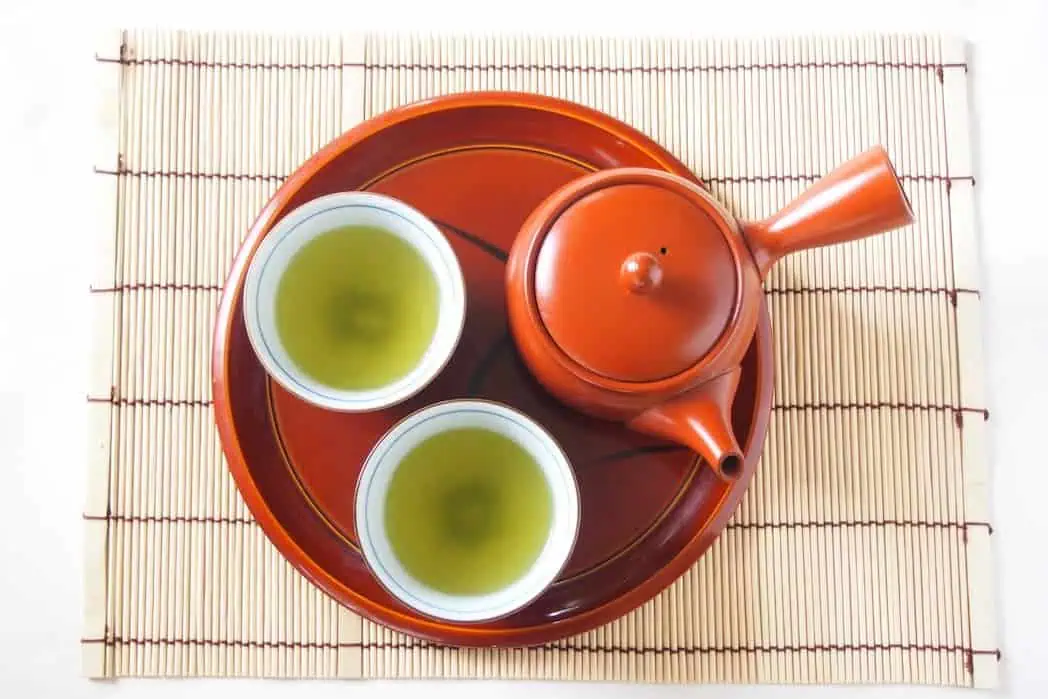
Asamushi Sencha (浅蒸し煎茶) is a lightly steamed Japanese green tea known for its elegant leaf shape, clear liquor, vivid fragrance, refreshing astringency, and delicate finish. The word asamushi means “light steamed” or “shallow steamed,” referring to the brief steaming process used shortly after the leaves are harvested.
Unlike sencha styles designed to produce a dense color or immediate richness, Asamushi Sencha emphasizes definition. Its fragrance remains easy to notice, its flavors unfold gradually, and the brewed tea often appears pale yellow-green rather than intensely green. It is especially appealing to drinkers who enjoy clarity, aroma, and the changing character of several infusions.
What Is Asamushi Sencha?
Asamushi Sencha is sencha made with a relatively short steaming stage. As a practical guide, the leaves are often steamed for no more than about 30 seconds, although individual producers adjust the timing according to the tenderness, thickness, moisture, and condition of each harvest.
The purpose of light steaming is not to leave the leaves partly oxidized. The steam must still deactivate the enzymes that cause oxidation. Instead, the producer limits the leaves’ exposure to heat once that essential task has been completed.
Because the leaves remain structurally firm, they are less likely to break apart during rolling. Finished Asamushi Sencha therefore often contains long, narrow leaves with a neat, needle-like appearance and relatively little powder. When brewed, these leaves open slowly and release their flavor in distinct stages.
Why Short Steaming Matters
Short steaming preserves the physical character of the harvested leaves. The leaf fibers remain comparatively strong, allowing the rolling process to form slender strands instead of producing a large amount of fine material.
This intact structure changes how the tea behaves in water. Hot water must gradually enter the rolled leaves before their soluble compounds can move into the infusion. As a result, Asamushi Sencha normally develops more slowly than teas made from softer, more fragmented leaves.
The shorter exposure to heat also helps producers retain the fresh, high-toned fragrance of suitable leaves. Well-made examples may carry an aroma reminiscent of young shoots, herbs, flowers, citrus peel, fresh wood, or cool mountain air. The goal is not simply to make a lighter tea, but to preserve distinctions that heavier processing could obscure.
However, light steaming demands careful judgment. If the steaming is insufficient or uneven, the tea may develop an unpleasant raw or overly green smell. Producers must therefore stop oxidation completely without exposing the leaves to more heat than their intended style requires.
A Traditional Sencha Style
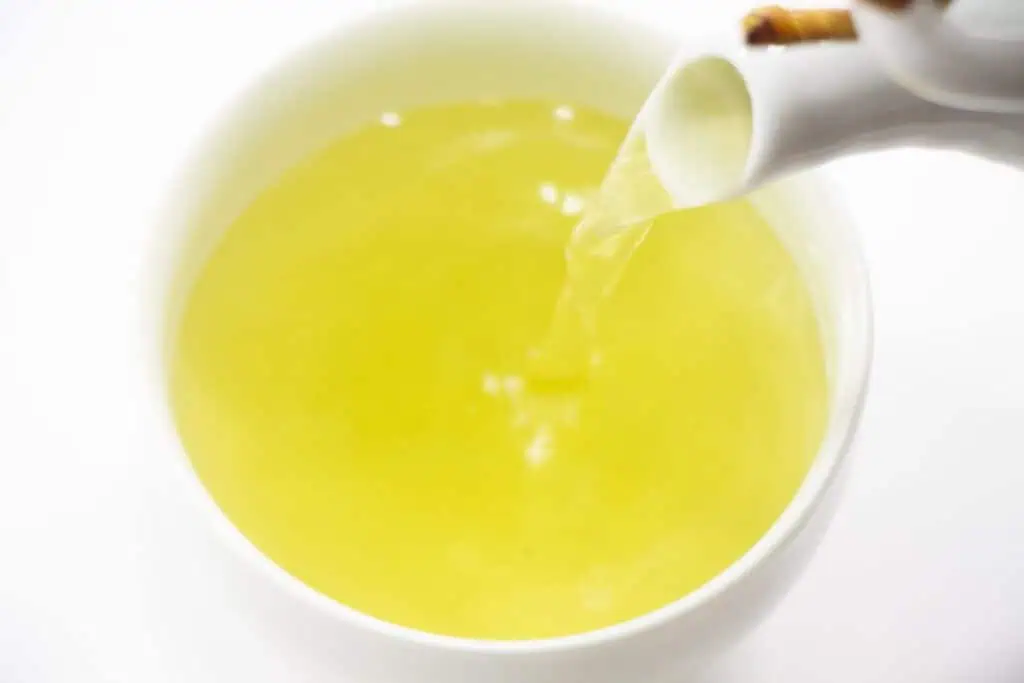
Asamushi is sometimes presented as a specialized alternative to modern sencha. Historically, however, relatively light steaming was once a common approach to Japanese sencha production. Long steaming became more widespread later as producers developed methods suited to different leaves, environments, and consumer preferences.
Some mountain tea regions continue to preserve older processing philosophies. In Kawane, Shizuoka, producers use the expression dentō-mushi, or “traditional steaming,” for methods intended to protect the natural fragrance and taste of young, tender shoots. The regional approach is not necessarily identical to every product labeled Asamushi, but both share the principle of avoiding unnecessary steaming.
This connection with traditional production helps explain why Asamushi Sencha is often valued for more than its taste. Its orderly dry leaves, transparent infusion, gradual extraction, and visible transformation in the teapot allow drinkers to appreciate the workmanship behind the finished tea.
How Asamushi Sencha Is Made
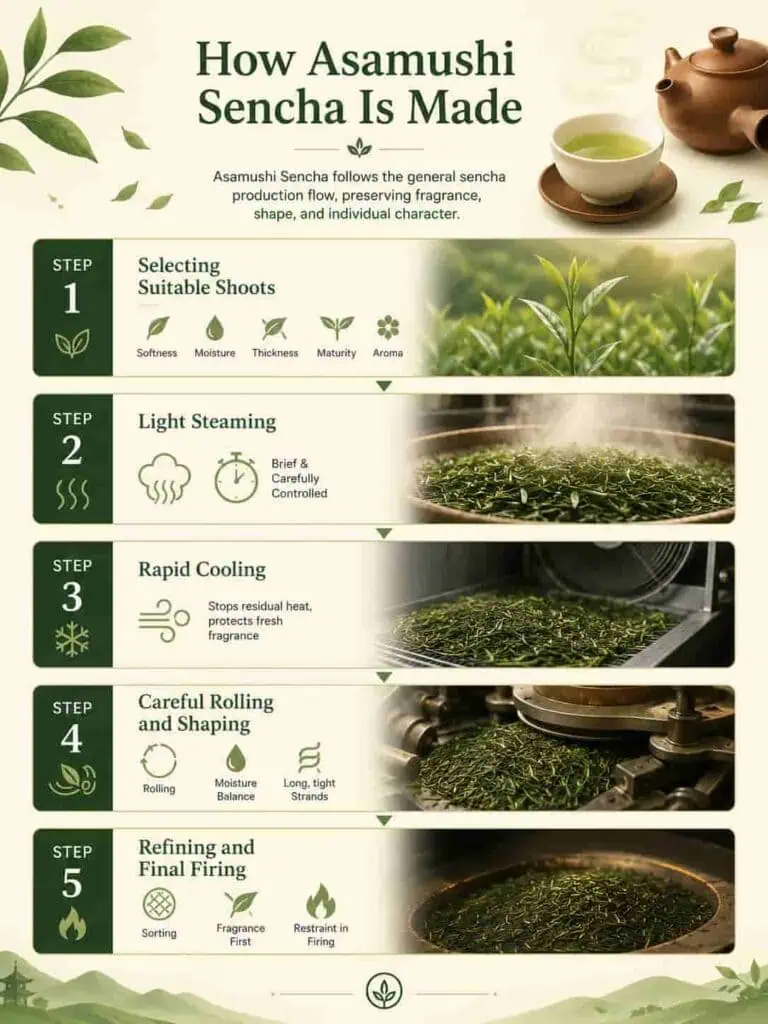
Asamushi Sencha follows the general sencha production flow, but every stage must support the decision to preserve the leaf’s fragrance, shape, and individual character.
Producers evaluate the softness, moisture, thickness, maturity, and aroma of the harvested shoots. Tender leaves can respond particularly well to light steaming because their character can be preserved without requiring prolonged heat.
The leaves receive a brief but carefully controlled application of steam. The producer must deactivate the oxidation enzymes while avoiding excessive softening of the leaf fibers. A few seconds can affect the final aroma, shape, and extraction speed.
The steamed leaves are cooled promptly. Rapid cooling prevents residual heat from continuing to alter the tender shoots and helps protect the fresh fragrance that light steaming is intended to preserve.
The leaves pass through several rolling and drying stages. Their firmer structure allows skilled producers to form long, tight strands. Good rolling distributes moisture evenly and shapes the leaves without crushing away their visual character.
The crude tea is sorted by size and condition before its final finishing. When fragrance is the main priority, the producer may use a restrained firing style so that roasted notes do not hide the tea’s fresh, leafy aroma.
Flavor, Aroma, and Appearance
The most recognizable quality of Asamushi Sencha is its fragrance. Depending on the cultivar, field, harvest, and finishing method, the aroma may recall fresh leaves, spring herbs, white flowers, bamboo, citrus zest, pine needles, green wood, or newly cut grass.
Its taste is often precise rather than immediately heavy. Sweetness and umami may appear first, followed by a clear, refreshing astringency that gives the cup structure. High-quality examples can finish with a cool sensation and a fragrance that continues after the tea has been swallowed.
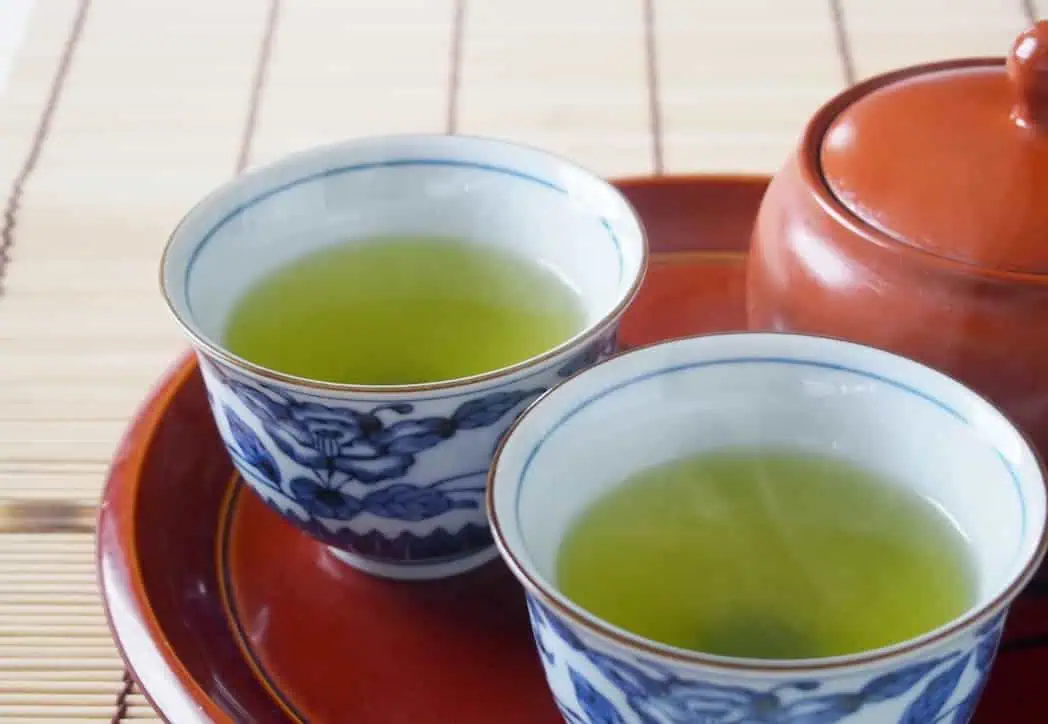
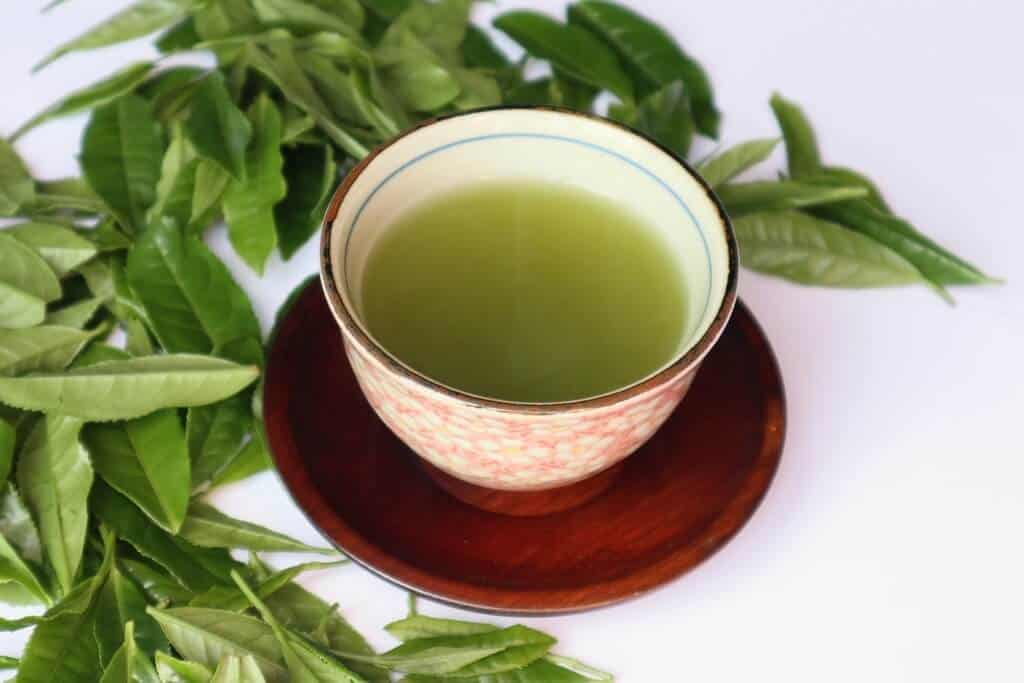
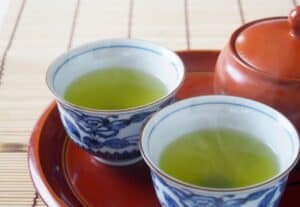
The liquor is commonly transparent pale yellow, yellow-green, or light green. A lightly colored cup should not automatically be judged as weak. In Asamushi Sencha, clarity allows the drinker to observe the brightness, cleanliness, and subtle changes between infusions.
Professional evaluation of conventionally steamed sencha places importance on neat, tightly rolled leaves, fresh young-shoot aroma, a bright and clear yellow-green liquor, and a harmonious combination of sweetness, astringency, bitterness, and umami. These qualities closely reflect what many drinkers seek in carefully made Asamushi Sencha.
What Sets Asamushi Apart?
Rather than repeating the complete profiles of other steaming styles, the table below focuses on the features that are especially important when drinking Asamushi Sencha.
| Asamushi Signature | What It Means for the Drinker |
|---|---|
| Brief steaming | The original fragrance and individual character of suitable leaves remain easier to recognize. |
| Long, needle-like leaves | The dry tea displays the skill involved in rolling and shaping. |
| Relatively little powder | The liquor normally looks clean and transparent. |
| Slower extraction | The first infusion benefits from more time, while later infusions reveal new layers. |
| Prominent aroma | The tea may feel floral, herbal, woody, citrus-like, or reminiscent of young shoots. |
| Clear astringency | The finish feels refreshing and structured rather than simply soft. |
| Pale liquor | Color is not the main measure of strength or quality. |
| Intact brewed leaves | The opened leaves can reveal their tenderness, evenness, and careful processing. |
| Sensitive brewing | Small changes in water temperature and infusion time are easy to notice. |
Mountain Tea Regions Associated with Asamushi
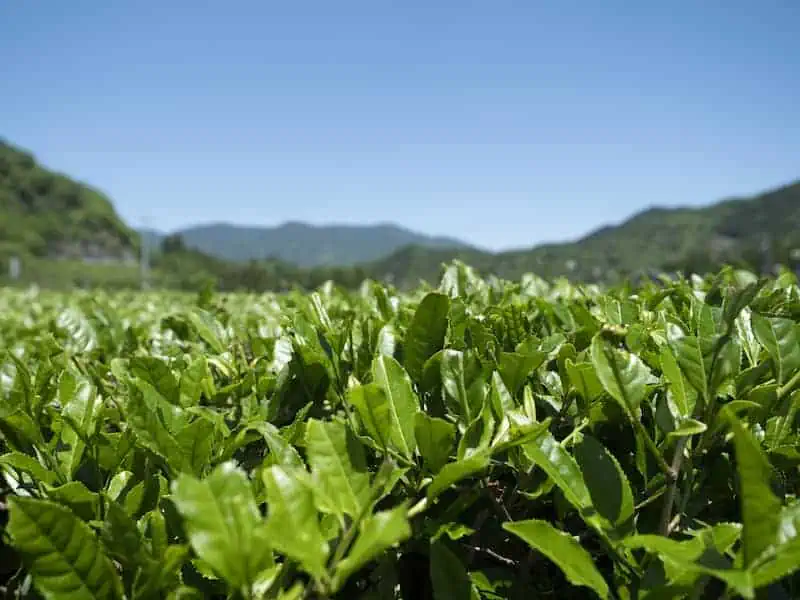
Asamushi Sencha is a processing style rather than a protected regional name, so it can be produced anywhere in Japan. Nevertheless, it has a particularly strong connection with mountain tea districts where growers seek to express the fragrance and delicacy of slowly developed shoots.
Kawane (Shizuoka)
This place is closely associated with traditional, lightly steamed tea. The area’s producers describe young, tender shoots known locally as mirume and use carefully controlled steaming and rolling to protect their natural aroma and taste. Kawane’s regional “traditional steaming” philosophy developed from the belief that its soft, moisture-rich leaves should not be oversteamed.
Tenryu (Shizuoka)
Tenryu, Shizuokais another important mountain tea area. Tea fields in the region are shaped by steep terrain, morning mist, and pronounced differences between daytime and nighttime temperatures. Shizuoka Prefecture describes Tenryu tea as having a refined, crisp taste and fragrance, qualities that suit producers who wish to emphasize aromatic clarity.[4]
Lightly steamed tea is also produced in other mountain districts of Shizuoka and elsewhere in Japan. However, elevation alone does not determine the steaming style. The producer must consider the cultivar, tenderness, weather, harvest date, and intended expression of each batch.
How to Brew Asamushi Sencha
Asamushi leaves remain comparatively intact, so they usually need more time to open during the first infusion. A slightly longer brew allows the water to enter the tightly rolled leaves and release their fragrance, sweetness, and refreshing astringency.
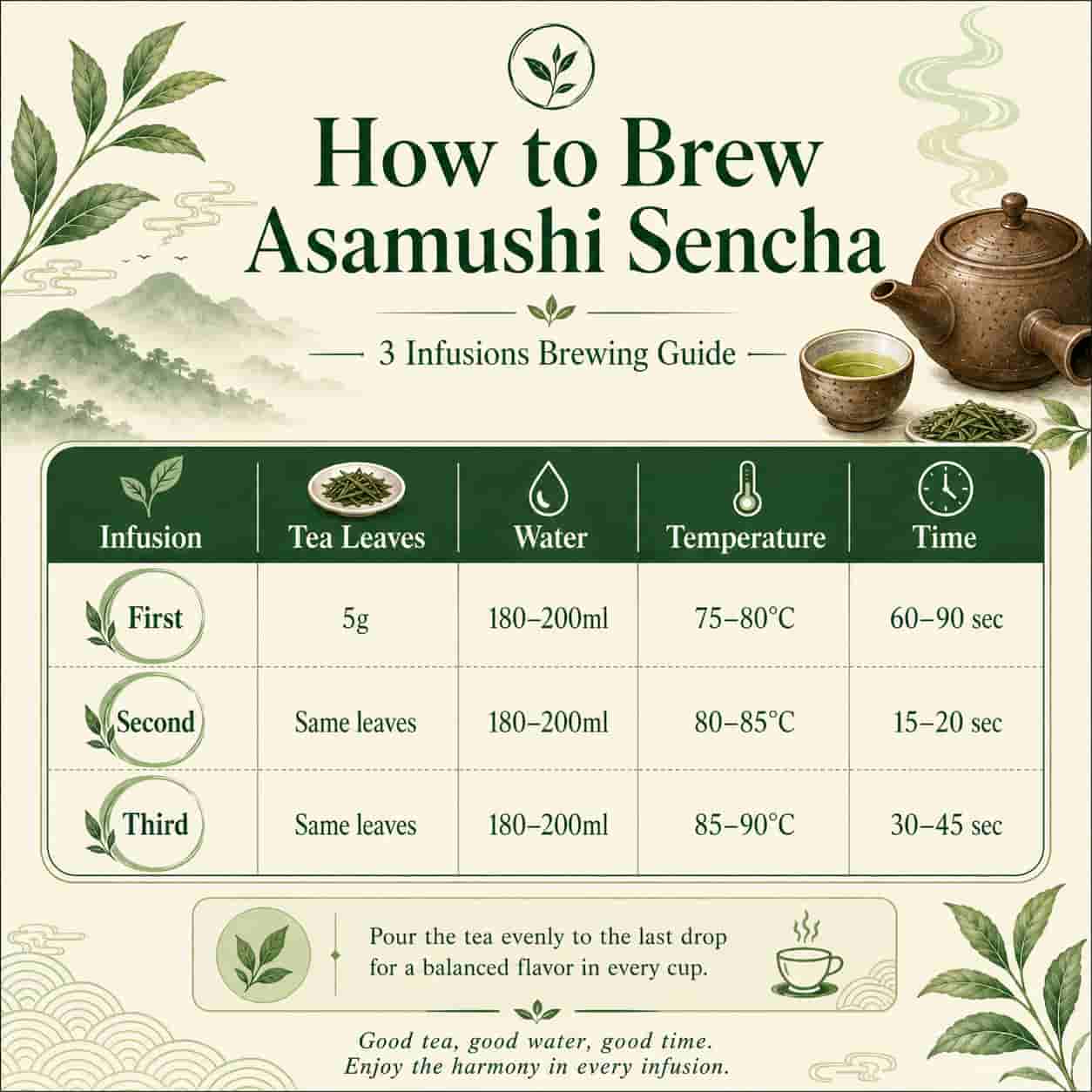
These numbers are a starting point rather than a fixed rule. General sencha guides often recommend approximately 80°C water, but Asamushi products vary considerably in leaf size, tenderness, and intended flavor.
Use a kyusu or small teapot with enough interior space for the leaves to expand. A traditional ceramic or metal sasame filter works well because Asamushi normally contains less powder and does not require an extremely fine mesh.
Observe the leaves during the first infusion. They should begin to loosen but may not open completely. Pour the tea evenly between the cups and drain the pot fully. The leaves can then continue opening during the second and third infusions.
For more sweetness and umami, lower the temperature to around 70°C and extend the first infusion. To emphasize fragrance and briskness, raise the temperature slightly and shorten the time. Change only one variable at a time so that you can understand how the tea responds.
Cold Brew Method
Cold brewing softens the astringency of Asamushi Sencha while preserving its clean fragrance. Because the leaves are relatively intact, they may need more time than finely broken tea to release a satisfying amount of flavor.
- Add 8g of Asamushi Sencha to 500ml of cold, soft water.
- Place the bottle in the refrigerator for approximately four hours.
- Taste the tea. Continue brewing for up to six hours if it remains too light.
- Turn the bottle over gently instead of shaking it strongly.
- Strain the tea and serve it in a clear glass.
Cold water suppresses much of the sharpness that hot water can extract, allowing sweetness, umami, and delicate aromatic notes to become more noticeable. Japanese cold-brew guidance also recommends using ice and cool water when the goal is to reduce astringency and emphasize umami.
The finished cold brew may be pale. Avoid judging it by color alone. A successful Asamushi cold brew should smell fresh and taste clean, with enough structure to remain refreshing rather than watery.
How to Choose Good Asamushi Sencha
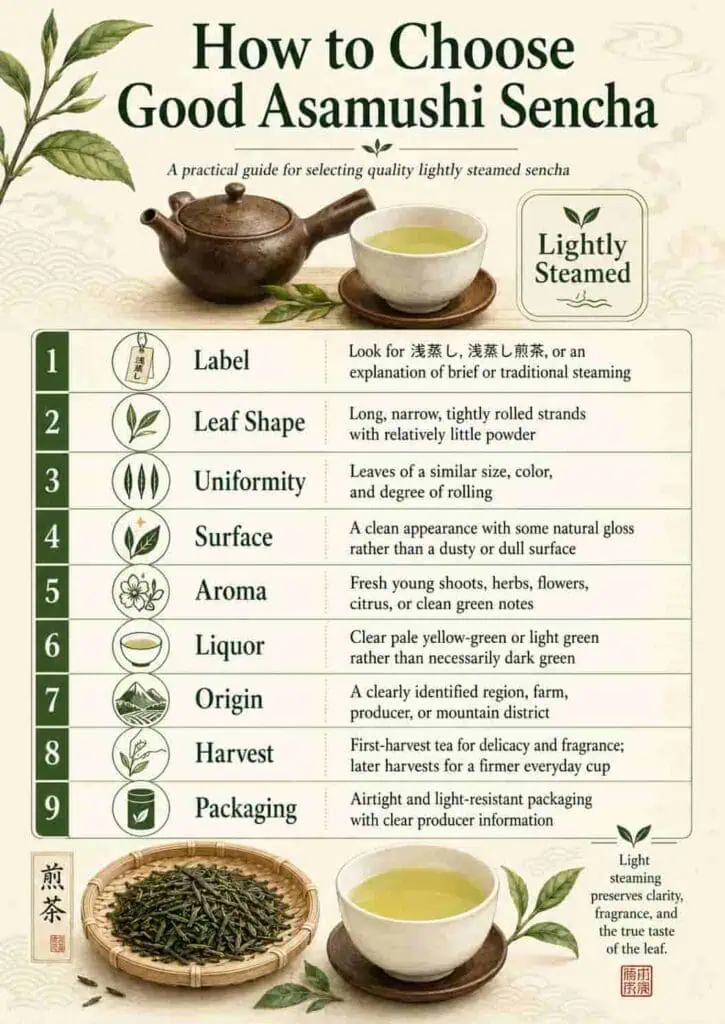
Visual examination is particularly useful when choosing Asamushi Sencha because its intact leaf shape is one of the style’s defining qualities.
Do not reject a package simply because some leaves are shorter than others. Asamushi does not guarantee perfect hand-rolled needles. The aroma, freshness, cultivar, harvesting method, and producer’s intended style remain more important than appearance alone.
After brewing, examine the opened leaves. Tender shoots should become supple and display a recognizable leaf shape. Their color and aroma can reveal details that are difficult to notice in the dry tea.
Food Pairings
Asamushi Sencha pairs best with foods that leave room for its fragrance. Very oily, spicy, or heavily seasoned dishes can overwhelm its delicate aroma and make its astringency feel disconnected from the meal.
For savory pairings, try sashimi made from mild white fish, lightly salted grilled fish, chilled tofu, cucumber dishes, steamed vegetables, plain rice, delicate onigiri, clear soup, or lightly seasoned soba. Its clean finish can refresh the mouth without covering subtle flavors.
For sweets, choose wagashi with restrained sweetness, such as nerikiri, uiro, lightly sweetened yokan, wasanbon, or seasonal sweets made with fruit. Simple sponge cake, butter cookies, and white chocolate can also work when the tea has a floral or citrus-like fragrance.
Serving the tea in a white or pale cup makes it easier to appreciate its transparent liquor. A smaller cup also helps concentrate the fragrance near the nose.
How to Store It
Asamushi Sencha is often purchased for its fragrance, so even a moderate loss of aroma can noticeably change the drinking experience. Protecting the leaves from oxygen, heat, moisture, light, and strong surrounding smells is therefore especially important.[8]
- Keep unopened tea in a cool, dark place or refrigerator.
- Allow refrigerated tea to return to room temperature before opening the package.
- After opening, remove excess air and seal the original package tightly.
- Use a light-resistant, airtight container when transferring the tea.
- Avoid repeatedly crushing or shaking the long, delicate leaves.
- Keep the tea away from coffee, spices, perfume, and strongly scented foods.
- Buy small packages that can be finished within approximately two weeks to one month.
Once the package is open, storing the tea in the refrigerator is not always ideal. Repeated temperature changes can create condensation, while the leaves may also absorb refrigerator odors. A sealed container in a cool, dark cupboard is usually more practical for tea that is being consumed regularly.[8]
Final Thoughts
Asamushi Sencha expresses Japanese green tea through clarity, fragrance, and structure. Its brief steaming process allows the leaves to retain an elegant shape and release their character gradually rather than all at once.
The pale liquor and light texture can be misleading to drinkers who associate strong tea with dark color. However, a carefully brewed cup may offer remarkable depth through its young-shoot aroma, controlled astringency, subtle sweetness, and long, clean finish.
Start with water at 75–80°C and give the first infusion at least one minute. Watch the leaves slowly unfold, compare each infusion, and pay attention to fragrance as much as taste. Asamushi Sencha rewards patience and careful observation.
To explore more Japanese tea culture, read these related guides:
.jpg)
Asamushi Sencha FAQ
What is Asamushi Sencha?
Asamushi Sencha is lightly steamed sencha. Its brief steaming process helps preserve an elegant leaf shape, clear liquor, prominent aroma, and refreshing astringency.
How long is Asamushi Sencha steamed?
It is often steamed for no more than approximately 30 seconds. However, producers adjust the exact timing according to the condition of the harvested leaves.
Why is Asamushi Sencha pale?
The leaves remain relatively intact and release fewer fine particles into the water. The resulting infusion is therefore usually transparent pale yellow-green or light green.
Does a pale color mean the tea is weak?
No. Asamushi Sencha can have a strong aroma, clear astringency, sweetness, and a long finish even when its liquor is light in color.
Why does Asamushi Sencha need a longer infusion?
The leaves remain firm and tightly rolled, so water needs more time to enter them during the first infusion. Later infusions can be much shorter because the leaves have already begun to open.
What type of teapot is best?
Use a kyusu with enough room for the leaves to expand. A ceramic sasame filter or regular metal mesh works well because the tea usually contains relatively little powder.
Is Asamushi the same as Shincha?
No. Asamushi describes steaming intensity, while Shincha refers to newly processed tea from the first harvest season. A Shincha can be lightly, normally, or deeply steamed.
Is Asamushi the same as Asairi?
No. Asamushi means lightly steamed, whereas asairi means lightly roasted or lightly fired. The terms describe different production stages.
Is Asamushi Sencha only produced in mountain areas?
No. It can be produced anywhere. However, some mountain tea regions favor light or traditional steaming because it can preserve the fragrance of their tender leaves.
Can Asamushi Sencha be cold brewed?
Yes. Give the intact leaves enough extraction time. Cold brewing produces a clean, fragrant tea with softer astringency and a light, refreshing finish.
References
- Dorin Farm, on the characteristics of tea steamed for up to approximately 30 seconds, including its retained needle-like leaf shape, preserved fragrance, and association with mountain-grown tea.
- Shizuoka Tea Market, on the professional evaluation of conventionally steamed sencha, including tightly rolled leaves, a fresh young-shoot aroma, clear yellow-green liquor, and a harmonious balance of sweetness, astringency, bitterness, and umami.
- Kawane Tea Portal, on Kawane’s young and tender mirume shoots and its traditional steaming and rolling methods, which are intended to preserve their natural aroma and flavor.
- Shizuoka Prefectural Government – Tenryu Tea, on the highly fragrant and elegant character of Tenryu tea and the influence of mountain mist, altitude, and temperature differences on the leaves.
- Ministry of Agriculture, Forestry and Fisheries of Japan, on the production stages of steamed Japanese tea, including steaming, cooling, rolling, drying, crude-tea production, sorting, firing, blending, and final quality inspection.
- Ocha Encyclopedia by ITO EN – How to Brew Sencha, on standard sencha brewing quantities, water temperature, infusion time, even pouring, and draining the teapot completely.
- Ocha Encyclopedia by ITO EN – How to Cold Brew Green Tea, on using ice and cold water to suppress astringency and emphasize the umami of Japanese green tea.
- Ocha Encyclopedia by ITO EN – How to Store Tea, on protecting tea from moisture, oxygen, light, high temperatures, and surrounding odors, as well as recommended storage practices before and after opening.
-300x200.jpg "Sencha(煎茶)")




Comments