


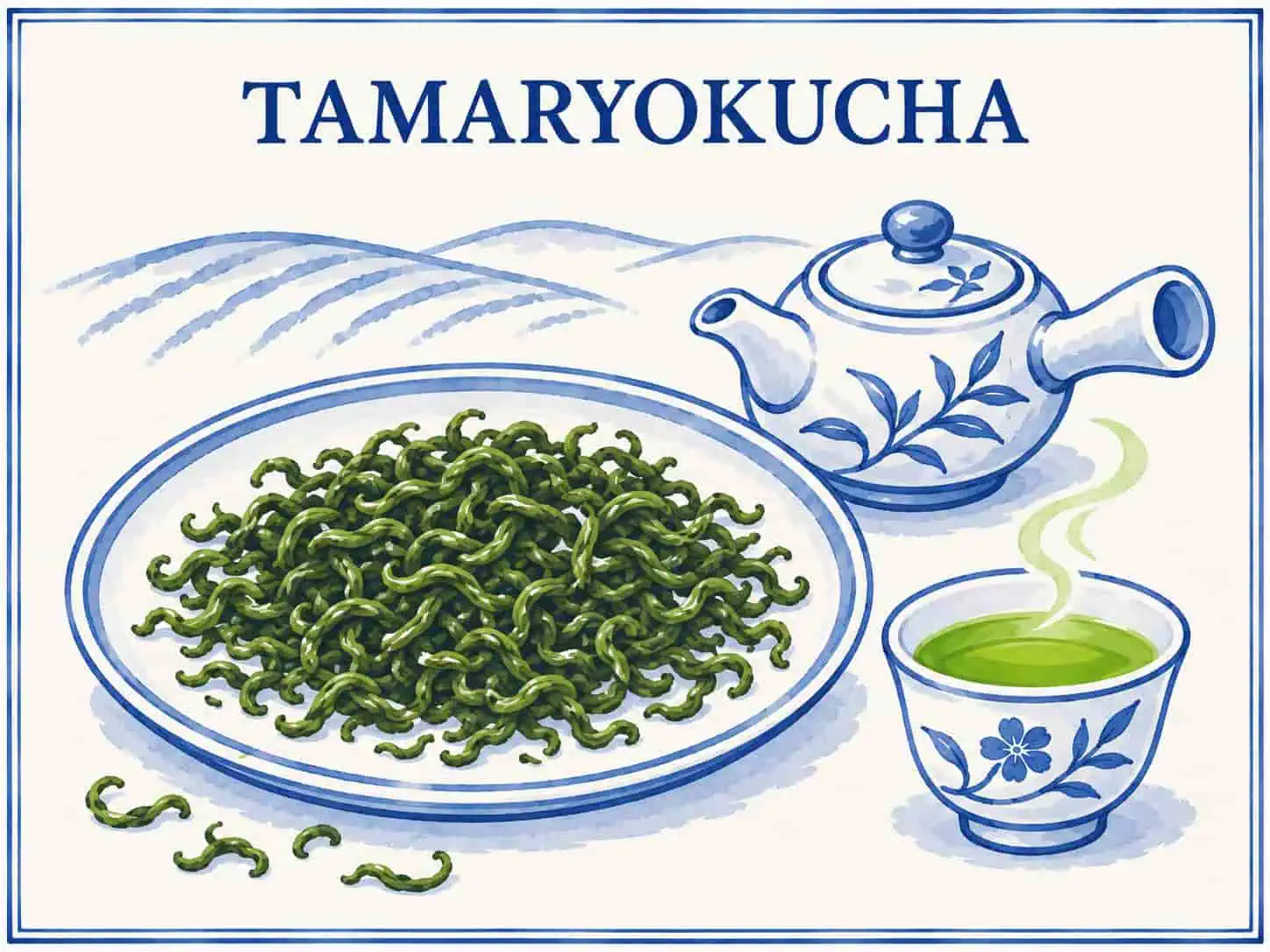

Pour a spoonful of sencha onto a plate, and you see thin, straight needles. Pour out a spoonful of tamaryokucha, and the leaves look completely different. They are curled into tiny hooks and commas, a little like green tadpoles. The tea comes from the same plant and is often steamed in the same way. The difference comes from one step near the end of the factory line that tamaryokucha simply leaves out.
Tamaryokucha (玉緑茶) is a Japanese green tea with curled, rounded leaves, made mostly in Kyushu. It is often sold as guricha, and it brews a mellow, rounded cup with little bitterness. In this guide, you’ll learn what the name means, where the curled shape comes from, how the steamed and pan-fired styles differ, which Kyushu towns grow it, and how to brew it at home.
The short answer
Tamaryokucha is curly Japanese green tea. Most of it is steamed like sencha, but it skips the final shaping step that presses sencha into needles, so the leaves dry into loose curls. It grows mainly in Saga, Nagasaki, Kumamoto and Miyazaki in Kyushu, and it tastes smoother and gentler than most sencha.
What Is Tamaryokucha?
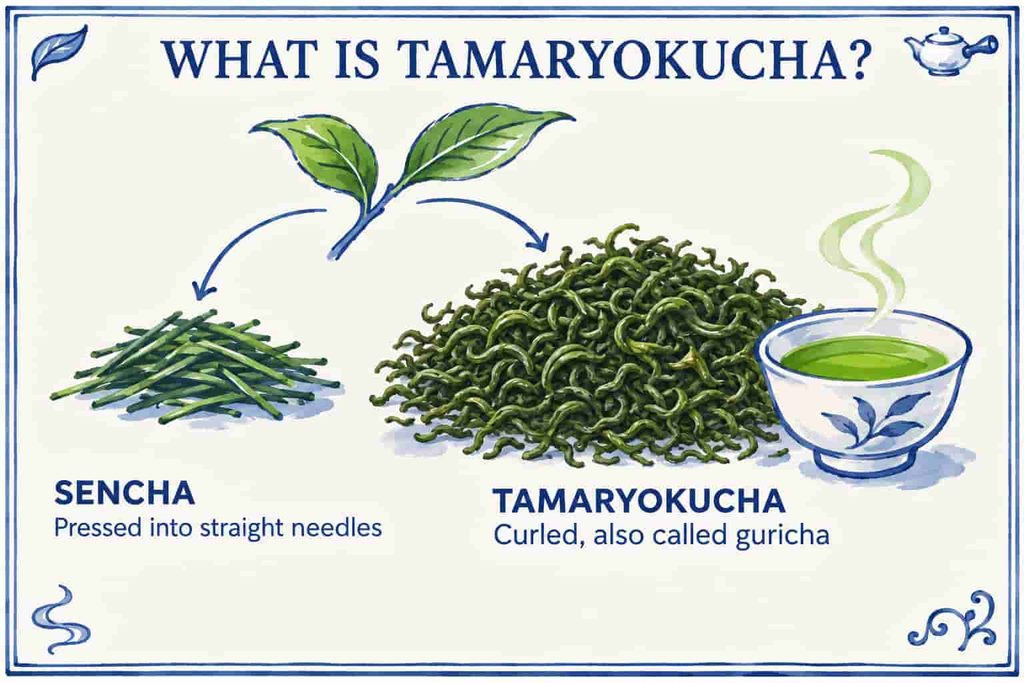
Tamaryokucha is a loose-leaf Japanese green tea whose leaves curl into small, rounded shapes as they dry. Like sencha, it is an unoxidized green tea. Unlike sencha, it is never pressed straight at the end, so it keeps the curled look that Japan’s earliest pan-fired teas once had.
Tamaryokucha Quick Facts
- Japanese name
- 玉緑茶, read tamaryokucha
- Other names
- Guricha (ぐり茶), curly green tea
- Type
- Unoxidized green tea; the name covers a steamed and a pan-fired style, but on its own it usually means the steamed one
- Leaf shape
- Curled hooks and commas, not straight needles
- Key difference
- Skips sencha’s final shaping step (seijū)
- Main regions
- Saga, Nagasaki, Kumamoto and Miyazaki (Kyushu)
- Flavor
- Mellow and rounded, with soft umami and low bitterness
What the Name Tamaryokucha Means
The name joins three characters: 玉 (tama), meaning a ball or jewel, 緑 (ryoku), meaning green, and 茶 (cha), meaning tea. Put together, tamaryokucha means something like “round green tea.” According to a history page from the Kyoto tea shop Chikiriya, the name became the official trade term in 1932, replacing older names used during the export years. These are the words you are most likely to see on a package:
On the package
玉緑茶
tamaryokucha
Curly green tea, the general term
ぐり茶
guricha
Everyday name for the same tea
蒸し製玉緑茶
mushisei tamaryokucha
Steamed style, the most common
釜炒り製玉緑茶
kamairisei tamaryokucha
Pan-fired style, usually sold as kamairicha
嬉野茶
Ureshino-cha
Tea from Ureshino, Saga
そのぎ茶
Sonogi-cha
Tea from Higashisonogi, Nagasaki
Not the same as gunpowder tea
Chinese gunpowder tea is also rolled, but into tight pellets, and it is pan-fired in China. Steamed tamaryokucha curls more loosely and tastes greener and fresher. If a label only says “curly green tea,” check the origin to see which one you are buying.
The History of Tamaryokucha
Tamaryokucha has an unusual history. Its curled shape is older than sencha’s needles, yet the steamed version that dominates today was created in the 20th century as an export product.
Pan-Fired Roots in Ureshino
Kyushu sits close to the Chinese mainland, and Chinese pan-firing reached its hills early. According to a local tradition recorded by Japan’s Agency for Cultural Affairs, in 1504 a potter from Ming China brought an iron “Nanking pan” to Ureshino and taught the pan-firing method. Leaves heated and stirred in a hot pan naturally dry into curls, because nothing presses them flat.
In the early Edo period, a samurai named Yoshimura Shinbei (1603–1657) cleared the hills around Ureshino for tea fields. A Japan Tourism Agency guide calls him the father of Ureshino tea. A giant tea tree linked to him, the Ōchanoki, still stands above the hot-spring town. It is about 4.6 meters tall and was named a national natural monument in 1926.
The 1930s Export Push
The steamed version of tamaryokucha grew out of trade. According to the Kyoto tea shop Chikiriya, Japan wanted to sell more tea in the 1920s and 1930s to the Soviet Union and Central Asia, where drinkers were used to curled Chinese green tea. Straight Japanese needles looked unfamiliar there. Around 1930, producers developed a tea with the Chinese shape that could still be made on Japan’s steaming machines. They did it by leaving out the final needle-shaping machine.
- 1504By tradition, a Ming Chinese potter brings pan-firing to Ureshino.
- 1600sYoshimura Shinbei expands tea growing around Ureshino.
- 1823Philipp Franz von Siebold collects Ureshino pan-fired tea.
- c.1930Steamed curly tea is developed for export markets.
- 1932The name tamaryokucha becomes the official term.
- PostwarKyushu shifts from pan-firing to steaming.
From Export Tea to Kyushu Specialty
After World War II, export demand faded, but Kyushu farmers kept making curled tea. Steaming was faster and more consistent than pan-firing, so production moved steadily to the steamed style. Chikiriya estimates that about 98 percent of tamaryokucha is now steamed. Today the tea is a regional favorite rather than an export product, and in much of Kyushu it is simply everyday tea.
How Tamaryokucha Is Made
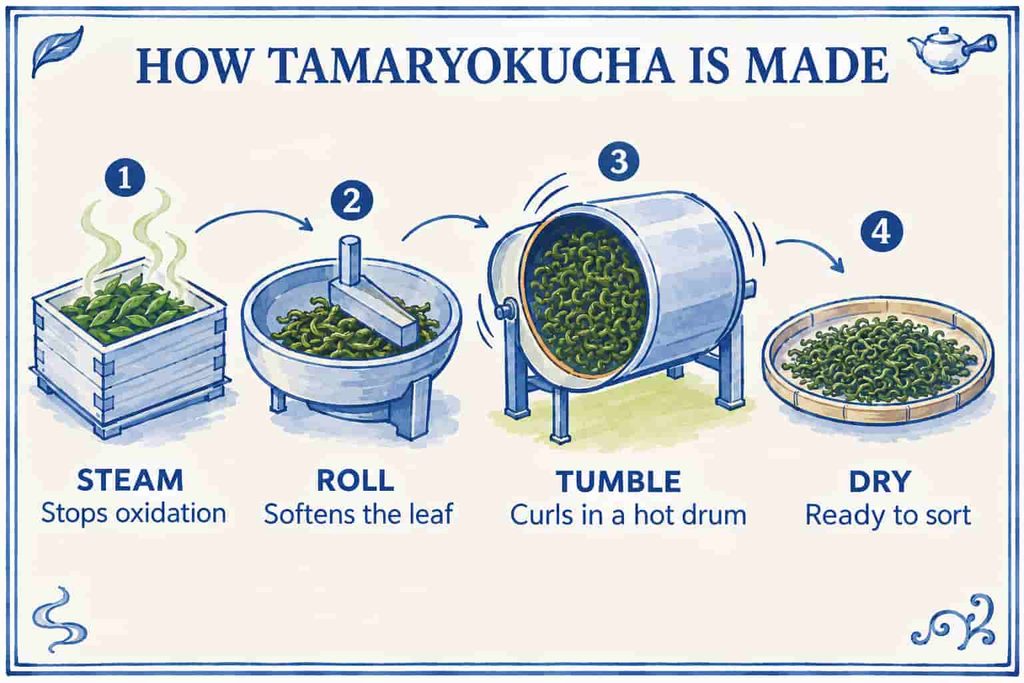
Steamed tamaryokucha follows almost the same path as sencha until the final stages. The key change is where the leaves get their shape. The outline below shows the usual order; machines, timings and the names used for each step vary between factories.
- Steaming: fresh leaves are steamed to stop oxidation and keep them green. Some factories steam longer for a deeper color, similar to deep-steamed sencha.
- Rough rolling (sojū): the leaves are tossed and pressed in warm air to remove moisture.
- Rolling (jūnen): pressure breaks down the leaf cells so the flavor releases more easily.
- Middle rolling (chūjū): the leaves dry further and begin to curve.
- Curl drying (saikan): instead of the needle-shaping machine, the leaves tumble in a heated rotating drum. As they dry, they twist into curls.
- Final drying and sorting: the rough tea is dried, then sorted and blended into the finished product.
The Step Tamaryokucha Skips
For sencha, a machine called a seijūki presses and rolls the leaves into straight, glossy needles. This step, called seijū, works the leaves hard. Tamaryokucha leaves it out completely. Without that final straightening, the leaves dry in a curled shape instead. Tea shops often describe the result as softer and rounder than sencha, although the grade, harvest and steaming time shape the taste just as much.
Worth knowing
Kyushu’s research stations still refine this process. Kumamoto Prefecture has published settings for deep-steaming tamaryokucha, because buyers increasingly want a vivid green leaf and cup. Nagasaki Prefecture has tested how much moisture to leave after rough rolling to get a brighter color and a better market price.
Steamed vs. Pan-Fired Tamaryokucha
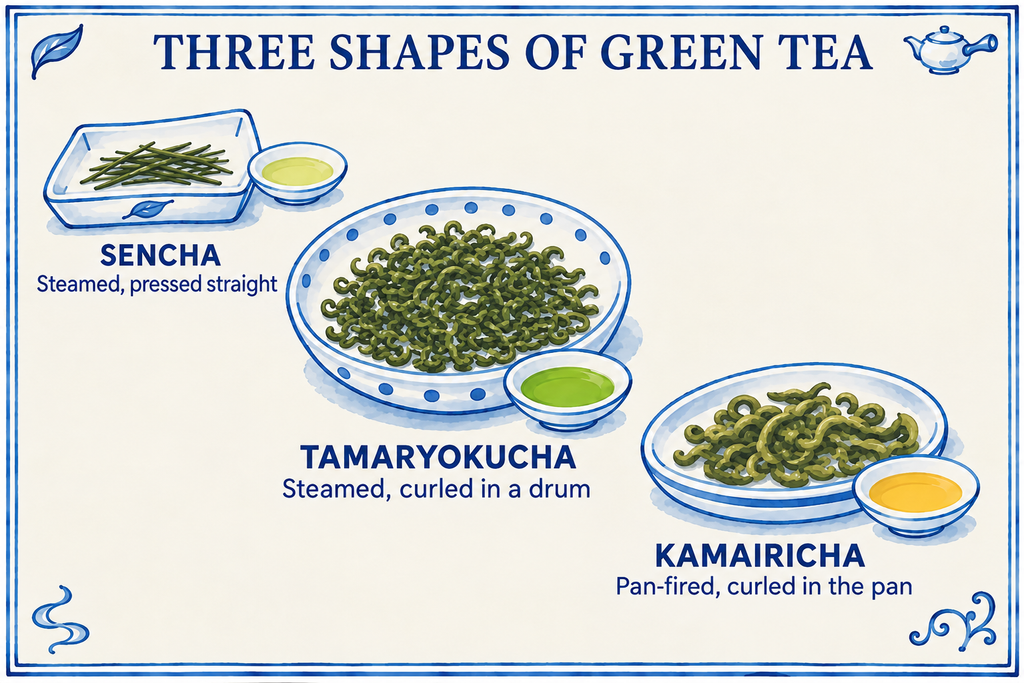
Strictly speaking, the name tamaryokucha covers two styles of curled tea: steamed (mushisei) and pan-fired (kamairisei). In everyday use, though, tamaryokucha usually means the steamed style, and the pan-fired one is sold as kamairicha. The national tea competition also judges them separately. At the 2023 National Tea Fair in Fukuoka, for example, steamed tamaryokucha and pan-fired kamairicha were entered as two different divisions. Here is how they compare with each other and with sencha.
| Point | Sencha (煎茶) | Steamed tamaryokucha | Pan-fired (kamairicha) |
|---|---|---|---|
| Heat to stop oxidation | Steam | Steam | Hot iron pan |
| Final shaping | Pressed into needles | None; curls in a drum | None; curls in the pan |
| Leaf shape | Straight needles | Small, tight curls | Looser, rounder curls |
| Cup color | Yellow-green | Bright green | Clear golden-yellow |
| Aroma | Fresh, grassy | Fresh, sweet, green | Toasty kamaka (pan aroma) |
| Main areas | Shizuoka, Kagoshima and more | Saga, Nagasaki, Kumamoto | Miyazaki, Kumamoto, Saga |
The pan-fired style deserves its own story, from the tilted pans of Ureshino to the mountain farms of Takachiho. We cover it fully in our guide to kamairicha, so the rest of this article focuses mainly on the steamed style.
Where Tamaryokucha Comes From
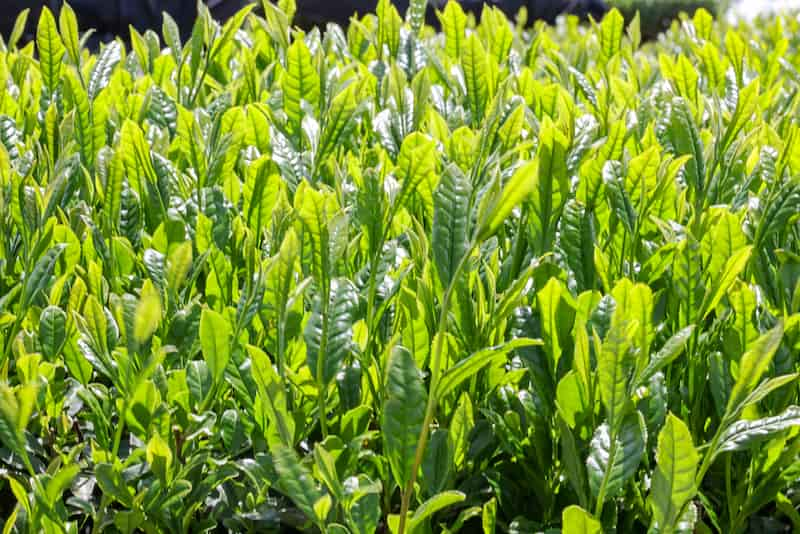
Almost all tamaryokucha is made in western and central Kyushu, with Saga Prefecture at its center. It is a small category: the Global Japanese Tea Association estimates that the steamed and pan-fired styles together make up only about 3 percent of Japanese tea. Each area has its own name and its own character.
Ureshino, Saga
嬉野茶
The historic home of curled tea, in a hot-spring town. Known for a sweet aroma and smooth body.
Higashisonogi, Nagasaki
そのぎ茶
Hillside fields above Omura Bay. A repeat national champion in the steamed tamaryokucha division.
Kumamoto & Miyazaki
熊本・宮崎
Both steamed and pan-fired curled teas. Miyazaki is especially known for kamairicha.
Sonogi Tea: A Small Town With National Titles
Higashisonogi is a small town on the shore of Omura Bay, yet its tea keeps winning. Nagasaki Prefecture reports that local growers took the Minister of Agriculture’s Award in the steamed tamaryokucha division of the National Tea Fair from 2017 to 2020 and again in 2022. In one of those years, a few kilograms of the top prize-winning crude tea sold at a special auction for 300,000 yen per kilogram. That price applies only to that award-winning lot; the same farms sell their regular tea in town at ordinary prices.
Nagasaki’s tea research staff also note that the prefecture’s tea industry grew up mainly around steamed tamaryokucha. Visiting Saga instead? Pair a tea tasting in Ureshino with the town’s famous hot-spring tofu.
What Does Tamaryokucha Taste Like?
Tamaryokucha is best summed up in one word: mellow. It has the fresh green character of Japanese tea, but it feels gentler on the tongue than many sencha. The dry leaves are deep green and glossy. In the cup, steamed tamaryokucha brews a bright, slightly cloudy green.
Typical flavor profile (steamed style)
Sweetness
Medium-high
Umami
Medium
Bitterness
Low
Astringency
Low
Aroma
Fresh, sweet
Editorial description for comparison only, not lab scores. Grade, harvest and steaming time change the taste.
The flavor is smooth, with gentle umami and a soft sweetness on the finish. Second and third infusions usually stay pleasant, so one spoonful of leaves goes a long way. If you find sencha a little sharp, tamaryokucha is an easy next tea to try. Pan-fired versions taste lighter and cleaner, with a faint toasted note.
How to Brew Tamaryokucha
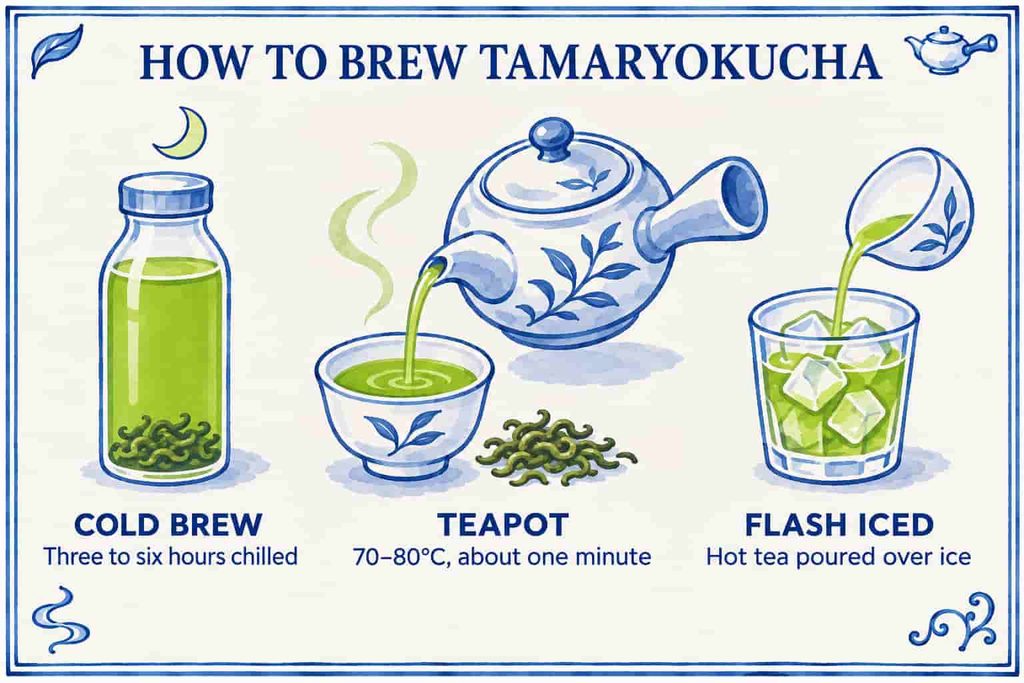
Tamaryokucha is forgiving to brew. Start with the method on the package, since grades and steaming times vary. Then use the guide below to adjust to your taste.
Teapot
Mellow and sweet
- Leaf
- 4–5 g (about 2 tsp)
- Water
- 150–200 ml at 70–80°C
- Time
- About 60 seconds
Cold brew
Sweet, almost no bitterness
- Leaf
- 10 g per liter
- Water
- Cold, in a jug or bottle
- Time
- 3–6 hours in the fridge
Flash iced
Bright and quick
- Leaf
- 8–10 g
- Water
- 150 ml at 80°C
- Then
- Pour over a glass of ice
Step by Step in a Teapot
- Cool the water: pour just-boiled water into your cups first. This cools it by roughly 10°C and warms the cups.
- Add the leaves to a small teapot, ideally a Japanese kyusu with a built-in strainer.
- Steep for about a minute. The curled leaves need a little longer than fine needles to open.
- Pour every last drop, moving between cups so each gets the same strength.
- Brew again with slightly hotter water and a shorter time, about 20 to 30 seconds.
For high-grade first-flush tea, try cooler water around 60–65°C to bring out more sweetness. For pan-fired curled tea, slightly hotter water suits its toasty aroma.
How to Buy and Store Tamaryokucha
Tamaryokucha is easy to find in Kyushu and harder to find abroad, where only specialist tea shops tend to stock it. These points help you choose well.
- Check the characters: look for 玉緑茶 or ぐり茶. 蒸し製 means steamed; 釜炒り means pan-fired.
- Check the origin: Ureshino, Sonogi, Kumamoto or Miyazaki on the label is a good sign.
- Check the harvest: first-flush (ichibancha) tea is usually the most aromatic and the most prized.
- Look at the leaf: choose glossy, deep green curls with few broken pieces or pale stems.
- Buy small amounts: a 50–100 g bag is easy to finish while the tea is fresh.
Store the tea sealed in a cool, dark, dry place, away from strong smells. If you keep an unopened bag in the fridge, let it reach room temperature before opening so moisture doesn’t form on the leaves. Follow the date and storage advice on the package. Once a bag is open, many tea shops suggest finishing it within about a month or two for the best aroma.
Tamaryokucha shows how much one step can change a tea. Leave out the final straightening, and the same Kyushu leaf becomes a curled, mellow cup with a story that runs from Chinese pan-firing to a 1930s export plan.
Next time you open a bag of Japanese green tea, look at the leaf before you brew. If it curls instead of pointing straight, you are holding a little piece of Kyushu tea history.
Tamaryokucha FAQ
About the Tea
Is tamaryokucha the same as guricha?
Yes. Guricha is a common everyday name for tamaryokucha, inspired by its curled leaves. Both names describe the same tea.
What is the difference between tamaryokucha and sencha?
Both are usually steamed green teas. Sencha goes through a final shaping step that presses it into needles. Tamaryokucha skips that step and dries in curls instead. Its cup is often described as softer and rounder.
Is kamairicha a type of tamaryokucha?
In the broad sense, yes. The name tamaryokucha covers both steamed and pan-fired curled tea. In practice, though, the pan-fired style is usually sold as kamairicha, and the National Tea Fair judges it as a separate category from steamed tamaryokucha.
Drinking and Buying
Does tamaryokucha have caffeine?
Yes. Like sencha, it contains a moderate amount of caffeine. If you want a lighter option, roasted hojicha is a common choice in the evening.
What water temperature is best for tamaryokucha?
Start at 70–80°C for about one minute. Use cooler water for high-grade tea and slightly hotter water for later infusions.
Where is most tamaryokucha made?
Almost all of it comes from Kyushu, especially Ureshino in Saga, Higashisonogi in Nagasaki, and parts of Kumamoto and Miyazaki.
References
- Agency for Cultural Affairs – Kamairicha (釜炒り茶), on the 1504 tradition and the Ureshino and Aoyagi pan styles. (Accessed November 2026)
- Japan Tourism Agency – Japanese Tea: A Historical Overview, on Yoshimura Shinbei, Ureshino pan-fired tea and Siebold’s 1823 collection. (Accessed November 2026)
- Japan Tourism Agency – The Great Tea Tree of Ureshino, on the Ōchanoki’s size and 1926 designation. (Accessed November 2026)
- Chikiriya – The Beginnings of Ureshino Tea, on the 1932 name, export history and the share of steamed tamaryokucha. (Accessed November 2026)
- Nagasaki Prefecture – Tea promotion report (2025), on National Tea Fair awards in the steamed tamaryokucha division. (Accessed November 2026)
- Nagasaki Prefecture – Sonogi tea auction prices (2021), on prize-winning crude tea prices. (Accessed November 2026)
- Fukuoka Prefecture – 77th National Tea Fair (2023), on separate steamed tamaryokucha and kamairicha divisions. (Accessed November 2026)
- Kumamoto Prefecture Tea Research Institute – Deep steaming for steamed tamaryokucha (2016), on market demand for vivid green color. (Accessed November 2026)
- Nagasaki Agriculture and Forestry Technical Development Center – Moisture after rough rolling in steamed tamaryokucha (2025), on color, quality and price. (Accessed November 2026)
- Nagasaki Agriculture and Forestry Technical Development Center – Alternating tencha and steamed tamaryokucha (2021), on Nagasaki as a steamed tamaryokucha region. (Accessed November 2026)
- Global Japanese Tea Association – Tamaryokucha, on the two styles, the main production areas and its share of about 3 percent of Japanese tea. (Accessed November 2026)



Comments