


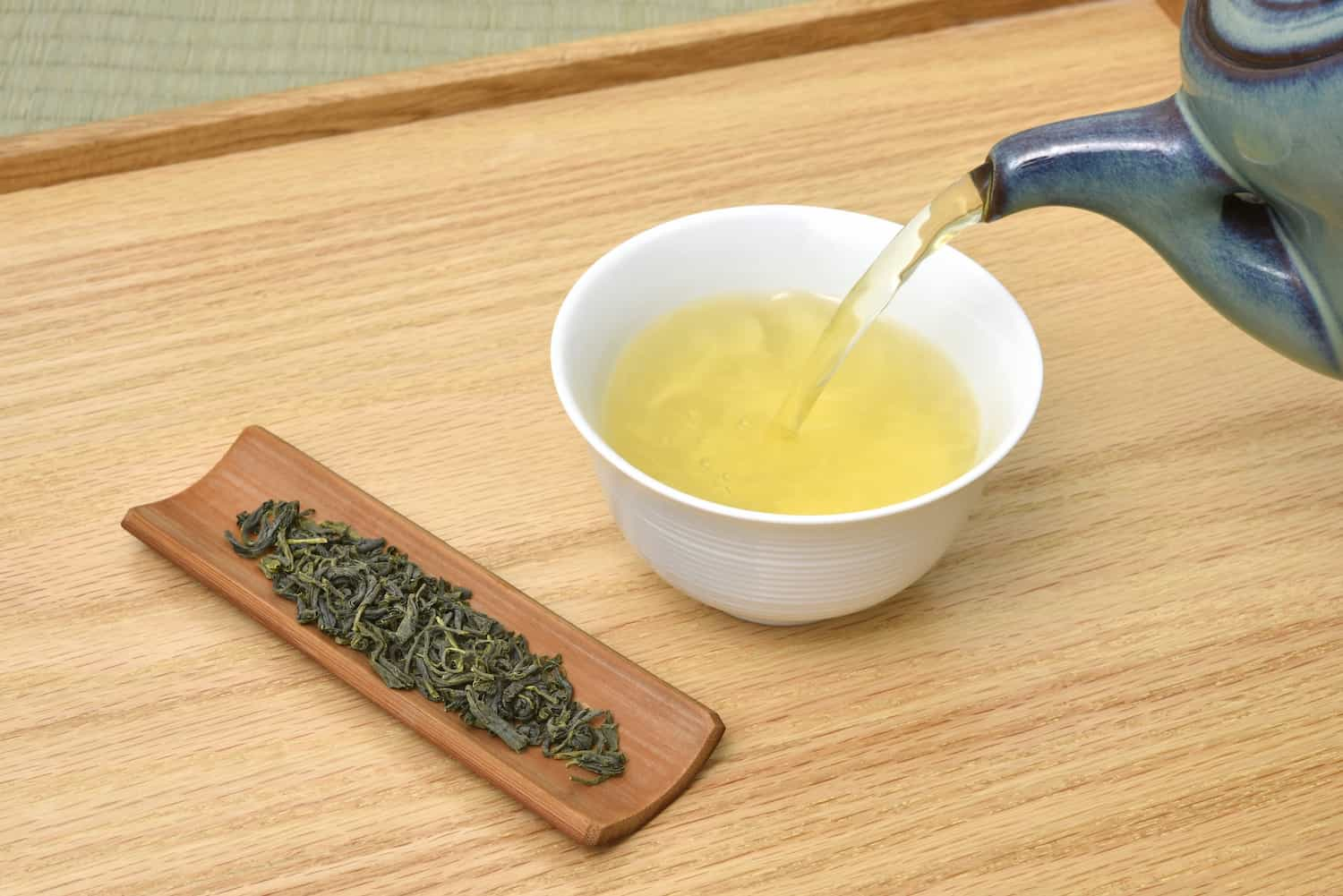

Most Japanese green tea is steamed soon after it is picked. In the mountain towns of northern Miyazaki, the fresh leaves meet hot iron instead. They are tossed in a pan hot enough to hiss, and the tea that comes out smells faintly toasty and sweet, a little like warm grain. That tea is kamairicha. Only a small amount is made in Japan, yet in the mountains where it grows, it is simply the everyday tea.
Kamairicha (釜炒り茶) is a Japanese green tea that is pan-fired rather than steamed to stop the leaves from oxidizing. It brews a clear, golden-yellow cup with a clean taste, little astringency and a gentle toasty aroma called kamaka. In this guide, you’ll learn what the name means, how the pan-firing works, the two traditional pan styles, where kamairicha is made today, and how to brew it at home.
The short answer
Kamairicha is pan-fired Japanese green tea. Fresh leaves are heated in a very hot iron pan instead of being steamed, then rolled and dried into loose curls. It is still a green tea, not a roasted one like hojicha. Miyazaki Prefecture produces the most kamairicha in Japan, and the tea tastes clean and refreshing, with a light toasty aroma.
What Is Kamairicha?
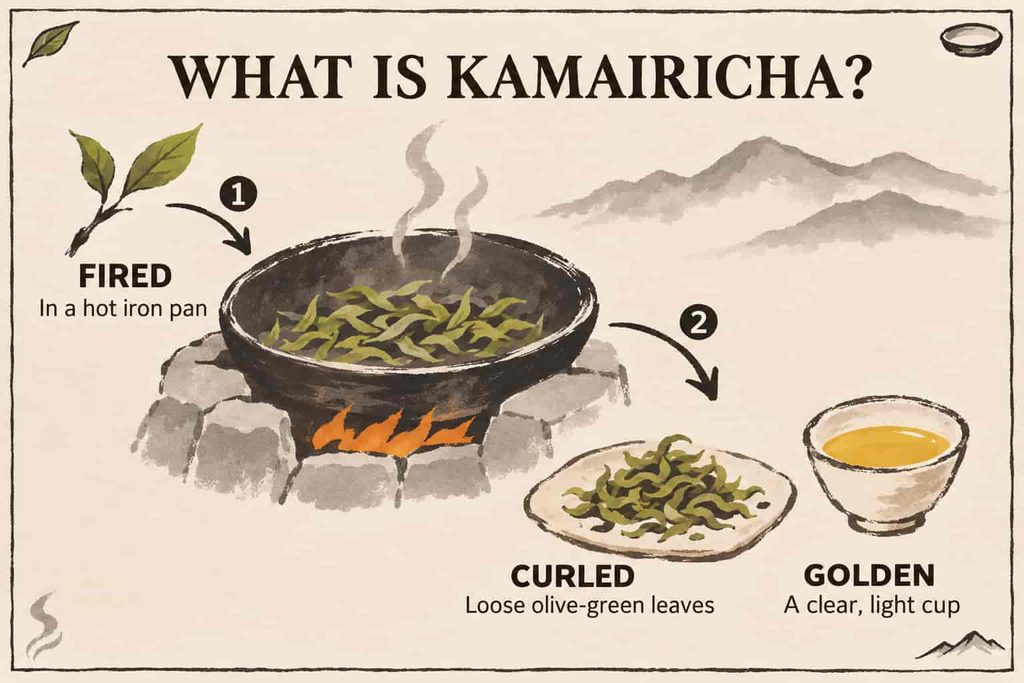
Kamairicha is an unoxidized green tea, just like sencha. The difference lies in the very first step. Sencha is steamed to stop the natural browning of the leaves, while kamairicha is fired in a dry, hot pan. The method came to Kyushu from China centuries ago, and it is still closer to how most green tea is made in China.
Kamairicha Quick Facts
- Japanese name
- 釜炒り茶, read kamairicha
- Type
- Unoxidized green tea, pan-fired instead of steamed
- Leaf shape
- Loose, rounded curls; not pressed into needles
- Cup color
- Clear golden-yellow
- Aroma
- Kamaka (釜香), a light toasty “pan aroma”
- Main region
- Miyazaki, Japan’s top producer; also Kumamoto and Saga
- Production
- Small; about 1% of Japan’s green tea, according to a 2019 Japan Tourism Agency profile
- Flavor
- Clean and refreshing, with little astringency
What the Name Kamairicha Means
The name explains the method. 釜 (kama) is an iron pot or pan, 炒り (iri) means dry-frying or firing, and 茶 (cha) means tea. So kamairicha is simply “pan-fired tea.” You may also see it written as 釜煎り茶, or sold as kamairi green tea. These are the words you are most likely to meet on a package or in a tea shop:
Words to know
釜炒り茶
kamairicha
Pan-fired green tea
釜香
kamaka
The toasty aroma from the pan
炒り葉
iriha
Firing the fresh leaves
水乾
suikan
Drum-drying step unique to kamairicha
釜炒り製玉緑茶
kamairisei tamaryokucha
Formal name for curled pan-fired tea
高千穂
Takachiho
Best-known kamairicha town, Miyazaki
Not the same as hojicha
“Pan-fired” can sound like “roasted,” but kamairicha is a green tea. The pan only heats the fresh leaves long enough to stop oxidation, so the dry leaves stay green. Hojicha is made by roasting finished tea until it turns brown, which gives a much darker, smoky cup.
How Kamairicha Is Made
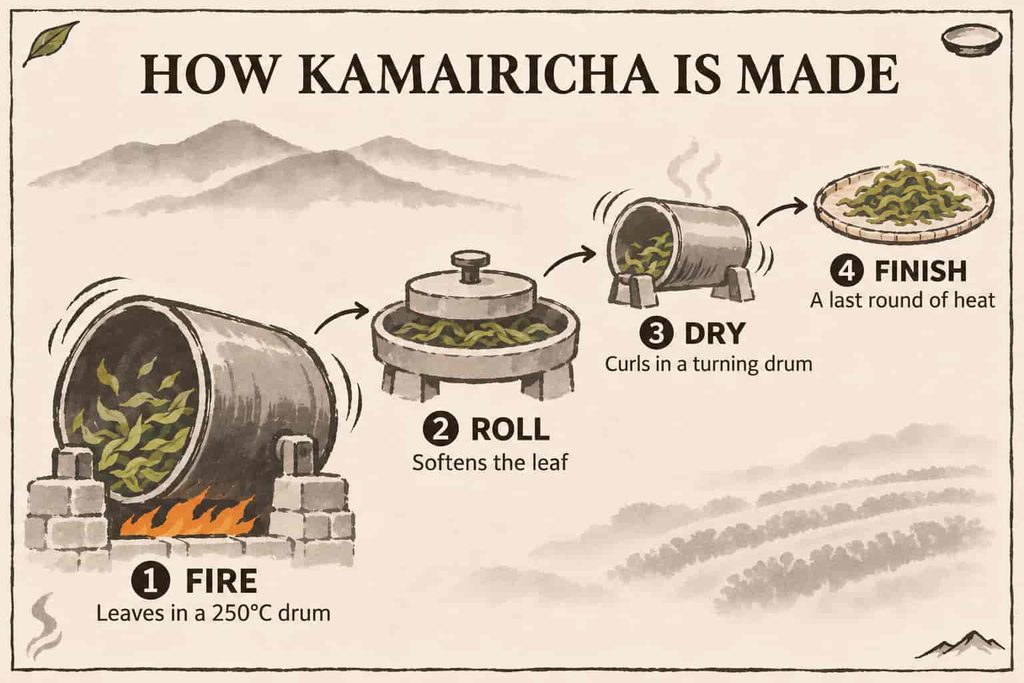
Kamairicha is made in spring, like other Japanese green teas, but the factory looks different. Instead of a steaming machine, the line begins with a hot rotating iron drum. A guide from the Takachiho tourism association names the pan-firing and the drum-drying as the two steps unique to kamairicha. The outline below shows the usual order in a modern factory; machines and timings vary from farm to farm.
- Pan-firing (iriha): fresh leaves tumble in a hot iron drum. The Takachiho guide notes the drum surface reaches 250°C or more. The heat stops oxidation and softens the leaves.
- Rolling (jūnen): the soft leaves are rolled to break the cells and bring out flavor.
- Drum-drying (suikan): the leaves turn in a heated drum, lose moisture and start to curl.
- Final firing and drying: a last round of heat dries the tea and sets its curled shape and toasty aroma.
Moisture control matters at every stage. The same Takachiho guide warns that if steam builds up in the drum, leaves can stick to the hot wall and pick up a scorched or smoky smell. Good kamairicha smells toasty, never burnt.
By Hand: The Old Ureshino Method
Before machines, kamairicha was made entirely by hand. In a 2017 paper, a researcher at the Kumamoto Prefectural Industrial Technology Center recorded the memories of Ureshino tea makers. They first fired the leaves in a pan above 300°C, then rolled them, half-dried them, rolled them again, half-dried them a second time, let them rest, and finished them with a final firing. The same paper suggests the tilted pan was adopted to save labor, not to mass-produce tea for export.
That hand method still lives on in demonstrations. At Kisaraku-kan, a tea facility in Ureshino, the Japan Tourism Agency describes leaves being fired above 300°C in metal pans set into stone hearths, tossed by hand so they do not burn, then pressed and rolled into curls.
Why the Pan Changes the Tea
Steam is wet heat, while a pan is dry heat. That difference shows up in the cup. In samples tested by Saga Prefecture’s tea researchers, kamairicha contained about twice as much of the aroma compounds behind kamaka as sencha did. The researchers also describe it as low in astringency and easy to taste as umami, with fewer catechins in the cup in their comparisons.
Worth knowing
A 2018 study by the Saga Prefectural Tea Research Station made kamairicha, steamed tamaryokucha and sencha from the same Yabukita leaves. A taste sensor found kamairicha about as savory as sencha but less astringent. The authors link this partly to lighter rolling, which draws fewer astringent components out of the leaf.
Two Ways to Fire the Leaves
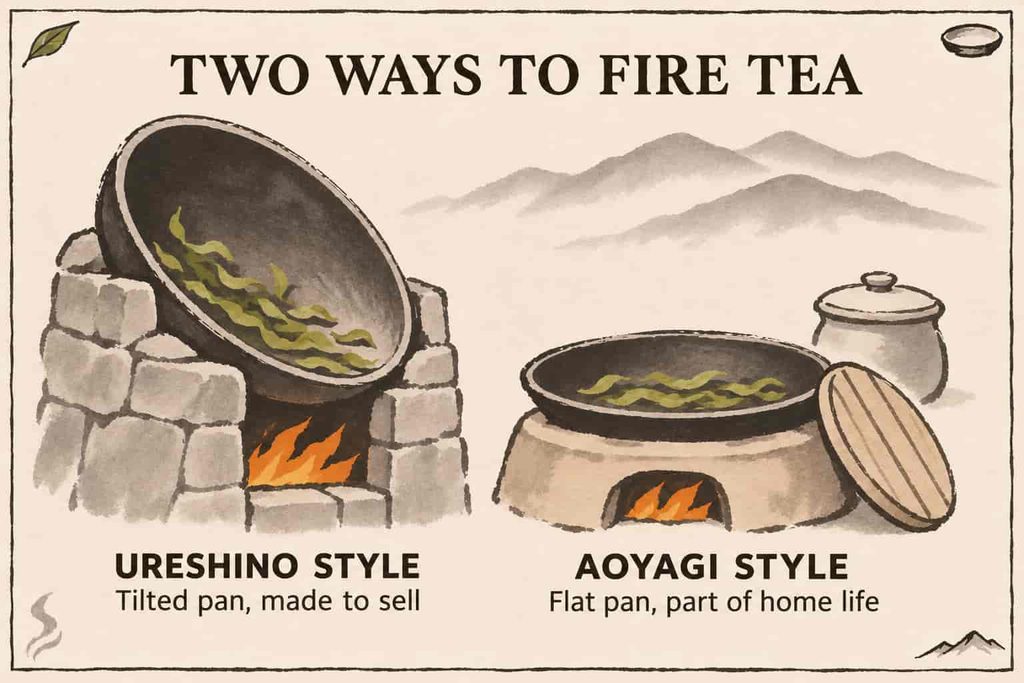
Japan developed two traditional styles of kamairicha, named after the pans they use. According to Japan’s Agency for Cultural Affairs, the two styles grew from very different ways of life.
Ureshino style
嬉野式・唐釜
A tilted pan, also called a Chinese pan. Built for making tea to sell, with efficiency in mind. Still used by hand in Ureshino, Saga.
Aoyagi style
青柳式
A flat, horizontal pan used in Kumamoto and Miyazaki. The same pan also cooked the family’s meals, so tea-making was part of home life.
Ureshino is also where, by local tradition, pan-firing first came to Japan in the early 1500s. Our guide to tamaryokucha tells that story and explains how Ureshino later moved to a steamed tea with the same curled shape. In the mountains of Kumamoto and Miyazaki, by contrast, kamairicha simply stayed the everyday tea of farming households.
Kamairicha vs. Other Japanese Teas
Kamairicha sits between familiar teas. It shares its green leaf with sencha, its curled shape with steamed tamaryokucha, and a touch of toasty aroma with hojicha. The table shows how they compare.
| Point | Sencha | Steamed tamaryokucha | Kamairicha | Hojicha |
|---|---|---|---|---|
| First heat | Steam | Steam | Hot iron pan | Steam, then roasted later |
| Leaf | Straight needles | Small, tight curls | Looser, rounder curls | Brown leaves and stems |
| Cup color | Yellow-green | Bright green | Clear golden-yellow | Reddish brown |
| Aroma | Fresh, grassy | Fresh, sweet | Light toasty kamaka | Strong roasted |
| Astringency | Moderate | Moderate | Low | Very low |
Kamairicha is also sometimes compared with Chinese green teas, which are usually pan-fired too. The Japan Tourism Agency describes its mouthfeel as similar to Chinese tea. Still, Japanese kamairicha has its own cultivars and regions, as the next section shows.
Where Kamairicha Comes From
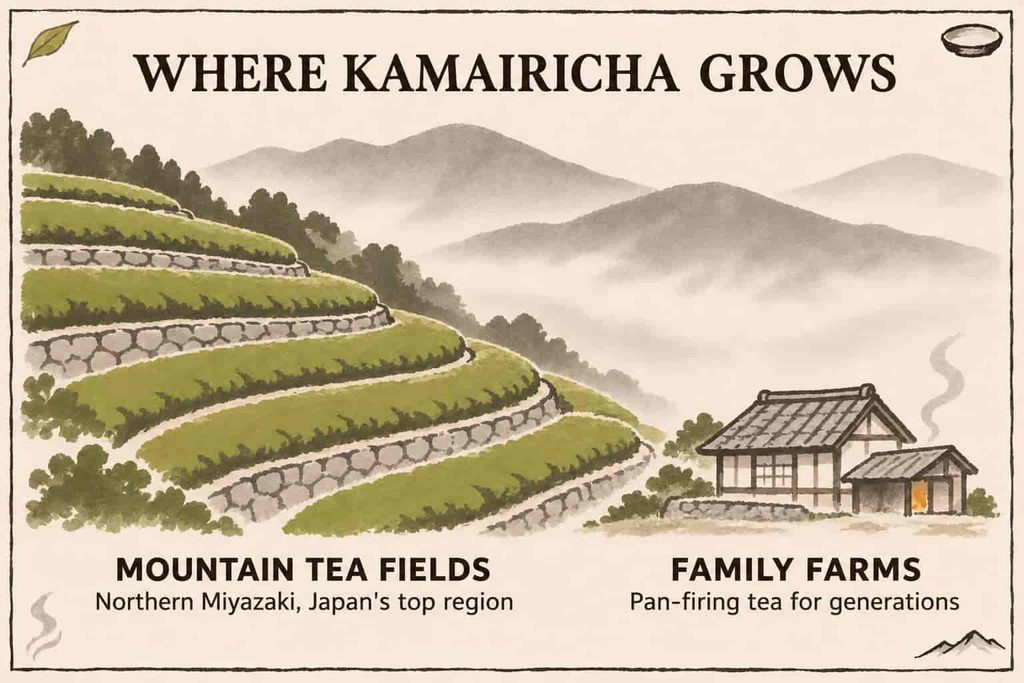
Kamairicha is a Kyushu tea, and above all a Miyazaki tea. Japan’s Ministry of Agriculture, Forestry and Fisheries (MAFF) lists Miyazaki as the country’s top producer of kamairicha in its 2025 tea report. Most of it comes from the steep, misty mountains in the north of the prefecture.
Nishiusuki, Miyazaki
高千穂・日之影・五ヶ瀬
Takachiho, Hinokage and Gokase. The heartland of kamairicha and Japan’s leading production area.
Kumamoto
熊本
Mountain tea areas with an Aoyagi-style tradition. The prefecture’s tea researchers have tested kamairicha machines.
Ureshino, Saga
嬉野
Home of the tilted-pan style, kept alive by a small number of hand makers.
Takachiho: Small Farms, Big Reputation
Takachiho is famous for its gorge and its night-time kagura dances, but tea is part of daily life there too. A 2019 Japan Tourism Agency profile counted 33 family-run tea farms in the area that still make kamairicha by careful pan-firing. In the surrounding district, kamairicha is simply the everyday tea, while elsewhere in Japan it is something special. One local family farm won the Minister of Agriculture’s Award at the 2015 National Tea Fair.
Miyazaki has even bred its own tea plants for pan-firing. The Takachiho guide lists the cultivars Takachiho, Unkai, Yamanami and Nagomiyutaka, all developed by the prefecture for kamairicha.
A World Agricultural Heritage Site
In December 2015, the Takachiho-go and Shiibayama area was designated a Globally Important Agricultural Heritage System by the UN’s Food and Agriculture Organization. The site covers five mountain towns and villages, including Takachiho, Hinokage and Gokase. Miyazaki Prefecture names kamairicha, along with terraced-field rice and shiitake, as a local product that helps protect this mountain way of farming.
What Does Kamairicha Taste Like?
Kamairicha tastes clean. The first thing most people notice is the aroma: sweet, nutty and lightly toasty, a little like warm grain. The cup is clear and golden-yellow, lighter in color than most steamed green tea.
Typical flavor profile
Aroma
Toasty, sweet
Sweetness
Medium
Umami
Medium
Astringency
Low
Bitterness
Low
Editorial description for comparison only, not lab scores. Grade, cultivar and harvest change the taste.
On the tongue, kamairicha is light and refreshing rather than thick. Saga’s researchers describe it as “free of astringency and refreshing,” and that matches the classic reputation of the tea. If you find steamed green tea too grassy or brothy, kamairicha is a good tea to try next. It also suits people who like Chinese green teas but want something from Japan.
How to Brew Kamairicha
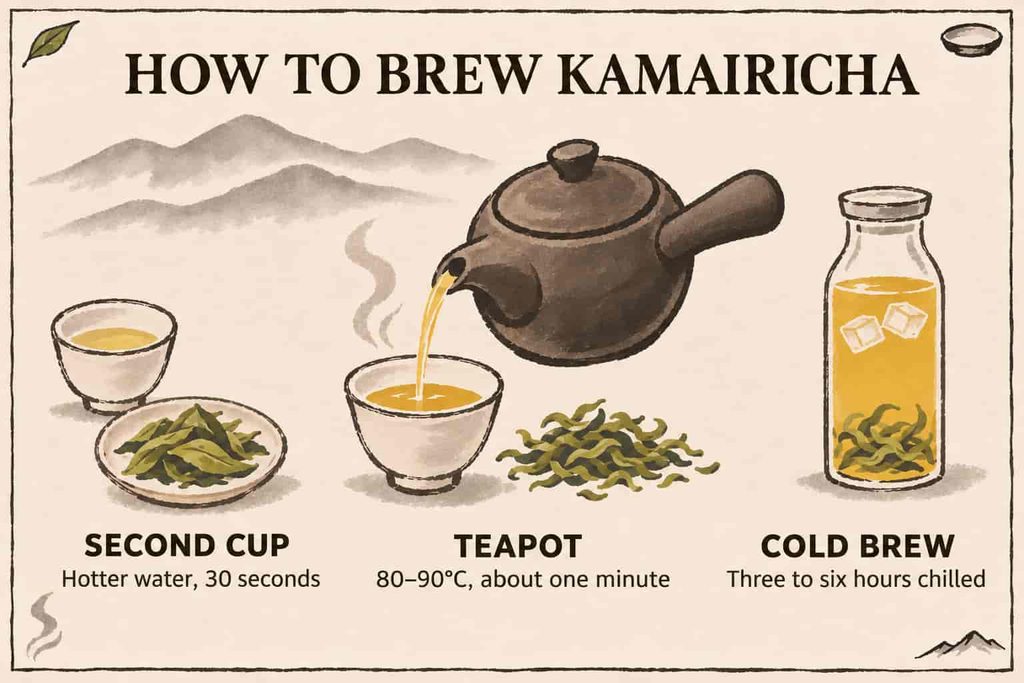
Kamairicha is easy to brew, and it likes a little more heat than most Japanese green teas. The Japan Tourism Agency notes that slightly hotter water suits it. Hotter water brings out the toasty kamaka aroma, and because the tea is low in astringency, it rarely turns harsh. Treat the amounts below as a starting point, and adjust them to the tea and your taste.
Teapot
Aromatic and clean
- Leaf
- 4–5 g (about 2 tsp)
- Water
- 150–200 ml at 80–90°C
- Time
- About 60 seconds
Second cup
Lighter, still fragrant
- Leaf
- Same leaves
- Water
- Just off the boil
- Time
- About 30 seconds
Cold brew
Sweet and refreshing
- Leaf
- 10 g per liter
- Water
- Cold, in a jug or bottle
- Time
- 3–6 hours in the fridge
Step by Step in a Teapot
- Heat the water to 80–90°C. Letting boiled water stand for a minute or two is enough.
- Add the leaves to a small teapot, such as a Japanese kyusu.
- Steep for about a minute. Watch the loose curls open and the cup turn golden.
- Pour every last drop, moving between cups so each gets the same strength.
- Brew again with hotter water and a shorter time. Good kamairicha gives two or three pleasant cups.
Miyazaki’s tea promoters also recommend cold-brewed kamairicha for the hot months. Its low astringency makes it especially smooth when steeped in cold water, so it is a good tea for a summer jug in the fridge.
How to Buy and Store Kamairicha
Because so little is made, kamairicha can be hard to find outside Kyushu. Specialist tea shops, Miyazaki souvenir shops and online stores are your best options. These points help you choose well.
- Check the label: look for 釜炒り茶 or 釜炒り. Simply “curly green tea” may be the steamed style instead.
- Check the origin: Takachiho, Gokase, Hinokage or Miyazaki on the label is a good sign. Ureshino hand-made kamairicha is rarer still.
- Look at the leaf: expect loose, olive-green curls. Brown leaves suggest a roasted tea such as hojicha.
- Look for a cultivar: some farms sell single cultivars such as Takachiho or Yabukita, which is a fun way to compare.
- Buy small amounts: a 50–100 g bag lets you finish the tea while its aroma is fresh.
Store kamairicha sealed in a cool, dark, dry place, away from strong smells. If you keep an unopened bag in the fridge, let it reach room temperature before opening so moisture doesn’t form on the leaves. Follow the date and storage advice on the package, and finish an opened bag while it still smells toasty and sweet.
Kamairicha is a small tea with a long memory. Every cup carries a pan-firing method that reached Kyushu from China centuries ago, kept alive by mountain farm families who never gave it up. If you enjoy sencha, try a cup of kamairicha beside it and taste what a hot iron pan can do.
Kamairicha FAQ
About the Tea
Is kamairicha the same as tamaryokucha?
They are related. Both have curled leaves, and in the formal sense pan-fired curled tea is a kind of tamaryokucha. In everyday use, though, tamaryokucha usually means the steamed style, while the pan-fired style is sold as kamairicha.
Is kamairicha roasted like hojicha?
No. The pan only heats the fresh leaves to stop oxidation, so kamairicha stays a green tea with green leaves and a golden cup. Hojicha is finished tea roasted until brown.
Is kamairicha a Chinese tea?
No, it is made in Japan, mainly in Miyazaki. Its pan-firing method is closer to Chinese green tea than to steamed Japanese tea, which is why its taste is often compared to Chinese green tea.
Drinking and Buying
What water temperature is best for kamairicha?
Use slightly hotter water than for sencha, around 80–90°C, for about one minute. Use even hotter water for the second infusion.
Does kamairicha have caffeine?
Yes. Like other green teas, it contains caffeine. The amount depends on the leaf and how strongly you brew it.
Where is kamairicha made?
Mostly in Miyazaki Prefecture, especially Takachiho, Hinokage and Gokase. Smaller amounts come from Kumamoto and Ureshino in Saga.
References
- Ministry of Agriculture, Forestry and Fisheries – The situation of tea (お茶をめぐる情勢), on Miyazaki as Japan’s top kamairicha producer (2025 data). (Accessed November 2026)
- Japan Tourism Agency – Takachiho tea, on kamairicha’s production share, 33 family farms, taste and color. (Accessed November 2026)
- Japan Tourism Agency – Gamadase Market and Kai Tea Farm, on the 2015 award and brewing with slightly hotter water. (Accessed November 2026)
- Japan Tourism Agency – Kisaraku-kan hand-rolling process, on hand-firing kamairicha above 300°C in Ureshino. (Accessed November 2026)
- Agency for Cultural Affairs – Ureshino food culture story (釜炒り茶), on the Ureshino-style and Aoyagi-style pans. (Accessed November 2026)
- Takachiho Tourism Association – Tea guide, on pan-firing and drum-drying steps, drum temperature and kamairicha cultivars. (Accessed November 2026)
- Sakamoto, T. (2017). 傾斜釜でつくられる釜炒り茶. Tea Research Journal, 124, 23–27, on making kamairicha in an inclined pan by the traditional Ureshino hand method. (Accessed November 2026)
- Yamaguchi, K. & Miyazaki, H. (2018). Tea Research Journal, 125, 45–52, a taste-sensor analysis of umami and astringency in kamairicha, steamed tamaryokucha and sencha. (Accessed November 2026)
- Saga Prefecture – Research report on Saga’s distinctive teas, on kamairicha’s kamaka aroma compounds and low astringency. (Accessed November 2026)
- Kumamoto Prefecture Tea Research Institute – Tea processing machine trials, on modern kamairicha pan-firing research. (Accessed November 2026)
- MAFF Kyushu Regional Office – Takachiho-go and Shiibayama GIAHS, on the December 2015 designation. (Accessed November 2026)
- Miyazaki Prefecture – Nishiusuki news, on kamairicha as a GIAHS product and cold-brewed kamairicha. (Accessed November 2026)



Comments