







Picture a hot pot arriving at the table with its surface hidden beneath overlapping lemon slices. Steam carries the citrus aroma before you even taste the broth. The broth itself is savory and gently tart rather than sharply sour. This is lemon nabe, a modern hot pot closely associated with Hiroshima’s lemon-growing islands.
Unlike a fixed traditional recipe, lemon nabe can hold chicken, pork, oysters, sea bream or tofu. What defines it is the contrast between an umami-rich broth and fresh lemon added near the end of cooking.
What Is Lemon Nabe?
Lemon nabe (レモン鍋) is a modern Japanese hot pot flavored with fresh lemon juice or thin lemon slices. It is strongly associated with Hiroshima Prefecture, Japan’s largest lemon-producing region. Still, it has no single standard recipe. Typically, common versions use chicken, pork or seafood in a light salt- or soy-based broth.
Lemon Nabe at a Glance
- Japanese name
- レモン鍋 (lemon nabe)
- Region
- Associated with Hiroshima Prefecture, especially the Seto Inland Sea islands
- Type
- Modern regional specialty, not a long-established folk dish
- Broth
- Varies: salt and chicken stock, soy sauce dashi or shio-koji
- Main ingredients
- Chicken, pork or seafood; tofu; napa cabbage; mizuna; lemon
- Taste
- Savory and aromatic, with a clean citrus finish
- Best season
- Autumn and winter, when hot pots are popular
- Finishing dish
- Rice porridge (zosui) or noodles in the leftover broth

However, the broth changes from cook to cook. The recipe below uses salt and chicken stock. A well-known seafood version on Ikuchijima uses soy sauce and bonito dashi instead. Meanwhile, a bottled soup base from Kure relies on shio-koji. In other words, lemon nabe is not usually a miso hot pot, unlike Hiroshima’s miso-based oyster hot pot.
What Does Lemon Nabe Taste Like?
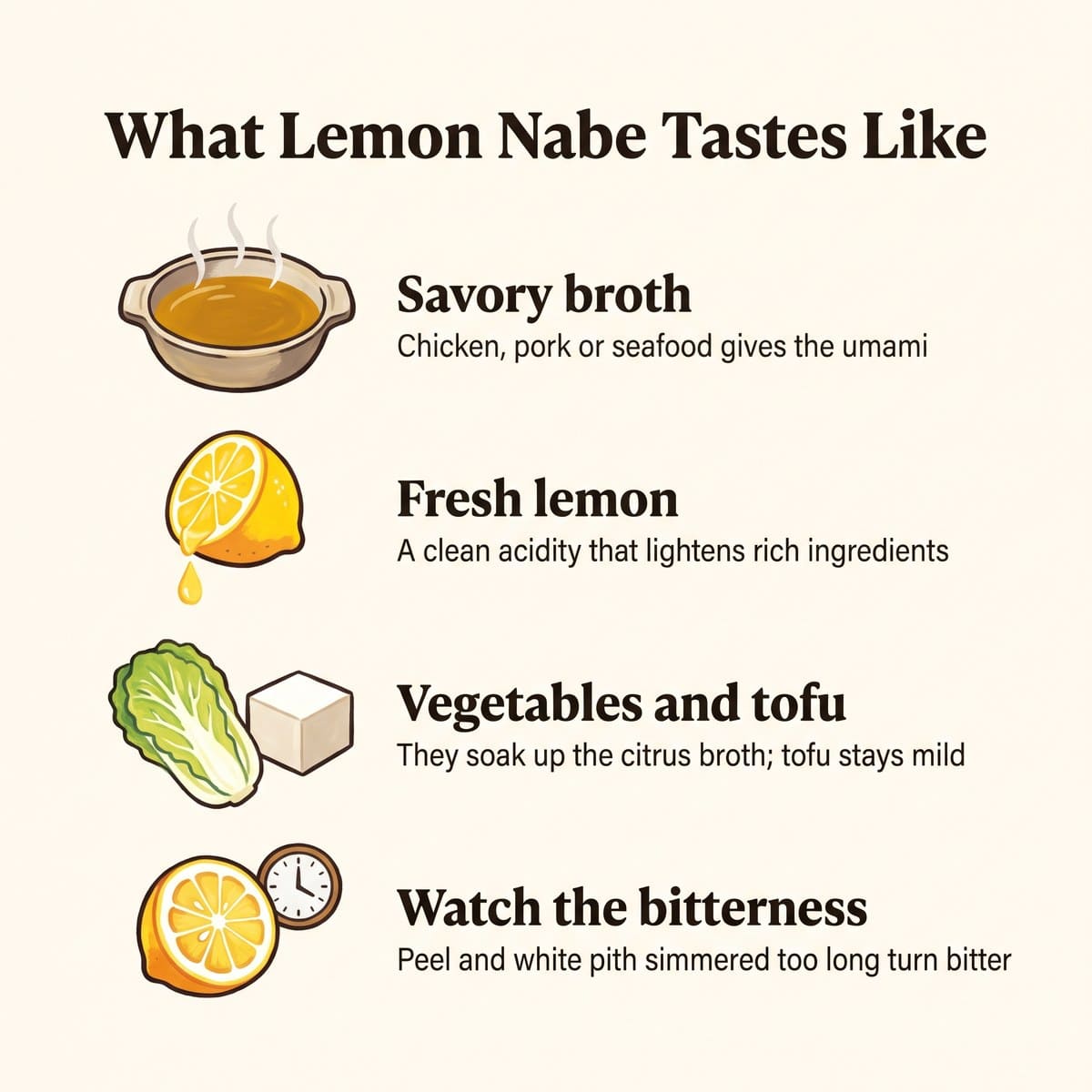
Lemon nabe tastes savory and aromatic rather than intensely sour. Chicken, pork or seafood supplies the main umami. Fresh lemon then adds a clean acidity that makes rich ingredients feel lighter. If the peel and white pith simmer too long, however, the broth can develop a noticeable bitter finish.
The first spoonful can feel a little surprising. Even so, the citrus cuts through fat from pork or chicken, so the pot never feels heavy. Meanwhile, vegetables soak up the citrusy broth, while tofu stays soft and mild. As a result, the finished broth is light enough to sip on its own. Its saltiness depends on the stock powder and how much it reduces.

Easy Lemon Nabe Recipe

This easy lemon nabe recipe uses a light salt and chicken stock broth, not miso. It is adapted from a recipe by Takara Shuzo, a Japanese sake and mirin maker. Overall, it serves two and takes about 30 minutes. Use a medium pot with plenty of room above the water, so the vegetables fit below the rim as they soften.
The key rule: cook the meat and vegetables first, then add the lemon slices only at the end. Long heating draws bitterness out of the white pith.
Salt Lemon Nabe
Ingredients
- Chicken thigh, 100 g
- Napa cabbage (Chinese cabbage), 150 g
- Mizuna, 80 g
- Firm tofu, 150 g
- Buna-shimeji mushrooms, 80 g
- Lemon, 1, sliced about 3 mm thick
Broth
- Cooking sake, 2 tbsp
- Hon mirin, 2 tbsp
- Chicken stock powder (gara soup), 2 tsp
- Salt, 1 tsp, then adjust to taste
- Water, 700 ml
Instructions
- Prepare. Wash the lemon well and slice it into thin rounds, removing the seeds. Cut the chicken and vegetables into bite-size pieces. Use a separate board and knife for raw chicken.
- Build the broth. Combine the sake, mirin, stock powder, salt and water in a pot. Heat over medium heat until it boils.
- Cook the chicken. Add the chicken and skim off any foam. Once the surface changes color, move on.
- Add vegetables. Add everything except the mizuna and lemon. Cover and simmer for about 5 minutes, or until the thickest piece of chicken reaches 75°C (167°F) at the center for at least one minute.
- Finish with lemon. Top with the mizuna and lemon slices, and serve.
Tips for Success
Quick Checks
- Check the chicken. Japan’s health ministry recommends 75°C (167°F) at the center for at least one minute. Color alone is not a reliable sign.
- Watch the salt. Stock powders vary in saltiness, so taste the broth before adding all the salt.
- Keep it gentle. After the first boil, hold the pot at a lively simmer so the broth stays clear.
Alcohol-Free Version
For an alcohol-free version, leave out the sake and mirin, and add a little more water to keep the volume. After the chicken and vegetables have cooked, taste the broth and add salt gradually. A small pinch of sugar can replace some of the mirin’s sweetness, but it is optional.
How to Prevent a Bitter Broth
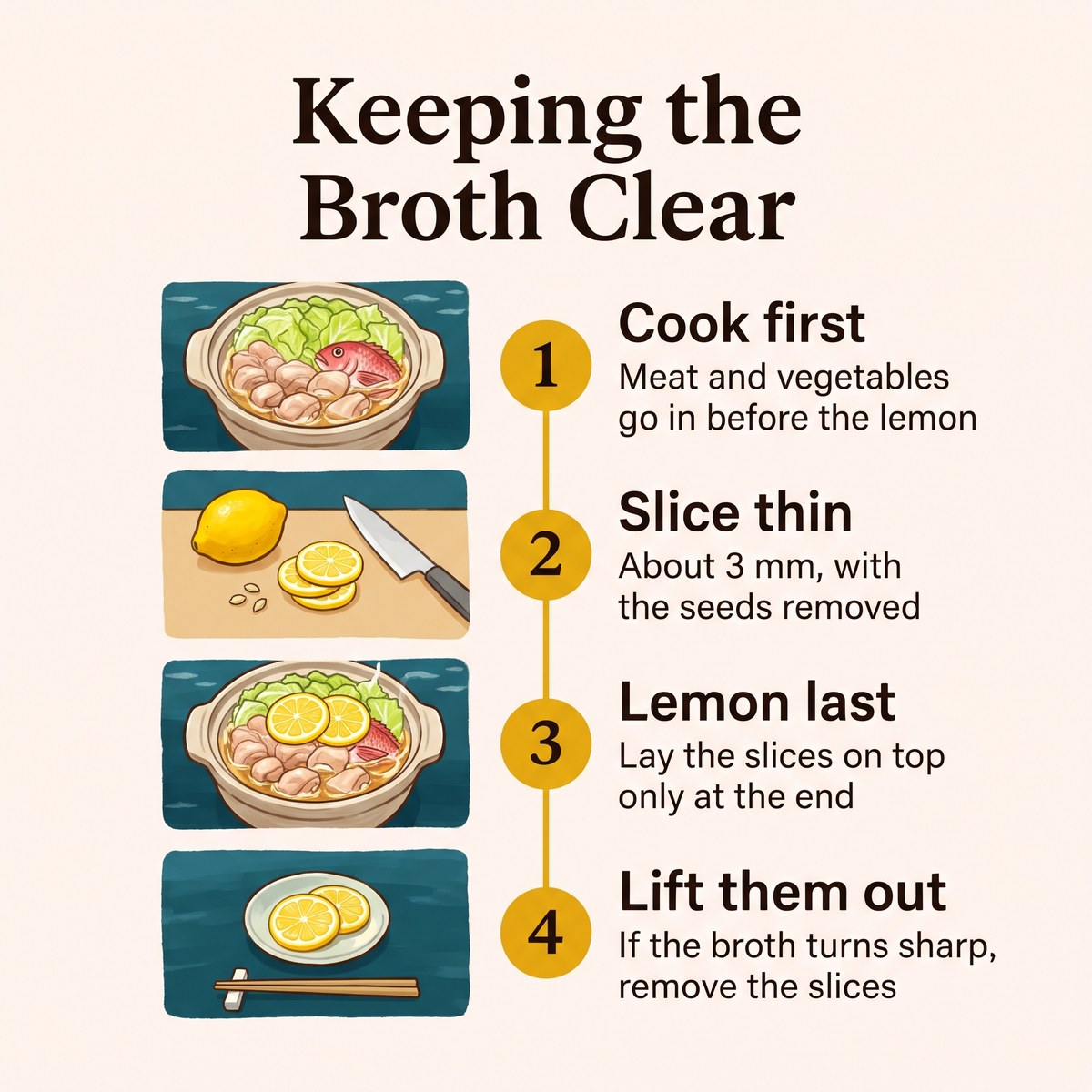
The original recipe explains that the white part inside the peel causes bitterness, and that overcooking draws it out. So lay the slices on top only when everything else is cooked. Enjoy the aroma for a few minutes, then lift the slices out if the broth turns sharp. Thin slices without seeds also help.
What If the Broth Is Already Bitter?
First, remove every lemon slice and seed right away. Next, dilute the broth with a little water or unsalted stock. Then rebalance it with salt or soy sauce. Sugar can mask bitterness, but it may make the broth taste oddly sweet, so try dilution first.
Can You Eat the Lemon Peel?
If you plan to eat or simmer the peel, choose lemons sold as suitable for whole-fruit use. Also check the label for any post-harvest fungicide. In Japan, sellers must show these, even on loose fruit. Then wash and scrub the fruit well before slicing. Do not assume that origin alone guarantees identical handling.
Why Is Lemon Nabe Associated with Hiroshima?
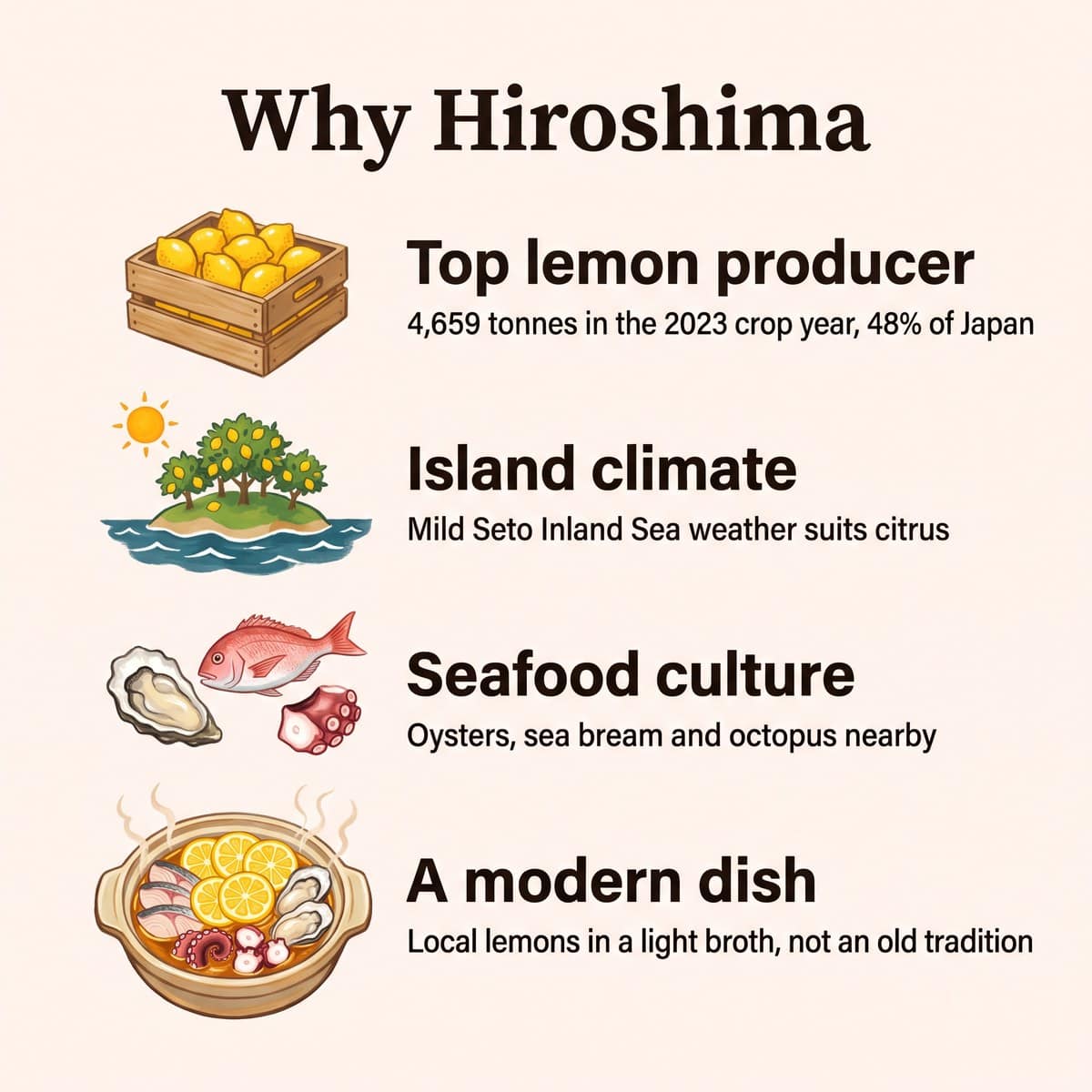
Lemon nabe is associated with Hiroshima because the prefecture is Japan’s largest lemon producer. Its Seto Inland Sea islands also have a mild climate suited to citrus farming. Even so, the dish is modern rather than an old regional tradition. Instead, it simply uses local lemons to complement chicken, pork and seafood in a light broth.
According to the prefecture, Hiroshima was Japan’s largest lemon-producing prefecture in the 2023 crop year. It produced 4,659 tonnes, or 48% of the national total. In addition, Hiroshima has a strong seafood culture, from oysters to sea bream and octopus. So a citrus hot pot with local seafood fits naturally into Hiroshima’s regional food culture.
Lemon Season and Availability
In practice, Hiroshima ships lemons almost all year. According to the prefecture, greenhouse lemons appear from July, and green lemons follow in autumn. Yellow lemons then run from around the end of the year into spring. That said, exact periods vary by producer and year. For lemon nabe, autumn and winter are the natural season, since that is when Japanese households turn to hot pots.
How Lemon Nabe Became Associated with Hiroshima
No single record proves who first made lemon nabe. Instead, its story has two threads. The first is Hiroshima’s long history of lemon growing. The second is a wave of promotions and restaurants that turned local lemons into hot pots in the 2010s.
- 1898
Hiroshima Prefecture traces its lemon growing to seedlings said to have been planted in Ocho Village, now part of Kure City.
- 1953
Hiroshima becomes Japan’s top prefecture for lemon-growing area.
- 2012
A documented promotion announces original hot-pot dishes made with Setouchi Hiroshima lemons at Tokyo restaurants from October 9.
- 2023
Hiroshima produces 48% of Japan’s lemons.
Lemons on the Seto Inland Sea Islands
The prefecture says the story began in 1898, when three lemon seedlings arrived mixed in with navel orange seedlings. Later, Ikuchijima, home to Setoda Town in Onomichi, became another major center. Local growers call its Tarumi area the birthplace of domestic lemons. However, other Hiroshima areas make similar claims, so treat it as one of several.
The 2012 Promotion
In October 2012, a Setouchi Hiroshima lemon PR office announced that several Tokyo restaurants would serve original lemon dishes from October 9. Notably, the launch matched that season’s first lemon shipment to Tokyo. This shows an early organized promotion, not necessarily the invention of lemon nabe.
A Restaurant Story from Setoda
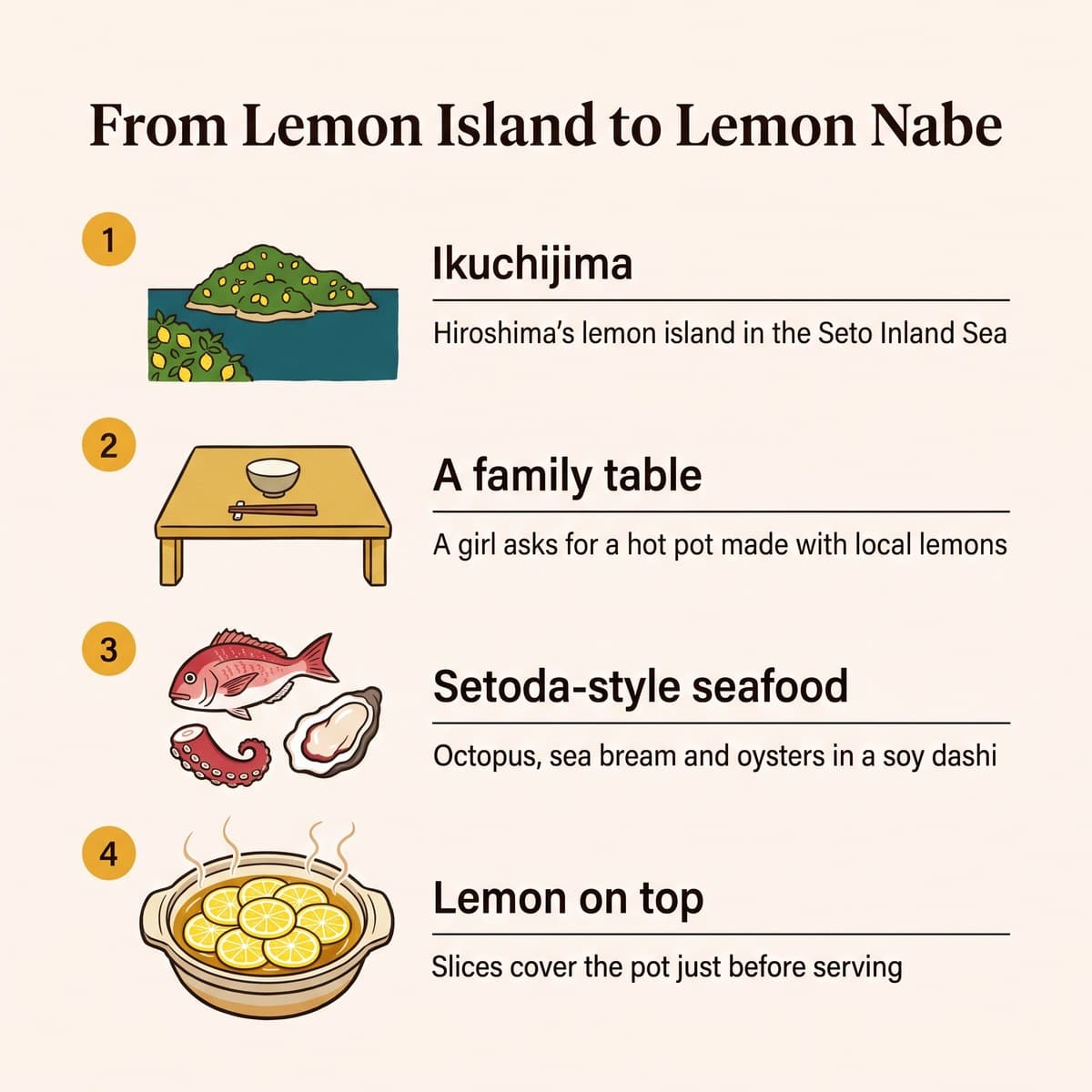
Separately, travel magazines have reported how one Setoda restaurant created its own version. According to those reports, third-generation chef Takashi Hashimoto of Chidori developed a seafood lemon nabe. A young girl had asked him for a hot pot made with local lemons. One report describes her as his daughter, and both say the dish took shape over about a year.
Lemon Nabe Ingredients and Variations
The best lemon nabe ingredients are simple: a protein, soft vegetables, tofu and fresh lemons. For example, most versions use sliced pork belly or bite-size chicken thigh. From there, you can lean toward seafood or keep it vegetarian.
Meat and protein
- Chicken thigh
- Thin pork belly
- Chicken or pork meatballs
- Tofu
Vegetables
- Napa cabbage (hakusai)
- Mizuna (Japanese mustard greens)
- Shimeji, shiitake or enoki
- Green onion, carrot, daikon
Seafood
- Oysters
- Sea bream (tai)
- Octopus
- Shrimp
Finishing
- Cooked rice for zosui
- Udon
- Ramen noodles
- Beaten egg
Choosing Meat and Seafood
Chicken thigh is the easiest choice, because it stays juicy in a light salt broth. By contrast, pork belly adds richness, and the lemon balances its fat well. Oysters, sea bream and octopus are locally evocative seafood choices from the Seto Inland Sea. If you love oysters, also read about Hiroshima oysters. Above all, cook oysters thoroughly, because undercooked shellfish can spread norovirus.
| Style | Broth | Main ingredients | Character |
|---|---|---|---|
| Salt and chicken | Salt, chicken stock, sake, mirin | Chicken, napa cabbage, tofu | Clean-tasting and easy; the recipe above |
| Seafood (Setoda style) | Bonito and kombu dashi with soy sauce | Octopus, sea bream, oysters, pork | Rich with seafood umami |
| Shio-koji | Shio-koji and lemon | Chicken or pork, vegetables | Gently sweet and mellow |
| Pork and cabbage | Salt and chicken stock | Pork belly, napa cabbage | Hearty yet citrusy |
| Vegetarian | Kombu and dried shiitake dashi | Tofu, mushrooms, cabbage | Brothy and mild |
Vegetarian Lemon Nabe
For a vegetarian version, skip the chicken stock and build umami from kombu and dried shiitake. However, watch for hidden animal ingredients. Bonito dashi comes from fish, and many dashi packs, mentsuyu and bottled hot pot bases contain fish or meat extracts. So check the label before using any of them.
Lemon Nabe vs Other Japanese Hot Pots
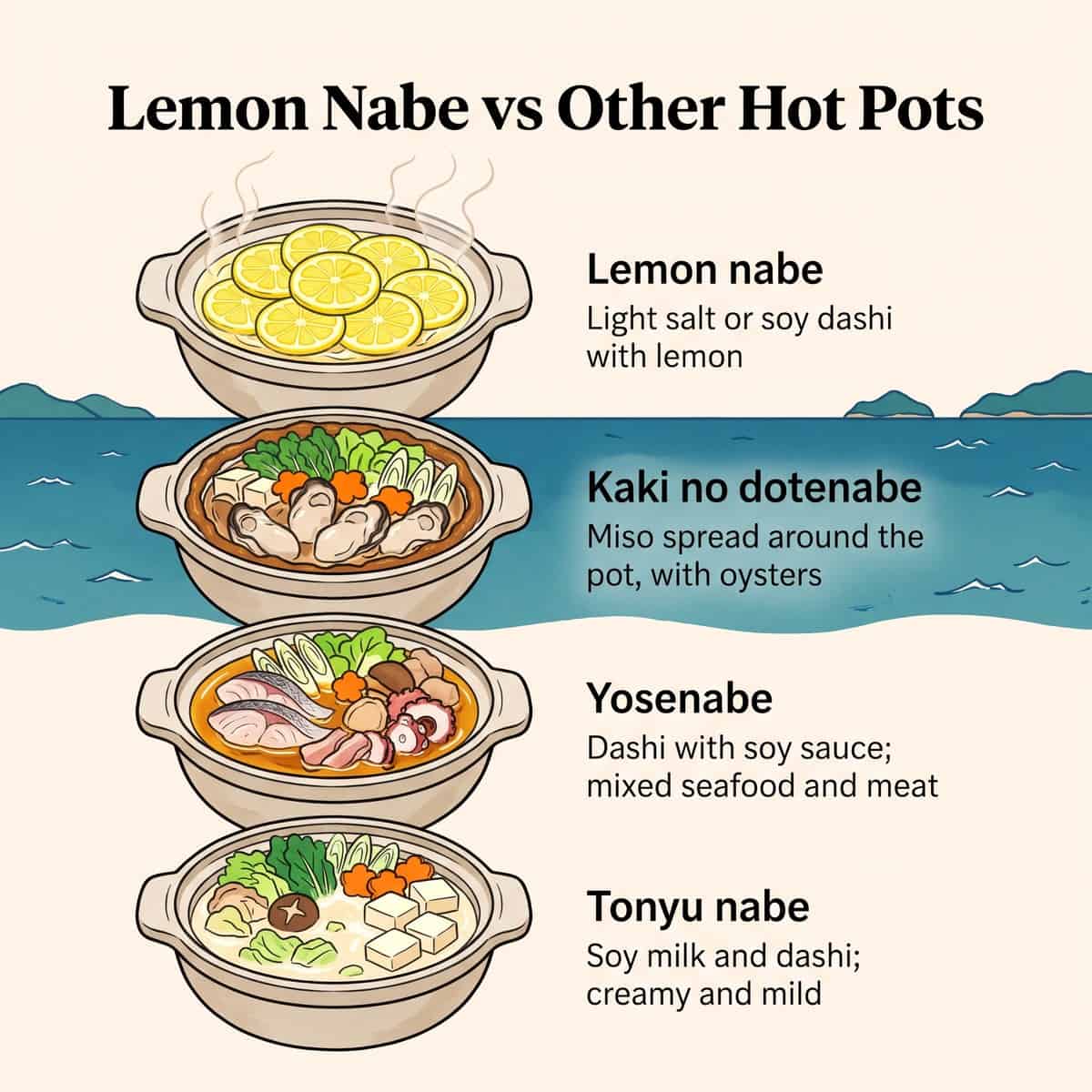
In short, lemon nabe differs from older hot pots mainly in its citrus finish and lighter broth. Here is how it compares with three familiar styles.
| Lemon nabe | Kaki no dotenabe | Yosenabe | Tonyu nabe | |
|---|---|---|---|---|
| Region | Hiroshima | Hiroshima | Nationwide | Nationwide |
| Broth | Light salt or soy dashi with lemon | Miso spread around the pot | Dashi with soy sauce | Soy milk and dashi |
| Main ingredients | Chicken, pork or seafood | Oysters | Mixed seafood and meat | Pork, chicken, vegetables |
| Taste | Savory, tart, aromatic | Rich, sweet-savory | Balanced, savory | Creamy, mild |
| Season | Autumn to winter | Winter | Autumn to winter | Autumn to winter |
How to Eat Lemon Nabe
Nabe is usually served in a communal pot at the table. Diners move cooked meat, tofu and vegetables into their own bowls, then add more ingredients as space opens up. Use serving chopsticks or a shared ladle, not chopsticks that have touched your mouth. For more table manners, see our guide to Japanese nabe etiquette.
The lemon slices can be eaten if they suit whole-fruit use. Still, many diners remove them once they have flavored the broth. Also, some people squeeze a little extra juice into their bowl.
Best Finishing Dishes
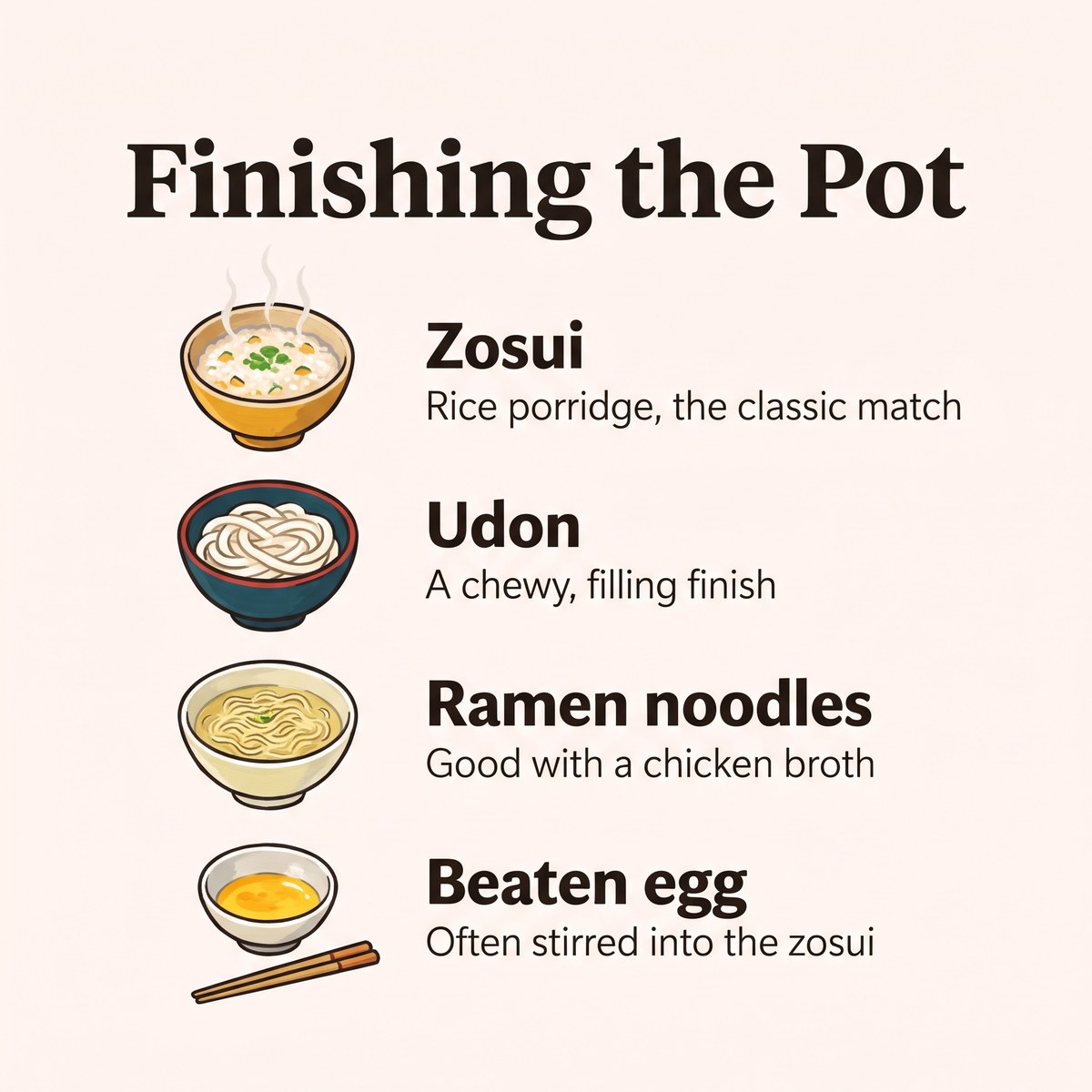
Like most Japanese hot pots, lemon nabe ends with a shime, a final dish cooked in the leftover broth. For example, rice porridge (zosui) is the classic match; the original recipe suggests a salt-lemon zosui. Alternatively, udon gives a chewy, filling finish. Ramen noodles also work well with a chicken broth.
Storing Leftover Broth
First, do not leave leftover nabe in the pot at room temperature. Instead, take out the lemon slices and move the rest to clean, shallow containers so it cools quickly. Then refrigerate it promptly. Japan’s agriculture ministry advises reheating soups to a full boil before serving. Finally, if the broth sat out too long, throw it away.
Where Can You Try Lemon Nabe in Hiroshima?
One of the most frequently documented places to try lemon nabe is Setoda on Ikuchijima, an island on the Shimanami Kaido route. There, Chidori serves a seafood version. Elsewhere in Hiroshima, however, availability changes by season, so check menus before you go.
Last fact-checked: October 24, 2026. Hours, prices and seasonal menus may change. Please contact the restaurant before visiting.
Chidori Shokudo (御食事処ちどり)

Chidori opened as a diner in 1965 in Setoda, Onomichi City. Its official site lists lemon nabe as a specialty, alongside octopus rice. The pot holds Seto Inland Sea octopus, sea bream and oysters, plus pork, in a soy-based dashi. According to travel reports, the cooks cover the pot with local lemon slices until the ingredients disappear.
- Address
- 530-2 Setoda, Setoda-cho, Onomichi City, Hiroshima 722-2411
- Phone
- 0845-27-0231
- Hours
- Weekdays 11:00–15:00; weekends and public holidays 11:00–16:00; dinner 18:00–21:00. Confirm when reserving, as hours may change.
- Closed
- Tuesdays
- Reservation
- Advance booking has been reported as required for lemon nabe. Confirm the current minimum order and booking conditions directly with the restaurant.
- Price
- Current price not confirmed. A February 2023 travel report listed ¥2,550 per person, but this historical price may no longer apply.
- Website
- Chidori official site
Setoda sits on Ikuchijima in the Seto Inland Sea. When planning a visit, check current ferry, bus and cycling routes along the Shimanami Kaido.
Buying Lemon Nabe Soup Base
If you can’t reach Setoda, you can still taste a local version at home. Yoshino Miso in Kure makes Hiroshima Lemon Nabe, a five-times-concentrated soup base made with Hiroshima lemons and shio-koji. As of Hiroshima City’s March 2026 update, the 180 g bottle was listed at ¥432, with year-round availability. However, prices and stock may change.
Final Thoughts
Lemon nabe is a modern hot pot associated with Hiroshima that pairs a savory broth with fresh citrus. It is young as Japanese dishes go, yet it shows off the prefecture’s lemons and seafood well. The one rule to remember is to add the lemon last. Then try the recipe at home, compare it with kaki no dotenabe, or plan a stop in Setoda.
This article was checked against information from Hiroshima Prefecture, Hiroshima City, Japan’s agriculture and health ministries, the recipe maker and the restaurant’s official website.
Lemon Nabe FAQ
About the Dish
- Is lemon nabe a traditional Hiroshima dish?
-
It is better described as a modern hot pot associated with Hiroshima’s lemon industry. Hiroshima’s lemon growing dates to the late 19th century. By contrast, documented restaurant promotion of lemon hot pots appeared in the 2010s.
- Does lemon nabe taste sour?
-
It tastes gently tart rather than sharply sour. The savory broth comes first, and the lemon adds a fresh finish. You can control the sourness with how long the slices stay in the pot.
- Does lemon nabe use miso?
-
Usually not. Most versions use a light salt and chicken stock or a soy sauce dashi, and one Hiroshima product uses shio-koji. For a miso hot pot from Hiroshima, try kaki no dotenabe instead.
- Can I make vegetarian lemon nabe?
-
Yes. Build the broth from kombu and dried shiitake, then add tofu, mushrooms and napa cabbage. Check labels on dashi packs and bottled bases, since many contain fish or meat extracts.
Lemons and Cooking
- Does lemon nabe need Hiroshima lemons?
-
No. Hiroshima lemons give the dish its strongest regional identity, but other fresh lemons work too. If you plan to simmer and eat the peel, choose fruit labeled suitable for whole-fruit use. Wash it well and remove stickers and seeds.
- Can I use bottled lemon juice?
-
Bottled juice can adjust acidity, but it will not give the fresh peel aroma or the look of sliced lemon. Add it gradually at the end, because brands vary in acidity and some contain other ingredients.
- How do I fix bitter lemon nabe?
-
Remove all lemon slices and seeds, then dilute the broth with a little water or unsalted stock. Next time, slice the lemon thinly and add it only at the end.
- What should I add at the end of the meal?
-
Rice porridge (zosui) is the classic finish, often with a beaten egg. Udon and ramen noodles also work well.
- Is lemon nabe a balanced meal?
-
It can be, because it combines protein, tofu and plenty of vegetables. For reference, the original Takara recipe lists about 233 kcal and 2.1 g of salt per serving. To eat less salt, leave some broth in the pot.
References
- Hiroshima Prefecture (Hiroshima Climate Change Adaptation Center) – Expansion of Lemon Cultivation (レモン栽培の拡大) (Accessed October 2026)
- Hiroshima Prefecture – What Are Setouchi Hiroshima Lemons? (瀬戸内 広島レモンとは) (Accessed October 2026)
- Ministry of Agriculture, Forestry and Fisheries – Specialty Fruit Production Survey (特産果樹生産動態等調査) (Accessed October 2026)
- PR TIMES (Setouchi Hiroshima Lemon PR Office) – Lemon Nabe Launch Announcement, October 9, 2012 (Accessed October 2026)
- Takara Shuzo – Easy Salt Lemon Hot Pot Recipe (うま塩レモン鍋) (Accessed October 2026)
- Hiroshima City – The Hiroshima Brand: Hiroshima Lemon Nabe (広島れもん鍋) (Accessed October 2026)
- Ministry of Agriculture, Forestry and Fisheries – Our Regional Cuisines: Hiroshima Prefecture (Accessed October 2026)
- Ministry of Agriculture, Forestry and Fisheries – Our Regional Cuisines: Kaki no Dotenabe (Accessed October 2026)
- Ministry of Health, Labour and Welfare – Preventing Campylobacter Food Poisoning (Q&A) (Accessed October 2026)
- Ministry of Health, Labour and Welfare – Norovirus Q&A (Accessed October 2026)
- Tokyo Metropolitan Government Bureau of Public Health – Fungicides Used on Fruit (防かび剤又は防ばい剤) (Accessed October 2026)
- MAFF Kinki Regional Agricultural Administration Office – Handling Leftover Food Safely (Accessed October 2026)
- Tabiyomi (Yomiuri Travel) – Setoda Lemon Nabe at Chidori (February 2023) (Accessed October 2026)
- JB Honshi Kosoku (Seto Mare) – Seto Mare Vol. 59 (Winter 2024) (Accessed October 2026)
- JA Hiroshima – Setoda Lemons (Accessed October 2026)
- Chidori Shokudo – Official Website (Accessed October 2026)
Related Articles
- Kaki no Dotenabe: Hiroshima Oyster Hot Pot (Surveyed: October 2026)
- Hiroshima Kaki (広島かき) (Surveyed: October 2026)
- Hiroshima’s Food Culture (Surveyed: October 2026)
- Japanese Hot Pot (Surveyed: October 2026)
- A Complete Guide to Japanese Nabe Pot Etiquette (Surveyed: October 2026)




Comments