





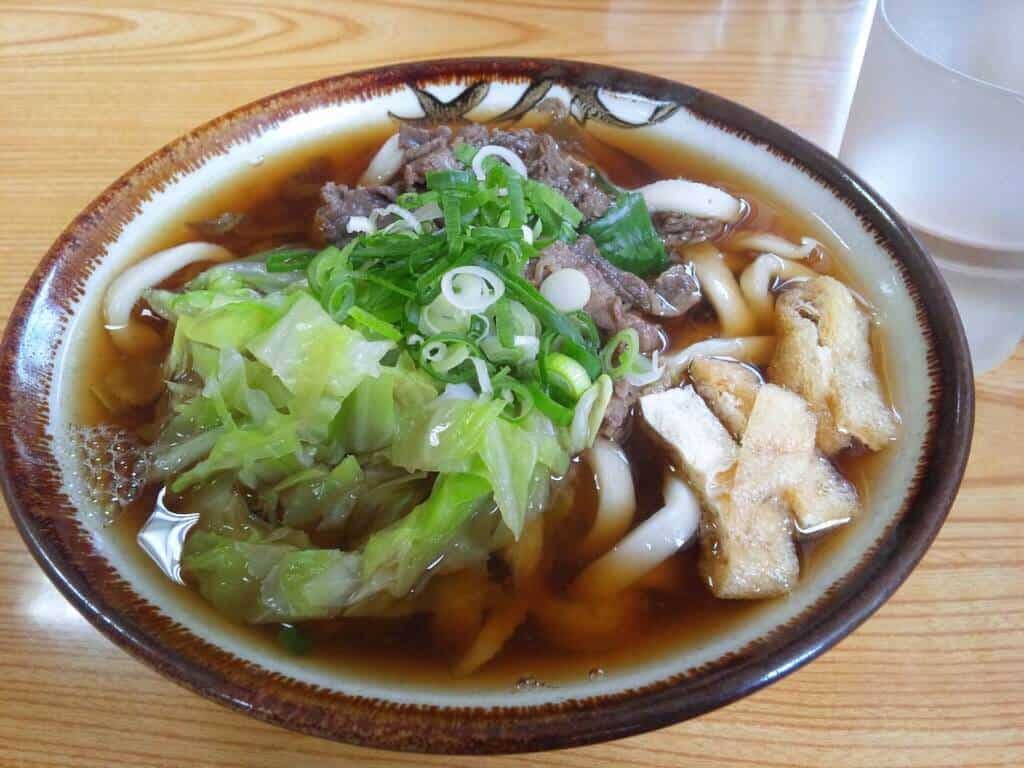
Yoshida Udon is a regional udon from Fujiyoshida in Yamanashi Prefecture. The dish is known for its extremely firm noodles, miso and soy sauce broth, boiled cabbage, and a chili condiment called suridane. Locals in this city at the foot of Mt. Fuji treat it as their soul food.
Over 60 shops serve it across Fujiyoshida, and each bowl has its own personality. This guide covers the taste, history, ingredients, a home recipe, and the best restaurants to try. Fair warning: the noodles are harder than any udon you have met before.
What Is Yoshida Udon? Fujiyoshida’s Signature Thick Noodles
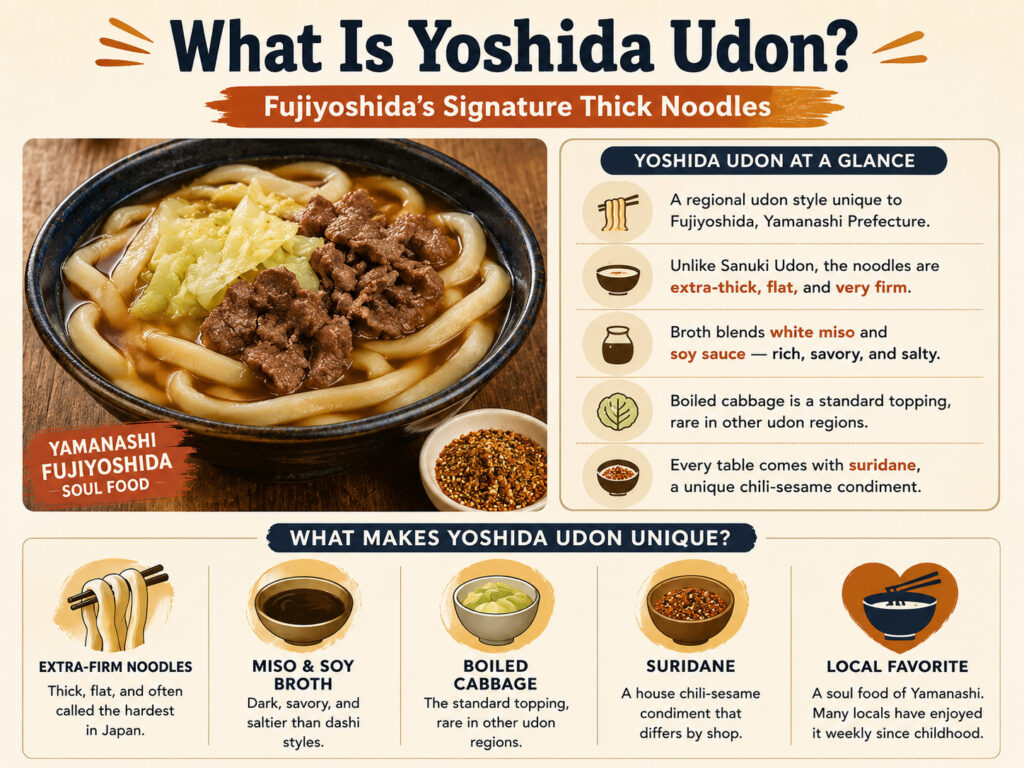
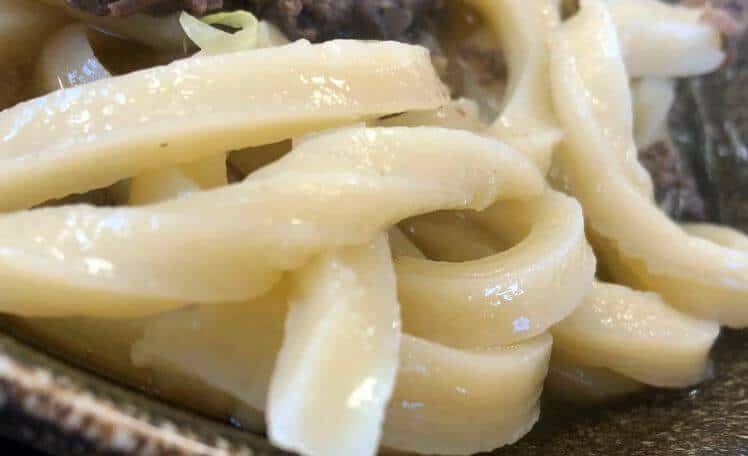
Yoshida Udon is a regional udon style unique to Fujiyoshida, Yamanashi Prefecture. Unlike the smooth, elastic noodles of Sanuki Udon (讃岐うどん) from Kagawa, the noodles here are extra-thick, flat, and noticeably firm. Locals call it “hard udon,” and that description fits immediately. Most visitors immediately notice the noodles’ remarkable firmness and chewiness.
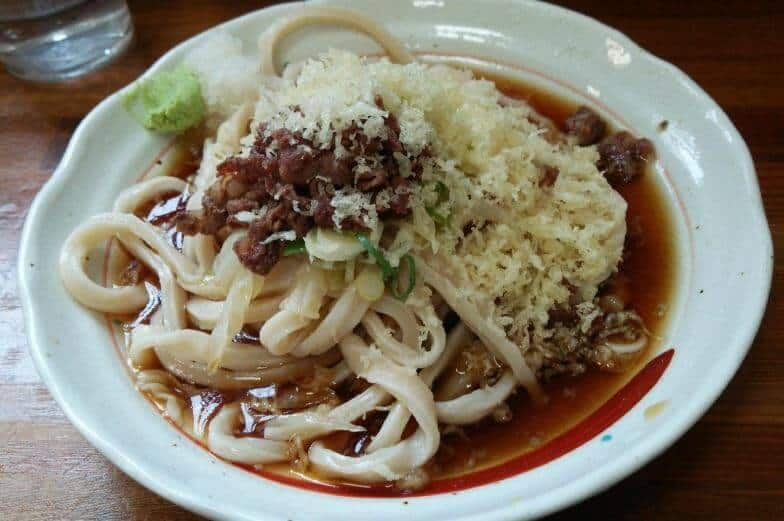
The broth blends white miso and soy sauce. This creates a richer and saltier taste than many dashi-based udon soups. Boiled cabbage is practically a constant, and traditional bowls use horse meat as the main protein. Every table also comes with suridane on the side, and that condiment matters more than it might appear.
What Makes Yoshida Udon Unique?
- Extra-firm noodles: thick, flat, and often called the hardest in Japan.
- Miso and soy sauce broth: dark, savory, and saltier than dashi styles.
- Boiled cabbage: the standard topping, rare in other udon regions.
- Suridane: a house chili-sesame condiment that differs from shop to shop.
Together, these ingredients create the distinctive flavour that defines Yoshida Udon. Locals consider it a soul food of Yamanashi Prefecture, and many have eaten it weekly since childhood.
What Does Yoshida Udon Taste Like?
The first bite demands actual chewing. The noodles push back against your teeth, dense and wheaty, closer to fresh pasta than to soft udon. Some visitors need a bowl or two to adjust. I will admit the firmness startled me at first, and then it became the whole point.
The broth tastes salty-sweet and deeply savory, with miso richness under the soy. Sweet cabbage and rich horse meat round out each spoonful. Then comes suridane, which adds heat, sesame aroma, and a slow burn. One bowl covers a surprising range of flavors.
History of Yoshida Udon in Yamanashi Prefecture
Edo Period: Wheat Country at the Foot of Mt. Fuji
The story starts with geography. The northern foothills of Mt. Fuji have cool temperatures and volcanic soil, so rice cultivation was difficult. Farmers relied on wheat and barley instead, and flour-based foods became everyday meals. Pilgrims climbing Mt. Fuji also bought udon from vendors near the mountain entrance. That trade helped the dish gain recognition beyond the local community.
Meiji to Showa: The Textile Industry Shapes the Noodles
Fujiyoshida’s other major industry was silk weaving. Women ran the looms, and their hands had to stay smooth to handle delicate silk threads. Because of this, the men who handled sales and peddling prepared lunch instead, an unusual arrangement for the era. They chose udon because it was simple to cook and kept workers full through the afternoon. Strong arms kneaded the dough hard, and that force created noodles now called the hardest in Japan. Over generations, a softer noodle simply felt inadequate.
Postwar to Today: From Home Kitchens to 60 Shops
After the textile industry declined, many families turned their kneading skills into small businesses. Front rooms of private homes became udon shops, often run by retired couples. The city now counts more than 60 of them, and the local government promotes “Yoshida no Udon” as a tourism asset. The firmness is therefore not an accident. It is a direct record of the community’s labor history.
A Soul Food for Fujiyoshida Locals
Yoshida Udon holds a place in local life that goes beyond lunch. The long, white noodles are treated as a symbol of longevity and lasting happiness. For that reason, families have served them at Bon, New Year, and wedding celebrations for generations. In 2007, Japan’s agriculture ministry selected the dish among its 100 great rural regional cuisines. The habit remains strong today. Many residents eat it several times a week, and heated debates over the best shop are common. For another Yamanashi heritage dish with a similar community story, see Seida no Tamaji.
Ingredients of Yoshida Udon
The ingredient list is short, and that is the point. Each element does one clear job in the bowl.
| Ingredient | Role in the bowl |
|---|---|
| Strong wheat flour | High-gluten flour builds the firm, chewy noodles |
| Water and salt | A low water ratio keeps the dough stiff |
| Miso and soy sauce | The double seasoning makes the broth dark and savory |
| Dashi stock | Usually niboshi or kombu based, under the miso |
| Boiled cabbage | Adds sweetness and a soft contrast to the noodles |
| Horse meat | The traditional protein, simmered until tender |
| Suridane | Chili-sesame condiment for adjusting the flavor |
Popular Toppings Beyond Horse Meat
Horse meat is traditional, but far from mandatory. Chikuwa fish cake slices are a common sight, and so is wakame seaweed. Some shops add a soft-boiled egg, kakiage fritters, or thin fried tofu. Tempura toppings cost a little extra and pair well with the salty broth. In short, you can build a bowl with no horse meat at all.
What Is Suridane?
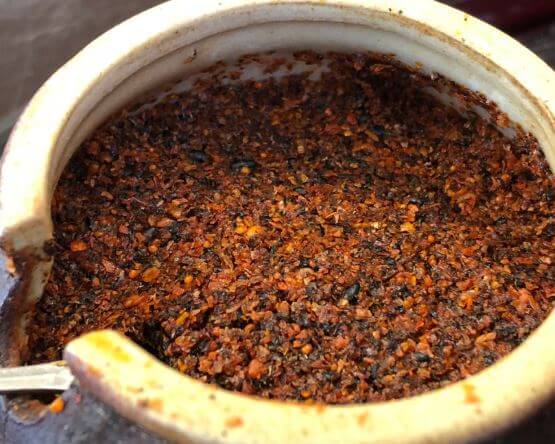
Suridane (すりだね) is a house-made chili condiment served with every bowl of Yoshida Udon. The base is usually chili pepper, sesame seeds, and oil, ground together into a coarse paste. Beyond that, recipes split apart. Some shops add sansho pepper for a numbing note. Others work in dried fish flakes, garlic, or extra toasted sesame.
No two shops make it the same way, and most keep the exact blend private. Regulars often judge a restaurant by its suridane before anything else. Trying several versions across town is part of the fun. Jars of it also make a good souvenir, when available.
Popular Types of Yoshida Udon
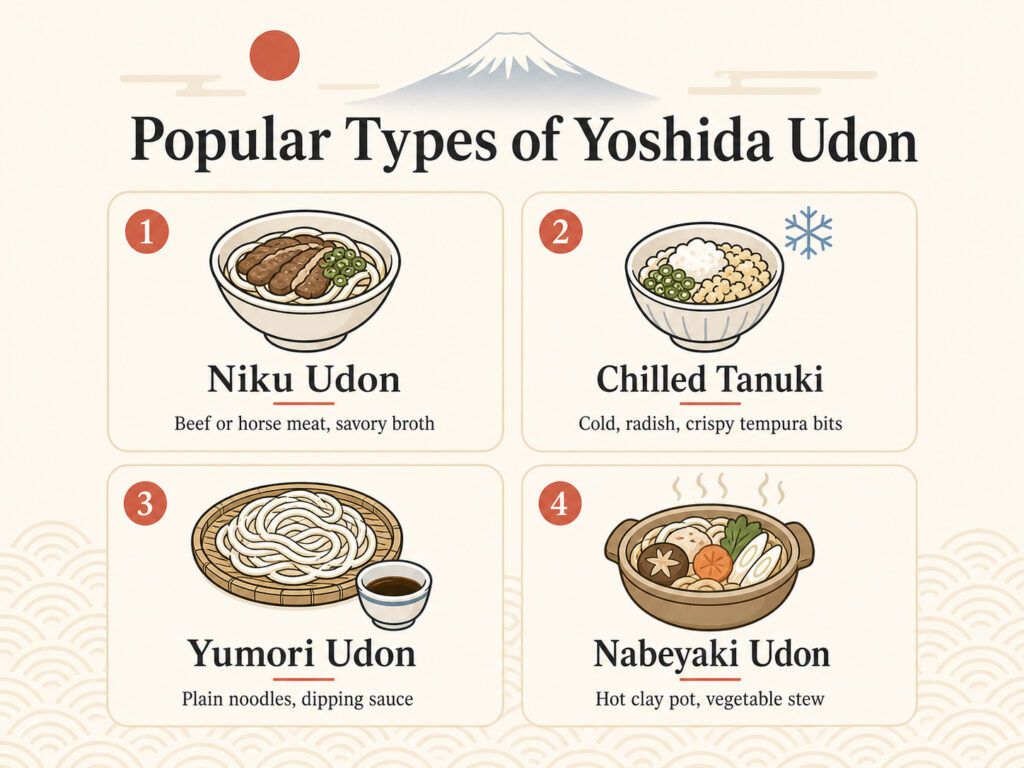
Fujiyoshida has over 60 udon shops, and each runs its own style. That said, several variations appear consistently across menus. Here are the main types to know before you visit.
- Niku Udon (肉うどん): the most traditional option, topped with simmered horse meat. The slightly gamey flavor suits the miso-soy broth. A good starting point for first-timers.
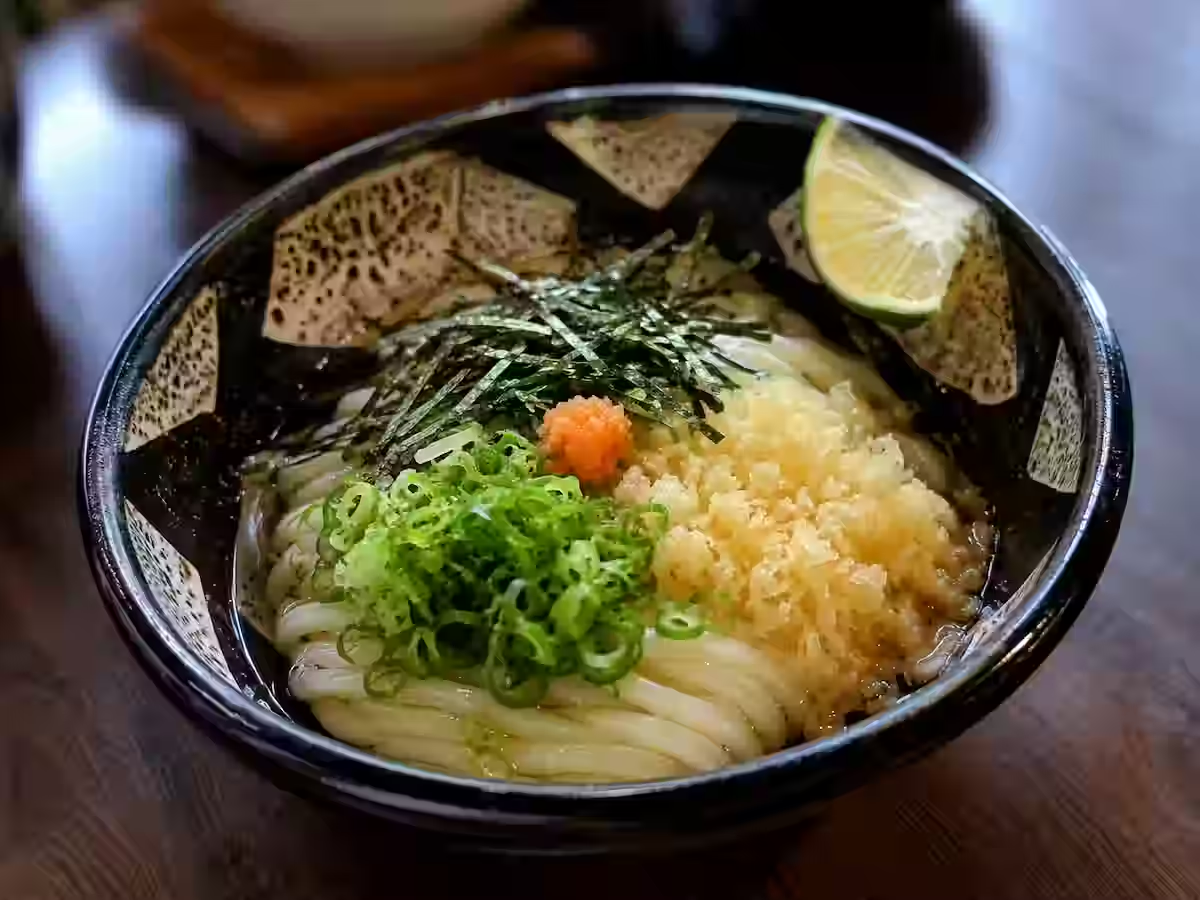
- Chilled Tanuki Udon (冷やしたぬきうどん): served cold with grated daikon and crispy tenkasu. It shows the noodle texture most clearly. See our tanuki udon guide for the wider style.
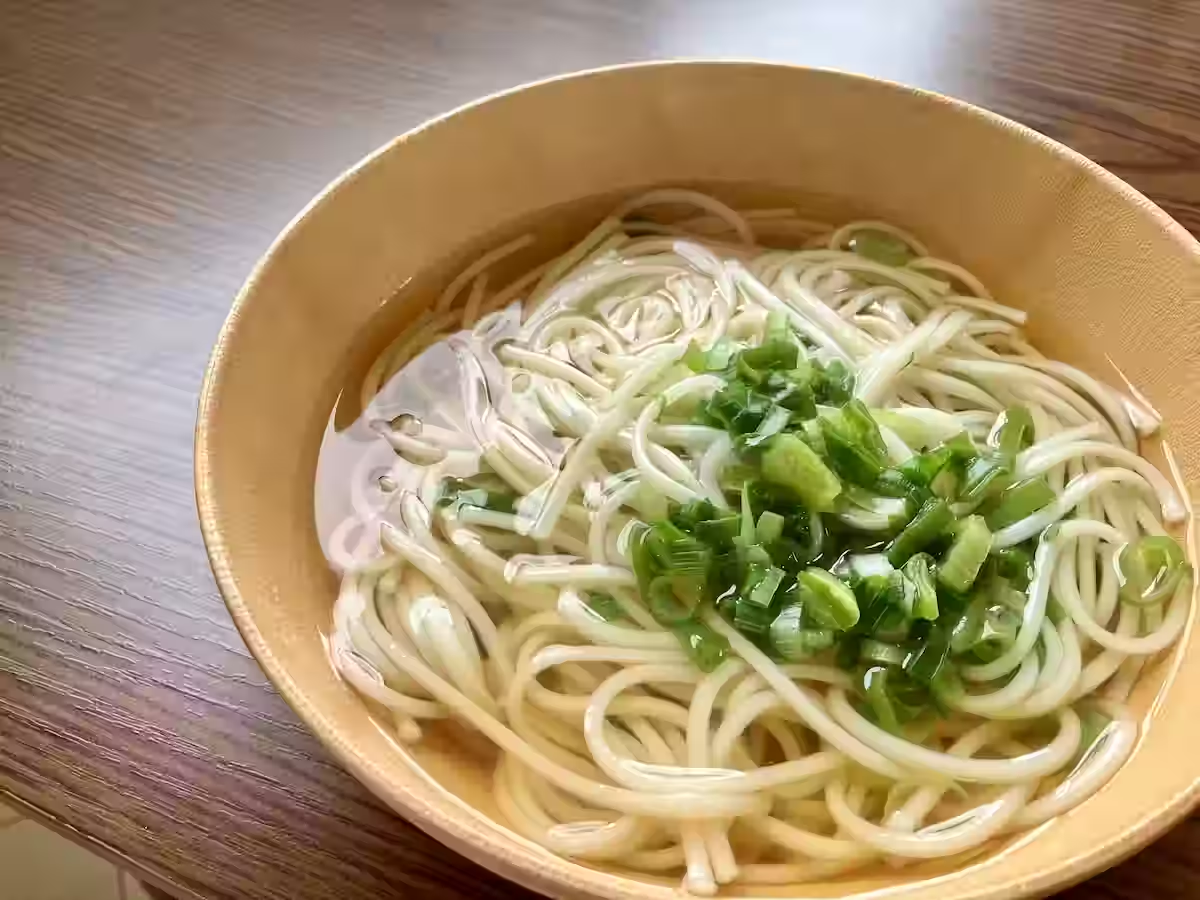
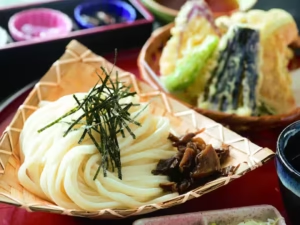
- Yumori Udon (湯もりうどん): plain noodles in their cooking water, with dipping sauce on the side. The style began as hospitality for Mt. Fuji pilgrims, who ate the white noodles to purify the body before climbing.
- Nabeyaki Udon (鍋焼きうどん): a small clay pot with hot vegetable stew. A warming choice for autumn and winter visits near Mt. Fuji.
How to Eat Yoshida Udon (Like Locals Do)
There is a rhythm to a proper bowl, and suridane sits at the center of it. Follow these three steps.
- Eat it plain first. Take two or three bites without any additions. This gives you a clear sense of the broth and the noodle quality.
- Add a small spoonful of suridane. Stir it in and taste the shift. The chili heat and toasted sesame change the character of the broth entirely.
- Adjust as you go. Add more suridane in stages through the bowl. Many locals finish with a spicier soup than they started with.
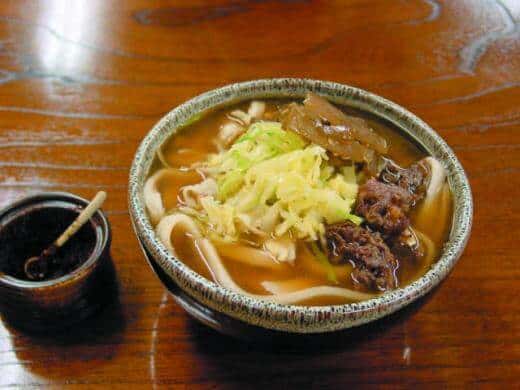
Broth quantity also varies between shops. Some pour generously, while others use just enough to coat the noodles. Neither approach is more authentic. If you prefer a soupier bowl, asking is perfectly acceptable.
How to Order: A Quick Guide for Visitors
Ordering is simple once you know the pattern. Many shops use a ticket vending machine near the entrance, so buy your ticket first and hand it to the staff. Menus are usually Japanese-only, but pointing at a photo works fine. Bring cash, since cards are rarely accepted. Seats are often shared tables, and finishing within 30 minutes or so is polite at busy shops. Finally, arrive before noon. Most places sell out early.
How Is Yoshida Udon Different from Sanuki Udon?
Yoshida Udon occupies a distinct position within Japanese noodle culture. Sanuki Udon from Kagawa uses a clear dashi broth and smooth, elastic noodles. Yoshida Udon goes the opposite way, with maximum firmness and a dark, miso-forward flavor. Meanwhile, Houtou (ほうとう) from the same Yamanashi Prefecture cooks wide flat noodles directly in miso soup until soft. The three sit at different points of the same spectrum.
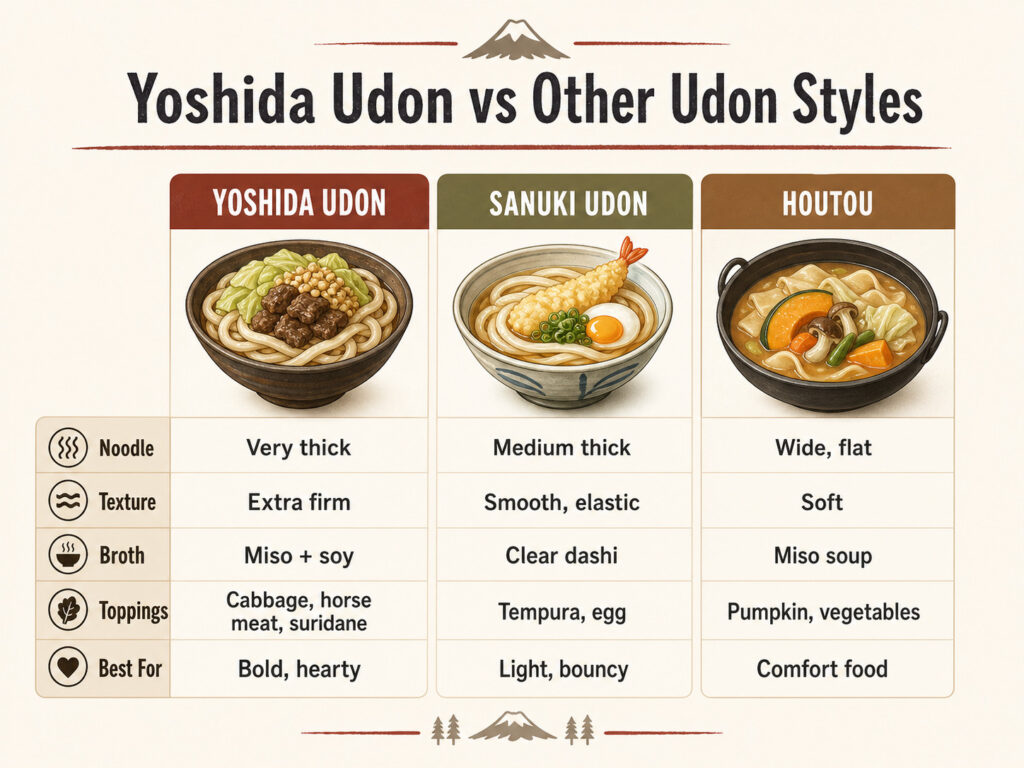
| Category | Yoshida Udon (吉田うどん) | Sanuki Udon (讃岐うどん) | Houtou (ほうとう) |
| Noodle thickness | Very thick, flat/square | Medium thick, round | Very wide, flat and irregular |
| Texture | Extra-firm, very chewy | Smooth, elastic, bouncy | Soft (cooked directly in broth) |
| Broth / Base | Miso + soy sauce | Clear dashi (light) | Miso soup |
| Key toppings | Cabbage, horse meat, suridane | Tempura, raw egg | Pumpkin, root vegetables |
| Region | Fujiyoshida, Yamanashi | Kagawa Prefecture | Yamanashi Prefecture |
| Best for | Bold, hearty flavour seekers | Light, delicate texture lovers | Vegetable-rich comfort food |
For an even wider view, Inaniwa Udon (稲庭うどん) from Akita takes yet another path, with thin, silky hand-stretched noodles. Comparing them all makes each style easier to appreciate.
Average Price of Yoshida Udon
Yoshida Udon remains one of Japan’s best noodle bargains. A regular bowl (nami) costs about 500 to 800 yen. A large size (omori) usually adds 100 to 150 yen, and extra-large options exist at some shops. Toppings like tempura or extra meat add 100 to 200 yen each. Even a large bowl with toppings rarely passes 1,000 yen. Portions are generous, so the regular size satisfies most visitors.
Yoshida Udon Recipe (Home-Style)
Making Yoshida Udon at home is possible, though the firmness takes practice. The keys are kneading the dough hard and not overcooking the noodles. This recipe makes two servings in about one hour, including resting time.
Ingredients
For the noodles: Strong wheat flour (強力粉) 200g / Salt 4g / Cold water 90ml
For the broth: Dashi stock 600ml / White miso 2 tbsp / Soy sauce 1 tbsp
Toppings: Cabbage 100g (sliced thin) / Thinly sliced beef or pork (as a substitute for horse meat)
Suridane substitute: Toasted sesame seeds 1 tbsp / Shichimi (七味) 1 tsp / Sesame oil 1 tsp
Method
Combine flour and salt in a bowl. Add cold water gradually and mix until a rough dough forms. Knead firmly for 10 to 15 minutes, until the dough feels stiff rather than soft. This strong kneading gives Yoshida Udon its signature firmness. Wrap and rest for 30 minutes at room temperature.
Roll the rested dough to about 4mm thickness. Cut into wide strips, roughly 5 to 6mm across. Thicker and wider than standard udon is the goal. Dust lightly with flour to prevent sticking.
Bring dashi stock to a gentle simmer. Dissolve white miso and soy sauce into it, then taste for balance. In a separate pot, blanch the sliced cabbage for 2 minutes. Cook the meat in a lightly oiled pan until just done.
Boil the noodles in unsalted water for 10 to 13 minutes. They should stay firm with a clear bite. Drain and rinse briefly. Unlike standard udon, do not rinse too thoroughly, since some surface starch helps the broth cling.
Mix toasted sesame, shichimi, and sesame oil in a small bowl. Place the noodles in bowls, ladle broth over, and top with cabbage and meat. Serve the suridane substitute on the side. Add it gradually as you eat.
Can You Buy Yoshida Udon to Take Home?
Yes, and it makes an easy souvenir. Packaged noodle sets, both dried and semi-fresh, are sold at the Q-Sta building by Fujisan Station, local supermarkets, and roadside stations around the Fuji Five Lakes. Most sets include the miso-soy soup base, so you only add cabbage and meat. Several local makers also ship nationwide through their online shops. Jars of suridane appear in the same shops, though small makers sell out quickly. If you enjoy Yamanashi souvenirs, the famous Shingen Mochi pairs well as a sweet to carry home.
Where Can You Eat Yoshida Udon? Best Restaurants in Fujiyoshida
Most Yoshida Udon shops are small, family-run, and open only for lunch. Many operate out of a converted room in a private home, and that informality is part of the experience. Here are four reliable options.
Kurechi Udon (くれちうどん)
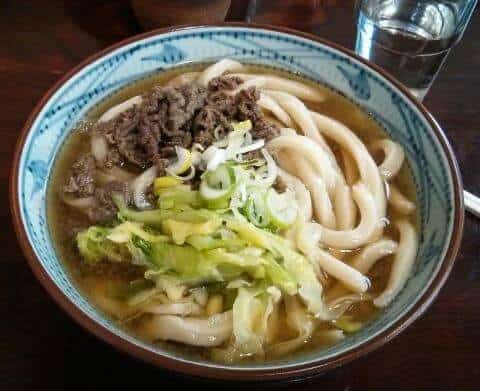
For the most traditional bowl in the city, Kurechi is a strong first choice. Miso-soy broth, horse meat, boiled cabbage, and suridane arrive exactly as the style intends. The taste is old-fashioned in the best sense. Reviews consistently praise both quality and price, and many locals treat it as the benchmark.
Sky Blue
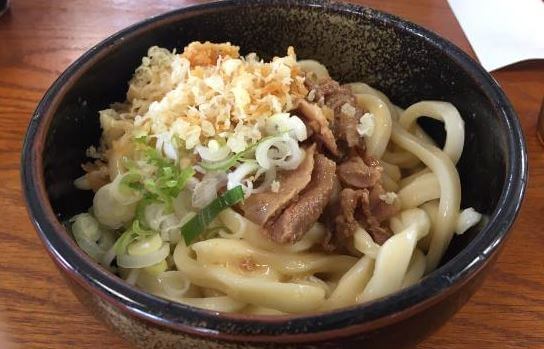
Technically in Minamitsuru-gun rather than Fujiyoshida proper, Sky Blue is still deep in Mt. Fuji country. The spacious interior seats 46 people, which makes it one of the more comfortable spots in the area. Both warm and chilled udon are on the menu. For visitors combining udon with a Fuji Five Lakes day, it works well as a lunch stop.
Togawa (とがわ)
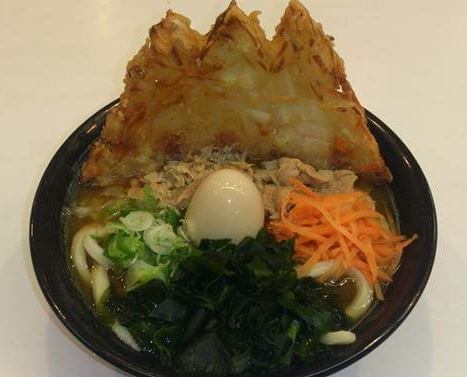
Togawa sits inside the Q-Sta shopping center at Fujisan Station, so it is the easiest stop for train travelers. Extended hours, 10am to 8pm, also set it apart from lunch-only rivals. The signature “Mt. Fuji Udon” features a mountain-shaped tempura, a seasoned soft-boiled egg, and the standard thick noodles. It is a fun presentation and a practical afternoon option.
Miyaki (みやき)
Miyaki is consistently rated the top udon restaurant in Fujiyoshida, and the reputation is well established. Order in whatever style you prefer and add suridane to taste. No English menu exists, but showing a photo works reliably. Expect a wait at peak lunch hours, since seats fill fast. Cash only, and lunch hours only.
How to Reach Fujiyoshida for Udon
Fujiyoshida sits in the northern foothills of Mt. Fuji, roughly 100km west of central Tokyo. From Shinjuku Station, direct trains on the Fujikyuko Line reach Fujisan Station in about two hours. Most recommended shops are a short taxi or bus ride from there. Togawa, inside the station-adjacent Q-Sta building, is the easiest first stop if you arrive hungry. Many visitors pair an udon lunch with an afternoon at the Fuji Five Lakes, only minutes away by car or bus. The area rewards a full day.
Conclusion
Yoshida Udon is not just a noodle dish. It is a record of the geography, labor, and food culture of the Mt. Fuji foothills. The extra-firm noodles, the miso-soy broth, and the first spoonful of suridane all make more sense once you know how the dish came to be. If you plan a Mt. Fuji trip, add a lunch stop in Fujiyoshida. Try one shop, then maybe two. The differences between bowls are part of what makes the experience worthwhile.
Curious about other regional noodle dishes from Japan? Read our guides to Houtou (ほうとう) from Yamanashi, Sanuki Udon (讃岐うどん) from Kagawa, and Inaniwa Udon (稲庭うどん) from Akita for a broader picture of Japan’s udon culture.
Yoshida Udon FAQ
What is suridane?
Suridane is a house-made chili condiment served beside every bowl. Shops grind chili pepper, sesame, and oil into a coarse paste, sometimes adding sansho or garlic. Each restaurant guards its own blend. Locals often judge a shop by its suridane first.
Why are Yoshida Udon noodles so hard?
The firmness comes from the area’s silk-weaving history. Men kneaded the dough forcefully at home while women worked the looms. That strong kneading produced extra-firm noodles, and locals came to prefer the texture. Shops now maintain it deliberately.
Is Yoshida Udon spicy?
The broth itself is not spicy. The heat lives in suridane, which arrives separately, so you control the level completely. Some shops blend it mild while others make it fiery. Skipping it entirely is fine too.
Is horse meat mandatory?
No. Horse meat is traditional in niku udon, but many shops offer pork, chicken, chikuwa, or tempura instead. Chilled tanuki and yumori styles contain no meat at all. Pointing at another menu photo solves it easily.
Can vegetarians eat Yoshida Udon?
It is difficult at most shops. The broth usually contains fish-based dashi, and sometimes meat stock. Meat-free toppings exist, but a fully vegetarian broth is rare. Travelers with strict diets should confirm with staff before ordering.
How much does a bowl cost?
A regular bowl runs about 500 to 800 yen. Large sizes add roughly 100 to 150 yen, and toppings cost 100 to 200 yen each. Even a loaded bowl rarely exceeds 1,000 yen. Bring cash, since most shops accept nothing else.
What is the best season to visit?
Yoshida Udon is served year-round, so any season works. Hot bowls suit the cool mountain air of autumn and winter, while chilled tanuki udon shines in summer. Clear spring days add Mt. Fuji views to the trip. Weekday lunchtimes bring the shortest waits.
Can I buy Yoshida Udon outside Fujiyoshida?
Yes, in packaged form. Noodle sets with soup base sell at Q-Sta, roadside stations, and local supermarkets. Several makers also ship nationwide through online shops. Fresh restaurant bowls, however, stay a Fujiyoshida experience.
References
- MAFF (Ministry of Agriculture, Forestry and Fisheries), Our Regional Cuisines: Yoshida no Udon (Yamanashi), https://www.maff.go.jp/j/keikaku/syokubunka/k_ryouri/search_menu/menu/yoshida_no_udon_yama_nashi.html (Surveyed: July 2026)
- MAFF, Traditional Foods of Japan Encyclopedia: Yoshida no Udon, https://www.maff.go.jp/j/keikaku/syokubunka/traditional-foods/menu/yosidano_udon.html (Surveyed: July 2026)
- Fujiyoshida City Tourism Association, Official Tourism Guide, https://www.fujiyoshida.net/en/ (Surveyed: July 2026)
- Kyoto University of the Arts, Web Graduation Research: Udon Culture of the Fuji Hokuroku Region in Yamanashi, http://g.kyoto-art.ac.jp/reports/655/ (Surveyed: July 2026)
Related Articles
- Houtou (ほうとう) (Surveyed: July 2026)
- Sanuki Udon (讃岐うどん) (Surveyed: July 2026)
- Inaniwa Udon (稲庭うどん) (Surveyed: July 2026)
- Shingen Mochi (信玄餅) (Surveyed: July 2026)
- Seida no Tamaji (せいだのたまじ) (Surveyed: July 2026)



Comments