



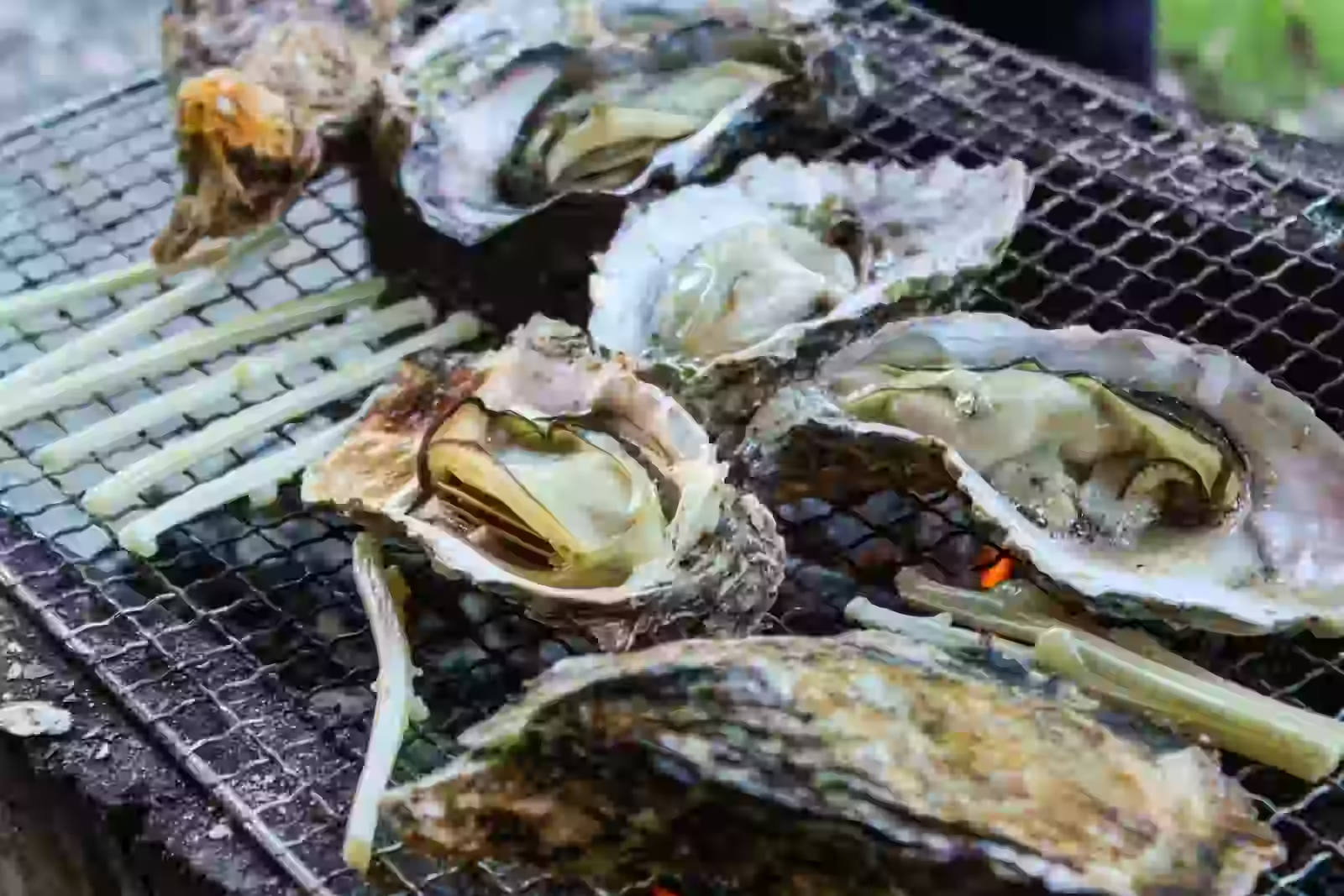
Sanriku oysters are Pacific oysters farmed along Japan’s rugged Sanriku Coast in Miyagi and Iwate Prefectures. Cold, nutrient-rich waters from the Oyashio Current give them a plump body and a deep, briny sweetness. Fishing communities here rebuilt their oyster farms almost from scratch after the 2011 tsunami, and that recovery shaped how the industry works today.
You slurp one straight from the shell at a small oyster hut near Minamisanriku, and the brine hits before the sweetness does. That contrast is basically the whole appeal. So why does this particular stretch of coastline produce oysters that chefs and seafood lovers keep coming back for, and how does it differ from Japan’s other major oyster region in Hiroshima?
What Are Sanriku Oysters?
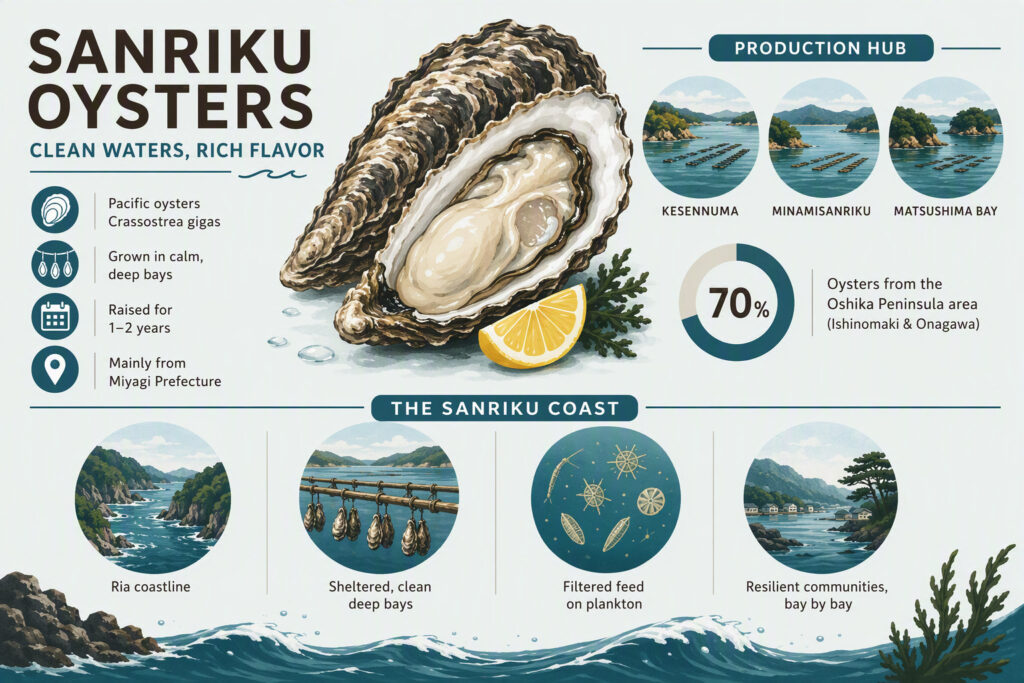
Sanriku oysters are Crassostrea gigas, the Pacific oyster species, raised in the bays along Japan’s Sanriku Coast. Farmers hang oyster spat from ropes suspended in calm, deep bays, letting the shellfish filter feed on plankton for one to two years. Most of this production comes from Miyagi Prefecture, while neighboring Iwate contributes a much smaller share.
Overview of Sanriku Oysters
Unlike some regional specialties tied to a single town, Sanriku oysters come from dozens of small bays scattered across two prefectures. Kesennuma, Minamisanriku, and Matsushima Bay all raise their own versions, each shaped slightly by local water conditions. Within Miyagi, however, the Oshika Peninsula area around Ishinomaki and Onagawa produces roughly 70 percent of the prefecture’s oyster harvest, making it the true production center, even though Kesennuma and Minamisanriku often get more attention for their earthquake recovery story. Locals rarely brand these oysters under one unified name, though “Sanriku oysters” works well as a regional umbrella term for visitors.
Where the Sanriku Coast Is Located
The Sanriku Coast stretches roughly from Hachinohe in Aomori down to Ishinomaki in Miyagi. Geographers classify it as a classic ria coastline, meaning drowned river valleys create deep, narrow inlets. Those inlets shelter the water from harsh Pacific swells, which turns out to be perfect for oyster rafts. Researchers studying Japan’s ria coasts note that this fragmented bay structure also shapes how differently each community experiences and recovers from natural disasters, since damage and recovery speed vary bay by bay rather than uniformly across the region.
History of Oyster Farming in Sanriku
Oyster cultivation along this coast goes back generations, though it looked very different before modern methods arrived.
Early Oyster Cultivation in Miyagi
Oyster farming in Miyagi traces back to the 1600s, when fishing families began ground-sowing cultivation in Matsushima Bay. That makes it a tradition well over 300 years old. Farmers in Shizugawa Bay, near Minamisanriku, have raised oysters there for more than a century using similarly patient, small-scale methods. Early techniques relied on simple stone or shell collectors placed on the seabed, quite different from the rope systems used today.
Development of Modern Oyster Farming
The real turning point came after 1955, when a hanging cultivation method called haenawa-shiki spread rapidly across Miyagi’s coast. Farmers string oyster spat onto wires or ropes, then suspend them from floating rafts. Today, roughly 90 percent of Miyagi’s oyster production still relies on this technique.
Recovery and Growth After the 2011 Earthquake
The Great East Japan Earthquake and tsunami devastated Sanriku’s oyster industry in March 2011, causing nearly 16,000 confirmed deaths and leaving thousands more missing along the affected coastline. Government surveys found that roughly 98 percent of Miyagi’s oyster farming facilities suffered damage, and only about 23 percent of operators had resumed work a year later. Many farmers lost their rafts, ropes, and processing sheds entirely, forcing them to rebuild from almost nothing.
What happened next turned into an unlikely success story. Fishermen in Togura, part of Minamisanriku, decided to reduce the density of their oyster rafts instead of simply restoring the old system. Fewer oysters per raft meant more food for each one, and yields actually improved beyond pre-disaster levels. Marine researchers later used satellite remote sensing to track exactly this kind of recovery in nearby Sanriku lagoons, mapping how oyster culture rafts and seagrass meadows returned to pre-tsunami levels over several years, offering one of the clearest scientific records of the region’s aquaculture rebound. In 2016, the Shizugawa branch of the Miyagi Prefecture Fisheries Co-operative, covering Togura’s oyster producers, became the first farming collective in Japan to earn ASC certification, an international label for sustainable aquaculture, following an independent assessment against the ASC Bivalve Standard. That shift from crowded, competitive fishing grounds toward shared, lower-density farming reshaped how many Sanriku producers now operate.
Why Are Sanriku Oysters Famous?
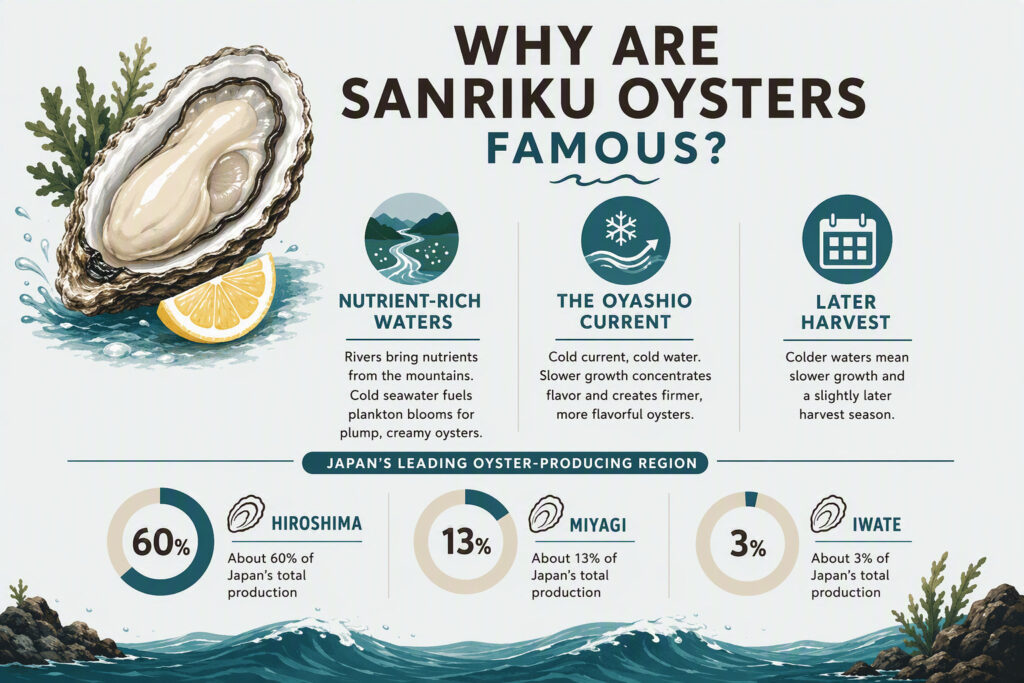
A few environmental factors set this coastline apart from other oyster-growing regions in Japan.
Nutrient-Rich Waters of the Sanriku Coast
Rivers draining from the Kitakami Mountains carry organic nutrients into Sanriku’s bays. Combined with cold seawater, this creates ideal plankton blooms that oysters feed on constantly. The result is a fatter, creamier oyster than warmer waters typically produce.
The Influence of the Oyashio Current
The cold Oyashio Current flows south along Japan’s northeastern coast, keeping Sanriku’s waters noticeably colder than the Seto Inland Sea near Hiroshima. Colder water slows oyster metabolism, and that slower growth tends to concentrate flavor. Fisheries researchers studying Crassostrea gigas across different Japanese growing regions have found that water temperature and nutrient exposure directly influence oyster growth rate and final flesh quality, which helps explain why colder Sanriku waters produce a firmer, more concentrated oyster. It also means the harvest season runs slightly later than in warmer regions.
Japan’s Leading Oyster-Producing Region
Hiroshima dominates national production, accounting for around 60 percent of Japan’s total oyster harvest. Miyagi ranks among the next tier of major producers, contributing roughly 13 percent nationally in pre-disaster figures, a share it shared closely with Okayama Prefecture. Iwate’s own output stays much smaller, at around 3 percent, which is why Miyagi carries most of the Sanriku region’s reputation for oysters.
Characteristics of Sanriku Oysters
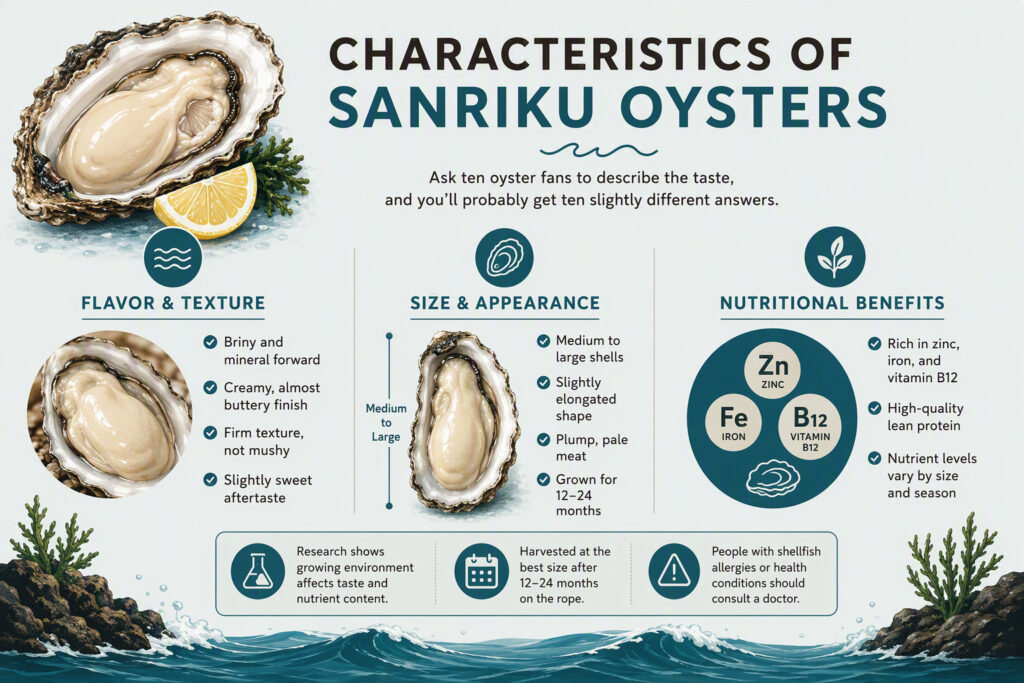
Ask ten oyster fans to describe the taste, and you’ll probably get ten slightly different answers.
Flavor and Texture
Sanriku oysters tend to taste briny and mineral forward, with a creamy, almost buttery finish once you chew. The texture stays firm rather than mushy, which surprises people expecting something delicate. A 2023 academic study comparing Pacific oysters from different Japanese regions found measurable differences in taste compounds and micronutrient content depending on growing water temperature and location, supporting what many regular tasters already notice by feel. Locals often describe the aftertaste as slightly sweet, a contrast to the initial salty hit.
Oyster Size and Appearance
Shells from this region tend to run medium to large, with a slightly elongated shape compared to Hiroshima’s smaller, rounder shells. The meat inside looks plump and pale, almost cream colored when fresh. Farmers usually harvest them once they reach a marketable size after twelve to twenty four months on the rope.
Nutritional Benefits
Oysters generally rank among the most nutrient-dense shellfish available, offering meaningful levels of zinc, iron, and vitamin B12 alongside lean protein. The same 2023 comparative study on Japanese Pacific oysters measured differences in micronutrient concentration between growing regions, though it did not single out Sanriku specifically. Exact nutritional values vary by size and season, so treat these as general figures rather than fixed numbers for every oyster, and readers with shellfish allergies or health conditions should confirm details with a doctor before eating raw seafood.
How Are Sanriku Oysters Farmed?
The farming process itself hasn’t changed dramatically in decades, though sustainability practices have evolved quite a bit.
Hanging Oyster Cultivation
Farmers collect wild oyster larvae on scallop shells strung along ropes, then suspend those ropes from bamboo or wooden rafts. The oysters hang freely in the water, feeding continuously as tides move plankton past them. This method avoids the mud and sediment that bottom-grown oysters sometimes pick up.
Family-Run Farming vs Corporate Operations
Miyagi’s oyster industry runs mostly on small, family-operated fishing households using the rope-hanging method. Hiroshima’s operations, by contrast, lean toward larger corporate businesses using raft cultivation. That structural difference shapes everything from pricing to how quickly each region can rebuild after a disaster.
Sustainable Aquaculture Practices
Following the 2011 disaster, several Sanriku producers reduced raft density to give oysters more room and food per rope. Togura’s fishermen, working with guidance from WWF Japan through a three year pilot program, monitored water quality and limited farming pressure across shared fishing grounds rather than competing for space. This approach has become something of a model for sustainable aquaculture elsewhere in Japan.
Harvesting and Distribution
Workers haul the ropes up by boat, then shuck the oysters by hand at processing sheds along the shore. Roughly 90 percent of Miyagi’s oyster harvest ships out for raw consumption, unlike Hiroshima, where most oysters go toward cooked dishes. From there, fresh oysters travel to markets in Sendai, Tokyo, and beyond, often within a day of harvest.
Sanriku Oysters vs Hiroshima Oysters
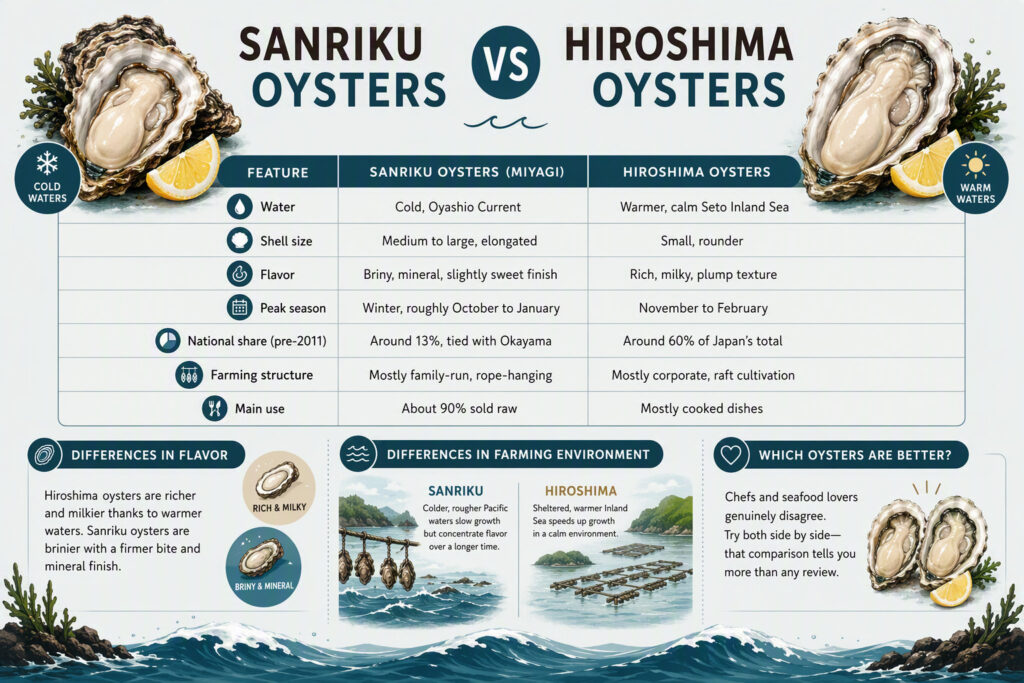
These two regions get compared constantly, and honestly, the differences come down to water temperature, farming structure, and how the oysters get eaten.
| Feature | Sanriku Oysters (Miyagi) | Hiroshima Oysters |
|---|---|---|
| Water | Cold, Oyashio Current | Warmer, calm Seto Inland Sea |
| Shell size | Medium to large, elongated | Small, rounder |
| Flavor | Briny, mineral, slightly sweet finish | Rich, milky, plump texture |
| Peak season | Winter, roughly October to January | November to February |
| National share (pre-2011) | Around 13%, tied with Okayama | Around 60% of Japan’s total |
| Farming structure | Mostly family-run, rope-hanging | Mostly corporate, raft cultivation |
| Main use | About 90% sold raw | Mostly cooked dishes |
Differences in Flavor
Hiroshima oysters tend to taste richer and milkier, largely thanks to the Seto Inland Sea’s calmer, warmer waters. Sanriku oysters lean brinier, with a firmer bite and a more mineral finish. Neither is objectively better. It really comes down to personal preference.
Differences in Farming Environment
Hiroshima’s Inland Sea stays sheltered and relatively warm year round, which speeds up oyster growth. Sanriku’s colder, rougher Pacific waters slow growth but concentrate flavor over a longer cultivation period. Both approaches work, just with different trade-offs between speed and intensity.
Which Oysters Are Better?
Chefs and seafood lovers genuinely disagree on this one. Some prefer Hiroshima’s plump sweetness, while others gravitate toward Sanriku’s briny complexity. If you can, try both side by side. That comparison tells you more than any single review ever could.
Best Season for Sanriku Oysters
Timing matters more than people expect when it comes to oyster flavor.
Peak Harvest Period
In Miyagi, harvesting runs from September through the following May, with the true peak falling between October and January. Cold water during these months causes oysters to store extra glycogen, which translates into a richer, sweeter taste. Many local restaurants build seasonal menus specifically around this window.
Seasonal Availability
Some farms also harvest smaller summer oysters, though these tend to taste thinner and less concentrated. If you’re visiting specifically for the best flavor, plan your trip for deep winter rather than summer. Cold weather at the coast is a small price to pay for a better bowl of oysters.
How to Eat Sanriku Oysters
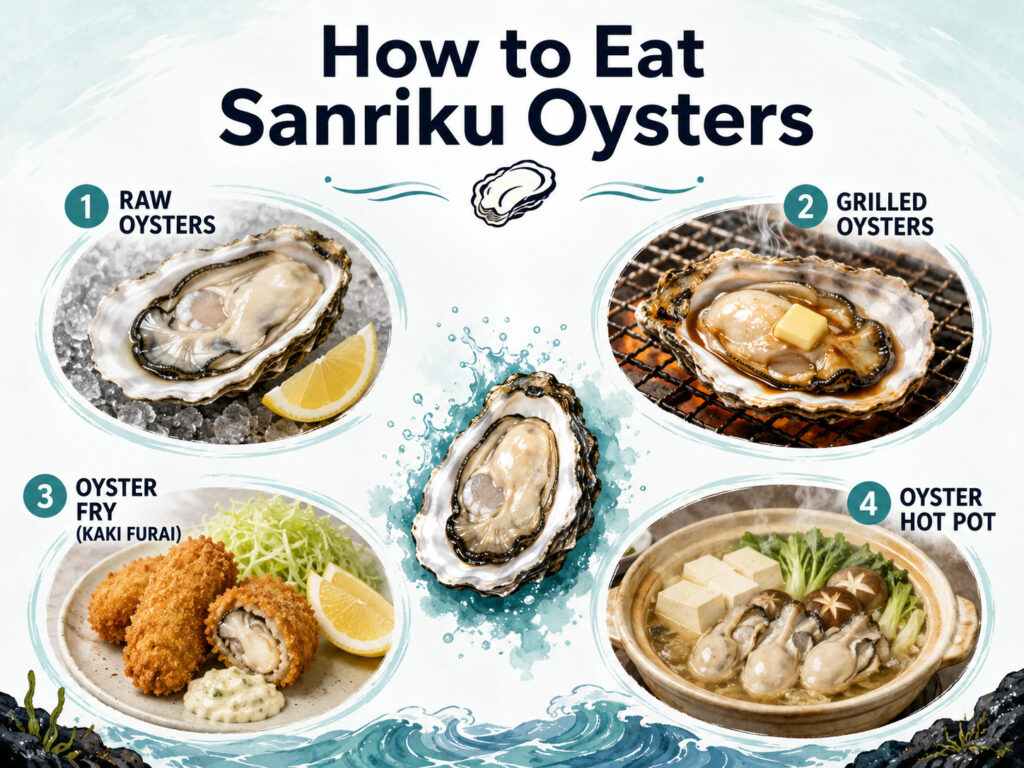
Locals prepare Sanriku oysters in several different ways, depending on the season and occasion.
Raw Oysters
Fresh, raw oysters with just a squeeze of citrus let the brine speak for itself. Restaurants near Kesennuma and Minamisanriku often serve them straight from the shell, still cold from the sea. This is the version most seafood purists insist on trying first.
Grilled Oysters
Grilling the shell whole over charcoal brings out a smoky sweetness that raw oysters simply don’t have. A splash of soy sauce or a bit of butter finishes the dish nicely. This method also feels a little more approachable for people nervous about raw seafood.
Oyster Fry (Kaki Furai)
Breaded and deep fried, kaki furai turns the oyster crispy on the outside while keeping the inside soft and juicy. This preparation shows up on menus throughout Sendai, often paired with tartar sauce and shredded cabbage. It’s a great entry point for anyone hesitant about oyster texture.
Oyster Hot Pot
During the coldest months, families simmer oysters in a miso or soy based hot pot alongside tofu, mushrooms, and leafy greens. The broth soaks up the oyster’s briny liquor as it cooks, which deepens the whole pot’s flavor. This dish feels especially fitting after a day exploring the coast in winter.
Sanriku Oysters and Local Culture
Beyond the plate, oysters shape daily life along this stretch of coast in ways that go deeper than food alone.
Oyster Festivals
Coastal towns across Miyagi and Iwate host winter oyster festivals, where visitors can grill and eat freshly harvested shellfish right at the dock. These events typically run from late autumn through early spring, timed to the peak harvest. Check with local tourism offices for exact dates, since scheduling can shift year to year.
Fishing Communities
Small fishing villages like Togura and Kesennuma built their economies around oyster and seaweed farming for generations. Academic research on Kesennuma’s fish processing sector found that policy delays and land use restrictions after the disaster actually slowed some parts of the industry’s recovery more than the physical damage itself. Even so, many families chose to rebuild rather than relocate, and that persistence says a lot about how tightly oyster farming is woven into the region’s sense of self.
Seafood Tourism in Miyagi and Iwate
Several oyster farms now welcome visitors for shucking experiences and boat tours through the rafts. Pairing an oyster farm visit with other Miyagi specialties, like Sendai’s local dishes, makes for a well-rounded food trip. It’s a chance to see exactly where your meal came from, which honestly changes how it tastes.
Sanriku oysters carry more history in each shell than most people realize at first bite. They survived a disaster that wiped out nearly every farm along the coast, then came back leaner, more sustainable, and arguably better tasting. If you find yourself near Kesennuma or Minamisanriku during winter, order a plate raw and taste that story for yourself. It’s not flashy, but it’s real, and that’s exactly the point.
Sanriku Oysters FAQ
What are Sanriku oysters?
Sanriku oysters are Pacific oysters farmed along Japan’s Sanriku Coast in Miyagi and Iwate. They’re known for a briny, mineral-rich flavor shaped by cold northern waters.
Where are Sanriku oysters grown?
They’re grown in sheltered bays along the Sanriku Coast, including Kesennuma, Minamisanriku, and the Oshika Peninsula in Miyagi Prefecture, which alone produces about 70 percent of the prefecture’s harvest.
Does Iwate produce as many oysters as Miyagi?
No, Iwate’s oyster output is much smaller, around 3 percent of Japan’s total, compared to Miyagi’s roughly 13 percent.
Are Sanriku oysters safe to eat raw?
Yes, when sourced from certified farms and handled properly, they’re commonly served raw in Japan. As with any raw shellfish, pregnant individuals and those with weakened immune systems should check with a doctor first.
When is Sanriku oyster season?
Peak season runs from October through January, though harvesting continues from September to May. Cold winter water gives the oysters a richer, sweeter flavor.
How do Sanriku oysters compare to Hiroshima oysters?
Sanriku oysters taste brinier and more mineral forward, while Hiroshima oysters tend to be milkier and plumper thanks to warmer Inland Sea water. Farming structures also differ: Miyagi relies on family-run operations, Hiroshima on larger corporate farms.
Are Sanriku oysters sustainably farmed?
Many are. The Shizugawa branch covering Togura’s oyster producers earned Japan’s first ASC sustainability certification in 2016 after switching to lower-density farming following the 2011 disaster.
What dishes use Sanriku oysters?
Common preparations include raw oysters, grilled oysters, kaki furai (fried oysters), and oyster hot pot during winter months.
Can tourists visit oyster farms in Miyagi?
Yes, several farms around Kesennuma and Minamisanriku offer shucking experiences and boat tours through the oyster rafts.
References
- Norinchukin Research Institute, official report on Miyagi oyster farming history, national production share, farming structure, and earthquake recovery status. (Surveyed: July 2026)
- Murata, H. et al., “Monitoring oyster culture rafts and seagrass meadows before and after the 2011 tsunami,” PeerJ, 2021, remote sensing study of oyster raft recovery in the Sanriku region. (Surveyed: July 2026)
- Hu, Y. et al., “Characterization of taste and micronutrient content of rock oysters and Pacific oysters in Japan,” Journal of Marine Science and Engineering, 2023, comparative academic study on Japanese oyster flavor compounds and nutrients. (Surveyed: July 2026)
- Hasegawa, N., “Comparative study of the impact of environmental changes on Crassostrea gigas,” Japan Fisheries Research and Education Agency, 2021, academic research on water temperature effects on Pacific oyster growth. (Surveyed: July 2026)
- Shoji, J. et al., “Possible effect of anxiety unique to the ria coast,” Sustainability Science, Springer, 2024, academic study on social-ecological diversity along Japan’s ria coastlines. (Surveyed: July 2026)
- Torayashiki, T. and Maruya, H., “Obstacles to Early Recovery and Reconstruction of the Fish Processing Industry: The Case of Kesennuma City,” Journal of Disaster Research, 2022, academic case study on Kesennuma’s fisheries recovery challenges. (Surveyed: July 2026)
- Aquaculture Stewardship Council, official farmer story on Shizugawa Bay oyster farming, tsunami impact, and ASC certification process. (Surveyed: July 2026)
- WWF Japan, report on sustainable aquaculture born from earthquake recovery and Togura’s ASC certification. (Surveyed: July 2026)
- Tohoku Geographical Association, academic explanation of Sanriku Coast’s ria coastline formation and regional geography. (Surveyed: July 2026)
- Food In Japan, comparative data on Hiroshima oyster production share, size, and peak season. (Surveyed: July 2026)
Related Articles
- Hiroshima Kaki (広島かき) (Surveyed: July 2026)
- What to Eat in Sendai: 20 Must-Try Foods (Surveyed: July 2026)
- What to Eat in Hiroshima: 20 Must-Try Foods (Surveyed: July 2026)
- Hiroshima’s Food Culture (Surveyed: July 2026)
- Sendai Beef – A5 Wagyu Beef in Miyagi (Surveyed: July 2026)




Comments