





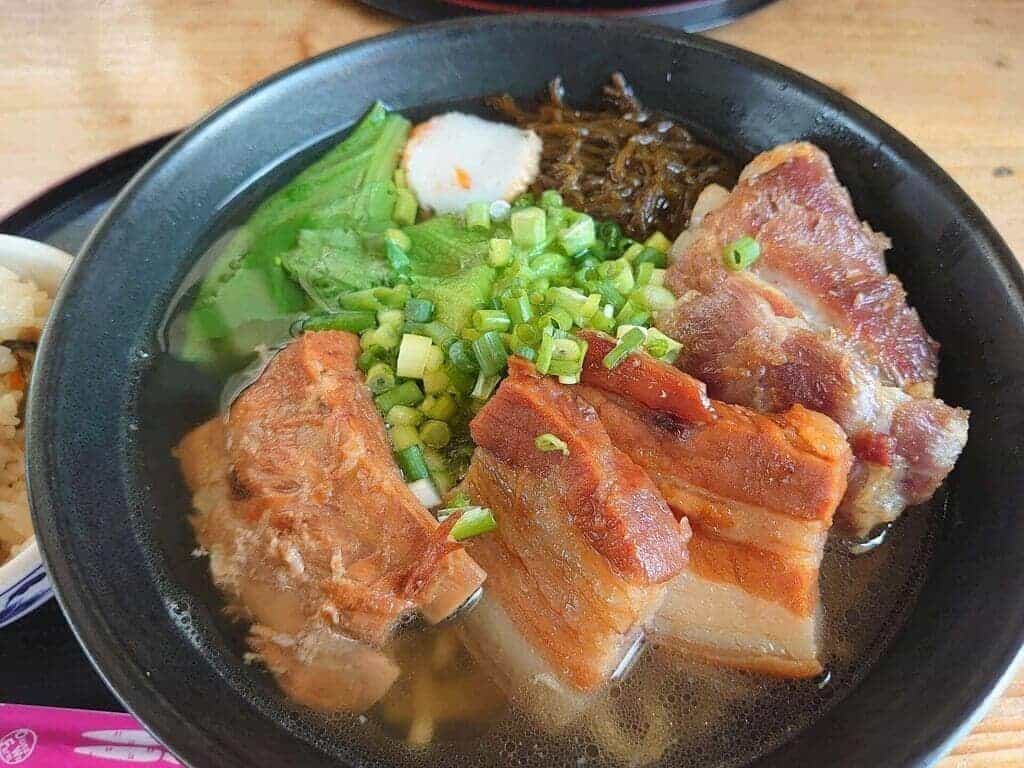
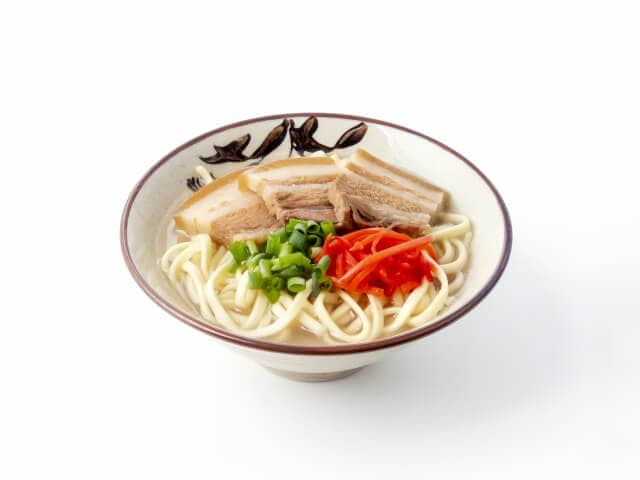
Okinawa soba is the most iconic noodle dish of Okinawa Prefecture, and despite the name it contains no buckwheat at all. Locals call Okinawa soba “suba.” Thick wheat flour noodles sit in a clear bonito and pork broth, topped with stewed pork belly called san-mai niku. It is everyday food here, eaten at lunch counters, festivals, and family gatherings alike.
| Quick Facts | Okinawa Soba |
|---|---|
| Origin | Okinawa Prefecture, formerly the Ryukyu Kingdom |
| Local name | Suba, or uchina suba |
| Noodles | 100 percent wheat flour with kansui, no buckwheat |
| Broth | Pork bones and katsuobushi, seasoned lightly |
| Classic topping | San-mai niku (stewed pork belly) |
| Typical price | 600 to 900 yen (Surveyed: July 2026) |
| Okinawa Soba Day | 17 October, set in 1997 |
What Is Okinawa Soba?
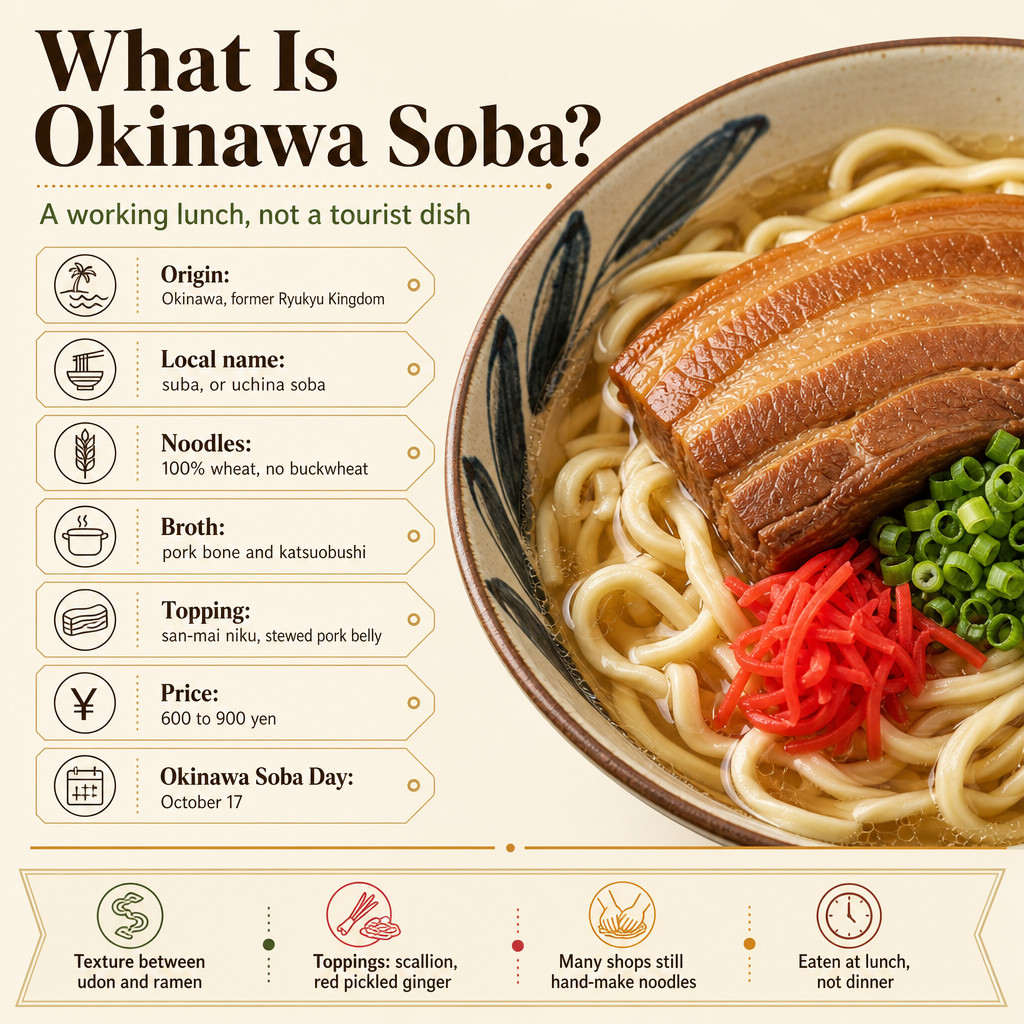
Okinawa soba is a noodle soup from Okinawa Prefecture made with thick wheat flour noodles rather than buckwheat. Cooks serve it in a light broth of pork bones and dried bonito. Stewed pork belly, green onions, and red pickled ginger complete the standard bowl. The texture sits somewhere between udon and ramen.
Many shops still make the noodles by hand. This technique preserves the authentic texture that locals value. Okinawans tend to eat soba at lunch rather than dinner, and small neighborhood shops often sell out and close by early afternoon. In other words, this is a working meal rather than a tourist dish.
Okinawa Soba vs Japanese Soba: What Is Different?
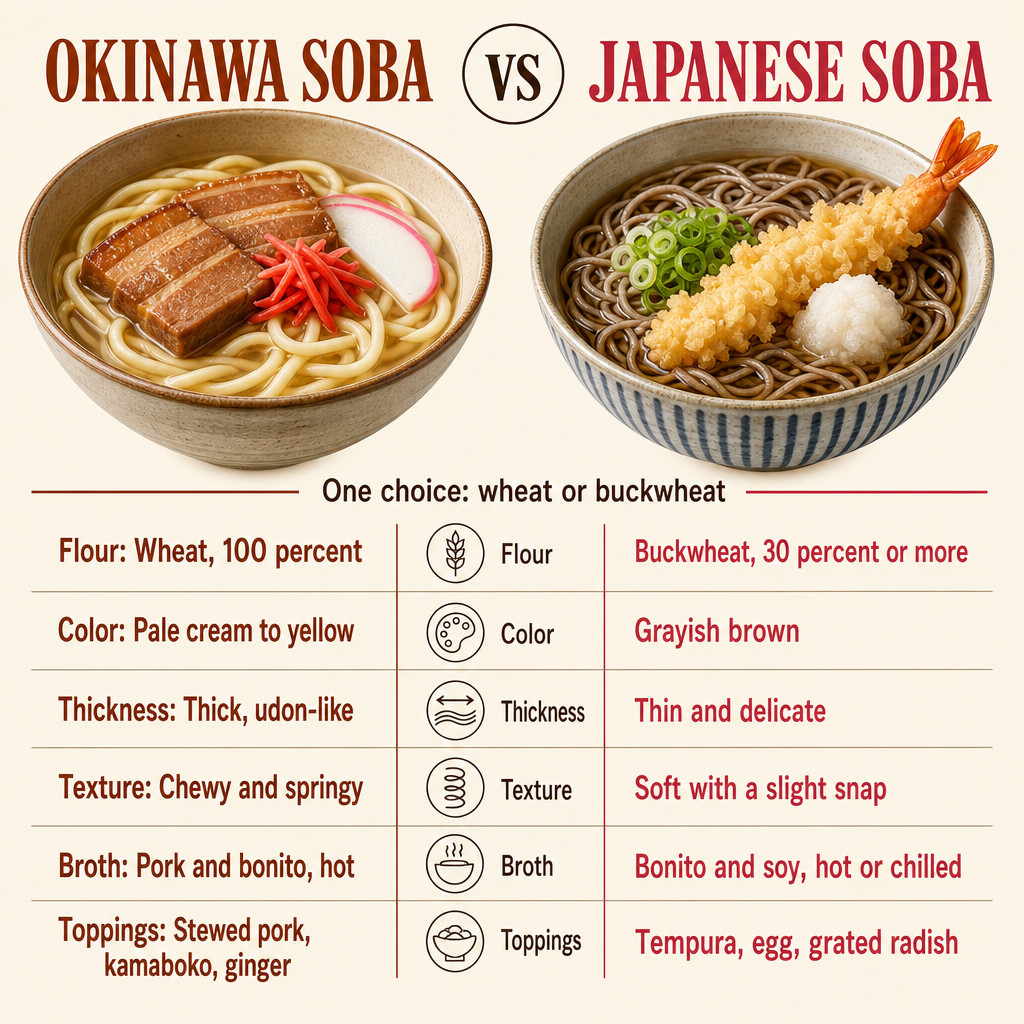
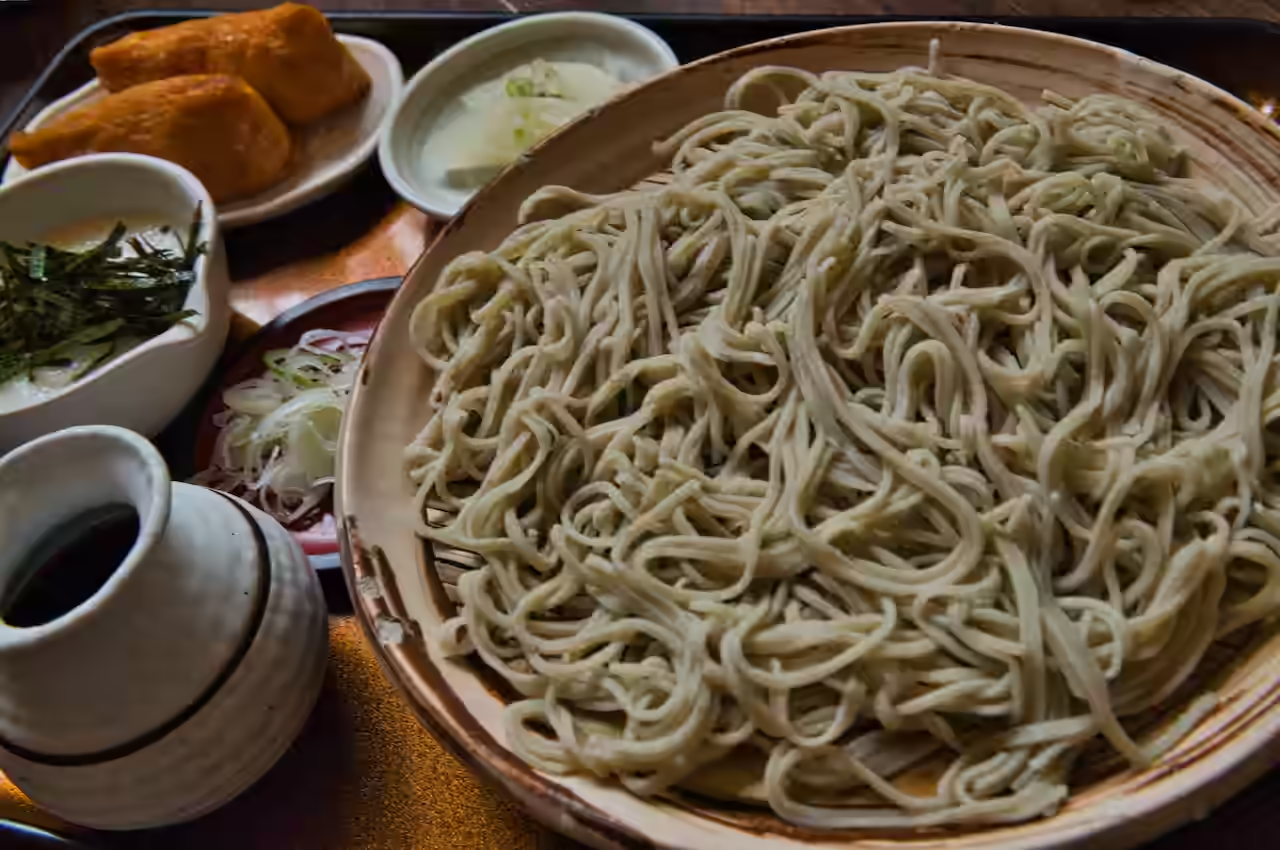
The difference is simple: mainland soba is buckwheat, while Okinawa soba is wheat. Everything else follows from that one choice. The table sums it up.
| Feature | Okinawa soba | Mainland Japanese soba |
|---|---|---|
| Flour | Wheat flour, 100 percent | Buckwheat, at least 30 percent |
| Color | Pale cream to light yellow | Grayish brown |
| Thickness | Thick, udon-like | Thin and delicate |
| Texture | Chewy and springy | Soft with a slight snap |
| Broth | Pork and bonito, served hot | Bonito and soy, hot or chilled |
| Toppings | Stewed pork, kamaboko, ginger | Tempura, egg, grated radish |
So why call it soba at all?
Okinawans historically used “soba” for any noodle dish, long before mainland labeling rules existed. That habit almost cost the dish its name. In 1976, Japan’s Fair Trade Commission noted that industry labeling rules reserved the word “soba” for noodles containing at least 30 percent buckwheat. Okinawa soba contains none.
The Okinawa Fresh Noodle Cooperative pushed back hard. After two years of negotiation, “Honba Okinawa Soba,” meaning authentic Okinawa soba, joined the official list of regional specialty names on 17 October 1978. It was the seventh such approval nationwide, after names including Sanuki Udon and Izumo soba. The cooperative later declared 17 October Okinawa Soba Day, starting in 1997.
What Does Okinawa Soba Taste Like?
Okinawa soba tastes clean and gently savory, with chewy noodles and a broth lighter than most ramen. Here is how the bowl breaks down.
Flavor
Bonito leads, backed by a soft pork sweetness. The seasoning stays restrained, so the broth tastes closer to a good dashi stock than to a heavy noodle soup. Stewed pork belly then adds sweetness from soy sauce, sugar, and awamori, the local rice-based distilled spirit. I will admit the soup looked too pale to be interesting, and the first sip corrected me quickly.
Aroma
The steam smells of smoked bonito and simmered pork, plus a faint trace of the oil coating the noodles. Ginger cuts through it all. On a humid Okinawan afternoon, that lightness matters more than you might expect.
Texture
The noodles feel dense and springy, with an irregular surface from hand-massaging. Because shops pre-boil and oil them, the bite is softer than fresh ramen noodles yet firmer than udon. Kamaboko fish cake supplies a light chew, and the pork almost dissolves.
How Okinawa Soba Noodles Are Made
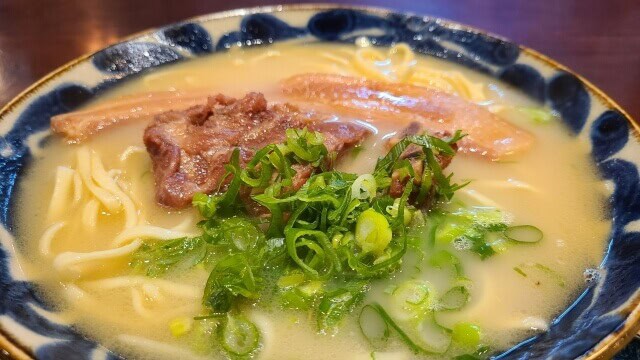
What makes Okinawa soba noodles unique?
Four things separate these noodles from udon or ramen, and none of them involve buckwheat.
- Wheat flour plus kansui: kansui is an alkaline solution that gives the strands their yellow tint and springy bite.
- Hand-massaging (temomi): makers rub the cut strands between their palms, creating the uneven surface that grips broth.
- A very short rest: the dough sits for 30 minutes or less, which keeps the bite firm rather than udon-soft.
- An oil coating: after boiling, the noodles get a light coat of oil so they keep at room temperature.
That last step explains something visitors always notice. Because shops boil noodles in advance and hold them ready, a bowl reaches your table within a minute of ordering. Miss the massaging or the oil, and the result simply tastes like thick udon.
What is Honba Okinawa Soba?
Honba Okinawa Soba means “authentic Okinawa soba,” and it is a protected specialty name rather than marketing language. Industry rules set 12 conditions, and a noodle missing even one of them cannot use the name. The table shows the main ones.
| Condition | Requirement |
|---|---|
| Place of production | Inside Okinawa Prefecture |
| Method | Hand-kneading style |
| Water content | 34 to 36 percent of flour weight |
| Resting time | 30 minutes or less |
| Noodle thickness | 1.5 to 1.7mm |
| Hand-massaging | Required before boiling |
| Boiling | About two minutes, in water at pH 8 to 9 |
| Finish | Oil-treated |
The remaining conditions cover flour quality and the strength of the kansui and salt solutions. Okinawa soba also holds a separate distinction: in 2013 it became the first noodle in Japan certified under “Honba no Honmono,” a national labeling standard for genuine regional foods. Look for that wording on souvenir packs.
Okinawa Soba History
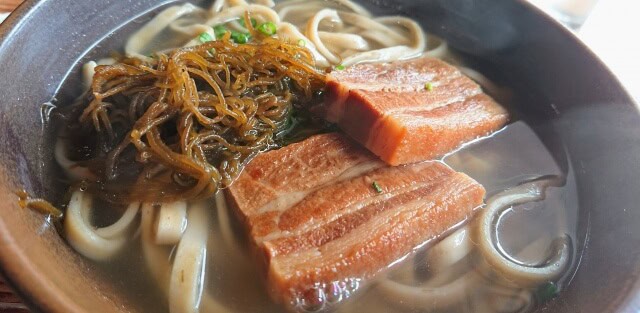
Okinawa soba arrived through Chinese trade, spread when wheat became affordable, and turned into an everyday staple after the war.
Ryukyu Kingdom era
The Ryukyu Kingdom traded actively with China for centuries, and Chinese wheat noodles almost certainly shaped the earliest version of the dish. Wheat came from overseas, so it cost a great deal. Local histories therefore describe those early noodles as court food. Documentation from that period is thin, though, so treat this stage as a reconstruction rather than settled fact.
Meiji era: soba for everyone
Japan ended its isolation policy during the Meiji era, which ran from 1868 to 1912. Imported wheat grew far cheaper, and Chinese-style noodle shops opened in Naha. Those shops are the clearest direct ancestor of today’s bowl. The noodles also grew thicker to suit working appetites.
Postwar Okinawa and the fight for a name
The Battle of Okinawa in 1945 destroyed much of the island and left severe food shortages. American surplus wheat flour then flooded in during the long US administration. Noodle shops used it, and soba shifted from festival food to ordinary lunch. Many of today’s institutions date from those decades.
Okinawa returned to Japanese administration in 1972, and the labeling dispute followed four years later. Looking back, it seems fitting that a dish born from trade and hardship had to fight for its own name.
Traditional Toppings of Okinawa Soba
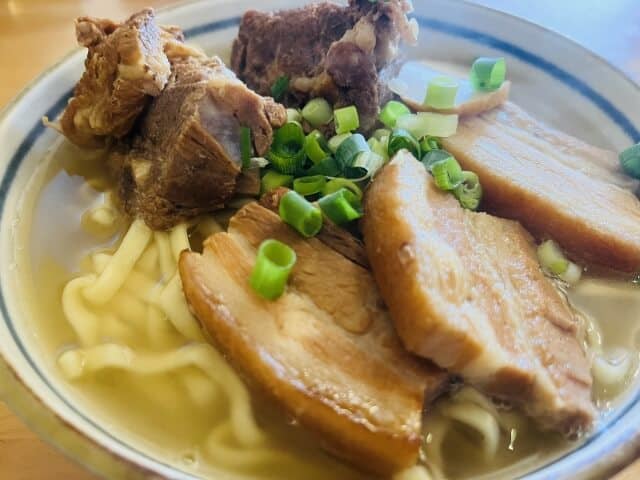
Okinawa soba keeps its toppings few and purposeful. Chefs top the noodles with tender stewed pork belly, green onions, and pickled ginger.
- San-mai niku: thick slices of pork belly stewed in soy sauce, sake, sugar, and ginger until sweet and tender. This is the classic.
- Soki: pork spareribs simmered until a chopstick cuts through them. Order soki soba and you get these instead of belly.
- Kamaboko: cured fish cake, subtly sweet and firm. Okinawan versions are often fried rather than steamed.
- Green onions: finely chopped, added for freshness against the pork.
- Beni shoga: red pickled ginger, tangy and bright. Island shops usually add it, though Yaeyama cooks often skip it.
- Tebichi: stewed pig’s trotters, rich in collagen. Try Tebichi Soba if you like gelatinous textures.
Okinawa Soba vs Soki Soba
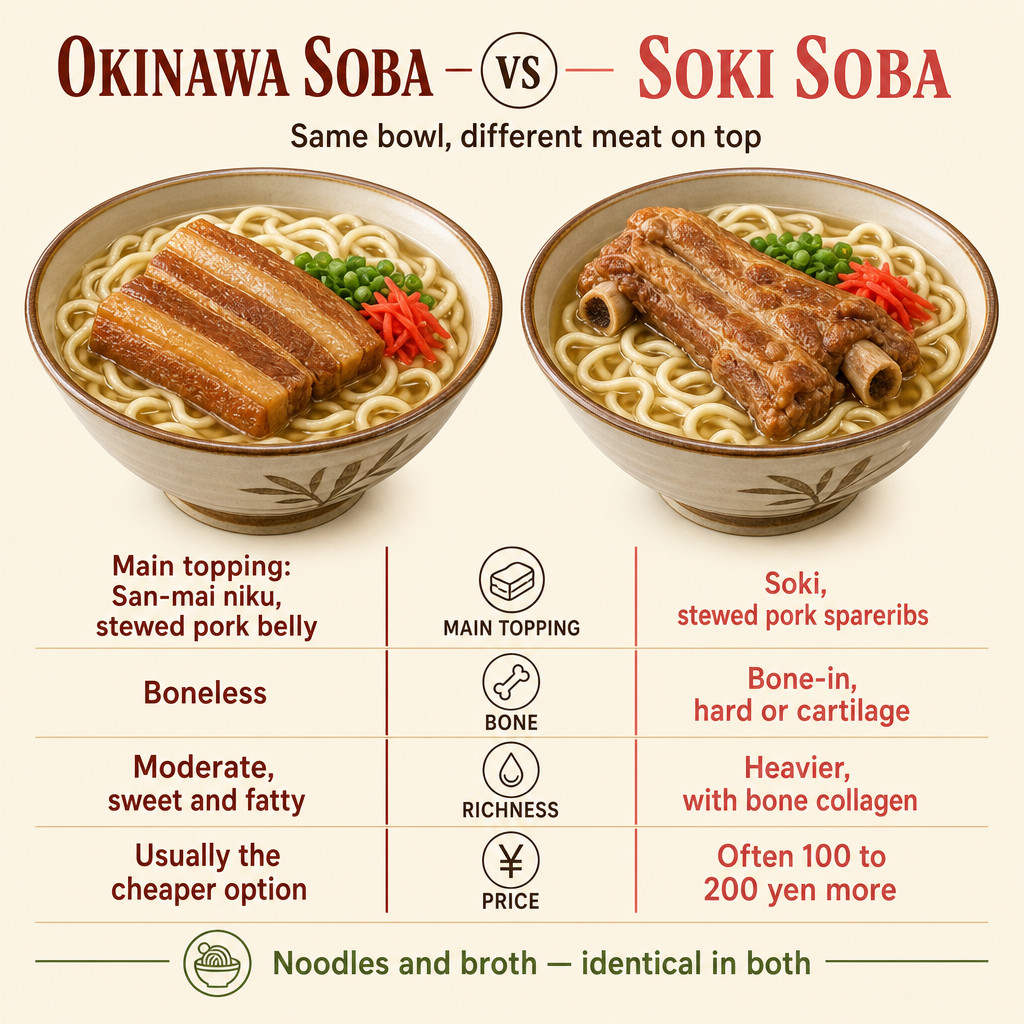
Soki soba is Okinawa soba with pork spareribs on top instead of pork belly. The noodles and broth stay the same, so the difference is purely the meat.
| Feature | Okinawa soba | Soki soba |
|---|---|---|
| Main topping | San-mai niku, stewed pork belly | Soki, stewed pork spareribs |
| Bone | Boneless | Bone-in, hard or cartilage type |
| Richness | Moderate, sweet and fatty | Heavier, with collagen from the bone |
| Noodles and broth | Identical | Identical |
| Price | Usually the cheaper option | Often 100 to 200 yen more |
Soki comes in two forms. Hon-soki has hard bones you discard, while nankotsu-soki keeps soft cartilage you can eat. For a fuller breakdown, see our guide to Soki Soba.
Regional Styles Across Okinawa
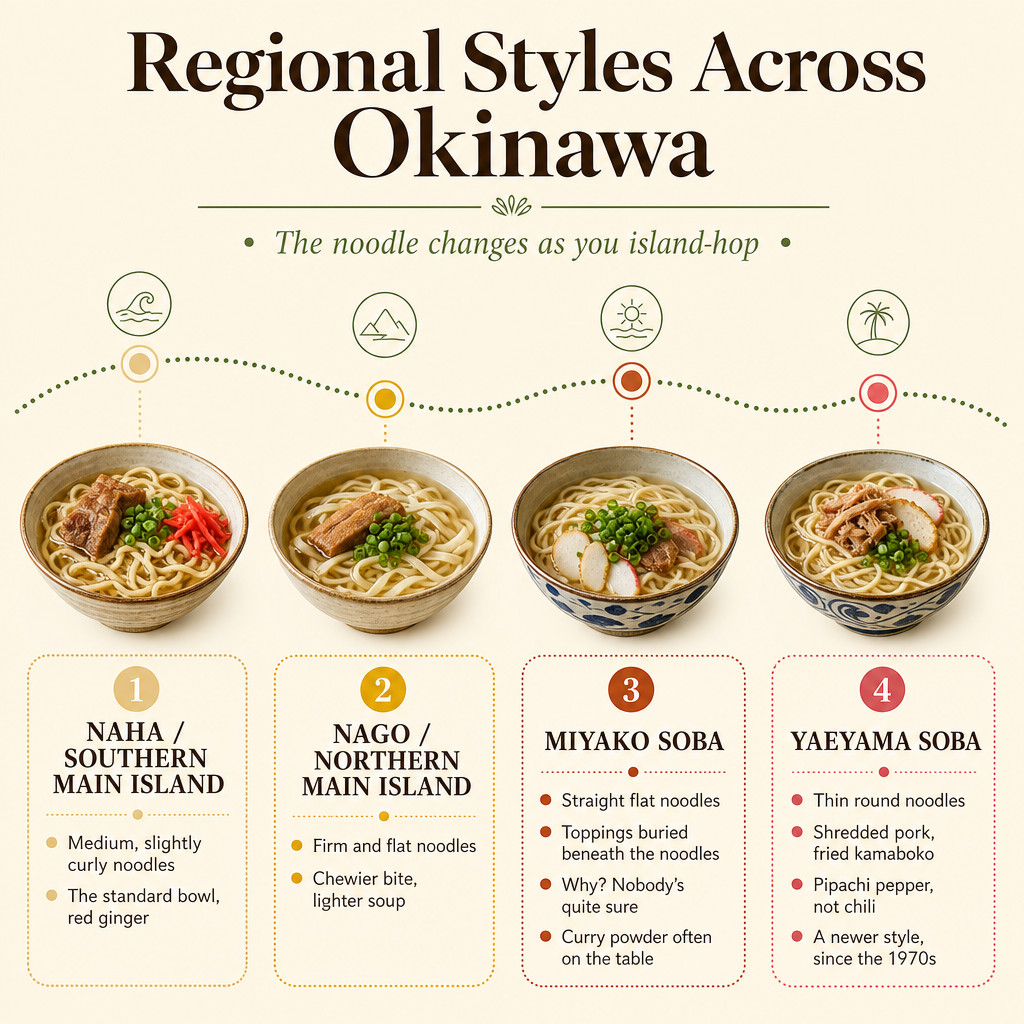
Okinawa soba changes shape as you island-hop. Southern shops favor curly noodles, the north prefers flat ones, and the outer islands go their own way entirely.
| Style | Where | Noodles | Distinctive point |
|---|---|---|---|
| Naha and southern main island | Naha, Shuri | Medium, slightly curly | The standard bowl, with red pickled ginger |
| Nago and northern main island | Nago, Yanbaru | Firm and flat | Chewier bite, often lighter soup |
| Miyako soba | Miyako Islands | Straight flat noodles | Toppings hidden under the noodles |
| Yaeyama soba | Ishigaki, Taketomi, Iriomote | Thin round noodles | Shredded pork, fried kamaboko, pipachi pepper |
Miyako soba deserves a note. Cooks there bury the pork and kamaboko beneath the noodles, so the bowl looks almost bare. Explanations vary: some say it protected the toppings, others claim it hid expensive meat from tax inspectors. Nobody seems certain, and locals rather enjoy the mystery. Several Miyako shops also keep curry powder on the table.
Yaeyama soba went the opposite direction with thin round strands, which reportedly appeared only in the 1970s. Instead of chili, diners there reach for pipachi, a fragrant island pepper.
How Locals Eat Okinawa Soba
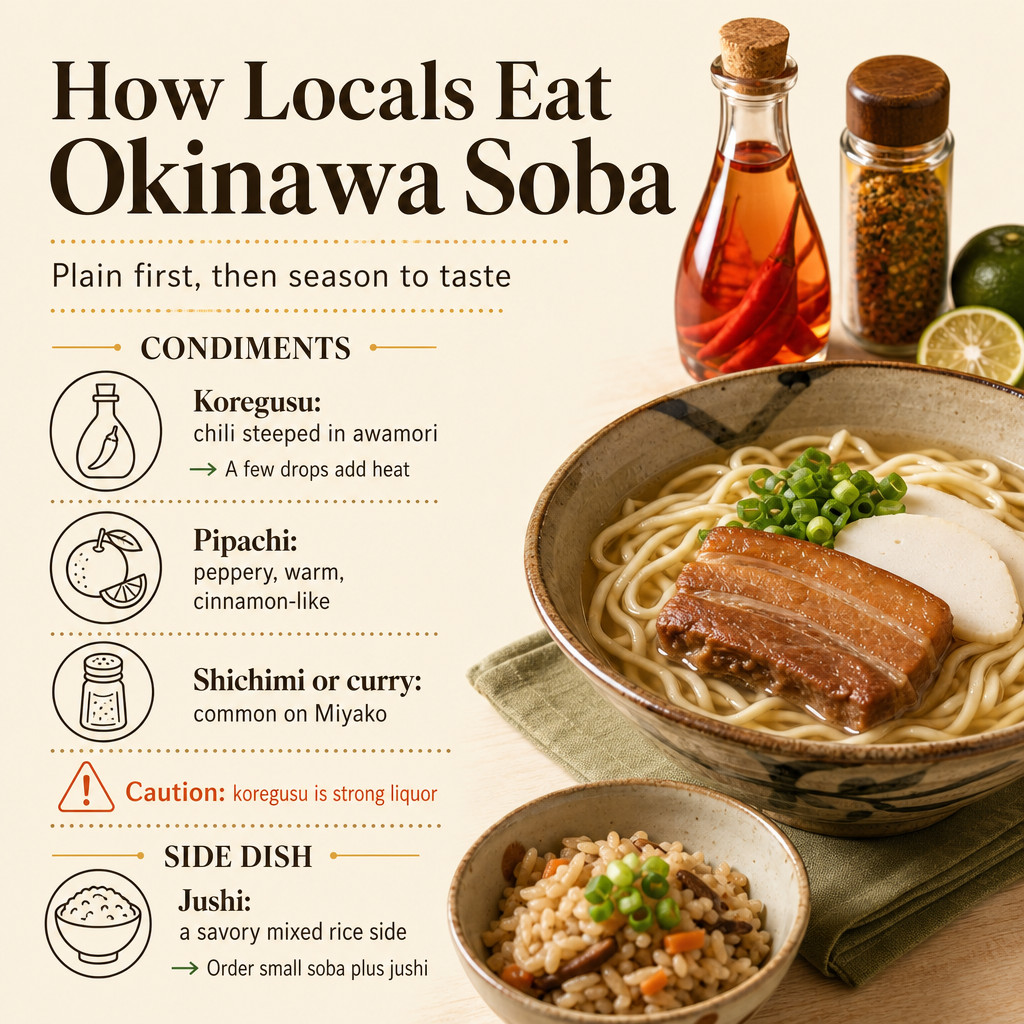
Most locals eat it plain first, then adjust with the condiments on the table. Two of those condiments are worth knowing before you sit down.
- Koregusu: island chili peppers steeped in awamori liquor. A few drops add heat and a sharp fragrance.
- Pipachi: a peppery Yaeyama spice with a warm, almost cinnamon-like edge.
- Shichimi or curry powder: less traditional, though common on Miyako.
One caution about koregusu: the awamori base is strong liquor, so drivers and children should go easy. Many shops also serve jushi, a savory Okinawan mixed rice, as a side. Locals often order the smaller soba plus jushi rather than a large bowl alone. Lunch is the main occasion, and soba appears at funerals, festivals, and family gatherings too.
Okinawa Soba Calories, Nutrition, and Allergens
How many calories are in Okinawa soba?
Boiled Okinawa soba noodles contain 132 kcal per 100 g, according to Japan’s official food composition tables. A shop portion usually runs 200 to 250 g of boiled noodles, so the noodles alone supply roughly 260 to 330 kcal. Broth and toppings then add more, and pork belly or tebichi push the total up noticeably.
| Boiled noodles, per 100 g | Amount |
|---|---|
| Energy | 132 kcal |
| Protein | 5.2 g |
| Fat | 0.8 g |
| Carbohydrate | 28.0 g |
| Dietary fiber | 1.5 g |
| Salt equivalent | 0.4 g |
Nutrition and allergens
The broth is lighter than tonkotsu ramen yet still salty, so leaving some soup cuts the sodium noticeably. Vegetables are minimal in a standard bowl, which is partly why locals pair it with a side.
Allergens matter here. The noodles contain wheat, the broth uses fish and pork, and kamaboko contains fish and often egg. Nothing in a standard bowl is gluten-free. If you have restrictions, ask before ordering, since bonito dashi is easy to overlook.
How Much Does Okinawa Soba Cost?
A standard bowl generally runs 600 to 900 yen as of July 2026. Soki soba usually costs 100 to 200 yen more, and set meals with jushi rice land around 1,000 to 1,300 yen. Small neighborhood shops sit at the lower end, whereas renovated houses and tourist areas charge more. Many older shops still prefer cash, so carry some with you.
Best Okinawa Soba Shops: Where to Eat
Good Okinawa soba hides in ordinary neighborhoods rather than resort strips. Three signs tell you a shop is worth queueing for: handmade noodles listed on the menu, a lunch-only schedule, and a note that they close when sold out. All three suggest small-batch cooking.
| Shop | Area | Why go |
|---|---|---|
| Shimujo | Shuri, Naha | Historic house setting, three-day broth |
| Sobadokoro Sumanume | Kokuba, Naha | Home-style bowl with mugwort on the side |
| Kinchichi Soba | Yomitan Village | Okinawan wheat noodles, seven-fish dashi |
Shimujo (しむじょう)
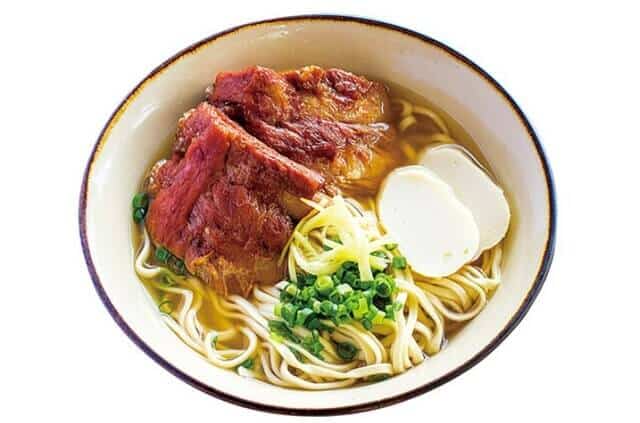
The owner converted his grandfather’s house into a soba shop, and you eat while looking out at old stone walls and a garden. Staff simmer pork bones and bonito, cool the stock, skim the surface fat, and repeat over three days. The result is unusually clear. Best for: atmosphere plus a serious broth. Access: Shuri district, Naha. Reservation: not accepted.
Sobadokoro Sumanume (そば処 すーまぬめぇ)
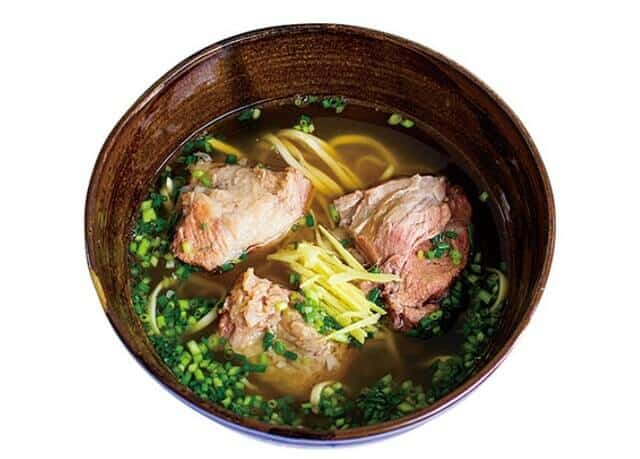
You walk in through a garden and slide open a rattling wooden door, which feels more like visiting a relative than eating out. The broth builds on bonito with chicken, pork, and kelp. Follow the regulars and add the mugwort served alongside, since it lifts the whole bowl. Best for: a homely, local lunch. Access: Kokuba, Naha. Note: closes when sold out.
Kinchichi Soba (金月そば)
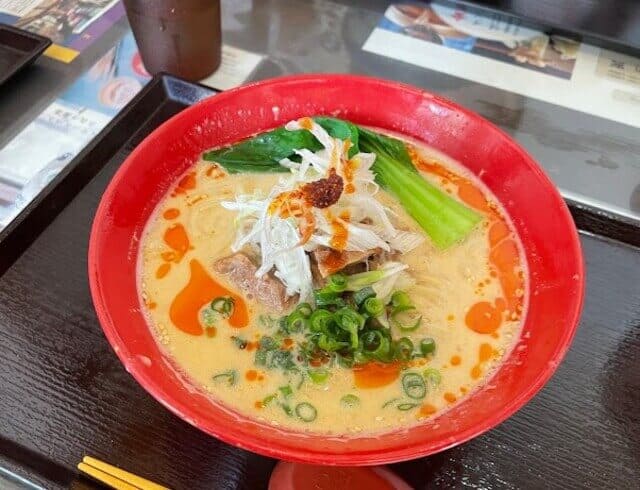
Kinchichi blends rare Okinawan wheat with domestic flour and develops its own fresh noodles in-house. Those flat noodles have real presence. The clear soup uses pork, bonito flakes, and island salt, and the shop draws its dashi from seven kinds of dried fish. Best for: noodle-focused eaters. Access: Yomitan Village, central main island.
Buying Okinawa Soba: Souvenirs and Online
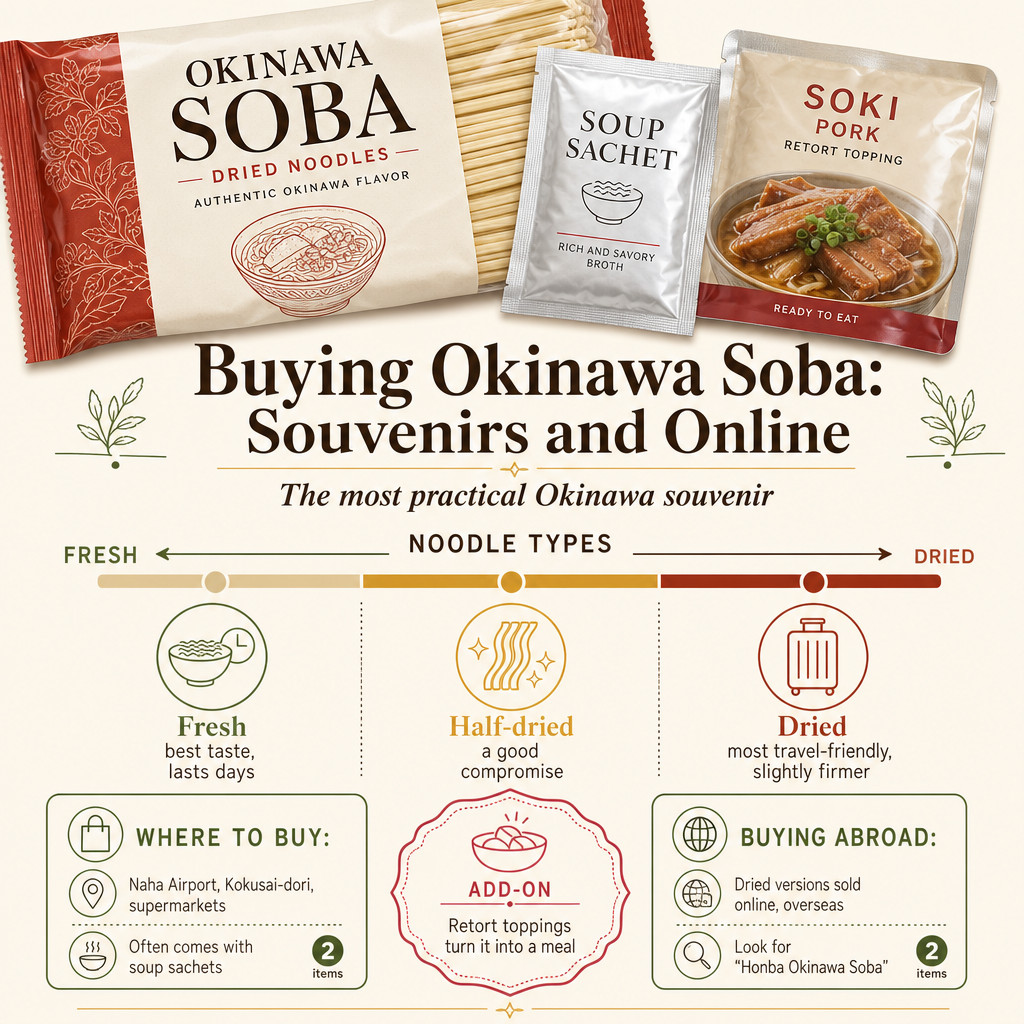
Packaged Okinawa soba is one of the prefecture’s most practical souvenirs. Naha Airport, Kokusai-dori shops, and ordinary supermarkets all stock it, often with soup sachets included.
- Fresh noodles: closest to the real thing, but they keep only a few days.
- Half-dried noodles: a good compromise, lasting several weeks.
- Dried noodles: the most travel-friendly, though slightly firmer in texture.
- Retort soki or san-mai niku: vacuum-packed toppings that turn a pack into a real meal.
Outside Japan, Japanese grocery stores and online retailers carry dried versions. Look for the “Honba Okinawa Soba” wording if you want noodles made to the certified standard.
Okinawa Soba Recipe
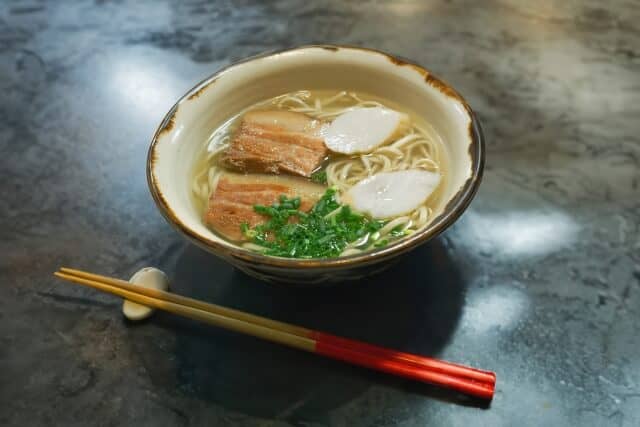
This recipe serves four and takes about four hours, mostly unattended simmering. Shop-bought noodles work perfectly well if you would rather skip the dough.
Ingredients
| Ingredient (serves 4) | Amount |
|---|---|
| Cake flour | 360 g |
| Strong (bread) flour | 180 g |
| Water | 190 ml |
| Salt | 15 g |
| Kansui, or baked baking soda | 8 g |
| Dusting starch (tapioca or potato) | 60 g |
| Pork bones | 500 g |
| Katsuobushi and kombu | 30 g and 10 g |
| Pork belly | 250 g |
| Soki spareribs (optional) | 120 g |
| Kamaboko, green onion, beni shoga | To taste |
Making the noodles
Sift both flours together. Dissolve the salt and kansui in the water, then add it gradually while rubbing the flour into crumbs. Knead for 10 to 15 minutes. Why this step matters: even hydration builds the gluten that makes the noodles springy.
Seal the dough in a bag and leave it at room temperature. Okinawan makers keep this rest short, unlike udon. Why this step matters: a brief rest relaxes the dough without softening the bite.
Dust both sides with starch and roll the dough into a rectangle 1.5 to 2mm thick. Fold it and cut strands about 3mm wide, then rub them between your palms. Why this step matters: hand-massaging creates the uneven surface that holds broth.
Making the broth and toppings
Blanch the pork bones, rinse them clean, then simmer them gently with kombu for two to three hours. Add katsuobushi in the final 15 minutes and strain. Season with salt and a little soy sauce. Why this step matters: a gentle simmer keeps the soup clear, which defines this style.
Boil the pork belly and optional soki until tender, then simmer them in soy sauce, sake or awamori, sugar, and ginger. Let them cool in the liquid. Why this step matters: cooling in the sauce is what makes the meat taste sweet all the way through.
Boil the noodles for about two minutes, drain them, and toss them with a spoonful of oil. Divide them between warmed bowls, pour the hot broth, and add pork, kamaboko, green onion, and beni shoga. Why this step matters: the oil coating stops the noodles clumping and mirrors the shop method.
Common mistakes to avoid
- Adding too much water. These noodles use less than udon, so the dough should feel stiff at first.
- Resting too long. Hours of resting produces udon texture instead.
- Skipping the hand-massage. Without it the noodles turn out straight and dull.
- Boiling the bones hard. A rolling boil clouds the soup and turns it heavy.
- Over-seasoning. This broth should taste gentler than ramen, so add salt slowly.
Why Okinawa Soba Is Still Loved Today
Okinawa soba survives because it belongs to daily life rather than to tourism. Families eat it at funerals and festivals, students eat it between classes, and grandmothers still argue about which shop makes the best broth. The dish also carries the island’s history in one bowl: Chinese trade, Meiji-era imports, wartime scarcity, and a hard-won fight over a single word.
That is a lot of weight for something so simple. Order a plain soba first, add a drop of koregusu, and try a northern shop the next day for comparison. For more island cooking, browse our Okinawan cuisine guide or the wider Kyushu food guide.
You can check some Japanese soba dishes that we know you would like to try too.
Okinawa Soba FAQ
What is Okinawa soba?
Okinawa soba is a noodle dish from Okinawa Prefecture made with thick wheat flour noodles and no buckwheat. Cooks serve it in a light broth of pork bones and dried bonito flakes. Stewed pork belly, kamaboko, green onions, and red pickled ginger sit on top. Locals call these Okinawan noodles suba in the island dialect.
Why is it called soba if it contains no buckwheat?
Okinawans historically used the word soba for any noodle dish, well before national labeling rules arrived. In 1976 the Fair Trade Commission pointed out that industry rules reserved “soba” for noodles with at least 30 percent buckwheat. The Okinawa Fresh Noodle Cooperative negotiated for two years and won an exception. On 17 October 1978, “Honba Okinawa Soba” gained official recognition as a regional specialty name.
What does Okinawa soba taste like?
It tastes clean and gently savory rather than rich. Bonito leads the broth, with a soft pork sweetness underneath and restrained seasoning. The thick wheat noodles feel dense and springy, closer to udon than to ramen in body. Stewed pork belly adds sweetness, and red pickled ginger cuts the fat.
What is the difference between Okinawa soba and soki soba?
Soki soba is Okinawa soba topped with pork spareribs instead of pork belly. The noodles and the broth stay identical, so only the meat changes. Soki comes in two types: hon-soki with hard bones and nankotsu-soki with edible cartilage. Expect to pay roughly 100 to 200 yen more for a soki bowl.
How do regional styles of Okinawa soba differ?
Southern main island shops around Naha use medium, slightly curly noodles, whereas northern shops near Nago prefer firm flat noodles. Miyako soba uses straight flat noodles and hides the toppings beneath them. Yaeyama soba on Ishigaki uses thin round noodles with shredded pork and fried kamaboko. Diners there season with pipachi island pepper instead of chili.
Where can I eat the best Okinawa soba?
Naha holds the widest choice, and Shuri in particular has several respected shops. Shimujo serves its bowl inside a converted family house, while Sumanume nearby keeps a home-style feel. Further north, Kinchichi Soba in Yomitan makes noodles from Okinawan wheat. Look for shops that advertise handmade noodles and close when sold out.
How much does Okinawa soba cost?
A standard bowl generally costs 600 to 900 yen as of July 2026. Soki soba adds roughly 100 to 200 yen, and set meals with jushi rice reach 1,000 to 1,300 yen. Neighborhood shops charge less than restaurants in tourist districts. Many older shops accept cash only, so bring some with you.
How many calories are in Okinawa soba?
Boiled Okinawa soba noodles contain 132 kcal per 100 g, according to Japan’s official food composition tables. A shop portion of 200 to 250 g therefore supplies roughly 260 to 330 kcal from the noodles alone. Broth and toppings add more, and pork belly or tebichi raise the total considerably. Leaving some soup also cuts the salt, which sits at 0.4 g per 100 g of noodles before seasoning.
What is koregusu and how do I use it?
Koregusu is a fiery Okinawan condiment made by steeping small island chili peppers in awamori liquor. Shops keep a bottle on every table. Add two or three drops, taste, then add more if you want. Keep in mind that the awamori base is strong alcohol, so drivers and children should use it sparingly.
Is Okinawa soba suitable for vegetarians?
Standard bowls are not, because the broth uses pork bones and bonito flakes. Removing the pork topping does not change the soup. A handful of vegetarian and vegan restaurants in Naha now serve plant-based versions using kombu or vegetable stock. Ask about the broth before ordering, since fish dashi is easy to overlook.
References
- Okinawa Fresh Noodle Cooperative, History of Okinawa Soba and Okinawa Soba Day, https://oki-soba.jp/history/day/ (Surveyed: July 2026)
- Okinawa Prefectural Archives, 17 October 1978: The Origin of Okinawa Soba Day, https://www.archives.pref.okinawa.jp/news/that_day/4923 (Surveyed: July 2026)
- Okinawa Convention and Visitors Bureau (Okinawa Story), Okinawa Soba Feature, https://www.okinawastory.jp/feature/okinawa_soba/ (Surveyed: July 2026)
- Ministry of Education, Culture, Sports, Science and Technology, Food Composition Database: Okinawa Soba, Boiled (item 01053), https://fooddb.mext.go.jp/ (Surveyed: July 2026)
- Tamura, H. and Teruya, H. (1990). Research on the Quality of Okinawa Soba. Okinawa Prefectural Industrial Technology Center, Annual Report No. 17. (Surveyed: July 2026)
- Tsuchida, T. (1984). Survey Report on Okinawa Soba. Gekkan Aoi Umi, Vol. 14 No. 2. (Surveyed: July 2026)
- Ishige, N. (2001). The History and Culture of Japanese Food. London: Kegan Paul. (Surveyed: July 2026)
- Kushner, B. (2012). Slurp! A Social and Culinary History of Ramen, Japan’s Favorite Noodle Soup. Leiden: Brill. (Surveyed: July 2026)
Related Articles
- Soki Soba (ソーキそば) (Surveyed: July 2026)
- Tebichi Soba (てびちそば) (Surveyed: July 2026)
- Goya Chanpuru (ゴーヤーチャンプルー) (Surveyed: July 2026)
- Okinawa Champon (沖縄ちゃんぽん) (Surveyed: July 2026)
- Okinawa Oden (沖縄おでん) (Surveyed: July 2026)
- Sanuki Udon (讃岐うどん) (Surveyed: July 2026)
- Okinawa Food Guide (Surveyed: July 2026)
- Kyushu Food Guide (Surveyed: July 2026)



Comments