



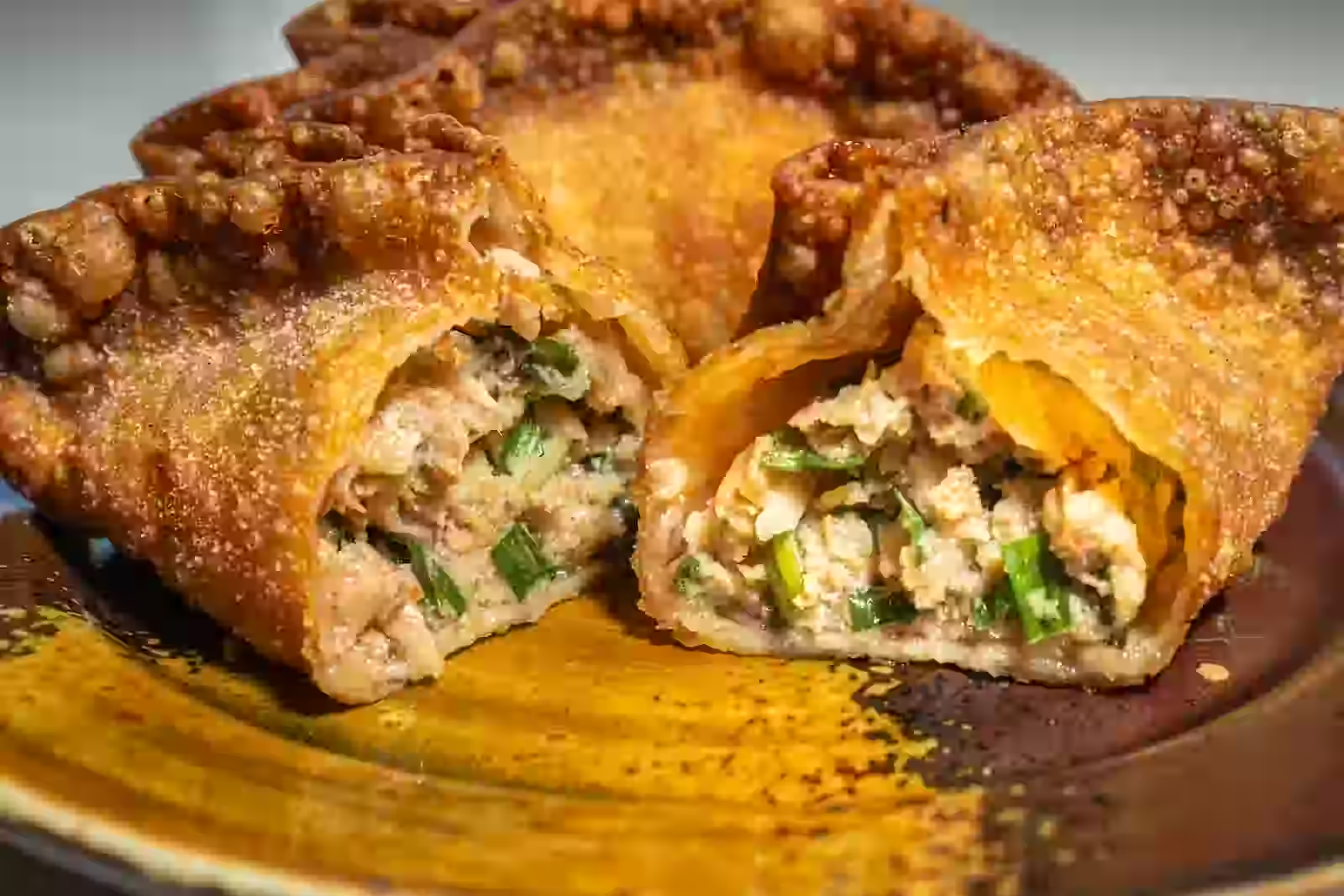
Tsu Gyoza (津ぎょうざ) is a giant deep-fried dumpling from Tsu City, the capital of Mie Prefecture. Each one uses a custom wrapper 15 centimeters across, so a single piece replaces about three ordinary gyoza. It began in school lunches rather than restaurants, which is unusual for a Japanese regional specialty.
Most gyoza in Japan arrive small, pan-fried, and lined up in neat rows. Tsu Gyoza breaks all three habits at once. It lands on the plate looking more like a golden pastry, and I laughed the first time one turned up in front of me.
What Is Tsu Gyoza?
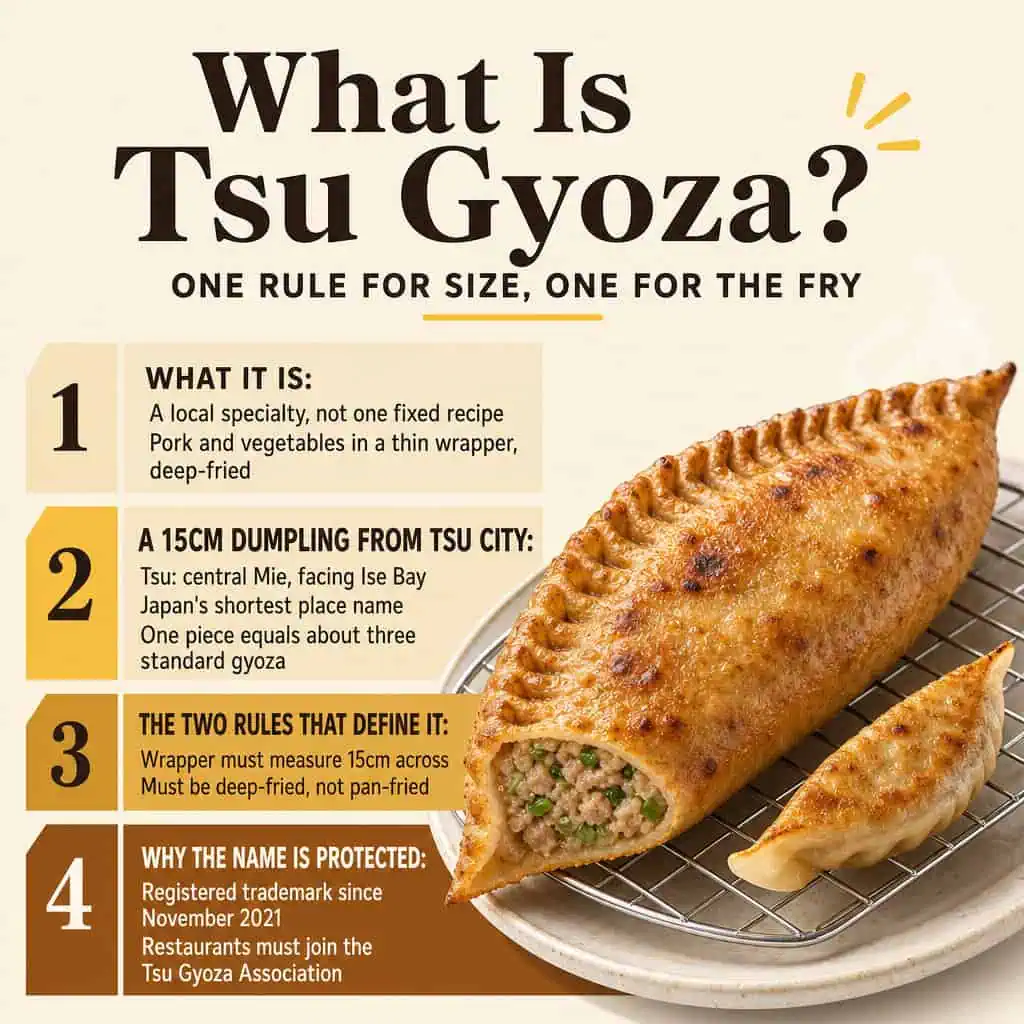
Tsu Gyoza is a local specialty rather than one fixed recipe. Cooks fill a large, thin wrapper with pork and vegetables, then fry the whole thing in oil until it crisps. Because the filling follows no rules, every shop in town tastes a little different.
A 15-Centimeter Dumpling from Tsu City
Tsu sits in central Mie, facing Ise Bay, south of Nagoya. Japanese people also know the city for having the shortest name in the country, since it is written with the single character 津. The wrapper measures 15 cm across, roughly the width of an adult hand. So one piece delivers about the same volume as three standard gyoza.
The Two Rules That Define It
A local volunteer group called Tsu Gyoza Elementary School narrowed the definition down to two points, which keeps things refreshingly simple.
- Rule 1: the wrapper must measure 15 centimeters in diameter.
- Rule 2: the gyoza must be deep-fried, not pan-fried.
Everything else stays open. Shops choose their own filling, seasoning, and dipping sauce, so comparing two or three places makes a genuinely different meal each time.
Why the Name Is Protected
Japan registered Tsu Gyoza as a regional collective trademark on 30 November 2021. An NPO set up by the two local promotion groups holds the right. So restaurants cannot sell it without joining the Tsu Gyoza Association first. That sounds strict, though it guards a dish that started as public property in a school kitchen.
How Tsu Gyoza Differs from Regular Gyoza
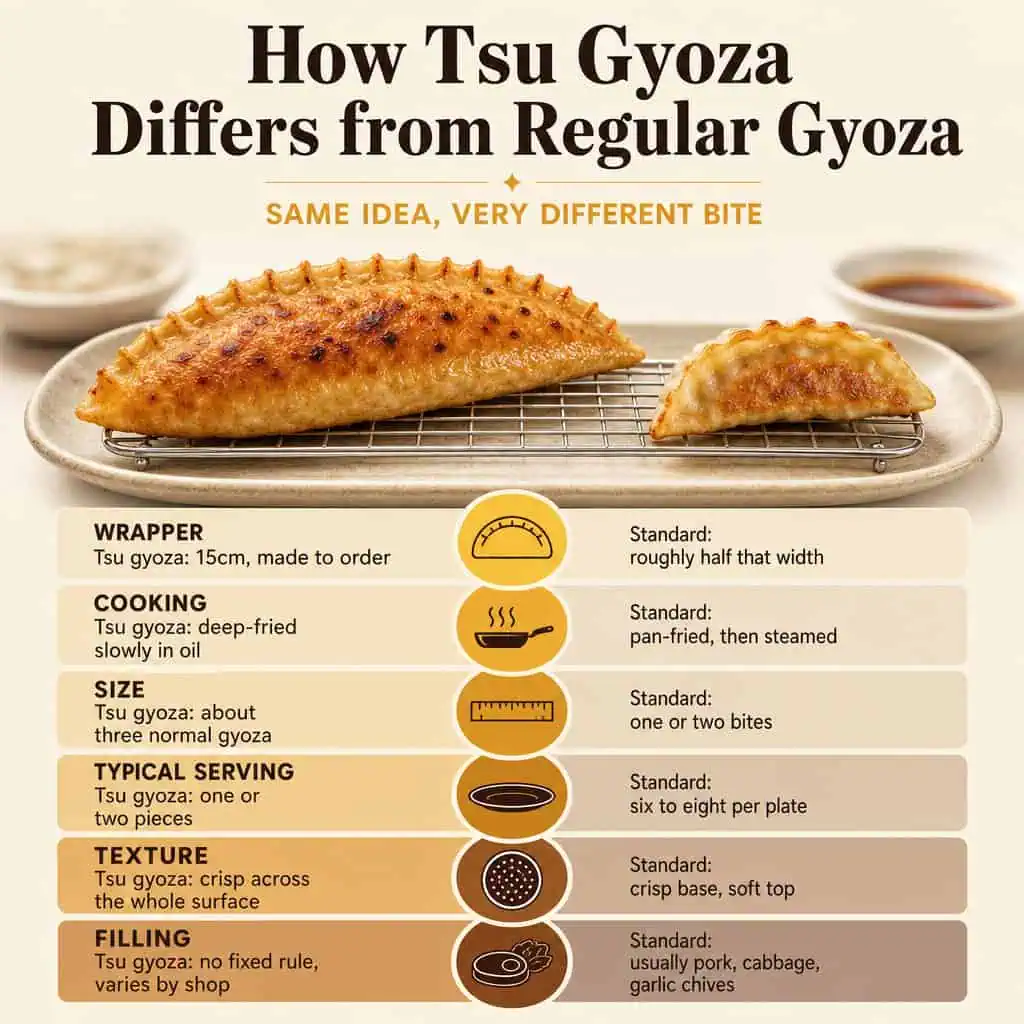
| Feature | Tsu Gyoza | Standard Japanese gyoza |
|---|---|---|
| Wrapper | 15 cm, made to order | Roughly half that width |
| Cooking | Deep-fried slowly in oil | Pan-fried, then steamed |
| Size | About three normal gyoza | One or two bites |
| Typical serving | One or two pieces | Six to eight per plate |
| Texture | Crisp across the whole surface | Crisp base, soft top |
| Filling | No fixed rule, varies by shop | Usually pork, cabbage, garlic chives |
The cooking method matters most. Pan-frying gives you two textures in one bite, crisp underneath and soft on top. Deep-frying, by contrast, treats the whole wrapper the same way.
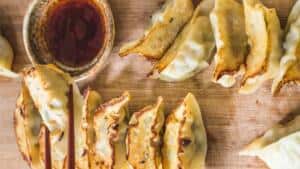
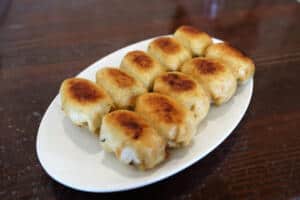
Shape gives it away as well. Standard gyoza get folded into a crescent, with pleats running along one edge. The pieces in the photographs here are gathered into a pouch instead, and the wrapper edges stand up in stiff ruffles. Hot oil also leaves the surface blistered and pebbled rather than smooth.
Gyoza itself descends from Chinese jiaozi, which Japan reworked into a pan-fried, garlic-forward dish after the war. Food researchers describe that shift as a national reinterpretation rather than a copy. Tsu simply pushed the idea one step further. For the wider family of styles, see our Japanese gyoza guide, or compare it with Utsunomiya gyoza and Hamamatsu gyoza.
From School Lunch to Local Icon
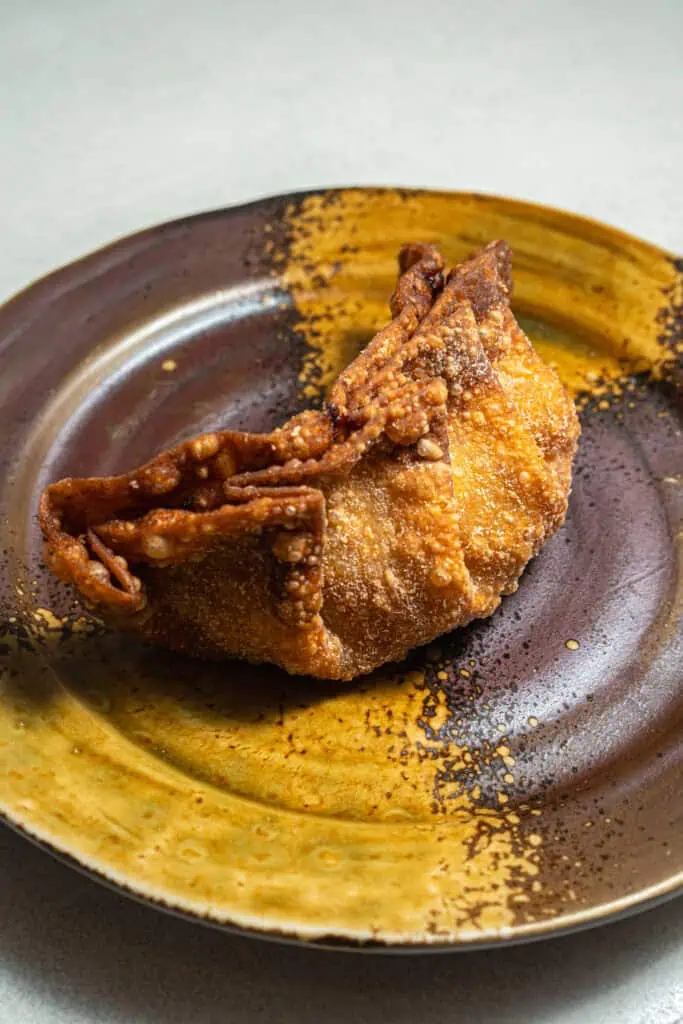
Born in a School Kitchen Around 1985
Nutritionists at the Tsu City Board of Education designed the dish for school lunches. They wanted one item that carried plenty of nutrition, worked inside a school kitchen, and genuinely excited children. Wrapping hundreds of small gyoza by hand took far too long, however. So the team went big instead, and this oversized fried gyoza appeared on lunch trays.
A practical origin, not a culinary one: the size came from kitchen labor, not from chefs chasing impact. Fewer pieces meant less folding, and deep-frying cooked everything at once. The visual drama arrived as a side effect.
The 2008 Festival That Changed Everything
For roughly twenty years, only schoolchildren ate it. Adults remembered the taste, yet no restaurant sold it. Then a citizens’ group tried selling Tsu Gyoza at Tsu Matsuri, one of the prefecture’s largest festivals, in October 2008. All 400 pieces sold out over two days. Around twenty local restaurants put it on the menu that November.
Awards and National Recognition
Momentum kept building afterward. In 2019, the volunteer group Tsu Gyoza Elementary School took the Gold Grand Prix at the B-1 Grand Prix in Akashi. The association later announced certification under the Agency for Cultural Affairs “100 Year Food” programme, which recognises dishes a community intends to carry forward. Meanwhile it still ranks at or near the top of local school lunch popularity surveys.
What Does Tsu Gyoza Taste Like?
The first bite is loud. The wrapper shatters rather than yields, and steam escapes straight away. Honestly, I expected something heavy, since deep-fried food usually sits like a brick. It did not.
Slow frying at a low oil temperature keeps the wrapper thin and dry instead of greasy. Inside, the filling stays juicy, and pork fat mixes with the vegetable moisture. Garlic chives push through the aroma first, followed by hot oil and a faint toastiness from the wrapper.
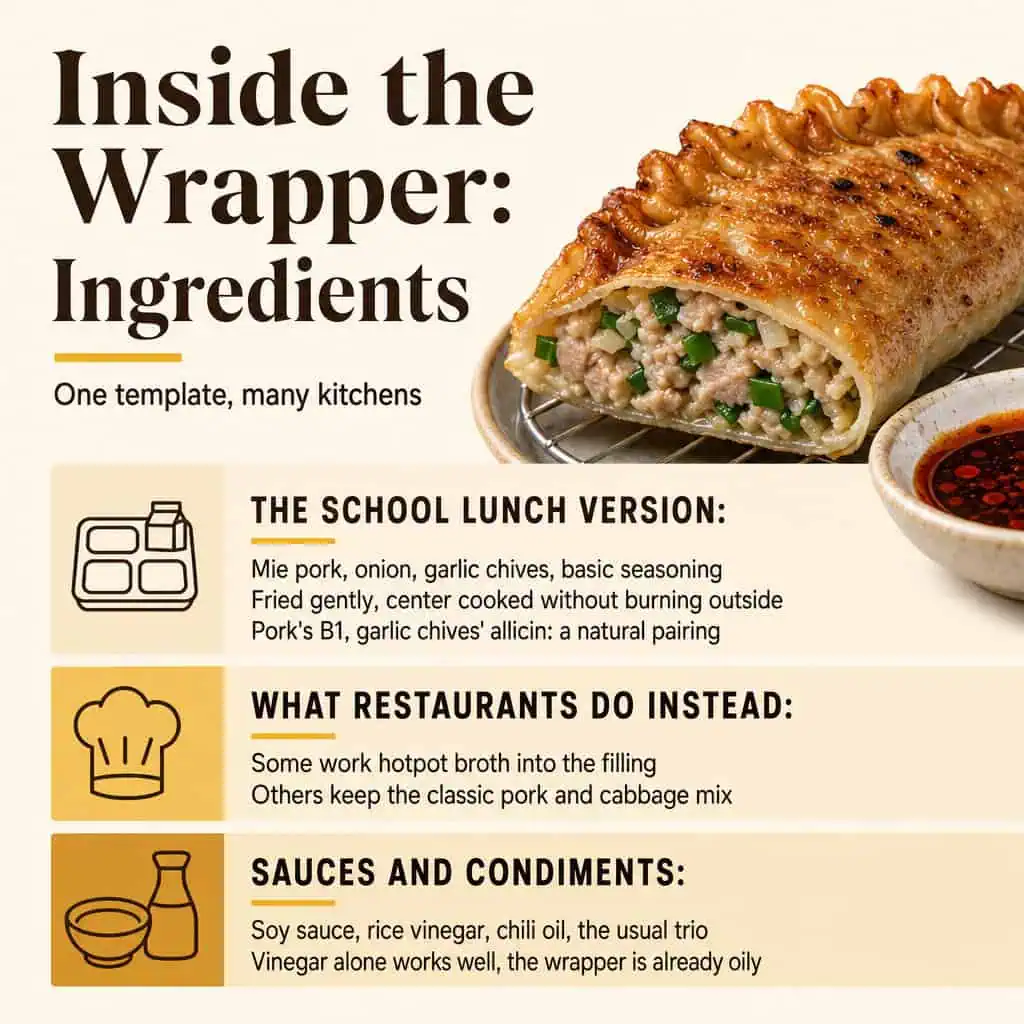
Cut one open and the filling reads clearly. Ground pork, chopped garlic chives, and pale shredded vegetables sit in a loose, moist mass. The wrapper stays thin where it wraps the filling, though it puffs and separates into layers near the folds.
Texture shifts as you work across the piece. Edges stay brittle, while the middle softens where the wrapper meets the filling. That contrast is the whole appeal. Whether one piece counts as a snack or a meal, though, still depends on your appetite, and I got that wrong the first time.
Inside the Wrapper: Ingredients
The School Lunch Version
School kitchens keep the sourcing local. The filling combines Mie-raised pork, onion, garlic chives, and basic seasonings. Cooks then fry it gently so the center reaches full temperature without burning the outside. A registered dietitian quoted by the agriculture ministry notes a neat pairing here. Pork supplies vitamin B1, while garlic chives contain allicin, which supports its absorption.
What Restaurants Do Instead
Shops treat the two rules as a starting line. Mie’s tourism federation has reported on a sumo-cuisine restaurant in Tsu that works its own hotpot broth into the filling, which builds a deeper savory base. Others stay closer to the classic pork and cabbage mix. Since nobody has to follow a template, comparing shops is half the fun.
Sauces and Condiments
Most tables carry the usual gyoza trio: soy sauce, rice vinegar, and chili oil. Vinegar on its own works surprisingly well here, because the wrapper already carries oil. Ask what the shop suggests, though, since house sauces differ from place to place.
How Tsu Gyoza Is Cooked
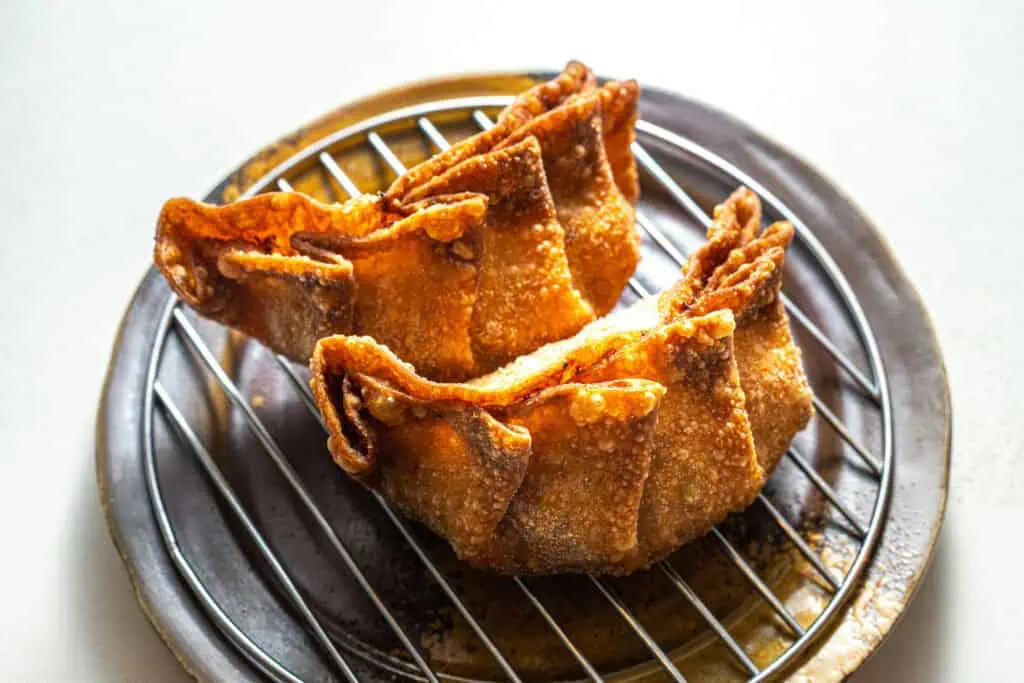
The method looks simple on paper. Getting the oil temperature right is the hard part.
- Mix ground pork with chopped vegetables and seasonings.
- Spread the filling across a 15 cm wrapper, keeping it flat.
- Fold and seal the edge firmly, so nothing leaks during frying.
- Fry slowly at a low temperature, since the ministry description stresses gentle heat rather than a fast, hot fry.
- Drain well, then serve immediately while the wrapper still crackles.
One published wrapper-maker recipe suggests around 160°C as a home guideline. High heat browns the outside before the filling cooks, which is exactly the trap. Low and patient wins.
Where to Eat Tsu Gyoza in Tsu City
Start at Tsu Station
The Tsu Gyoza Association keeps its office inside the Tsu City Tourism Association, in the Ast Tsu building beside Tsu Station. That makes the station a sensible first stop. Patent Office material describes more than thirty shops serving it in the city, and the association publishes the current list online, which is the figure worth trusting.
What to Expect at the Shops
Venues range widely, from ramen shops and izakaya to hot spring inns and food trucks. Some offer takeaway, while others sell frozen packs to take home. Opening hours change often, so checking ahead saves a wasted trip. Only member shops may use the name legally, and they display a certificate.
Events and Festivals
Tsu Matsuri in October remains the natural showcase, since that festival launched the whole revival. The association has also joined regional B-1 events and sponsored a Tsu Gyoza speed-eating contest at the station-front street festival. Editions have been cancelled in some years, however, so confirm current dates before planning around one.
Can You Make Tsu Gyoza at Home?
What You Need
Ground pork, cabbage or onion, garlic chives, garlic, ginger, and soy sauce cover the basics. The wrapper is the only real obstacle. Standard supermarket wrappers run roughly half the required size, so you will need large ones.
If You Cannot Find 15 cm Wrappers
Outside Japan, large gyoza wrappers rarely appear in shops. Spring roll wrappers make a reasonable substitute, although the texture turns lighter and less chewy. Rolling your own dough works too, but expect a slower afternoon. Either way, seal the edge tightly, because a leak in hot oil ends badly.
One Thing to Remember
Cooking it at home is completely fine. Selling it under the name is not, thanks to the trademark. Anyone planning a commercial version needs permission from the association in Tsu.
Other Foods to Try in Mie Prefecture
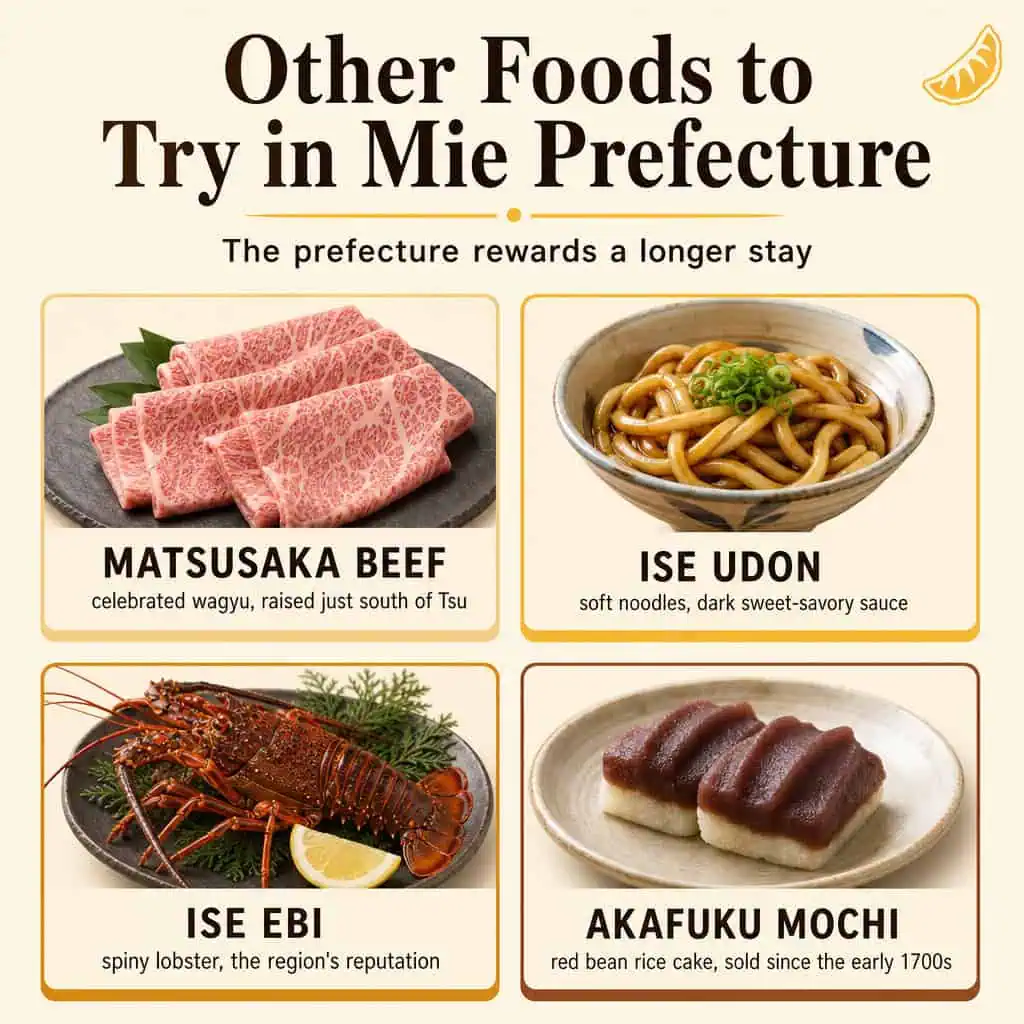
Mie rewards a longer stay, and Tsu makes a practical base. The prefecture stretches from Ise Grand Shrine down to the citrus country of the far south, so the food changes as you travel.
- Matsusaka beef: one of Japan’s most celebrated wagyu brands, raised just south of Tsu.
- Ise udon: unusually soft noodles in a dark, sweet-savory sauce, served near Ise Grand Shrine.
- Ise ebi: the spiny lobster that gave the region part of its culinary reputation.
- Akafuku mochi: a red bean and rice cake sweet sold in Ise since the early 1700s.
For a broader route through the region, our Kansai food guide maps out the rest.
Conclusion
Tsu Gyoza did not come from a famous chef or an old family recipe. It came from a school kitchen trying to feed children efficiently, which is a rare origin story for regional food anywhere.
That history still shows on the plate. The dish is big, cheerful, and slightly ridiculous in the best way. If your route through Japan passes Nagoya or Ise, Tsu deserves an hour, and a single gyoza will probably do.
Tsu Gyoza FAQ
What is Tsu Gyoza?
Tsu Gyoza is a giant deep-fried dumpling from Tsu City in Mie Prefecture. Cooks use a custom wrapper 15 centimeters wide, then fry it in oil. One piece equals roughly three ordinary gyoza. The dish began as a school lunch item and later became the city’s signature local food.
Why is Tsu Gyoza so big?
The size solved a practical kitchen problem. School cooks had to fold gyoza by hand for hundreds of children every day. Larger wrappers meant fewer pieces and far less folding time. So the giant format came from labor and timing rather than showmanship.
Is Tsu Gyoza deep-fried or pan-fried?
Deep-fried, always. That is one of only two rules that define the dish, alongside the 15 cm wrapper. Cooks fry it slowly at a low oil temperature so the filling cooks through. A pan-fried version, however impressive, would not qualify as Tsu Gyoza.
Did Tsu Gyoza really start as a school lunch?
Yes, and that origin is well documented. Nutritionists at the Tsu City Board of Education created it around 1985 for school meals. For about two decades, only pupils ate it. Restaurants started selling it in late 2008, after a festival trial run sold out in two days.
Is Tsu Gyoza suitable for vegetarian, halal, or gluten-free diets?
Usually not, on all three counts. The wrapper is wheat-based, the standard filling contains pork, and garlic appears in most versions. Shops set their own recipes, so ingredients vary and no blanket answer applies. Ask the individual restaurant directly if you follow a specific diet.
Where can I eat Tsu Gyoza in Tsu City?
Dozens of registered shops serve it around Tsu. The Tsu Gyoza Association office sits inside the Tsu City Tourism Association next to Tsu Station, so that area works as a starting point. Only member shops may use the name. Check the association’s current list and opening hours first.
What sauce goes with Tsu Gyoza?
Soy sauce, rice vinegar, and chili oil cover the standard setup. Vinegar alone suits this dish nicely, since the fried wrapper already brings richness. Some shops serve their own house sauce instead. Asking the staff is the simplest approach, and they usually enjoy the question.
Can I make Tsu Gyoza at home?
Cooking it at home is fine, though the wrapper is the sticking point. Standard supermarket wrappers measure about half the required width. Spring roll wrappers work as a substitute, with a lighter texture. Selling it commercially under the name, however, requires permission because of the regional trademark.
References
- Ministry of Agriculture, Forestry and Fisheries, School Lunches of Mie Prefecture: Tsu Gyoza (aff, September 2020) (Surveyed: August 2026)
- Japan Patent Office, Regional Collective Trademark Registration No. 6478405 “Tsu Gyoza” (Surveyed: August 2026)
- Tsu Gyoza Association, Official Site and Shop List (Surveyed: August 2026)
- Tsu Gyoza Elementary School, What Is Tsu Gyoza (Surveyed: August 2026)
- Mie Prefecture Tourism Federation, Four Great Shops for Tsu Gyoza (Surveyed: August 2026)
- Agency for Cultural Affairs, 100 Year Food Project (Surveyed: August 2026)
- Tokyo Tenryu Co., Ltd., Tsu Gyoza Recipe Using 15 cm Wrappers (Surveyed: August 2026)
- Xu Hangming, “Gyoza: A Dumpling Innovation”, Digest: A Journal of Foodways and Culture, Vol. 4 No. 1, 2015 (Surveyed: August 2026)
- Photo credit: ©Mie Prefecture Tourism Federation, Kanko Mie
Related Articles
- Gyoza (餃子) Japanese Dumpling Guide (Surveyed: August 2026)
- Utsunomiya Gyoza (宇都宮餃子) (Surveyed: August 2026)
- Hamamatsu Gyoza (浜松餃子) (Surveyed: August 2026)
- Tetsunabe Gyoza (鉄鍋餃子) (Surveyed: August 2026)
- White Gyoza (ホワイト餃子) (Surveyed: August 2026)
- Kobe Miso Gyoza (味噌だれ餃子) (Surveyed: August 2026)
- Matsusaka Beef (松阪牛) (Surveyed: August 2026)
- Ise Udon (伊勢うどん) (Surveyed: August 2026)
- Ise Ebi (伊勢海老) (Surveyed: August 2026)
- Akafuku (赤福) (Surveyed: August 2026)
- The Complete Kansai Food Guide (Surveyed: August 2026)




Comments