



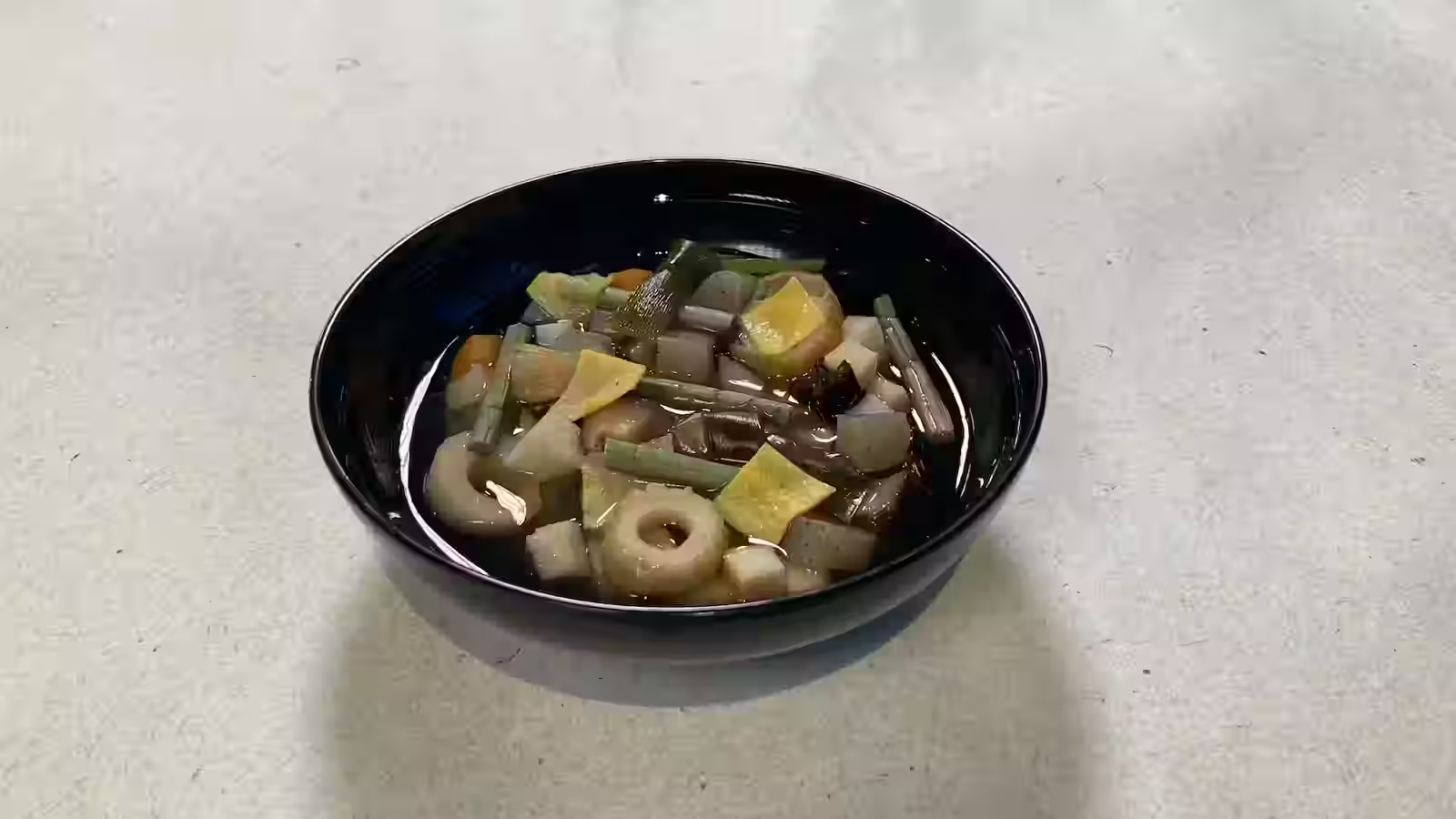
Some dishes tell you almost nothing about where they come from. Kozuyu is not one of them. Lift the small red lacquer bowl, taste the broth, and the whole story of Aizu arrives in a few mouthfuls. Picture a snowbound inland basin, no fresh fish worth speaking of, and a stubborn tradition of feeding guests properly.
Visitors to Fukushima usually hear about Kitakata ramen first. Kozuyu sits further back, quieter, and honestly a little harder to find. Yet in Aizu households it still carries more weight than almost anything else on the table. This guide covers what the soup contains, why it appears at weddings and funerals alike, and how to make a decent version at home.
Quick orientation: Kozuyu (こづゆ) is a clear, dried-scallop soup from the Aizu region of Fukushima Prefecture. Japan’s Ministry of Agriculture, Forestry and Fisheries lists it as a regional dish of Aizu excluding the Minami-Aizu area. It also holds two national designations: a place in the “100 Local Dishes of Rural Japan” selection, and certification by the Agency for Cultural Affairs as a “100-Year Food” in the traditional category.
What Is Kozuyu?
A Clear Soup Built on Dried Scallops
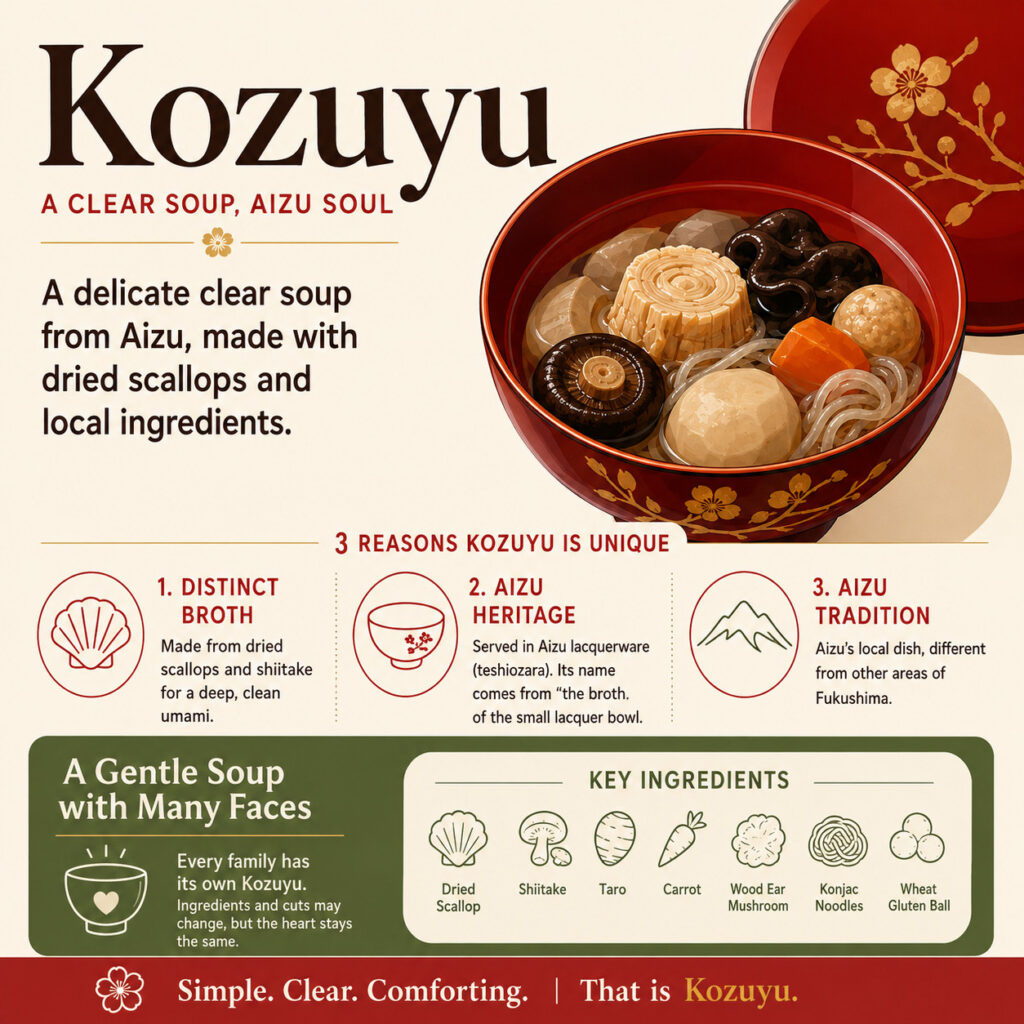
Kozuyu starts with dried scallop adductor muscle, soaked overnight until it softens and shreds. That soaking liquid becomes the backbone of the broth. Cooks then add dried shiitake and its soaking water, so the umami arrives from two directions at once.
Into that broth go taro, carrot, wood ear mushroom, konjac noodles and small wheat gluten balls. Soy sauce and salt finish the seasoning, but lightly. The point is never a heavy soup; the point is letting each ingredient stay recognisable.
Where the Name Comes From
Aizu produces a famous red lacquerware called Aizu-nuri. Kozuyu arrives in a shallow version of it, known locally as a teshiozara. According to the agriculture ministry, “kojū no tsuyu”, roughly the broth of the small lacquer vessel, gradually slurred into “kozuyu”.
Older records suggest the naming settled fairly late. Before that, people called the dish jū or ōhira, and it came out in two separate bowls rather than one. That double-bowl format persisted until roughly the late 1980s.
Why It Belongs to Aizu Rather Than All of Fukushima
Fukushima splits into three very different zones: Hamadori on the coast, Nakadori in the middle, and Aizu in the mountainous west. Each zone eats differently, so a single “Fukushima cuisine” barely exists. Kozuyu belongs firmly to Aizu.
Nearby Koriyama has its own close relative called tsuyuju, and a rougher home-style cousin called zakuzaku turns up elsewhere in the prefecture. Zakuzaku leans on niboshi stock instead of scallop, and the vegetables come cut chunkier. Confusingly, some communities apply the word zakuzaku to Kozuyu itself and treat the two as one dish.
Household variation runs deep as well. Cutting styles, ingredient lists and seasoning all shift from family to family, and the agriculture ministry notes that some households once slipped in rolled omelette. So there is no single correct Kozuyu, only a recognisable shape.
The History Behind Kozuyu
From Samurai Banquet Dish to Family Table
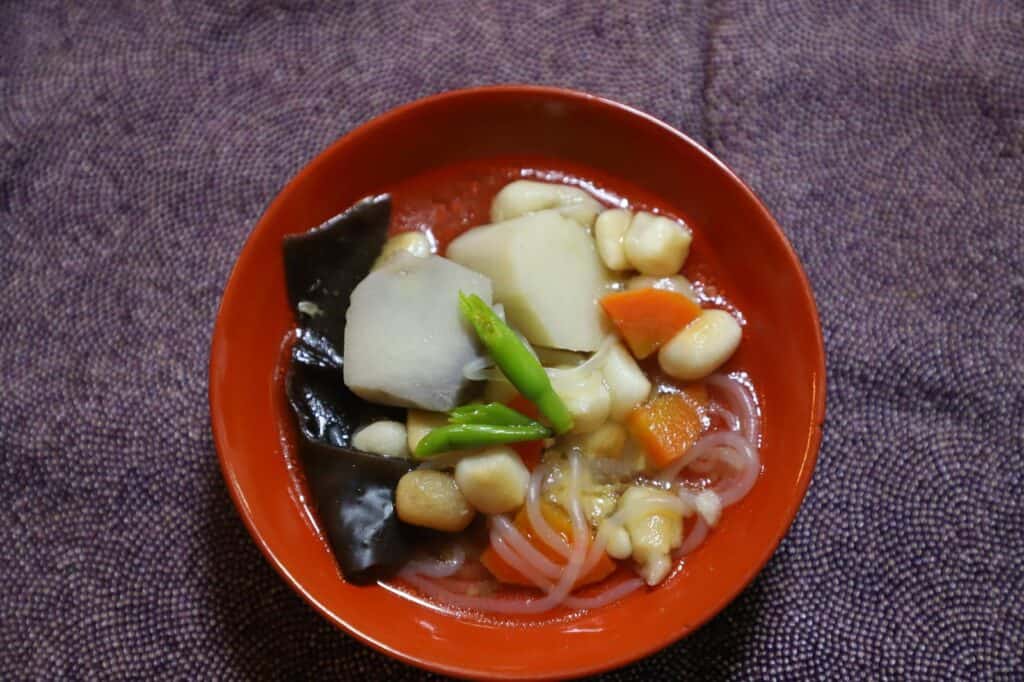
The commonly repeated origin story traces Kozuyu back to a formal Aizu domain banquet dish called jū. Samurai households served it first, since dried seafood cost real money in a landlocked province. Ordinary families ate nothing like it.
Distribution improved through the late Edo and early Meiji years. As dried goods became easier to buy, the soup spread outward from the warrior class. By the end of the Meiji period, the version we recognise today had more or less settled into shape.
Kitamaebune and the Dried Seafood Trade
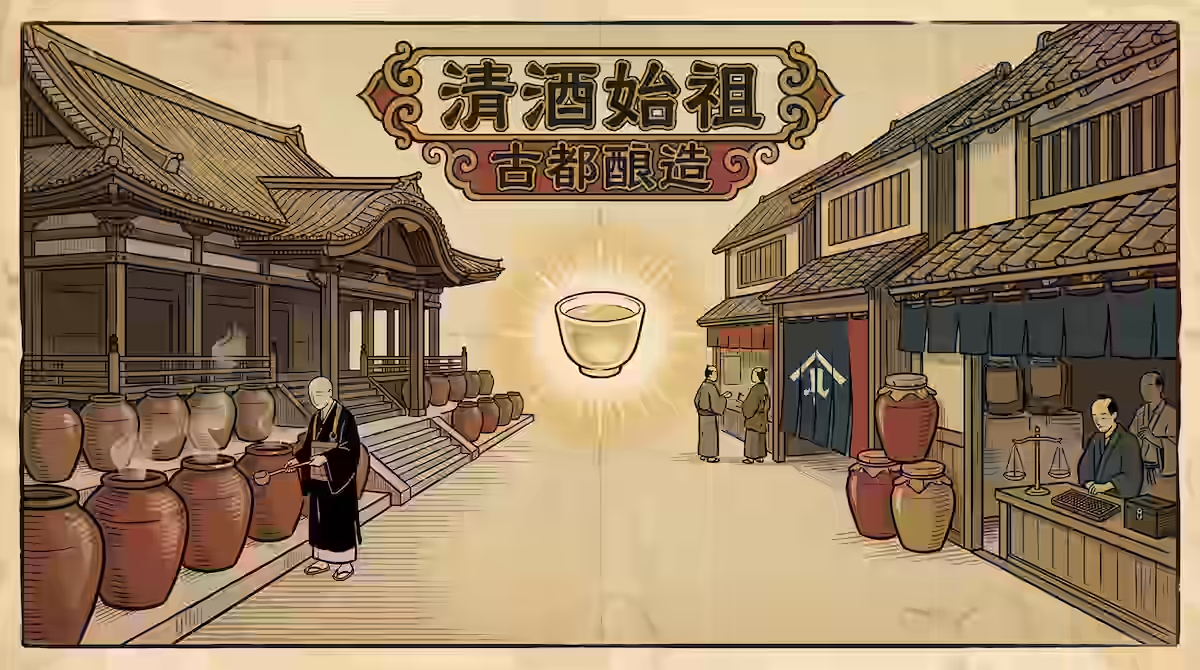
Aizu sits behind two mountain ranges, with heavy winter snow and no coastline. Fresh fish simply could not survive the journey. Preserved seafood could, though, and the Kitamaebune coastal trading ships carried it south from Hokkaido.
Dried scallop, dried herring and rock-dried cod all reached Aizu this way. Consequently, an inland region ended up with a marine-flavoured festive cuisine. Kozuyu is the clearest surviving example of that trade route on a plate.
How the Modern Bowl Took Shape
Historically, hosts brought the soup out in a large lidded vessel called an ōhira, measuring 35 to 40 centimetres across. From there they ladled portions into the small shallow teshiozara. Guests could then keep going for as long as they liked.
Around the 1980s the two-bowl service faded, and the single-bowl “Kozuyu” became standard. Something was probably lost in that simplification. Still, the refill custom survived, which matters more than the crockery.
Kozuyu and Aizu’s Ceremonial Food Culture
Hare no Hi: Japan’s Special-Occasion Days
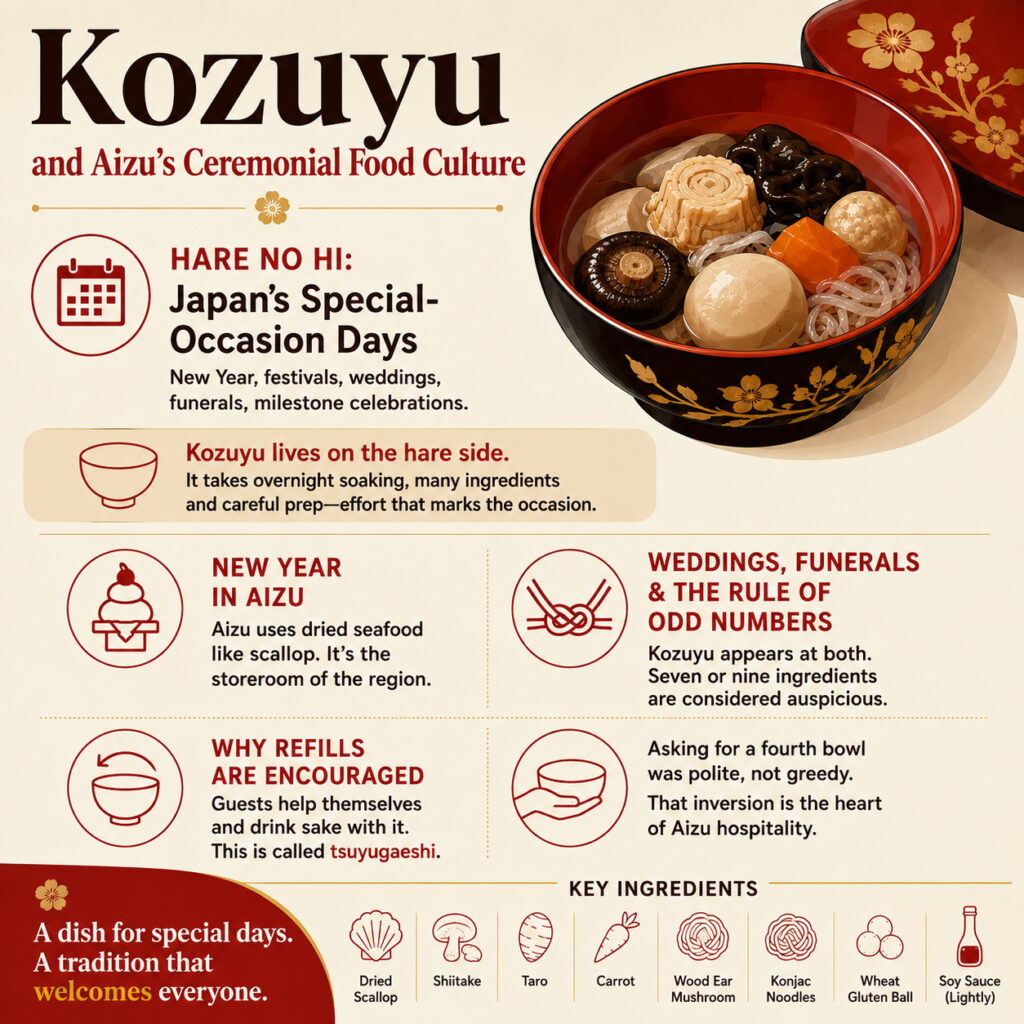
Japanese food culture draws a line between hare and ke. Hare no hi means the marked days: New Year, festivals, weddings, funerals, milestone celebrations. Ke covers everything ordinary in between.
Kozuyu lives almost entirely on the hare side. Nobody in Aizu cooks it on a Tuesday evening. Because it demands overnight soaking, seven or nine prepared ingredients and a fair amount of knife work, the effort itself signals the occasion.
New Year in Aizu
A 2021 study of Fukushima event foods, presented to the Japan Society of Cookery Science, found clear regional patterns across the prefecture. Aizu households leaned on dried seafood for New Year cooking, adding dried scallop even to their zoni. Kozuyu appeared alongside dishes using rock-dried cod and dried herring.
That pattern makes intuitive sense once you see the geography. Coastal Hamadori used fresh fish, Nakadori used river fish, and Aizu used the storeroom.
Weddings, Funerals and the Rule of Odd Numbers
Kozuyu turns up at weddings and at funerals, which strikes some visitors as odd. In Japanese ceremonial cooking, though, the same dish frequently serves both. What matters is the gathering, not its mood.
Cooks traditionally use seven or nine ingredients. Odd numbers cannot be divided evenly, so they read as auspicious. It sounds like superstition, and perhaps it partly is, yet almost every household still follows the rule.
Why Refills Are Encouraged
Here is the detail that explains Aizu hospitality better than any brochure. Formal banquet trays were once taken home largely untouched, so guests barely ate at the table. Kozuyu escaped that rule entirely.
People drank sake with it and helped themselves repeatedly, a practice locals call tsuyugaeshi. Asking for a fourth bowl was polite rather than greedy. Honestly, that inversion of normal Japanese table manners is my favourite thing about the dish.
Kozuyu and Aizu Craft Culture
Served in Aizu Lacquerware
Aizu-nuri lacquerware has been produced in the Aizu basin for centuries, and Kozuyu is arguably its most famous dining partner. The specific vessel, a shallow red dish called a teshiozara, also answers to kaishiki or suigasa depending on who you ask.
Aesthetically the pairing works hard. Red lacquer flatters a pale broth, and the orange carrot and dark kikurage sharpen against it. Practically, the shallow shape cools each portion fast, which matters when guests are taking four or five servings.
Food, Hospitality and Local Craftsmanship
Few Japanese dishes bind a recipe to a craft this tightly. Remove the lacquer bowl and the soup still tastes fine, yet something in the ritual disappears. Even the name points at the vessel rather than the contents, which tells you where the emphasis sat.
Modern souvenir sets lean on that connection. Producers now bundle retort Kozuyu together with a teshiozara, effectively selling the craft alongside the food. Purists may raise an eyebrow, although the packaging does preserve the pairing.
What Goes Into a Bowl of Kozuyu
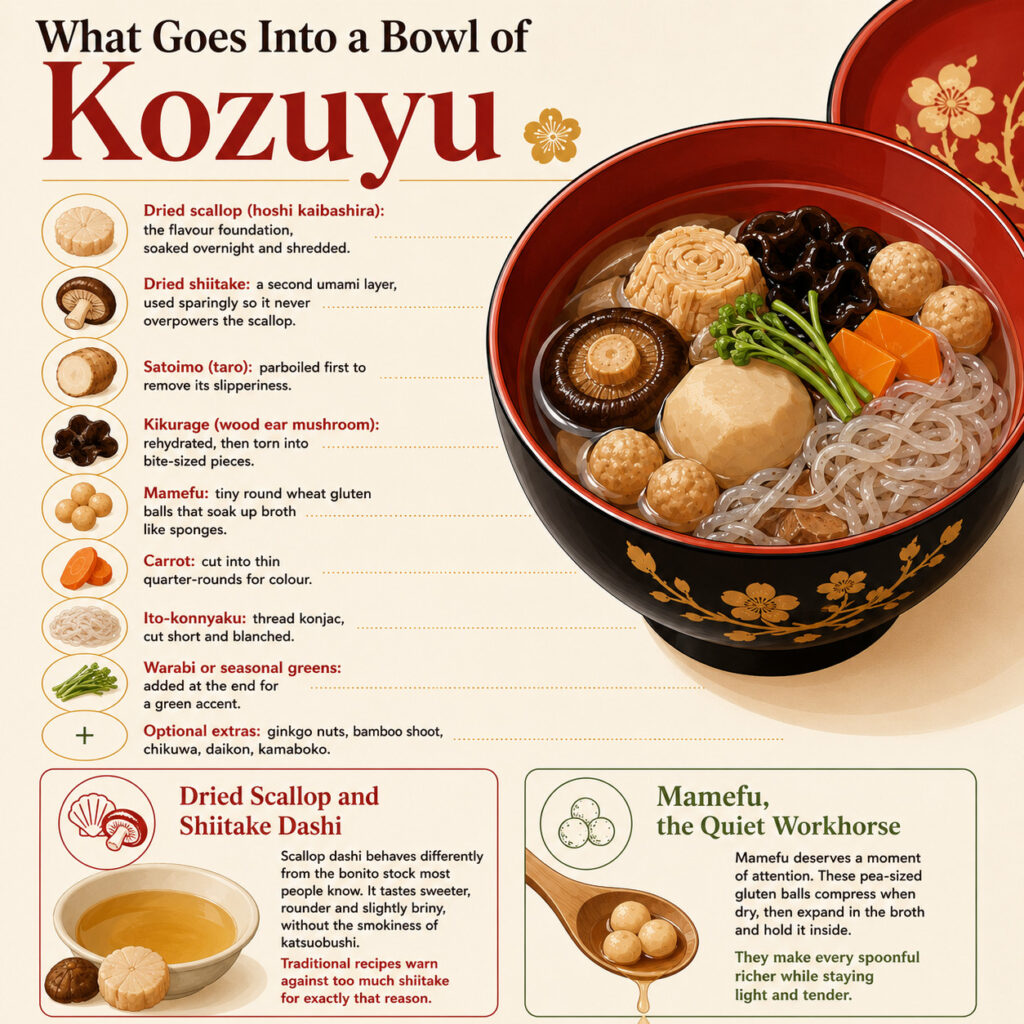
- Dried scallop (hoshi kaibashira): the flavour foundation, soaked overnight and shredded.
- Dried shiitake: a second umami layer, though used sparingly so it never overpowers the scallop.
- Satoimo (taro): parboiled first to remove its slipperiness.
- Kikurage (wood ear mushroom): rehydrated, then torn into bite-sized pieces.
- Mamefu: tiny round wheat gluten balls that soak up broth like sponges.
- Carrot: cut into thin quarter-rounds for colour.
- Ito-konnyaku: thread konjac, cut short and blanched.
- Warabi or seasonal greens: added at the end for a green accent.
- Optional extras: ginkgo nuts, bamboo shoot, chikuwa, daikon, kamaboko.
Dried Scallop and Shiitake Dashi
Scallop dashi behaves differently from the bonito stock most people know. It tastes sweeter, rounder and slightly briny, without the smokiness of katsuobushi. Traditional recipes warn against too much shiitake for exactly that reason.
Mamefu, the Quiet Workhorse
Mamefu deserves a moment of attention. These pea-sized gluten balls contribute almost no flavour of their own, yet they carry broth beautifully and add a soft bounce. Wheat gluten has fed Japanese temple kitchens for centuries, so its presence here is no accident.
What Does Kozuyu Taste Like?
A Light Broth With Deep Umami
First impressions can be underwhelming, and I think that is worth admitting. The broth looks pale, almost thin. Then the scallop registers, sweet and marine, and the whole bowl suddenly makes sense.
Seasoning stays deliberately restrained. Aizu cooks want the dashi audible, so they hold back on soy sauce. Anyone expecting the salt punch of a ramen broth may need a second bowl before the flavour lands.
Texture Doing the Heavy Lifting
Because the flavour runs gentle, texture carries a lot of the interest. Taro turns creamy, kikurage stays crunchy, and konjac threads slip around. Meanwhile the mamefu go soft and heavy with broth.
Everything arrives cut small, roughly one bite each. That uniformity looks decorative, yet it also lets a single spoonful contain the entire dish.
How It Compares to Other Japanese Soups
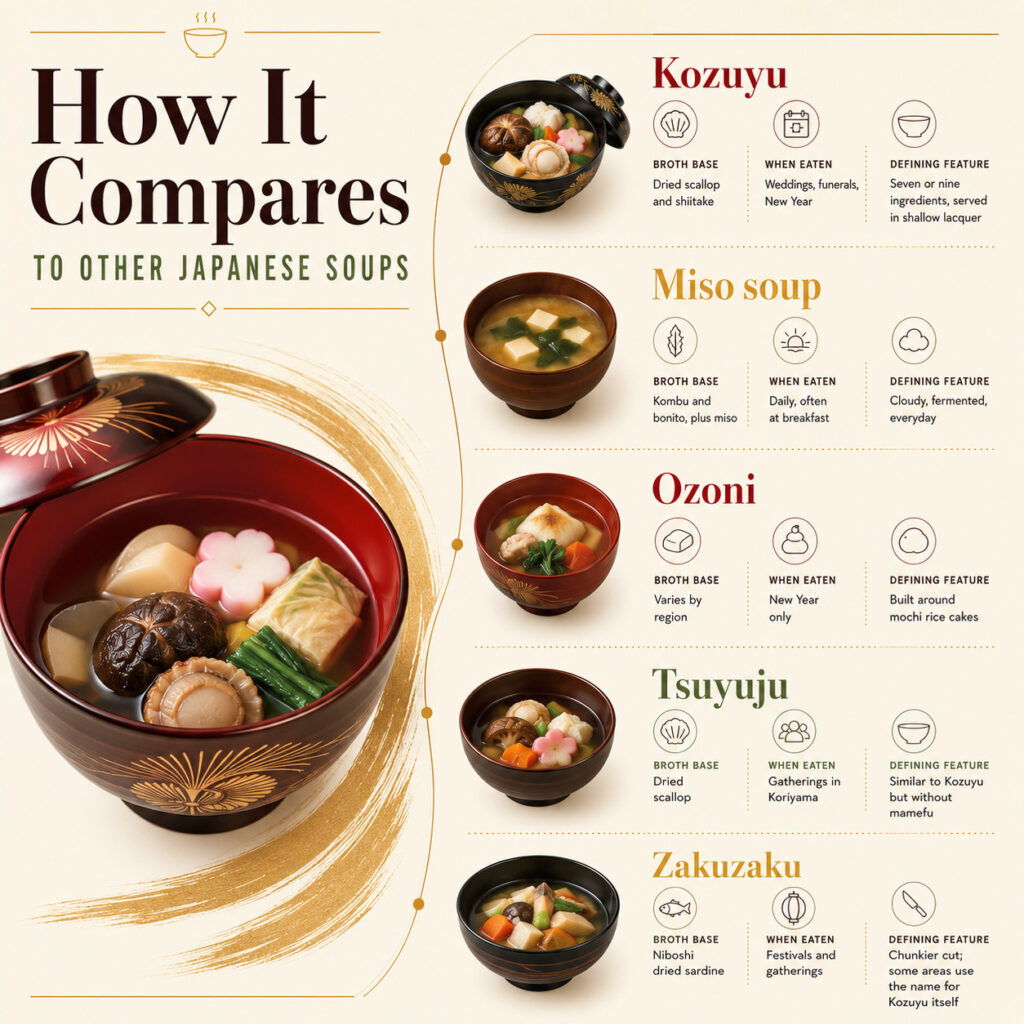
| Soup | Broth base | When eaten | Defining feature |
|---|---|---|---|
| Kozuyu | Dried scallop and shiitake | Weddings, funerals, New Year | Seven or nine ingredients, served in shallow lacquer |
| Miso soup | Kombu and bonito, plus miso | Daily, often at breakfast | Cloudy, fermented, everyday |
| Ozoni | Varies by region | New Year only | Built around mochi rice cakes |
| Tsuyuju | Dried scallop | Gatherings in Koriyama | Similar to Kozuyu but without mamefu |
| Zakuzaku | Niboshi dried sardine | Festivals and gatherings | Chunkier cut; some areas use the name for Kozuyu itself |
How to Make Kozuyu at Home
Preparing the Scallop Dashi
Start the night before. Cover two dried scallops with a cup of water and leave them at room temperature or in the fridge. Next morning, shred the softened scallop by hand and keep every drop of that liquid.
Soak the dried shiitake separately, then strain its liquid through a fine sieve. Grit hides in dried mushrooms more often than people expect.
A Basic Method for Four People
- Cut carrot and taro into thin quarter-rounds. Parboil the taro briefly with a pinch of salt, then rinse off the sliminess.
- Tear rehydrated kikurage into small pieces. Dice the shiitake, cut the konjac threads to about one centimetre, and drain the soaked mamefu.
- Bring the scallop liquid, shiitake liquid and roughly four cups of light dashi to a boil.
- Add carrot, kikurage and konjac. Once the carrot softens, add the taro and simmer until tender.
- Season with one to two tablespoons of soy sauce plus a splash of sake. Taste before adding salt.
- Drop in the mamefu last, return to a brief boil, and serve. Finish each bowl with blanched greens.
Substitutions Outside Japan
Dried scallop appears in most Chinese groceries, usually labelled conpoy, and it stores for months. If you cannot find it, dried shrimp gets you partway there. The result tastes different, though nobody at the table will complain.
Practical tip: taro can be swapped for waxy potato at a pinch, and small dumplings of wheat gluten sold as fu work in place of mamefu. Wood ear mushrooms sit in the dried section of almost every Asian supermarket.
Can Kozuyu Be Vegetarian?
Not in its traditional form, since the scallop is the entire point. A plant-based version built on kombu and generous shiitake still tastes good, however. Call it kozuyu-style rather than kozuyu, and everyone stays happy.
Where to Try Kozuyu in Fukushima
Aizu-Wakamatsu and the Surrounding Area
Aizu-Wakamatsu makes the obvious base. Traditional restaurants around the castle district and Nanokamachi often list Kozuyu as part of a set meal, frequently beside wappa meshi or nishin no sanshozuke. Ryokan in the nearby Higashiyama and Ashinomaki hot spring areas serve it too.
One detail I find satisfying: several long-standing Aizu restaurants began life as marine-products wholesalers. Shibukawa Donya near Nanokamachi Station, founded in 1882, is the best known example. That business history sits directly on top of the trade route that made Kozuyu possible.
Because Kozuyu is an occasion dish rather than a daily one, availability varies by season and by restaurant. Please confirm menus, prices and opening hours directly before travelling.
Taking Kozuyu Home
Souvenir shops and station stores stock shelf-stable retort pouches, which travel well and need only reheating. Local manufacturers in Aizu-Wakamatsu also produce them alongside botara-ni and nishin no sanshozuke. For a gift, the boxed sets that include a teshiozara make more of an impression.
What to Drink Alongside
Sake, without much hesitation. Fukushima runs around sixty breweries, and roughly a third of them cluster in Aizu. A clean, dry local junmai suits the soup far better than anything sweet or heavily aromatic.
How Kozuyu Is Being Passed On
National Recognition
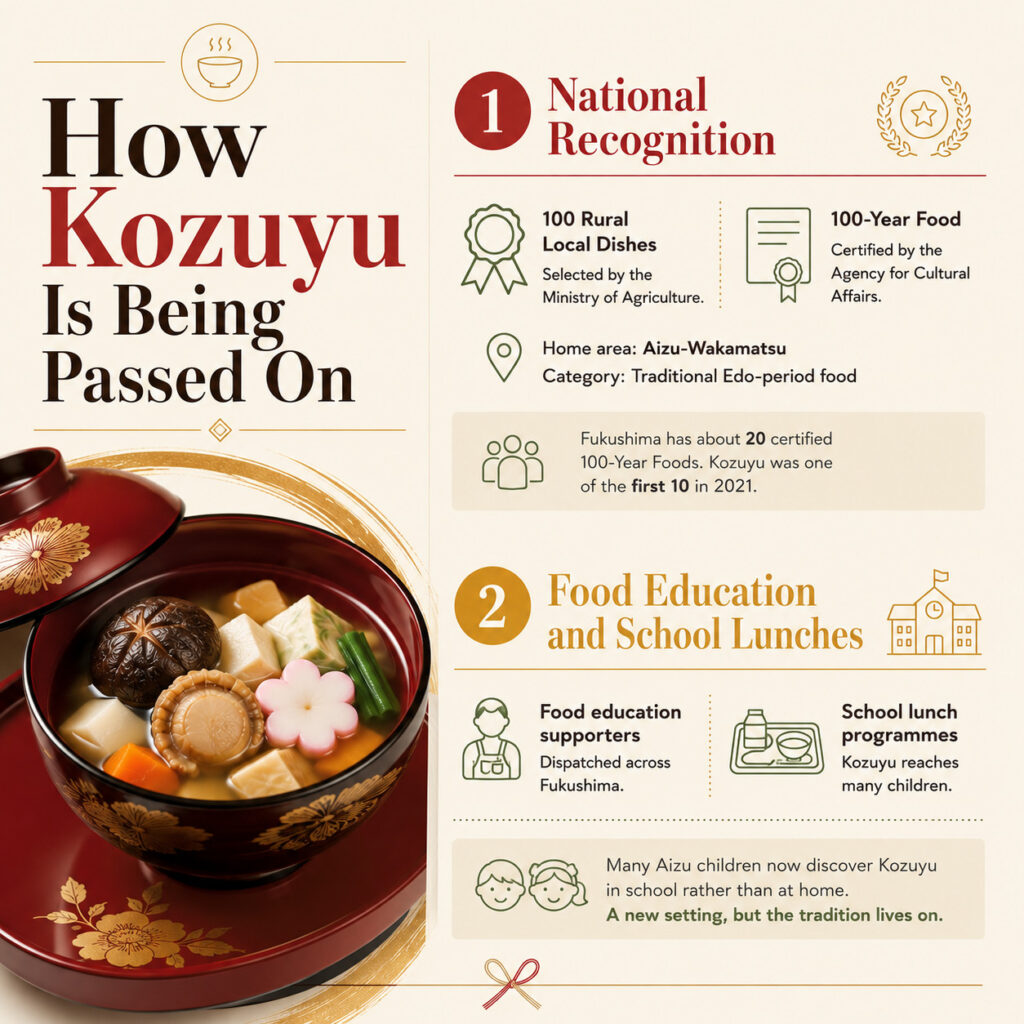
Kozuyu carries two official designations, which helps explain its visibility. The agriculture ministry included it in the national selection of 100 rural local dishes. Separately, the Agency for Cultural Affairs certified it as a “100-Year Food”, listing Aizu-Wakamatsu as the home area and placing it in the traditional Edo-period category.
Fukushima has roughly twenty certified 100-Year Foods in total, added in batches since 2021. Kozuyu came through in that first prefectural group of ten.
Food Education and School Lunches
Fewer households cook Kozuyu from scratch now, so transmission has partly moved outside the home. Fukushima’s cultural promotion plan, adopted in 2021, names the succession of food culture as a policy priority. The prefecture works through dispatched food-education supporters and through school lunch programmes.
Consequently, plenty of Aizu children first meet Kozuyu in a school canteen rather than at a wedding. That shift feels slightly melancholy, yet it keeps the dish alive in a generation that might otherwise miss it entirely.
Kozuyu Within Japanese Regional Cuisine
Why Local Soups Matter
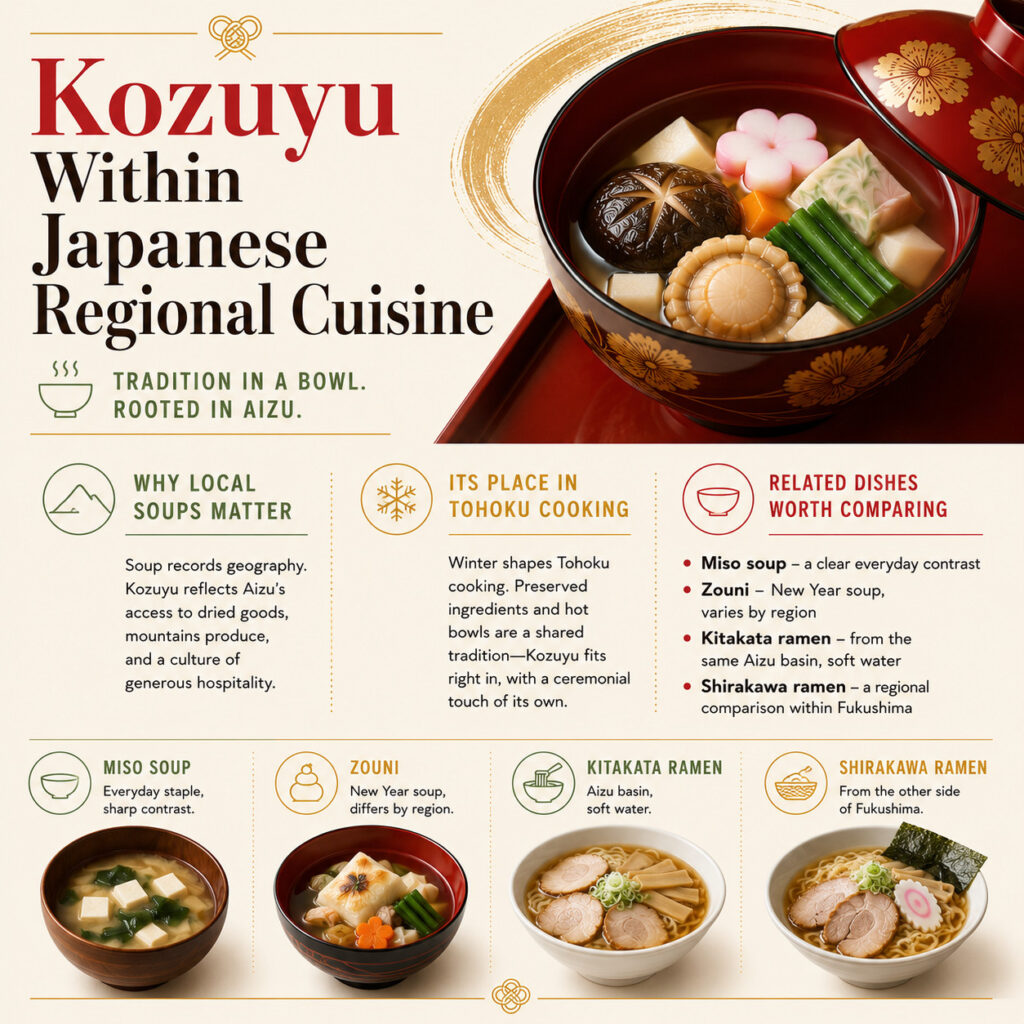
Soup records geography with unusual honesty. A broth reveals what a community could obtain, preserve and afford. Kozuyu tells you Aizu had money for imported dried goods, mountains full of taro and mushrooms, and a serious commitment to hosting.
Its Place in Tohoku Cooking
Across Tohoku, winter shapes almost everything. Preserved ingredients, long simmering and hot bowls appear everywhere from Aomori down to Fukushima. Kozuyu belongs to that pattern, although its ceremonial framing sets it slightly apart.
Related Dishes Worth Comparing
Anyone interested in Japanese broths should read about miso soup next, simply because the contrast is so sharp. For the New Year angle, zouni shows how wildly one dish can vary by region.
Staying inside Fukushima, Kitakata ramen comes from the same Aizu basin and shares the local soft water. Shirakawa ramen offers a useful comparison from the other side of the prefecture.
Final Thoughts on Aizu’s Quiet Ceremonial Soup
Kozuyu will never trend. It photographs poorly, tastes subtle, and takes two days of low-grade attention to prepare properly. None of that has stopped Aizu families from making it for well over a century.
If you reach Aizu-Wakamatsu, order it and take your time. Notice the shallow red bowl, count the ingredients, and remember that a second helping is expected rather than merely permitted. Few dishes state their hospitality quite so plainly.
Kozuyu FAQ
What is Kozuyu?
Kozuyu is a clear soup from the Aizu region of Fukushima Prefecture. Cooks build the broth from dried scallop and dried shiitake, then add taro, carrot, wood ear mushroom, konjac threads and small wheat gluten balls. Soy sauce and salt season it lightly. Families serve it at weddings, funerals, New Year and other special gatherings.
What does Kozuyu taste like?
Expect a light, clear broth with a sweet marine depth from the scallop. The seasoning stays gentle on purpose, so the dashi leads. Texture supplies much of the interest: creamy taro, crunchy kikurage and soft gluten balls in every spoonful. First-time eaters often need a second bowl before the flavour fully registers.
Why does Kozuyu use dried scallop?
Aizu lies inland behind mountain ranges, so fresh seafood rarely survived the journey there. Kitamaebune trading ships brought dried scallop, herring and cod down from Hokkaido instead. Those preserved goods kept well through long snowbound winters. As a result, an inland region built its most prized soup on a marine ingredient.
Why do recipes call for seven or nine ingredients?
Odd numbers cannot divide evenly, which Japanese custom reads as a good sign. Aizu cooks therefore aim for seven or nine components rather than an even count. The habit shows up in the agriculture ministry’s own description of the dish. Households still follow it at weddings and celebrations today.
Is it really served at funerals as well as weddings?
Yes, and that surprises many visitors. Japanese ceremonial cooking often uses one dish across both joyful and solemn gatherings. What counts is the act of feeding people who have come together. Kozuyu appears at weddings, memorial services, festivals and New Year alike.
Can I ask for a second bowl?
Absolutely, and tradition actively encourages it. Guests once left formal banquet trays untouched to carry home, so Kozuyu became the one dish they ate freely at the table. People drank sake alongside it and refilled repeatedly. Locals call that custom tsuyugaeshi.
Is Kozuyu officially recognised in Japan?
Yes, on two separate counts. The agriculture ministry named it among the country’s 100 rural local dishes. The Agency for Cultural Affairs also certified it as a “100-Year Food”, listing Aizu-Wakamatsu as its home and grouping it with Edo-period traditions. Fukushima holds roughly twenty such certifications overall.
Can I make Kozuyu outside Japan?
You can, provided you plan a day ahead. Chinese groceries sell dried scallop as conpoy, and wood ear mushrooms sit in most Asian supermarkets. Soak the scallop overnight, then simmer the vegetables in that liquid. Waxy potato substitutes for taro if necessary.
Where can I eat Kozuyu in Fukushima?
Aizu-Wakamatsu offers the best odds, particularly at traditional restaurants near the castle and along Nanokamachi. Hot spring inns in Higashiyama and Ashinomaki frequently include it in kaiseki-style dinners. Souvenir shops also stock retort packs and lacquer bowl sets. Check current menus with each venue before you go.
References
- Ministry of Agriculture, Forestry and Fisheries, Kozuyu, Fukushima Prefecture | Our Regional Cuisines, https://www.maff.go.jp/j/keikaku/syokubunka/k_ryouri/search_menu/menu/30_2_fukushima.html (Surveyed: August 2026)
- Ministry of Agriculture, Forestry and Fisheries, Kozuyu | Our Regional Cuisines (English edition), https://www.maff.go.jp/e/policies/market/k_ryouri/search_menu/983/index.html (Surveyed: August 2026)
- Ministry of Agriculture, Forestry and Fisheries, Zakuzaku, Fukushima Prefecture | Our Regional Cuisines, https://www.maff.go.jp/j/keikaku/syokubunka/k_ryouri/search_menu/menu/30_8_fukushima.html (Surveyed: August 2026)
- Ministry of Agriculture, Forestry and Fisheries, Kozuyu | Local Cuisines of Japan (Shokuiku pages), https://www.maff.go.jp/j/syokuiku/kodomo_navi/cuisine/cuisine1_7.html (Surveyed: August 2026)
- Agency for Cultural Affairs, 100-Year Food: List for Fukushima Prefecture, https://www.bunka.go.jp/seisaku/shokubunka/foodculture/hyakunenfood/jirei/list_fukushima.html (Surveyed: August 2026)
- Fukushima Prefectural Government, On the Succession of Fukushima’s Traditional Food Culture, https://www.pref.fukushima.lg.jp/sec/11055a/100nenfood.html (Surveyed: August 2026)
- Fukushima Prefecture Tourism and Local Products Association, Fukushima’s 100-Year Foods (Educational Travel), https://www.tif.ne.jp/kyoiku/info/disp.html?id=673 (Surveyed: August 2026)
- Tsuda, W., Aida, K., Kato, M., Nakamura, K., Abe, Y., Fukunaga, Y. and Yaginuma, K., Characteristics of Annual Event Foods in Fukushima Prefecture, Proceedings of the Annual Meeting of the Japan Society of Cookery Science, Vol. 32 (2021), p. 151, DOI 10.11402/ajscs.32.0_151, https://www.jstage.jst.go.jp/article/ajscs/32/0/32_151/_article/-char/ja (Surveyed: August 2026)
- National Association of School Dietitians, Local Foods of Fukushima Prefecture: Kozuyu, https://www.zengakuei.or.jp/kyodosyoku/pref/fukushima_01.html (Surveyed: August 2026)
- Location Research Co., 100 Local Dishes of Rural Japan: Kozuyu (Fukushima), https://www.location-research.co.jp/kyoudoryouri100/recipe/recipe/070037 (Surveyed: August 2026)
- Aizu-Wakamatsu City Official Tourism Site, Traditional Flavours of Aizu (feature), https://www.aizukanko.com/feature/aizulocalfood/aizulocalfood (Surveyed: August 2026)
- Gokujo Aizu Project Council, Kozuyu, https://gokujo-aizu.com/area-all/1573/ (Surveyed: August 2026)
- JA Group, Aizu no Kozuyu (JA Aizu Wakamatsu Women’s Association), https://life.ja-group.jp/recipe/detail?id=5005 (Surveyed: August 2026)
- Umami Information Center, Kozuyu | Japanese Regional Cuisine and Umami, https://www.umamiinfo.jp/japaneseumami/localcuisine/category-01/fukushima/kozuyu.html (Surveyed: August 2026)
- All Nippon Airways, Unique Local Cuisine Steeped in the Tradition of Aizu, Fukushima Prefecture, https://www.ana.co.jp/en/us/japan-travel-planner/fukushima/0000028.html (Surveyed: August 2026)
- Discover Aizu (Aizu Regional Tourism), Food & Sake, https://discoveraizu.jp/en/food-sake/ (Surveyed: August 2026)
- Aizu-Wakamatsu Public Wholesale Market Association, Kozuyu Recipe, https://www.aizu-ichiba.jp/recipe/128 (Surveyed: August 2026)
Related Articles
- Fukushima Food: Regional Cuisine & Traditional Dishes (Surveyed: August 2026)
- Complete Guide to Tohoku Food (Surveyed: August 2026)
- Kitakata Ramen (喜多方ラーメン) (Surveyed: August 2026)
- Shirakawa Ramen (白河ラーメン) (Surveyed: August 2026)
- Zouni (雑煮) (Surveyed: August 2026)
- The Complete Guide to Miso Soup (Surveyed: August 2026)
- Spring on a Plate: The Seasonal Tastes of Japan (Surveyed: August 2026)
- Japanese Food Guide: Popular Dishes and Regional Cuisine (Surveyed: August 2026)




Comments