






Japan might not be the first country that comes to mind for vegetarian travel. Many dishes hide dashi, a fish-based broth, in unexpected places. But here’s the truth: Japan has a rich, centuries-old tradition of plant-based eating. You just need to know where to look.
This guide walks you through everything. From ancient temple cuisine to modern vegan cafés in Tokyo, there’s more to explore than you might expect.
Understanding Washoku and Plant-Based Cuisine
Washoku, Japan’s traditional dietary culture, is built on balance. A typical meal centers on rice, miso soup, and several small side dishes. Vegetables, tofu, and pickles play a starring role.
The concept is sometimes called “ichiju sansai” — one soup, three sides. Most of those sides are naturally plant-based. Grilled greens, simmered root vegetables, and pickled daikon all fit this pattern with ease.
That said, fish and seafood have historically been woven into many recipes. Dashi, the foundational Japanese stock, is usually made from katsuobushi (dried tuna flakes). It’s subtle, but it’s there.
The good news? Japanese food trends are shifting fast. Plant-based washoku is now a growing movement. Young chefs are rethinking traditional recipes. Kombu dashi, seaweed broth, is gaining popularity as a vegan-friendly alternative.
You’ll notice this shift especially in cities. Vegan ramen shops, meat-free izakayas, and Buddhist-inspired restaurants are appearing on every corner.
Must-Try Vegetarian Dishes
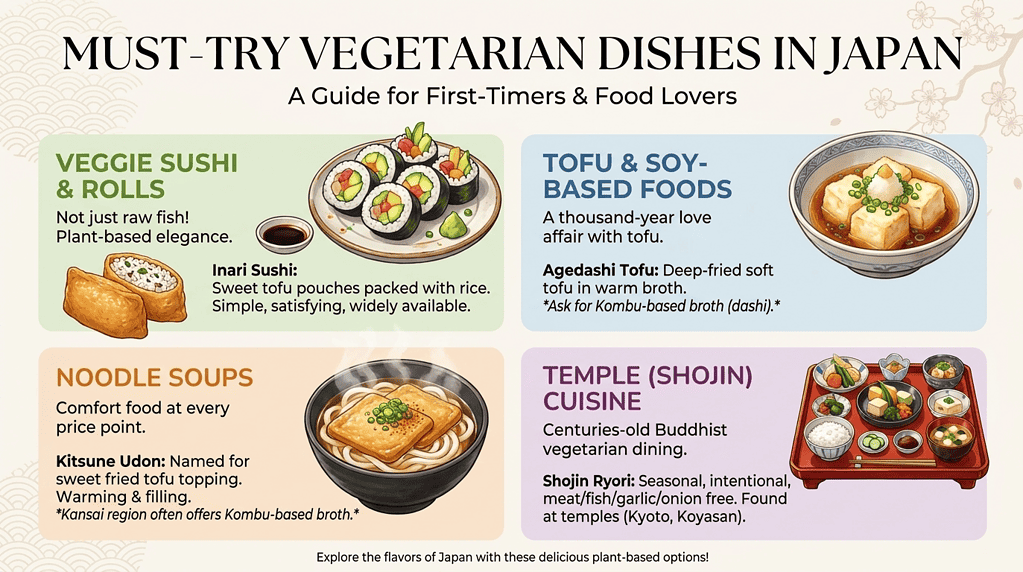
Where do you even begin? There are so many options that first-timers often feel a little overwhelmed. Here are the dishes worth seeking out first.
Veggie Sushi and Rolls
Sushi isn’t just raw fish. In fact, some of the most elegant sushi pieces are entirely plant-based. Vegan sushi rolls have become increasingly popular at restaurants across Japan.
Inari sushi is one of the safest bets. It’s rice packed into sweet, golden tofu pouches. Simple, satisfying, and almost always vegan. You’ll find it at convenience stores, train station kiosks, and traditional restaurants alike.
Cucumber rolls (kappamaki) and avocado rolls are also widely available. Some restaurants now offer seasonal vegetable nigiri, featuring sweet potato, pickled radish, or roasted mushroom. These pieces are surprisingly beautiful.
One thing to watch: sushi rice sometimes contains mirin or other seasonings. It’s worth asking if you’re strictly avoiding all animal products.
Tofu and Soy-Based Foods
Japan’s love affair with tofu runs deep. It goes back over a thousand years. Today, tofu appears in dozens of forms, and many of them are naturally vegan.
Agedashi tofu is a classic. It’s soft tofu, lightly coated and deep-fried, served in a warm broth. The broth is the tricky part — it’s usually made with dashi. But more restaurants now offer kombu-based versions. Just ask.
Yudofu is even simpler. It’s silken tofu gently simmered in kombu broth, served with dipping sauces. You’ll often find it in Kyoto, where temple cuisine has kept this dish alive for centuries.
Natto deserves a mention here too. It’s fermented soybeans with a sticky, pungent character that divides people instantly. Love it or hate it, natto is 100% plant-based and packed with protein. It’s also a breakfast staple in many Japanese homes.
Edamame, miso, yuba (tofu skin), and aburaage (fried tofu) round out the soy family. Once you start noticing them, they’re everywhere.
Noodle Soups
Noodles are a comfort food in Japan, available at every price point. But finding a vegetarian broth can take some effort.
Kitsune udon is one of the most accessible options. “Kitsune” means fox — the dish is named for the sweet fried tofu (aburaage) on top. The broth is often lighter and more likely to be kombu-based in the Kansai region. It’s warming, filling, and genuinely delicious.
Misoshiru (miso soup) is worth understanding in depth. Miso paste itself is plant-based. But traditional miso soup uses dashi, which typically contains fish. Restaurants that use kombu dashi — kelp broth — serve a fully vegan version. When in doubt, you can ask: “Katsuo dashi wa haitte imasu ka?” (Does this contain katsuobushi dashi?)
Soba noodles made from buckwheat are naturally vegan. Served cold with a dipping sauce called tsuyu, they make a refreshing lunch. Again, check whether the tsuyu contains fish-based dashi.
Temple (Shojin) Cuisine
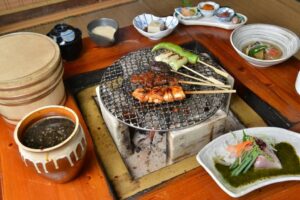
This one is worth a special trip. Shojin ryori is the centuries-old Buddhist vegetarian cuisine of Japan. It’s served at temples, particularly in Kyoto and Koyasan.
The philosophy behind shojin ryori is as important as the food itself. It prohibits meat, fish, and even pungent vegetables like garlic and onion. Every dish is made with intention, using seasonal ingredients and careful technique.
A typical shojin ryori meal might include tofu in several preparations, root vegetable simmers, pickled vegetables, and sesame-dressed greens. The flavors are delicate. The presentation is elegant.
If you visit a temple in Kyoto, Nara, or Mount Koya, consider booking a shojin ryori meal in advance. It’s an experience, not just a dinner. Many visitors say it’s one of the most memorable meals of their trip to Japan.
Dining Tips for Vegans in Japan
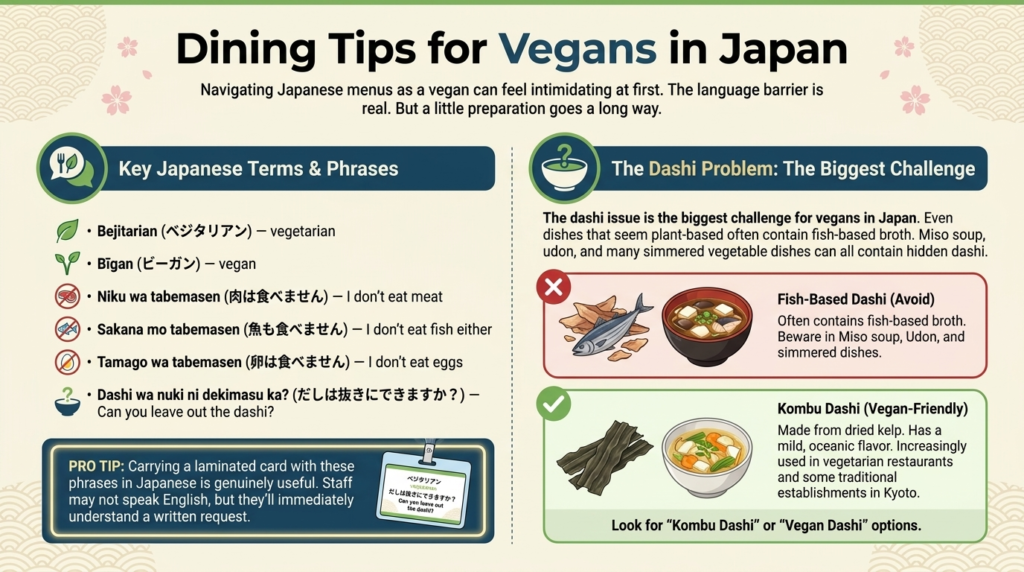
Navigating Japanese menus as a vegan can feel intimidating at first. The language barrier is real. But a little preparation goes a long way.
Key Japanese Terms and the Dashi Problem
Learning a few key phrases makes a huge difference. Here are the most useful ones:
- Bejitarian (ベジタリアン) — vegetarian
- Bīgan (ビーガン) — vegan
- Niku wa tabemasen (肉は食べません) — I don’t eat meat
- Sakana mo tabemasen (魚も食べません) — I don’t eat fish either
- Tamago wa tabemasen (卵は食べません) — I don’t eat eggs
- Dashi wa nuki ni dekimasu ka? (だしは抜きにできますか?) — Can you leave out the dashi?
Carrying a laminated card with these phrases in Japanese is genuinely useful. Staff may not speak English, but they’ll immediately understand a written request.
The dashi issue is the biggest challenge for vegans in Japan. Even dishes that seem plant-based often contain fish-based broth. Miso soup, udon, and many simmered vegetable dishes can all contain hidden dashi.
Kombu dashi is the vegan-friendly version. It’s made from dried kelp and has a mild, oceanic flavor. Increasingly, this is being used in vegetarian restaurants and some traditional establishments in Kyoto.
Navigating Convenience Stores
Japanese convenience stores (konbini) are legendary for their food quality. But for vegetarians, they require careful reading.
Most convenience store onigiri contain seafood fillings — tuna, salmon, and shrimp are everywhere. However, some safe options do exist. Umeboshi (pickled plum) onigiri is reliably plant-based and widely available. Kombu onigiri is another good choice.
Look for vegetable-based sandwiches and egg salad options if you eat eggs. Natto rolls are often available too. FamilyMart and 7-Eleven now label some items with allergen information, which makes it easier to check for fish-derived ingredients.
Plain steamed rice, edamame snacks, and some packaged salads are safe bets. Convenience stores have actually improved significantly for plant-based travelers in recent years.
Where to Find Vegetarian Food
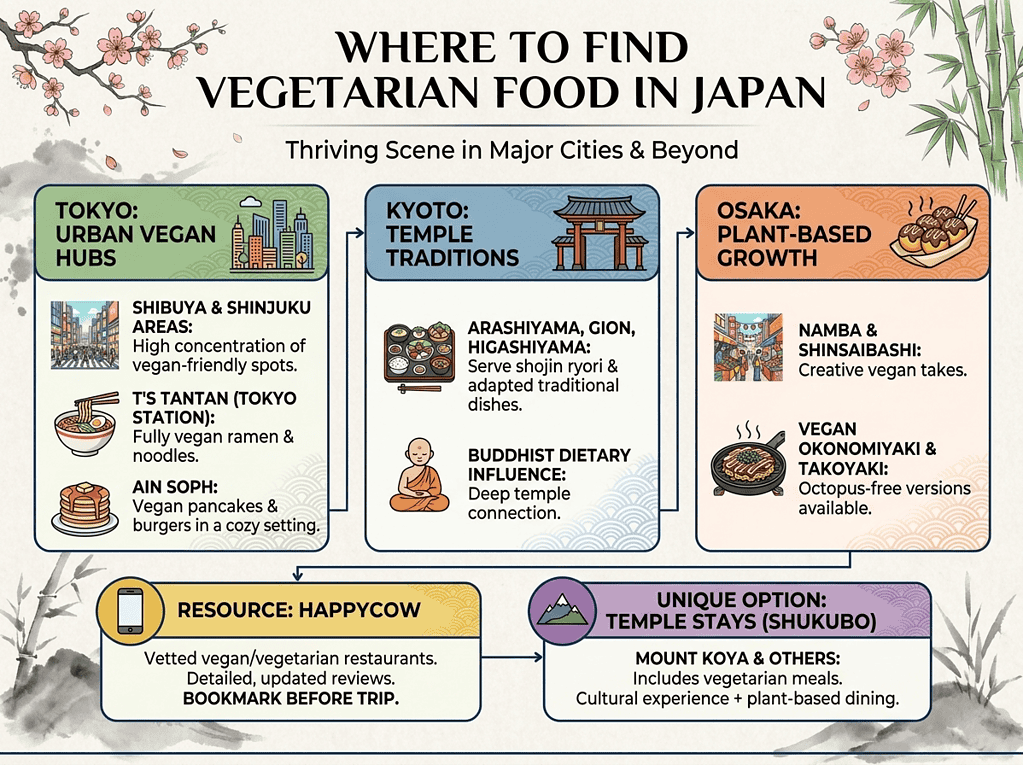
Good news: dedicated vegetarian and vegan restaurants are thriving in Japan’s major cities. You don’t have to search hard in Tokyo or Osaka anymore.
In Tokyo, the Shibuya and Shinjuku areas have the highest concentration of vegan-friendly spots. Café chains like T’s Tantan (inside Tokyo Station) offer fully vegan ramen and noodle dishes. Ain Soph serves vegan pancakes and burgers in a cozy setting. These places are popular with both locals and travelers.
In Kyoto, the temple connection runs deep. Restaurants around Arashiyama, Gion, and Higashiyama often serve shojin ryori or traditional dishes adapted for vegetarians. The city has long catered to Buddhist dietary traditions.
In Osaka, the plant-based scene is growing quickly. Several spots near Namba and Shinsaibashi offer creative vegan takes on Osaka classics like okonomiyaki and takoyaki (yes, octopus-free versions now exist).
HappyCow is an excellent resource for finding vetted vegan and vegetarian restaurants in Japan. Reviews are detailed and regularly updated. It’s worth bookmarking before your trip.
Temple stays (shukubo) at places like Mount Koya automatically include vegetarian meals. This is a unique option for travelers interested in combining cultural experience with plant-based dining.
Bonus: Vegetarian Snacks Worth Trying
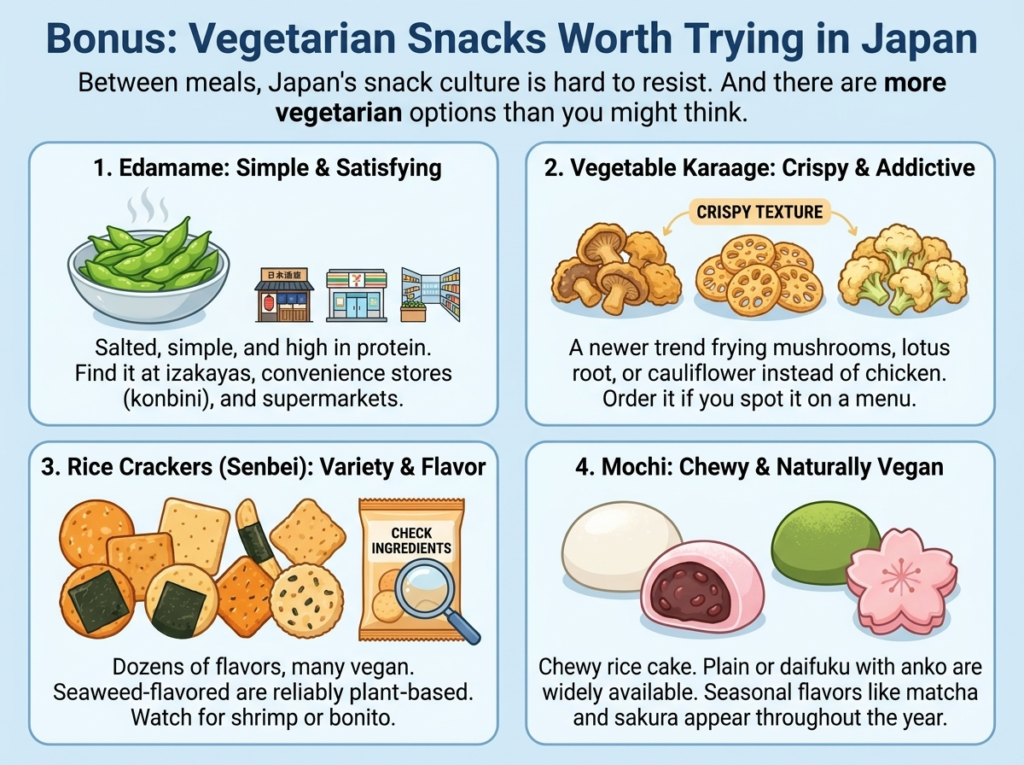
Between meals, Japan’s snack culture is hard to resist. And there are more vegetarian options than you might think.
Edamame is the perfect snack — salted, simple, and satisfying. You’ll find it at izakayas, convenience stores, and supermarkets. It’s also one of the better protein sources for plant-based travelers.
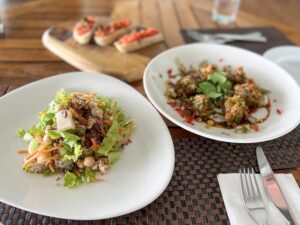
Vegetable karaage is a newer trend. Instead of chicken, restaurants fry mushrooms, lotus root, or cauliflower with the same crispy karaage technique. The texture is addictive. If you spot it on a menu, order it.
Rice crackers (senbei) come in dozens of flavors, many of which are vegan. Seaweed-flavored varieties are especially popular and reliably plant-based. Check the packaging for shrimp or bonito flavoring.
Mochi, the chewy rice cake, is another naturally vegan treat. Plain mochi or daifuku filled with red bean paste (anko) are widely available. Seasonal flavors like matcha and sakura appear throughout the year.
For a deeper dive into snack options, check out our full Japanese snack guide.
Start Your Vegetarian Journey in Japan
Japan’s plant-based food culture is richer than most visitors expect. The history is ancient, the flavors are refined, and the scene is evolving quickly.
Whether you’re drawn to serene temple meals, creative vegan ramen, or the simple pleasure of a perfectly made inari sushi, there’s something here for every plant-based traveler.
Have you tried a vegetarian dish in Japan that surprised you? Share it in the comments below. And if you’re inspired to try cooking at home, start with agedashi tofu or a simple miso soup with kombu dashi. Both are easier to make than you might think.
Vegetarian Food in Japan FAQ
Can I find vegetarian food easily in Japan?
Your location determines the ease of finding plant-based meals. Major cities like Tokyo, Kyoto, and Osaka offer plenty of dedicated vegan and vegetarian restaurants. Rural areas present more challenges. You can navigate these areas easily by researching ahead and learning a few key Japanese phrases.
What are common Japanese vegetarian dishes?
You can reliably eat Inari sushi, agedashi tofu, vegetable tempura, kitsune udon, natto, yudofu, edamame, and shojin ryori. Traditional restaurants also serve many plant-based rice and pickled vegetable sides.
How do I say I’m vegetarian in Japanese?
You can say “Watashi wa bejitarian desu” (私はベジタリアンです) to mean “I am vegetarian.” For vegan, you say “Watashi wa bīgan desu” (私はビーガンです). We highly recommend carrying a written card in Japanese to explain your dietary needs clearly to restaurant staff.
Is miso soup vegetarian?
Miso paste itself contains only plant ingredients. However, cooks traditionally prepare the soup using katsuobushi dashi, a broth containing dried fish. You must ask the chef if they use kelp (kombu) dashi instead. Shojin ryori and dedicated vegetarian restaurants standardly use pure kelp dashi.
What is Shojin Ryori?
Shojin Ryori represents the traditional Buddhist vegetarian cuisine of Japan. Buddhist monks exclude all meat, fish, and pungent vegetables from this diet. Monks and specialized chefs prepare these seasonal meals carefully and serve them at temples in Kyoto and on Mount Koya. Diners consider it one of the purest vegetarian dining experiences in the world.
References
- Japan Tourism Agency. Traditional Japanese Cuisine (Washoku). https://www.mlit.go.jp/kankocho/en/
- HappyCow. Vegan & Vegetarian Restaurants in Japan. https://www.happycow.net/asia/japan/
- UNESCO. Washoku, Traditional Dietary Cultures of the Japanese. https://ich.unesco.org/en/RL/washoku-traditional-dietary-cultures-of-the-japanese-00869






Comments