



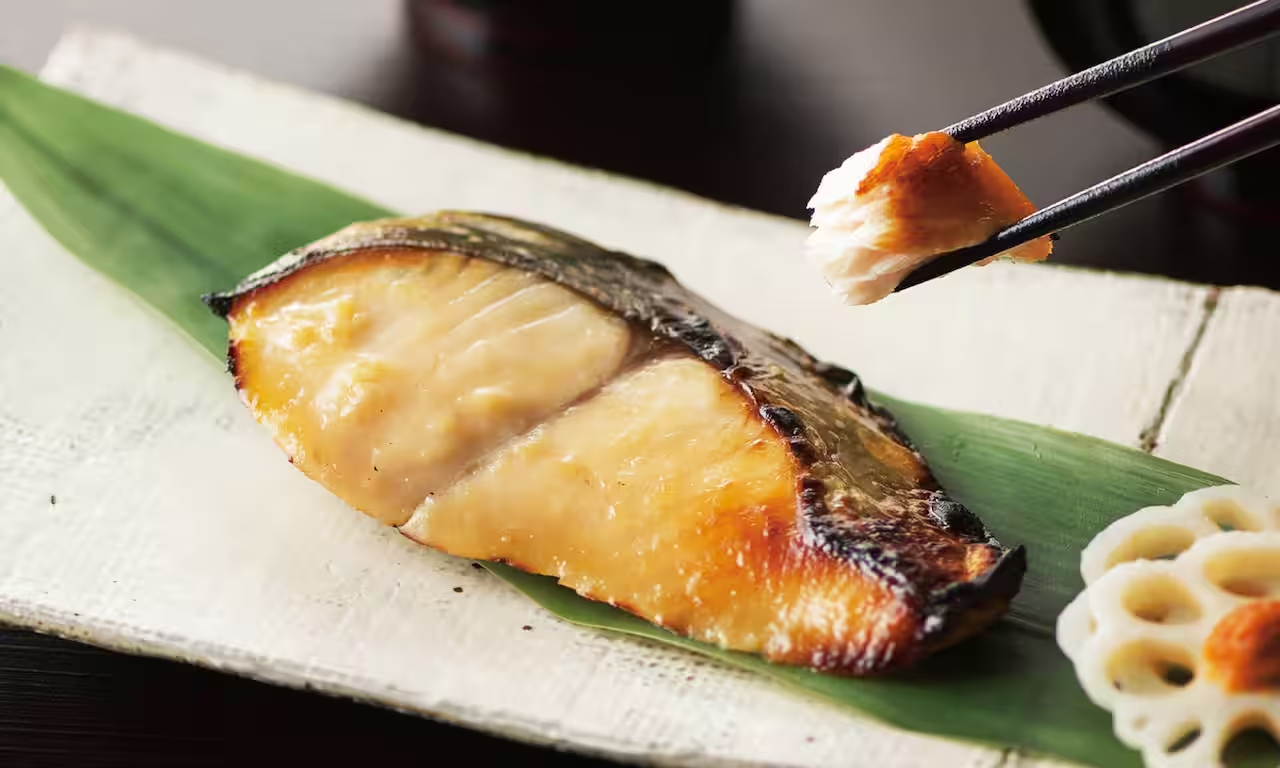
Sawara (鰆) is the Japanese Spanish mackerel (Scomberomorus niphonius), a slender member of the mackerel family. Japanese cooks prize it for its pale flesh, soft texture, and mild savory flavor. Although the flesh looks white, the Ministry of Agriculture, Forestry and Fisheries classifies sawara as a red-fleshed fish. Okayama Prefecture and the wider Seto Inland Sea treat spring sawara as a seasonal highlight. Cold-season kan-sawara carries more fat and a richer taste. Cooks serve it as sashimi, tataki, salt-grilled fillets, teriyaki, and the famous Kyoto-style Saikyo-yaki.
Sawara at a Glance
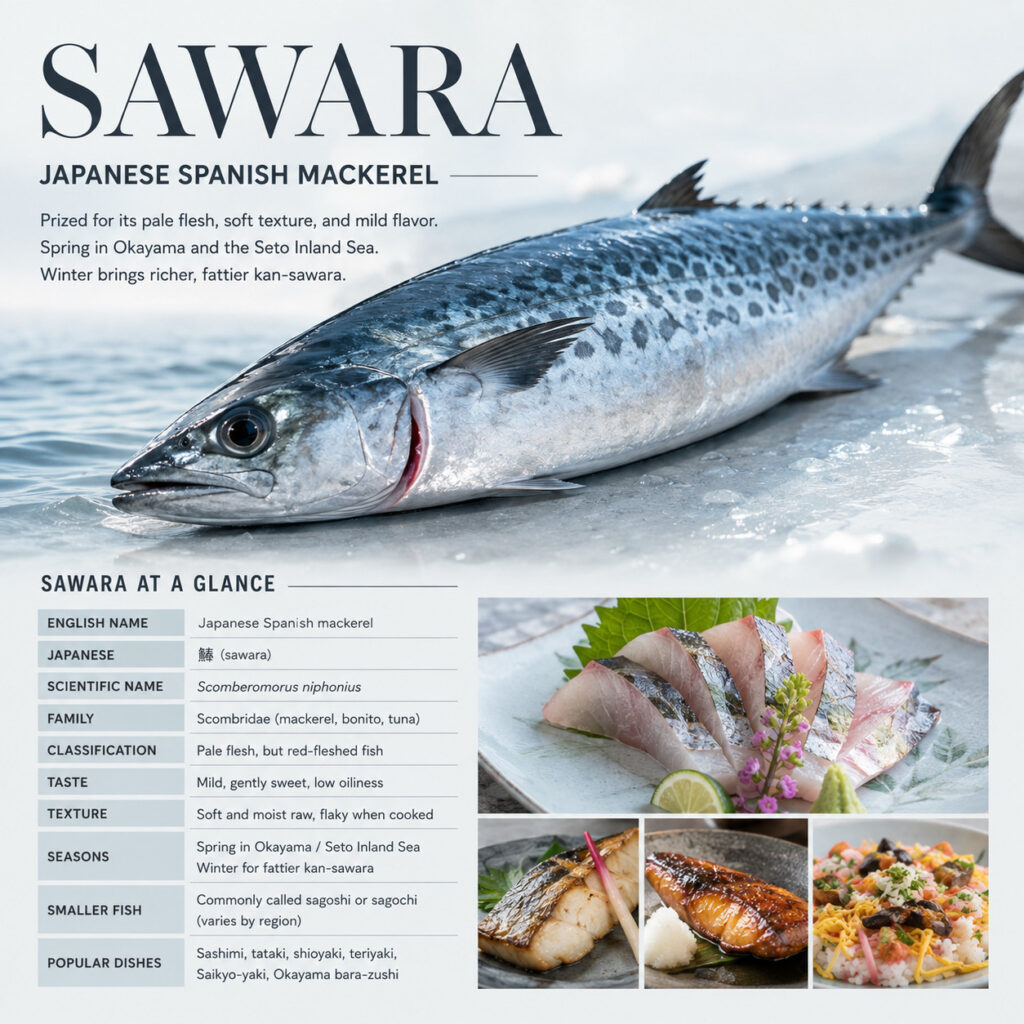
- English name: Japanese Spanish mackerel
- Japanese: 鰆 (sawara)
- Scientific name: Scomberomorus niphonius
- Family: Scombridae, the same family as mackerel, bonito, and tuna
- Classification: Pale-looking flesh, but generally counted as a red-fleshed fish
- Taste: Mild, gently sweet, and low in the strong oiliness people associate with saba
- Texture: Soft and moist raw, light and flaky once cooked
- Seasons: Spring in Okayama and the Seto Inland Sea; winter for fattier kan-sawara
- Smaller fish: Commonly called sagoshi or sagochi, with naming that varies by region
- Popular dishes: Sashimi, tataki, shioyaki, teriyaki, Saikyo-yaki, and Okayama bara-zushi
What Is Sawara?
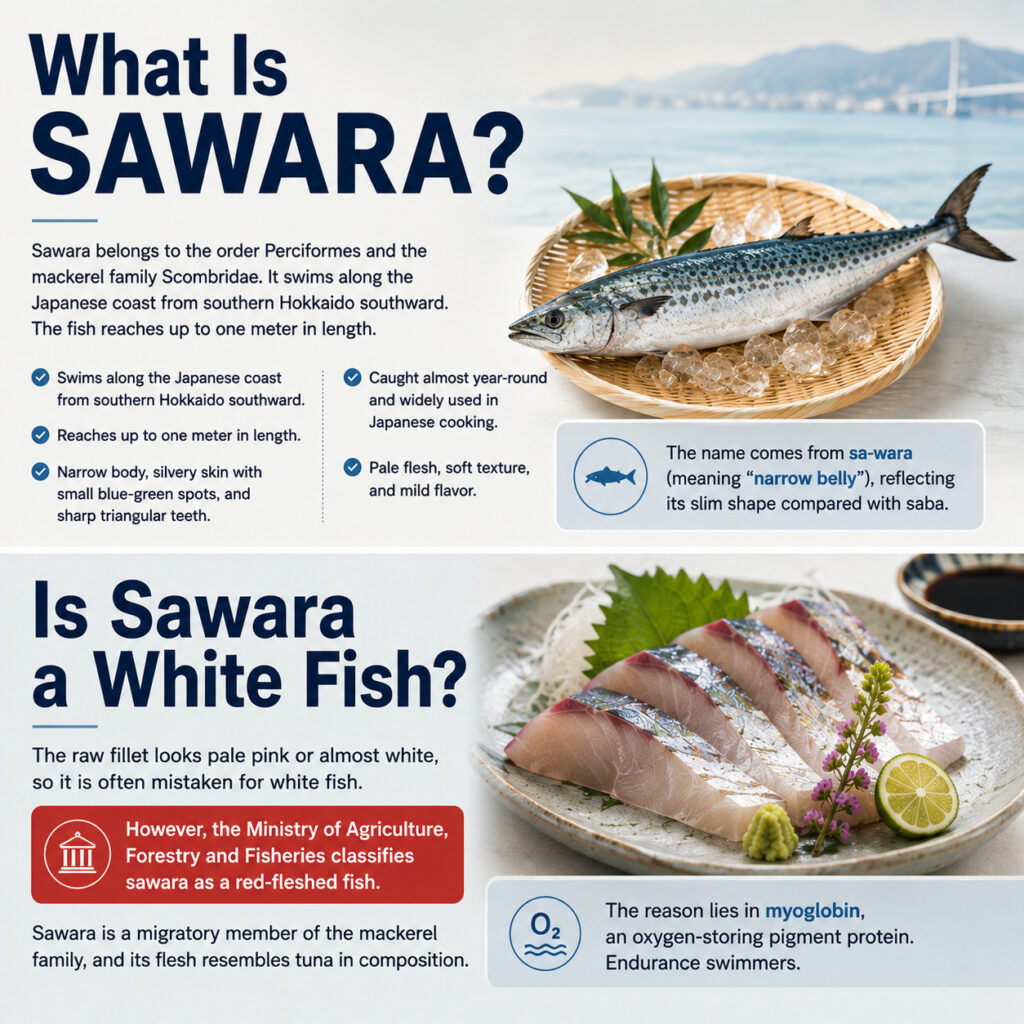
Sawara belongs to the order Perciformes and the mackerel family Scombridae. It swims along the Japanese coast from southern Hokkaido southward. The fish reaches up to one meter in length. You can recognize it by its narrow body, silvery skin with small blue-green spots, and sharp triangular teeth. Fishing boats land sawara almost year-round. That is one reason the fish appears so widely in Japanese home cooking.
The name itself points to that slim shape. One widely cited explanation traces sawara to sa-wara (狭腹), meaning “narrow belly.” The fish does look noticeably slimmer than its cousin saba.
Is Sawara a White Fish?
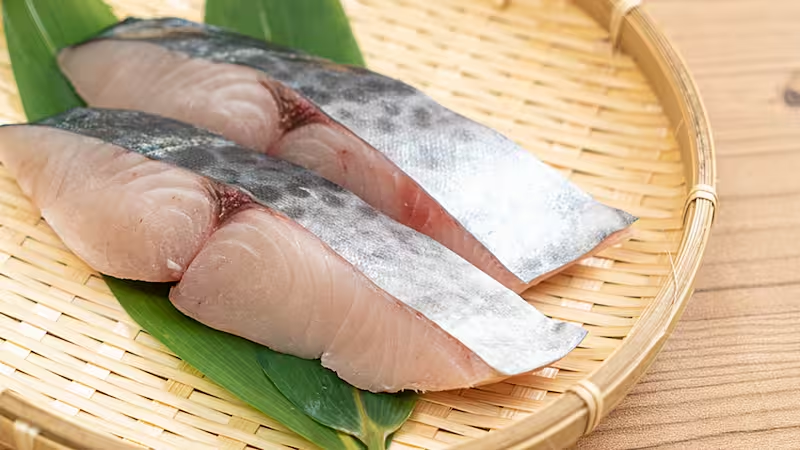
This is the single most common misunderstanding about sawara, so it deserves a clear answer. The raw fillet looks pale pink or almost white, and shoppers naturally file it alongside cod or sea bream. However, the Ministry of Agriculture, Forestry and Fisheries puts it on the red-fleshed side. Sawara is a migratory member of the mackerel family, and its flesh resembles tuna in composition.
The reason lies in myoglobin, an oxygen-storing pigment protein. Endurance swimmers such as tuna, bonito, and yellowtail carry a lot of it in their muscle. Sawara carries less of it than a bluefin tuna does, so the fillet looks light. Because the fish still migrates constantly, though, food science places it on the red-fleshed side of the line.
What Does Sawara Taste Like?
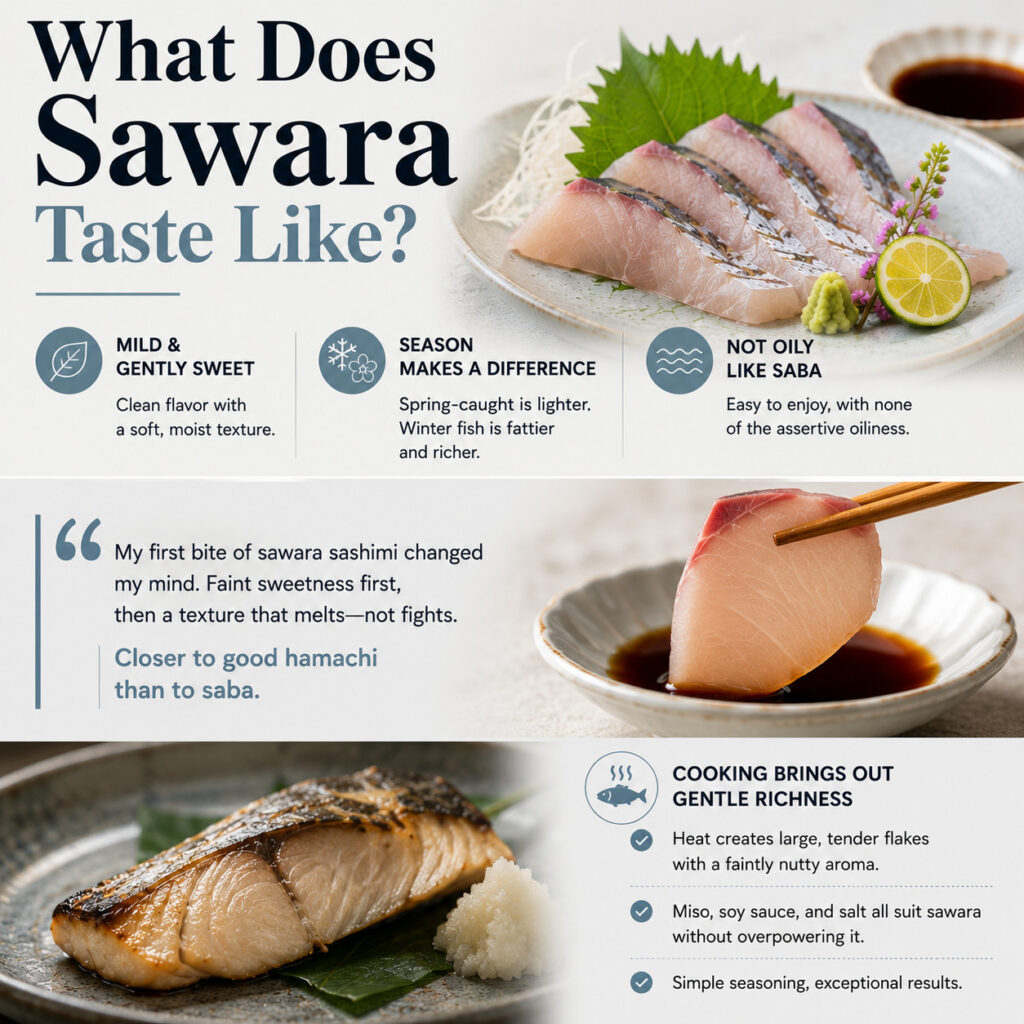
Sawara tastes mild and quietly sweet, with a soft, moist texture that sets it apart from firmer white fish. Spring-caught fish reads cleaner and lighter on the palate, while winter sawara carries more fat and a rounder, richer flavor. Neither version has the assertive oiliness that makes some people hesitate around saba.
I will admit I approached my first plate of sawara sashimi with some doubt. The word “mackerel” had set my expectations one way. The pale, almost translucent slices in front of me pointed somewhere else entirely. What arrived was gentler than I expected. A faint sweetness came first, then a texture that collapsed rather than resisted. Honestly, it sat closer to a good piece of hamachi than to anything in the saba family. Since then I have stopped placing sawara on a familiar map. I simply take it on its own terms.
Cooking changes the fish considerably. Heat firms the flesh into large, tender flakes that separate easily with chopsticks. The aroma turns faintly nutty rather than fishy. That gentleness explains why miso, soy sauce, and salt all suit sawara so well. Each seasoning adds character without covering the fish.
Sawara and Sagoshi: What Is the Difference?
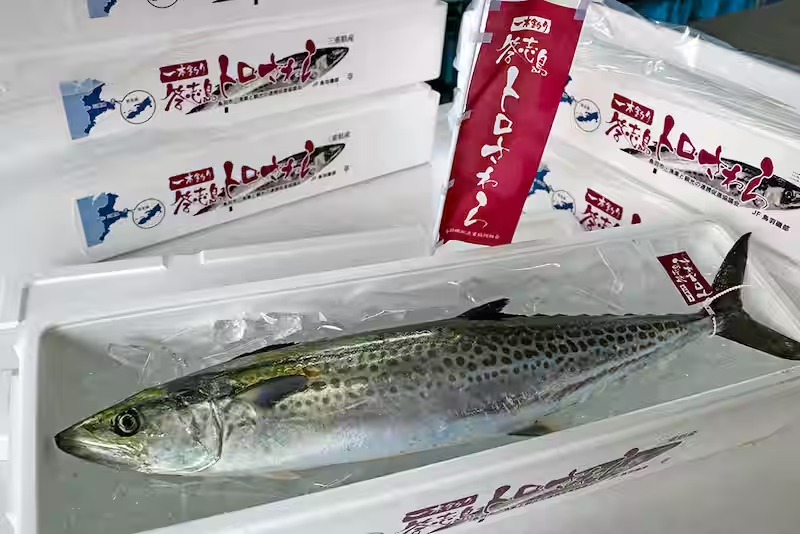
Sawara is a shusse-uo, a fish whose Japanese name changes as it grows. Buri and its younger form hamachi work the same way. Smaller fish carry different names, and adults become sawara. A fishmonger labelling a fillet sagoshi is not selling you a different fish.
The exact names and size boundaries vary considerably by region, which is worth remembering when you read conflicting figures online. According to MAFF, fish under about 50 centimeters go by sagochi in Kanto and sagoshi in Kansai. Fish measuring roughly 60 to 80 centimeters sometimes take the name yanagi. Local markets sometimes use their own thresholds, so treat any single number as a guideline rather than a national rule.
Flavor tracks size fairly closely. Sagoshi tends to taste leaner and lighter, which suits grilling and frying. Larger sawara carries the fat that makes sashimi and Saikyo-yaki so satisfying.
When Is Sawara in Season?
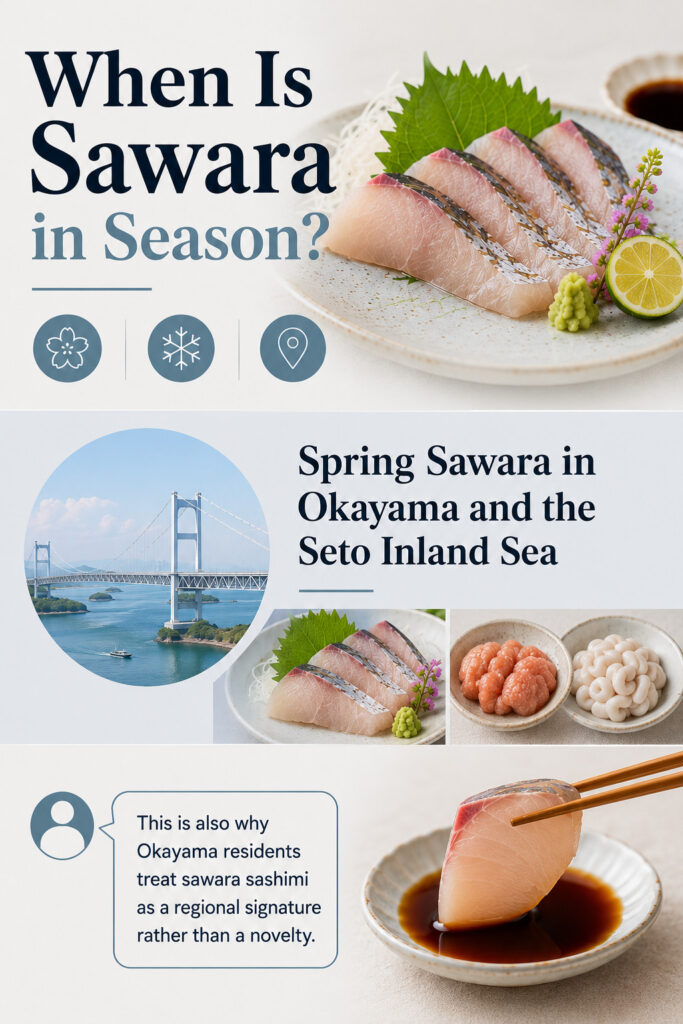
Sawara has two widely recognized peaks, and which one counts as “the” season depends entirely on where you are standing. The kanji 鰆 combines the characters for fish and spring. Yet many Tokyo diners insist the best sawara arrives in the depths of winter. Both camps are right, because they are describing different qualities.
Spring Sawara in Okayama and the Seto Inland Sea
Each spring, sawara migrate into the Seto Inland Sea to spawn. The Bisan Seto strait between Okayama and Kagawa has long served as a major spawning ground. Okayama Prefecture’s tourism body notes that the fish appears widely in local markets and supermarkets from late April through June. Local cooks make full use of the season. They serve not only the fillet but also the roe (mako) and milt (shirako) from spawning fish.
This is also why Okayama residents treat sawara sashimi as a regional signature rather than a novelty. Ask for sashimi in Okayama and many people will assume you mean sawara.
Kan-sawara in Winter
In Kanto and much of eastern Japan, cooks reserve their enthusiasm for kan-sawara. This means sawara from the cold months before spawning. These fish carry noticeably more fat, and the flesh turns denser and more luxurious as a result. Winter fillets grill beautifully and hold up well to miso marinades. That is why high-end Saikyo-yaki so often uses cold-season fish.
So there is no single correct answer to the season question. Spring sawara belongs to a regional food culture built around the spawning migration. Winter sawara answers a simpler preference for fat and richness.
How Is Sawara Prepared in Japan?
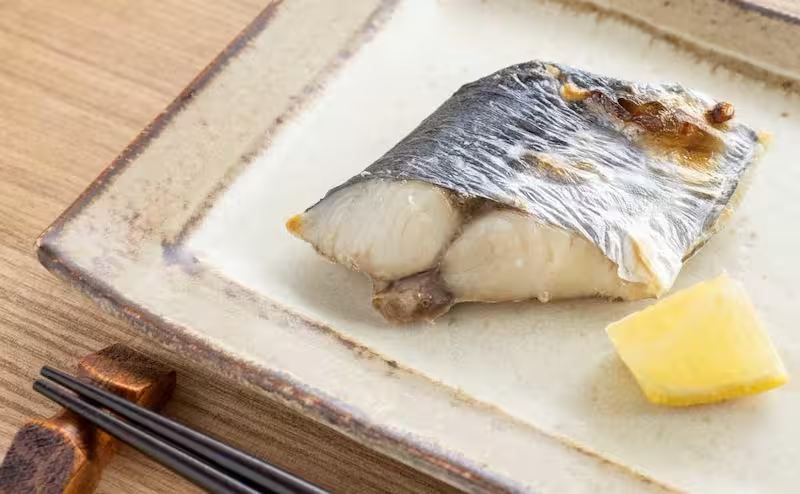
Sawara holds a lot of water and bruises easily, so Japanese cooks handle it gently at every stage. That fragility shapes the classic preparations, most of which either preserve the fish quickly or protect it with a marinade.
Sawara Sashimi
Thick-cut sawara sashimi shows off the fish at its most delicate. The melting texture and clean sweetness pair naturally with local sake. Because freshness matters enormously here, restaurants outside the Seto Inland Sea rarely offer it. Buy only fish specifically prepared and sold for raw consumption if you want to try this at home.
Sawara Tataki
For tataki, cooks sear the surface of the fillet briefly and slice it thickly. They usually finish the plate with ponzu, grated ginger, and thin-sliced negi. The quick sear adds a smoky top note while leaving the center raw and soft. Anyone who enjoys Katsuo no Tataki will recognize the technique immediately, though sawara delivers a milder result.
Saikyo-yaki
Saikyo-yaki is the Kyoto method that made sawara famous nationwide. Cooks bed the fillets in Saikyo zuke , a marinade of sweet white Kyoto miso, sake, and mirin. After a day or more, they wipe off the excess and grill the fish slowly. The koji enzymes firm the flesh slightly while drawing out umami. Residual sugars then caramelize into a glossy, gently sweet crust.
The technique began as a preservation method in a landlocked capital far from the sea. Today it survives because the flavor is genuinely worth the trouble.
Shioyaki and Teriyaki
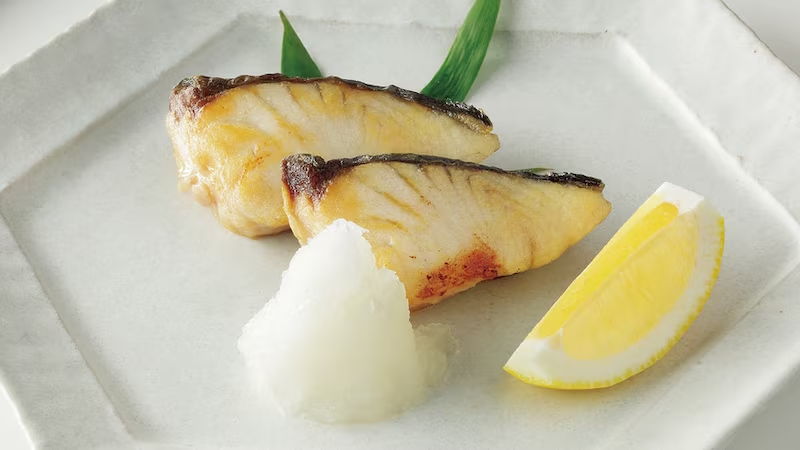
Salt-grilled sawara, or shioyaki, is the everyday preparation you will find on countless set-meal menus. Cooks salt the fillet, rest it briefly, and grill it until the skin crisps and the flesh flakes apart. Teriyaki takes the opposite approach, glazing the fish with soy sauce, mirin, and sugar. That sweet-savory finish works especially well with leaner spring fish.
Bara-zushi and Other Regional Dishes
In Okayama, vinegar-cured sawara serves as a headline topping for Okayama Barazushi, the prefecture’s celebratory scattered sushi. Historically the connection ran even deeper. Cooks once used the vinegar from curing the fish to season the rice itself. Sawara also turns up in sunomono vinegared dishes, and in Kagawa the roe becomes a local style of karasumi.
Sawara Nutrition
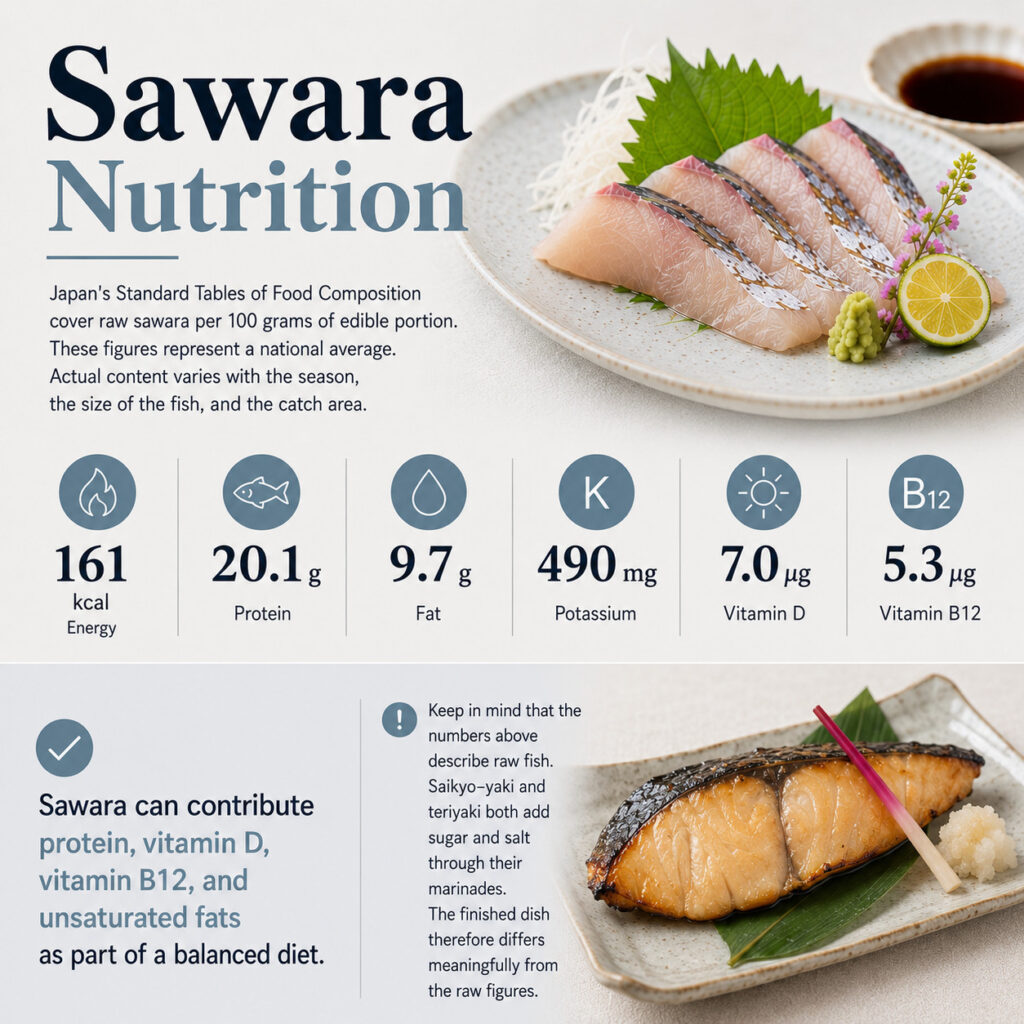
Japan’s Standard Tables of Food Composition cover raw sawara per 100 grams of edible portion. That portion provides approximately 161 kcal, 20.1 grams of protein, and 9.7 grams of fat. It also supplies 490 milligrams of potassium, 7.0 micrograms of vitamin D, and 5.3 micrograms of vitamin B12. These figures represent a national average. Actual content varies with the season, the size of the fish, and the catch area.
Sawara can therefore contribute protein, vitamin D, vitamin B12, and unsaturated fats as part of a balanced diet. Keep in mind that the numbers above describe raw fish. Saikyo-yaki and teriyaki both add sugar and salt through their marinades. The finished dish therefore differs meaningfully from the raw figures.
Where to Eat Sawara in Japan
Okayama and the Seto Inland Sea
Okayama City and Kurashiki offer the most direct route to sawara sashimi and tataki, particularly between late April and June. Look for local izakaya and sushi restaurants near Okayama Station or around Korakuen, and ask what came in that morning. Restaurants serving Okayama bara-zushi usually feature sawara on the same menu. That lets you compare the raw and vinegar-cured versions in one sitting.
Kyoto
Kyoto approaches sawara through miso rather than through raw fish. Kaiseki restaurants, obanzai counters, and traditional set-meal shops across the city serve sawara Saikyo-yaki. Long-established miso-marinade specialists also sell vacuum-packed fillets that travel well as souvenirs. Department store basement food halls in Kyoto and Osaka stock these year-round. Buy a pack if you want to cook the dish at home.
Beyond these two regions, sawara appears reliably in supermarkets nationwide as pre-cut fillets and ready-to-grill miso-marinated portions. That accessibility makes it one of the easier Japanese fish to try without a special trip.
Final Thoughts
Sawara rewards a little context. Three facts clear up most of the confusion. The pale flesh belongs to a red-fleshed migratory fish. Spring and winter offer genuinely different experiences, and sagoshi is simply a younger sawara. You might meet the fish as spring sashimi in Okayama or as a caramelized square of Saikyo-yaki in Kyoto. Either way, the same quiet, gently sweet flavor reaches you through two very different traditions.
Do you enjoy the soft, flaky character of sawara? Explore more of Japan’s coastal cooking in our guide to Japanese Seafood.
Sawara FAQ
Is sawara a white fish?
Sawara’s flesh looks pale, so shoppers often mistake it for a white-fleshed fish. Japan’s Ministry of Agriculture, Forestry and Fisheries classifies it as a red-fleshed fish instead. The fish migrates constantly and its muscle composition resembles tuna, though it contains less of the red pigment myoglobin. That lower pigment level explains the light color of the fillet.
Is sawara the same as mackerel?
Sawara belongs to the mackerel family. However, it is not the same fish as saba, the smaller mackerel common in Japanese cooking. Sawara has a longer, narrower body and paler-looking flesh. Its flavor is also much milder, without the strong oiliness that defines saba. Japanese menus treat the two as entirely separate ingredients.
Can you eat sawara raw?
Yes, people eat sawara as sashimi and tataki, especially in Okayama and around the Seto Inland Sea. The flesh holds a lot of water and loses quality quickly, so handling matters enormously. Only eat sawara raw when a shop has specifically prepared and labelled it for raw consumption. Outside western Japan, restaurants more often serve it grilled or marinated.
What is the difference between sawara and sagoshi?
Both names refer to the same species at different growth stages. Sawara is a shusse-uo, so its name changes as it grows. Smaller fish go by sagoshi in Kansai and sagochi in Kanto, while larger adults become sawara. The exact size boundaries vary by region, so no single national threshold applies. Sagoshi generally tastes leaner, which suits grilling and frying.
When is sawara in season?
Sawara has two seasonal peaks. In Okayama and the Seto Inland Sea, spring marks the traditional season. The fish migrates in to spawn, then fills local markets from late April through June. In Kanto and much of eastern Japan, diners prefer winter kan-sawara for its higher fat content. Fishing boats land the fish nearly year-round, so both answers hold true.
What does kan-sawara mean?
Kan-sawara (寒鰆) refers to sawara caught during the cold winter months before spawning. These fish carry noticeably more fat than spring fish, and the flesh tastes denser and richer as a result. Restaurants often reserve kan-sawara for premium grilled dishes and high-grade Saikyo-yaki. The word kan simply means cold.
What is sawara Saikyo-yaki?
Saikyo-yaki is a Kyoto preparation built around sweet white Saikyo miso. Cooks mix the miso with sake and mirin, marinate the fish, and grill it slowly. The koji enzymes in the miso draw out umami and firm the flesh slightly. Cooks wipe off the excess marinade before grilling, because the residual sugars burn easily. Sawara ranks among the most popular fish for this method.
Where in Japan is sawara most popular?
Okayama Prefecture holds the strongest association with sawara, thanks to the spawning migration into the Seto Inland Sea. Locals there eat it as sashimi, tataki, and salt-grilled fillets, and it tops the region’s celebratory bara-zushi. Kyoto claims a different connection through Saikyo-yaki and miso marinades. Supermarkets across the rest of Japan stock sawara fillets year-round.
What nutrients does sawara contain?
Japan’s Standard Tables of Food Composition cover raw sawara per 100 grams. The listing gives roughly 161 kcal, 20.1 grams of protein, and 9.7 grams of fat. It also shows 490 milligrams of potassium, 7.0 micrograms of vitamin D, and 5.3 micrograms of vitamin B12. Season, size, and origin all shift these numbers. Marinated preparations such as Saikyo-yaki add sugar and salt on top of the raw values.
How do you cook sawara at home?
Salt-grilling is the simplest starting point. Salt the fillet, rest it for around fifteen minutes, pat it dry, and grill it skin-side first. The flesh is delicate, which means you should turn it only once. Teriyaki and miso marinades also work well and forgive slight overcooking. Japanese supermarkets sell ready-marinated sawara if you want to skip the preparation entirely.
References
- Ministry of Agriculture, Forestry and Fisheries, Is sawara a red-fleshed or white-fleshed fish?, https://www.maff.go.jp/j/heya/sodan/1905/01.html (Surveyed: August 2026)
- Okayama Prefectural Tourism Federation, Sawara: The Seafood Beloved by Okayama Locals, https://www.okayama-kanko.jp/feature/okayama-gourmet/01 (Surveyed: August 2026)
- Okayama Prefectural Tourism Federation, Seven Seto Inland Sea Fish to Eat in Okayama (Spring to Early Summer), https://www.okayama-kanko.jp/okatabi/3/page (Surveyed: August 2026)
- Kurashiki City Tourism Web, Sawara, https://www.kurashiki-tabi.jp/rm_buy/rm-buy128/ (Surveyed: August 2026)
- Okayama Prefecture Fisheries Division, Seasonal Fish of Okayama Recipe Book, https://www.pref.okayama.jp/page/842885.html (Surveyed: August 2026)
- Ministry of Education, Culture, Sports, Science and Technology, Standard Tables of Food Composition in Japan, https://fooddb.mext.go.jp/ (Surveyed: August 2026)
Related Articles
- Saikyo Zuke: Kyoto’s Sweet Miso Fish Delicacy (Surveyed: August 2026)
- Okayama Barazushi (Surveyed: August 2026)
- Mamakari (Surveyed: August 2026)
- Katsuo no Tataki (Surveyed: August 2026)
- Chirashizushi (Surveyed: August 2026)
- What to Eat in Kyoto (Surveyed: August 2026)
- Japanese Seafood (Surveyed: August 2026)



Comments