


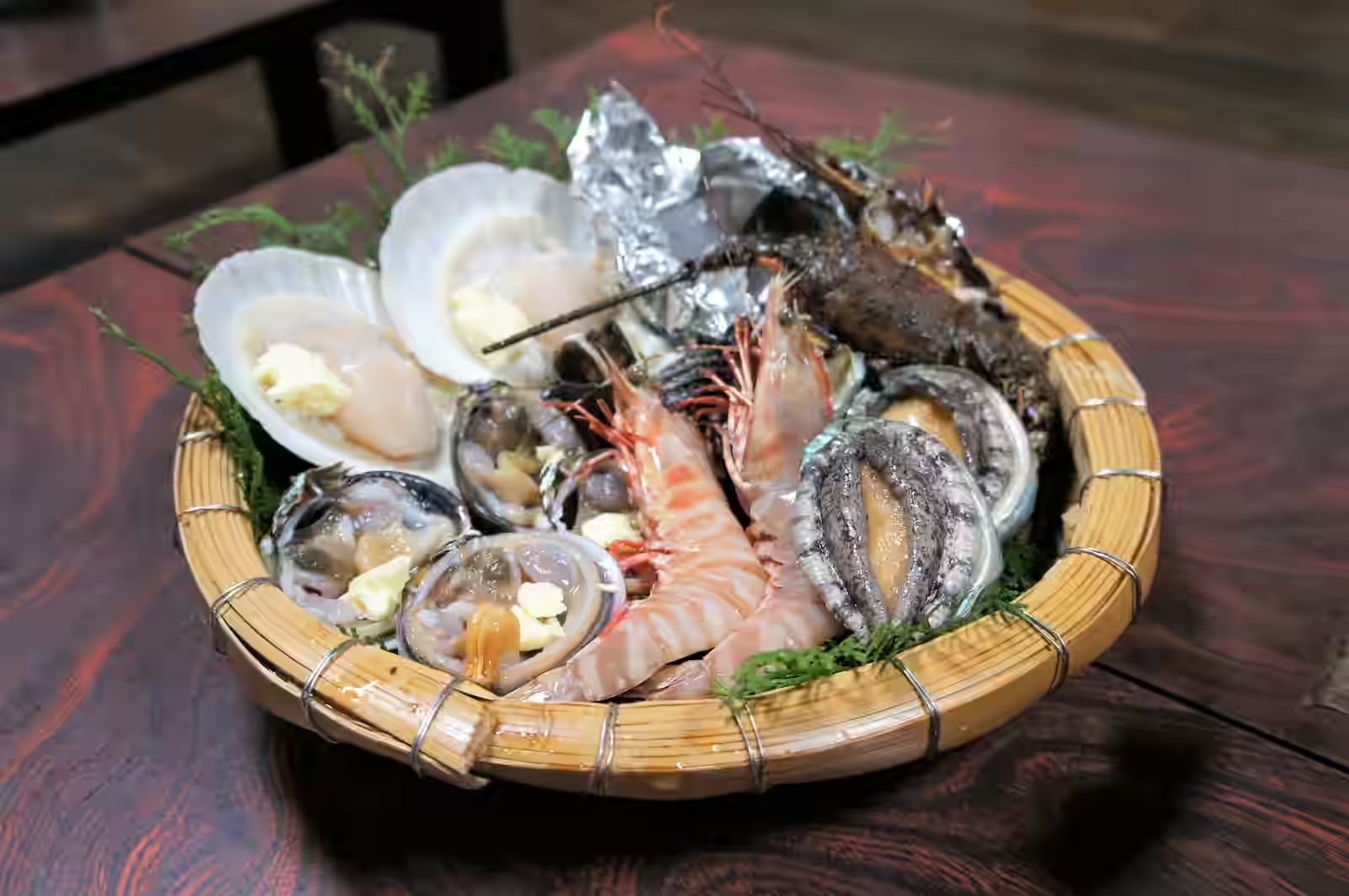



Kaizoku Ryori translates as pirate cuisine, and it means grilling seafood yourself at the table in southern Tokushima. Spiny lobster, abalone, turban shells, and scallops go straight onto a mesh grill in front of you. Some restaurants sit on rafts floating on the sea, which explains a good deal about the name.
No pirates were involved, though. That part surprises people, so this guide starts there. You will also find what actually arrives on the grill, how Tokushima manages its lobster season, and where along the Pacific coast to book a table.
Kaizoku Ryori at a Glance
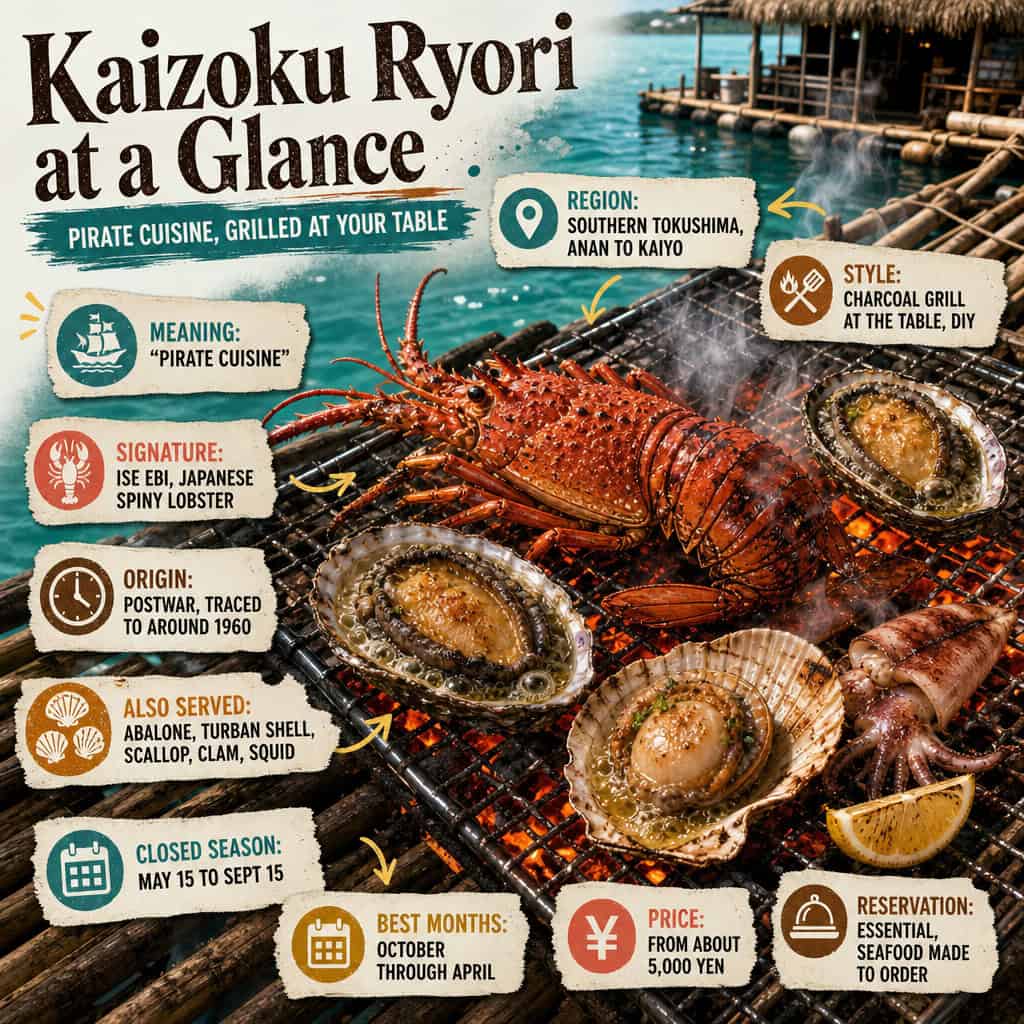
Before the detail, here is the short version. Figures below come from Tokushima Prefecture and restaurant sources, listed at the end.
| Japanese name | Kaizoku ryori (海賊料理), roughly kai-ZO-koo ryo-ree |
|---|---|
| Literal meaning | Pirate cuisine |
| Region | Southern Tokushima, from Anan City down to Kaiyo Town |
| Style | Charcoal or gas grill at the table, guests cook their own |
| Signature ingredient | Ise ebi, the Japanese spiny lobster |
| Origin | Postwar, traced by one restaurant to around 1960 |
| Also served | Abalone, turban shell, noble scallop, hard clam, squid, sashimi |
| Lobster closed season | May 15 to September 15 under prefectural regulation |
| Best months | October through April, when landings peak |
| Typical set price | Around 5,000 yen upward, varying by catch |
| Reservation | Essential at most places, since seafood is prepared to order |
What Is Kaizoku Ryori?
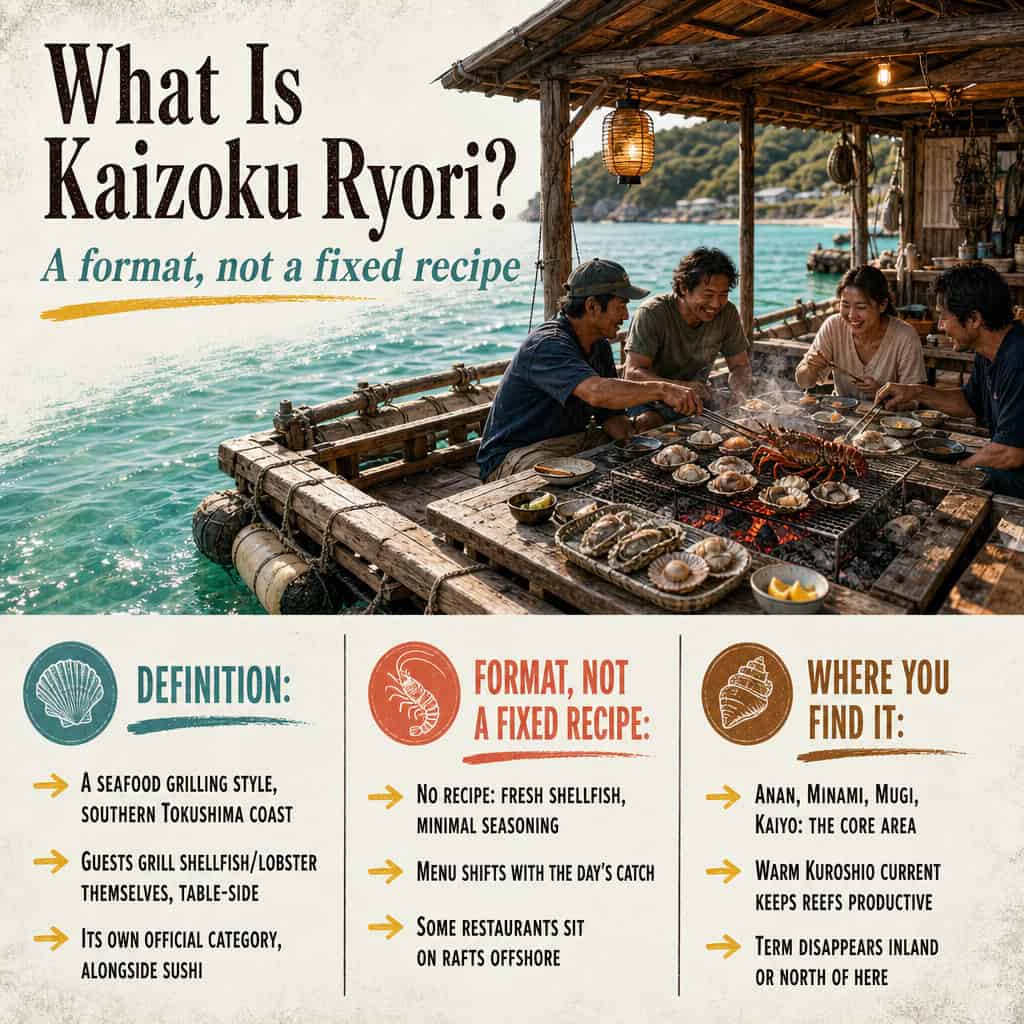
Kaizoku ryori is a seafood grilling style found along the southern coast of Tokushima Prefecture, on the island of Shikoku. Guests cook shellfish and lobster themselves over a mesh grill set into the table. The prefectural tourism board treats it as a category of its own, alongside sushi and local chicken.
The Format, Not a Fixed Recipe
Nobody hands you a recipe here. Instead, the term describes a way of eating: extremely fresh shellfish, minimal seasoning, and heat applied at the table. Contents shift with the day’s catch, so two visits rarely produce identical plates.
Many restaurants keep live tanks and pull your order out shortly before grilling. A few build their dining rooms on rafts moored just offshore. Sitting on water while cooking lobster does feel theatrical, and I suspect that is entirely the point.
Where You Find It
The dish belongs to a specific stretch of coast rather than to the whole prefecture. Anan City, Minami Town, Mugi Town, and Kaiyo Town form the core area. Tokushima’s Pacific shoreline sits directly in the path of the Kuroshio current, therefore the water stays warm and the reefs stay productive.
Head inland or north toward Naruto and the term largely disappears. That geographic limit is worth knowing before you plan a trip around it.
Why It Is Called Pirate Cuisine
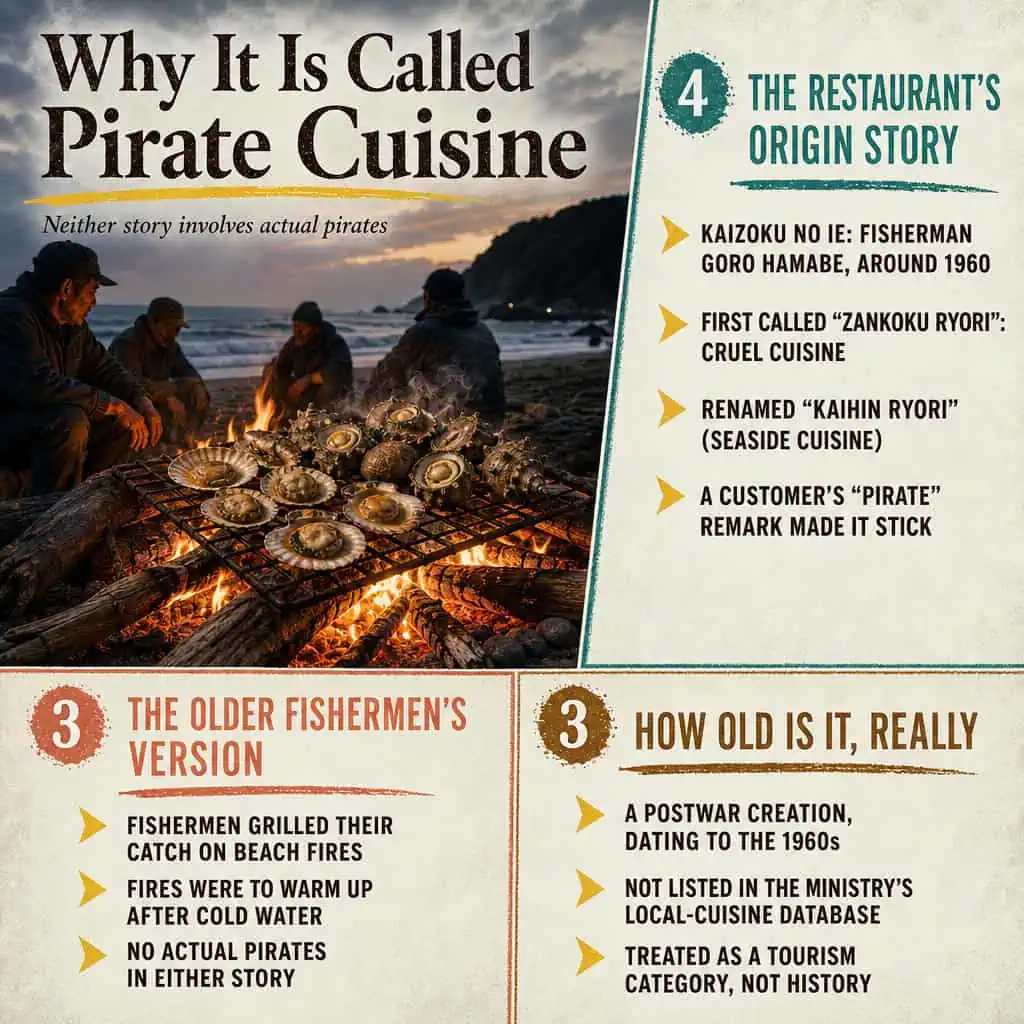
Here is the part most English pages get wrong. Two explanations circulate locally, and neither involves actual pirates.
The Restaurant That Claims to Have Started It
One account is unusually specific. According to Kaizoku no Ie in Kaiyo Town, a fisherman named Goro Hamabe began grilling live seafood on the beach at Shishikui around 1960. He worked as a fisherman and a tour guide at the same time, so visitors were already coming to him.
His first name for it was zankoku ryori, meaning cruel cuisine, because the shellfish went on the grill alive. Unsurprisingly that label caused problems. He changed it to kaihin ryori, or seaside cuisine, and the crowds kept growing.
Then a customer supposedly remarked that eating this way felt like being a pirate. The name stuck, and the restaurant still describes itself as the original. Take that claim as the restaurant’s own telling rather than as documented history.
The Older Fishermen’s Version
A second explanation runs further back and stays vaguer. Ama divers and fishermen built fires on the shore to warm up after working in cold water. While waiting, they grilled whatever they had just brought in.
Both accounts agree on the important point. Pirates did not eat this, and the word describes an atmosphere rather than any historical group. Anyone telling you about Seto Inland Sea pirate fleets is thinking of a different region entirely.
How Old Is It, Really?
Age is worth stating plainly, since English pages often imply centuries of history. Kaizoku ryori is a postwar creation, dating to roughly the 1960s in its current form. Grilling shellfish on a beach is obviously far older, yet the name and the restaurant format are recent.
One useful check supports that reading. The national local-cuisine database run by the agriculture ministry lists twenty-odd Tokushima dishes, and kaizoku ryori is not among them. Prefectural tourism materials treat it as a regional dining category instead. Neither framing makes it less enjoyable, though accuracy matters more than romance.
What Arrives on the Grill
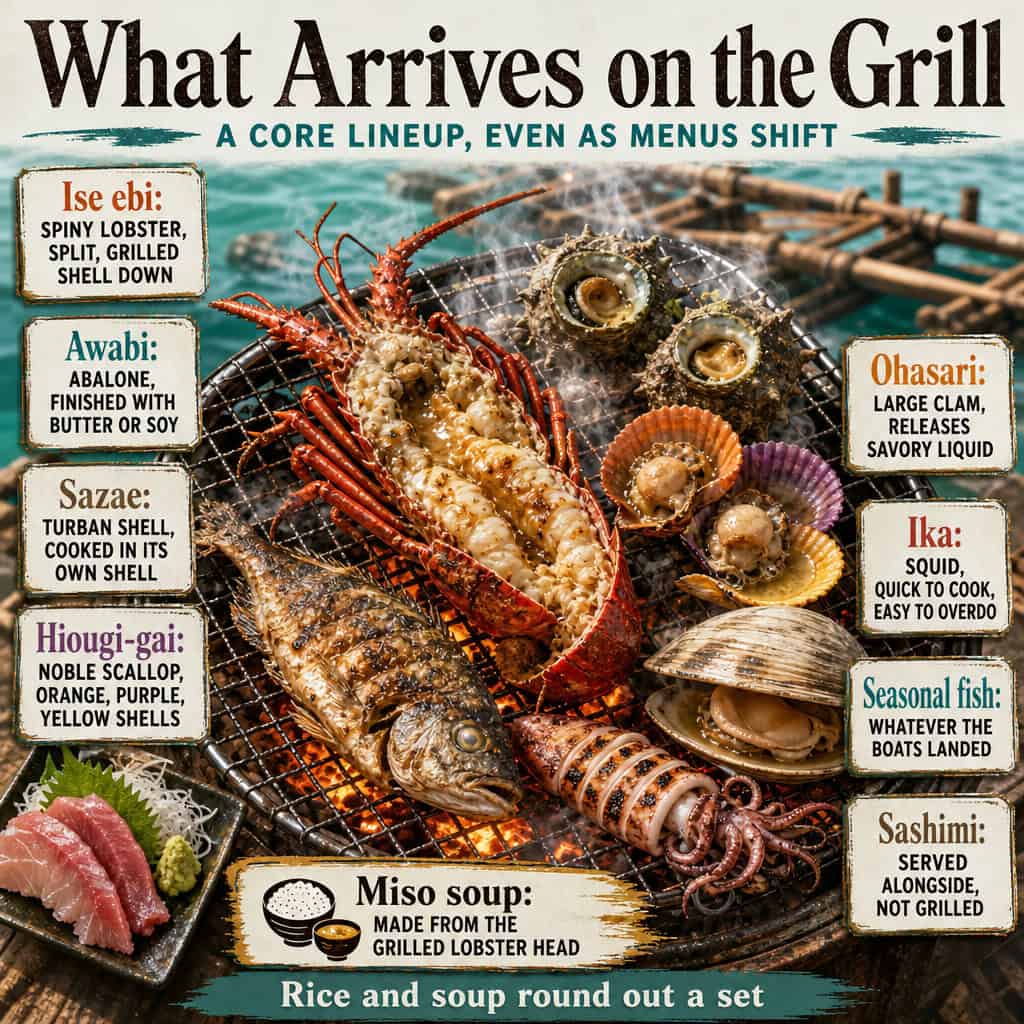
Menus change constantly. Still, a core lineup shows up at nearly every restaurant on this coast.
- Ise ebi: Japanese spiny lobster, usually split and grilled shell down
- Awabi: abalone, firm and mineral, often finished with butter or soy
- Sazae: turban shell, cooked upright in its own shell and juices
- Hiougi-gai: noble scallop, whose shells come in orange, purple, and yellow
- Ohasari: a large clam that releases a lot of savory liquid
- Ika: squid, quick to cook and easy to overdo
- Seasonal fish: whatever the boats landed, grilled whole or salted
- Sashimi: served alongside rather than on the grill
- Miso soup: frequently made from the lobster head after grilling
Rice and soup usually round out a set. Larger groups sometimes order funamori, a sashimi platter arranged in a wooden boat, though many places require eight or more people for it.
Ise Ebi, the Star of the Table
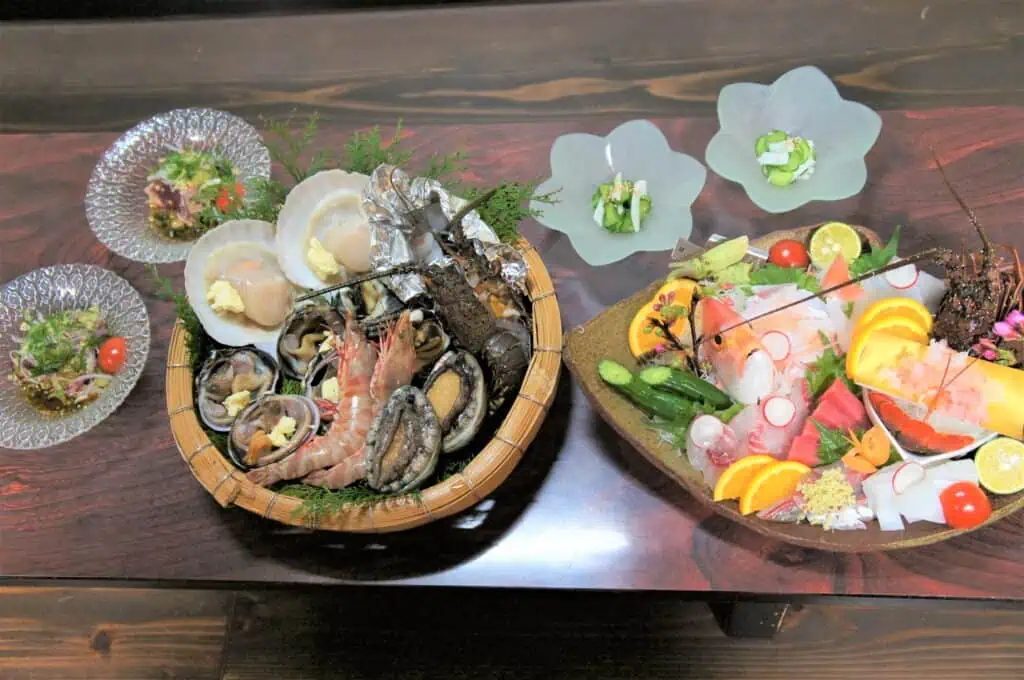
The spiny lobster carries this cuisine, and Tokushima manages it seriously. Understanding the fishery explains both the price and the calendar.
Tokushima’s Place in the Fishery
Ise ebi is Panulirus japonicus, a walking lobster with no large claws. Prefectural research records Tokushima’s average landings at about 72 tons a year, roughly 5.8 percent of the national total. That placed the prefecture fifth nationally in the mid-2010s, up from eighth a decade earlier.
Boats work the coast from Anan City down to Kaiyo Town. Tsubakidomari, Ishima, and Shishikui are the most productive grounds. Local fishermen, asked to rank the prefecture’s shrimp and lobster, put ise ebi first by a wide margin.
How the Lobster Is Caught
Crews set gill nets across rocky ground like curtains, then haul them at dawn. Since the lobster feeds at night, the nets go down after dark. Boats deploy several hundred metres of netting each.
Two details struck me as unexpectedly clever. Nets are dyed orange, brown, or red so they blend into the rock. Beyond that, crews deliberately leave the netting slack, because a taut net lets the lobster bounce off. Fishermen call that slack ratio ise, and they say it decides the size of the catch.
Moonlight ruins the whole operation, therefore fishing concentrates on dark nights. Every cooperative also observes a rest period of about a week around each full moon.
The Rules That Protect the Stock
Tokushima closes lobster fishing from May 15 to September 15 under Article 35 of its fisheries regulations. Article 36 additionally bans taking any lobster of 13 centimetres or less. Individual cooperatives then set stricter limits on net size, mesh, and operating hours.
Hiwasa Town’s cooperative received a Fisheries Agency commissioner’s award in 2017 for its management work. Crews there avoid fishing in rough weather, since damaged lobsters lose value and many die. Landings and stock both improved as a result.
Producer prices ran between 4,000 and 5,500 yen per kilogram in prefectural figures for 2014. Restaurant menus reflect that reality, so nobody should expect this to be a cheap meal.
An Odd Piece of Natural History
Prefectural divers off Hiwasa have photographed spiny lobsters sharing rock crevices with moray eels. The arrangement suits both animals. Octopus hunt lobster, moray eels hunt octopus, and so the lobster gains a bodyguard while the eel gains a lure.
Ise ebi also makes noise. Rubbing the base of its long antennae against a ridged organ produces a low grating sound, apparently used to warn off intruders. Hold one and you may hear it complain.
How the Meal Works
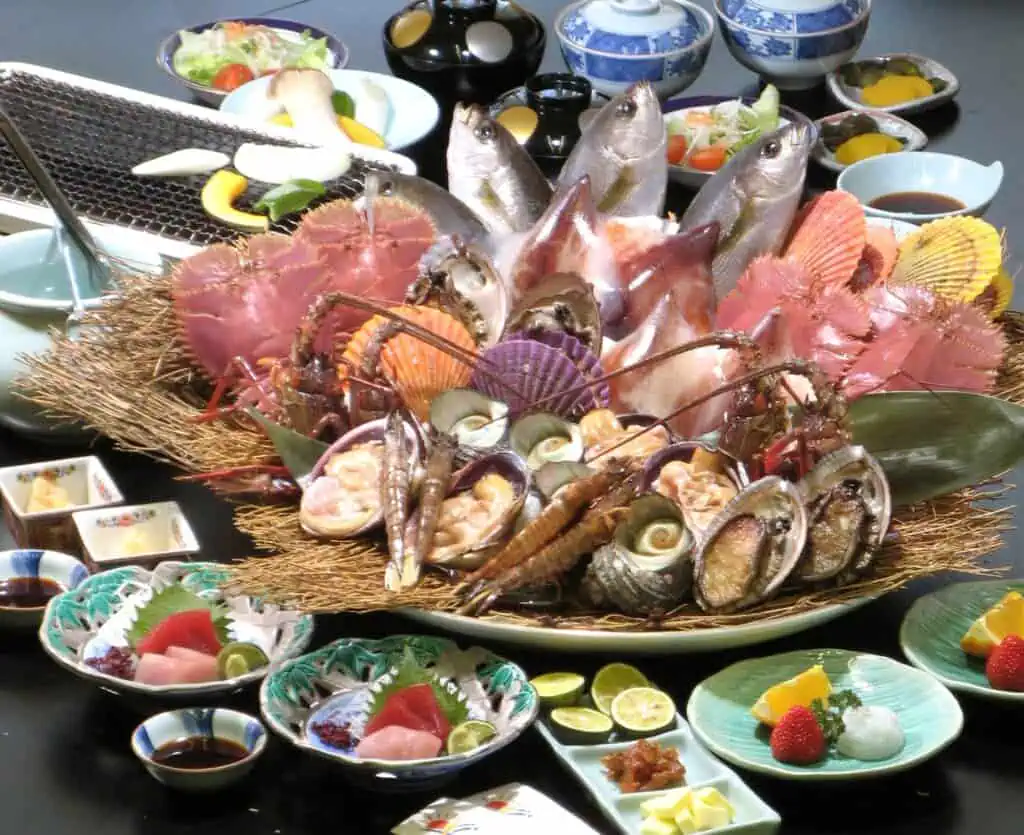
The format is casual, though a few practical points help. Staff will guide you, and asking is entirely normal.
Grilling and Timing
Shellfish go on in their shells, cup side down at first. Turban shells cook in their own liquid, so let them bubble rather than rushing them. Lobster halves take the longest, whereas squid needs barely a minute per side.
Seasoning stays minimal. Salt, a little soy sauce, and a squeeze of sudachi citrus cover most of it. Tokushima supplies about 98 percent of Japan’s sudachi, which holds a Geographical Indication registration. Its sharp green acidity suits grilled shellfish better than lemon does.
Safety and Comfort
Shells get extremely hot and hold heat long after leaving the grill. Use the tongs provided rather than chopsticks for moving anything. Shells can also crack and spit liquid, therefore keeping a small distance is sensible.
Cook shellfish through rather than serving it barely warm. Smoke is another consideration, since clothes absorb it readily. Wear something you can wash.
Allergies and Dietary Limits
This meal is built almost entirely from crustaceans and molluscs. Anyone with a shellfish allergy should avoid it, because shared grills make cross-contact unavoidable. Dipping sauces normally contain soy and often wheat as well.
Vegetarian options are limited at these restaurants, so call ahead if that matters. Small children can join, although the hot shells need adult supervision.
What It Tastes Like
Simplicity is the whole argument here. With seafood this fresh, seasoning mostly gets in the way.
Sweetness, Salt, and Smoke
Grilled spiny lobster tastes noticeably sweeter than boiled lobster, with a firmer bite. Abalone runs mineral and slightly chewy, while turban shell brings a faint bitterness from the darker parts near the tip. Noble scallops are the sweetest thing on the grill.
Charcoal adds aroma without dominating. Shell liquid reduces on the grill and concentrates as it goes, which is honestly the best part of the meal.
An Honest Caveat
Not everyone enjoys the turban shell. Those dark coils at the tip taste distinctly bitter and marine, and reactions split sharply. I like them, though I would not press anyone who does not.
Watching your food move before it cooks also bothers some diners. Restaurants vary in how they handle this, so ask when booking if it concerns you.
How It Compares with Other Japanese Grilled Seafood
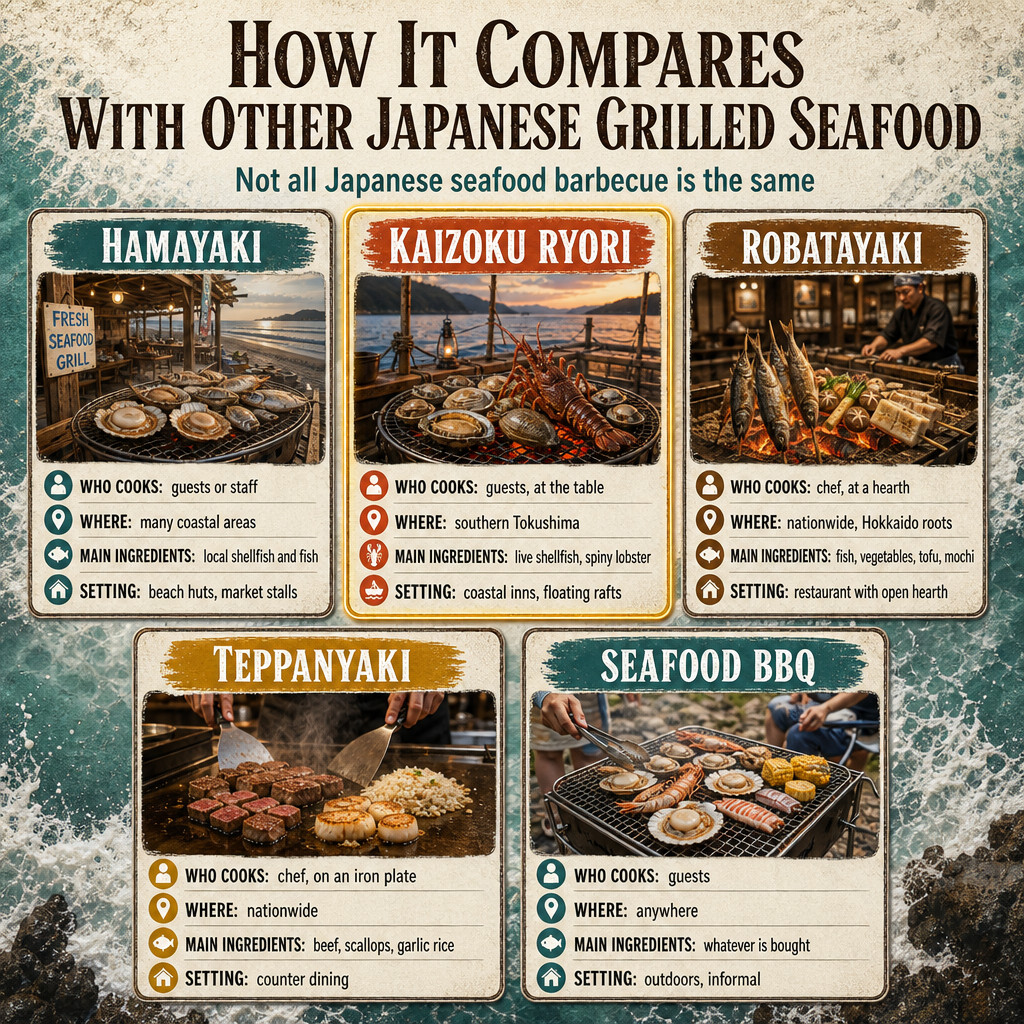
English writing tends to lump these together as Japanese seafood barbecue. The table separates them.
| Style | Who cooks | Where | Main ingredients | Setting |
|---|---|---|---|---|
| Kaizoku ryori | Guests, at the table | Southern Tokushima | Live shellfish and spiny lobster | Coastal inns and floating rafts |
| Hamayaki | Guests or staff | Many coastal areas | Local shellfish and fish | Beach huts and market stalls |
| Robatayaki | Chef, at a hearth | Nationwide, Hokkaido roots | Fish, vegetables, tofu, mochi | Restaurant with open hearth |
| Teppanyaki | Chef, on an iron plate | Nationwide | Beef, scallops, garlic rice | Counter dining |
| Seafood BBQ | Guests | Anywhere | Whatever is bought | Outdoors, informal |
Kaizoku Ryori and Hamayaki
These two overlap heavily, and locals do not police the boundary. Hamayaki is the broader national term for grilling shellfish near the shore. Kaizoku ryori is the regional name used along Tokushima’s southern coast, generally implying a seated meal with a set menu.
Kaizoku Ryori and Robatayaki
The difference here is cleaner. In robatayaki, a chef grills at a central hearth and passes food across on a long paddle. You never touch the fire. Kaizoku ryori hands the cooking to you instead, which changes the whole rhythm of the meal.
Where and When to Eat It
Planning matters more than usual with this one. Season, reservations, and transport all need thought.
The Coastal Towns
Awa Navi, the prefectural tourism site, lists kaizoku ryori as a gourmet category with venues concentrated in the south. Kaizoku no Ie in Kaiyo Town serves on a floating raft and is run by a fisherman. Meisanso, also in the south, is known for its lobster and shellfish.
Kaisan-so near Sabase Station and Minshuku Shirakiya in Mugi Town both offer the meal without an overnight stay. Details were surveyed in August 2026, so confirm before travelling.
Timing and Cost
Lobster is unavailable from mid-May to mid-September. During that gap, restaurants substitute other seafood, and at least one openly swaps in black tiger prawn. October through April is the strong window, with landings peaking then.
Sets generally start around 5,000 yen and climb with lobster size. Individual grilled items appear on some menus from a few hundred yen. Reservations are effectively mandatory, given that kitchens buy to order.
Getting There
The JR Mugi Line runs down this coast and now terminates at Awa-Kainan, serving Sabase and Mugi along the way. Beyond that point, the Asa Kaigan Railway takes over toward Shishikui and Kannoura. Trains are infrequent either way, so check timetables carefully.
That southern operator runs a dual-mode vehicle that switches between road and rail, the first of its kind in commercial service. Mechanical trouble has interrupted it repeatedly during 2026, with buses covering the gap, therefore confirm the current status before relying on it. A rental car from Tokushima City removes the problem entirely, and the drive south takes roughly two hours.
Rough weather can close raft restaurants outright. Calling ahead on a stormy day saves a wasted trip.
What Else to Eat in Tokushima
One seafood dinner does not cover a prefecture. A few others deserve room in the schedule.
Tokushima ramen offers the sharpest possible contrast, with its dark sweet-salty broth and raw egg. Awa Odori chicken turns up grilled and in soups across the prefecture. Naruto wakame, sudachi, and Iya soba fill out the rest.
Our Shikoku food guide sets these beside dishes from Kagawa, Ehime, and Kochi. If raw seafood appeals more than grilling, a kaisen don makes an easy alternative lunch.
Conclusion
Kaizoku ryori is a dramatic name attached to a simple idea. Fresh shellfish, a grill, and almost nothing else. What makes it worth the drive is the fishery behind it, managed by cooperatives that count centimetres and skip full moons.
Book ahead, come between October and April, and bring an appetite. Then order the sudachi and let the shells do the seasoning. Our Japan food guide covers where similar coastal traditions survive elsewhere.
Kaizoku Ryori FAQ
What is Kaizoku Ryori?
Kaizoku ryori means pirate cuisine, and it describes grilling fresh seafood at your own table in southern Tokushima. Spiny lobster, abalone, turban shells, and scallops make up the usual lineup. Restaurants keep live tanks, so ingredients reach the grill within minutes. The prefectural tourism board treats it as a distinct local category.
Did pirates actually eat this?
No, and the name is more recent than it sounds. One restaurant traces it to around 1960, when a fisherman in Shishikui grilled seafood for visitors. He first called it cruel cuisine, then seaside cuisine, before a customer suggested the pirate label. A second account credits fishermen and ama divers warming themselves by shore fires.
What seafood is served?
Ise ebi spiny lobster leads the menu, supported by abalone, turban shell, noble scallop, and large clams. Squid and seasonal fish appear too, alongside sashimi served off the grill. Many restaurants finish the meal with miso soup made from the lobster head. Exact contents change with each day’s catch.
When is the best season?
Aim for October through April, when spiny lobster landings peak. Tokushima closes lobster fishing entirely from May 15 to September 15 to protect spawning stock. Restaurants stay open during that gap and substitute other seafood instead. Autumn and spring both deliver strong catches.
How much does it cost?
Sets commonly start near 5,000 yen per person and rise with lobster size. Prefectural data put producer prices for spiny lobster between 4,000 and 5,500 yen per kilogram, which explains the figure. Some restaurants also sell individual grilled items from a few hundred yen. Prices were surveyed in August 2026 and change with the catch.
Do I need a reservation?
Yes, at almost every venue. Kitchens buy and hold live seafood specifically for booked guests, so walk-ins often get turned away. Phone booking a day or more ahead is standard practice. Rough weather can also close raft restaurants, therefore calling on the day is worthwhile.
Is Kaizoku Ryori a traditional Tokushima dish?
It is regional, though not ancient. The current format dates to roughly the 1960s, when coastal restaurants began serving visitors. Japan’s national local-cuisine database does not list it among Tokushima’s registered dishes, while prefectural tourism materials treat it as a local dining category. Shore-side grilling itself is naturally much older.
How is it different from hamayaki or robatayaki?
Hamayaki is the general national term for shore-side shellfish grilling, and the two overlap considerably. Kaizoku ryori is the regional name along Tokushima’s southern coast, usually meaning a seated set meal. Robatayaki differs more clearly, since a chef grills at a hearth and passes food to you. Here you do the cooking yourself.
Is it safe for people with shellfish allergies?
No. The meal centres on crustaceans and molluscs, and shared grills make cross-contact unavoidable. Dipping sauces normally contain soy and frequently wheat. Anyone with a serious shellfish allergy should choose a different restaurant entirely. Call ahead if you need to check specific ingredients.
Is it suitable for families with children?
Generally yes, though supervision matters. Shells hold heat for a long time and can crack and spit liquid unexpectedly. Use the tongs provided rather than chopsticks when moving anything. Many venues are inns that regularly host family groups.
How do I get to the restaurants?
The JR Mugi Line serves this coast, stopping at Sabase, Mugi, and Kaifu among others. Services run infrequently, so check timetables before committing. Driving from Tokushima City takes roughly two hours and gives much more flexibility. Some inns collect guests from nearby stations by arrangement.
References
Government and Prefectural Sources
- Tokushima Prefecture, Fisheries Research Division, Ise Ebi: Japanese Spiny Lobster (biology, fishery, regulations, prices), https://www.pref.tokushima.lg.jp/file/attachment/503877.pdf (Surveyed: August 2026)
- Tokushima Prefecture, Department of Agriculture, Forestry and Fisheries, official website, https://www.pref.tokushima.lg.jp/ (Surveyed: August 2026)
- Awa Navi, Tokushima Prefecture Tourism Information Site, Kaizoku Ryori gourmet category, https://www.awanavi.jp/archives/spot-purpose/gourmet (Surveyed: August 2026)
- Ministry of Agriculture, Forestry and Fisheries, Our Local Cuisine: Tokushima Prefecture index, https://www.maff.go.jp/j/keikaku/syokubunka/k_ryouri/search_menu/area/tokushima.html (Surveyed: August 2026)
- Ministry of Agriculture, Forestry and Fisheries, Geographical Indication Register No. 129: Tokushima Sudachi (98 percent national share), https://www.maff.go.jp/j/shokusan/gi_act/register/0129/index.html (Surveyed: August 2026)
- Asa Kaigan Railway, official site (dual-mode vehicle operation and service notices), https://asatetu.com/ (Surveyed: August 2026)
Restaurant and Local Sources
- Kaizoku no Ie, Kaiyo Town, official site (origin account, menu, seasonal substitution), https://www.mitoko-hamabe.com/kaizokuryori (Surveyed: August 2026)
- Awa Navi, Kaizoku no Ie venue listing, https://www.awanavi.jp/archives/spot/1932 (Surveyed: August 2026)
- Awa Navi, Meisanso venue listing, https://www.awanavi.jp/archives/spot/1533 (Surveyed: August 2026)
- Minshuku Shirakiya, Mugi Town, official site, https://shirakiya-mugi.com/ (Surveyed: August 2026)
Further Reading and Research Entry Points
- Yamakawa, H., Stock Assessment and Fishery Management of the Japanese Spiny Lobster (1997), cited in Tokushima Prefecture research materials on age and growth, https://cir.nii.ac.jp/ (Surveyed: August 2026)
- Rural Culture Association Japan, Complete Collection of Japanese Food Life Vol. 36: Interviews on the Food of Tokushima, https://www.ruralnet.or.jp/zensyu/syoku/syoku36.html (Surveyed: August 2026)
- J-STAGE, Japanese academic journal platform, entry point for spiny lobster and coastal fishery research, https://www.jstage.jst.go.jp/ (Surveyed: August 2026)
Related Articles
- Shikoku Food Guide (Surveyed: August 2026)
- Tokushima Ramen (Surveyed: August 2026)
- Awa Odori Chicken (Surveyed: August 2026)
- Ise Ebi (Surveyed: August 2026)
- Awabi (Surveyed: August 2026)
- Kaisen Don (Surveyed: August 2026)
- Teppanyaki and Hibachi (Surveyed: August 2026)
- Uwajima Taimeshi (Surveyed: August 2026)
- Chikuwa (Surveyed: August 2026)
- Teishoku (Surveyed: August 2026)
- Sushi (Surveyed: August 2026)
- Japan Food Guide (Surveyed: August 2026)



Comments