




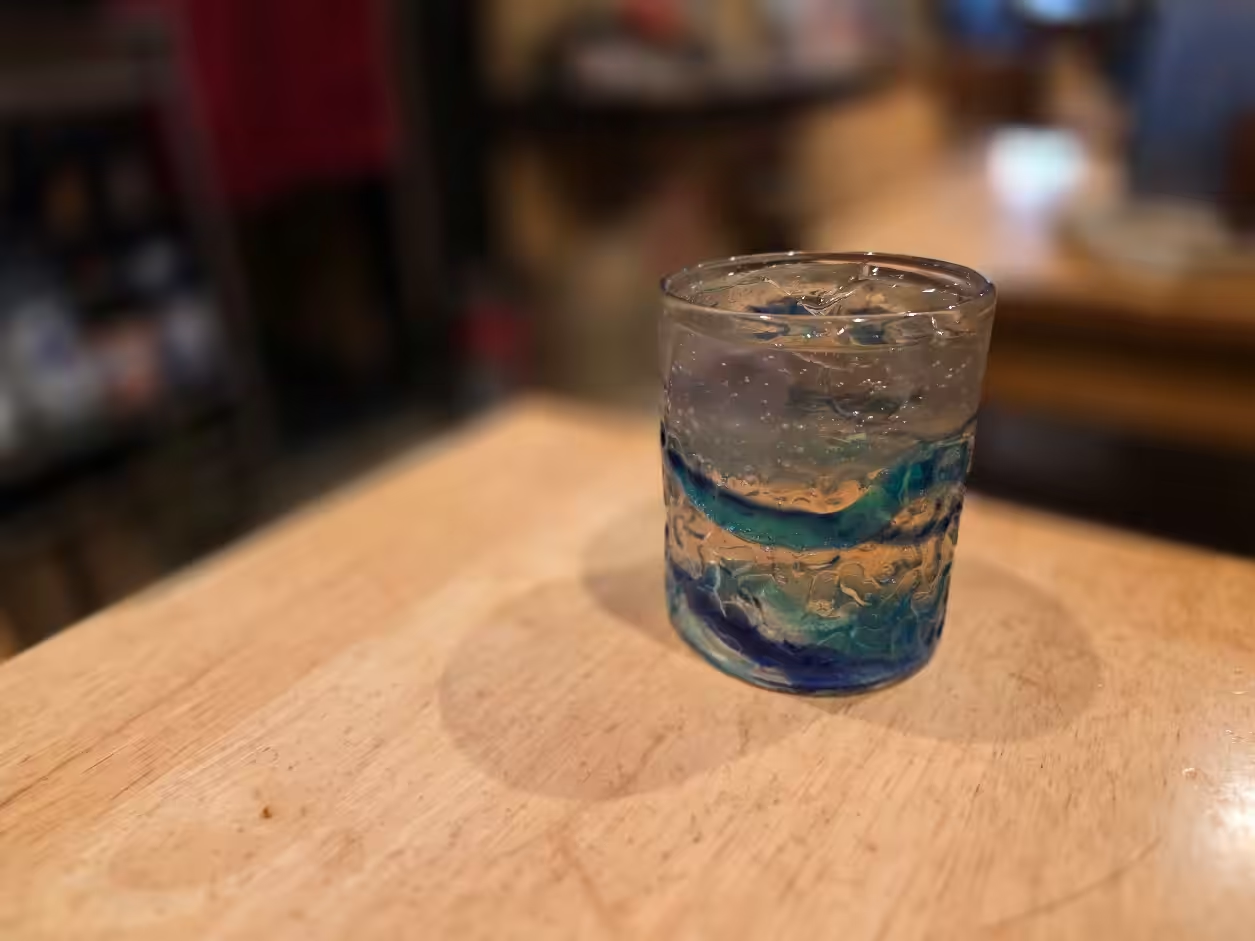
Shikuwasa drink is Okinawa’s everyday citrus beverage, made from a small green fruit called Citrus depressa. It tastes sharply sour with a green, faintly bitter edge, so almost nobody drinks it straight. Instead, locals dilute it with cold water, mix it with soda, or pour it over shaved ice on a hot afternoon.
In fact, you will meet it within hours of landing in Naha. Bottles line the shelves of every souvenir shop, and restaurants list it beside beer and awamori. Yet the English spelling changes constantly, the health marketing runs ahead of the evidence, and nobody explains how much water to add. This guide sorts all of that out, using Japanese government data and published research rather than product copy.
Shikuwasa at a Glance
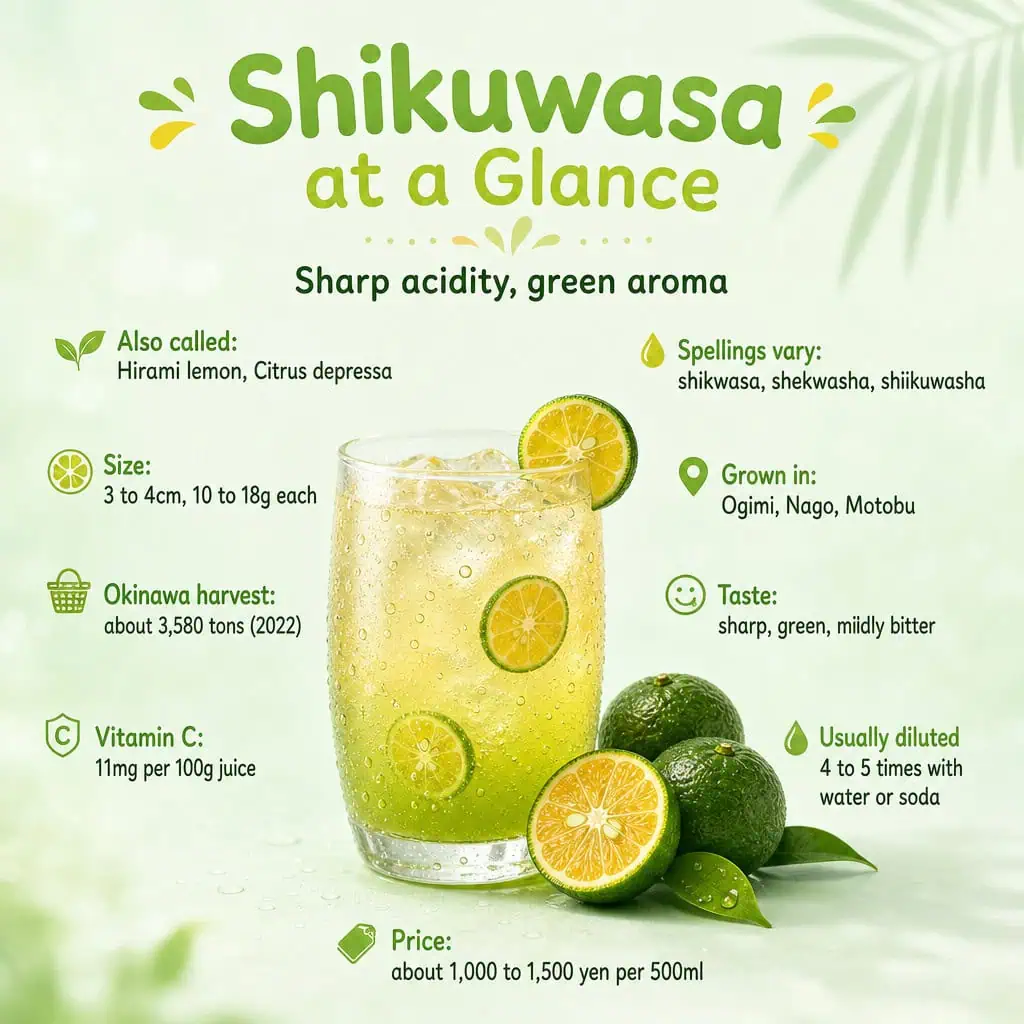
Here is the short version before the detail. In addition, every figure below comes from Japanese government publications or peer-reviewed research, with sources listed at the end.
| Okinawan name | Shikuwasa (シークヮーサー), roughly shee-koo-WAH-sah |
|---|---|
| Standard Japanese name | Hirami lemon (ヒラミレモン) |
| Scientific name | Citrus depressa |
| Common spellings | Shikuwasa, shikwasa, shekwasha, shiikuwasha |
| Fruit size | Roughly 3 to 4 cm across, 10 to 18 g each |
| Main growing area | Ogimi, Nago, and Motobu in northern Okinawa |
| Okinawa harvest | About 3,580 tons from roughly 430 hectares in 2022 |
| Taste | Sharp acidity, green aroma, mild bitterness |
| Vitamin C in juice | 11 mg per 100 g |
| Usual serving | Diluted about 4 to 5 times with water or soda |
| Typical price | Around 1,000 to 1,500 yen for 500 ml of 100% juice |
What Is Shikuwasa?
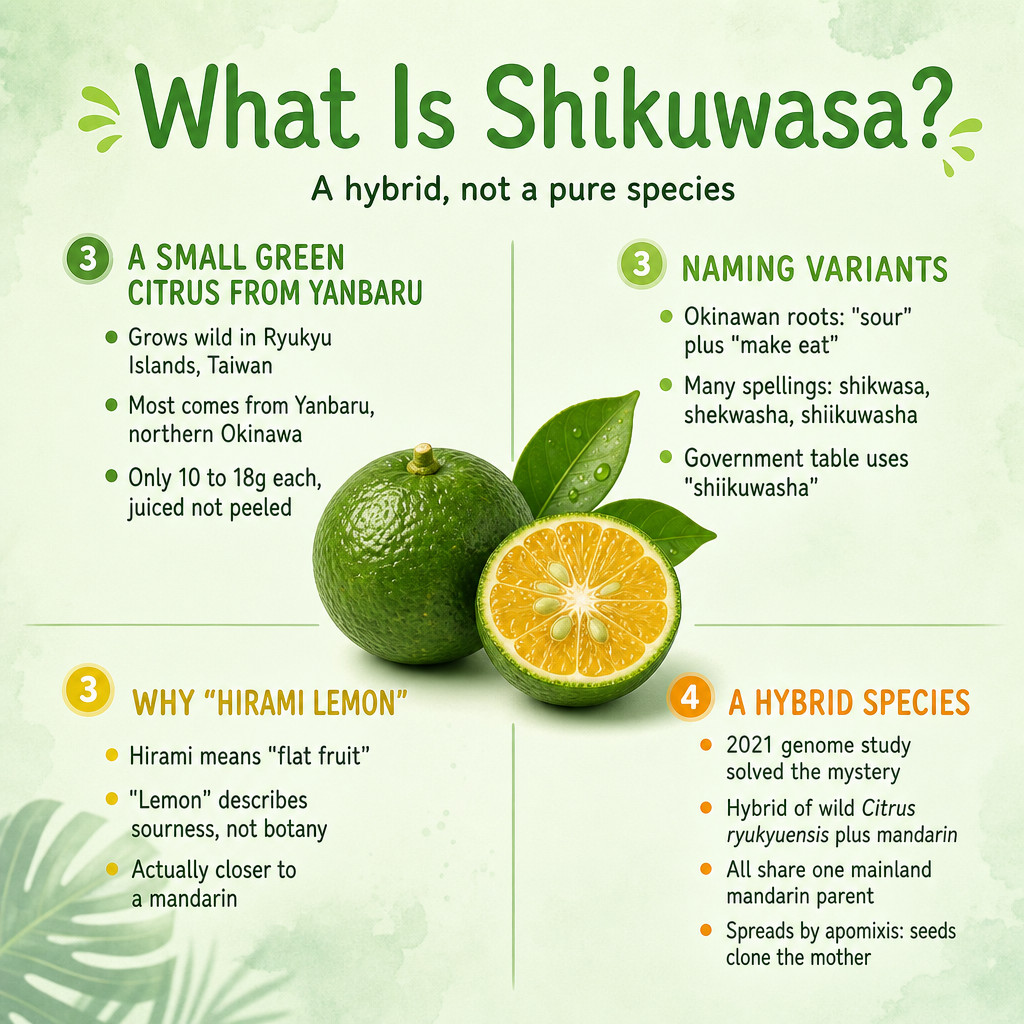
Shikuwasa is a small sour citrus that grows wild across the Ryukyu Islands and Taiwan. In practice, the fruit is about the size of a golf ball. Nobody eats much of it fresh while green, so the juice does almost all the work.
A Small Green Citrus from Yanbaru
Most shikuwasa comes from Yanbaru, the forested northern third of Okinawa’s main island. Trees grow on hillsides rather than in flat orchards, and many of them are old. JA Okinawa describes the fruit as a small loose-skinned citrus native to the region.
Each fruit weighs only 10 to 18 grams. Because of that size, peeling one is fiddly, and juicing becomes the practical option. As a result, that single fact shapes the entire product category.
Shikuwasa, Shikwasa, and Shekwasha
The name comes from the Okinawan language, where shii means sour and kwaasaa means to make someone eat. Roughly translated, it means something that makes you eat sourness. Since the word was spoken long before anyone wrote it in English, spellings multiplied.
For example, you will see shikuwasa, shikwasa, shekwasha, and shiikuwasha on labels. Meanwhile, the Japanese government food composition table uses shiikuwasha. All of them refer to the same fruit, so do not worry if a bottle spells it differently from a menu.
Why It Is Also Called Hirami Lemon
The standard Japanese name is hirami lemon, written 平実レモン. Hirami means flat fruit, which describes the slightly squashed mandarin shape. Lemon refers to the sourness rather than to any botanical link.
Botanically, however, shikuwasa sits closer to mandarins than to lemons. That surprised me the first time I read it, because the flavor really does read as lime-adjacent. Once you taste a fully ripe one in February, though, the mandarin side becomes obvious.
A Hybrid Species, Confirmed by Genome Research
Genome research published in 2021 settled a long argument about this fruit. A team sequencing 69 east Asian citrus samples identified a wild species new to science, Citrus ryukyuensis, native to the Ryukyu Islands. In short, shikuwasa turned out to be a hybrid of that wild species with a mainland Asian mandarin.
One detail is stranger still. Every shikuwasa in the study shared a single mainland mandarin parent, which makes them a large family of half-siblings. Moreover, researchers located a living clone of that parent in a private collection in Nago City. Shikuwasa then spread by apomixis, meaning its seeds grow into clones of the mother tree instead of new crosses.
So the fruit is neither an ancient pure species nor a modern bred cultivar. It sits between the two, and that history explains both its variety and its stability. The same study found that tachibana, mainland Japan’s sacred citrus, arose from a separate and unrelated hybridization.
Where Shikuwasa Comes From
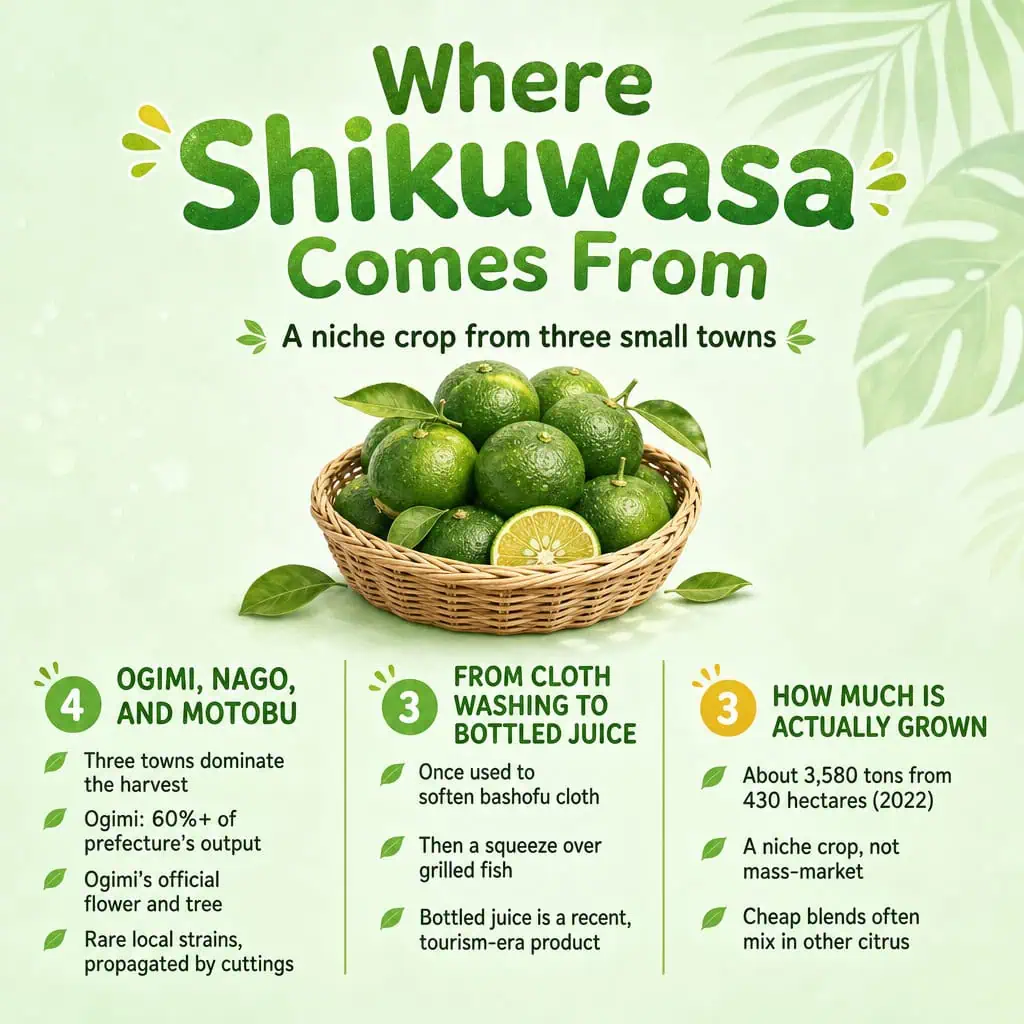
Production is concentrated in a very small area. Consequently, that concentration explains both the price and the souvenir shelf space.
Ogimi, Nago, and Motobu
Three northern municipalities dominate the harvest: Ogimi Village, Nago City, and Motobu Town. Ogimi states that it accounts for more than 60 percent of the prefecture’s output, and the village designates shikuwasa as both its official flower and its official tree. Nago’s Katsuyama district also holds prefectural recognition as a core production area.
Kagoshima also grows a tiny amount, and a few trees exist elsewhere. In practice, though, almost every bottle you buy traces back to northern Okinawa.
The area also holds a surprising number of local strains. Researchers cataloguing Okinawan landraces have described named types such as Ogimi-kugani and Izumi-kugani, alongside related island citrus like kabuchii and oto. Many survive as a handful of old trees, propagated by cuttings rather than sold commercially.
From Cloth Washing to Bottled Juice
The fruit had a job long before it became a drink. JA Okinawa notes that people once used the juice to soften and clean bashofu, the banana-fiber cloth woven in the Ryukyu Kingdom. Similarly, cooking use came alongside that, mainly as an acid squeezed over grilled fish.
Bottled juice, however, is a much more recent development. Commercial processing scaled up as Okinawa built its tourism economy, and eventually the drink became a standard souvenir.
How Much Is Actually Grown
Okinawa Prefecture reports a shikuwasa harvest of about 3,580 tons, grown on roughly 430 hectares in 2022. For comparison, Japan grows mandarins by the hundreds of thousands of tons every year. So shikuwasa is genuinely a niche crop rather than a mass-market fruit.
That scarcity matters when you shop, because cheaper products often blend shikuwasa with other citrus. In particular, the section on buying below explains how to spot that on a label.
What Does Shikuwasa Drink Taste Like?
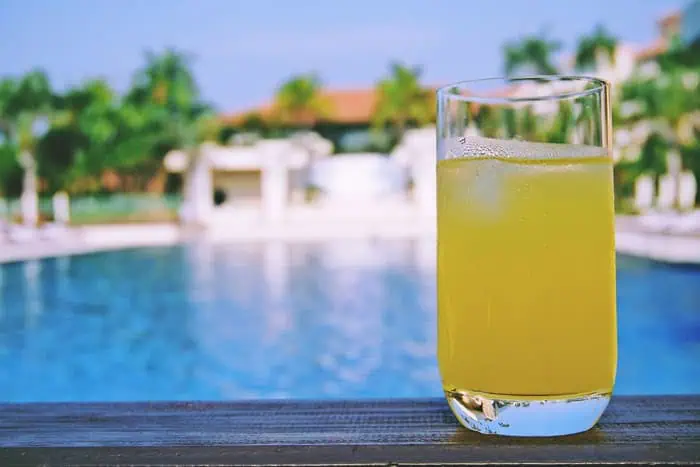
This is the question that decides whether you buy a bottle. The honest answer, though, is that it depends heavily on which product you pick up.
Sour, Green, and Slightly Bitter
Undiluted shikuwasa juice is aggressively sour. Sharper than orange, less rounded than lemon, and with a green vegetal note underneath. There is a mild bitterness too, especially in products pressed with the peel.
For instance, JA Okinawa ran a taste-sensor comparison against kabosu, sudachi, lemon, yuzu, and calamansi. Their result put shikuwasa lower in bitterness than most of those, with astringency acting as the accent instead. That matches my experience, although the first sip still made me wince.
Aroma and Aftertaste
The aroma arrives before the sourness. Generally, it reads as fresh-cut grass and lime peel, brighter than yuzu and less floral. That impression has a measurable basis. Japanese researchers analysing peel volatiles from the Ogimi-kugani strain found gamma-terpinene at roughly 21 to 30 percent of the profile, with p-cymene alongside it.
The finish, by contrast, is short and clean. Unlike grapefruit, it does not linger bitterly on the tongue. That quality is exactly why it works as a mixer.
How the Harvest Season Changes the Flavor
Okinawa harvests shikuwasa in three rough windows, and each one produces a different drink. First, late August through September brings aogiri, the green-cut fruit, which is the sourest and most aromatic. October to December fruit goes mainly into juice, since the acidity has softened by then.
Finally, from December into February, the skin turns yellow and the fruit sweetens enough to eat by hand. Ogimi Village calls this ripe stage kugani, and juice from it tastes noticeably gentler. If a bottle says kanjuku or kugani, expect that softer profile rather than the sharp green one.
Types of Shikuwasa Drinks
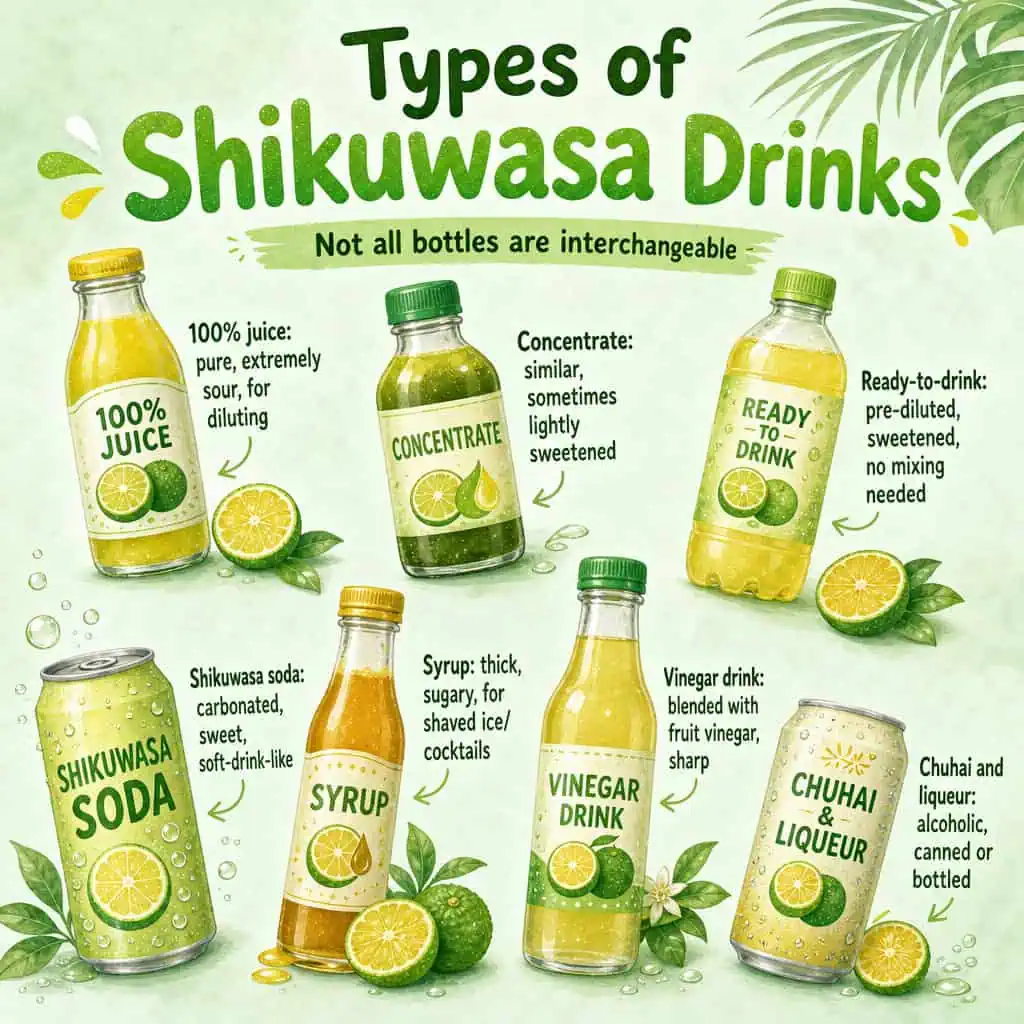
Okinawan shops sell several formats, and they are not interchangeable. Indeed, buying the wrong one is the most common mistake visitors make.
- 100% juice (果汁100%): pure pressed juice, extremely sour, meant for diluting
- Concentrate (原液): similar to the above, though sometimes lightly sweetened, and always diluted
- Ready-to-drink juice: already diluted and usually sweetened, so it needs no mixing
- Shikuwasa soda: carbonated and sweet, closer to a soft drink
- Syrup: thick and sugary, therefore aimed at shaved ice and cocktails
- Vinegar drink: shikuwasa blended with fruit vinegar, so it tastes especially sharp
- Chuhai and liqueur: alcoholic versions sold in cans and bottles
Straight Juice and Concentrate
These two are the workhorses. Both come in glass or plastic bottles, usually 500 to 720 millilitres, and both need water. A bottle lasts a long time because you use so little at once.
Some producers press the whole fruit, peel included, to capture more of the peel compounds. Of course, those versions taste noticeably more bitter. Whether that trade is worth it depends on how you plan to drink it.
Soda, Syrup, and Vinegar Drinks
Shikuwasa soda is the easiest entry point, and Okinawan vending machines stock it widely. Syrup instead shows up on shaved ice at summer festivals. Vinegar drinks, meanwhile, sit in the health-food aisle and taste much sharper than the label suggests.
Alcoholic options exist as well. Canned chuhai with shikuwasa appears in every Okinawan convenience store, and local breweries have used the fruit in beer.
How to Drink Shikuwasa
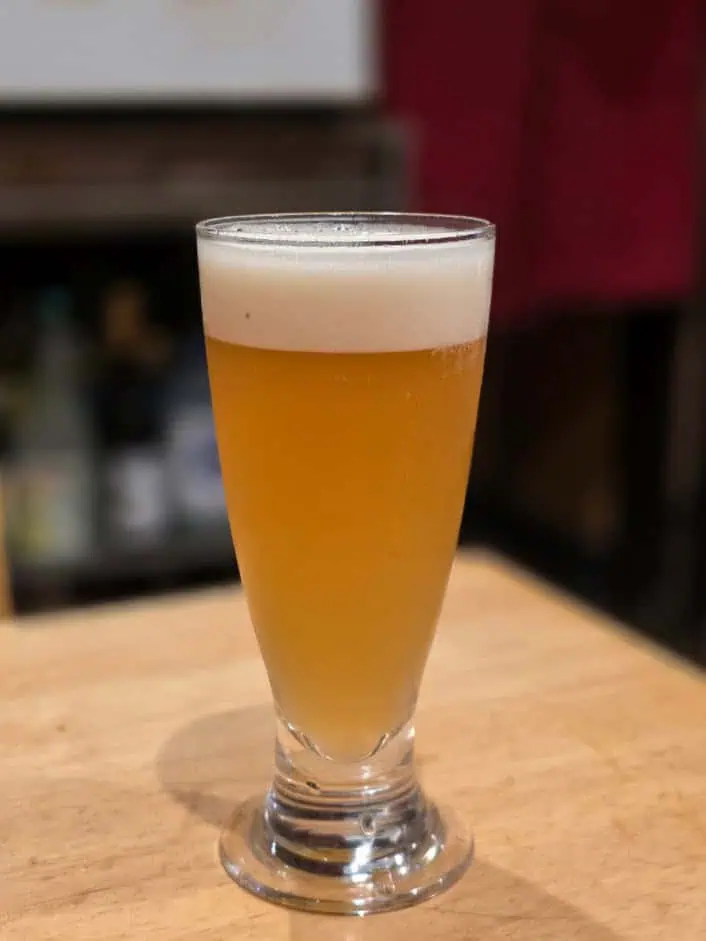
Nobody prints instructions in English on most bottles. Here is what actually works, starting with the ratio.
Dilution Ratios That Work
Start at one part juice to four parts cold water. Japanese labels suggest anywhere from three to eight times dilution depending on the product, so check the bottle before pouring. Four or five times suits most palates as a starting point, and you can adjust from there.
If it tastes harsh, add water before adding sugar. Undiluted juice is acidic enough to be unpleasant on tooth enamel, and drinking it neat serves no purpose. In any case, a tall glass with plenty of ice is the standard Okinawan serve.
With Sparkling Water or Honey
Sparkling water changes the drink completely. Carbonation lifts the aroma and softens the perception of acidity, therefore many people prefer it to still water. Use the same ratio and pour the water first to keep the bubbles.
Honey is the traditional sweetener here rather than sugar. One teaspoon per glass is usually enough. Dissolve it in a little warm water first, since honey sinks straight to the bottom of a cold glass otherwise.
Cocktails, Mocktails, and Awamori
In Okinawa, the classic pairing is with awamori. To begin with, mix roughly one part awamori, one part shikuwasa juice, and three parts water over ice. Bars across Naha serve some version of this, often under the name shikuwasa sour.
The juice also substitutes neatly for lime in a gin and tonic or a mojito. For a mocktail, combine shikuwasa, sparkling water, honey, and a few mint leaves. It is not complicated, and it works better than most citrus alternatives.
Shikuwasa Compared with Other Japanese Citrus
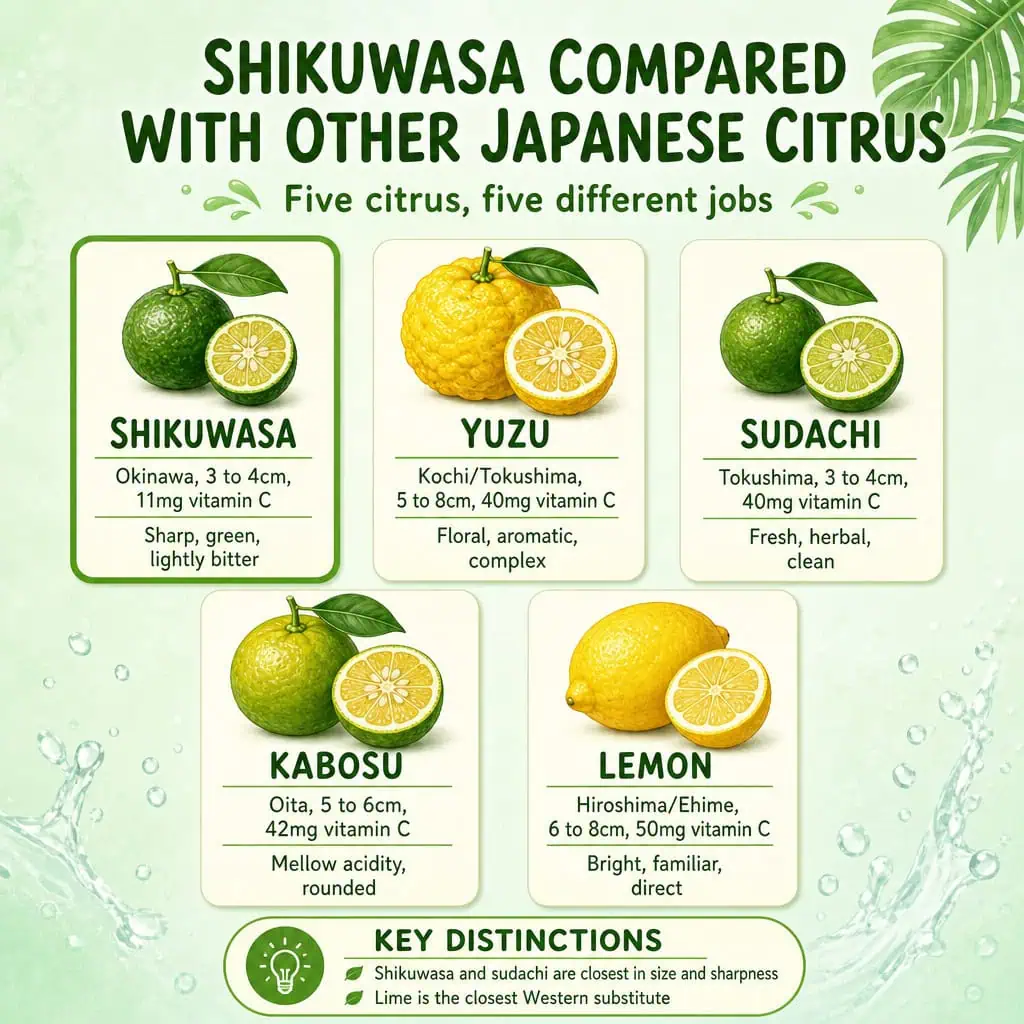
Japan grows many sour citrus fruits, and they get confused constantly. The table below therefore sets out the practical differences.
| Citrus | Main region | Fruit size | Vitamin C in juice | Flavor character |
|---|---|---|---|---|
| Shikuwasa | Okinawa | 3 to 4 cm | 11 mg / 100 g | Sharp, green, lightly bitter |
| Yuzu | Kochi and Tokushima | 5 to 8 cm | 40 mg / 100 g | Floral, aromatic, complex |
| Sudachi | Tokushima | 3 to 4 cm | 40 mg / 100 g | Fresh, herbal, clean |
| Kabosu | Oita | 5 to 6 cm | 42 mg / 100 g | Mellow acidity, rounded |
| Lemon | Hiroshima and Ehime | 6 to 8 cm | 50 mg / 100 g | Bright, familiar, direct |
Yuzu, Sudachi, and Kabosu
Yuzu is the aromatic one, prized mainly for its peel rather than its juice. Sudachi is closest to shikuwasa in size and sharpness, but it grows in Tokushima and carries a more herbal scent. Kabosu, in contrast, falls between the two with softer acidity.
All three appear in ponzu and as garnishes in Japanese cooking. Shikuwasa plays the same role in Okinawa, where the other three barely feature.
Lime, Lemon, and Calamansi
Lime is the closest Western substitute for cooking, although shikuwasa has a rounder, less piercing acidity. Calamansi also looks almost identical and gets confused with it regularly. Chemical markers such as gamma-terpinene levels let laboratories tell the two juices apart, which matters commercially because calamansi is cheaper.
If you cannot find shikuwasa at home, use lime juice with a small squeeze of mandarin. Overall, that combination gets closer than lime alone.
Nutrition and Health Claims
Shikuwasa marketing leans hard on wellness language. Some of it holds up, and some of it does not, so it is worth separating the two carefully.
What the Nutrition Table Shows
Japan’s official food composition table lists raw shikuwasa juice at 35 kcal per 100 grams, with 180 mg of potassium and 11 mg of vitamin C. It also records 120 micrograms of beta-cryptoxanthin, a carotenoid found in mandarins.
That vitamin C figure deserves attention, because English articles routinely call shikuwasa a vitamin C powerhouse. The same government table puts lemon juice at 50 mg and yuzu juice at 40 mg per 100 grams. Shikuwasa juice sits well below both, and you drink it diluted anyway.
Where the Nobiletin Actually Sits
The compound behind most of the health interest is nobiletin, a polymethoxylated flavonoid. Shikuwasa carries unusually high levels of it, and tangeretin and sinensetin appear alongside. Accordingly, researchers have studied this group for well over a decade.
One measurement changes how you should read the marketing. These compounds concentrate in the peel rather than the juice, and unripe peel holds the most. Analysis of Okinawan citrus put total polymethoxyflavones in immature Ogimi-kugani peel at about 20.6 milligrams per gram of dry weight. Likewise, comparisons of juice against peel show the same gap consistently.
The same analysis also detected synephrine in the peel, at roughly 5.2 milligrams per gram of dry weight. So a whole-fruit pressed product does carry more of these compounds than a clear juice. That is precisely why it tastes more bitter.
What the Research Has and Has Not Shown
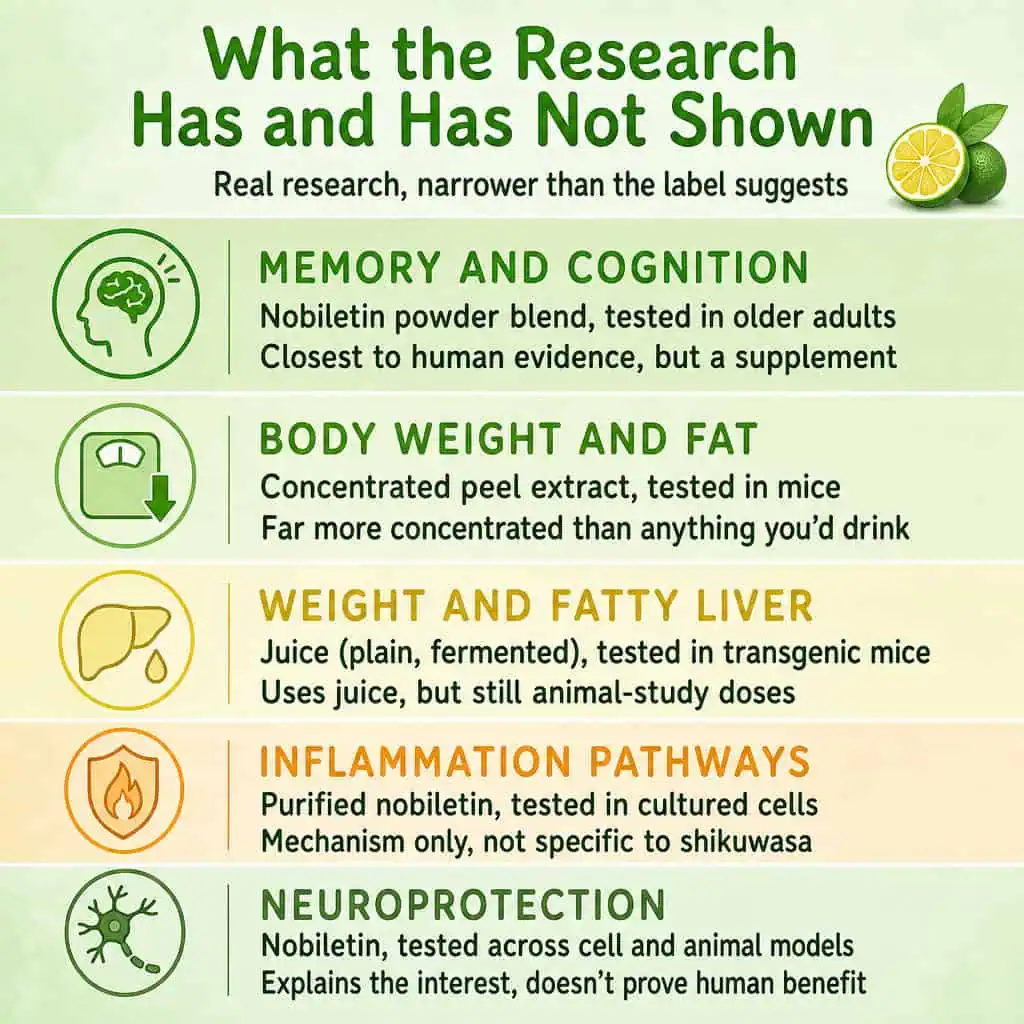
Published work on shikuwasa is real, and it is also narrower than product labels suggest. The table below summarises what each strand of research actually tested.
| Research focus | What was tested | Subjects | What it means for a drink |
|---|---|---|---|
| Memory and cognition | Peel-derived nobiletin powder blended with two other plant extracts | Older Japanese adults | Closest thing to human evidence, but a supplement rather than juice |
| Body weight and fat | Shiikuwasa peel extract at 1 to 1.5 percent of the diet | Mice fed a high-fat diet | Concentrated peel, far above anything you would drink |
| Weight gain and fatty liver | Shikuwasa juice, plain and fermented | Transgenic mice | Uses juice, though still at animal-study doses |
| Inflammation pathways | Purified nobiletin from citrus peel | Cultured cells | Mechanism only, and not specific to shikuwasa |
| Neuroprotection | Nobiletin across many disease models | Cell and animal models | Explains the interest rather than proving benefit in people |
Read down that last column and the pattern is clear enough. In general, almost everything runs on concentrated extracts, cells, or animals. Only one human trial exists, and it tested a formulated supplement rather than a glass of anything.
The Longevity Question
Shikuwasa marketing frequently gestures toward Okinawan longevity. Research on that subject, though, points elsewhere. Reviews of the traditional Okinawan diet credit the overall pattern, meaning sweet potato, vegetables, soy, and low calorie density. No single fruit carries that weight.
There is a further wrinkle worth knowing. A 2003 public health paper documented that Okinawa’s longevity ranking had already slipped, particularly among men, as postwar diets changed. Later, demographers revisited the trend again in 2024. Treat the longevity story as background, then buy the juice because you like how it tastes.
Sugar, Acidity, and Medication
Ready-to-drink bottles and sodas often contain substantial added sugar, and syrups contain a great deal more. Since a label may only say shikuwasa drink, checking the ingredient list is the only reliable method. Look for 果汁100% when you want pure juice with nothing added.
Besides sugar, acidity is the other practical point. Diluting properly and drinking with a meal both help, and rinsing with water afterwards is sensible. Citrus allergy is uncommon, though anyone who reacts to other citrus should treat this the same way.
One further note deserves care. Grapefruit, pomelo, and Seville orange are documented to affect how the body processes certain medicines, through compounds called furanocoumarins. Comparable data specific to shikuwasa is not established either way. So if you take prescription medication, ask a pharmacist rather than assuming, because this article is general information and not medical advice.
Where to Buy Shikuwasa Drink
Availability drops sharply the further you get from Okinawa. Planning ahead helps, and so does knowing what a fair price looks like.
Buying It in Okinawa
Naha Airport, roadside stations, and souvenir shops along Kokusai-dori all stock multiple brands. Michi-no-eki Kyoda in Nago sits close to the growing area and usually carries a wide range. Generally, supermarkets tend to be cheaper than tourist shops for the same bottle.
Glass bottles are heavy, so buy them at the end of your trip. Airport branches let you skip carrying them around northern Okinawa for a week. Remember that liquids over 100 millilitres cannot travel in hand baggage on international flights, therefore anything you buy needs to go in checked luggage with some padding.
Ogimi Shikuwasa Park
If you are driving through Yanbaru, this is the obvious stop. Ogimi Shikuwasa Park opened in April 2016 in Tsuha, Ogimi Village, and admission is free. Additionally, visitors can watch the pressing line, taste juice from a tap, and compare batches made from different harvest stages.
That side-by-side tasting is the part worth the detour. Reading about aogiri and kugani is one thing, and drinking them within a minute of each other makes the difference land properly.
What It Costs and How to Read the Label
Prices vary by product type more than by shop. Surveyed in August 2026, a 500 millilitre bottle of 100 percent juice generally ran between 1,000 and 1,500 yen. Premium whole-fruit pressed bottles at 720 millilitres sat closer to 2,000 to 2,300 yen, while blended drinks and sodas often cost under 800 yen.
Reading the label matters more than the price, though. Japanese ingredient lists, importantly, run in order of weight. One widely sold Okinawan bottle names Taiwanese shikikan, a calamansi type, ahead of shikuwasa itself, which tells you exactly which fruit dominates. Cheap is not automatically bad, yet you should know what you are drinking.
Supermarkets and Ordering from Outside Japan
Mainland Japanese supermarkets stock shikuwasa juice inconsistently. Antenna shops for Okinawa in Tokyo and Osaka are more reliable, and department store food halls occasionally carry premium bottles from single producers.
Japanese grocery stores overseas sometimes carry bottled concentrate, and online retailers ship internationally. Prices roughly double once shipping is included, which is worth knowing before you order. Frozen whole fruit occasionally appears in larger Asian supermarkets.
Choosing Between Juice, Concentrate, and Syrup
For general drinking, 100 percent juice gives the most flexibility. Choose a whole-fruit pressed version only if you actively enjoy bitterness. Syrup makes sense for shaved ice and cocktails but little else.
Store opened bottles in the refrigerator and use them within a few weeks. Acidity slows spoilage, although the aroma fades faster than the sourness does.
What to Drink It With
Shikuwasa functions as an acid, so it partners well with anything rich or fried. That principle covers most of the Okinawan table.
Okinawan Dishes
Fried gurukun is the obvious match, and many restaurants serve a wedge of shikuwasa beside it. Braised rafute likewise benefits from the same contrast. Goya chanpuru works too, since bitterness and acidity handle each other well.
Fried Food, Seafood, and Desserts
Tempura, karaage, and grilled fish all improve with a squeeze. Sashimi also takes it well in place of lemon. On the sweet side, the juice cuts through cheesecake and lifts a simple fruit jelly.
A cold glass alongside a bowl of Okinawa soba is the everyday combination, though. Nothing fancy, just useful on a humid day.
Conclusion
Shikuwasa drink is one of the easiest Okinawan flavors to bring home. A bottle of juice costs about the same as a decent lunch, keeps for weeks, and turns ordinary sparkling water into something worth drinking. Meanwhile, the fruit itself remains genuinely local, grown on a few hundred hectares of northern hillside.
Skip the wellness marketing and buy it for the taste instead. Look for 果汁100% on the label, dilute it four or five times, and add honey if you want. Then explore the rest of the island’s table through our Okinawa food guide.
Shikuwasa Drink FAQ
What is shikuwasa drink?
Shikuwasa drink is a citrus beverage made from Citrus depressa, a small green fruit grown in northern Okinawa. Producers press the fruit into juice, which people then dilute with water or soda. Sweetened ready-to-drink bottles and sodas also exist. Overall, the flavor is sharply sour with a green, faintly bitter edge.
What does shikuwasa taste like?
Shikuwasa tastes sharper than orange and greener than lemon, with mild bitterness from the peel. Meanwhile, the aroma suggests cut grass and lime zest. Green-harvested fruit is the most acidic, while ripe winter fruit tastes noticeably gentler. The finish stays clean rather than lingering.
How do you dilute shikuwasa concentrate?
Mix roughly one part juice with four parts cold water as a starting point. Japanese labels recommend anywhere from three to eight times dilution depending on the product, so check your bottle first. Sparkling water also works well and softens the acidity. Add honey rather than sugar if you want it sweeter.
Is shikuwasa the same as lime or calamansi?
No. Shikuwasa is botanically closer to mandarins, despite its lime-like sourness. Calamansi looks very similar and appears in some blended Okinawan drinks, so check the ingredient list if you want pure shikuwasa. Instead, lime with a small squeeze of mandarin makes the nearest substitute at home.
Why does the spelling keep changing?
The word comes from the Okinawan language and had no fixed English spelling. However, shikuwasa, shikwasa, shekwasha, and shiikuwasha all describe the same fruit. Japan’s official food composition table uses shiikuwasha. Product labels vary freely, so treat the spellings as interchangeable.
Is shikuwasa juice high in vitamin C?
Not especially. Japan’s official food composition table lists raw shikuwasa juice at 11 mg of vitamin C per 100 grams. By comparison, the same table puts lemon juice at 50 mg and yuzu juice at 40 mg. Since you drink shikuwasa diluted, the amount per glass is smaller again.
What is nobiletin in shikuwasa?
Nobiletin is a polymethoxylated flavonoid that shikuwasa contains in unusually high amounts. It concentrates in the peel rather than the juice, and unripe peel holds the most. Furthermore, most published studies used concentrated peel extracts, cultured cells, or animals. The single human trial tested a formulated supplement, so its results do not transfer to a glass of diluted juice.
Can I drink shikuwasa juice if I take medication?
Ask a pharmacist rather than guessing. Grapefruit, pomelo, and Seville orange are known to affect how the body handles certain medicines, and comparable data for shikuwasa is not established either way. A pharmacist can check your specific prescription. This answer is general information and not medical advice.
Is shikuwasa drink alcoholic?
Plain shikuwasa juice, concentrate, and soda contain no alcohol. Canned chuhai and shikuwasa liqueur do, and Okinawan convenience stores sell both. Bars also mix the juice with awamori. Therefore, check the label if you need to avoid alcohol entirely.
Where can I buy shikuwasa drink and what does it cost?
In Okinawa, look in supermarkets, roadside stations, and Naha Airport shops. Alternatively, Ogimi Shikuwasa Park sits near the growing area and offers free tasting. Prices surveyed in August 2026 ran roughly 1,000 to 1,500 yen for 500 ml of 100 percent juice. Overseas buyers can order bottled concentrate from Japanese online retailers, though shipping roughly doubles the cost.
References
Government and Institutional Sources
- Ministry of Education, Culture, Sports, Science and Technology, Standard Tables of Food Composition in Japan (Eighth Revised Edition): Shiikuwasha juice, raw, item 07075, https://fooddb.mext.go.jp/details/details.pl?ITEM_NO=7_07075_7&MODE=0 (Surveyed: August 2026)
- Ministry of Education, Culture, Sports, Science and Technology, Food Composition Database, https://fooddb.mext.go.jp/ (Surveyed: August 2026)
- Okinawa Prefecture, Agriculture in Okinawa: Fruit Production Statistics, https://www.pref.okinawa.lg.jp/_res/projects/default_project/_page_/001/034/339/okinawakennnonougyou21-30.pdf (Surveyed: August 2026)
- Okinawa Prefecture, Current State of Fruit Production, Chapter 5, https://www.pref.okinawa.jp/_res/projects/default_project/_page_/001/010/522/05_p72-87.pdf (Surveyed: August 2026)
- Ministry of Agriculture, Forestry and Fisheries, Overview of Agriculture in Okinawa Prefecture, https://www.maff.go.jp/j/kanbo/tiho/attach/pdf/todouhuken_gaiyou-42.pdf (Surveyed: August 2026)
- Japan Fruit Association, Kudamono Navi: Shiikuwasha cultivation area and harvest statistics for 2022, https://www.kudamononavi.com/zukan/kousan/shiikuwasha (Surveyed: August 2026)
- Ogimi Village, Shikuwasa, Source of Longevity (share of prefectural output), http://kanko.vill.ogimi.okinawa.jp/village/shikuwasa/index.html (Surveyed: August 2026)
- Ogimi Village, Local Specialties of Ogimi (aogiri and kugani harvest stages), https://www.vill.ogimi.okinawa.jp/soshiki/kanri/gyomu/kanko_joho/342.html (Surveyed: August 2026)
- Okinawa Convention and Visitors Bureau, Okinawa Story: Ogimi Village profile, https://www.okinawastory.jp/spot/20020100 (Surveyed: August 2026)
- JA Okinawa, Shikuwasa Product Page (history, taste-sensor comparison, uses), https://www.ja-okinawa.or.jp/agriculture/fruit/shikuwasa/special/ (Surveyed: August 2026)
Citrus Botany and Composition Research
- Wu, G. A. et al., Diversification of mandarin citrus by hybrid speciation and apomixis, Nature Communications, Vol. 12, Article 4377 (2021), https://www.nature.com/articles/s41467-021-24653-0 (Surveyed: August 2026)
- Shimizu, T. et al., Hybrid origins of citrus varieties inferred from DNA marker analysis of nuclear and organelle genomes, PLoS ONE, Vol. 11, No. 11, e0166969 (2016), https://journals.plos.org/plosone/article?id=10.1371/journal.pone.0166969 (Surveyed: August 2026)
- Yamamoto, M. et al., Diversity of Citrus depressa Hayata (shiikuwasha) revealed by DNA analysis, Genetic Resources and Crop Evolution, Vol. 64, pp. 805-814 (2017), https://link.springer.com/article/10.1007/s10722-016-0403-2 (Surveyed: August 2026)
- Lam, D. T. and Ishikawa, R., Molecular discrimination of landraces of Citrus species in Okinawa, Japan, Genetic Resources and Crop Evolution, Vol. 66, pp. 321-333 (2019), https://link.springer.com/article/10.1007/s10722-018-0710-x (Surveyed: August 2026)
- Inafuku-Teramoto, S. et al., Polymethoxyflavones, synephrine and volatile constitution of peels of citrus fruit grown in Okinawa, Journal of the Japanese Society for Horticultural Science, Vol. 80, No. 2, pp. 214-222 (2011), https://www.jstage.jst.go.jp/article/jjshs1/80/2/80_2_214/_article (Surveyed: August 2026)
- Inafuku-Teramoto, S. et al., Local citrus genetic resources and their polymethoxyflavones content in the northern part of Okinawa Island, Horticultural Research (Japan), Vol. 9, pp. 263-271 (2010), https://www.jstage.jst.go.jp/article/hrj/9/3/9_3_263/_article/-char/en (Surveyed: August 2026)
- Yamamoto, M., Citrus genetic resources grown on the Ryukyu Islands, Japan (polymethoxyflavonoid content of juice and peel), Occasional Papers, Kagoshima University, Vol. 54, pp. 9-15 (2014), http://cpi.kagoshima-u.ac.jp/publications/occasionalpapers/occasional/vol-54/OCCASIONAL_PAPERS_54(pp9-15).pdf (Surveyed: August 2026)
Nutrition and Functional Compound Research
- Yamada, S. et al., Beneficial effects of a nobiletin-rich formulated supplement of Sikwasa (C. depressa) peel on cognitive function in older Japanese subjects, Food Science & Nutrition, Vol. 9, pp. 6844-6853 (2021), https://onlinelibrary.wiley.com/doi/full/10.1002/fsn3.2640 (Surveyed: August 2026)
- Nakajima, A. and Ohizumi, Y., Potential benefits of nobiletin, a citrus flavonoid, against Alzheimer’s disease and Parkinson’s disease, International Journal of Molecular Sciences, Vol. 20, No. 14, 3380 (2019), https://www.mdpi.com/1422-0067/20/14/3380 (Surveyed: August 2026)
- Fujiwara, H. et al., Nobiletin, a flavone from Citrus depressa, induces gene expression and increases the protein level and activity of neprilysin in SK-N-SH cells, Canadian Journal of Physiology and Pharmacology, Vol. 92, pp. 351-355 (2014), https://pubmed.ncbi.nlm.nih.gov/24784468/ (Surveyed: August 2026)
- Rong, X. et al., Citrus peel flavonoid nobiletin alleviates lipopolysaccharide-induced inflammation by activating IL-6/STAT3/FOXO3a-mediated autophagy, Food & Function, Vol. 12, No. 3, pp. 1305-1317 (2021), https://pubs.rsc.org/en/content/articlelanding/2021/FO/D0FO02141E (Surveyed: August 2026)
- Lee, Y. S. et al., Phytomedicine, Vol. 18, No. 8-9, pp. 648-654 (2011), a study of shiikuwasa peel extract and diet-induced weight gain in mice, https://pubmed.ncbi.nlm.nih.gov/21216135/ (Surveyed: August 2026)
- Chu, P. Y. et al., Heliyon, Vol. 10, No. 2, e24438 (2024), a study of Citrus depressa Hayata juice and a high-fat diet in HBV transgenic mice, https://pubmed.ncbi.nlm.nih.gov/38312542/ (Surveyed: August 2026)
Longevity and Food Safety Research
- Willcox, D. C., Scapagnini, G., and Willcox, B. J., Healthy aging diets other than the Mediterranean: a focus on the Okinawan diet, Mechanisms of Ageing and Development, Vol. 136-137, pp. 148-162 (2014), https://doi.org/10.1016/j.mad.2014.01.002 (Surveyed: August 2026)
- Miyagi, S. et al., Longevity and diet in Okinawa, Japan: the past, present and future, Asia Pacific Journal of Public Health, Vol. 15, Supplement, pp. S3-S9 (2003), https://pubmed.ncbi.nlm.nih.gov/18924533/ (Surveyed: August 2026)
- Poulain, M. and Herm, A., Exceptional longevity in Okinawa: demographic trends since 1975, Journal of Internal Medicine, Vol. 295, No. 4, pp. 387-399 (2024), https://pubmed.ncbi.nlm.nih.gov/38221516/ (Surveyed: August 2026)
- Masuda, M. et al., Screening of furanocoumarin derivatives as cytochrome P450 3A4 inhibitors in citrus, Journal of Clinical Pharmacy and Therapeutics (2018), https://onlinelibrary.wiley.com/doi/10.1111/jcpt.12595 (Surveyed: August 2026)
Related Articles
- Okinawa Food Guide (Surveyed: August 2026)
- Gurukun (Surveyed: August 2026)
- Goya Chanpuru (Surveyed: August 2026)
- Rafute (Surveyed: August 2026)
- Okinawa Soba (Surveyed: August 2026)
- Awamori (Surveyed: August 2026)
- Taco Rice (Surveyed: August 2026)
- Shima Tofu (Surveyed: August 2026)
- Yuzu (Surveyed: August 2026)
- Mikan (Surveyed: August 2026)
- Yuzu Kosho (Surveyed: August 2026)
- Ponzu (Surveyed: August 2026)
- Chuhai (Surveyed: August 2026)
- Yakumi (Surveyed: August 2026)
- Japanese Fruit (Surveyed: August 2026)
- Kyushu Food Guide (Surveyed: August 2026)




Comments