



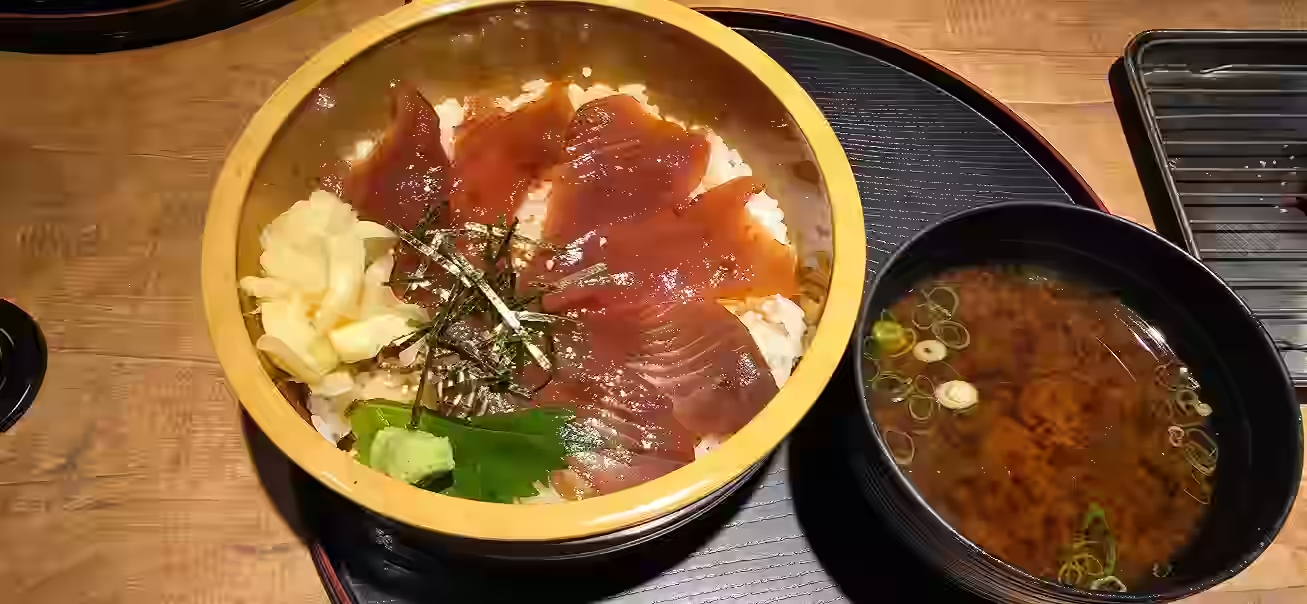
Tekonezushi is a traditional regional sushi dish from Mie Prefecture, made with red-fleshed fish marinated in a soy sauce tare and folded through vinegared rice. Bonito is the classic choice, though tuna appears often. Shiso, ginger and shredded nori usually go on top. The dish belongs to the Ise-Shima coast, and it started on fishing boats rather than in restaurants.
Most visitors first meet it near Ise Jingu, or else along the Shima Peninsula. Yet it is also a home dish, mixed in a wide wooden tub whenever family and neighbors gather.
What Is Tekonezushi?
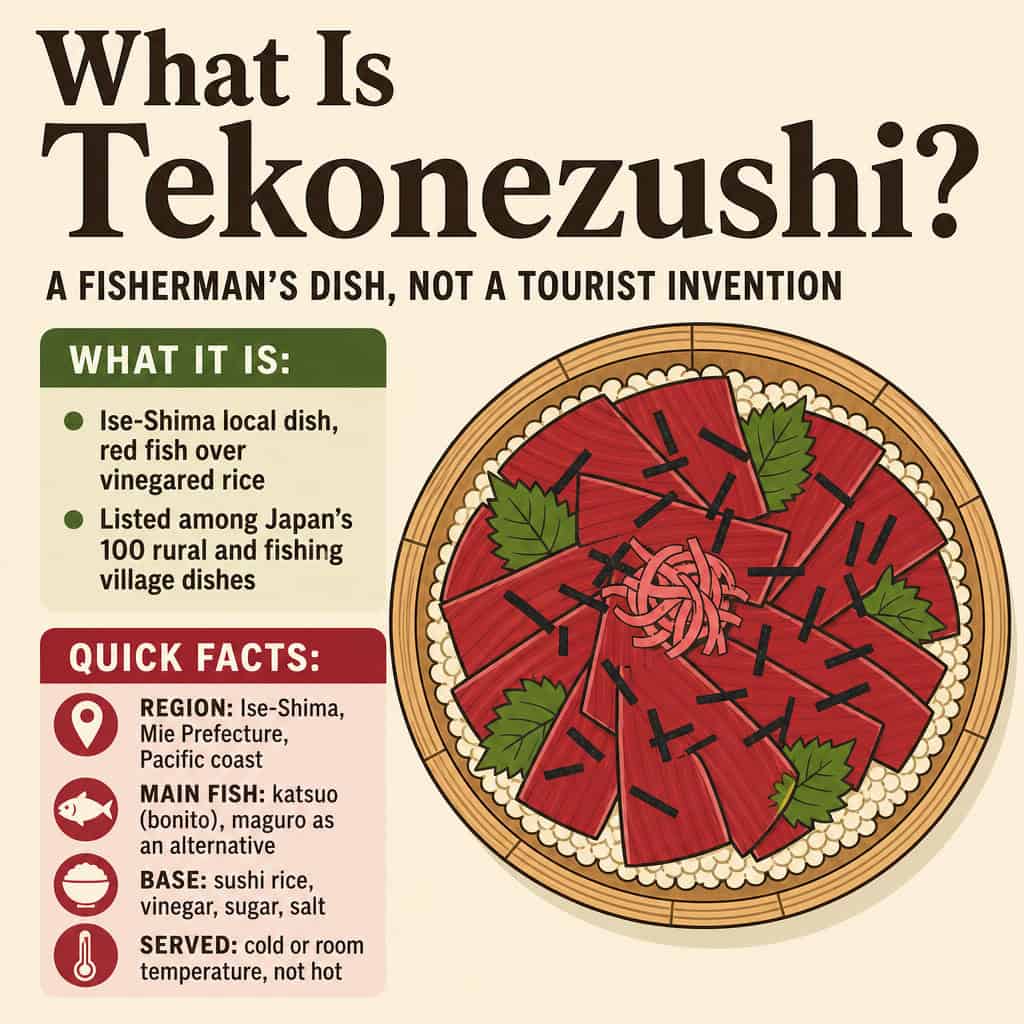
Japan’s agriculture ministry lists tekonezushi under the Ise-Shima food culture area, with red-fleshed fish and vinegared rice as its core ingredients. The dish also appears on the ministry’s selection of one hundred rural and fishing village local dishes. So this is not a modern tourist invention, even though restaurants now serve it constantly.
- Japanese name てこね寿司 or 手こね寿司, also written tekone sushi
- Home region The Ise-Shima area of Mie Prefecture, on the Pacific coast
- Main fish Katsuo, meaning bonito, with maguro tuna as a common alternative
- Base Sushi rice, usually seasoned with vinegar, sugar and salt
- Served Cold or at room temperature, rather than hot
How to say it
Say it as teh-koh-neh-zoo-shee, generally with even stress across the syllables. English speakers often stumble on the middle part, so break it into two halves. The word tekone means hand-mixed, while zushi is simply sushi with a softened first sound.
Where the Name Comes From
Mixed by hand on a fishing boat
According to the agriculture ministry, fishermen filleted their catch on deck and mixed it into rice with their hands. That gesture then gave the dish its name. Bonito fishing leaves little time for cooking, so speed mattered more than presentation. Obviously nobody was arranging slices neatly on a rolling boat.
Mie’s official tourism site specifically places the origin with fishermen in Shima City, in the southern part of the Shima district.
A second story worth knowing
There is another account, and Mie’s tourism authority mentions both. In that version, boat owners instead served the dish to their crews to celebrate a large catch. Tekonezushi therefore reads as a festive plate rather than a working lunch. Honestly, the two stories are not really in conflict. A dish born from speed can easily become the thing you make when something goes well.
Why Mie Prefecture Produces This Dish
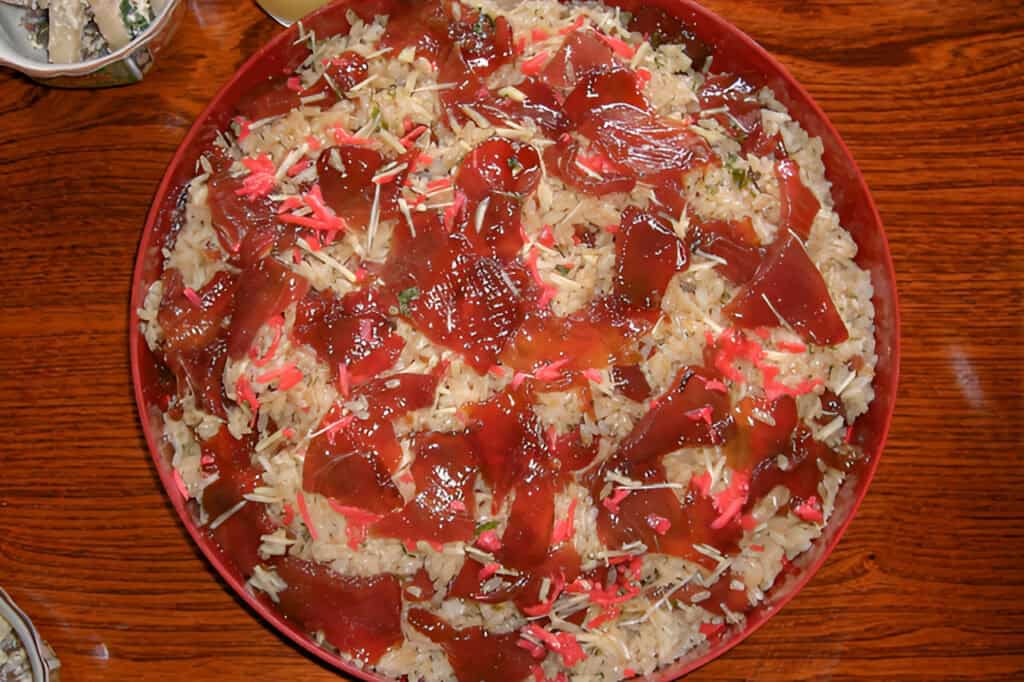
Geography, above all, explains most of it. Mie faces the Pacific along a deeply indented coast, so the fishing grounds sit close to shore. In the national fishery statistics for 2019, which the agriculture ministry cites, the prefecture ranked fourth in Japan for bonito. Pole-and-line fishing and trolling, meanwhile, remain active in the Kumano-nada waters to the south.
Tuna farming matters too, since Mie is a significant producer. Because fresh fish arrives constantly, raw preparations became ordinary rather than special. Tekonezushi therefore grew out of that habit. It also survives because it is quick, which suits busy households as much as it once suited fishermen.
What Does Tekonezushi Taste Like?
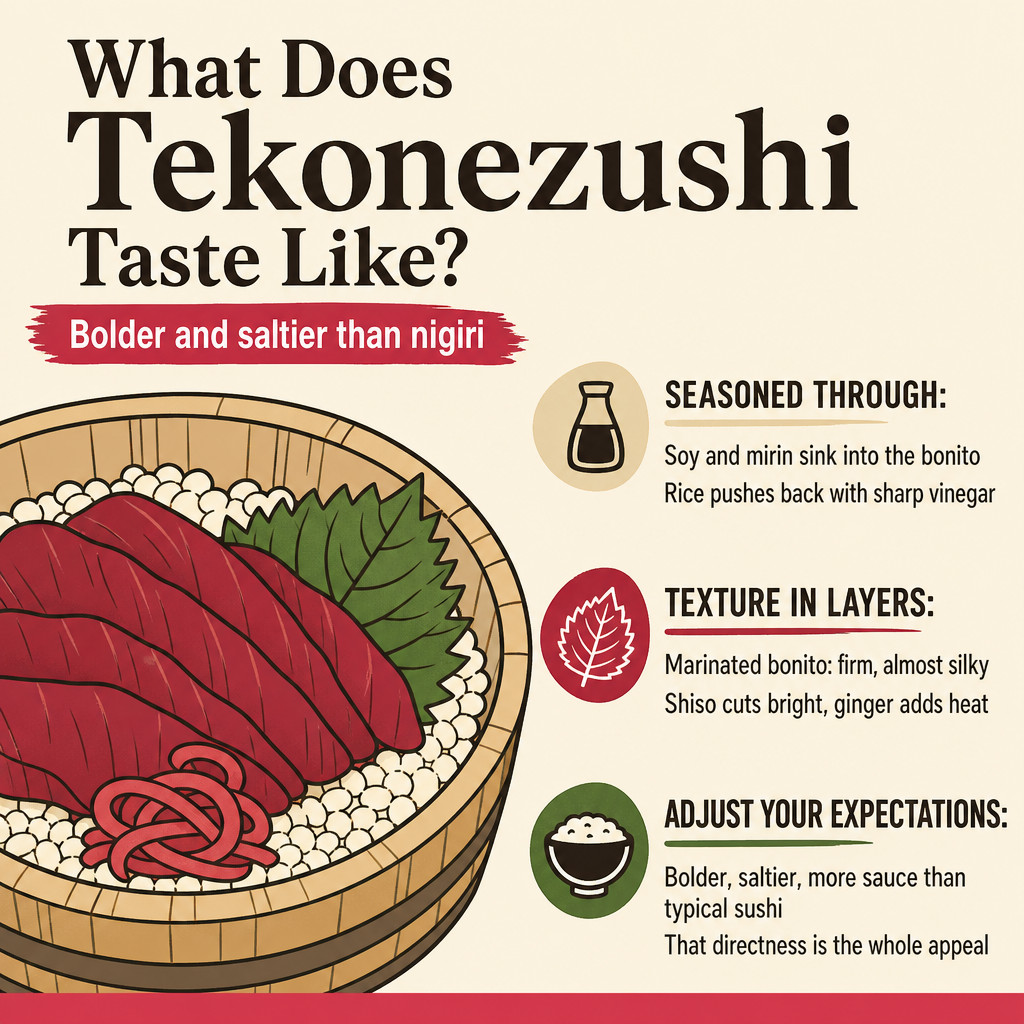
The first impression is savory rather than fishy. Soy sauce and mirin sink into the bonito, so the flesh tastes seasoned all the way through. Meanwhile the rice pushes back with sharp vinegar and a little sugar. Those two elements meet somewhere in the middle, and that meeting point is the dish.
Texture, similarly, works in layers. Marinated bonito turns slightly firm and almost silky, unlike plain sashimi. Rice stays loose and cool underneath, too. Shiso then cuts across everything with a bright, faintly minty note, while ginger adds heat at the edges.
A note on expectations. If you are picturing delicate nigiri, then adjust slightly. Tekonezushi is bolder and saltier, and the fish carries more sauce than most sushi. That directness is the appeal, although it can surprise people on the first mouthful.
Main Ingredients of Tekonezushi
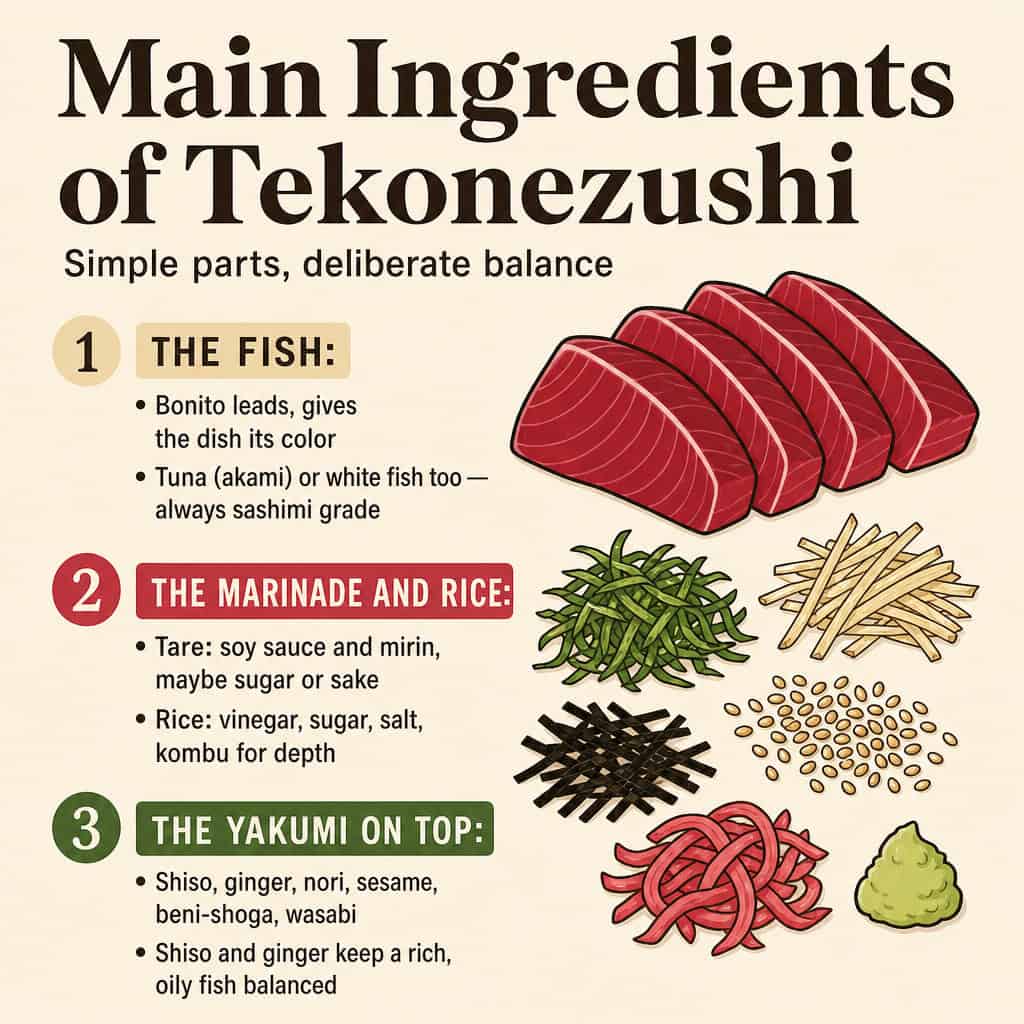
The fish
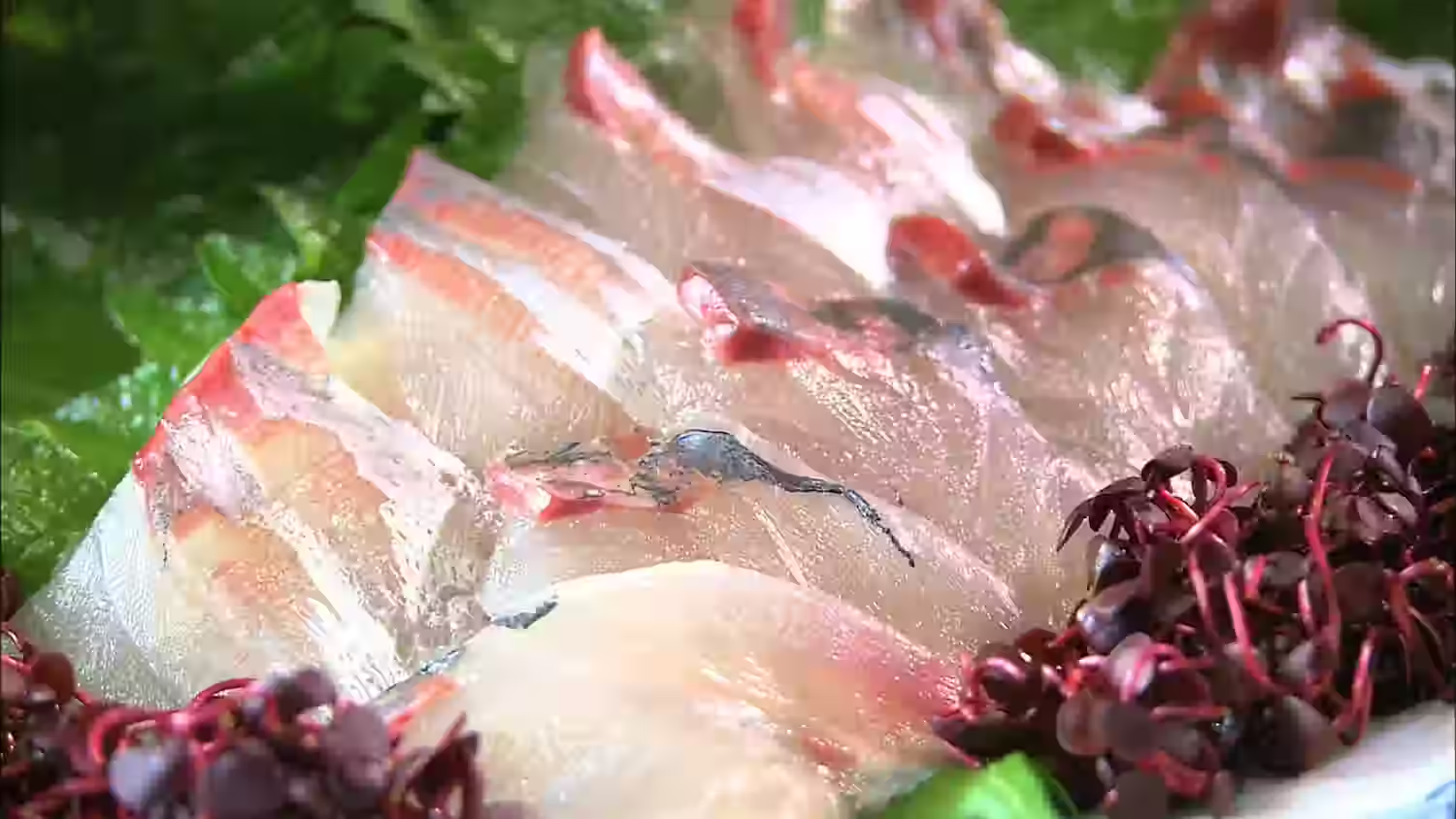
Bonito leads, since its deep red flesh gives the dish its color. Tuna works equally well, particularly lean akami. The agriculture ministry also notes that white fish such as sea bream now appears in some versions, which produces a lighter, gentler plate. Whichever fish you choose, it must be sashimi grade.
The marinade and the rice
The tare itself stays simple. Soy sauce and mirin form the base, although some households add a little sugar or sake. Sushi rice, meanwhile, needs vinegar, sugar and salt, plus a strip of kombu cooked with the rice for depth. Both parts should cool before they meet.
The yakumi on top
- Shiso, finely shredded
- Ginger, julienned
- Nori, cut into thin strips
- Toasted sesame seeds
- Beni-shoga, especially for color
- Wasabi, on the side
Those toppings are certainly not decoration. Shiso and ginger keep a rich, oily fish from feeling heavy, so skipping them changes the balance noticeably.
Tekonezushi vs Chirashizushi vs Kaisendon
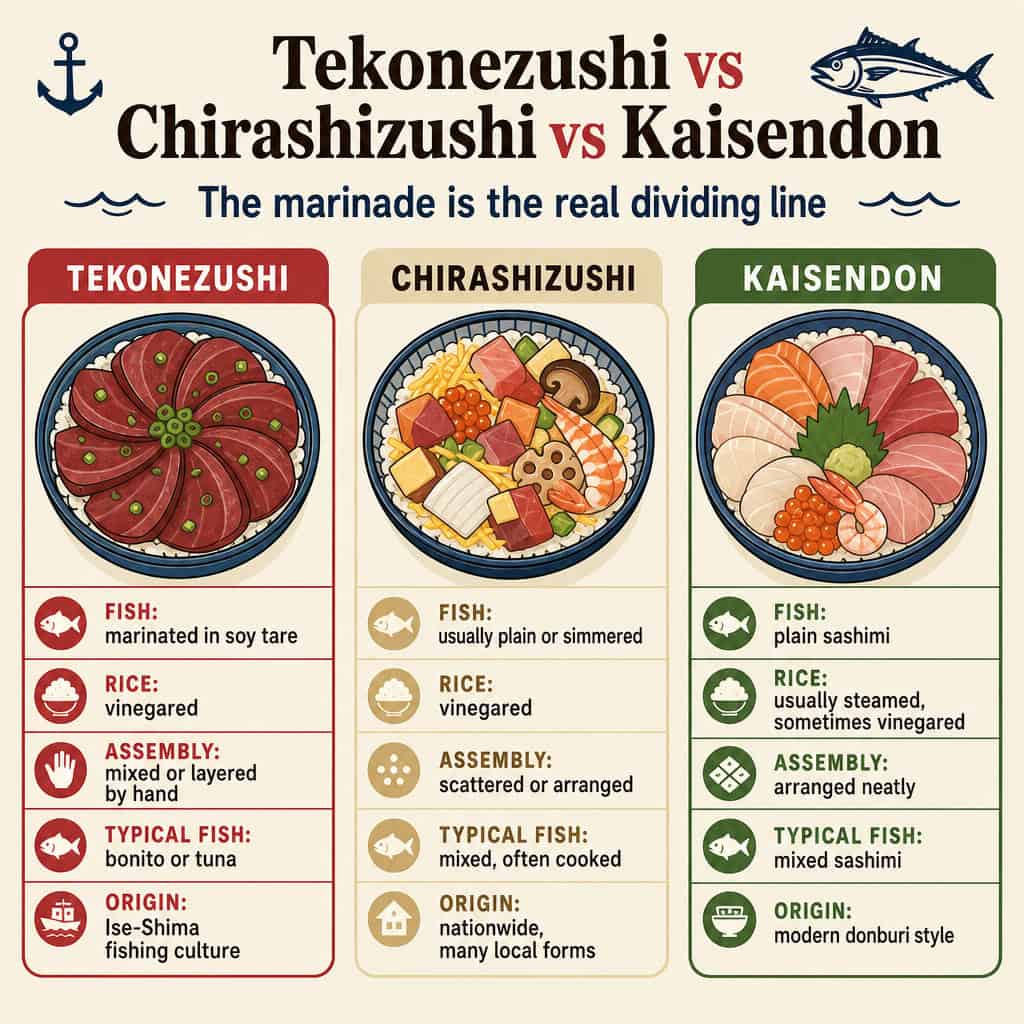
Three dishes look similar in photographs, yet they behave differently. So the table below sets them side by side.
| Point | Tekonezushi | Chirashizushi | Kaisendon |
|---|---|---|---|
| Fish treatment | Marinated in soy tare | Usually plain or simmered | Plain sashimi |
| Rice | Vinegared | Vinegared | Usually steamed, sometimes vinegared |
| Assembly | Mixed or layered by hand | Scattered or arranged | Arranged neatly |
| Typical fish | Bonito or tuna | Mixed, often cooked | Mixed sashimi |
| Origin | Ise-Shima fishing culture | Nationwide, many local forms | Modern donburi style |
So the marinade is the real dividing line. Read our guides too, to chirashizushi and kaisendon if you want the full picture. Both sit inside the wider world of Japanese sushi, which stretches far beyond nigiri.
How to Make Tekonezushi at Home
This is an unusually forgiving recipe, though. No rolling, no pressing, no knife skills beyond slicing. The proportions below follow the version published in Japan’s national regional cuisine database, then scaled for four people.
What you need
- Bonito fillet About a quarter of a whole fish, sashimi grade
- Rice 240 g uncooked, then cooked with a 10 cm strip of kombu
- Marinade 5 tbsp soy sauce and 2 tbsp mirin, boiled briefly then cooled
- Sushi vinegar 4 tbsp rice vinegar, 3 tbsp sugar and 1 tsp salt
- Toppings 8 shiso leaves, plus one knob of ginger and half a sheet of nori
Step by step
- Cook the rice with the kombu, then remove the kombu before it boils.
- Then fold the sushi vinegar through the hot rice, fanning it as you cut and turn.
- Simmer the soy sauce and mirin briefly, then let the tare cool completely.
- Afterwards, slice the bonito on a slight angle and marinate it for five to thirty minutes.
- Sprinkle a little tare over the rice, then lay the fish across the surface.
- Finally, finish with shredded shiso, ginger and nori, then serve immediately.
Marinating time obviously depends on freshness. Very fresh fish needs only a few minutes, whereas older fish benefits from longer. Overdoing it firms the flesh too much, so taste as you go.
Choosing fish safely, and what to substitute
Buy fish labeled for raw consumption, and ask the counter directly whenever the label is unclear. Keep everything cold, then eat the dish the same day. Bonito is hard to find outside Japan, so lean tuna is the easiest swap. Salmon also works, although the result tastes sweeter and less mineral. One more point matters for anyone avoiding gluten, since Japanese soy sauce commonly contains wheat.
How to Eat It, and What to Serve Alongside
At home, families use a hangiri, the wide flat-bottomed wooden tub built for cooling sushi rice. The agriculture ministry describes exactly that scene, with the tub brought out whenever people gather. Everyone then serves themselves, which is part of why the dish suits a crowd.
- Take fish and rice together, since neither works alone.
- Add wasabi sparingly, because the tare already carries plenty of salt.
- Pair it with clear soup or miso soup rather than anything heavy.
- Besides that, serve pickles or a simple seaweed salad on the side.
- Drink green tea, or chilled sake if the meal is a celebration.
Where to Eat Tekonezushi in Mie
Ise is usually the easiest starting point. Restaurants around Ise Jingu serve it throughout the day, and many visitors combine it with a shrine visit. Toba and Shima sit further along the coast, where seafood restaurants and inns often list their own versions.
Recipes also differ noticeably from place to place. Mie’s tourism authority describes a range running from the plain old style to versions built around Ise spiny lobster. Prices and opening hours change often, so check each restaurant’s own information before traveling.
Planning tip. Bonito reaches Japanese markets in two waves. Hatsu-gatsuo, the lean first bonito, arrives around May and June, while the fattier modori-gatsuo runs from mid-September to late October. Restaurants serve tekonezushi year-round, though, switching to tuna when bonito is scarce.
Why This Dish Still Matters
Plenty of regional sushi originally came from preservation. Pressed and fermented styles exist because fish had to survive a journey inland. Tekonezushi followed the opposite logic, since the fish never traveled at all. Instead it reflects a coast where freshness was normal and time was short.
The dish also stayed inside homes. According to the agriculture ministry, families still make it when people gather, and it appears at banquets as well. That domestic life is why it feels different from a restaurant specialty invented for tourists.
Is Tekonezushi Worth Trying?
If you are visiting Ise Jingu, the answer seems obvious. Few dishes connect a landscape to a plate so directly, and few are this easy to understand. Certainly you do not need any knowledge of sushi etiquette. You simply need an appetite, plus a reasonably strong liking for soy sauce.
Add tekonezushi to your Mie plans, then try it against the prefecture’s other specialties. Our Ise udon and Matsusaka beef guides cover the obvious rivals, and Akafuku mochi handles dessert.
Tekonezushi FAQ
Is Tekonezushi raw?
Yes, the fish stays raw, although the soy marinade changes it noticeably. Marinating firms the flesh and seasons it deeply, so the texture differs from plain sashimi. Cooks always use sashimi-grade fish for this reason. Anyone avoiding raw fish should choose a different Mie dish instead.
What fish is used in Tekonezushi?
Bonito, called katsuo, remains the traditional choice in Ise-Shima. Tuna also appears frequently, especially lean akami. The agriculture ministry notes that white-fish versions with sea bream have appeared more recently. All of them work, though bonito gives the deepest color and flavor.
Is Tekonezushi served hot or cold?
It arrives cold or at room temperature, rather than heated. Sushi rice should feel cool but not chilled hard, since fridge-cold rice turns dry. Restaurants usually assemble it shortly before serving. At home, therefore, mix it last rather than first.
What is the difference between Tekonezushi and chirashi sushi?
Both use vinegared rice, so the confusion makes sense. However, tekonezushi marinates its fish in a soy-based tare first, while chirashizushi generally does not. Chirashizushi also mixes many ingredients, including cooked ones. Tekonezushi, by comparison, keeps the focus on a single red-fleshed fish.
When is the best season to eat it?
Bonito arrives in two waves, so May to June and mid-September to late October both suit the classic version. The autumn fish carries more fat, whereas the spring fish tastes leaner. Restaurants nevertheless serve tekonezushi all year. Outside those months, kitchens often switch to tuna.
Can you make Tekonezushi outside Japan?
Yes, and it is one of the easier Japanese dishes to reproduce. Soy sauce, mirin, rice vinegar and sushi rice are generally available now. Bonito is the difficult part, so most people use lean tuna instead. Buy fish sold specifically for raw consumption.
When should travelers plan to eat it?
Lunch is the safest slot, especially around Ise Jingu, because shrine visitors fill nearby restaurants quickly. Many small kitchens also close between lunch and dinner. Check opening hours before you go, since these change without much notice. Booking ahead helps at weekends and during holidays.
References
- Ministry of Agriculture, Forestry and Fisheries, Tekonezushi, Mie Prefecture (Our Regional Cuisines) (Accessed August 2026)
- Ministry of Agriculture, Forestry and Fisheries, Our Regional Cuisines, English edition (Accessed August 2026)
- Kanko Mie, Mie Prefecture Official Tourism Site, Tekone Sushi Feature (Accessed August 2026)
- Tokyo Metropolitan Central Wholesale Market, Modori-gatsuo, Seasonal Seafood (Accessed August 2026)
- Japan Society of Cookery Science, A Survey of Local Cuisine in Mie Prefecture, Proceedings 2008 (Accessed August 2026)
Related Articles
- Japanese Sushi: Types and Sushi Culture (Surveyed: August 2026)
- Chirashizushi (ちらしずし) (Surveyed: August 2026)
- Kaisen Don (海鮮丼) (Surveyed: August 2026)
- Katsuo (鰹) (Surveyed: August 2026)
- Katsuo no Tataki (鰹のたたき) (Surveyed: August 2026)
- Ise Udon (伊勢うどん) (Surveyed: August 2026)
- Matsusaka Beef (松阪牛) (Surveyed: August 2026)
- Akafuku (赤福) (Surveyed: August 2026)
- The Complete Kansai Food Guide (Surveyed: August 2026)




Comments