





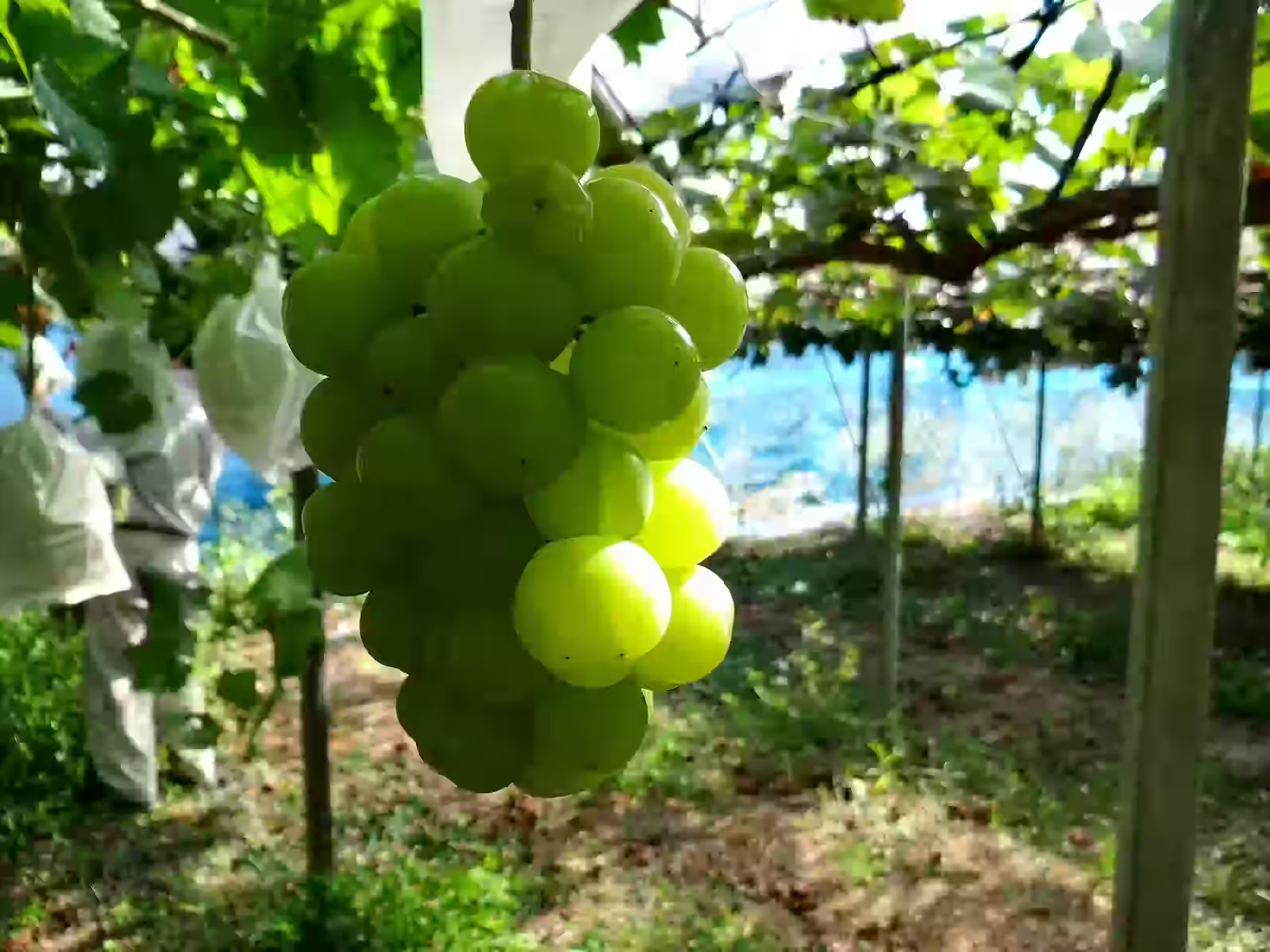
Seto Giants, known in Japanese as seto jaiantsu, is a large seedless green grape from Okayama Prefecture. It ranks among Japan’s premium table grapes, alongside Shine Muscat and Ruby Roman. Each berry carries a shallow dent around its middle, so a bunch looks a little like a cluster of tiny peaches.
Quick answer: Seto Giants is a premium Japanese grape bred in Okayama and registered as a variety in 1989. Growers produce it seedless, with a thin edible skin and sugar levels starting around 18 degrees Brix. It tastes clean and lightly sweet, with a crisp snap and a finish that clears quickly.
Most visitors meet Shine Muscat first, and Seto Giants gets mistaken for it constantly. That confusion is understandable, though the two grapes eat quite differently. Shopping rather than reading for pleasure? Jump straight to the Shine Muscat comparison, the season, why it costs what it does, or where to buy it.
Seto Giants Grapes at a Glance
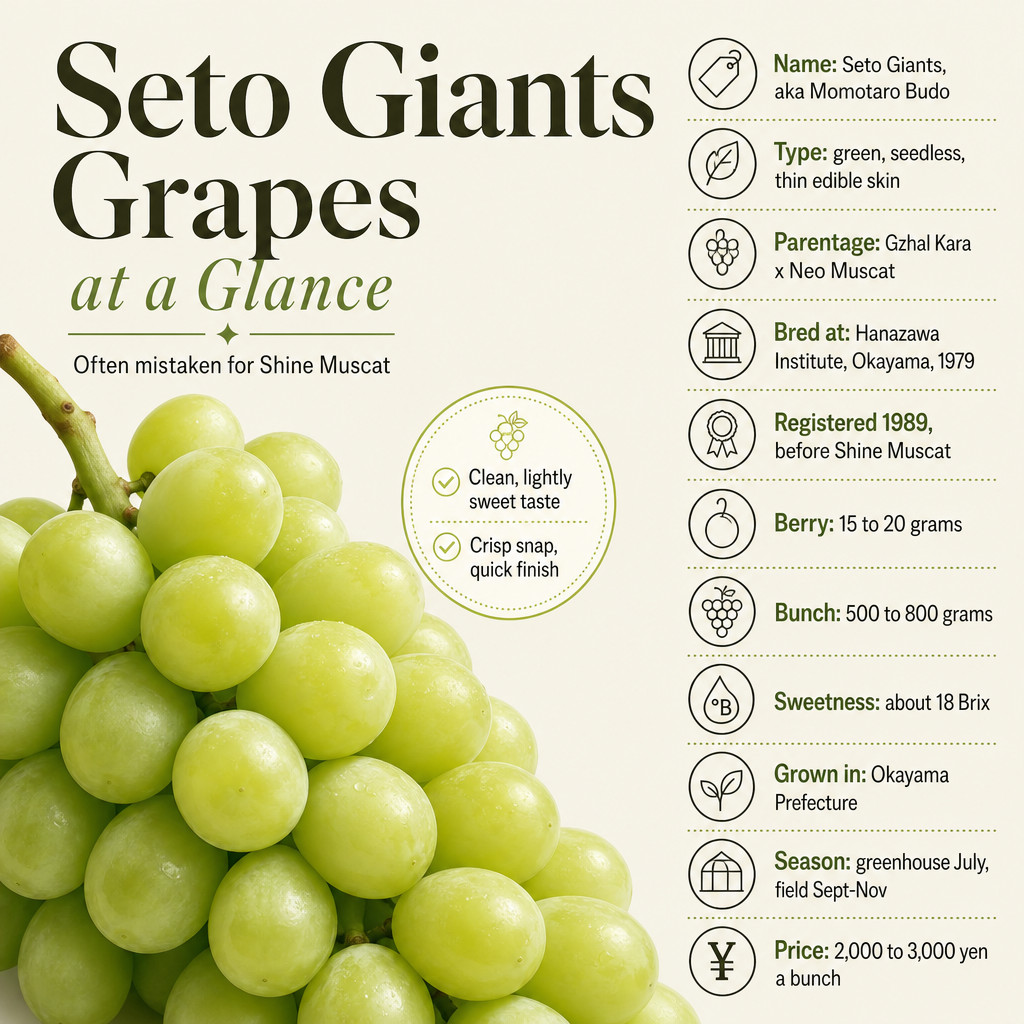
| Japanese name | 瀬戸ジャイアンツ (Seto Giants); premium lots sell as 桃太郎ぶどう (Momotaro Budo) |
| Type | Green table grape, seedless, thin edible skin |
| Parentage | Gzhal Kara × Neo Muscat |
| Bred by | Hanazawa Grape Research Institute, Okayama, from a 1979 cross |
| Variety registration | 1989, seventeen years before Shine Muscat |
| Berry size | About 15 to 20 grams, occasionally 30 grams |
| Bunch size | Roughly 500 to 800 grams |
| Sweetness | From about 18 degrees Brix at shipping |
| Main growing area | Okayama Prefecture |
| Season | Greenhouse fruit from mid-July; open field September to November |
| Price guide | Commonly ¥2,000 to ¥3,000 per bunch; Momotaro Budo grade from about ¥4,000 |
Key Facts About Seto Giants
- Origin: Okayama Prefecture, western Japan
- Registered: 1989, under Japan’s Plant Variety Protection Act
- Berry size: 15 to 20 grams, roughly double a supermarket grape
- Skin: Thin and edible, faintly astringent
- Seeds: None, thanks to hormone treatment during flowering
- Sweetness: 18 degrees Brix and above
- Best season: September
- Typical price: ¥2,000 to ¥3,000 per bunch in Japan
Prices here reflect retailer and grower listings checked in July 2026. Japanese fruit prices swing with the grade and the week, so treat every figure as a starting point rather than a quote.
Why Are Seto Giants Famous in Japan?
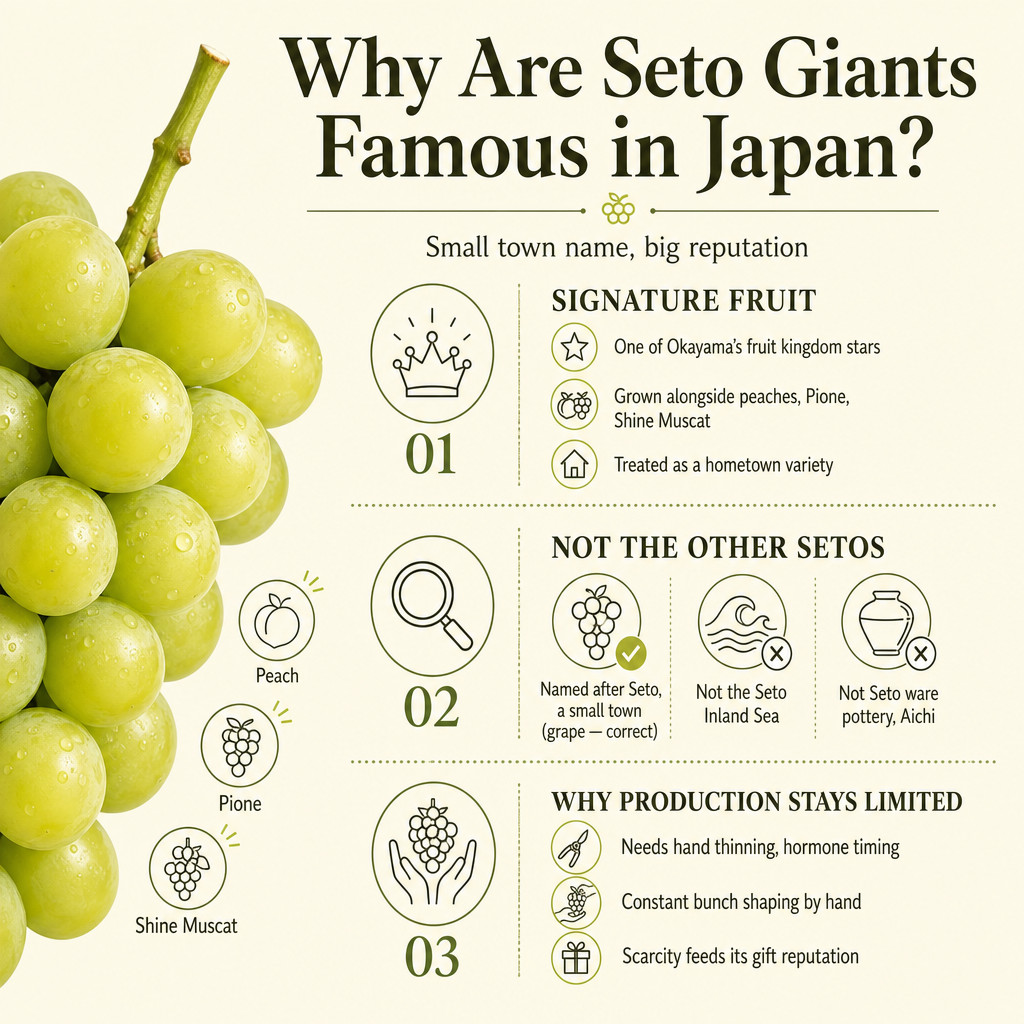
Seto Giants earned its reputation as one of Okayama’s signature luxury fruits, valued for its unusual berry shape, crisp texture, and deliberately small production volumes.
One of Okayama’s Signature Fruits
Okayama calls itself Japan’s fruit kingdom, and the claim holds up. White peaches, Muscat of Alexandria, Pione, and Shine Muscat all grow there in quantity. Seto Giants belongs to that lineup, and locals treat it as a hometown variety rather than a national one.
That regional identity matters commercially. Because the breeding happened in Okayama, the prefecture built its marketing around the grape early. Our Okayama fruits guide sets out the wider picture.
Not to Be Confused With Other Setos
The word Seto turns up all over western Japan, which trips up new readers. The Seto Inland Sea separates Honshu from Shikoku, while Seto ware is a pottery tradition from Aichi Prefecture.
This grape takes its name from somewhere much smaller. Seto was a town on the eastern edge of what is now Okayama City, and the breeding work happened there.
Why Production Remains Limited
National output stays small despite the fame. Cultivation demands hand thinning, precisely timed hormone treatment, and constant bunch shaping, so nobody can scale it quickly. Growers outside Okayama have adopted it slowly.
Scarcity then feeds the reputation, which is a familiar loop in Japanese fruit. A grape that resists mass production becomes a grape worth giving as a gift.
What Are Seto Giants Grapes?
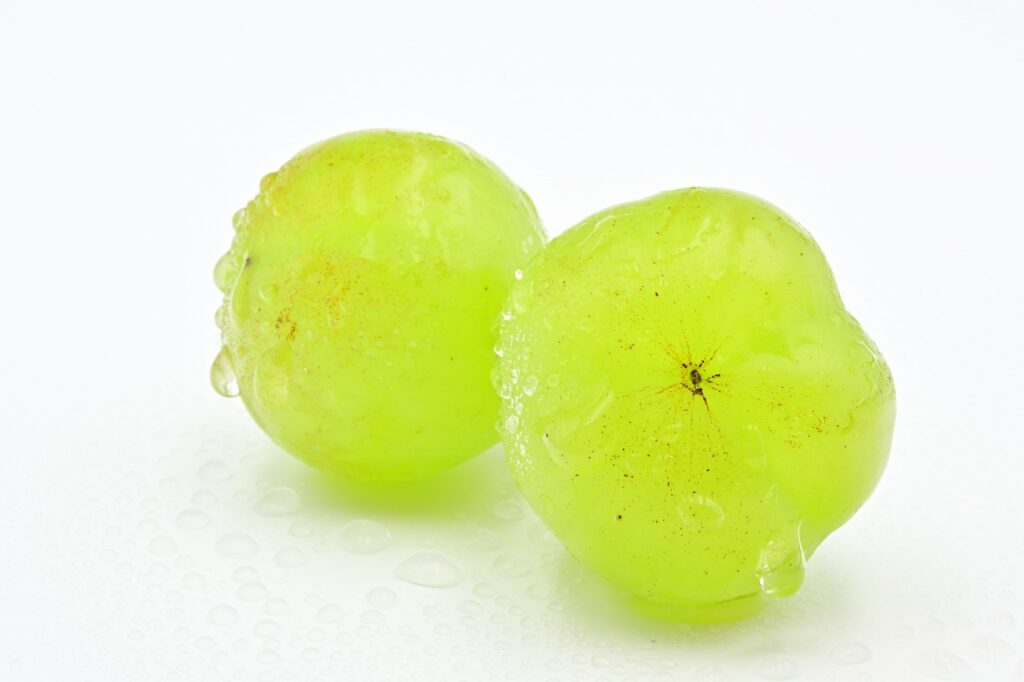
Seto Giants is a Japanese green table grape from Okayama, recognised by its dimpled berries, thin edible skin, and crisp, clean tasting flesh.
A Working Definition
Breeders crossed Gzhal Kara, a dark skinned vinifera variety whose name appears in several romanisations, with Neo Muscat. From the resulting seedlings they selected one standout plant. The fruit is yellow green, with berries of typically 15 to 20 grams in bunches of 500 to 800 grams.
Giants refers to that berry size, which impressed people at the time. Both halves of the name are literal, which is refreshingly rare in fruit branding.
Why the Berries Have a Waist
Each berry narrows slightly around the middle, forming a shallow groove. Japanese growers often describe the shape as three soap bubbles fused together. Others see the curve of a peach, which matters for reasons that become clear below.
That shape is not purely genetic. Growers treat the flowers with gibberellin, a plant hormone, and frequently with forchlorfenuron as well, to produce seedless fruit and swell the berries. Seedlessness therefore comes from cultivation technique rather than from the variety itself, which surprises people who assume it works like a seedless orange.
Seto Giants and Momotaro Budo
You will also see these grapes sold as Momotaro Budo, meaning Peach Boy grape. Okayama claims the Momotaro folk tale as its own, and the same legend gave the prefecture its famous kibi dango sweets. Because the berries resemble small peaches, the name fits neatly.
Momotaro Budo is a registered trademark, however, so not every Seto Giants bunch qualifies. Industry sources describe it as restricted to approved Okayama growers working to tighter grading standards. Same variety, stricter selection, noticeably higher price.
What Do Seto Giants Grapes Taste Like?
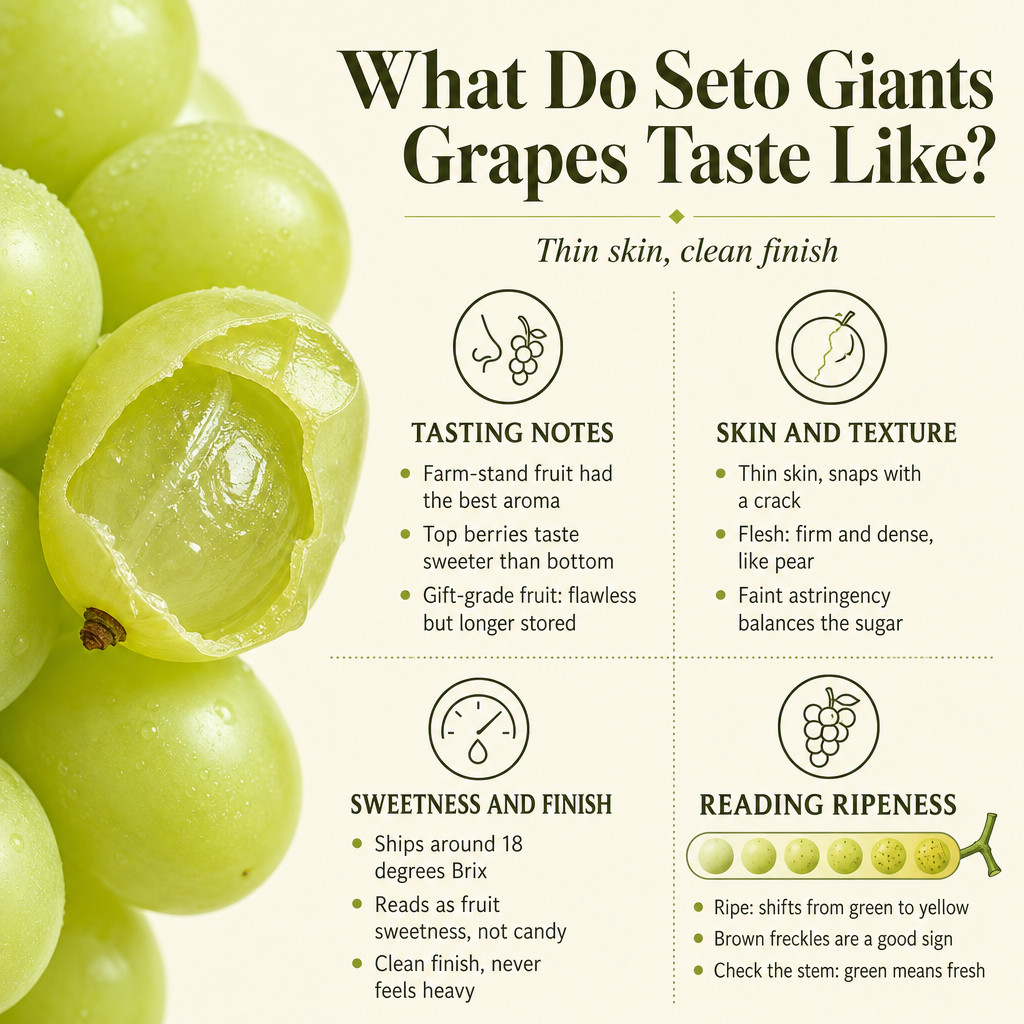
Seto Giants tastes lightly sweet and refreshingly clean, with a thin skin that snaps audibly and a finish that fades fast instead of lingering.
Our Tasting Notes
We sampled several bunches during the autumn harvest window, including farm stand fruit bought in Okayama and a gift grade box bought in Tokyo. The farm bunch won easily on aroma. Gift grade fruit looked flawless, yet it had clearly spent longer in cold storage.
One thing caught us off guard. Berries near the top of each bunch tasted measurably sweeter than the ones at the bottom. That gap was wide enough to change our opinion halfway through.
The Snap of the Skin
Texture arrives first. The skin is genuinely thin, so it gives way with a small crack rather than resisting. Underneath, the flesh is firm and dense, closer to a crisp pear than to a soft supermarket grape.
There is a faint astringency in the skin as well. Rather than spoiling things, it cuts the sugar and keeps each berry from tasting flat. We missed it entirely on the first bunch, then could not stop noticing it afterwards.
Sweetness and Finish
Growers generally ship from about 18 degrees Brix, the standard measure of sugar content in fruit. That figure is high by international table grape standards. Even so, the sweetness reads as fruit sweetness rather than candy, with a gentle acidity underneath.
The clean finish is the real dividing line between this grape and its more famous rival. Some people find Seto Giants slightly restrained by comparison. Others reach for a second bunch precisely because it never feels heavy.
Reading Ripeness
Ripe fruit shifts from pale green toward a warmer yellow. Small brown freckles often appear on the skin around the same time. Those marks look like damage, and plenty of shoppers reject the bunch because of them.
They are actually a ripeness signal. A green, taut stem and plump berries matter far more, so check the stem before you check the spots. Brown, dried stems mean the bunch has been sitting around.
Seto Giants vs Shine Muscat
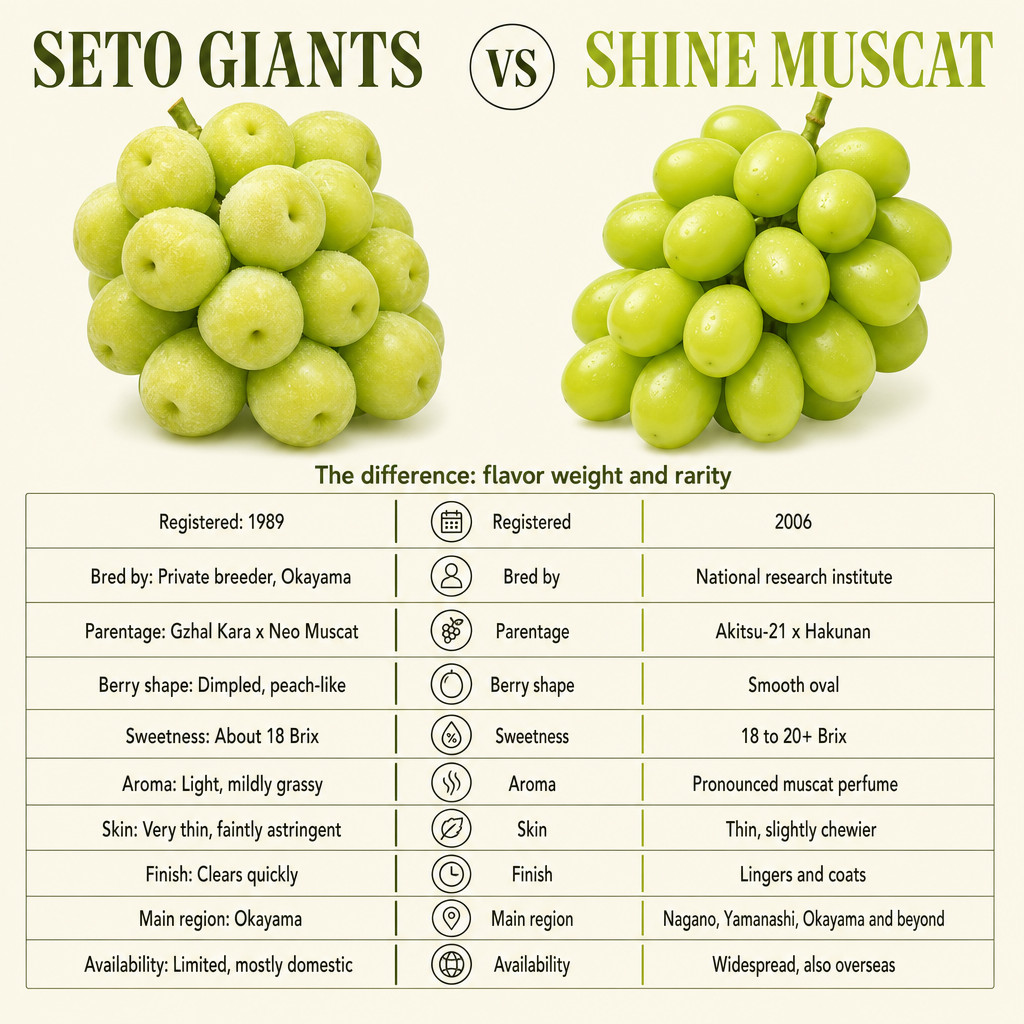
The main difference is flavour weight and rarity. Shine Muscat is sweeter, far more floral, and widely available, while Seto Giants is crisper, cleaner, and produced in much smaller volumes.
Comparison Table
| Seto Giants | Shine Muscat | |
|---|---|---|
| Registered | 1989 | 2006 |
| Bred by | Private breeder in Okayama | National research institute |
| Parentage | Gzhal Kara × Neo Muscat | Akitsu-21 × Hakunan |
| Berry shape | Dimpled waist, peach like | Smooth oval |
| Sweetness | From about 18 Brix | Around 18 to 20 Brix, sometimes higher |
| Aroma | Light, mildly grassy | Pronounced muscat perfume |
| Skin | Very thin, faintly astringent | Thin, slightly chewier |
| Finish | Clears quickly | Lingers and coats |
| Main region | Okayama | Nagano, Yamanashi, Okayama and beyond |
| Availability | Limited, mostly domestic | Widespread, also grown overseas |
Why Shoppers Mix Them Up
The confusion is not carelessness. Both grapes are green, large, seedless, and eaten whole with the skin on. From two metres away in a supermarket aisle, they honestly look like the same fruit in different boxes.
Labelling compounds the problem, since some retailers file both under premium green grapes without naming the variety. Once you know the tell, though, you cannot unsee it. Look for the waist on each berry, then check whether the bunch feels loose rather than tightly packed.
Two Different Family Trees
Shine Muscat came out of Japan’s national fruit research programme, from a cross between Akitsu-21 and Hakunan. Researchers spent years selecting for disease tolerance in Japan’s humid climate, which later let growers across many prefectures take it up.
Seto Giants took the private route instead. A breeder in Okayama crossed Gzhal Kara with Neo Muscat, then picked one seedling out of the batch. Different institutional origins, different priorities, and ultimately different fruit.
A Shared Ancestor Worth Knowing
Here is a connection that rarely appears in English writing. Both grapes trace back to Muscat of Alexandria, the perfumed variety that Okayama has grown in glasshouses since the Meiji era.
Shine Muscat inherits it through Akitsu-21, while Seto Giants inherits it through Neo Muscat. Neo Muscat itself came from Okayama, bred by Morimasa Hirota from Muscat of Alexandria and Koshu Sanjaku, and named in 1932. So these two rivals are distant relatives, which partly explains why beginners confuse them.
How They Look Side by Side
Place two bunches together and the shape gives it away immediately. Shine Muscat berries are smooth ovals, uniform and glossy. Seto Giants berries carry that shallow waist, so each one looks slightly pinched.
Colour differs too, though subtly. Shine Muscat tends toward a consistent yellow green, while ripe Seto Giants often shows warmer tones and those brown freckles. Bunch structure on Seto Giants is looser as well, with visible gaps between berries.
Sweetness Compared
Numbers first. Shine Muscat generally lands around 18 to 20 degrees Brix at peak ripeness and occasionally climbs higher, while Seto Giants ships from around 18. The measured gap is therefore narrower than the reputations suggest.
Character matters more than the reading. Japanese tasters often describe Shine Muscat sweetness as sugar like, almost confectionery. Seto Giants reads as brighter fruit sweetness, less concentrated. Neither is objectively better, though most people form a firm preference after one comparison.
Aroma: Perfume Versus Restraint
Shine Muscat announces itself. Open a box and the muscat perfume fills the room, floral and unmistakable. That aroma is the variety’s calling card, and it drives much of its popularity.
Seto Giants stays quiet by comparison. Its scent is faint, slightly green, and closer to fresh grape juice than to flowers. Anyone hunting that muscat hit will find Seto Giants underwhelming, and that is a legitimate reason to prefer the rival.
Texture and Skin
This is where Seto Giants pulls ahead for many people. Its skin is noticeably thinner, so the bite produces a clean snap instead of a chew. Shine Muscat skin is still edible, yet it offers slightly more resistance.
Flesh density differs as well. Seto Giants eats firm and almost pear like, while Shine Muscat feels juicier and more yielding. Neither turns mushy, which separates both from ordinary table grapes.
Cultivation, and Why It Reaches Your Plate Differently
Shine Muscat was bred partly for resilience, since researchers wanted European style flavour on a vine that survives humid Japanese summers. Growers outside the traditional grape prefectures could therefore take it up quickly, and planting expanded fast.
Seto Giants leans harder on its vinifera parentage, which makes it fussier. Rain cracking is a real risk, so many growers use covers or greenhouses. Berry shape also depends on hormone timing, and a mistimed application produces ordinary looking fruit that cannot reach the top grade.
Price and Availability
Shine Muscat once commanded extraordinary prices. Then planting expanded across Nagano, Yamanashi, Okayama, and eventually overseas, and prices softened accordingly. Japanese supermarkets now stock it routinely in season.
Seto Giants never scaled that way, so distribution stayed regional and prices held firm. Outside Okayama you may need a department store counter or an online order, whereas Shine Muscat sits in ordinary supermarkets nationwide.
Which Is Better as a Gift?
Shine Muscat is the safe choice, since almost every recipient recognises it and likes it. Its familiarity has a downside, however, because a gift that everybody sends stops feeling considered.
Seto Giants trades safety for interest. Many Japanese recipients have heard the name without ever tasting one, which makes the box a small talking point. For older recipients, the thin skin and absent seeds remove any fiddly preparation.
Which One Should You Choose?
Choose Shine Muscat for maximum sweetness and that unmistakable floral perfume. Our Shine Muscat guide goes deeper on that variety. Choose Seto Giants for a crisper bite, a lighter finish, or simply for something most visitors have never tried.
| If you want… | Pick |
|---|---|
| The sweetest possible grape | Shine Muscat |
| A clean, refreshing finish | Seto Giants |
| Strong floral aroma | Shine Muscat |
| The crispest texture | Seto Giants |
| Something easy to find | Shine Muscat |
| A gift with novelty value | Seto Giants |
| Best value per bunch | Shine Muscat |
| To finish a whole bunch without palate fatigue | Seto Giants |
Seto Giants vs Other Japanese Grapes
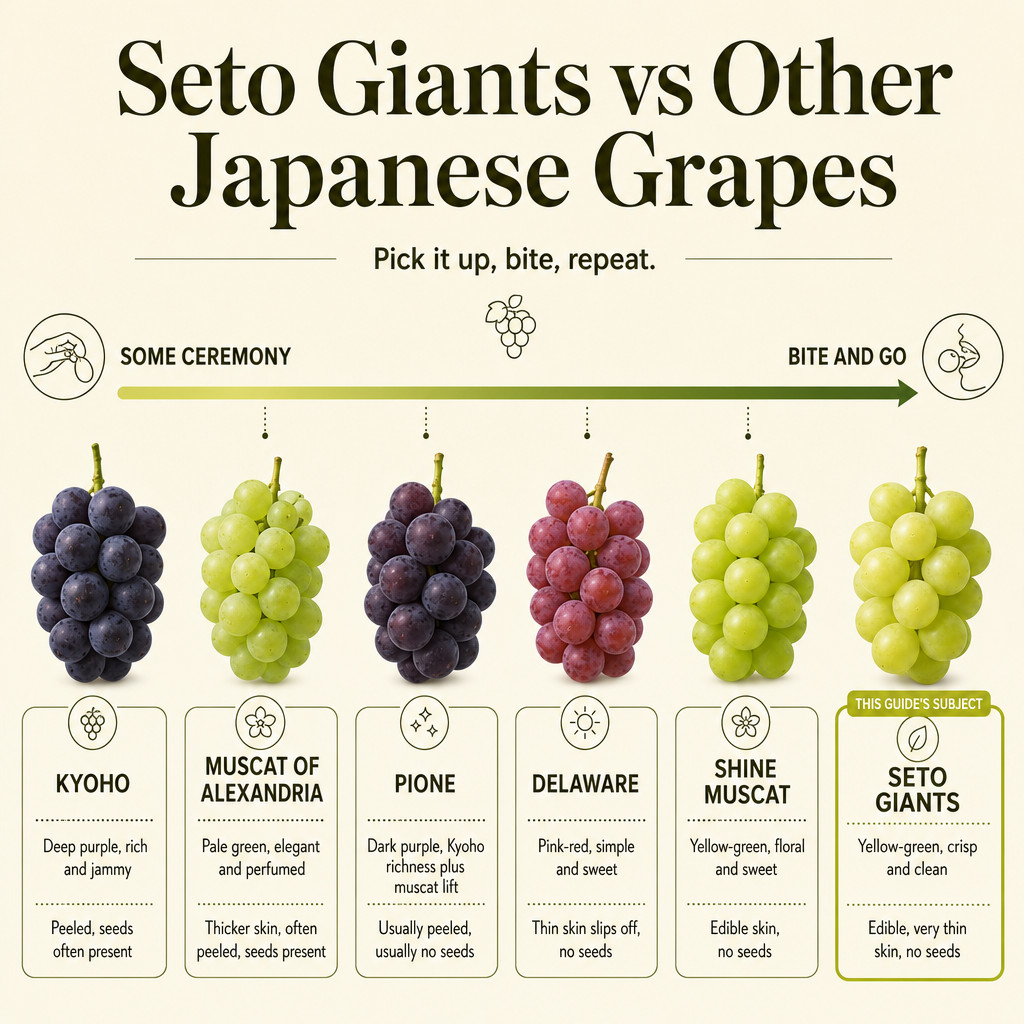
Japan grows dozens of table grape varieties, and Seto Giants sits at the crisp, seedless, thin skinned end of that range.
Variety Comparison Table
| Variety | Colour | Taste | Skin | Seeds |
|---|---|---|---|---|
| Seto Giants | Yellow green | Crisp, clean, lightly sweet | Edible, very thin | None |
| Shine Muscat | Yellow green | Floral, intensely sweet | Edible | None |
| Kyoho | Deep purple | Rich, jammy, mildly acidic | Usually peeled | Often present |
| Pione | Dark purple | Kyoho richness with muscat lift | Usually peeled | Usually none |
| Delaware | Pinkish red | Simple, very sweet | Thin, slipped off | None |
| Muscat of Alexandria | Pale green | Elegant, perfumed | Thicker, often peeled | Present |
What the Table Does Not Show
Eating method separates these varieties as much as flavour does. Kyoho and Muscat of Alexandria involve peeling, spitting seeds, or both, which turns eating into a small ceremony. Delaware slips out of its skin with a squeeze, a trick Japanese children learn young.
Seto Giants asks nothing of you. Pick it up, bite, repeat. That convenience explains much of its appeal to older buyers and families, and it also explains why gift givers like it. Our autumn food guide covers Kyoho and Pione in their own seasonal context.
When Is Seto Giants Season?
Greenhouse fruit starts appearing in mid-July, while open field bunches run from September into November, with September as the reliable peak.
Greenhouse and Open Field
Southern Okayama uses heated greenhouses, which stretches shipping across a long window. Northern parts of the prefecture rely on open field cultivation instead, taking advantage of wider day to night temperature swings. Between the two systems, the prefecture supplies fruit for roughly half the year.
Peak Months and Grape Picking
September is when quality and supply line up best. Early greenhouse bunches taste good, though they cost more and sometimes lack depth. Late October fruit can be excellent, but selection thins out quickly.
Okayama runs plenty of grape picking farms during the same months. Picking courses usually feature easier varieties such as Pione and Shine Muscat, so check each farm’s variety list before booking if Seto Giants is the goal.
Why Are Seto Giants Grapes Expensive?
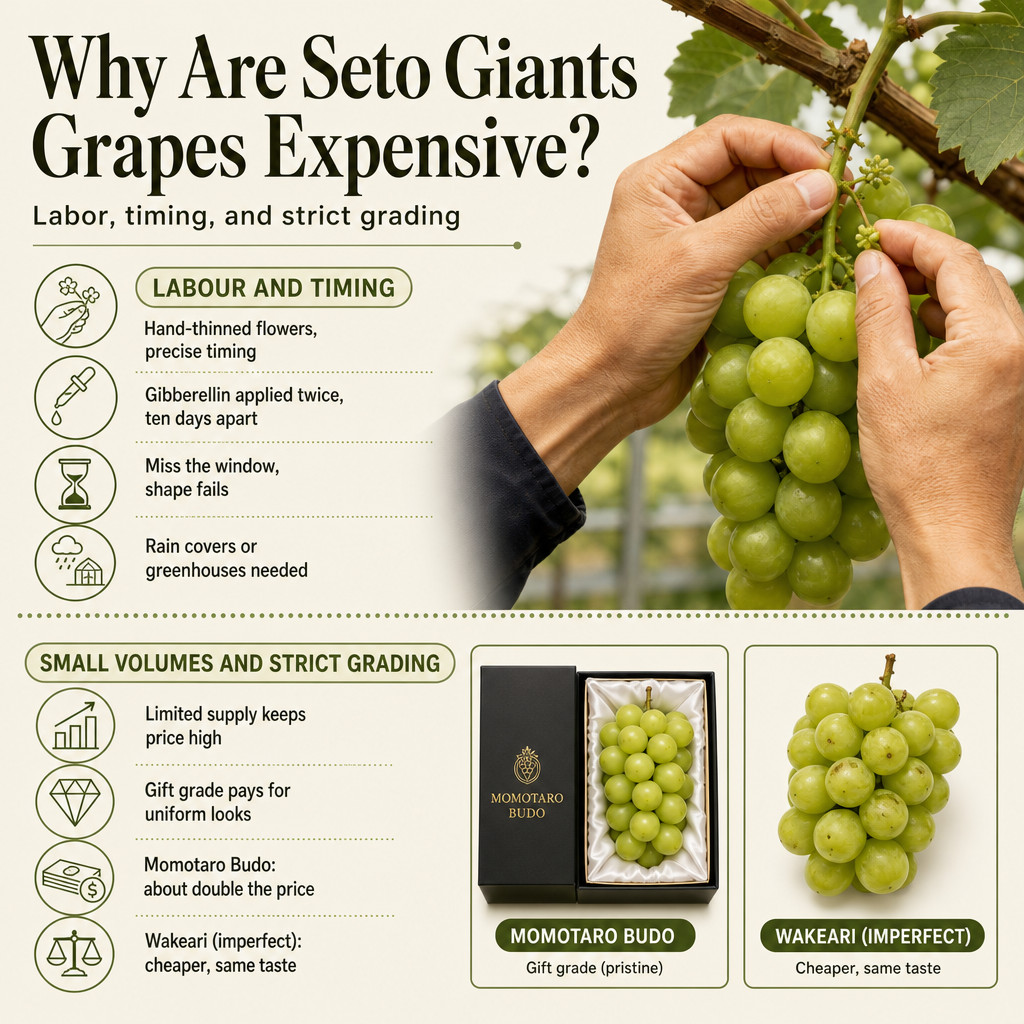
Seto Giants costs more because cultivation is labour intensive, timing sensitive, and impossible to scale quickly, while national production stays small.
Labour and Timing
Growers thin flowers by hand, then apply gibberellin within a narrow window after flowering. A second treatment follows roughly ten days later. Miss either window and the berries fail to size up, or the characteristic shape never forms.
Bunch shaping adds another round of manual work. Since vinifera types crack in wet weather, many growers also use rain covers or greenhouses, which raises infrastructure costs considerably.
Small Volumes and Strict Grading
Limited supply naturally supports the price. Gift grading then pushes it higher, since buyers pay for uniform berries and an intact surface bloom rather than for extra flavour.
Momotaro Budo lots face the tightest standards of all, which is why they start around double the ordinary price. Cosmetically imperfect fruit, sold as wakeari, costs far less and tastes the same.
Where to Buy Seto Giants Grapes
Okayama farm stands and JA direct sales outlets offer the best value, while department store fruit counters in major cities carry gift grade bunches at higher prices.
In Okayama and Nearby
Roadside stations and farm shops run by JA, the agricultural cooperative network, sell bunches at grower prices around Okayama City and Akaiwa. Fruit parlours in Okayama and Kurashiki also serve them by the plate during the season. Our Chugoku food guide covers what else to eat while you are in the region.
Department Stores in Tokyo and Osaka
Premium fruit counters in depachika food halls, the basement food floors of Japanese department stores, stock Seto Giants during peak weeks. Presentation there is immaculate, with each bunch cushioned and boxed. Expect a meaningful premium for that packaging, since it targets gift buyers rather than snackers.
What It Costs
A standard bunch commonly runs ¥2,000 to ¥3,000. Wakeari lots, meaning fruit sold cheaply for cosmetic flaws, can drop toward ¥1,500. Momotaro Budo branded fruit starts nearer ¥4,000 and climbs from there.
Can You Buy Seto Giants Online?
Yes, within Japan. Rakuten, Amazon Japan, JA online shops, grower websites, and furusato nozei portals all list Seto Giants during the season, though overseas shipping is rare.
Rakuten and Amazon Japan
Rakuten carries the widest selection, including two kilogram household packs of three or four bunches. Amazon Japan lists fewer sellers but often ships faster. Both platforms sell wakeari lots, which are the sensible choice for eating rather than gifting.
JA and Grower Direct Sales
JA Hare-no-Kuni Okayama runs a dedicated Seto Giants shop, and several individual farms sell directly. Ordering from a grower usually means fresher fruit, since the bunch skips a distribution step. Popular farms sell out early, so reserving in August is wise.
Furusato Nozei
Residents who pay Japanese tax can receive Seto Giants through furusato nozei, the hometown tax donation scheme. Okayama municipalities list it as a return gift each summer, and allocations disappear fast. Visitors cannot use this route, unfortunately.
Shipping Outside Japan
Availability abroad stays very limited. Volumes are small, the fruit travels poorly, and many countries restrict fresh grape imports on plant health grounds. Buying in Japan during the season remains the practical option.
How to Eat and Store Seto Giants Grapes
Rinse the bunch, chill it for two or three hours, and eat the berries whole with the skin on.
Chilling and Serving
Two to three hours in the vegetable drawer is about right. Over chilling dulls the aroma, so avoid leaving the bunch in cold storage for days before serving. Room temperature fruit tastes sweeter but loses the crisp snap.
Japanese growers often suggest eating from the bottom of the bunch upward, because berries near the top tend to be sweeter. Working upward means the flavour keeps rising. It sounds fussy, yet the difference is easy to taste.
Pairings and Simple Uses
Fresh is genuinely the best use, and cooking wastes both the texture and the price. That said, halved berries work beautifully on a fruit sandwich or a shortcake. Soft cheeses and dry sparkling wine suit them too.
Freezing whole berries makes a decent hot weather snack. The skin firms up, and they eat like small sorbet pieces straight from the freezer.
Storage
Keep the bunch in the vegetable compartment, wrapped in paper or sealed loosely in a bag so it does not dry out. Wash only just before eating, because moisture on the skin speeds up spoilage. Two or three days is the realistic window for peak quality.
Where Are Seto Giants Grapes Grown?
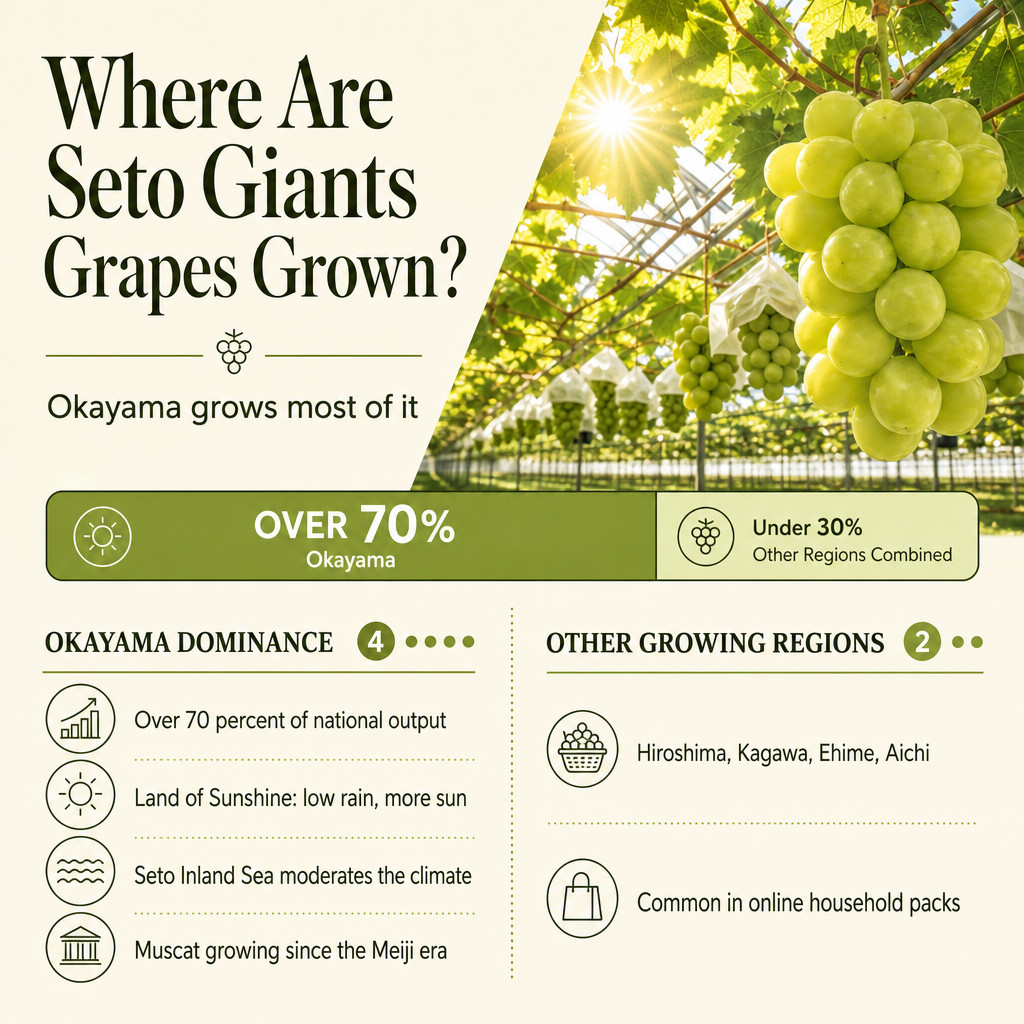
Okayama Prefecture dominates production. JA Hare-no-Kuni Okayama puts the prefecture’s national share above 70 percent, with smaller plantings in Hiroshima, Kagawa, Ehime, and Aichi.
Okayama, the Land of Sunshine
Locals call Okayama the Land of Sunshine, and the nickname is earned. Rainfall stays comparatively low, sunshine hours run high, and the Seto Inland Sea moderates the climate. Vinifera grape types struggle in wet Japanese summers, so those conditions matter enormously.
The prefecture also carries a long institutional memory around grapes, stretching back to Muscat of Alexandria cultivation in the Meiji era. Skilled labour and greenhouse infrastructure were already in place when Seto Giants arrived.
Other Growing Regions
Because the original breeding rights sat in Okayama, cultivation spread there first and stayed concentrated. Hiroshima, Kagawa, Ehime, and Aichi all grow it now, at much smaller scale. Fruit from those prefectures turns up more often in online household packs than on gift counters.
History of Seto Giants Grapes
Hanazawa Grape Research Institute in Okayama developed the variety from a 1979 cross, applied for protection in 1987, and secured registration in 1989.
Breeding at Hanazawa
Shigeru Hanazawa crossed Gzhal Kara with Neo Muscat, grew out the resulting seedlings, and picked the standout plant. Private breeders drove much of Japan’s grape development during this period, working outside the national research stations. The Seto name records where that work happened.
Commercial adoption took time. Growers had to learn the hormone treatments, and consumers had to accept a grape that looked, frankly, a bit odd on the shelf.
Older Than Shine Muscat
Here is the detail most people get wrong. Shine Muscat reached variety registration in 2006, seventeen years after Seto Giants. The newer grape simply scaled faster and captured the market.
Whether Seto Giants can now reposition itself as the connoisseur’s alternative is still an open question. Retail interest has clearly grown, though production has not followed at the same pace.
Nutrition and Health Notes
Japan’s Standard Tables of Food Composition list grapes at roughly 58 kcal per 100 grams without skin, rising to about 69 kcal when the skin is included.
What You Actually Get
Grapes are mostly water and sugar, with very little protein or fat. Potassium is the most notable mineral, and the skin carries polyphenols that peeled fruit loses. Eating Seto Giants whole therefore retains more of those compounds than peeling a Kyoho would.
Those figures cover grapes generally rather than this cultivar specifically, since no official entry exists for it. Given the high Brix at shipping, its sugar content likely sits toward the upper end of the range.
Sensible Portions
A full 700 gram bunch delivers a lot of sugar in one sitting, however easy it goes down. Half a bunch makes a reasonable dessert portion. Anyone monitoring blood glucose should treat premium grapes the same way they treat any sweet fruit.
Seto Giants in Japanese Gift Culture
Premium fruit functions as a formal gift in Japan, and Seto Giants sits comfortably in that category alongside melons and other luxury grapes.
Why Fruit Works as a Gift
Seasonal fruit signals attention to timing, which Japanese gift etiquette values highly. It also disappears after being enjoyed, so it never burdens the recipient with clutter. Ochugen, the midsummer gift season, and Keiro no Hi, the September holiday honouring older family members, both fall inside the grape window.
Choosing a Gift Bunch
Gift grade fruit is sorted by appearance as much as flavour, so uniform berries and an intact bloom command the price. Ask counter staff for the ochugen or seibo grade, the summer and year end gift tiers, if the box is going to a client or a workplace superior. For friends, ordinary grade tastes the same and costs considerably less. Readers curious about Japan’s other high end grapes can compare Ruby Roman, which pushes the luxury logic much further.
Common Mistakes to Avoid
Most disappointment comes from misreading ripeness, over chilling, or paying gift prices for a snack.
- Rejecting bunches with brown freckles, which usually signal ripeness rather than damage.
- Peeling the berries, since the thin skin carries much of the flavour.
- Washing the whole bunch days ahead, which speeds up spoilage.
- Leaving it in the fridge for a week and expecting the same crunch.
- Paying for department store presentation when the fruit is going straight into your mouth.
- Assuming Momotaro Budo is a different variety, when it is a trademark for selected Seto Giants.
Conclusion
Why It Deserves More Attention
Seto Giants spent decades as the grape that Shine Muscat overshadowed. Its shape looks odd, its volumes stay small, and its marketing never matched its rival. Taste it beside a Shine Muscat, though, and the case makes itself.
What to Do Next
Visit Okayama in September if the timing allows, and buy from a farm stand rather than a station kiosk. Otherwise, order a wakeari bunch online and skip the gift packaging entirely. Either way, put one berry of each variety on the same plate before you decide which side you are on.
Japan rewards seasonal eating in general, and grapes are only one entry point. Our Japanese fruit guide covers melons, strawberries, and the rest of the calendar, while the full Japan food guide maps every region.
Seto Giants Grapes FAQ
What are Seto Giants grapes?
Seto Giants is a large green table grape bred in Okayama Prefecture and registered as a variety in 1989. Growers produce it seedless, and the skin is thin enough to eat whole. Each berry has a distinctive dent around its middle. The flavour is sweet but clean, with a crisp bite.
Why are Seto Giants grapes expensive?
Cultivation requires hand thinning, two precisely timed hormone treatments, and constant bunch shaping. National production also stays small, since the variety never scaled beyond a handful of prefectures. Gift grading raises prices further because buyers pay for uniform appearance. Wakeari lots, sold cheaply for cosmetic flaws, cost far less and taste the same.
Can you eat the skin of Seto Giants grapes?
Yes, and you should. The skin is very thin and carries a mild astringency that balances the sweet flesh. Peeling removes flavour and polyphenols for no real benefit. The fruit is also seedless, so each berry goes down whole with no preparation.
Are Seto Giants sweeter than Shine Muscat?
No, Shine Muscat is generally sweeter. It reaches roughly 18 to 20 degrees Brix at peak ripeness and occasionally higher, while Seto Giants ships from around 18. Character differs more than the numbers do, since Shine Muscat tastes almost confectionery while Seto Giants reads as brighter fruit sweetness. Many people prefer the cleaner finish despite the lower reading.
What makes Seto Giants different from other Japanese grapes?
Three things set it apart: the dimpled berry shape, an unusually thin edible skin, and a crisp texture closer to a pear than a grape. Kyoho and Muscat of Alexandria need peeling and often contain seeds. Delaware is smaller and simpler in flavour. Seto Giants asks nothing of the eater, which explains much of its appeal.
Is Momotaro Budo the same as Seto Giants?
They are the same variety, but Momotaro Budo is a registered trademark rather than a separate grape. Industry sources describe it as limited to approved Okayama growers whose fruit clears stricter grading standards. Prices run roughly double as a result. The name references the Momotaro folk tale because the berries resemble small peaches.
How much do Seto Giants grapes cost?
A standard bunch commonly sells for ¥2,000 to ¥3,000, while wakeari lots can fall near ¥1,500. Momotaro Budo grade starts around ¥4,000 and rises with size and presentation. Department store gift boxes cost the most because of packaging. These figures reflect retailer listings checked in July 2026 and shift every season.
When is Seto Giants season?
Greenhouse fruit appears from mid-July, and open field bunches run from September through November. September offers the best combination of quality, supply, and price. Popular growers take reservations from August, so book early if you want a specific farm. Late autumn selection thins out quickly.
Which prefecture produces the most Seto Giants grapes?
Okayama Prefecture dominates, and JA Hare-no-Kuni Okayama puts its national share above 70 percent. Breeding happened there in the late 1970s, so cultivation spread locally first and stayed concentrated. Hiroshima, Kagawa, Ehime, and Aichi grow smaller quantities. Total national production remains modest even so.
Can I buy Seto Giants grapes outside Japan?
Availability abroad remains very limited, since production volumes are small and the fruit does not travel well. Most exports go to nearby Asian markets in tiny quantities. Many countries also restrict fresh grape imports on plant health grounds. Buying in Japan during the season is the practical option.
About This Guide
Food in Japan writes regional food guides for English speaking readers. Tasting notes here come from eating Seto Giants bought in Japan during the autumn season, comparing farm stand fruit against a gift grade box. Breeding history, cultivation methods, production shares, and nutritional figures come from the government, agricultural cooperative, and horticultural sources listed below. We checked prices, season dates, and grading details in July 2026, and this article carries no sponsorship or paid placement.
References
- JA Zen-Noh Okayama, Seto Giants Product Page, https://www.zennoh.or.jp/oy/product/fruits/giants/ (Accessed July 2026)
- JA Hare-no-Kuni Okayama, Seto Giants Online Shop, https://seto.ja-hareoka.or.jp/ (Accessed July 2026)
- Okayama Prefectural Tourism Federation, Okayama Kanko Web, Seto Giants, https://www.okayama-kanko.jp/gourmet/12002 (Accessed July 2026)
- Japan Fruit Association, Kudamono Navi, Seto Giants Variety Profile, https://www.kudamononavi.com/zukan/grape/setogiants (Accessed July 2026)
- Japan Fruit Association, Kudamono Navi, Neo Muscat Variety Profile, https://www.kudamononavi.com/zukan/grape/neomuscat (Accessed July 2026)
- Foodslink, Shun no Kudamono Hyakka, Seto Giants and Momotaro Budo, https://foodslink.jp/syokuzaihyakka/syun/fruit/budou-setoG.htm (Accessed July 2026)
- Uehara Grape Research Institute, Variety Catalogue, Seto Giants, http://www.uehara-grapes.jp/variety/grape_071.html (Accessed July 2026)
- Uehara Grape Research Institute, Variety Catalogue, Neo Muscat, http://www.uehara-grapes.jp/variety/grape_074.html (Accessed July 2026)
- Ministry of Education, Culture, Sports, Science and Technology (MEXT), Food Composition Database, Grapes with skin, raw, item 07178, https://fooddb.mext.go.jp/details/details.pl?ITEM_NO=7_07178_7 (Accessed July 2026)
- Ministry of Education, Culture, Sports, Science and Technology (MEXT), Food Composition Database, Grapes without skin, raw, item 07116, https://fooddb.mext.go.jp/details/details.pl?ITEM_NO=7_07116_7 (Accessed July 2026)
- Ministry of Education, Culture, Sports, Science and Technology (MEXT), Standard Tables of Food Composition in Japan, Eighth Revised Edition, 2023 supplement, https://www.mext.go.jp/content/20230428-mxt_kagsei-mext_00001_011.pdf (Accessed July 2026)
- Ministry of Agriculture, Forestry and Fisheries (MAFF), Plant Variety Protection and Seed Division, https://www.maff.go.jp/j/shokusan/hinshu/ (Accessed July 2026)
- Yamada, M., & Sato, A. (2016). Advances in table grape breeding in Japan. Breeding Science, 66(1), 34–45. (Surveyed: July 2026)
- Weaver, R. J., & McCune, S. B. (1959). Effect of gibberellin on seedless Vitis vinifera. Hilgardia, 29(6), 247–275. (Surveyed: July 2026)
- CiNii Research, National Institute of Informatics, academic literature on table grape breeding and gibberellin treatment, https://cir.nii.ac.jp/ (Accessed July 2026)
Related Articles
- Shine Muscat (シャインマスカット) (Surveyed: July 2026)
- Ruby Roman (ルビーロマン) (Surveyed: July 2026)
- Okayama Fruits Guide: Peaches and Grapes (Surveyed: July 2026)
- Kibi Dango (きびだんご) (Surveyed: July 2026)
- Japanese Fruit Guide (Surveyed: July 2026)
- Depachika Guide: Japanese Department Store Food Halls (Surveyed: July 2026)
- Autumn Eats: Must-Try Food in Autumn in Japan (Surveyed: July 2026)
- Chugoku Food Guide (Surveyed: July 2026)
- Japan Food Guide (Surveyed: July 2026)




Comments