




There are grapes, and then there are ルビーロマン Ruby Roman. The difference is not subtle. One is a fruit. The other is a statement. For anyone curious about Japan’s culture of premium food gifts, Ruby Roman is perhaps the clearest example in existence.
These are, without question, one of Japan’s most exclusive luxury grapes. The story behind them is worth knowing.
What Is Ruby Roman?
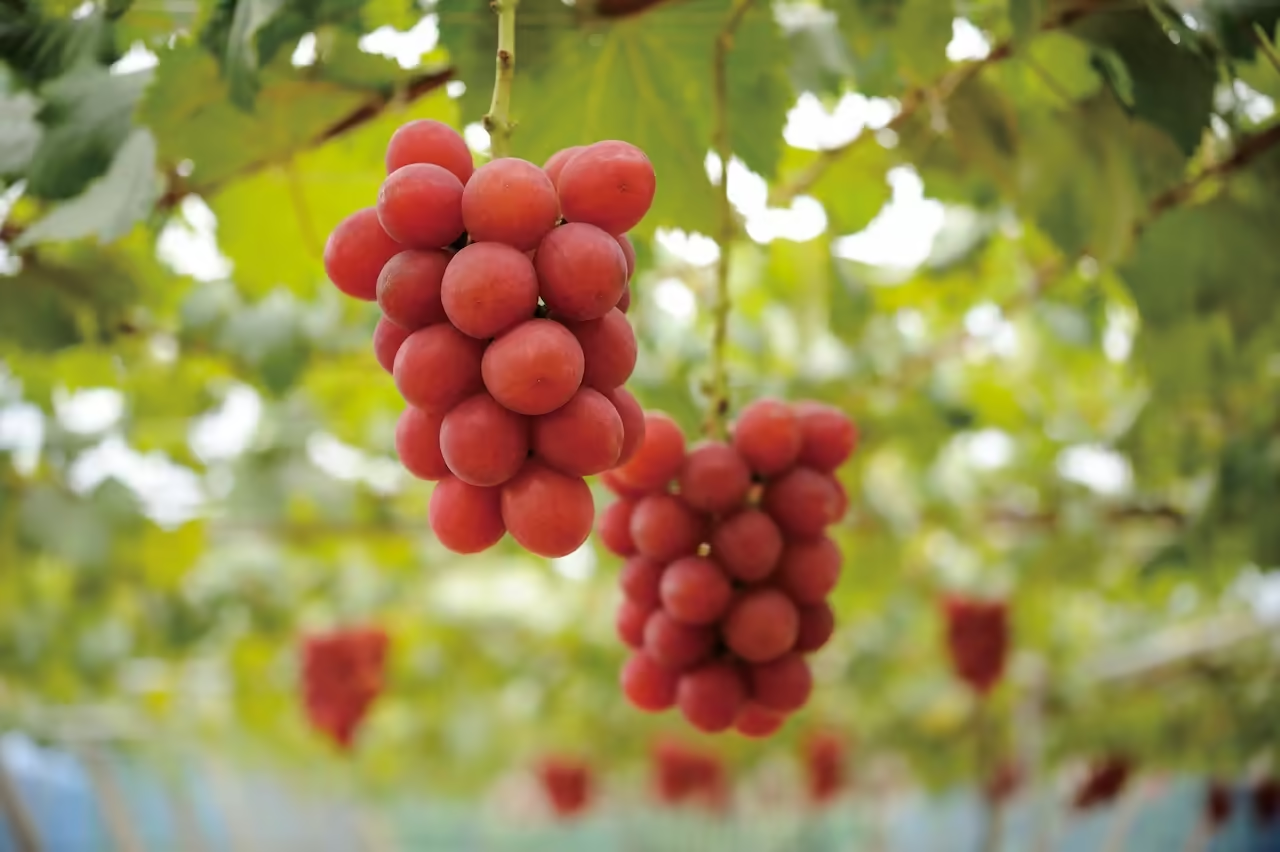
ルビーロマン Ruby Roman is a variety of large red grapes grown exclusively in Ishikawa Prefecture, on the western coast of central Honshu. Each grape is roughly the size of a ping-pong ball. That description sounds exaggerated until you hold one.
To qualify for the Ruby Roman label, each individual grape must meet three strict criteria. It must weigh at least 20 grams. It must measure at least 30 millimeters in diameter. And its sugar content must reach a minimum of 18 degrees Brix. If even one grape in a bunch falls short, the entire cluster is downgraded or rejected.
The grapes are large seeded premium grapes, not seedless. The seeds are part of the natural composition. That distinction matters, because the breeding focused on size, sugar, color, and juice, not convenience.
The History of Ruby Roman
The story starts in 1995. Grape farmers in Ishikawa approached the Prefectural Agricultural Research Center with a specific request. They wanted a large, red grape that could stand apart in Japan’s competitive fruit market. Ishikawa farmers were already growing Delaware grapes, a small seedless variety that made up roughly 75% of their grape production. They also cultivated the large black Kyoho grape on a smaller scale. But neither gave them an identity.
Researchers planted 400 experimental vines using seeds from Fujiminori, the largest black grape in Japan at the time, as the mother variety. The exact crossbreeding partner has never been officially disclosed. Of those 400 vines, only 4 produced red grapes. Only one met the size requirements.
Development continued for 14 years. Researchers refined the grape’s color intensity, sugar levels, ease of cultivation, and visual consistency. The name itself was chosen by popular vote. Residents of Ishikawa submitted 639 candidate names. The public selected Ruby Roman. The prefecture officially launched the grape commercially in August 2008.
The debut price was striking. A single 700-gram bunch sold at auction for 100,000 yen, roughly $910 at the time, which worked out to about $26 per grape.
Why Ruby Roman Is So Expensive
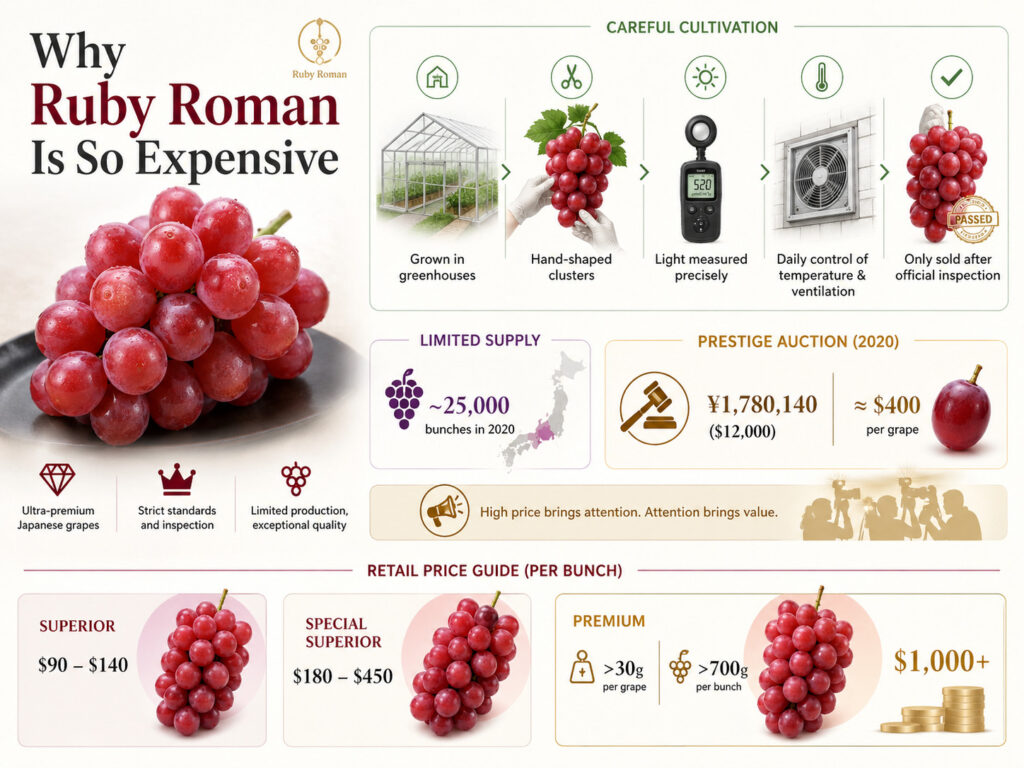
Why is Ruby Roman so expensive? The honest answer is that almost every part of the process costs more than normal grape farming.
Cultivation happens entirely in greenhouses. Farmers manually shape each cluster to ensure consistent berry size and spacing. They monitor light levels using proprietary measurement tools, because insufficient light causes pale coloring and lower sugar development. Temperature and ventilation are adjusted daily. Even after harvest, grapes cannot be sold until they pass the official inspection.
Supply is permanently limited. In 2020, only around 25,000 bunches were available for purchase. That year, a single bunch sold at auction for approximately 1,780,140 yen, or $12,000. That works out to roughly $400 per individual grape.
Auction prices are partly about prestige. Buyers who win the season’s first auction receive significant media attention. For a hotel chain or luxury fruit shop, the cost is closer to advertising spend than grocery shopping. As one academic noted, it makes economic sense precisely because it makes people talk.
The price for standard retail bunches is far more accessible. Superior-grade bunches typically sell between $90 and $140. Special Superior bunches can reach $180 to $450. Only the Premium category, where every grape weighs over 30 grams and the whole bunch exceeds 700 grams, pushes into four-figure territory.
The Tier System
Ruby Roman is sold in five recognized quality tiers: Superior, Special Superior, and Premium at the top. Superior bunches make up around 90% of each year’s certified harvest. Special Superior represents roughly 10%. Premium certification is rare. In 2010, only six bunches qualified. In 2011, not a single bunch passed the standard.
This scarcity is not manufactured for marketing. The Premium threshold is genuinely difficult to reach. Growing conditions, rainfall, sunlight variations, and minute differences in individual grape development all contribute. Most years produce some Premium bunches. Some years do not.
What Does Ruby Roman Taste Like?
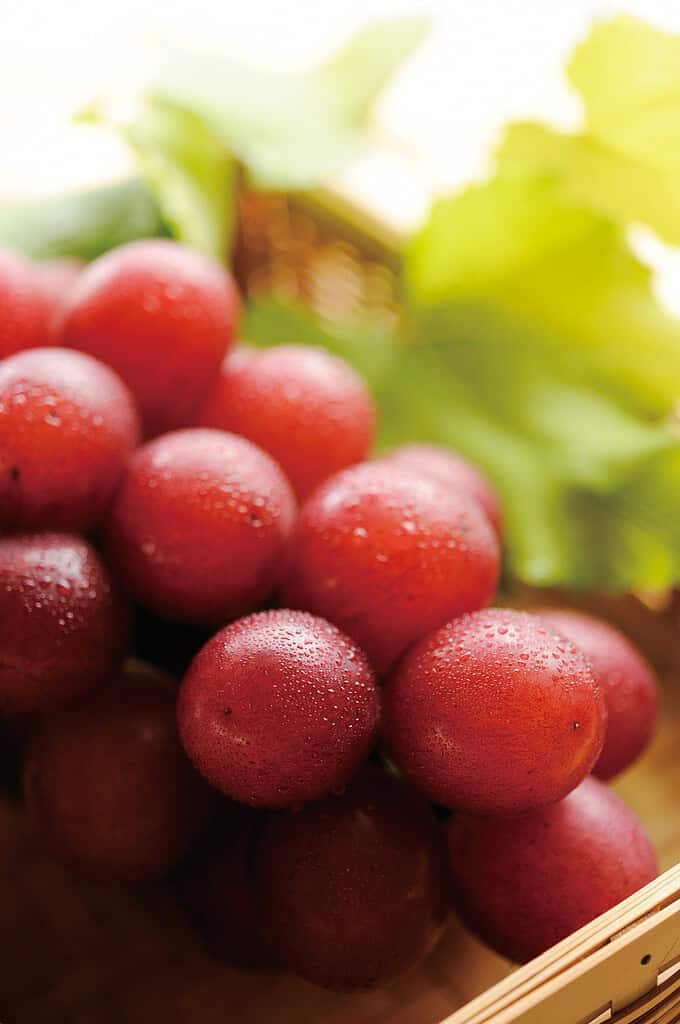
What does Ruby Roman taste like? This is a fair question, because the price creates an expectation that is hard to separate from the actual experience.
The flavor is sweet and juicy, with low acidity. The sugar level of 18 Brix is the minimum required, but many grapes exceed it noticeably. Biting through the skin releases a generous burst of juice. The texture is firm but yielding, with none of the toughness you find in lower-quality large grapes. The sweetness is clean rather than cloying.
Some describe a faint floral note. Others focus on the structural satisfaction of eating something that size without disappointment. The skin is thin. The interior is translucent gold when held to light. A white powdery bloom on the surface is a sign of freshness, not spoilage. The grape produces it naturally.
Is it worth the price? That depends entirely on what you are buying it for. As a fruit experience, it is genuinely exceptional. As a gift, it carries weight that no ordinary box of produce can match. Japan’s culture around premium fruit gift-giving is deeply embedded in seasonal customs and relationships. A bunch of Ruby Roman grapes tells the recipient something specific about how much they are valued.
Size Comparison
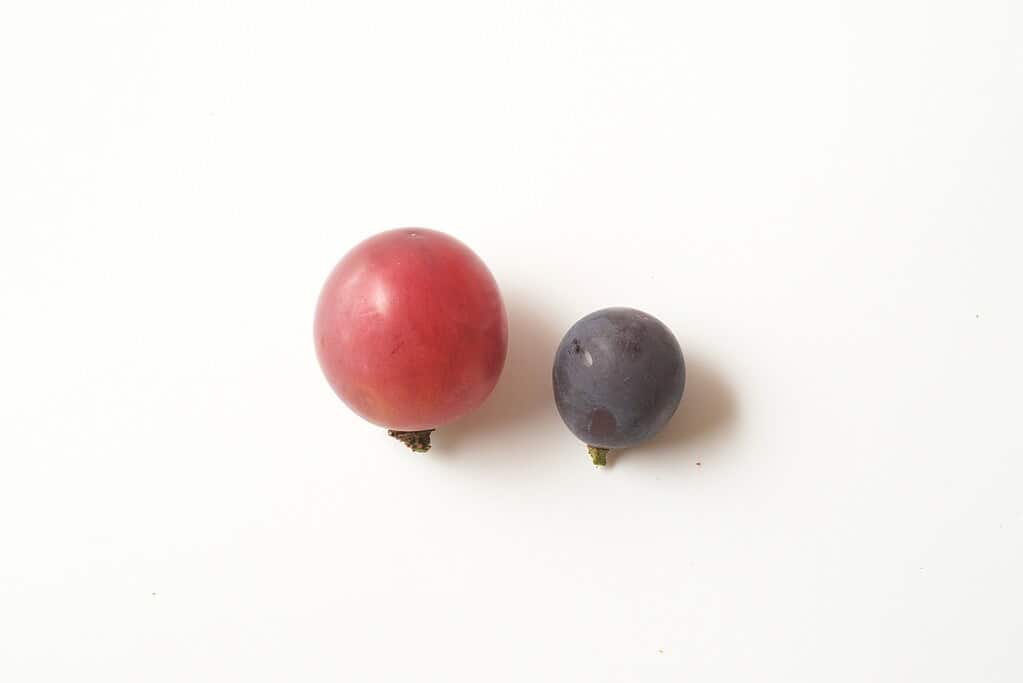
How big are Ruby Roman grapes? Standard Kyoho grapes are large by global standards. Ruby Roman is roughly twice the size of a Kyoho. A single grape can be four times the size of an ordinary supermarket grape. Holding one for the first time is genuinely startling. The proportion feels wrong at first, like an optical illusion.
This scale is not accidental. The original brief from Ishikawa farmers in 1995 was specifically for large red grapes. The entire 14-year development program was organized around achieving that size while maintaining color standards and sugar content. The result exceeded expectations.
Ruby Roman as a Gift
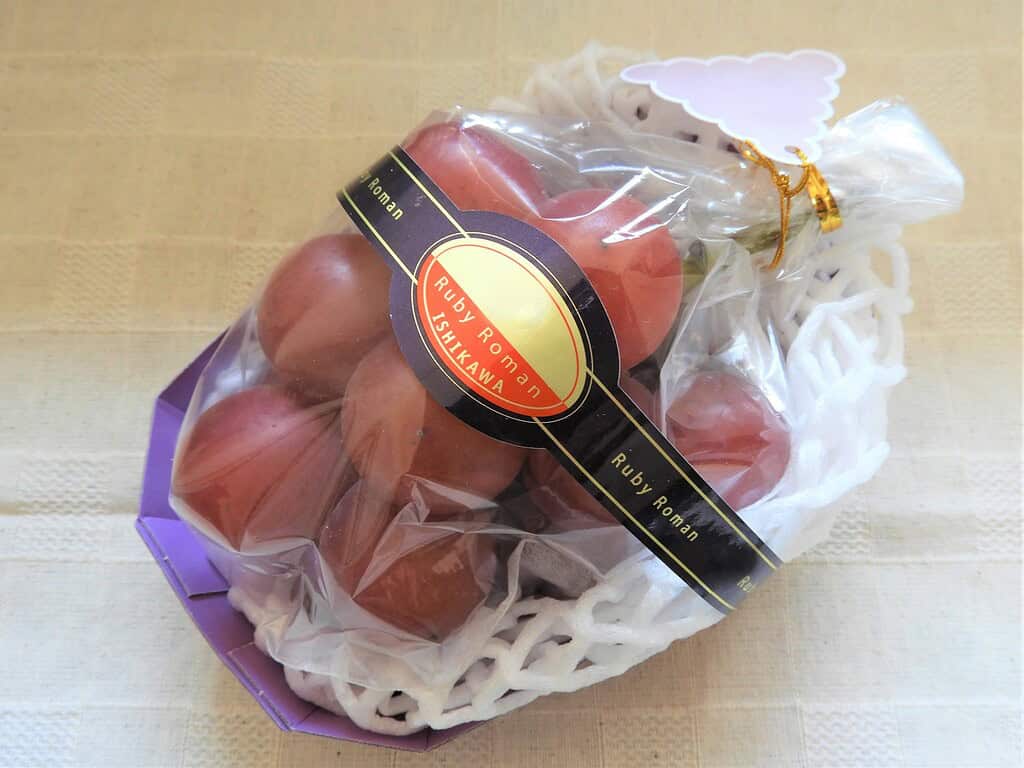
The Japanese practice of gifting premium fruit is not widely understood outside the country. Fruit in Japan can function similarly to wine in other cultures. A well-chosen piece of fruit communicates care, taste, and financial generosity all at once. Department store food halls dedicate significant floor space to premium fruit displays. Presentation boxes, individual wrapping, and seasonal timing matter enormously.
Ruby Roman sits at the top of that gifting hierarchy. A certified bunch in proper packaging is appropriate for serious occasions: business appreciation, major celebrations, visits to prestigious households. It is the 石川県の高級ぶどう luxury Japanese grapes that people in Ishikawa genuinely take pride in.
The nickname 夢のぶどう, or “dream grape,” appeared early and stuck. It captures the feeling more accurately than any price tag.
Ruby Roman within Japan’s Luxury Fruit Culture
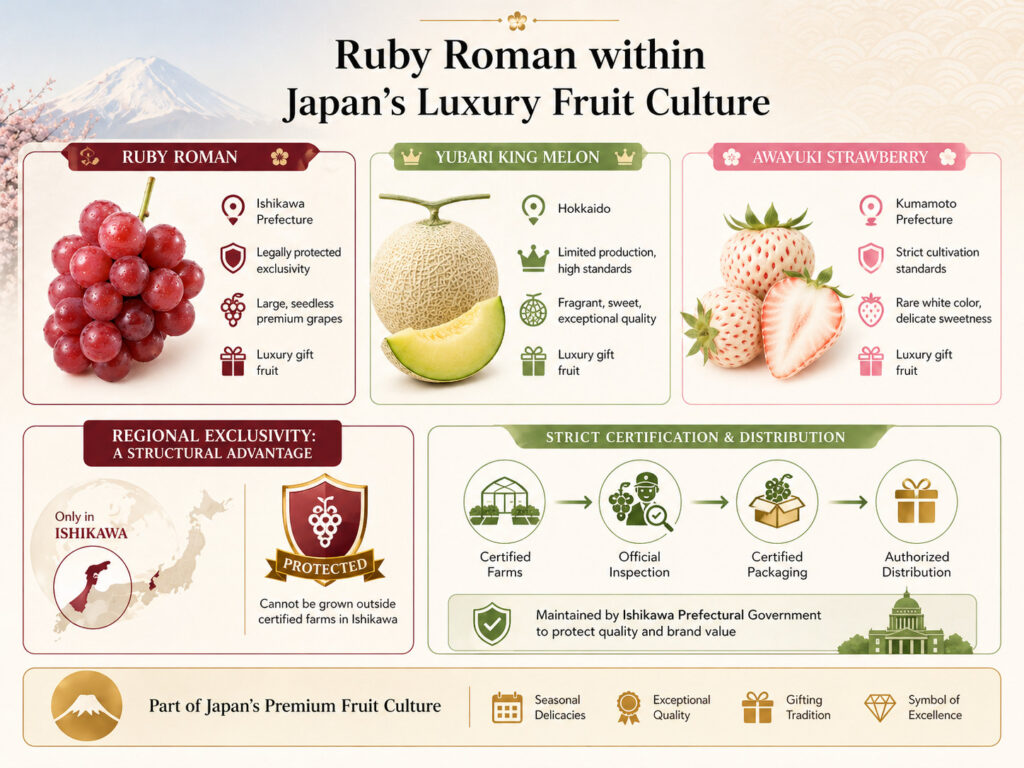
Ruby Roman is not alone. Japan produces several fruits that reach similar extremes. The Yubari King melon from Hokkaido is perhaps the most internationally recognized. Awayuki white strawberries from Kumamoto follow a similar model: rare, visually striking, grown under strict standards, and priced for gifting rather than daily eating.
What makes Ruby Roman distinct within this group is its regional exclusivity. The grape cannot legally be grown outside certified farms in Ishikawa. The Ishikawa Prefectural Government maintains strict control over certification and distribution. That exclusivity is structural, not just brand positioning.
For a broader view of Japan’s premium fruit culture, the Japanese fruit guide on Food in Japan covers the full range of seasonal varieties and their significance. Ruby Roman earns its place near the top of that list.
Ishikawa’s Broader Food Identity
Understanding Ruby Roman also means understanding Ishikawa. The prefecture runs along the Sea of Japan coast in central Honshu. Its food culture is among the most sophisticated in Japan, built around seasonal seafood, traditional fermentation, and deep agricultural pride.
The Hokuriku food guide on Food in Japan covers the broader regional picture, from Kanazawa’s celebrated Omicho Market to the famous nodoguro fish and Kaga crab. Ruby Roman fits naturally into this context. Ishikawa is a region that takes quality seriously across every category of food it produces.
Where to Find Ruby Roman
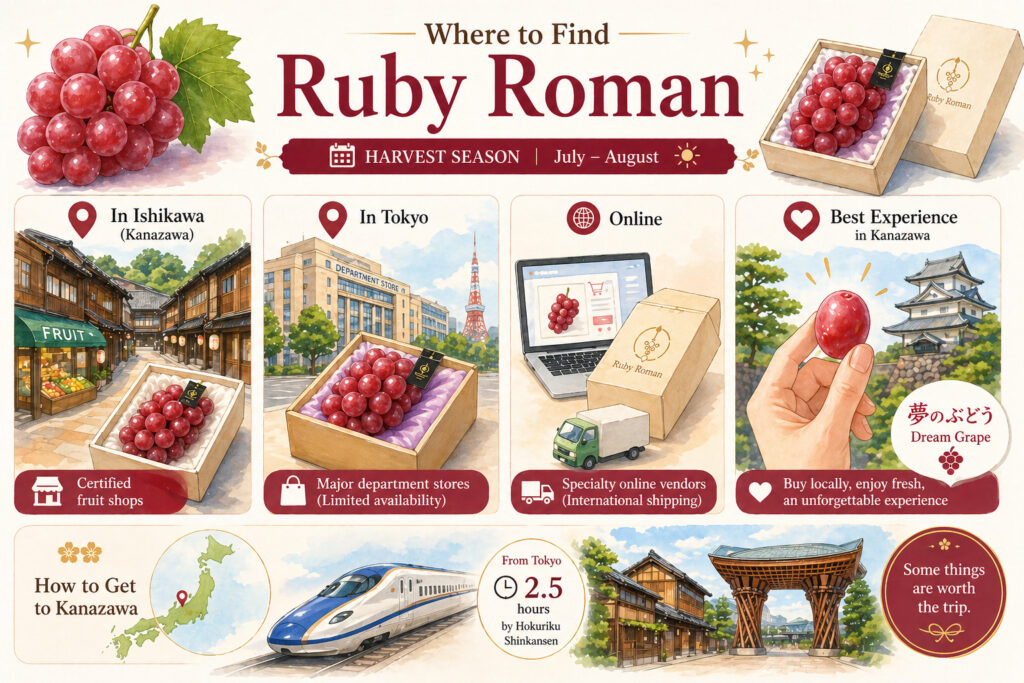
The harvest season runs from July through August. Grapes are sold through certified fruit shops in Ishikawa, particularly in Kanazawa. Major department stores in Tokyo occasionally carry them during peak season. Some specialty online vendors offer shipping to international destinations, though prices reflect both the rarity and the logistics.
Visiting Kanazawa in late July specifically to eat Ruby Roman grapes is, perhaps, the most direct approach. The experience of buying directly from a local fruit vendor, holding the bunch, and eating it on the spot is something that a gift box shipped overseas cannot quite replicate.
It is a 夢のぶどう dream grape. Some things are worth the trip.
References
- Ishikawa FOODishbook – Ruby Roman grapes: https://ishikawafood.com/en/foods/792/
- Japanese Taste – Ruby Roman Grapes, Japan’s Precious Jewel: https://int.japanesetaste.com/blogs/japanese-taste-blog/ruby-roman-grapes-japans-precious-jewel-of-agriculture




Comments