





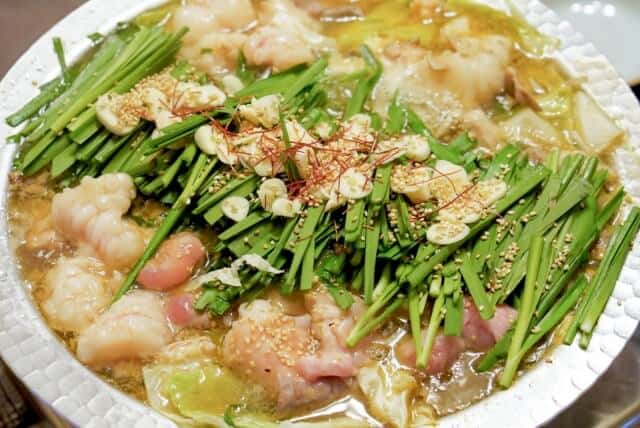
Motsunabe is Fukuoka’s famous offal hot pot. Beef or pork motsu simmers with cabbage, garlic chives, and garlic in a soy sauce or miso broth. If you enjoy tripe or other offal, motsunabe is worth trying. It also reflects Japan’s habit of using ingredients carefully.
Quick answer: Motsunabe is a Fukuoka hot pot made with beef or pork offal, cabbage, garlic chives, and a soy sauce or miso-based broth. It is known for its rich sweetness from fresh offal and its bold garlic aroma. Locals often finish the pot with champon noodles or rice.
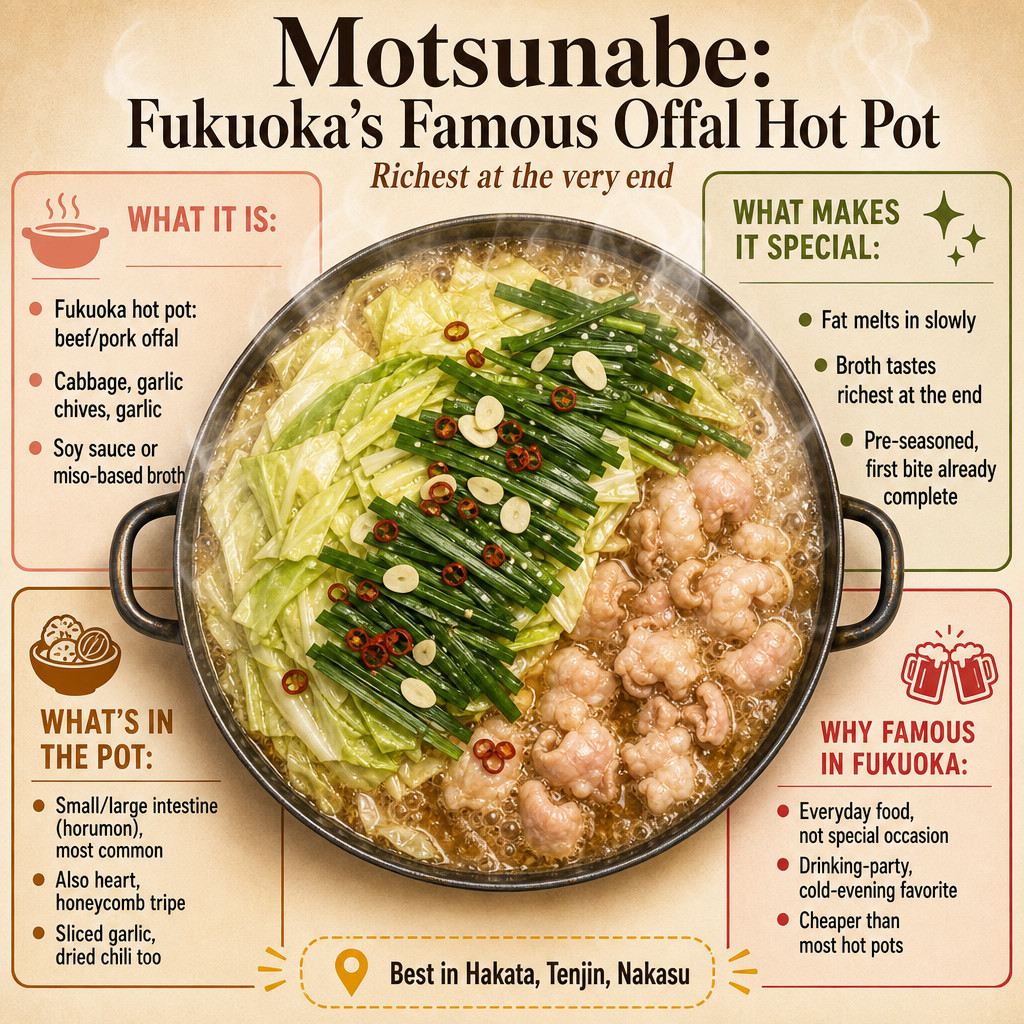
- What it is: a Fukuoka hot pot of beef or pork offal, together with cabbage, garlic chives, and garlic.
- What makes it special: the fat melts in slowly, so the broth tastes richest at the end.
- Where to try it: Hakata, Tenjin, and Nakasu in Fukuoka City, although Tokyo also has strong shops.
Motsunabe: Fukuoka’s Famous Offal Hot Pot
Motsunabe (もつ鍋) belongs to the nabemono family, the broad category of Japanese hot pot dishes cooked at the table. Unlike most of them, this one starts with an already seasoned broth. You do not build flavour as you go, so the first bite already tastes complete.
One detail surprises visitors. Hakata shops rarely use a clay donabe. Instead, they serve the pot in a shallow, two-handled metal pan, which heats fast and lets the vegetables collapse evenly.
What is motsunabe made of?
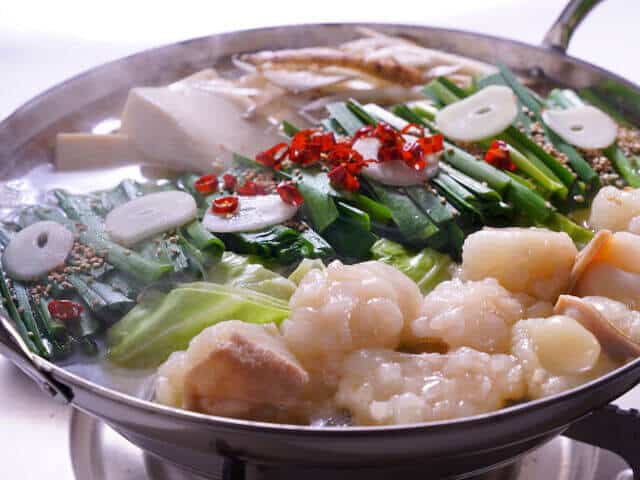
Cooks use offal such as small intestine and large intestine, which many Japanese diners call horumon. Shops also mix in heart, honeycomb tripe, and other stomach cuts. Small intestine remains the most common choice, because its fat melts into the soup.
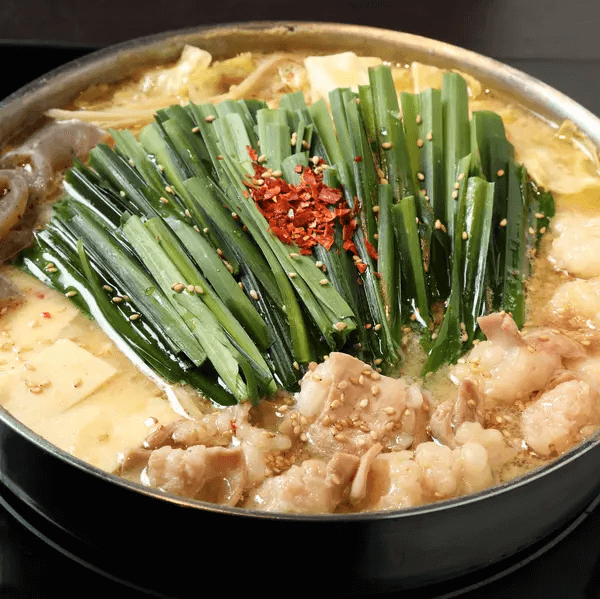
Above the offal sits a mound of cabbage and garlic chives. Sliced garlic and dried chilli go in as well. Tofu, burdock, and bean sprouts appear at some restaurants, though the core four rarely change.
Why is motsunabe famous in Fukuoka?
Fukuoka diners treat this pot as everyday food rather than a special occasion dish. It belongs to drinking parties, cold evenings, and long dinners with friends. Because it costs less than most hot pots, groups order it without much thought.
The city also has another famous Fukuoka specialty in Hakata ramen, plus mizutaki and mentaiko. Even so, motsunabe holds its own place. Locals love it because it is affordable, filling, and deeply flavorful.
What Does Motsunabe Taste Like?
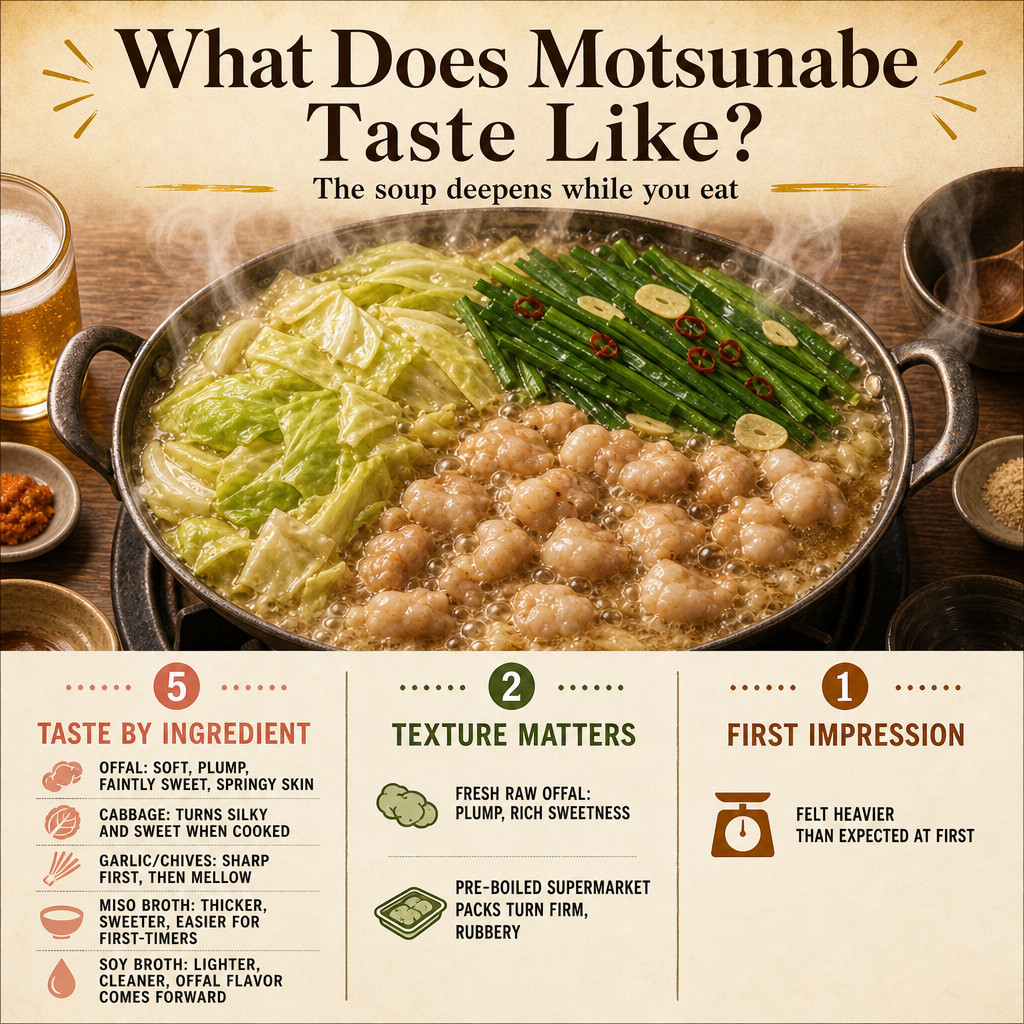
The broth tastes savoury, garlicky, and slightly sweet. Fat from the offal melts in gradually, so the soup deepens while you eat. That change, above all, is what regulars talk about.
- Offal: soft, plump, and faintly sweet, with a springy skin on each piece.
- Cabbage: turns silky and sweet once it collapses into the broth.
- Garlic and chives: sharp at first, then mellow after a few minutes of heat.
- Miso broth: thicker, sweeter, and more forgiving for first-timers.
- Soy sauce broth: lighter and cleaner, so the offal flavour comes forward.
Texture matters here more than most dishes. Fresh raw offal gives the dish a plump texture and rich sweetness that boiled offal cannot match. Pre-boiled supermarket packs turn firm and rubbery instead.
Honestly, my first pot felt heavier than I expected, and I paused halfway through. Then the cabbage softened and the balance shifted. By the end I was chasing the last of the broth with a spoon.
Where Does the Word Horumon Come From?
Two explanations circulate, although only one holds up well. The popular version links horumon to the Kansai phrase hōru mon, meaning things you throw away. It sounds neat, so it spreads easily.
Lexicographers, however, point to a different source. Restaurants advertised “horumon cuisine” before the war, and those menus covered stamina dishes in general, not just offal. That usage points to the German word Hormon, borrowed through medicine as a symbol of vitality.
Worth noting: treat the “things to throw away” story as folk etymology. It is charming, yet the pre-war advertising record argues against it.
Why Do Japanese Diners Enjoy Offal?
Visitors often ask why offal carries no stigma here, unlike in many Western kitchens. Anthropological work on Japanese offal cuisine gives a clear answer, and it begins with texture rather than flavour. Japanese holds hundreds of words for mouthfeel, so texture counts as much as taste. In fact, one pot delivers chewy, springy, and gelatinous bites in a single sitting.
The price tag tells the same story too. Offal in Japan often sells at rates close to steak, rather than as a discount cut. Supermarkets shelve it beside ordinary meat as well, without any separation.
Finally, attitudes toward waste play a part. The idea of mottainai, meaning regret at wastefulness, runs deep in Japanese kitchens. Because of that, using every part reads as respect rather than thrift.
History of Motsunabe
Postwar Coalfields and the Aluminium Pot
The dish grew out of scarcity soon after the war. Northern Kyushu held some of Japan’s largest coalfields, and miners needed cheap, filling food. Offal cost almost nothing, so it went into the pot with garlic chives.
Early versions cooked in a simple aluminium pan, seasoned with soy sauce. Many accounts credit Korean workers in the coal towns with spreading the habit. Sesame oil and chilli often went in first, which gave the pot its heat.
In fact, that link runs further back than the war itself. Korean labourers had opened the first horumon restaurants in Japanese cities during the late 1920s. Offal cooking therefore reached Fukuoka with a tradition already behind it.
Cabbage Joins the Pot
Cabbage arrived later, around 1962, once it became a common household vegetable. That addition created the offal, chives, and cabbage combination everyone recognises today. Meanwhile, the aluminium pan gave way to iron, and the dish moved from a dry simmer toward a proper soup.
Through the 1960s, cooks simmered everything in a sweet soy sauce base, closer to sukiyaki than to modern nabe. Bonito and kelp stock came later, along with miso versions.
The 1992 Tokyo Boom
Everything changed when Hakata-style shops opened in Tokyo in 1992. The bubble economy had just collapsed, so a cheap and generous hot pot suited the mood exactly. Word spread through television, so queues formed quickly.
That year, “motsunabe” won a bronze prize at Japan’s New Words and Buzzwords Awards. Curiously, young women drove much of the demand, not the salarymen you might expect. The boom faded after a few years, partly because shipping fresh offal to Tokyo proved difficult.
The Second Boom and Today
A second wave arrived in the early 2000s, this time framed around collagen and vegetables. Since then, the dish has settled into the national repertoire. Supermarket soup packs, which first appeared in 1991, made home cooking easy too.
Common Motsunabe Broth Types
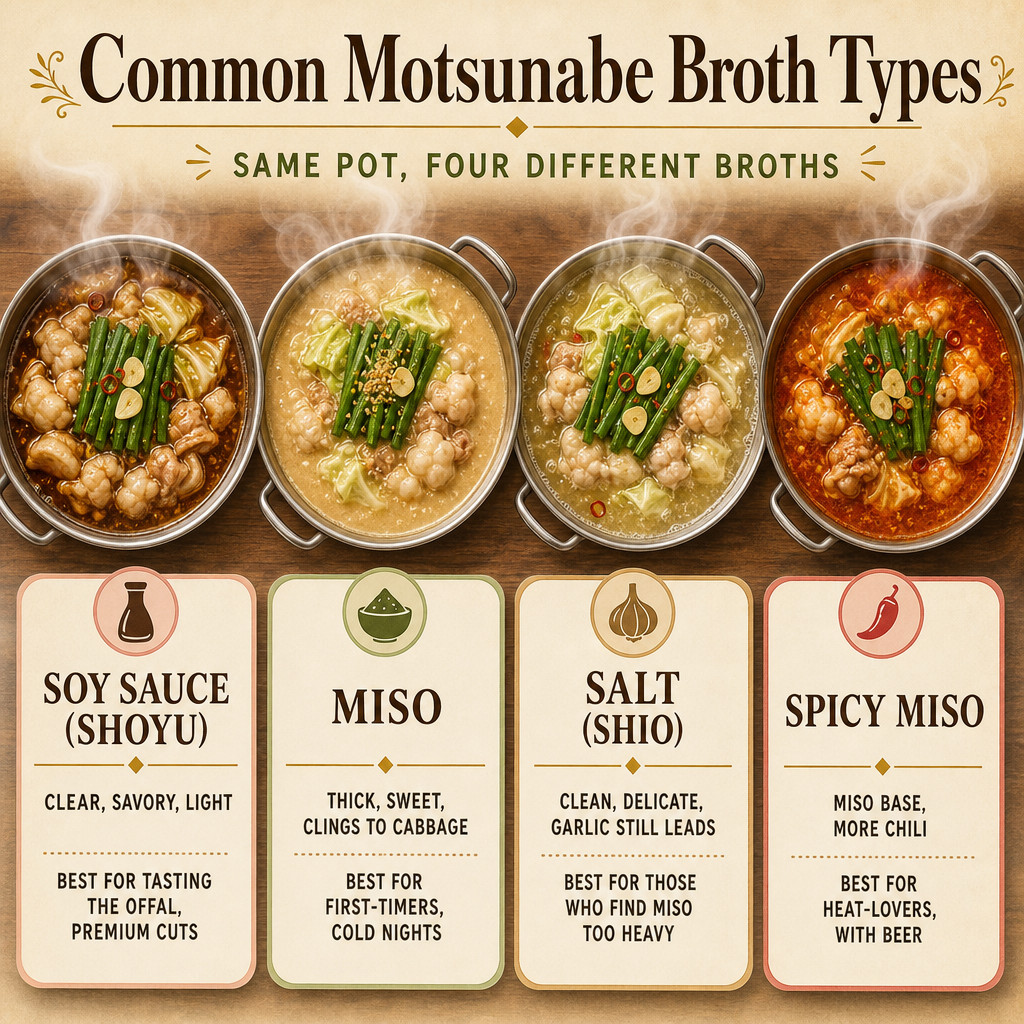
Most shops offer at least two bases, and some list six or more. The table below covers the four you will meet most often.
| Broth | Character | Best for |
|---|---|---|
| Soy sauce (shoyu) | Clear and savoury, and also light on the palate | Tasting the offal itself, especially premium cuts |
| Miso | Thick and sweet, so it clings to the cabbage | First-timers, particularly on cold nights |
| Salt (shio) | Clean and delicate, though garlic still leads | Anyone who finds miso too heavy |
| Spicy miso | Miso base, but with noticeably more chilli | Diners who want heat, especially alongside beer |
Shops build these bases on bonito and kelp stock, then adjust with soy sauce, salt, or miso. Garlic, meanwhile, goes into almost every version. If you cannot decide, order miso, since staff at many restaurants recommend it by default.
Can You Make Motsunabe at Home?
Yes, although sourcing takes more effort than cooking. Butchers and Asian grocers sell raw beef or pork intestine, sometimes frozen too. Japanese supermarkets often stock pre-boiled packs instead, which work but lose that plump bite.
Look for fresh domestic beef offal when you can find it. Colour should look pale and glossy rather than grey. Ask the butcher whether the pieces have been cleaned, because that answer changes your prep time considerably.
Cleaning is straightforward but not optional. Rub the offal with flour or salt, then rinse under running water until the water runs clear. Afterwards, blanch it briefly to remove any lingering smell.
Motsunabe Ingredients
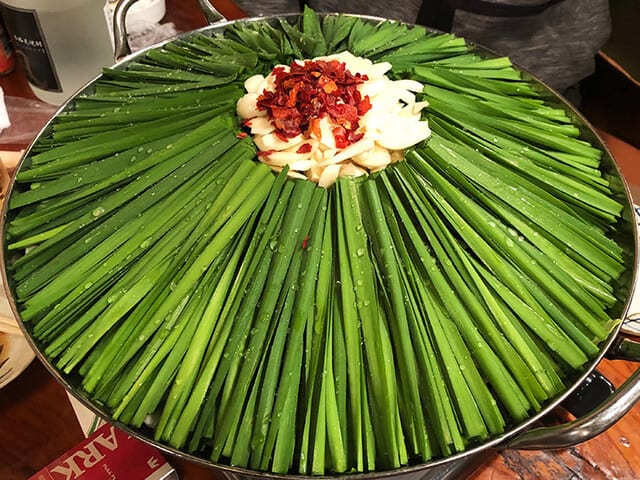
| Servings | 4 people, although 2 can share generously |
| Prep time | About 20 minutes, since cleaning the offal takes care |
| Cook time | About 25 minutes, once the broth simmers |
| Main ingredients | Beef or pork offal and cabbage, together with garlic chives and garlic |
| Broth type | Soy sauce base, then finished with miso |
| Ingredient | Amount | Purpose |
|---|---|---|
| Beef or pork offal | 400 g | Main protein, and also the source of richness |
| Plain flour | 25 g | Cleans the offal, so the broth stays clear |
| Cabbage | 450 g | Bulk, and especially sweetness once it softens |
| Garlic chives (nira) | 60 g | Aroma, and above all the signature green layer |
| Garlic | 2 to 3 cloves, sliced | Depth, while also taming any strong smell |
| Bean sprouts | 200 g | Texture and volume, particularly in a large pot |
| Dried chilli | 1 to 2 | Gentle heat, though you can leave it out |
| Broth ingredient | Amount | Purpose |
|---|---|---|
| Water | 1,000 ml | Base liquid, so use soft water if you can |
| Chicken stock powder | 40 g | Savoury backbone, especially in the first sips |
| Soy sauce | 33 g | Colour and salt, though miso adds more later |
| Mirin | 28 g | Sweetness and gloss, rather than plain sugar |
| Sake | 28 g | Softens any strong aroma before simmering |
| Oyster sauce | 5 g | Extra depth, although it is optional |
| Miso | 17 g | Body and a rounded finish, stirred in last |
Note on garlic chives: nira and garlic are different ingredients, and recipes sometimes confuse the two. You need both. The chives go on top in 4 cm lengths, while the garlic is sliced thin.
How to Make Motsunabe
Remove the cabbage core, then cut the leaves into rough 4 cm squares. Cut the garlic chives to the same length so they cook evenly. Slice the garlic thinly, and keep everything separate for now.
Sprinkle the offal with flour, then rub it in well. Then rinse under running water until the water runs clear. This step removes surface fat and smell, so do not rush it.
Bring a pan of water to the boil, then add the offal. Boil for roughly one minute only, then drain into a colander. Longer boiling tightens the texture, which is exactly what you want to avoid.
Combine the water, stock powder, soy sauce, mirin, sake, and oyster sauce in the pot. Then heat over medium until it reaches a simmer. Finally, stir the miso in off the heat so it dissolves smoothly.
Add the cabbage first, then the bean sprouts, then the offal on top. Then cover and simmer over medium heat for about ten minutes. Resist stirring, because the layers cook at different speeds on purpose.
Finally, remove the lid and scatter the garlic chives, garlic, and chilli on top. Cook for one or two more minutes, no longer. The chives should stay bright green and slightly crisp.
How to Eat Motsunabe in Fukuoka
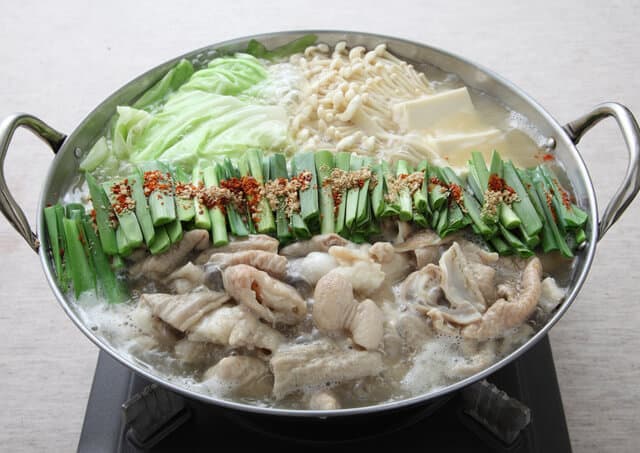
Restaurants bring the pot uncooked, then light the burner in front of you. Staff usually explain the timing, though the pattern is easy once you see it.
- Wait until the vegetables soften. Give the cabbage time to collapse into the broth, usually around ten minutes.
- Eat the offal while it stays tender. Serve it early, because long simmering firms it up.
- Finally, finish with champon noodles or rice. Add them to the remaining broth once the pot empties.
That last course, called the shime, matters more than it sounds. Thick champon noodles soak up everything the offal released, so nothing goes to waste. Alternatively, rice and egg turn the leftovers into a soft porridge.
Motsunabe vs Mizutaki vs Nabe
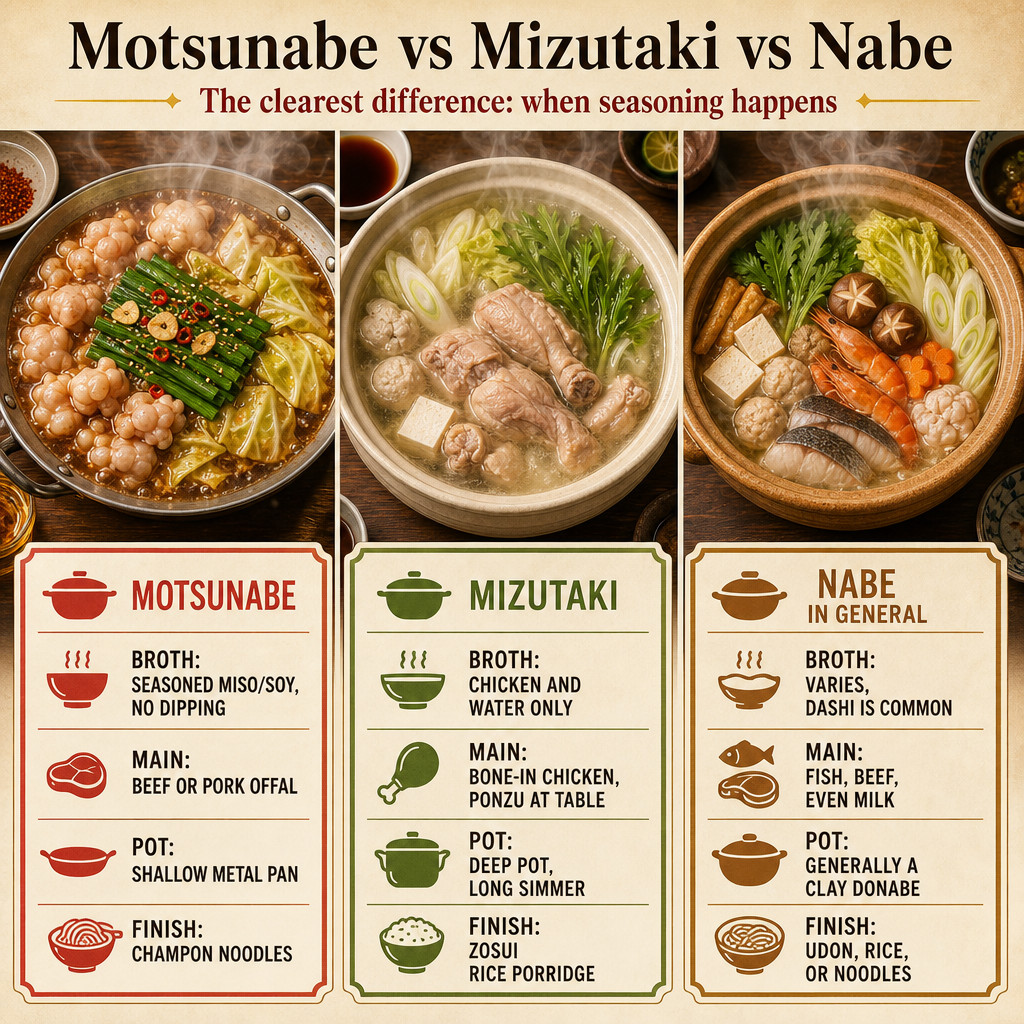
| Point | Motsunabe | Mizutaki | Nabe in general |
|---|---|---|---|
| Broth | Seasoned miso or soy sauce, so no dipping sauce | Chicken and water only, since seasoning comes later | Varies widely, although dashi is common |
| Main ingredient | Beef or pork offal | Bone-in chicken | Anything from fish to beef, and even milk |
| Seasoning | Already in the pot | Added at the table with ponzu instead | Either approach, though dipping is common |
| Pot | Shallow metal pan, rather than clay | Deep pot, since the broth simmers long | Generally a clay donabe |
| The finish | Champon noodles | Zosui rice porridge | Udon, rice, or noodles |
The clearest difference lies in when seasoning happens. Motsunabe arrives fully seasoned, while Fukuoka chicken hot pot asks you to season each bite yourself. Both belong on the same trip, and many visitors eat one on each night.
Is Motsunabe Healthy?
The honest answer sits somewhere in the middle. Beef small intestine carries roughly 268 kcal and 26 g of fat per 100 g, so the pot is not light. Large intestine runs lower, though, at about 150 kcal and 13 g of fat.
On the other hand, offal supplies vitamin B12, niacin, iron, and zinc in useful amounts. You also eat a large volume of cabbage and chives alongside it. That balance is genuinely better than the fat figures suggest.
Collagen deserves a careful note, since the 2000s boom leaned heavily on it. Research does show that collagen peptides enter the bloodstream after eating collagen-rich food. Whether that translates into visible skin benefits remains unsettled, though. Food anthropologists point out that the beauty claim spread faster than the evidence behind it, so enjoy the pot for its taste first.
Where to Eat Motsunabe

Fukuoka City holds the highest concentration of specialists, although three districts cover most of them.
- Hakata: convenient for travellers, with several shops inside and around the station buildings.
- Tenjin: the main shopping and nightlife district, and home to some of the largest specialists.
- Nakasu: the riverside entertainment quarter, best for late dinners after drinks.
- Yatai stalls: these open-air stalls mostly serve ramen and yakitori, so check before you sit down.
Motsunabe Rakutenchi (Fukuoka)
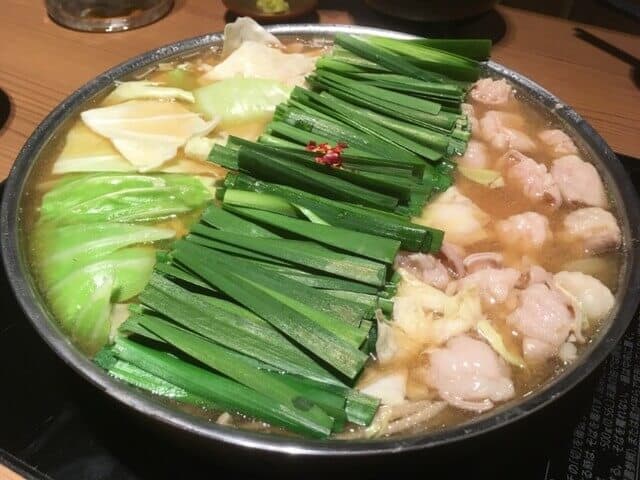
Rakutenchi keeps the menu deliberately narrow, so nervous first-timers relax quickly. You pick beef offal or a mixed cut, and the staff handle the cooking. English menus and a condiment bar also make the experience easy. Branches sit in Tenjin, Imaizumi, and near Hakata Station.
Hakata Motsunabe Ooyama (Fukuoka)
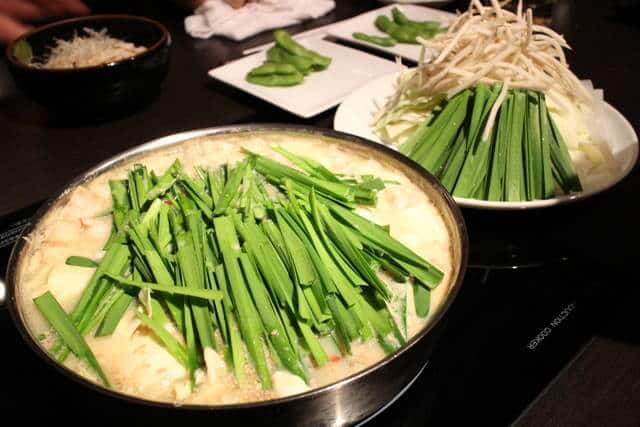
Ooyama builds its broth on a layered vegetable and seafood stock. The miso version gets the strongest recommendation from staff, and the set menus include champon noodles. Solo diners are welcome, which is unusual for hot pot. Reservations still help at dinner.
Arizuki Ebisu (Tokyo)
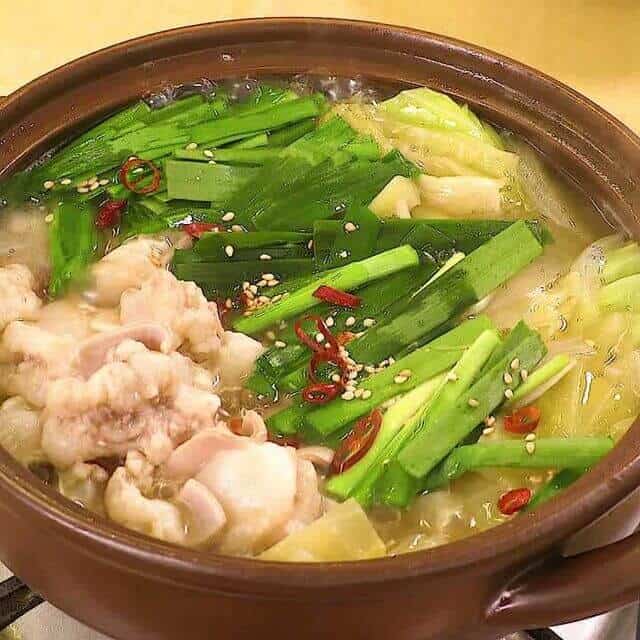
Arizuki uses domestically produced offal, and also offers two headline broths. The white version leans on Kyushu miso, while the red one runs on soy sauce. Side dishes deserve attention too, especially the mentaiko and the omelette. It gets loud, so book if you want conversation.
Hakata Motsudokoro Kirari (Tokyo)
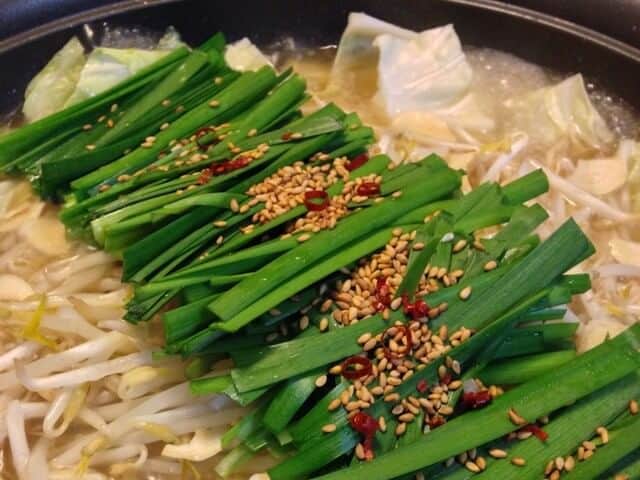
Kirari sources its offal and seasonings from Kyushu, and the careful preparation certainly shows. Besides the classics, it serves a black garlic oil pot and a grated yam version. Regulars say the offal carries no off smell at all. Good for anyone who has hesitated about offal before.
Please check before you go: hours, closing days, and prices change often. Confirm current details with the restaurant or its map listing.
Conclusion
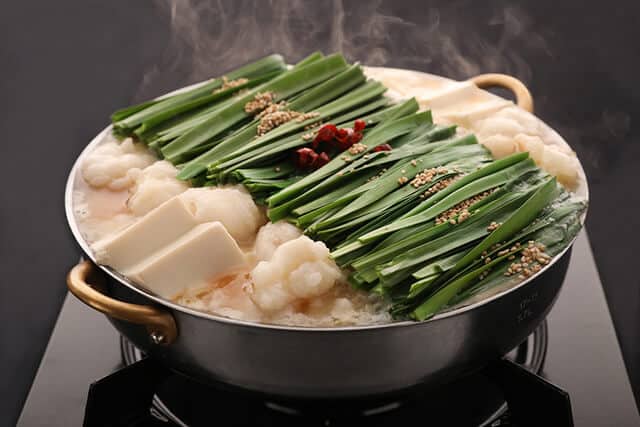
Motsunabe started as miners’ food and ended up on menus across Japan. That journey took about fifty years, and it changed the dish along the way. Cabbage, miso, and champon noodles all joined later.
If offal makes you hesitate, order the miso version and let the pot do the convincing. Planning a longer trip is easy too, since our guide to what to eat in Fukuoka covers the rest of the city.
Motsunabe FAQ
What is motsunabe?
Motsunabe is a Fukuoka hot pot built on beef or pork offal, cabbage, garlic chives, and garlic. The broth uses a soy sauce or miso base, seasoned before it reaches your table. Diners then cook everything together over a burner. Most people finish the meal with champon noodles too.
What part of the animal is used?
Small intestine appears most often, because its fat melts into the broth. Shops also use large intestine, heart, honeycomb tripe, and other stomach cuts. Some restaurants sell a mixed selection so you can compare textures. Beef is more common than pork in Fukuoka.
Is motsunabe healthy?
It sits in the middle. Beef small intestine holds around 268 kcal and 26 g of fat per 100 g, so the dish is rich. However, offal also delivers vitamin B12, niacin, iron, and zinc. The large volume of cabbage and chives also helps balance the meal.
What does motsunabe taste like?
Expect savoury, garlicky depth with a sweet edge from the cabbage. The offal itself tastes mild and faintly sweet, not gamey, when shops prepare it properly. Miso broths feel thicker, while soy sauce versions stay cleaner. The soup also grows richer as the meal continues.
Can I make it without offal?
You can, although the result becomes a different dish. Thinly sliced pork belly or chicken thigh works well in the same broth instead. Keep the cabbage, garlic chives, and garlic, since they carry much of the character. Mushrooms and tofu, meanwhile, suit a vegetarian version.
Where is motsunabe famous?
Fukuoka City is the home of this hot pot, especially the Hakata, Tenjin, and Nakasu districts. Specialist restaurants cluster there in especially large numbers. Tokyo also has strong Hakata-style shops, thanks to the 1990s boom. Eating it in Fukuoka still feels different, though.
What do you add at the end?
Champon noodles are the classic finish, and most restaurants offer them as an add-on. Their thickness also holds up in the concentrated broth. Rice with beaten egg is the other option, which produces a soft porridge. Order the shime before the soup reduces too far.
References
- Crossroad Fukuoka (Fukuoka Prefecture Tourism Association), Motsunabe vs Mizutaki: Fukuoka Winter Hot Pot Showdown, https://www.crossroadfukuoka.jp/feature/gourmet_2 (Surveyed: August 2026)
- Ministry of Education, Culture, Sports, Science and Technology, Standard Tables of Food Composition in Japan (Eighth Revised Edition), https://www.mext.go.jp/content/20201225-mxt_kagsei-mext_01110_011.pdf (Surveyed: August 2026)
- Asai, T. T. et al., Nutrients 16(20), 3574 (2024), Hydroxyprolyl-Glycine in 24 H Urine Shows Higher Correlation with Meat Consumption than Prolyl-Hydroxyproline, https://www.ncbi.nlm.nih.gov/pmc/articles/PMC11510011/ (Surveyed: August 2026)
- Hatanaka, Mioko (Yahoo News Japan Expert), The Explosive 1992 Motsunabe Boom and What Caused It, https://news.yahoo.co.jp/expert/articles/e2c5ee822cf8f82f85b537a2658aefe65edc1e44 (Surveyed: August 2026)
- Iima, Hiroaki (Shinchosha, Kangaeru Hito), Horumonyaki: On the Origin of the Word, https://kangaeruhito.jp/article/44496 (Surveyed: August 2026)
- Laurent, Christopher (Oxford Symposium on Food and Cookery), The Good, the Bad and the Ugly: The Allure of Offal Cuisine in Japan, https://www.academia.edu/33988754/ (Surveyed: August 2026)
- Cwiertka, Katarzyna J. (2007), Modern Japanese Cuisine: Food, Power and National Identity, Reaktion Books, https://reaktionbooks.co.uk/work/modern-japanese-cuisine (Surveyed: August 2026)
- Hosking, Richard (2014), A Dictionary of Japanese Food: Ingredients and Culture, Tuttle Publishing, https://books.google.com/books?id=Tg8dBAAAQBAJ&pg=PA144 (Surveyed: August 2026)
- Yonosuke Honten, A Chronology of Motsunabe in Fukuoka and Hakata, https://yonosukehonten.net/column/history.php (Surveyed: August 2026)
Related Articles
- Mizutaki (水炊き) (Surveyed: August 2026)
- Hakata Ramen (博多ラーメン) (Surveyed: August 2026)
- Nabe (鍋) (Surveyed: August 2026)
- What to Eat in Fukuoka (Surveyed: August 2026)
- Karashi Mentaiko (辛子明太子) (Surveyed: August 2026)
- Shabu-Shabu (しゃぶしゃぶ) (Surveyed: August 2026)
- Gyunabe (牛鍋) (Surveyed: August 2026)
- Seri Nabe (セリ鍋) (Surveyed: August 2026)
- Kyushu Food Guide (Surveyed: August 2026)
- Fukuoka Area Japanese Food (Surveyed: August 2026)



Comments