





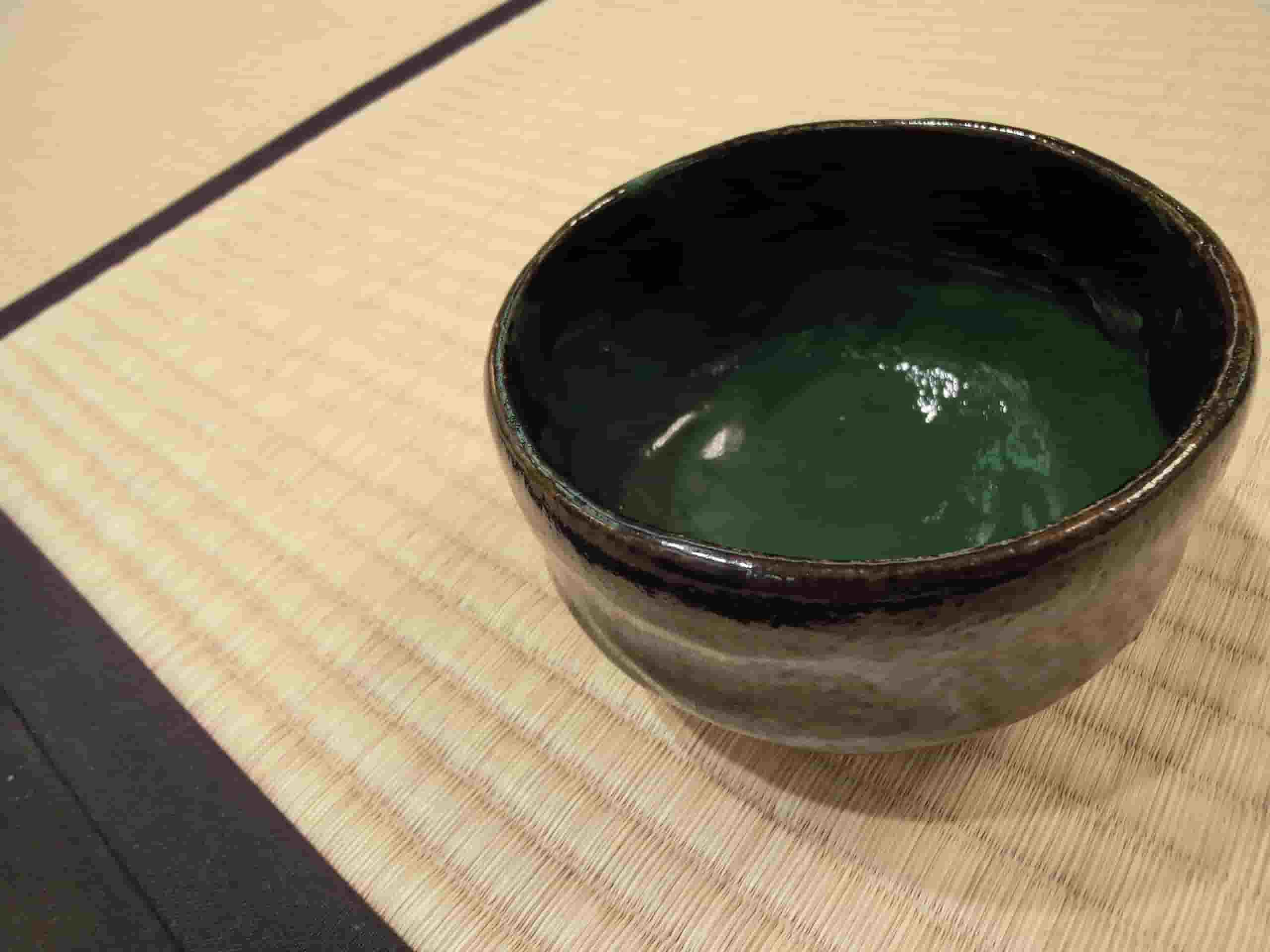
Koicha (濃茶), or “thick tea,” is the dense, syrup-like matcha that hosts prepare and guests share during the formal Japanese tea ceremony. The host kneads it slowly into a smooth, glossy paste rather than whisking it into a light, foamy bowl. This preparation uses roughly twice the matcha and half the water of an ordinary bowl. Guests often drink it from the same cup. Koicha is not simply “strong matcha.” It is a distinct preparation style, with its own tools, technique, and etiquette.
This guide focuses on koicha itself. It covers what separates koicha from ordinary thin-tea matcha, and where it fits into the history of the Japanese tea ceremony. It also explains how to select matcha for koicha, and how to prepare and share it correctly at home. For grading language used when buying matcha, see the companion Ceremonial Matcha guide. For the history of matcha, tencha production, and major growing areas, see the complete Matcha guide.
What Is Koicha?
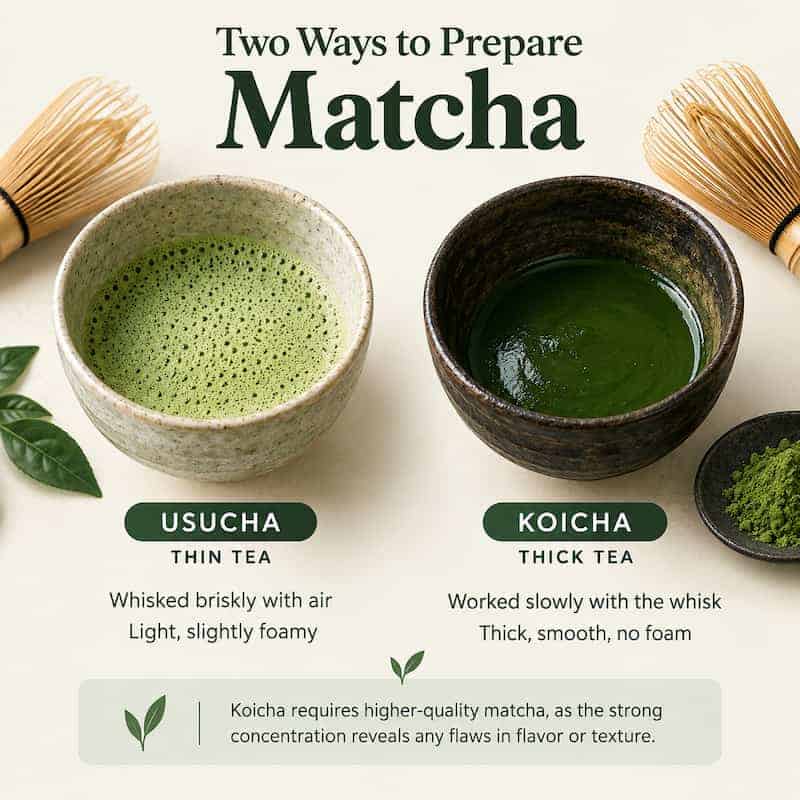
Japanese tea culture recognizes two standard ways to prepare matcha: koicha and usucha, or thin tea. To make usucha, the host whisks matcha briskly with air, creating a light, slightly foamy drink. To make koicha, the host uses much less water and works the paste slowly with the whisk. The result is a thick, smooth, almost paste-like liquid with a deep, glossy sheen and no foam at all.
Because there is so little water to hide flaws, koicha demands more from the matcha itself. Any grittiness, harsh bitterness, or short finish becomes obvious at this concentration. For that reason, tea houses traditionally reserve their most carefully selected matcha for koicha, often a named house blend made specifically for this purpose.
Koicha vs. Usucha: What Really Separates Them
The most commonly cited difference between koicha and usucha is the ratio of matcha to water. Koicha commonly uses around 4g of matcha to only about 20 to 40ml of hot water, compared to roughly 2g of matcha to 60ml for usucha. That gap in concentration is real, but it is only the starting point. Koicha and usucha also differ in their motion, their tools, and their level of formality.
To make usucha, the host whisks matcha back and forth briskly in a “W” or “M” motion. This works air into the tea and raises a layer of fine foam. Koicha never gets this treatment. Instead, the host kneads it: a slower, more deliberate motion that presses and folds the paste rather than aerating it. The goal is a dense, mirror-like surface, not foam.
That last row surprises many newcomers. In casual conversation today, people often treat usucha as the “everyday” matcha and koicha as an advanced specialty. Inside the tea ceremony itself, the relationship runs closer to the opposite. That context is worth understanding before you try koicha yourself.
The Place of Koicha in the Tea Ceremony
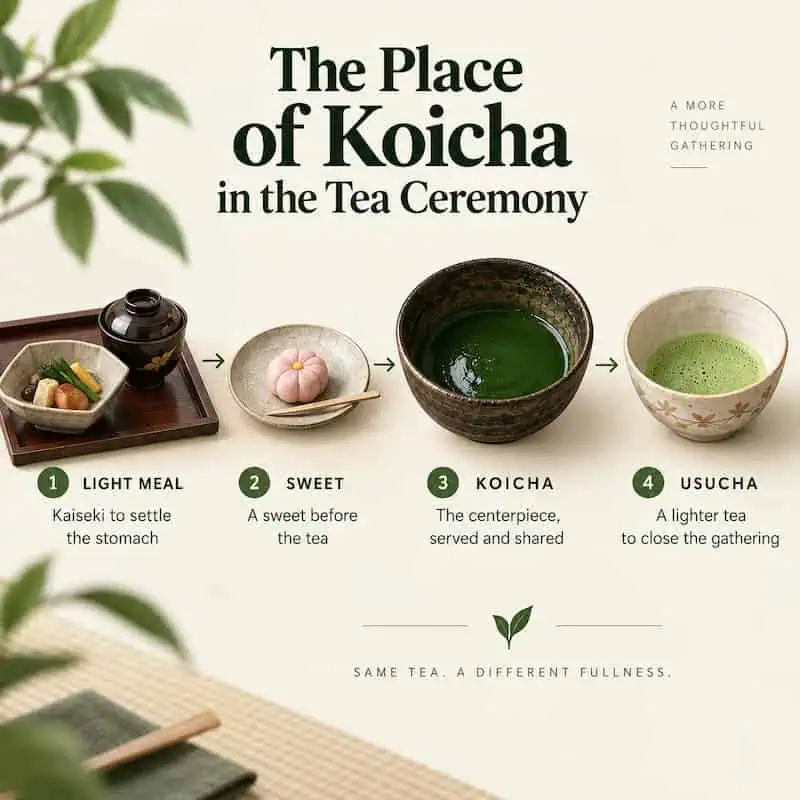
In a full, formal tea gathering, called a chaji, koicha is traditionally the centerpiece rather than an opening act. The host serves guests a light meal (kaiseki) and a sweet first. Only afterward does the host prepare and pass around koicha, followed later by a shorter, lighter usucha service before the gathering closes. Usucha-only gatherings, which are far more common today, developed as a shorter, more accessible format built around that closing portion of the full ceremony.
This ordering reflects koicha’s historic centrality within chanoyu, the way of tea associated with figures such as Sen no Rikyu in the sixteenth century. Because koicha asks so much of both the tea and the host’s technique, hosting it well has long marked a host’s skill and hospitality. Following its shared-bowl etiquette calmly likewise marks a guest’s own preparation.
None of this means you need formal training to make or enjoy koicha at home. It does mean koicha carries more ceremonial weight than an everyday bowl of matcha. That context helps explain why hosts prepare, serve, and share it so differently from usucha.
Choosing Matcha for Koicha
Not every matcha suits koicha, even a fine one. Because the tea is so concentrated, any harshness, dryness, or thinness in the leaf becomes far more obvious than in a diluted bowl of usucha. Sellers who understand this generally reserve a specific product line for it, sometimes a house blend with its own name. They label it as recommended for koicha.
Traditional teaching in chanoyu also points to the tea bushes themselves. Many practitioners consider leaves from older, more established bushes better suited to koicha. Mature bushes tend to produce a rounder, less astringent character that holds up at high concentration. Producers often reserve younger bushes for usucha instead. Practices vary from producer to producer, so treat this as a general guideline rather than a fixed rule.
Because grading language like “ceremonial” is a marketing term without one universal standard, the clearest signal is not the word on the front of the package. Instead, look for whether the seller specifically recommends the product for koicha. Good tasting notes describe smoothness, sweetness, umami, and a long, clean finish rather than bright, punchy bitterness. Marukyu Koyamaen, for example, recommends its Tenju blend specifically for thick tea. Ippodo rates products such as Kan-no-shiro for suitability in both usucha and koicha. For a full walkthrough of how to read these labels and evaluate a bowl at home, see the Ceremonial Matcha guide.
Tools Traditionally Used for Koicha
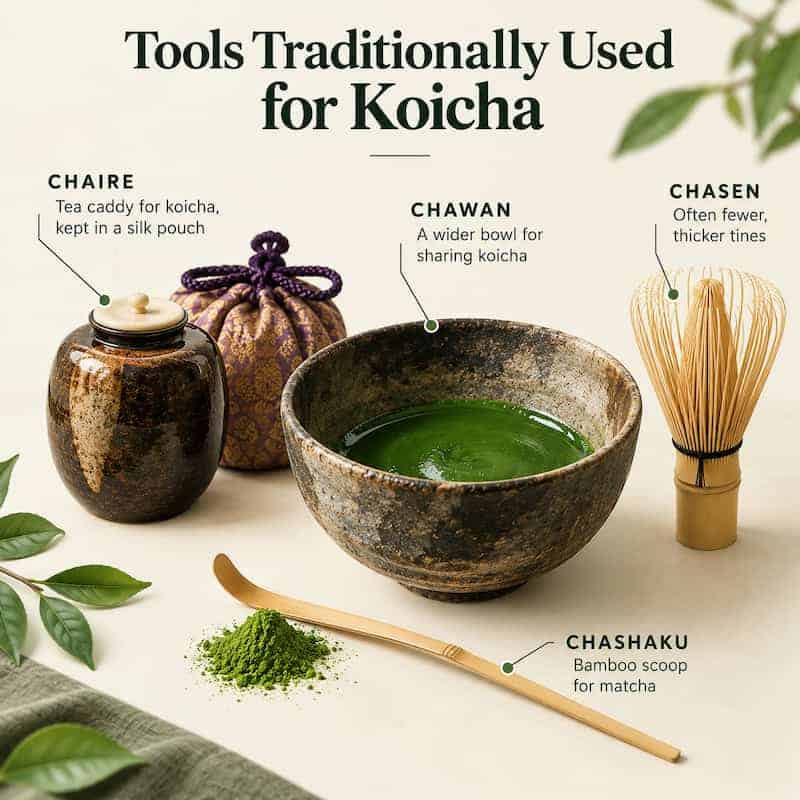
Koicha traditionally uses a slightly different set of utensils than usucha, chosen to suit both the tea’s formality and its texture.
- 🍃Chaire (茶入): A small ceramic tea caddy that stores and presents matcha for koicha, usually kept in its own silk pouch called a shifuku. This differs from the lacquered wood caddy, or natsume, that usucha generally uses.
- 🍃Chasen (茶筌): The bamboo whisk. Many practitioners use a chasen with fewer, thicker tines for koicha. A whisk with many delicate tines, built for raising foam in usucha, can bend or splay under the resistance of a dense paste.
- 🍃Chawan (茶碗): The tea bowl. Because guests often share koicha from one bowl, hosts commonly choose a wider or deeper chawan. It needs to hold enough tea and pass comfortably around the room.
- 🍃Chashaku (茶杓): The bamboo tea scoop used to measure matcha from the caddy into the bowl.
At home, you do not need every traditional utensil to make a satisfying bowl of koicha. A bamboo whisk, a bowl wide enough to knead in, a scale, and hot water are enough to start. The dedicated caddy and pouch matter most in a formal setting, where presenting the tea before preparing it is already part of the experience.
How to Prepare Koicha at Home
Koicha rewards patience more than speed. Rushing the kneading stage is the single most common reason a home-prepared bowl turns out lumpy or uneven.
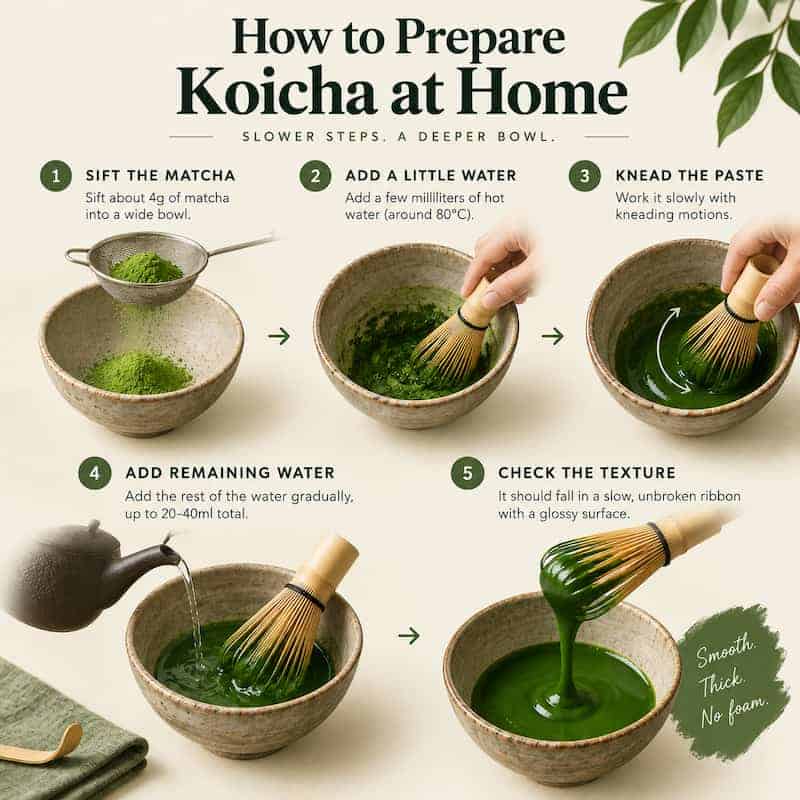
Sift about 4g of matcha suited to koicha into a wide bowl. Sifting breaks up clumps that become much harder to smooth out once you add water.
Add only a few milliliters of hot water at around 80°C, just enough to moisten the powder into a stiff paste. Work it gently with the tip of the whisk until no dry powder remains.
Press the whisk tines against the bottom and side of the bowl. Work the paste in slow, rolling, kneading motions rather than whisking back and forth. This step dissolves any remaining lumps and builds the glossy texture that makes koicha distinctive.
Add the rest of the water, up to roughly 20 to 40ml total, in two or three small additions. Continue kneading after each one — adding it all at once makes lumps far harder to work out.
Finished koicha should fall in a slow, unbroken ribbon off the whisk. It should have a smooth, glossy surface with no visible foam or dry streaks. If it still looks grainy, keep kneading rather than adding more water.
The ratio above is a common starting point, not a strict rule. Some tea houses and schools use slightly different proportions, and the right amount of water also depends on the fineness of the grind. Adjust in small increments, and judge the finished texture rather than following the numbers rigidly.
Tips for a Smooth, Lump-Free Bowl
- 🍃Sift every time. Even matcha that looks fine can hide small clumps that are nearly impossible to break down once you dilute it.
- 🍃Add water slowly. Building the paste in stages gives the whisk something to work against; adding all the water at once leaves the powder floating rather than blending.
- 🍃Knead, don’t whisk. A brisk whisking motion introduces air and foam that koicha should not have. Slow down and use pressure instead of speed.
- 🍃Use fresh matcha. Stale matcha tends to clump more and taste flatter, which is far more noticeable at koicha’s concentration than in a diluted bowl of usucha.
- 🍃Warm the bowl first. A cold bowl can cause the water to cool too quickly during kneading, making the paste harder to smooth out.
Sharing the Bowl: Koicha Etiquette
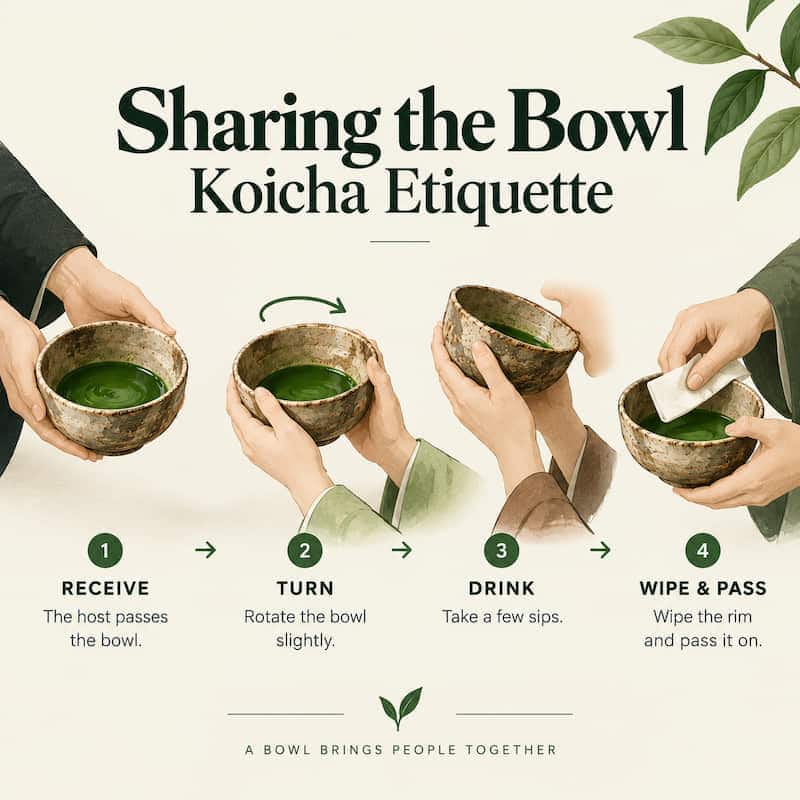
The custom most closely associated with koicha is mawashi-nomi, or “drinking in turn.” Rather than receiving an individual bowl, each guest shares one bowl of koicha. The host prepares it and passes it from guest to guest. Each person typically turns the bowl slightly before drinking, so as not to place their lips directly where the previous guest did. They take a few sips, wipe the rim with a small cloth or paper, and pass the bowl on.
This shared-bowl custom is part of why koicha carries more ceremonial significance than usucha. It turns the tea into something guests experience together rather than individually. It also asks more of both host and guests. The host must produce a bowl smooth and consistent enough to stay pleasant through several turns. Guests, in turn, must handle the shared bowl with care and attention.
You do not need to replicate a full formal gathering to enjoy this at home. Instead, prepare one bowl of koicha and share it among a few guests rather than making individual portions. It is a simple, meaningful way to bring a piece of that tradition into a casual setting.
Strength, Caffeine, and Who Should Try Koicha
Because koicha packs roughly twice the matcha of usucha into about half the water, it delivers noticeably more caffeine and other tea compounds per bowl. Producers make matcha from whole ground leaves rather than steeped and discarded leaves, so it already tends to be stronger than typical steeped green tea. Koicha concentrates that strength even further. If you are sensitive to caffeine or trying matcha for the first time, take smaller sips of koicha than you might with usucha. The same goes for drinking it later in the day.
Koicha suits people who already enjoy matcha whisked with water and want to explore a more intense, textured version of the same tea. It also suits anyone curious about the tea ceremony’s more formal side. If you are brand new to matcha, start elsewhere: a well-made bowl of usucha offers a gentler introduction. It also makes it easier to judge whether you like matcha’s flavor before committing to koicha’s concentration.
Storing Matcha for Koicha
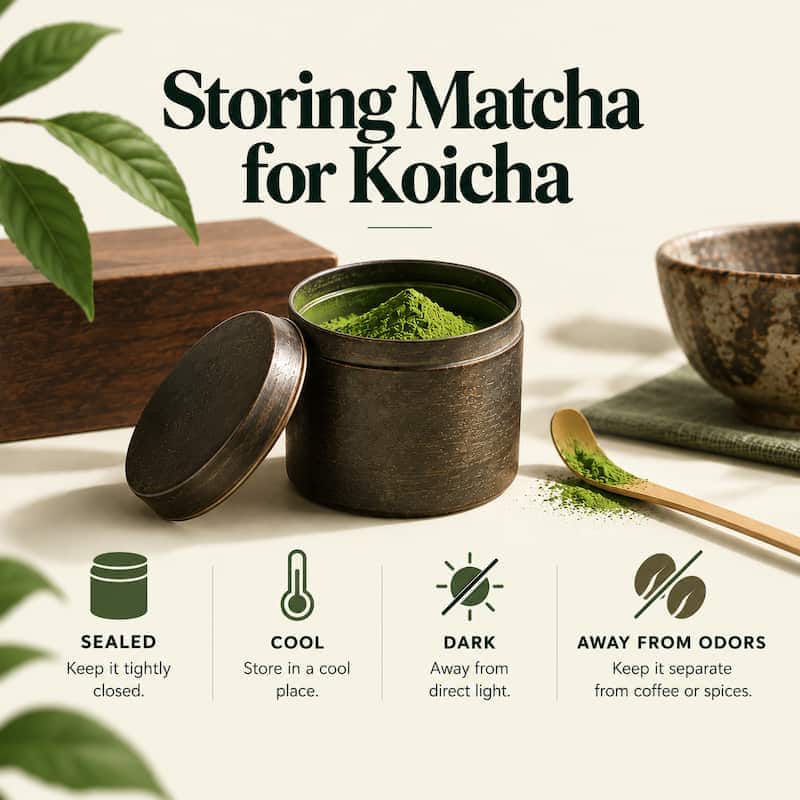
Because koicha exposes flaws that a diluted bowl of usucha can mask, freshness matters even more here. Keep matcha reserved for koicha tightly sealed, cool, dark, and away from strong odors such as coffee or spices. If you refrigerated an unopened tin, let it come to room temperature before opening so condensation does not form inside. Buy a quantity you can realistically use within a few weeks of opening, and always scoop with a clean, dry spoon.
Common Koicha Myths
“Koicha is just extra-strong usucha.”
→ The concentration is part of it, but koicha is a distinct preparation with its own technique, tools, and role in the tea ceremony. It is not simply usucha made with less water.
“You can use the same matcha for koicha and usucha.”
→ Some tea houses do make matcha to suit both, but not all of it. A matcha that tastes pleasant diluted for usucha can taste harsh, thin, or unbalanced at koicha’s concentration. Choose a product the seller specifically recommends for koicha.
“Koicha should have foam, just like usucha.”
→ Foam is a sign of whisking, not kneading. A well-made bowl of koicha should be smooth, dense, and glossy, with no foam at all.
“You need formal training before you can try koicha.”
→ Formal training shapes how hosts serve koicha in a full tea gathering. At home, though, preparing and sharing a bowl with patience and a suitable matcha is entirely achievable without it.
Final Thoughts
Koicha is thick matcha, but reducing it to a ratio misses most of what makes it distinct. It is a slower technique and a different set of tools. Inside the tea ceremony, it is also a more formal, often shared experience than an everyday bowl of matcha.
Making a good bowl at home comes down to two things: matcha genuinely suited to the concentration, and the patience to knead it smooth. Once you have both, koicha offers a texture and depth that a diluted bowl of usucha simply cannot show.
The most useful question when approaching koicha is not “How strong should this be?” but “Is this matcha, and is my technique, smooth enough to carry that concentration well?”
To explore more Japanese tea culture, read these related guides:
Koicha FAQ
What is koicha?
Koicha is thick matcha: a dense, glossy tea made with more matcha and less water than ordinary usucha, kneaded rather than whisked into a paste-like consistency.
What is the difference between koicha and usucha?
Koicha uses more matcha and far less water than usucha. The host kneads rather than whisks it, so it produces no foam, and guests often share it from one bowl. Usucha uses less matcha and more water; the host whisks it to a light foam and usually serves it as an individual bowl.
How much matcha and water does koicha use?
A common starting point is around 4g of matcha to roughly 20 to 40ml of hot water, added gradually and kneaded rather than whisked. Exact proportions vary by tea house and by how fine the grind is.
Why do guests share koicha from one bowl?
The custom, called mawashi-nomi, comes from koicha’s traditional role as the central, formal tea of a full tea gathering. Guests experience it together, rather than drinking it as individual bowls.
Can you use any matcha for koicha?
Not reliably. Matcha suited to koicha needs to stay smooth and balanced at high concentration. Look for a product the seller specifically recommends for koicha rather than assuming any ceremonial matcha will work.
Why does koicha have no foam?
Hosts knead koicha instead of whisking it. Kneading builds a smooth, dense paste instead of introducing the air that creates foam in usucha.
Is koicha stronger in caffeine than usucha?
Yes, generally. Koicha uses roughly twice the matcha in about half the water of usucha, so a bowl delivers noticeably more caffeine and other tea compounds per serving.
Should beginners start with koicha or usucha?
Usucha is usually the better starting point. It is a gentler introduction to matcha’s flavor, and it makes it easier to judge whether koicha’s greater concentration will suit you.
Do I need special tools to make koicha at home?
No. A bamboo whisk, a bowl wide enough to knead in, a scale, and hot water are enough. Traditional tools like a ceramic chaire and its silk pouch matter most in a formal setting.
References
- National Agriculture and Food Research Organization (NARO), on ISO/TR 21380, the definition and production background of matcha, and the lack of consensus in the international market.
- Urasenke Konnichian, resources on chanoyu, tea-making fundamentals, and usucha and koicha practice.
- Global Japanese Tea Association, Koicha, on koicha’s ratio, kneading technique, shared-bowl (mawashi-nomi) custom, and its role in the formal chaji gathering.
- Chano-yu.com, Types of Tea Caddies, on the distinction between the chaire used for koicha and the natsume used for usucha.
- Tezumi, A Guide to Chasen, on how tine count and thickness suit a whisk to koicha’s kneading versus usucha’s whisking.
- Marukyu Koyamaen, Tenju, an example of matcha specifically recommended for koicha.
- Ippodo Tea, Kan-no-shiro, an example of a Japanese matcha product described through flavor, fragrance, use, and suitability for both usucha and koicha.



Comments