





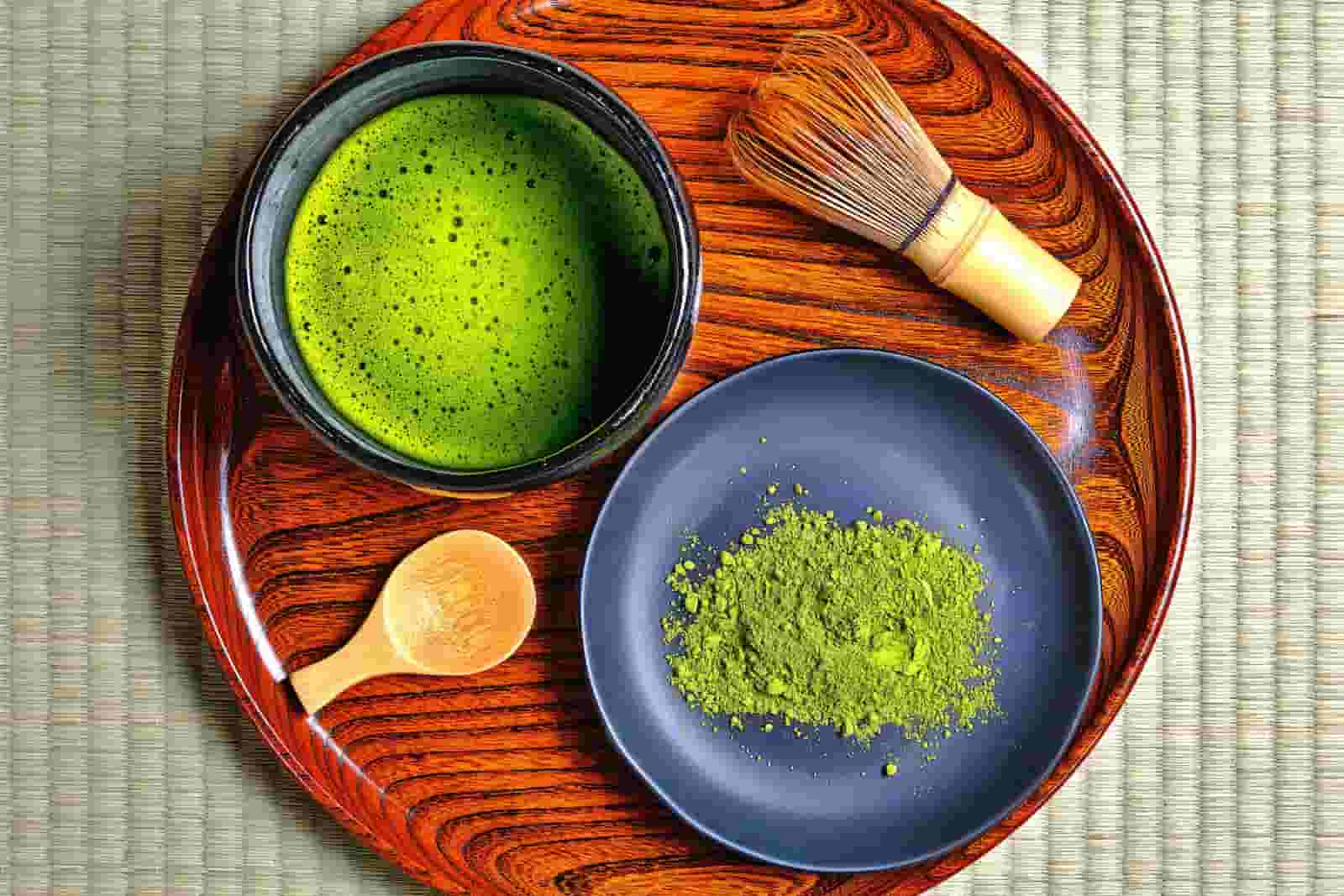
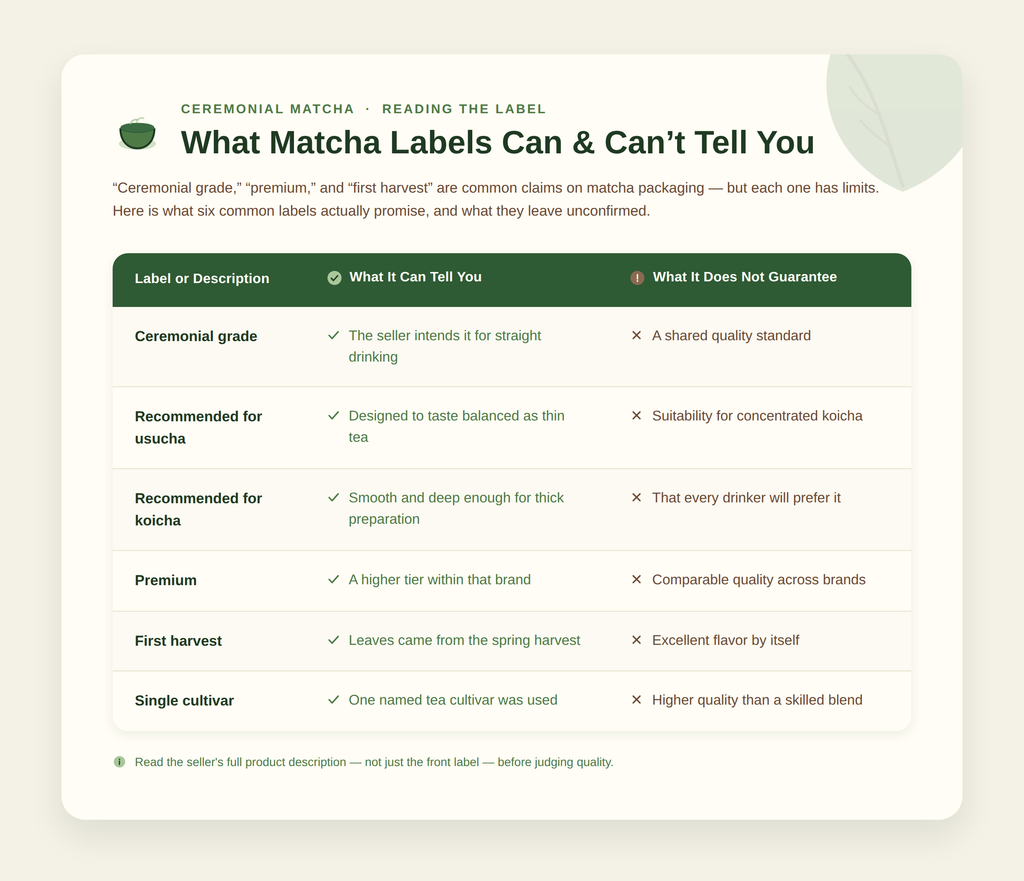
Ceremonial Matcha is a commercial term for matcha intended to taste good when whisked with water and enjoyed without milk or sugar. The label usually suggests a fine texture, clear fragrance, strong umami, and controlled bitterness. However, it does not refer to one official Japanese grade.
This distinction matters because almost any seller can place the word “ceremonial” on a package. To judge the tea, buyers need to look beyond the front label and consider its recommended use, producer, harvest information, flavor description, freshness, and suitability for usucha (thin tea) or koicha (thick tea).
This guide focuses specifically on how ceremonial matcha is described, selected, and evaluated. For the history of matcha, tencha production, major growing areas, health information, and general preparation, see the complete Matcha guide.
What Does “Ceremonial Matcha” Mean?
In English-language retail, “ceremonial matcha” generally means matcha that is pleasant enough to drink with only water. It is expected to offer more balance and less harshness than a product developed mainly to remain noticeable in milk, sugar, or baked goods.
The phrase describes an intended experience rather than a fixed recipe. One brand may reserve it for its most expensive koicha-quality tea. Another may apply it to an accessible everyday usucha. A third may use ceremonial for several products with different cultivars, regions, or flavor profiles.
The word also does not mean that the buyer is performing a formal Japanese tea ceremony. A person can prepare drinking-quality matcha casually at home. Conversely, a tea practitioner may select a particular named matcha according to school, host, occasion, season, and preferred producer rather than search for a package that says ceremonial grade.
Is Ceremonial Grade an Official Category?
No universal regulation defines ceremonial grade. ISO/TR 21380 describes the characteristics and production background of matcha, but it does not create a global ceremonial-versus-culinary grading system. NARO, which helped develop the report, has also noted the lack of consensus and rules in the international matcha market.
Commercial products nevertheless show some broad patterns. Matcha sold as ceremonial is often positioned as smoother, milder, and more suitable for water. Yet laboratory research on commercially available teas has also found overlap between products labeled ceremonial and culinary. In one study of ten matcha samples, all five ceremonial samples clustered together with three culinary samples when researchers compared catechin profiles. Labels did not create two perfectly separate chemical categories.
This does not make every ceremonial claim meaningless. It means the term works best within one producer’s range. If a tea company offers three matcha products, its ceremonial option may indeed be smoother than its latte option. Comparing ceremonial labels across unrelated companies is less reliable because each seller sets different thresholds.
How Japanese Tea Specialists Describe Matcha
Established Japanese tea houses often sell several individually named matcha rather than divide their entire range into ceremonial and culinary grades. Product pages may describe strength, aroma, bitterness, sweetness, umami, recommended sweets, and whether the tea suits usucha or koicha.
This approach is more informative. Marukyu Koyamaen, for example, recommends Tenju for thick tea and Aoarashi for thin tea (and notes the latter also works well with milk or cream). Ippodo identifies products that work for both usucha and koicha and rates them on tasting scales for strength, taste (spanning bitterness to sweetness and umami), and fragrance. These descriptions tell the buyer how a specific matcha behaves, not merely whether it belongs to a broad marketing tier.
Where Drinking Quality Comes From
No single feature creates ceremonial quality. Producers build a drinking matcha by combining several decisions, then evaluating how the finished powder tastes in water.
Leaf Material
Tender spring material is often selected for refined matcha because it can provide sweetness, softness, and vivid color. However, harvest season is one factor among many, and the ceremonial label does not automatically confirm it.
Cultivar and Field
Cultivar, soil, climate, field management, and shading affect aroma and taste. Some teas feel intensely savory, while others appear floral, creamy, fresh, or gently nutty.
Tencha Refining
Tencha is the steamed, unrolled leaf that is later ground into matcha. Removing its coarse stems and veins helps create a finer texture and cleaner flavor, and careful sorting also allows the producer to select material with the desired color and sensory profile.
Blending Skill
A blend is not automatically inferior to a single-cultivar matcha. A tea master may combine batches to balance aroma, umami, color, body, and finish or to maintain a house style from year to year.
Grinding and Freshness
Fine, controlled grinding supports a smooth suspension, but freshness determines whether the drinker can still perceive the intended aroma. Even excellent matcha becomes flatter and harsher after poor storage.
Usucha and Koicha Suitability
Usucha, or thin tea, is the normal starting point for tasting matcha. A common ratio is 2g of powder to 60ml of water. Because the drink is relatively light and whisked with air, it can accommodate gentle bitterness and a refreshing finish.
Koicha, or thick tea, may use about 4g of matcha with only 30ml of water. It is mixed slowly into a dense, glossy consistency rather than whipped into foam. At this concentration, rough bitterness, graininess, or a short finish becomes much more obvious. Matcha recommended for koicha therefore usually offers greater smoothness, sweetness, body, and depth.
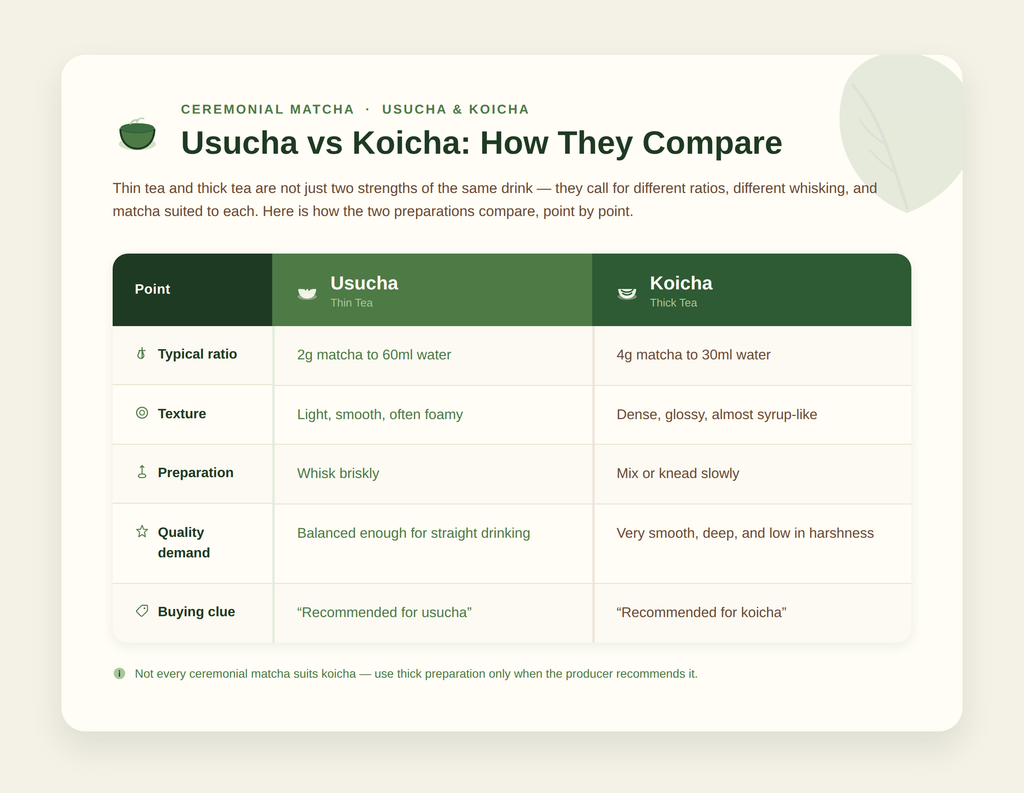
Do not assume that every ceremonial matcha is suitable for koicha. Use thick preparation only when the producer recommends it or when you already know that the tea remains smooth at high concentration.
How to Evaluate Ceremonial Matcha at Home
A consistent tasting method is more useful than judging powder from a photograph. Prepare unfamiliar matcha with the same ratio, water, and utensils before making adjustments.
- Examine the dry aroma. Fresh matcha should smell lively rather than dusty, stale, or odorless.
- Sift and weigh 2g. A scale creates a fairer comparison than a heaped spoon.
- Add 60ml of water at about 80°C. Use the same water source for every tea.
- Whisk for approximately 15 seconds. A good foam can make the texture more pleasant, but it is not the main quality score: sifting, ratio, and whisking technique affect foam as much as the tea itself.
- Taste in stages. Notice the opening aroma, first bitterness, middle sweetness or umami, body, and aftertaste.
- Adjust only after the baseline bowl. Cooler water can soften bitterness, while slightly less water can reveal more body.
A good drinking matcha does not need to be completely free of bitterness. The important question is whether bitterness has a clear role and finishes cleanly, or whether it dominates the bowl and leaves an unpleasant rough sensation.
Signs of Quality in the Bowl
Look for balance rather than one extreme characteristic. High-quality ceremonial matcha may be intensely savory or relatively light, but its elements should feel connected.
- Aroma: Fresh, clear, and recognizable before and after adding water.
- Texture: Fine and cohesive, without persistent sandiness.
- Umami and sweetness: Present enough to give the bowl depth, even when subtle.
- Bitterness: Controlled and integrated rather than sharp or hollow.
- Finish: Clean, lingering, and free from a stale or burnt impression.
- Overall balance: Pleasant with water alone and interesting beyond the first sip.
How to Read a Ceremonial Matcha Product Page
The strongest product descriptions explain the tea instead of relying on superlatives. Look for information that helps you predict use and flavor.
- Recommended preparation: Usucha, koicha, straight drinking, latte, or multiple uses.
- Sensory description: Strength, sweetness, umami, bitterness, fragrance, body, and finish.
- Producer identity: The tea house, blender, farm, or manufacturer responsible for the product.
- Origin: Country and, when available, prefecture or tea-producing area.
- Harvest and cultivar: Useful when provided, but not compulsory evidence of quality.
- Grinding or packing information: Helpful for judging freshness.
- Storage and package size: Important because a small fresh tin is often better than a large slowly consumed one.
Be cautious when a listing promises “the highest grade” but provides no producer, use, flavor, harvest, packing, or storage information. Attractive color in an edited photograph is not a substitute for traceability.
Common Ceremonial Matcha Myths
“The brightest powder is always the best.”
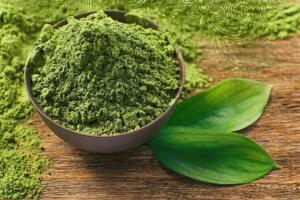
→ Vivid green can indicate fresh, well-shaded material, but lighting, cultivar, harvest, photography, and editing influence appearance. Color cannot show balance or aftertaste.
“More foam means higher-quality matcha.”
→ As noted above, foam depends heavily on sifting, water ratio, whisk condition, bowl shape, and technique. A beautiful foam can improve texture, but it does not prove that the tea itself is superior.
“Single-cultivar matcha is always better than a blend, and first harvest always means ceremonial quality.”
→ Neither claim holds up on its own, for the reasons covered under Blending Skill and Leaf Material above: a skilled blend can be just as refined as a single-cultivar tea, and spring leaves still depend on farming, processing, refining, grinding, and storage to reach the bowl.
“Stone-ground means ceremonial.”
→ Stone milling describes one part of production. It does not reveal the original tencha quality, freshness, or taste.
Is Ceremonial Matcha Worth the Price?
It is worth paying more when you plan to drink matcha with water and can taste the difference. A 20g tin provides about ten standard 2g bowls, so the cost per serving may be more useful than the price of the tin.
Choose an everyday usucha if you want freshness and balance without maximum intensity. Move toward a koicha-suitable tea when you value deeper umami, a longer finish, and a denser texture. For sweetened lattes or baking, a separate culinary matcha will usually offer better value and a flavor designed to remain present beside other ingredients.
How to Keep It Fresh
Buy a quantity you can finish within several weeks after opening. Keep the powder tightly sealed, cool, dry, dark, and away from strong odors. If an unopened tin has been refrigerated, allow it to reach room temperature before opening so moisture does not condense inside. Always use a clean, dry scoop and close the package immediately.
Final Thoughts
Ceremonial matcha is not a single official grade. It is a broad promise that a matcha has been selected for drinking with water. The reliability of that promise depends on the seller and the information behind it.
Instead of searching for the greenest powder or the strongest marketing claim, look for a reputable producer, a clear usucha or koicha recommendation, useful tasting notes, appropriate package size, and good freshness. Then evaluate the bowl for aroma, texture, balance, and finish.
The most useful question is not “Is this ceremonial grade?” but “Why is this particular matcha suitable for the way I want to drink it?”
To explore more Japanese tea culture, read these related guides:
Ceremonial Matcha FAQ
What is ceremonial matcha?
It is a commercial term for matcha intended to be whisked with water and enjoyed straight. It usually emphasizes fine texture, fresh aroma, umami, and controlled bitterness.
Is ceremonial grade official in Japan?
No. There is no universal Japanese ceremonial-grade standard. Japanese specialists often identify particular matcha by name, taste, and suitability for usucha or koicha.
Does ceremonial matcha have to be first harvest?
No. Many refined matcha products use spring leaves, but the word ceremonial does not guarantee harvest season. Check the seller’s product information.
Is all ceremonial matcha suitable for koicha?
No. Some ceremonial matcha is designed only for usucha. Use a tea for koicha when the producer specifically recommends thick preparation.
How can you tell whether ceremonial matcha is good?
Prepare it with a consistent ratio and judge its aroma, fineness, umami, sweetness, bitterness, body, and finish. It should taste balanced and pleasant with water alone.
Does greener matcha always taste better?
No. Color provides one clue, but cultivar, lighting, harvest, freshness, and photography affect appearance. A vivid powder can still taste unbalanced.
Does more foam mean better matcha?
No. Foam depends greatly on the whisk, bowl, ratio, sifting, and technique. Sensory balance matters more than foam height.
Is single-cultivar matcha superior to blended matcha?
Not necessarily. Single-cultivar matcha can show a distinctive character, while a skilled blend may provide better balance, depth, or consistency.
Can ceremonial matcha be used for lattes?
Yes, but milk and sweetener may hide its subtle qualities. Matcha developed for lattes often gives better value and a more noticeable flavor.
Who should buy ceremonial matcha?
It suits people who want to drink matcha with water, compare cultivars or blends, practice usucha, or explore koicha with a product recommended for thick tea.
References
- National Agriculture and Food Research Organization (NARO), on ISO/TR 21380, the definition and production background of matcha, and the lack of consensus in the international market.
- Meyer et al., Catechin Composition, Phenolic Content, and Antioxidant Properties of Commercially-Available Bagged, Gunpowder, and Matcha Green Teas, on measured differences and overlap among commercial products labeled culinary and ceremonial.
- Ippodo Tea, Kan-no-shiro, an example of a Japanese matcha product described through flavor, fragrance, use, and suitability for both usucha and koicha.
- Marukyu Koyamaen, Tenju, an example of matcha specifically recommended for koicha.
- Marukyu Koyamaen, Aoarashi, an example of matcha recommended for usucha and also usable with milk or cream.
- Urasenke Konnichian, resources on chanoyu, tea-making fundamentals, and usucha practice.




Comments