



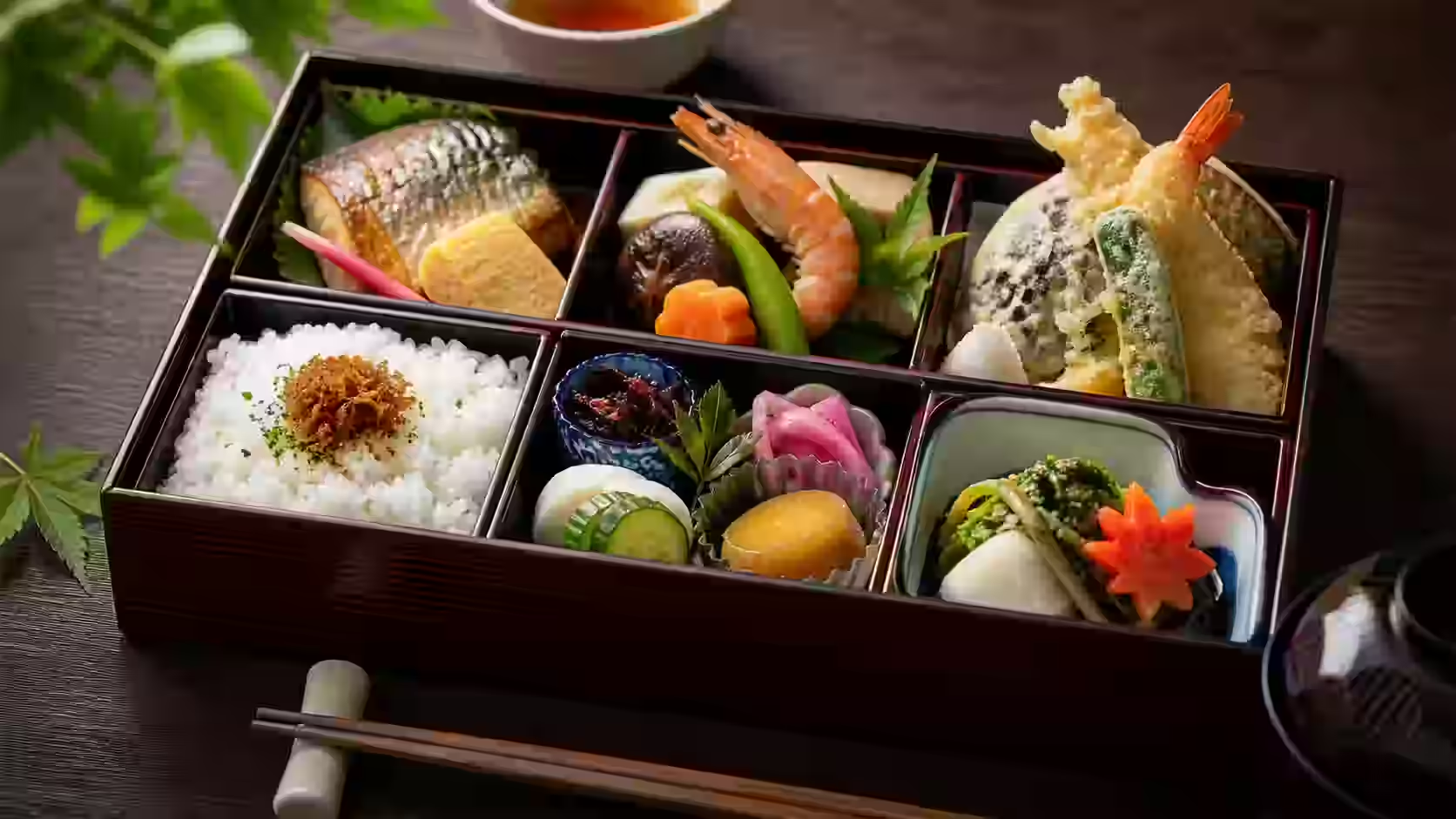
Japan has a long tradition of boxed meals. From simple rice and pickles to carefully arranged multi-dish spreads, bento culture reflects the care Japanese people bring to everyday food. Among all the bento formats available today, (幕の内弁当) stands out as the most classic and widely recognized. It is a balanced Japanese boxed meal containing rice, fish, egg, simmered vegetables, and pickles, all arranged neatly in one container. Many people in Japan consider it the standard form of a traditional bento. For travelers new to Japan, it often provides the most complete first impression of Japanese daily food culture.
What Is Makunouchi Bento?
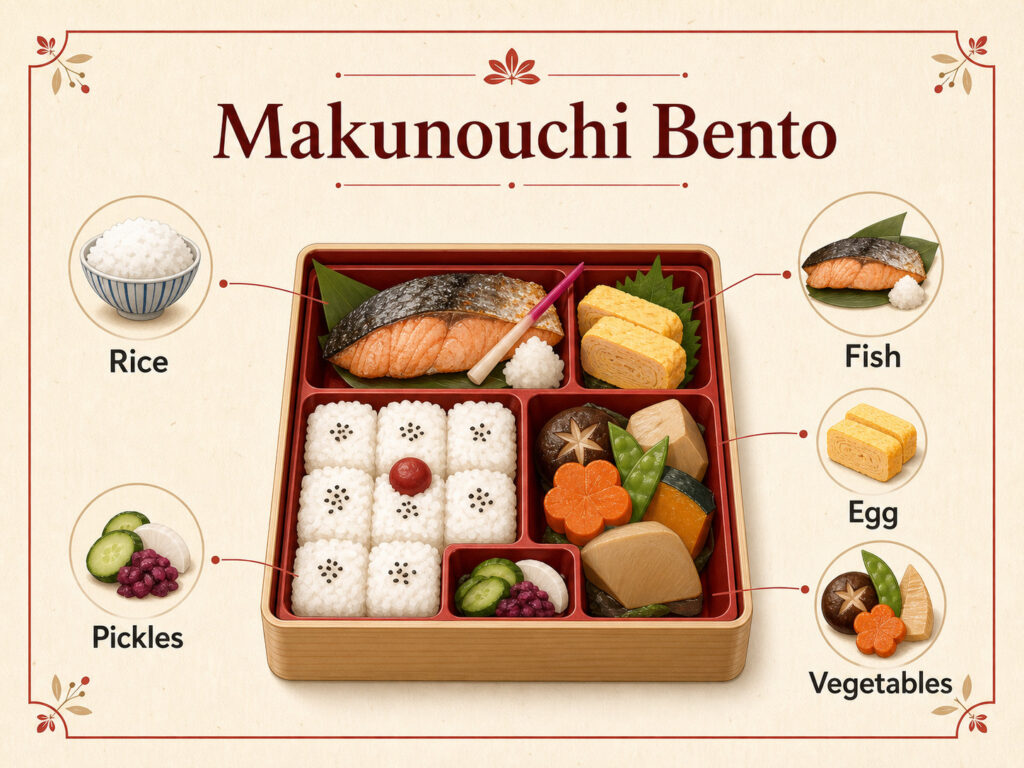
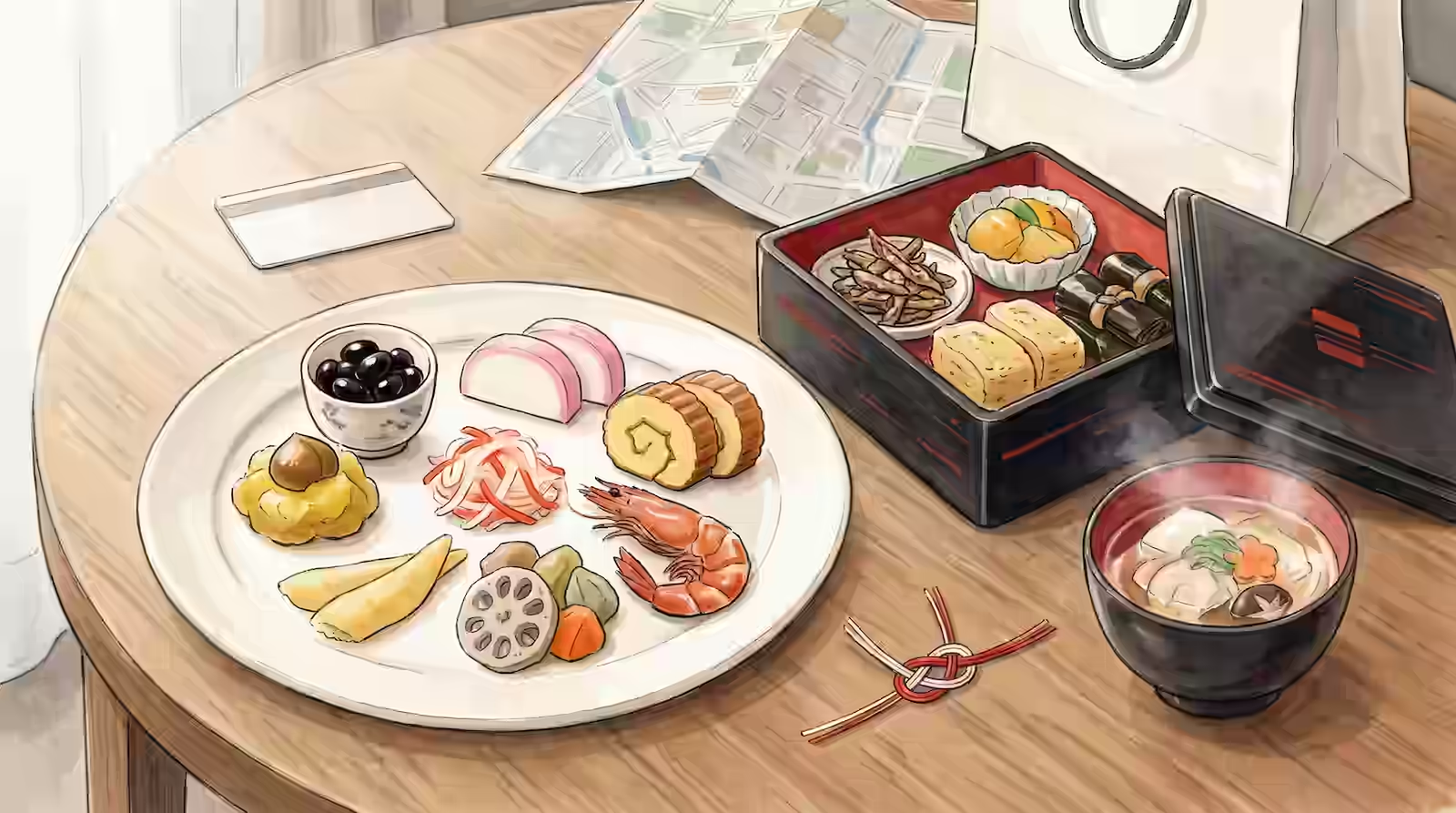
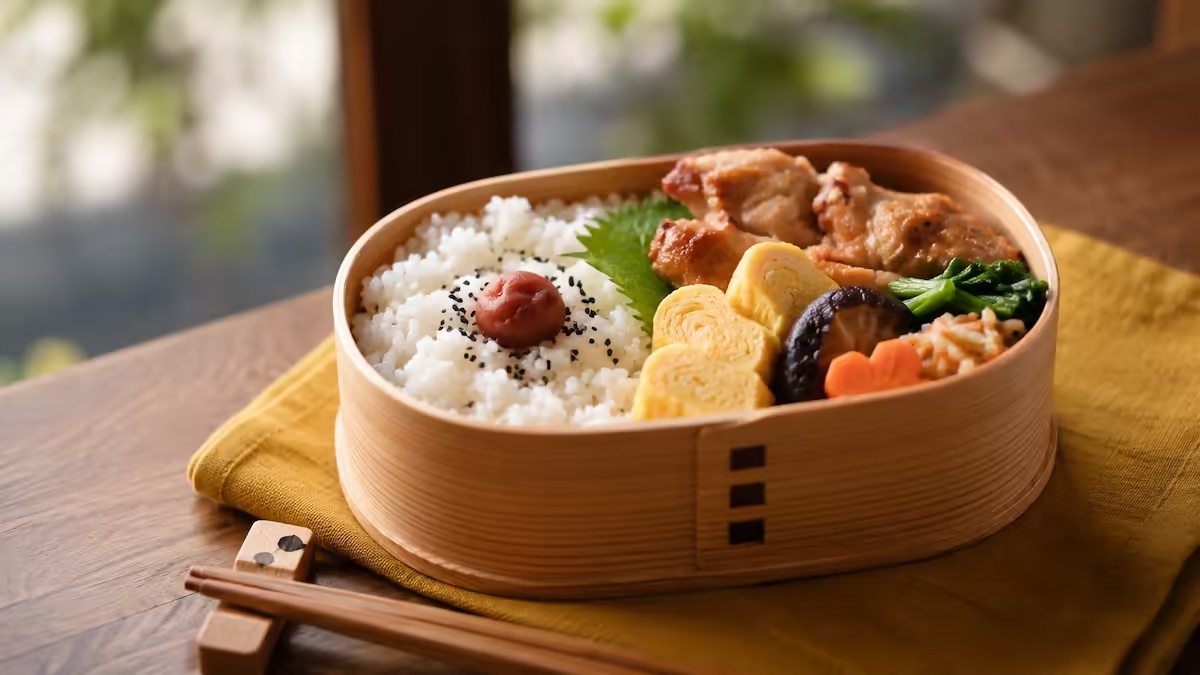
Makunouchi Bento is a traditional Japanese assorted bento consisting of rice and multiple side dishes. The rice typically appears as small shaped portions, sometimes pressed into neat rounds or lightly formed balls. Side dishes include grilled or simmered fish, tamagoyaki (rolled egg omelette), nimono (simmered root vegetables), pickled vegetables, and kamaboko (fish cake). The combination aims for balance: different proteins, textures, flavors, and colors in a single box.
This style differs from single-theme bento. A katsu bento, for example, centers entirely on a breaded cutlet. A sushi bento focuses on one style of preparation. Makunouchi Bento, however, offers variety within one container. That is its defining character, and also the reason it has remained Japan’s most recognizable classic Japanese bento for centuries. It is, in the most straightforward sense, a Japanese assorted bento with rice, fish, pickles, and side dishes that together form a complete meal.
Why Is It Called Makunouchi?
The name comes from the Japanese word “makunouchi” (幕の内), which translates literally as “between the acts.” During the Edo period, kabuki theater performances ran for most of the day. Audiences needed food during intervals between acts. The meal served in these breaks had to be compact, varied, and quick to eat. A box of shaped rice and assorted side dishes suited the occasion perfectly. Over time, people began calling this kind of boxed meal a makunouchi meal.
By the Meiji era, the term had spread well beyond theater culture. It became a general description for any well-organized, assorted bento. Today, most people use it simply as a category name. The theater origin has largely faded from everyday awareness, though it still surfaces in food history discussions. The meaning and origin of Makunouchi Bento remind us that Japanese food culture and performing arts have a longer shared history than many visitors expect.
A Brief History of Makunouchi Bento in Japan
The roots of Makunouchi Bento Bento stretch back to Edo-period Japan. Theater audiences drove early demand for a convenient, varied meal. The original format was modest: a few rice balls, some salted fish, and pickled vegetables. However, it addressed a real need for something portable, satisfying, and easy to eat in a public setting.
By the late Edo and early Meiji periods, the format had spread far beyond theaters. Catering services for public events and formal gatherings adopted it as a default boxed meal. When ekiben (train station bento) culture developed in the late Meiji era, Makunouchi Bento appeared among the earliest offerings at major stations. It suited train travel naturally: the variety satisfied different appetites, and the tidy format worked well inside a moving carriage.
Throughout the 20th century, the bento evolved alongside Japanese food culture more broadly. Department stores introduced premium versions in their basement food halls. Catering companies standardized it for business meetings and formal events. It became, in short, the formal bento option for occasions where a well-presented boxed meal was expected. Furthermore, convenience store chains brought more affordable versions to everyday life, making Makunouchi Bento accessible to a much wider audience. That reach, from high-end depachika to convenience store shelves, reflects how thoroughly it became part of Japanese daily food culture.
Typical Ingredients in Makunouchi Bento
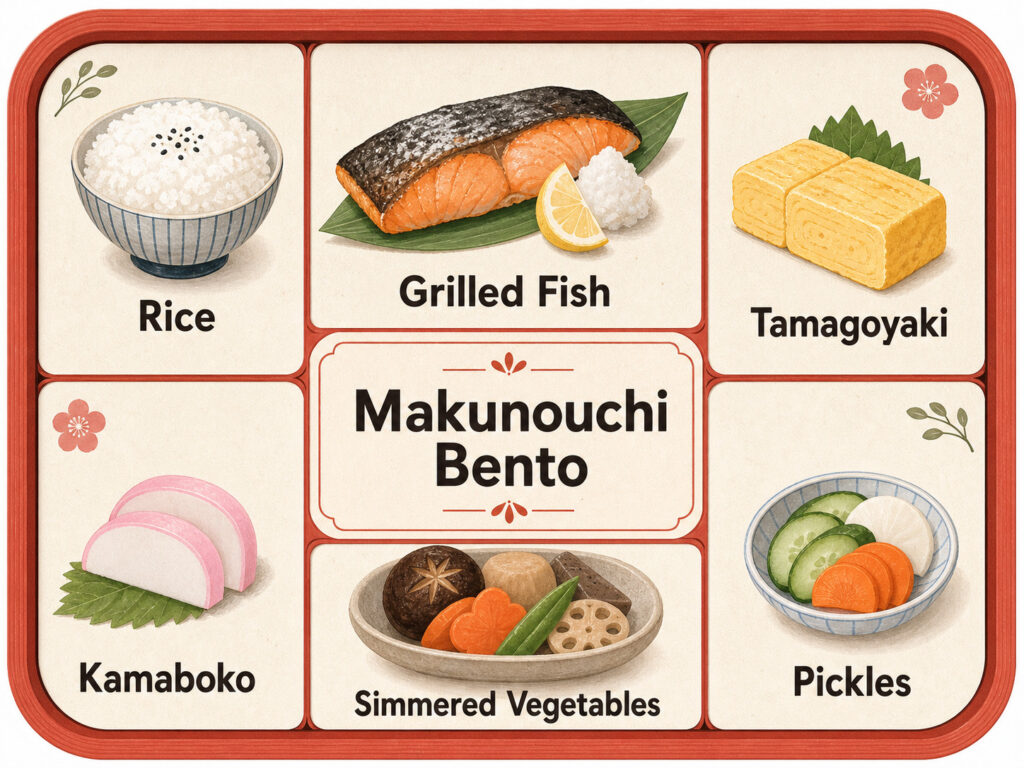
The contents of a traditional Makunouchi Bento follow a consistent structure, even though specific items vary by producer, season, and price point. In general, the box divides between rice and a selection of side dishes. Below are the typical components found in a standard Makunouchi Bento:
- Rice: small shaped portions or pressed rounds, often topped with sesame seeds or an umeboshi (pickled plum)
- Grilled or simmered fish: salmon, sea bream, or similar white fish; sometimes teriyaki-glazed
- Tamagoyaki: sweet rolled egg omelette, a consistent presence in almost all versions
- Kamaboko: steamed fish cake, typically in pink-and-white slices
- Nimono: root vegetables such as lotus root, burdock, carrot, or taro simmered in dashi-based broth
- Simmered hijiki or spinach with sesame: provides color and texture variety
- Tsukemono (pickles): takuan (yellow daikon), pickled ginger, or beni shoga (red pickled ginger)
The goal is not to serve large portions of any single item. Instead, a well-made Makunouchi Bento offers small amounts of several different things, each complementing the others. That approach reflects a broader principle in Japanese food: balance across flavors, colors, and cooking methods rather than abundance in a single direction. It is also, not coincidentally, quite nutritionally balanced. Japan’s school lunch culture carries a similar philosophy, as described in the Japanese food education guide.
Makunouchi Bento vs Ekiben vs Nori Bento
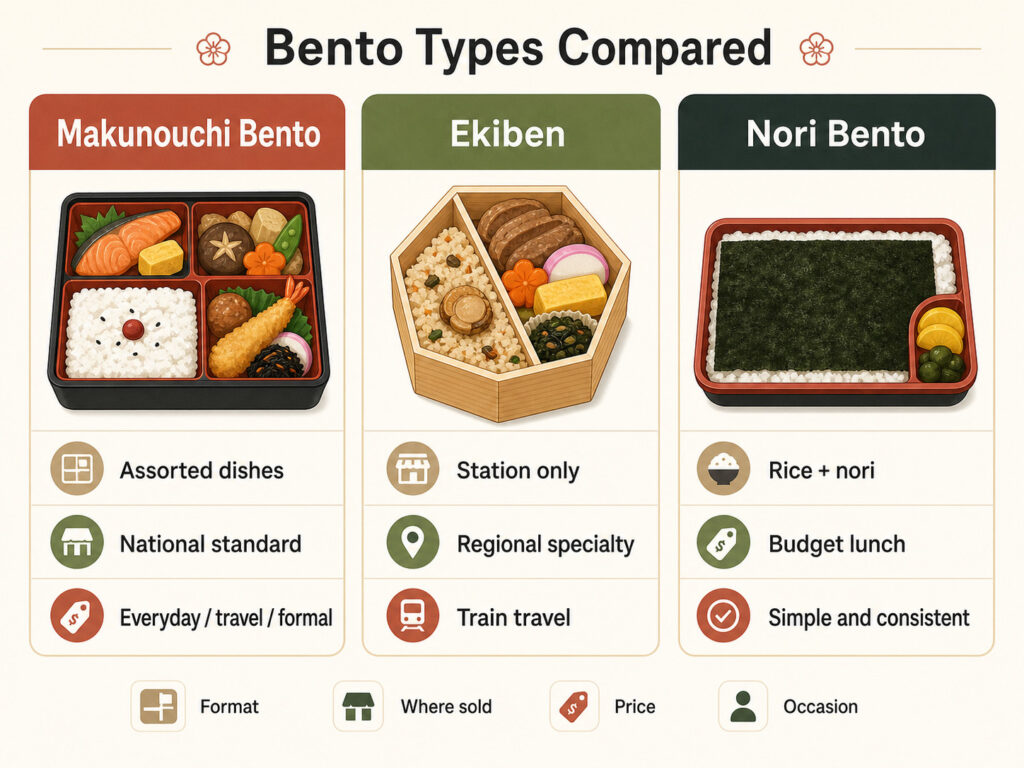
Understanding how Makunouchi Bento relates to other bento types helps clarify what makes it distinctive. The three most commonly compared formats are Makunouchi Bento, Ekiben, and Nori Bento.
| Feature | Makunouchi Bento | Ekiben | Nori Bento |
|---|---|---|---|
| Format | Assorted multi-dish | Varies; often regional specialty | Rice with seasoned nori |
| Rice | Shaped portions or rounds | Various formats | White rice under seaweed |
| Side dishes | Fish, egg, vegetables, pickles | Regional focus | Fried fish, kinpira, chikuwa tempura |
| Where sold | Depachika, catering, stations, convenience stores | Train stations only | Bento chains, convenience stores |
| Price range | ¥700–¥1,500 | ¥700–¥2,000+ | ¥500–¥800 |
| Occasion | Formal, travel, everyday | Train travel, regional souvenir | Budget everyday lunch |
| Regional identity | Standard national format | Strong regional character | Consistent national format |
Ekiben and Makunouchi Bento overlap in some situations, but their purposes differ considerably. Ekiben highlights regional identity. A good ekiben from Kanazawa showcases local seafood. One from Kyushu might feature regional chicken and burdock. The box tells a local story. Makunouchi Bento, in contrast, offers a consistent format regardless of where you buy it. That universality is both its strength and its limitation, depending on what you are looking for.
Nori Bento (海苔弁当) takes a simpler, more affordable approach. Rice layered with soy-seasoned nori forms the base. Compared with Shumai Bento, both are more thematic than Makunouchi Bento. For a quick weekday lunch, Nori Bento makes practical sense. For a more formal meal or a longer journey, Makunouchi Bento suits the occasion better.
Where to Buy Makunouchi Bento in Japan
Department Store Food Halls (Depachika)
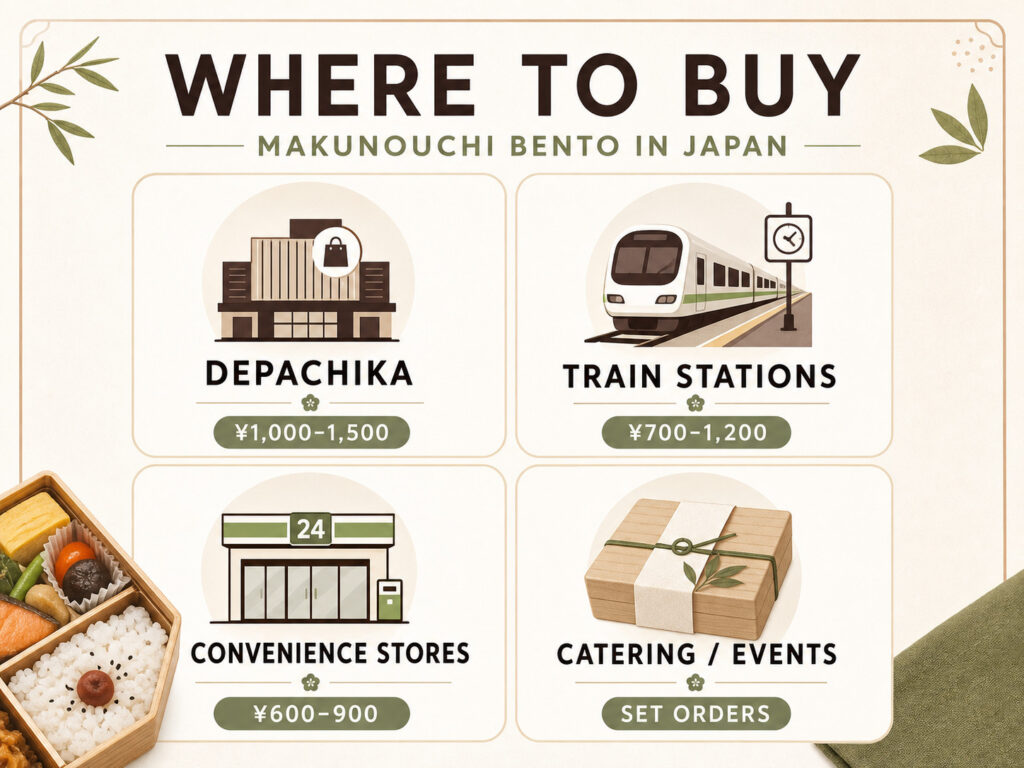
The depachika is probably the best place to find a high-quality Makunouchi Bento. Department stores in Tokyo, Osaka, Kyoto, and other major cities offer carefully prepared versions from established caterers and specialist food producers. Prices typically run ¥1,000 to ¥1,500, reflecting the quality. Seasonal ingredients appear often, and presentation is polished. For a gift or a meal before a long journey, a depachika Makunouchi Bento is hard to improve on.
Train Stations
Major train stations carry Makunouchi-style bento alongside regional ekiben. Tokyo Station’s ekiben specialty shops offer several Makunouchi-style options. The format naturally suits train travel, so rail travelers encounter it frequently. Prices at stations often run slightly higher than convenience store equivalents. However, the quality tends to be noticeably better, and the variety on offer at large hub stations is impressive.
Convenience Stores and Supermarkets
Everyday Makunouchi Bento appears in Japanese convenience stores and supermarkets throughout the day. These versions cost roughly ¥600 to ¥900. Quality is reasonable, though seasonal ingredients and premium fish are less common. For a quick midday meal during daily life in Japan, convenience store versions serve the purpose reliably. They are also consistently available, which makes them practical for travelers on tight schedules.
Catering and Corporate Events
At business meetings and formal gatherings across Japan, Makunouchi Bento is often the default catered option. Caterers deliver them in sets. The format signals a certain level of care without being extravagant. If you attend a business event or a seminar in Japan and receive a boxed lunch, there is a reasonable chance it follows the Makunouchi format. This use case explains why many Japanese people associate it with formal occasions rather than just travel.
Conclusion
Makunouchi Bento is not a trend or a specialty. It is, instead, the basic template for what a Japanese bento can be: balanced, varied, tidy, and complete. The format has persisted for centuries for a simple reason. It works. For travelers, ordering one offers a compact introduction to Japanese everyday food in a single box. For people living in Japan, it remains the natural choice for formal occasions and long journeys alike.
Its relationship to other bento styles is worth understanding too. Ekiben carries regional identity. Nori Bento offers simplicity and value. Makunouchi Bento sits in the middle, as the universal, multi-dish standard. Whether you find it at a train station, a depachika, or a catered business lunch, it gives you an honest and reliable picture of traditional Japanese bento culture. For those interested in exploring Japanese portable food more broadly, onigiri represents another deeply rooted tradition worth knowing alongside it.
Makunouchi Bento FAQ
What is Makunouchi Bento in Japan?
Makunouchi Bento (幕の内弁当) is a traditional Japanese assorted bento box containing shaped rice and multiple small side dishes. These typically include grilled fish, tamagoyaki (rolled egg), nimono (simmered vegetables), kamaboko (fish cake), and tsukemono (pickles). It is one of Japan’s most recognizable bento formats and appears in department store food halls, train stations, convenience stores, and catered business events across the country.
What does Makunouchi mean?
“Makunouchi” (幕の内) translates literally as “between the acts.” The name originates from Edo-period kabuki theater, where audiences ate compact, varied boxed meals during intervals between performances. Over time, the term extended beyond theater culture and became a general category for any well-organized assorted bento. Today, most people use it simply as a style name, with the theater connection largely forgotten in everyday usage.
What are the typical ingredients in Makunouchi Bento?
A standard Makunouchi Bento includes shaped rice portions, grilled or simmered white fish, tamagoyaki, kamaboko, simmered root vegetables, hijiki seaweed or spinach with sesame, and pickled vegetables (tsukemono). The specific items vary by producer and season. However, the overall principle stays consistent: small portions of several different items to create a balanced, nutritionally complete meal.
What is the difference between Makunouchi Bento and Ekiben?
Ekiben is a bento sold specifically at train stations, and its contents often highlight regional specialties from the area where the station is located. Makunouchi Bento, in contrast, follows a consistent multi-dish format regardless of where you buy it. Additionally, ekiben can take many forms, while Makunouchi Bento always includes the same core categories: rice, fish, egg, vegetables, and pickles. Both suit train travel, but they serve different purposes.
Is Makunouchi Bento the same as Nori Bento?
No. Nori Bento (海苔弁当) is a simpler, more affordable bento built around rice covered with soy-seasoned seaweed, accompanied by a smaller number of side dishes. Makunouchi Bento, on the other hand, offers a wider variety of components and generally targets more formal or occasion-specific eating. Nori Bento suits everyday budget lunches; Makunouchi Bento suits longer journeys, business meals, or situations where a more complete box is expected.
Where can I buy Makunouchi Bento in Japan?
Makunouchi Bento appears at department store food halls (depachika), major train stations, convenience stores, and supermarkets across Japan. Department stores offer the highest-quality versions, typically priced between ¥1,000 and ¥1,500. Convenience store versions cost ¥600 to ¥900 and provide a reliable everyday option. Catering companies also supply Makunouchi-style bento for business meetings and events throughout the country.
How much does Makunouchi Bento cost?
Prices vary depending on where you buy. Convenience store versions typically cost ¥600 to ¥900. Station bento at major hubs like Tokyo Station run ¥800 to ¥1,200. Department store food hall versions from established producers range from ¥1,000 to ¥1,500. Catered versions at business events vary by caterer and order volume. In general, the price reflects the quality of ingredients, the care in preparation, and where the bento is sold.
Can I eat Makunouchi Bento cold?
Yes. Makunouchi Bento is designed to be eaten at room temperature or chilled, which is why it suits train travel and catered events well. The rice portions, simmered dishes, and grilled fish all hold their flavor and texture when cold. Some convenience store versions can be warmed in a microwave if preferred, but the traditional eating method is at room temperature. In fact, many people feel the flavors are better balanced when the bento has had time to settle after preparation.
References
Japan National Tourism Organization — Experience Japan’s Local Ekiben Culture
https://www.japan.travel/en/guide/experience-japans-local-ekiben-culture/
(Surveyed: June 2026)
Kikkoman Corporation — Japanese Food Culture: Bento History and Overview
https://www.kikkoman.com/en/soy/trivia/trivia09.html
(Surveyed: June 2026)
Ministry of Agriculture, Forestry and Fisheries of Japan (MAFF) — Traditional Japanese Food Culture
https://www.maff.go.jp/
(Surveyed: June 2026)
Related Articles
- Bento (Surveyed: June 2026)
- Eki ben (駅弁) (Surveyed: June 2026)
- Nori Bento (海苔弁当) (Surveyed: June 2026)
- Shumai Bento (シウマイ弁当) (Surveyed: June 2026)
- Onigiri: Japan’s Most Iconic Portable Meal (Surveyed: June 2026)
- Depachika Guide: Exploring the Food Basements of Japanese Department Stores (Surveyed: June 2026)
- Japanese Food Education: A Comprehensive Guide to School Lunches (Surveyed: June 2026)




Comments