


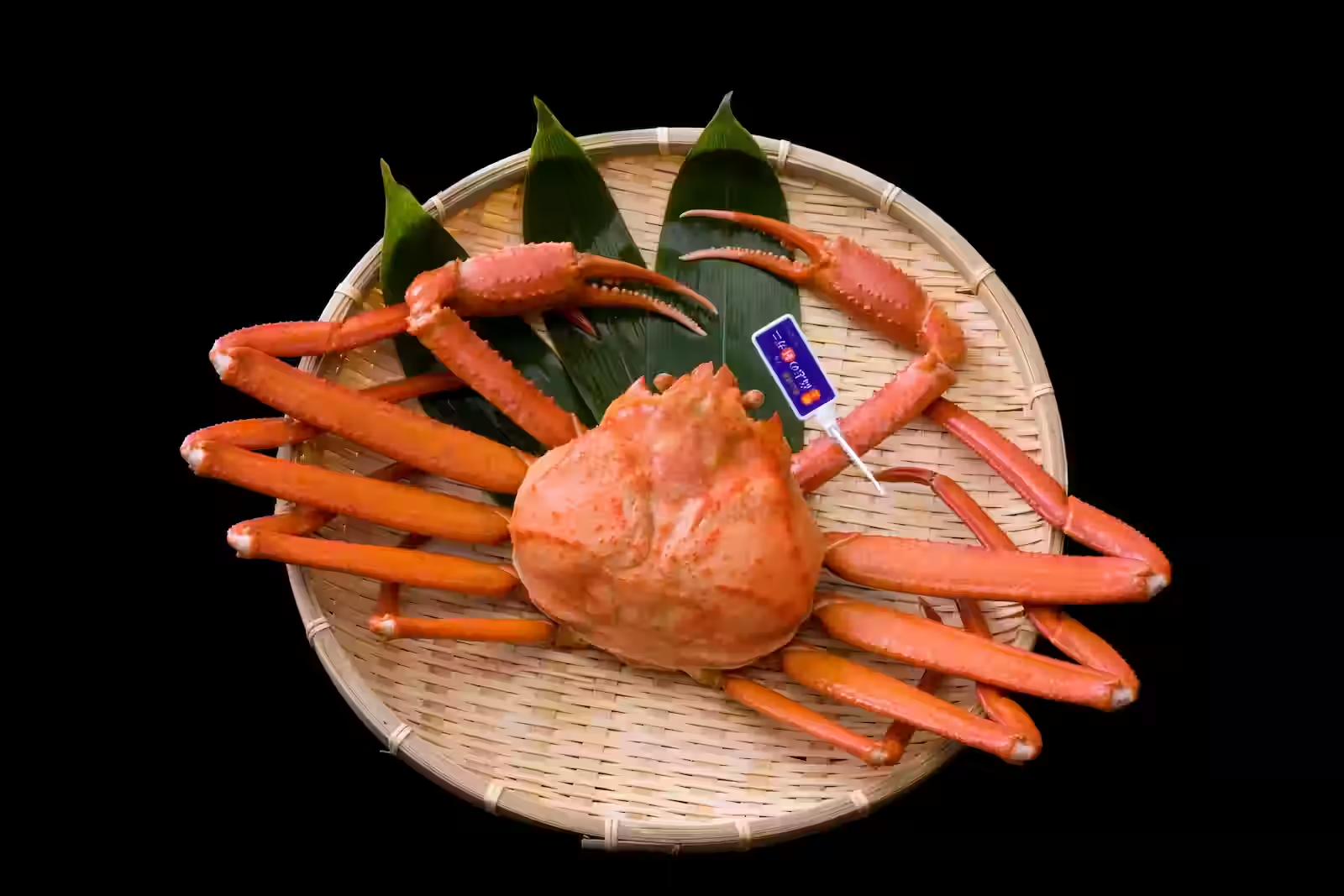

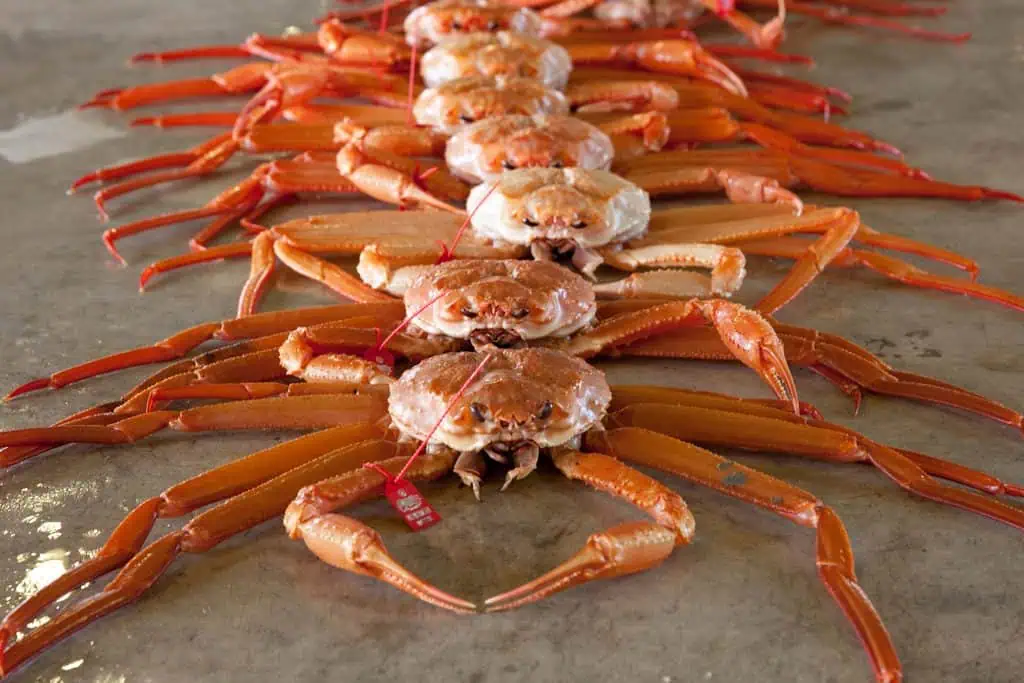
At half past noon in Shinminato, the floor of the fish market turns red. Crab after crab goes down on its back, packed shoulder to shoulder across the concrete, until the whole hall looks carpeted. Buyers are already crouching over the rows before the bell rings. This is Koshi no Aka-gani, the branded red snow crab of Toyama Bay. It came from deep water off the coast only hours earlier.
Toyama Prefecture faces the Sea of Japan in central Honshu, and the Hokuriku Shinkansen links it with Tokyo. Most Japanese crab stories start in winter, yet this one starts on September 1. Red snow crab season opens roughly two months earlier than snow crab season. Below you will find what the crab is and why Toyama Bay suits it so well. The guide also covers how to eat it, plus where travelers can watch the auction.
Quick Facts About Koshi no Aka-gani
Here is the short version before the detail.
- Origin
- Toyama Bay, Toyama Prefecture. Main landing ports include Shinminato, Uozu, and Namerikawa.
- Depth and habitat
- Deep sea. Boats set pots around 800 to 1,500 meters, inside the steep submarine canyons locals call aigame.
- Fishing method
- Kani-kago nawa, a gentle baited basket longline developed in Uozu.
- Texture and flavor
- Juicy, notably sweet meat, plus thick and creamy kanimiso (the crab’s innards) in the shell.
- Season
- September 1 through the end of May. Fishing closes from June to August.
What Is Koshi no Aka-gani?
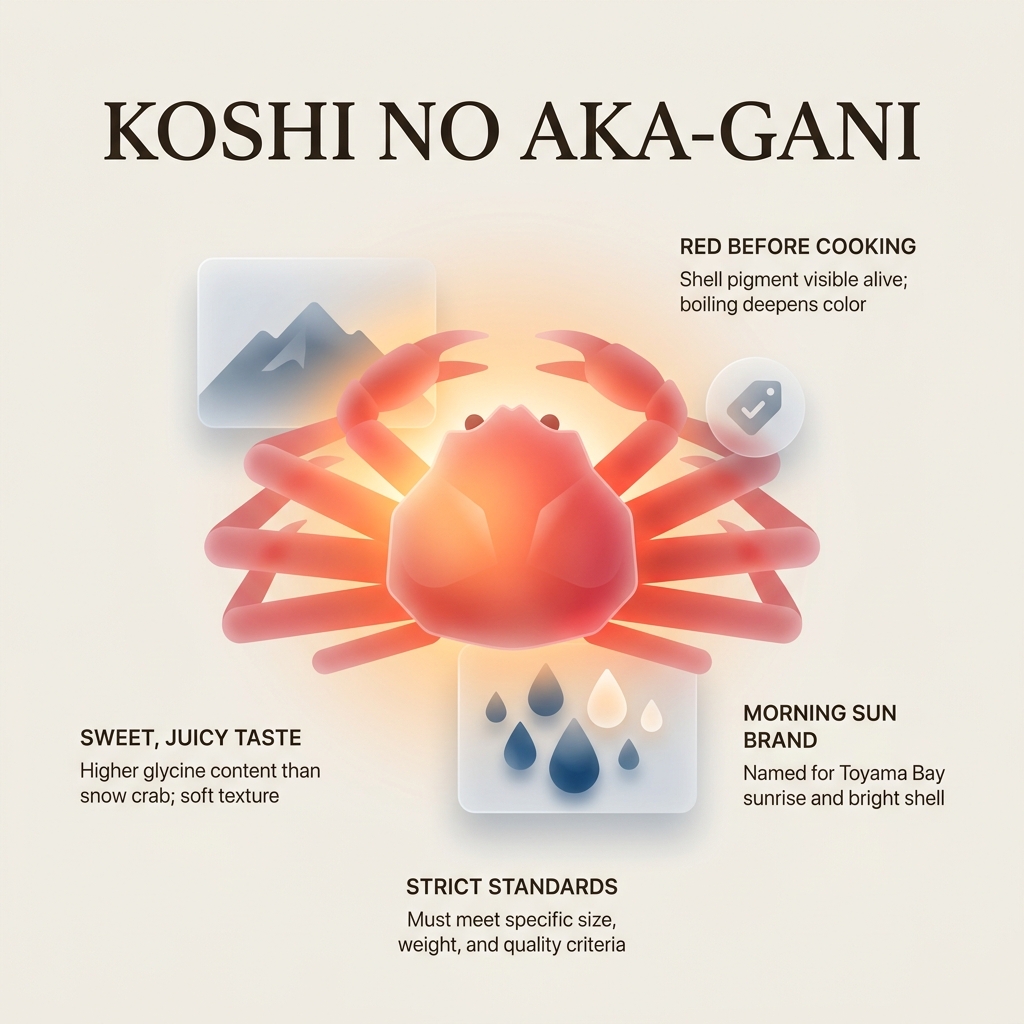
Koshi no Aka-gani is the brand name for red snow crab, Chionoecetes japonicus, landed at ports in Toyama Prefecture. Fishermen catch it in deep water with baited baskets, and the port sells it within hours. The crab is already red before cooking, and its meat tastes sweet and juicy. Toyama launched the brand in 2016.
The name carries a small pun. Koshi is an old name for this stretch of the Japan Sea coast. It also suggests the high aspirations of the fishermen who pushed for the brand. Aka-gani, meaning red crab, is simply what local boats have always called it. The official catchphrase, the morning sun of Toyama Bay, came from the color of a crab lying with its legs stretched out.
Toyama already had three seasonal stars, since firefly squid claims spring, white shrimp claims summer, and yellowtail claims winter. Autumn had no equivalent. The red snow crab filled that gap, and the prefecture registered both the name and the catchphrase as trademarks in 2017.
Why Is It Red Before Cooking?
Most crabs turn red only in the pot. Astaxanthin, the pigment in the shell, normally sits bound to protein, so a raw crab looks brown or olive. Heat breaks that bond and the red appears.
Red snow crab skips the wait. Its shell shows that red pigment even while the animal is alive, which is exactly why fishermen named it aka-gani. Boiling still deepens the color, though, so a cooked crab glows far brighter than a raw one. Toyama’s own food culture site puts it neatly, saying the crab announces autumn ahead of the maple leaves.
What Does It Taste Like?
The first impression is sweetness, and it arrives faster than you expect. Toyama’s food research institute measured glycine and glutamic acid in freshly landed red snow crab. On landing day, both ran higher than in snow crab. You taste that as a clean, almost sugary note rather than a heavy shellfish punch.
Texture is the honest trade off. Because the crab lives under enormous pressure, its shell stays thinner and its meat holds more water. So the flesh feels softer and juicier, yet it lacks the dense fiber of a top grade snow crab. The kanimiso makes up for it. Rich, slightly bitter, and almost custard like, it is the part locals reach for first.
The Deep Sea Canyons of Toyama Bay: Why It Thrives Here
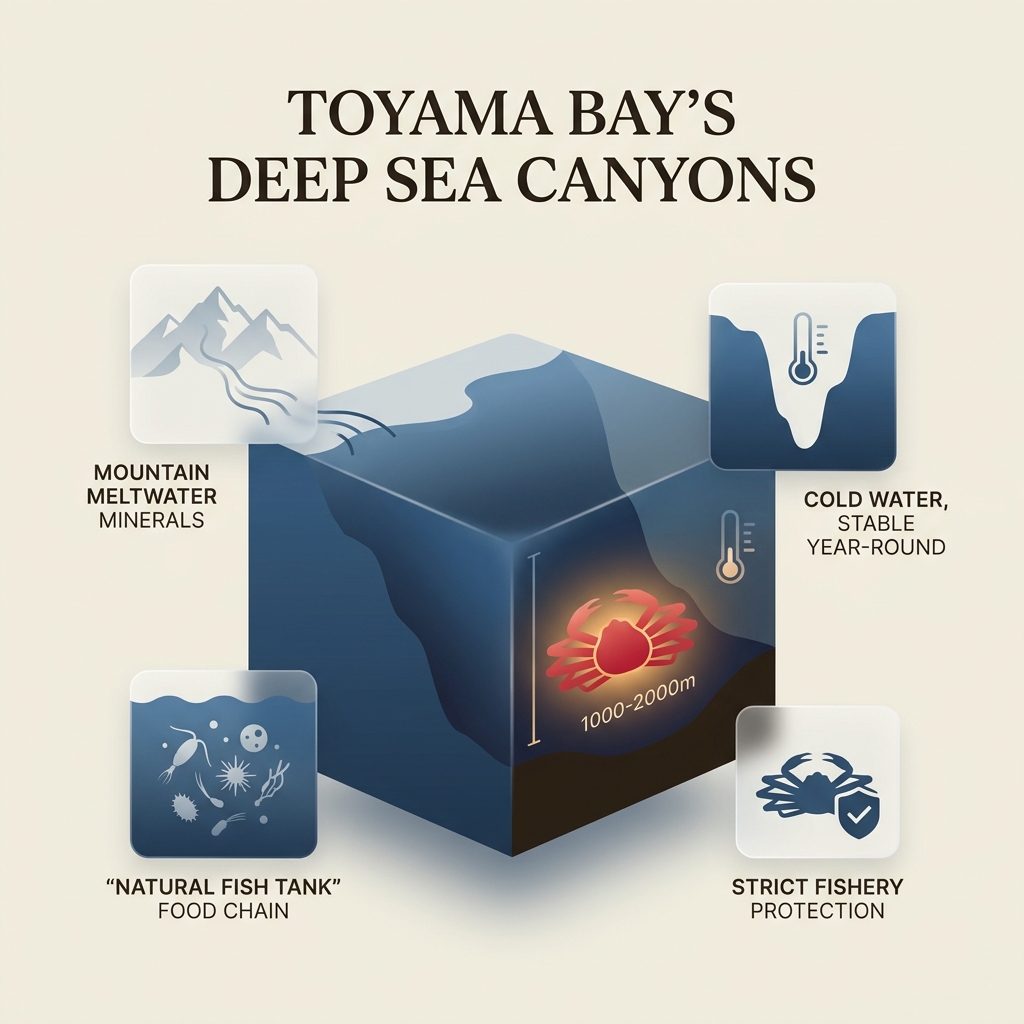
Toyama Bay hides a mountain range in reverse. The continental shelf is narrow, so the seabed drops away almost immediately from shore. Around sixteen submarine canyons cut into that slope. Their water looks so deeply blue that fishermen named them aigame, meaning indigo jars.
Cold Water That Never Changes
Below roughly 300 meters sits the Japan Sea Proper Water, a cold mass that stays near 2 degrees Celsius all year. Deeper still, at crab depth, the temperature barely moves at all. Red snow crab spreads from about 400 to 2,700 meters in the Japan Sea. However, the heart of the population sits between 1,000 and 2,000 meters.
Growth runs slowly in that cold. Researchers at Toyama’s fisheries institute reared crabs in deep sea water at about 0.7 degrees for roughly a decade. Their results show just how long the molting intervals stretch. Because of that, fishery rules protect every female and every male under 90 millimeters across the carapace.
Snowmelt From the Tateyama Range
Peaks near 3,000 meters rise right behind the coast, while the seabed falls to 1,000 meters offshore. That relief of roughly 4,000 meters is rare anywhere on earth. Snowmelt runs down short, steep rivers and carries minerals straight into the bay. Plankton therefore flourishes, and the whole food chain benefits. People call the bay a natural fish tank for good reason.
The Kani-Kago Basket Tradition: Craftsmanship at Sea
Before the baskets arrived, crews caught these crabs with nets baited with fish. Crabs tangled themselves in the mesh, and legs snapped off during hauling. Damaged crabs sold badly, so the method limited the fishery.
A fisherman from Uozu named Toramatsu Hamada changed that. He built bamboo crab pots in the early 1950s and landed successful catches around the middle of the decade. His kani-kago nawa, a longline of baited baskets, then spread along the Japan Sea coast and beyond.
- Set the line. Crews sink hundreds of steel framed baskets, each roughly 1.5 meters across, along one ground.
- Wait two or three days. Bait draws the crabs inside, and the baskets sit undisturbed on the bottom.
- Haul at night. Shinminato’s crab boats leave port around midnight, and their grounds lie only about 10 kilometers offshore.
- Reset and return. Crews drop the next day’s baskets before turning back, so the cycle never breaks.
- Lay them belly up. At the port, each crab goes on its back so the juices stay inside the shell.
Baskets also work where nets cannot. Canyon walls and rough bottoms defeat trawl gear, whereas a pot simply sits and waits. As a result, the crab arrives whole, unbruised, and still heavy with moisture.
The Rare Daytime Auction (Hiru-Seri) at Shinminato
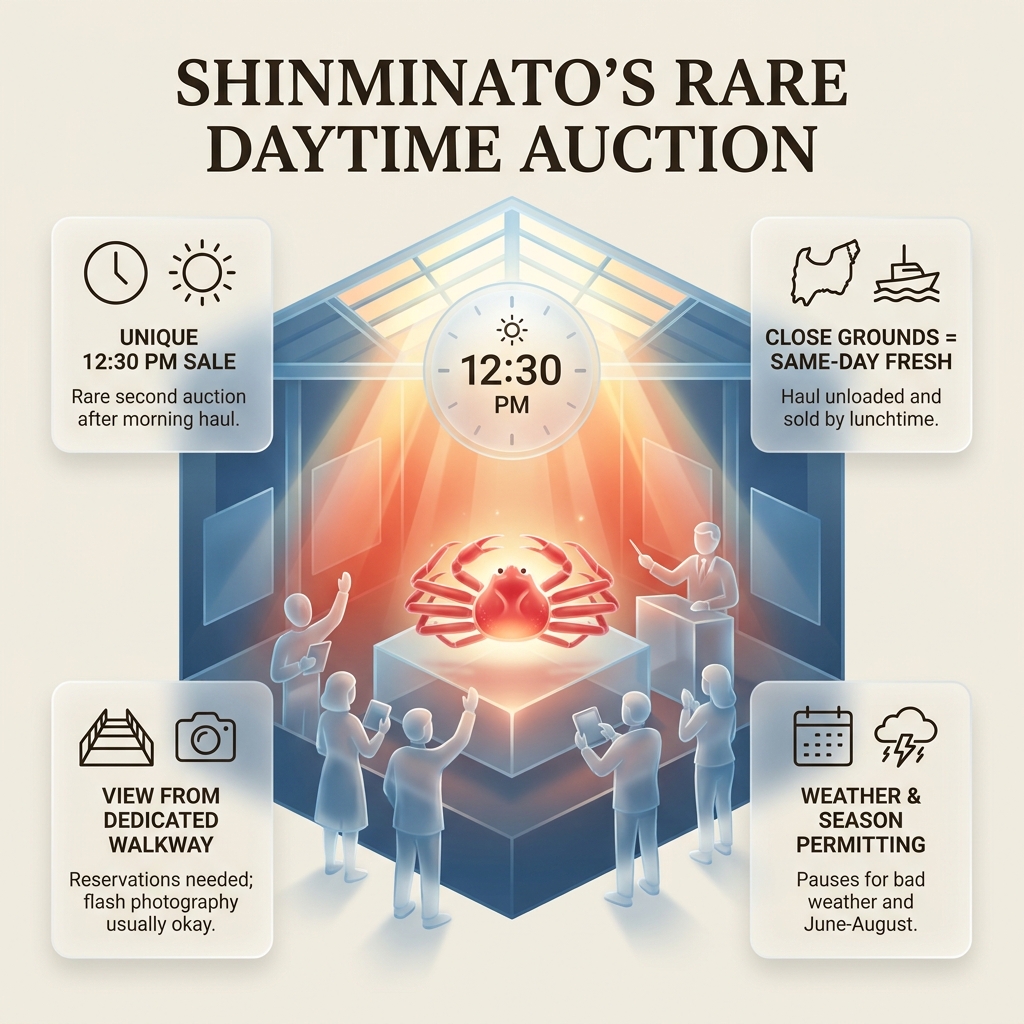
Fish auctions in Japan usually happen before dawn. Shinminato runs one then too, yet it adds a second sale at 12:30 in the afternoon. Very few ports in the country do this.
Geography makes it possible. The grounds sit close to shore. Boats that left at midnight can therefore haul their pots, unload, and lay everything out by lunchtime. Freshness therefore reaches the buyer the same morning it left the water. That single hour of travel is the quiet reason this crab tastes the way it does.
Visitor tips
Tourists watch from a dedicated walkway above the auction floor, and reservations are required in advance. Photography is usually allowed without flash. No auction runs on days when bad weather keeps the boats in port. The daytime sale also pauses from June through August.
Koshi no Aka-gani (Benizuwai) vs. Hon-Zuwai (Snow Crab)
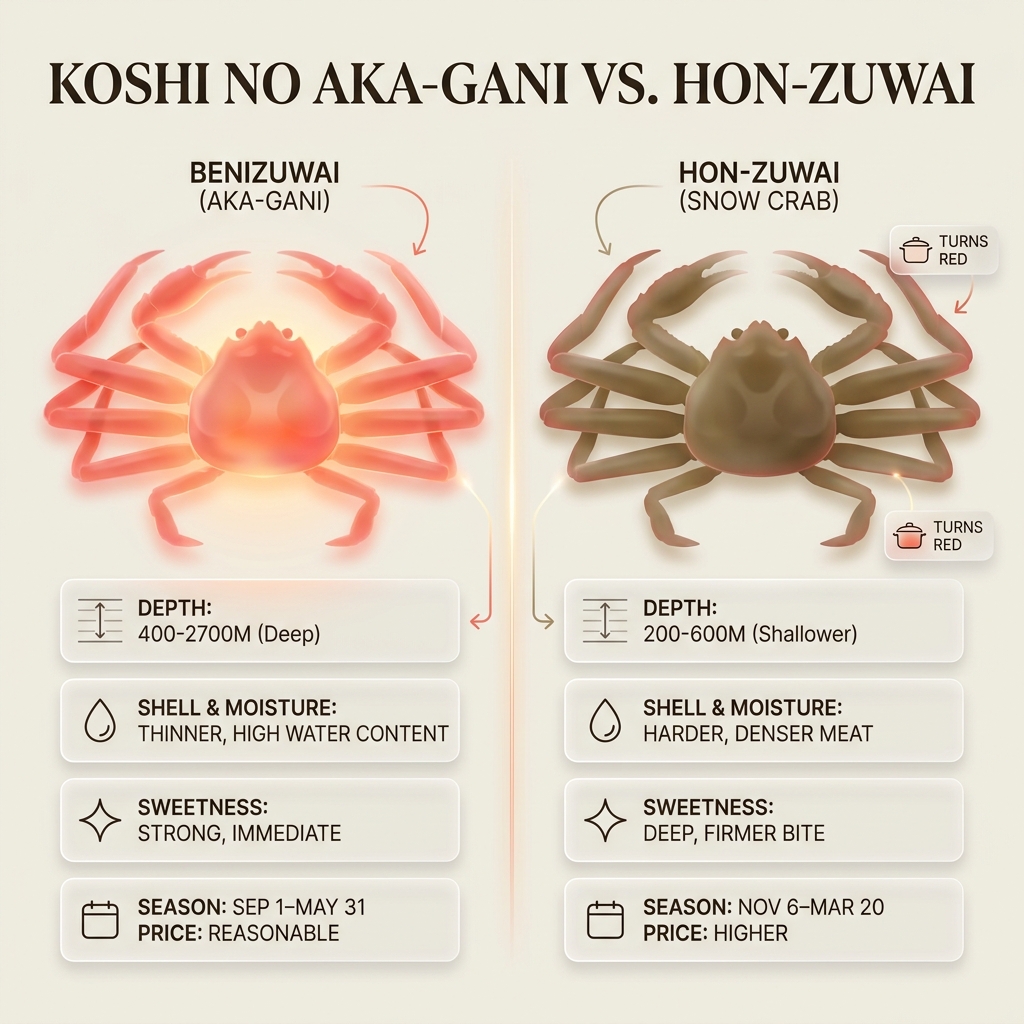
Japanese menus treat these as two different luxuries, not as a cheap version and a real one. The table sums up where they part ways.
| Point | Koshi no Aka-gani (Benizuwai) | Hon-Zuwai (Snow Crab) |
|---|---|---|
| Species | Chionoecetes japonicus | Chionoecetes opilio |
| Depth | Roughly 400 to 2,700 meters | Roughly 200 to 600 meters |
| Color when raw | Already red | Brownish, turns red when boiled |
| Shell and moisture | Thinner shell, high water content | Harder shell, denser meat |
| Sweetness | Strong and immediate when fresh | Deep, with a firmer bite |
| Season in Toyama | September 1 to end of May | November 6 to March 20 for male crabs |
| Price | Reasonable for the size | Considerably higher |
Freshness decides this contest, not pedigree. Red snow crab loses moisture quickly after landing, so it shines close to the port and fades in transit. Snow crab travels better, which partly explains its national reputation.
The Gokujo (Supreme) Brand Standard: The Gold Tag Criteria
Not every crab earns the tag. A branding promotion council set the specifications, and only crabs that clear all of them ship as Gokujo Koshi no Aka-gani.
Gold tag requirements
- Landed at a fishing port inside Toyama Prefecture
- Carapace width of 14 centimeters or more
- Live weight of roughly 1 kilogram or more, or about 800 grams once boiled
- All legs present and intact
- Hard shelled, meaning the crab is well filled with meat
Those numbers sound modest until you handle the crabs. One missing walking leg disqualifies the whole animal, and basket fishing still costs a few crabs their legs. Tagged crabs therefore sell at a premium. If you see the gold tag on a restaurant tank, expect the bill to reflect it.
How to Eat Koshi no Aka-gani: Best Serving Styles
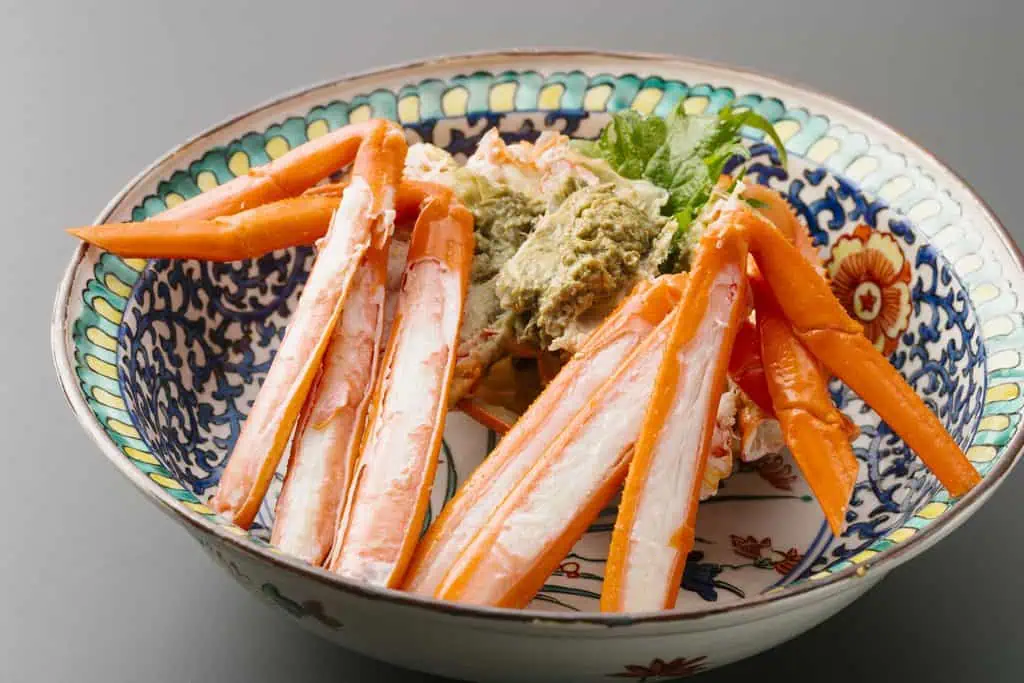
Boiled is the default, and nobody in Toyama apologizes for that. Still, being near the port opens two options that rarely travel.
Freshly Boiled and Chilled
Shops boil the crabs in salted water soon after the auction, then cool them. The meat slips out of the shell in long pieces, glossy and dripping. Eat it plain first, because vinegar sauce covers the sweetness that you came for. A little sudachi, a tart green citrus, works better if you want acidity.
Sashimi and Grilled
Raw crab needs genuine freshness, so you will find it mainly near the landing ports. The leg meat comes out translucent and faintly sticky, with a sweetness that feels concentrated. Grilling goes the other way. Heat tightens the flesh, the shell smells wonderful, and the flavor turns deeper rather than lighter.
The Kanimiso Finish
Save the shell until last. Dip a piece of leg meat into the kanimiso pooled inside, then eat both together. Some shops pour warm sake into the empty shell afterward, swirl it, and hand it back as kanimiso sake, a local treat known more widely as koura-zake. It is rich, briny, and honestly a little much for some people, yet regulars consider it the point of the meal.
Where to Eat Koshi no Aka-gani in Toyama
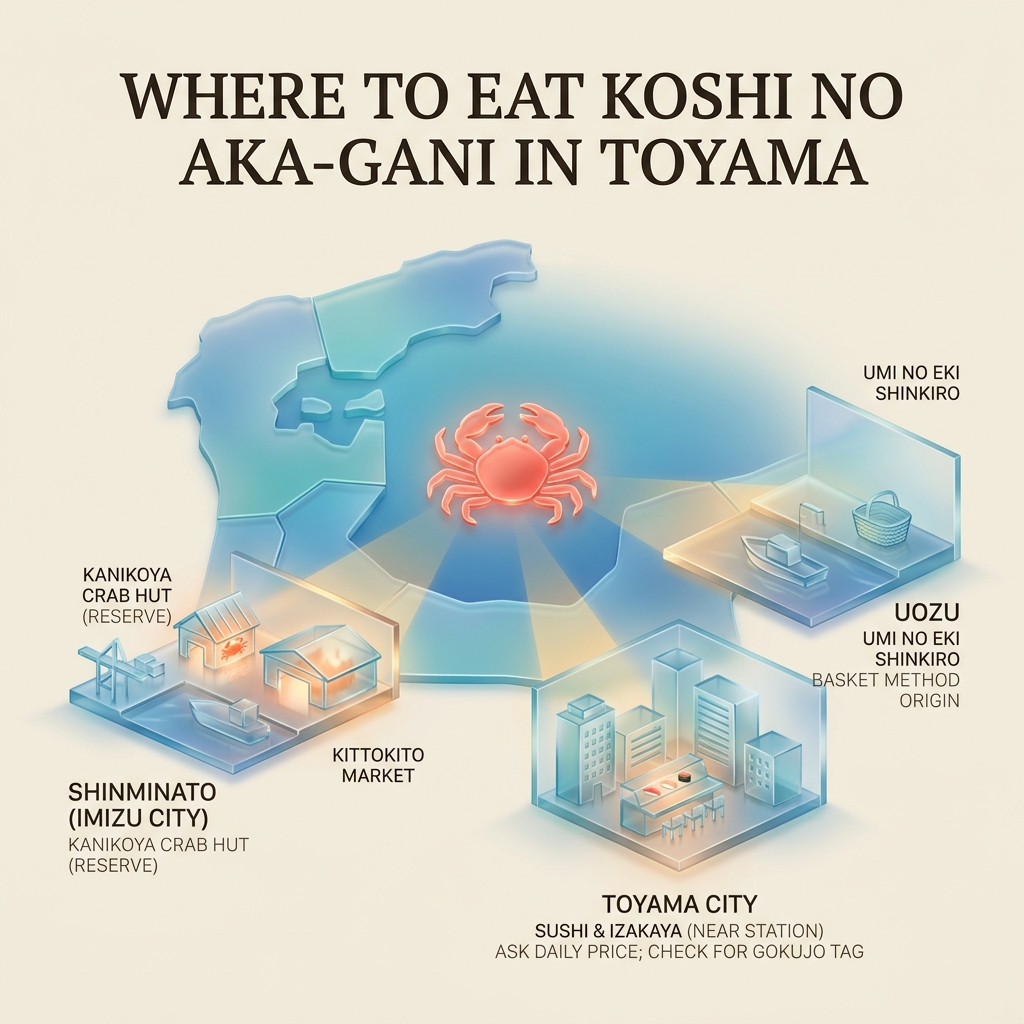
Shinminato in Imizu City makes the easiest base. Shinminato Kanikoya, a seasonal crab hut beside the port, serves crabs boiled after the auction, though it runs on reservations and seasonal hours. Check its current operating information before you go. The neighboring Shinminato Kittokito Market also has restaurants and counters near the auction hall.
Uozu offers a quieter alternative, and Umi no Eki Shinkiro is the obvious waterfront stop. Pride runs high in this town, because the basket method began here. Namerikawa lands crabs as well. Opening days and menus shift with the catch at every one of these places, so confirm in advance.
Toyama City works when time is short. Sushi counters and izakaya, meaning casual Japanese pubs, list red snow crab near Toyama Station through the season. Prices follow the daily auction rather than a fixed menu rate, so ask before you order. It also helps to check whether the crab carries a Gokujo tag.
How to Buy Koshi no Aka-gani as a Souvenir
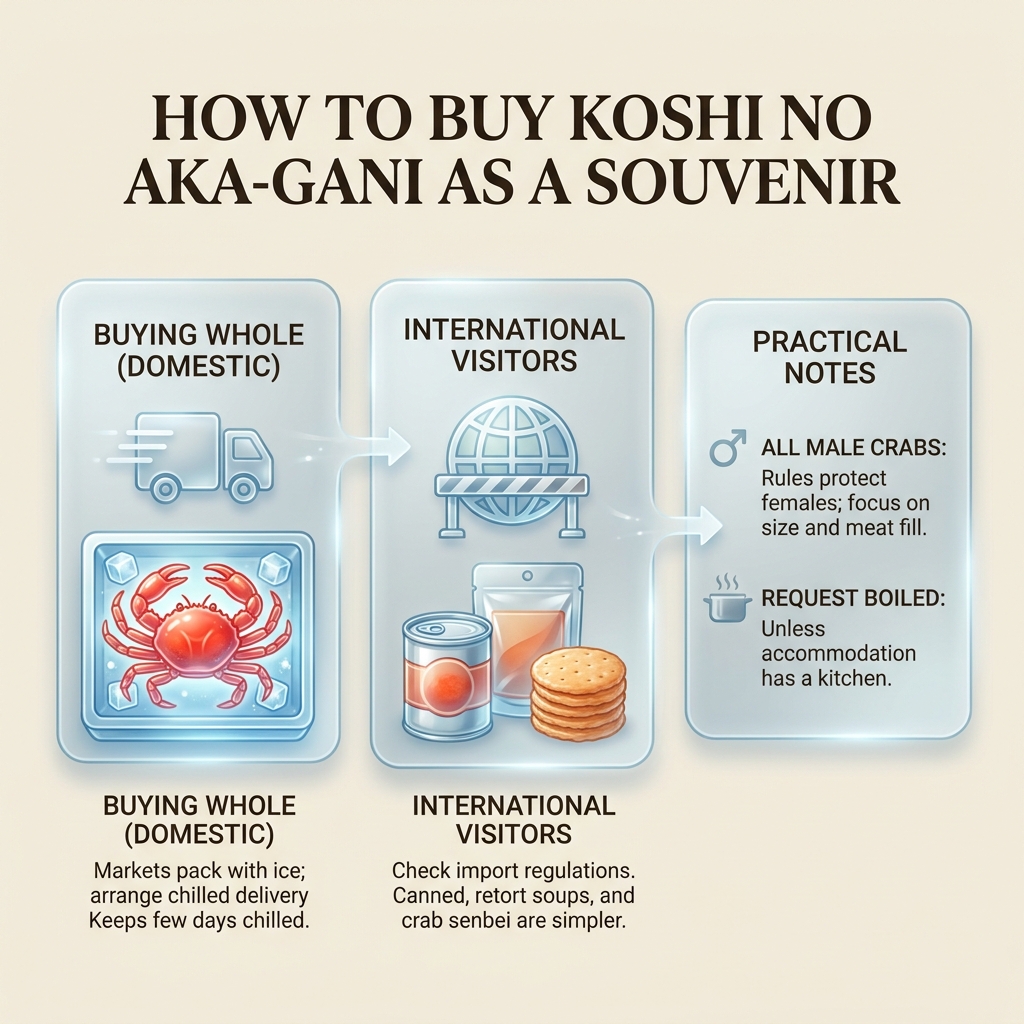
Markets near the ports sell boiled crabs whole. Most will pack them with ice for the trip home. Shipping is the safer route for domestic travelers, since shops arrange chilled delivery nationwide. Boiled crab keeps only a few days chilled, so plan around that limit.
International visitors face a harder call. Many countries restrict imports of fresh or cooked seafood, and rules differ sharply between them. Check your own country’s regulations first, then consider processed alternatives. Canned crab, retort soups, and crab flavored senbei, a type of rice cracker, are usually simpler to carry.
Two practical notes help at the counter. First, every crab on sale is male, since the rules protect all females, so size and meat fill matter more than any other question. Second, request a boiled crab rather than a live one unless your accommodation has a kitchen.
Other Local Seafood to Try in Toyama
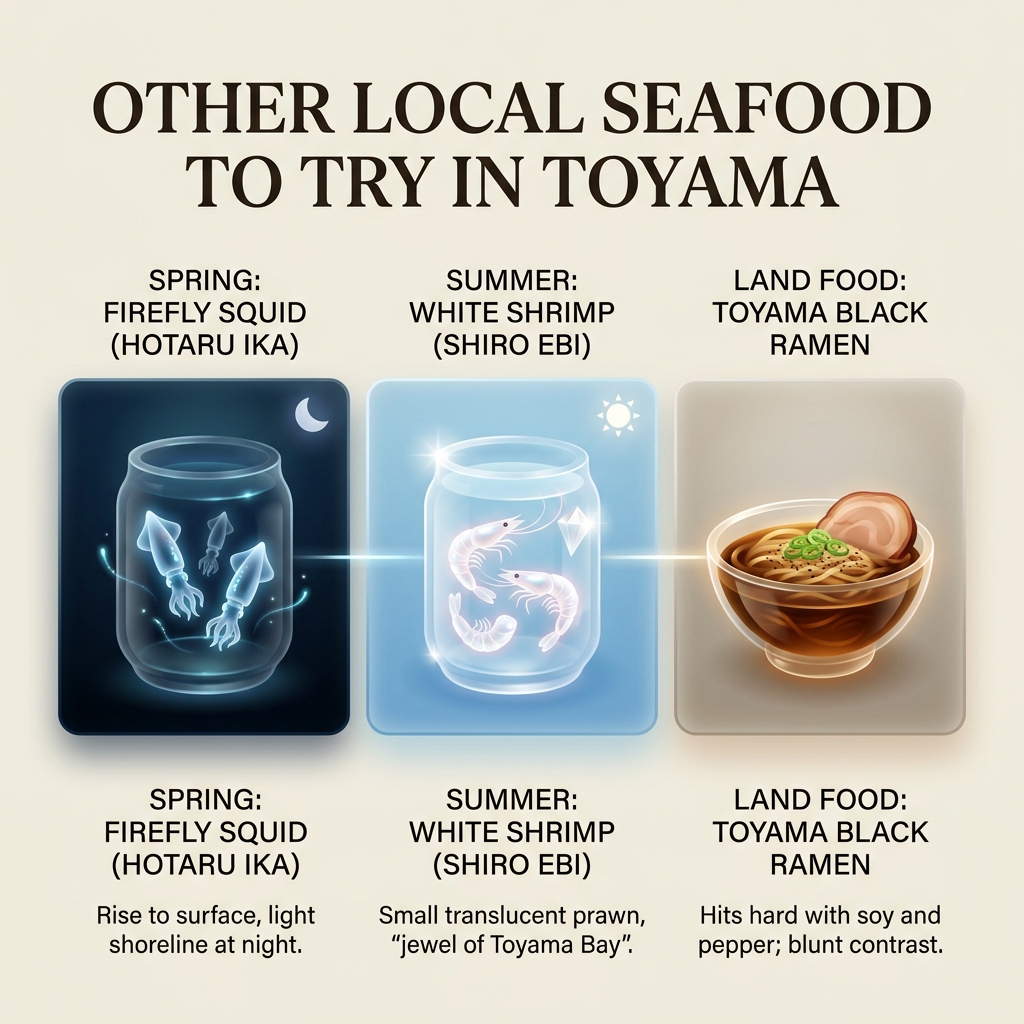
The bay keeps a calendar, and crab holds only one slot on it. In spring, firefly squid rise toward the surface and light the shoreline at night. Summer belongs to white shrimp, the small translucent prawn nicknamed the jewel of Toyama Bay.
Land food deserves a turn as well. Toyama black ramen hits hard with soy and pepper, and it makes a blunt contrast after a delicate crab lunch. For context on that bowl and its relatives, our guide to Japanese noodles maps the main styles.
Summary
Koshi no Aka-gani rewards travelers who show up in person. The crab comes from more than 800 meters down, reaches the auction floor within hours, and tastes sweetest close to the port. Toyama built the brand around that short distance rather than around rarity.
Visit between September and May if you can, and aim for the daytime auction at Shinminato. Eat one boiled crab first, then decide whether the sashimi or the grilled version tempts you more. Either way, do not leave the kanimiso in the shell.
Frequently Asked Questions About Koshi no Aka-gani
What is Koshi no Aka-gani?
Koshi no Aka-gani is Toyama Prefecture’s brand of red snow crab, Chionoecetes japonicus. Boats catch it in deep water with baited baskets, then land it at ports such as Shinminato, Uozu, and Namerikawa. The prefecture launched the brand in 2016 and registered the name in 2017. Locals had already called the crab aka-gani, meaning red crab, for generations.
How is Benizuwai crab different from regular Snow Crab (Hon-Zuwai)?
They are separate species that live at different depths. Red snow crab stays far deeper, so its shell is thinner and its meat holds more water. Snow crab gives a denser, firmer bite and costs considerably more. Red snow crab counters with strong sweetness and a much longer season.
Why is it red even before being cooked?
The red pigment in its shell already shows while the crab is alive. In most shallower crabs that pigment stays bound to protein, so heat is needed to reveal the color. Red snow crab does not need the pot to look cooked. Boiling still intensifies the shade, which is why market crabs look brighter than boat crabs.
What is the best season to eat it in Toyama?
The season runs from September 1 to the end of May, while fishing closes from June through August. Autumn draws the most attention, since the opening coincides with the branding campaign. Winter crabs often carry excellent meat fill, too. In summer, anything on the menu comes from frozen stock or from another region, so plan around the closed months.
Where can travelers watch the crab auction and eat it fresh?
Shinminato Fishing Port in Imizu City holds a daytime auction at 12:30. Visitors watch from a walkway upstairs with a prior reservation. Crab huts and the Kittokito Market next door serve boiled crab soon afterward. Uozu offers a calmer option around Umi no Eki Shinkiro. Bad weather can cancel the auction, so confirm before you travel.
What does the gold Gokujo tag mean?
The tag marks crabs that meet the council’s premium standard. Each one must land at a Toyama port and measure at least 14 centimeters across the carapace. Live weight should reach roughly 1 kilogram. Every leg must remain attached, and the shell must be hard with good meat fill. Tagged crabs sell at a clear premium.
Can I take Koshi no Aka-gani home from Japan?
Domestic travelers can ship chilled crab nationwide through the markets. International visitors should check their own country’s seafood import rules first, because fresh and boiled crab usually cannot cross the border. Processed goods usually work better as gifts. Canned crab, crab flavored rice crackers, and retort soups are the common choices.
References
- Toyama Prefecture, Ecchu Toyama Shoku no Okoku, Red Snow Crab (Benizuwaigani) (Surveyed: September 2026)
- Toyama Prefectural Federation of Fisheries Cooperative Associations, Red Snow Crab: season, flavor, and the Toyama Bay fishery (Surveyed: September 2026)
- Toyama Prefectural Federation of Fisheries Cooperative Associations, Introduction to Toyama Bay and its submarine canyons (aigame) (Surveyed: September 2026)
- Uozu City Tourism Association, Red Snow Crab and the birthplace of crab pot fishing (Surveyed: September 2026)
- Toyama Tourism Navi (Toyama Prefecture Tourism Association), Shinminato Fishing Port Daytime Auction Tour (Surveyed: September 2026)
- Japan Fisheries Association, Pride Fish, Red Snow Crab of Toyama Bay (Surveyed: September 2026)
- Maeda, T. and Uchiyama, I. (2024), Molt increment and intermolt period of red snow crab reared using deep sea water, Nippon Suisan Gakkaishi, 90(3), 242 to 253, J-STAGE (Surveyed: September 2026)
- Maeda, T. and Uchiyama, I. (2022), Growth of male red snow crab in Toyama Bay estimated from carapace width composition, Nippon Suisan Gakkaishi, 88(5), 386 to 395, J-STAGE (Surveyed: September 2026)
- Japan Fisheries Research and Education Agency, Stock Assessment of the Sea of Japan Red Snow Crab Stock, FY2025 (Surveyed: September 2026)
Related Articles
- Firefly Squid (Surveyed: September 2026)
- White Shrimp (Shiro Ebi) (Surveyed: September 2026)
- Toyama Black Ramen (Surveyed: September 2026)
- Japanese Noodles Guide (Surveyed: September 2026)




Comments