



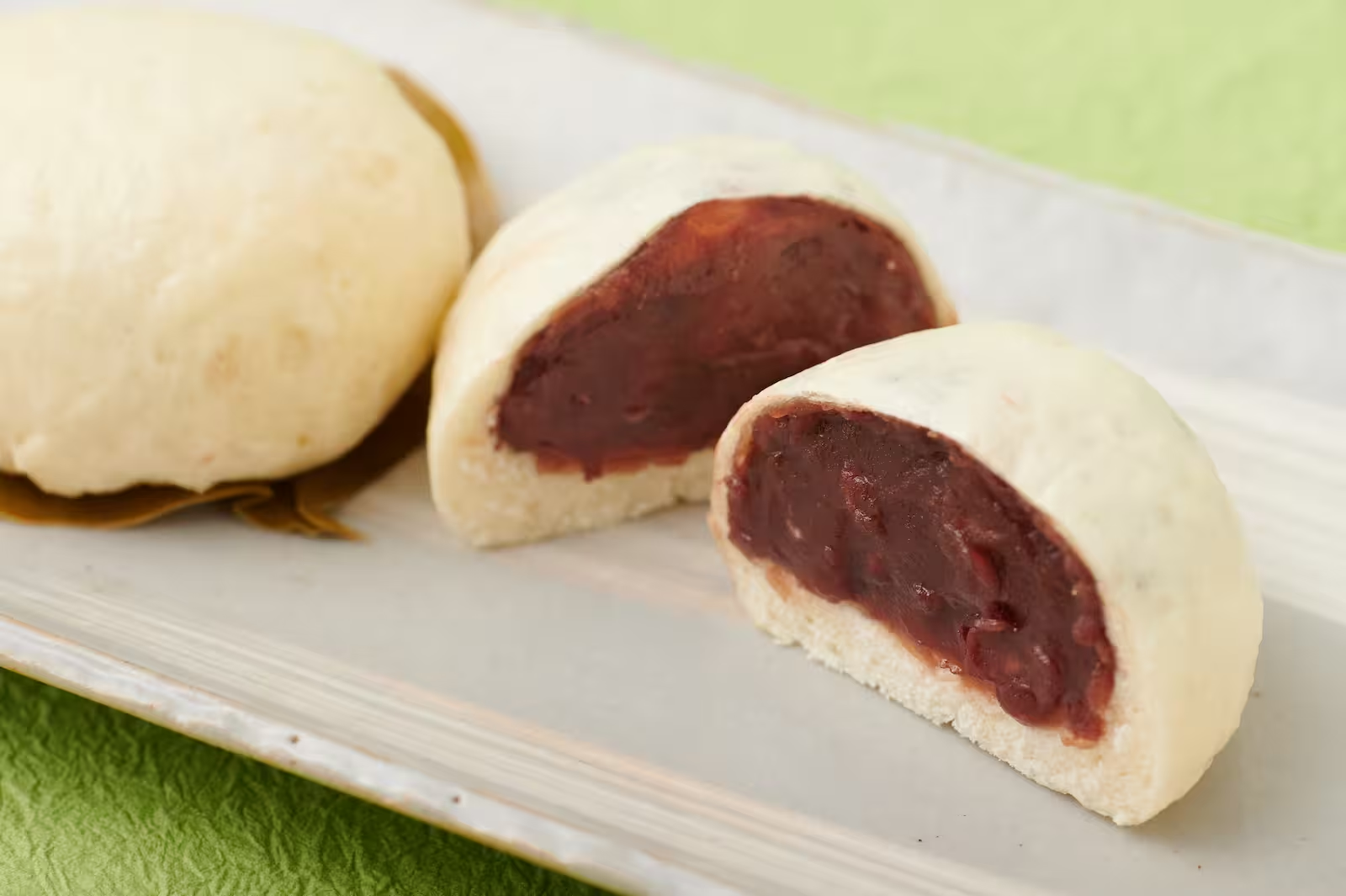
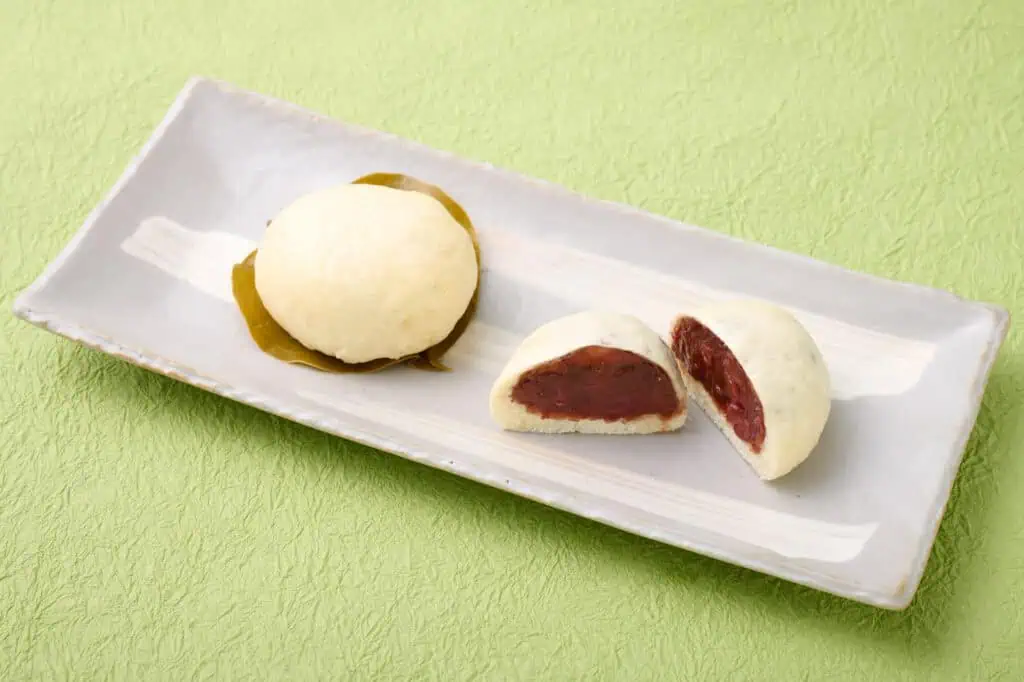
Barappa manju is a steamed wheat-flour bun filled with sweet red bean paste, cooked on a single wild leaf. It comes from the Hokuso area of northern Chiba Prefecture, and people there eat it during summer festivals and Obon. The leaf gives the sweet its name, its scent and most of its character.
This guide covers what barappa manju actually is, how it tastes, why the leaf matters, and where you can realistically find it. It also clears up two mix-ups that come up constantly, including the assumption that this is an Okinawan or Amami sweet. It is not.
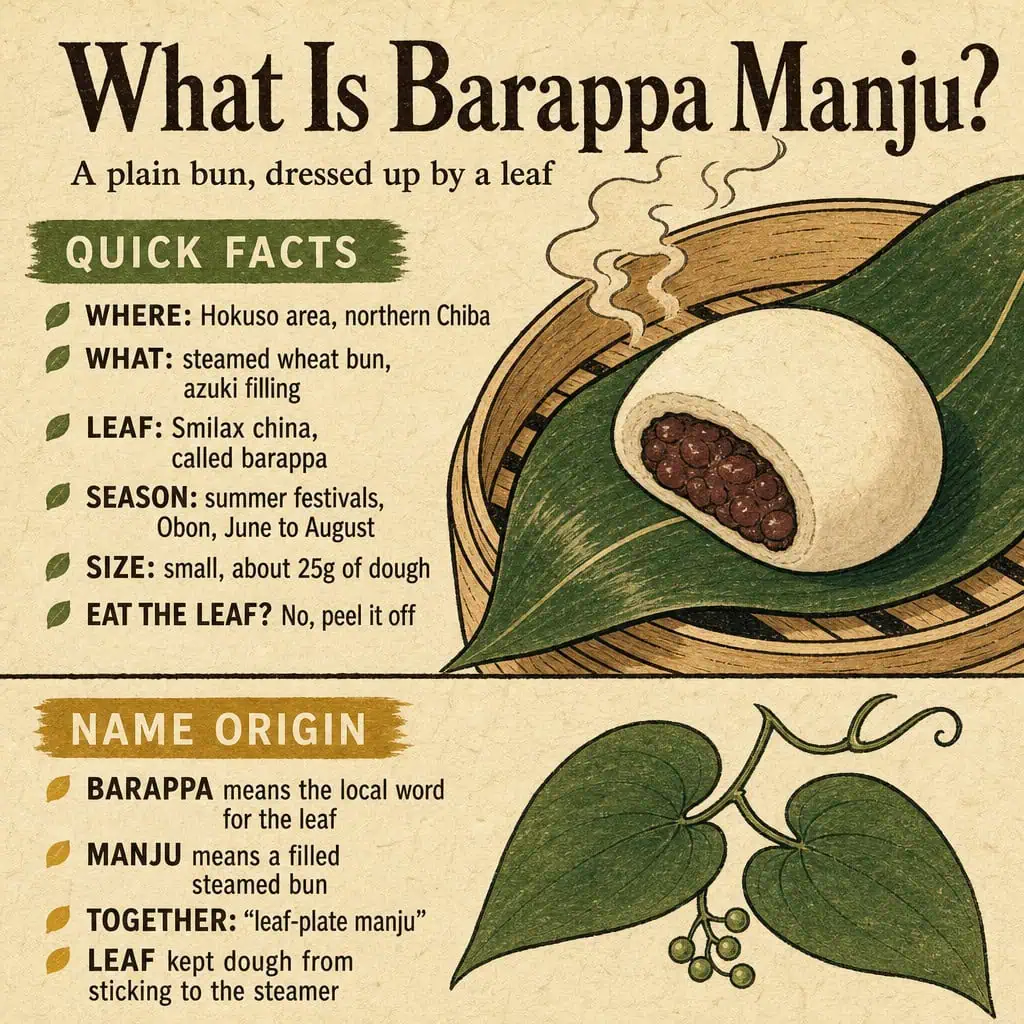
Barappa Manju at a Glance
- Japanese name: ばらっぱまんじゅう
- Where: Hokuso area, northern Chiba Prefecture
- What it is: Steamed wheat bun with sweet azuki bean filling
- The leaf: Smilax china, called barappa locally
- Season: Summer festivals and Obon, roughly late June to August
- Size: Small, around 25 g of dough per bun
- Eat the leaf? No, peel it off first
What Is Barappa Manju?
The Short Answer
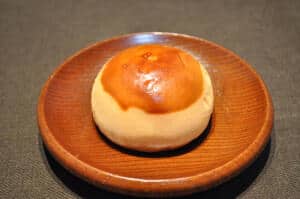
Barappa manju is a plain country manju, dressed up by a leaf. Cooks mix wheat flour, sugar and baking powder into a soft dough, wrap it around sweet azuki bean paste, and set each bun on a glossy green leaf. Then the whole tray goes into a steamer for ten to fifteen minutes.
The Ministry of Agriculture, Forestry and Fisheries lists it as a traditional dish of the Hokuso area, the northern part of Chiba Prefecture. That region covers cities such as Narita, Sakura, Inzai and Katori. Local supermarkets still carry the buns in season, which surprises most visitors.
Where the Name Comes From
Barappa has nothing to do with roses, despite the sound. It is the local word for the leaf of Smilax china, and manju simply means a filled steamed bun. So the name translates roughly as “leaf-plate manju.” Cooks originally laid the leaf underneath to stop the dough from sticking to the steamer.
How to Say It and How to Ask for It
Say it as ba-rap-pa man-joo, with a small pause on the double p. Shop staff outside Chiba may not recognize the word at all, so the written form helps.
Useful at the counter: ばらっぱまんじゅうはありますか。
Barappa manju wa arimasu ka. (“Do you have barappa manju?”)
The Leaf That Defines It
What the Plant Actually Is
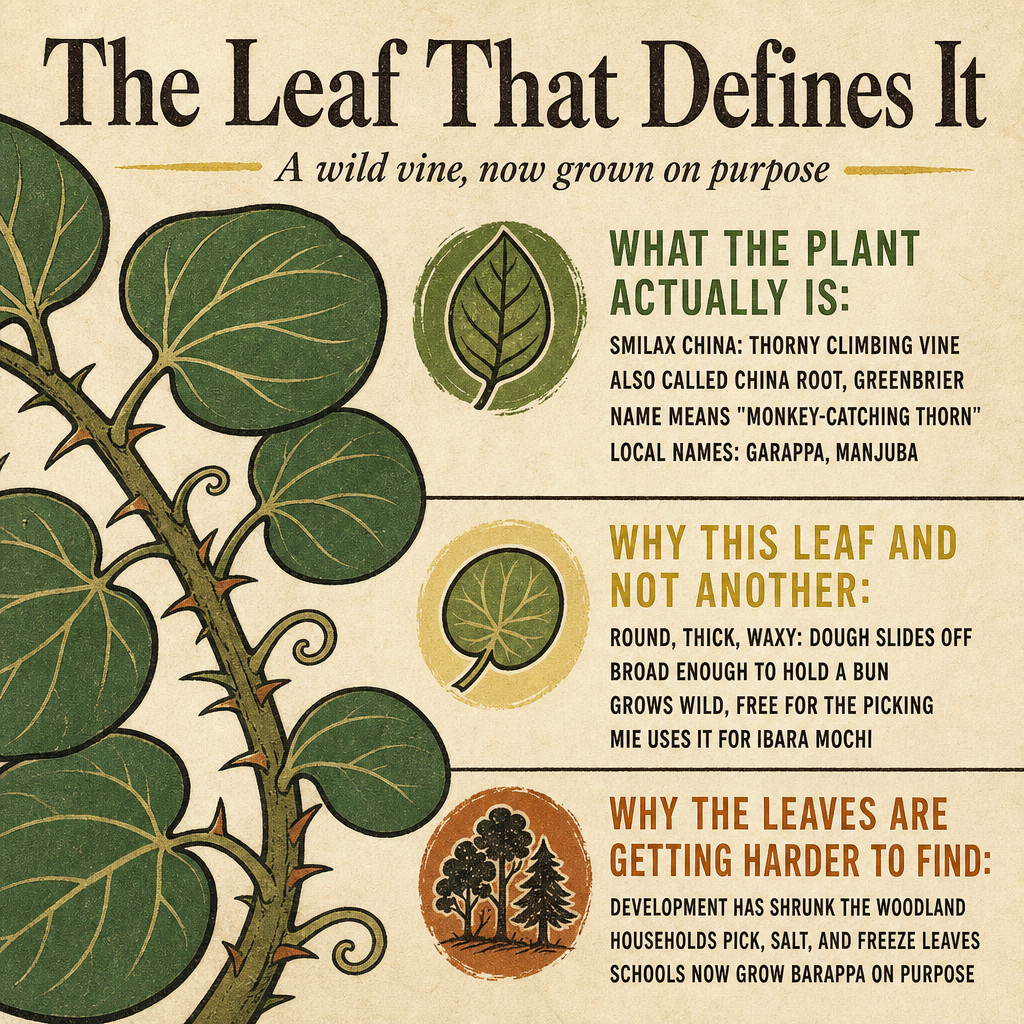
Smilax china is a thorny climbing vine, known in standard Japanese as sarutoriibara or sankirai. English references usually call it China root or greenbrier. Botanists place it in the family Smilacaceae, although older Japanese sources still file it under the lily family. The vine grows wild along woodland edges across most of Japan.
Its Japanese name means roughly “monkey-catching thorn,” a nod to the hooked spines along the stem. In Chiba the leaf also goes by garappa or manjuba, the latter meaning simply “manju leaf.”
Why This Leaf and Not Another
The leaves are round, thick and waxy, so dough slides off cleanly after steaming. They are also broad enough to hold a small bun without tearing. Because the vine grows wild in hedgerows, farming families could gather what they needed for free.
Other regions reached the same conclusion independently. Mie Prefecture uses the identical plant for a sweet called ibara mochi, and in Naruto, Tokushima, the local version goes by baramochi. Across western Japan, cooks often substitute these leaves for oak in kashiwa mochi.
Why the Leaves Are Getting Harder to Find
Here is the quiet problem behind the tradition. Inzai City’s municipal newsletter notes that the vine once grew freely in local woodland, but development has shrunk those areas, so leaves have become difficult to obtain. Households therefore pick young leaves in mid-June, then salt them or dry them in the shade and freeze them for the rest of the year.
Schools and community groups in the area now grow barappa deliberately. That effort says something about how fragile a recipe becomes when it depends on a wild plant.
History: New Wheat, Shrines and the Niibashi Rite
July Was New Wheat Month
Farm households across the Hokuso area once grew their own wheat. They harvested it around June, dried it, then milled it into flour. By July, families were eating the first food made from that year’s crop. Barappa manju was one of the things they made with it.
The timing works almost too neatly. Young barappa leaves reach usable size in mid-June, exactly when the wheat came in. Two seasonal supplies met, and a regional sweet followed.
Niibashi, the New Chopsticks Observance
This is the detail most English sources miss entirely. Niibashi, also pronounced nyubashi, is a folk observance recorded from Chiba down into Kanagawa. Participants offer wheat-flour foods such as udon and manju to the gods, then make fresh chopsticks from susuki grass stems and eat with them. The point is to celebrate the wheat harvest.
In Inzai, households ate barappa manju on 27 July for niibashi. They also made batches for the Afuri Shrine festival in Takanishi-shinden, held in late July. So the sweet was never just a snack. It sat inside a calendar of offerings.
A Ceremonial Food, Not a Daily Snack
Local historians classify barappa manju as a ceremonial food, in the same category as red rice and pounded mochi. Nobody ate it casually. Neighbours pooled ingredients, worked in one kitchen, and shared the results at summer festivals and Obon.
Some of that persists. Households in the region still make a batch when relatives visit in August, and municipal events sell limited quantities.
Ingredients and Proportions
The Dough
The dough is wheat flour, a small amount of sugar and baking powder. Chiba Prefecture’s published recipe uses 500 g of flour, 35 g of sugar and three tablespoons of baking powder for twenty buns. Cooks sift the dry ingredients three times, then work in about 1.5 cups of water by hand.
Notice what is absent. There is no yeast, no fermentation and no resting overnight. As a result, the skin lands somewhere between a steamed bun and a light scone, and it never turns airy the way a Chinese bao does.
The Filling
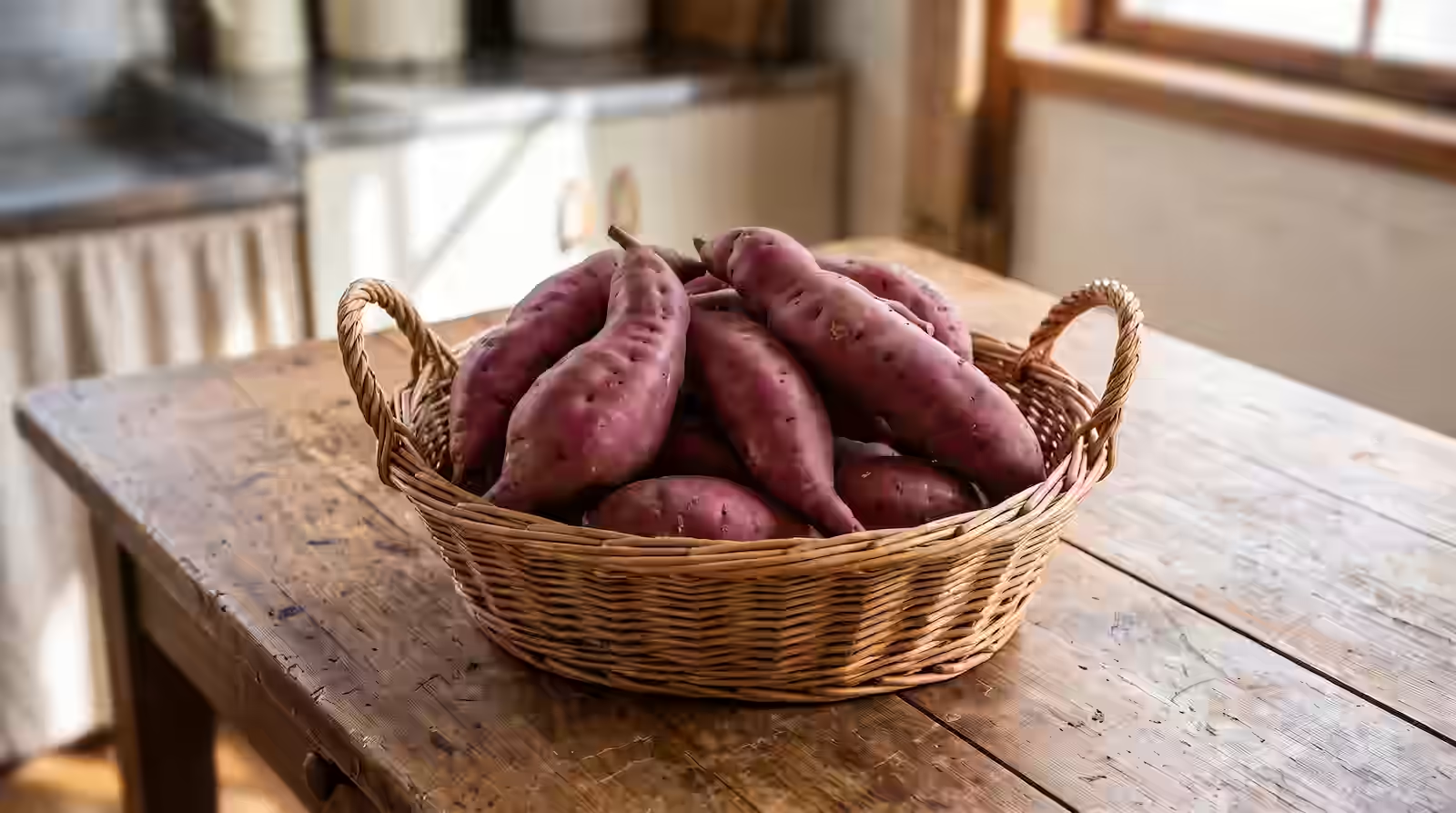
Sweet azuki bean paste is standard, and households traditionally made their own. Still, the filling was never fixed. Sweet potato and kabocha squash both appear in the official recipe notes, which fits Chiba’s farm produce well. Sweet potato versions taste noticeably gentler and slightly drier.
How Big Is One Bun?
Work the numbers through and each bun uses roughly 25 g of flour and 30 g of bean paste. In other words, these are small, and one fits comfortably in a cupped hand. Two make a modest afternoon snack rather than a dessert course.
How Barappa Manju Is Made
The method is short enough to memorize. Here is the sequence a Chiba home cook follows.
- Sift flour, sugar and baking powder together three times.
- Roll the bean paste into twenty equal balls and set them aside.
- Add water gradually, mixing by hand until the dough feels as soft as an earlobe.
- Cover with a damp cloth, rest for five or six minutes, then divide it.
- Flatten a piece on your palm, wrap it around the filling, and shape a round bun.
- Sit each bun on a barappa leaf and steam for ten to fifteen minutes.
The step people get wrong: add the water bit by bit, never all at once. Wheat flour absorbs unevenly, so the dough turns sticky faster than you expect. Stop while it still feels slightly firm.
What Does Barappa Manju Taste Like?
Expect mild sweetness and a wheat-forward dough. The first bite can feel underwhelming if you arrive expecting a dessert, because the sugar content is genuinely low. Most of the flavor comes from the bean paste.
Then the aroma arrives. Peel the leaf away and you catch something green and faintly herbal, closer to fresh hay than to flowers. It fades within a minute or two, which is part of the appeal. Warm buns smell distinctly stronger than cold ones.
Texture sits between soft and springy. The skin is denser than a convenience-store steamed bun, yet far lighter than mochi. Chilled overnight, it firms up considerably, so locals usually re-steam it for a couple of minutes before eating.
Barappa Manju Compared With Other Leaf-Wrapped Sweets
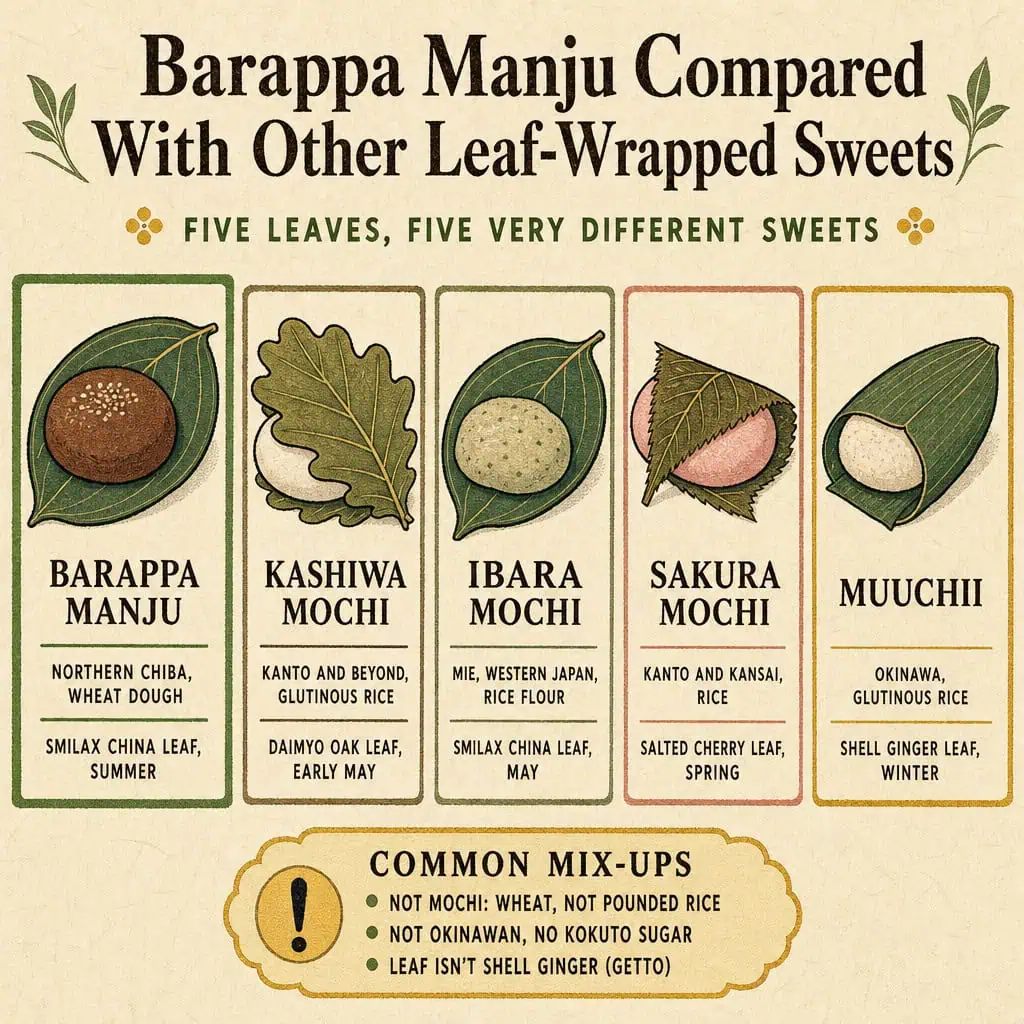
Japan has a whole family of sweets built around a leaf, and they get confused constantly. This table should sort out the differences quickly.
| Sweet | Region | Dough base | Leaf | Main season |
|---|---|---|---|---|
| Barappa manju | Northern Chiba | Wheat flour | Smilax china | Summer |
| Kashiwa mochi | Kanto and beyond | Glutinous rice | Daimyo oak | Early May |
| Ibara mochi | Mie and western Japan | Rice flour | Smilax china | May |
| Sakura mochi | Kanto and Kansai | Rice | Salted cherry | Spring |
| Muuchii | Okinawa | Glutinous rice | Shell ginger | Winter |
Barappa Manju and Okinawan Muuchii
People group these two together, and the confusion makes sense on the surface. Both arrive wrapped in a fragrant leaf, and neither leaf gets eaten. Beyond that, though, they diverge sharply.
Muuchii comes from Okinawa and uses glutinous rice flour, giving it a dense, chewy body. Okinawan families wrap it in shell ginger leaves, called sannin locally, and eat it in winter as a health charm. Barappa manju, by contrast, is a wheat sweet from Chiba tied to midsummer. Only the wrapping technique links them.
Is It the Same as Mochi?
No, and the difference is immediate. Mochi comes from pounded glutinous rice, so it stretches and pulls. Barappa manju uses wheat and baking powder, which produces a crumblier, cakier bite. Anyone who has tried kashiwa mochi or sakura mochi will notice it instantly.
Two Mix-Ups Worth Correcting
First, barappa manju is not an Amami or Okinawan sweet, and it contains no kokuto brown sugar. English-language summaries sometimes place it in the southern islands, probably because leaf-wrapped sweets are common there. The dish belongs to Chiba, in eastern Honshu.
Second, the leaf is not shell ginger. Shell ginger, or getto, belongs to the ginger family and grows in subtropical Japan. Smilax china is an unrelated temperate vine with a much fainter scent.
How and When to Eat It
Peel the leaf off and discard it. The leaf is edible in principle, yet nobody eats it here, because the texture is tough and papery. Its job is to scent the dough and keep the steamer clean.
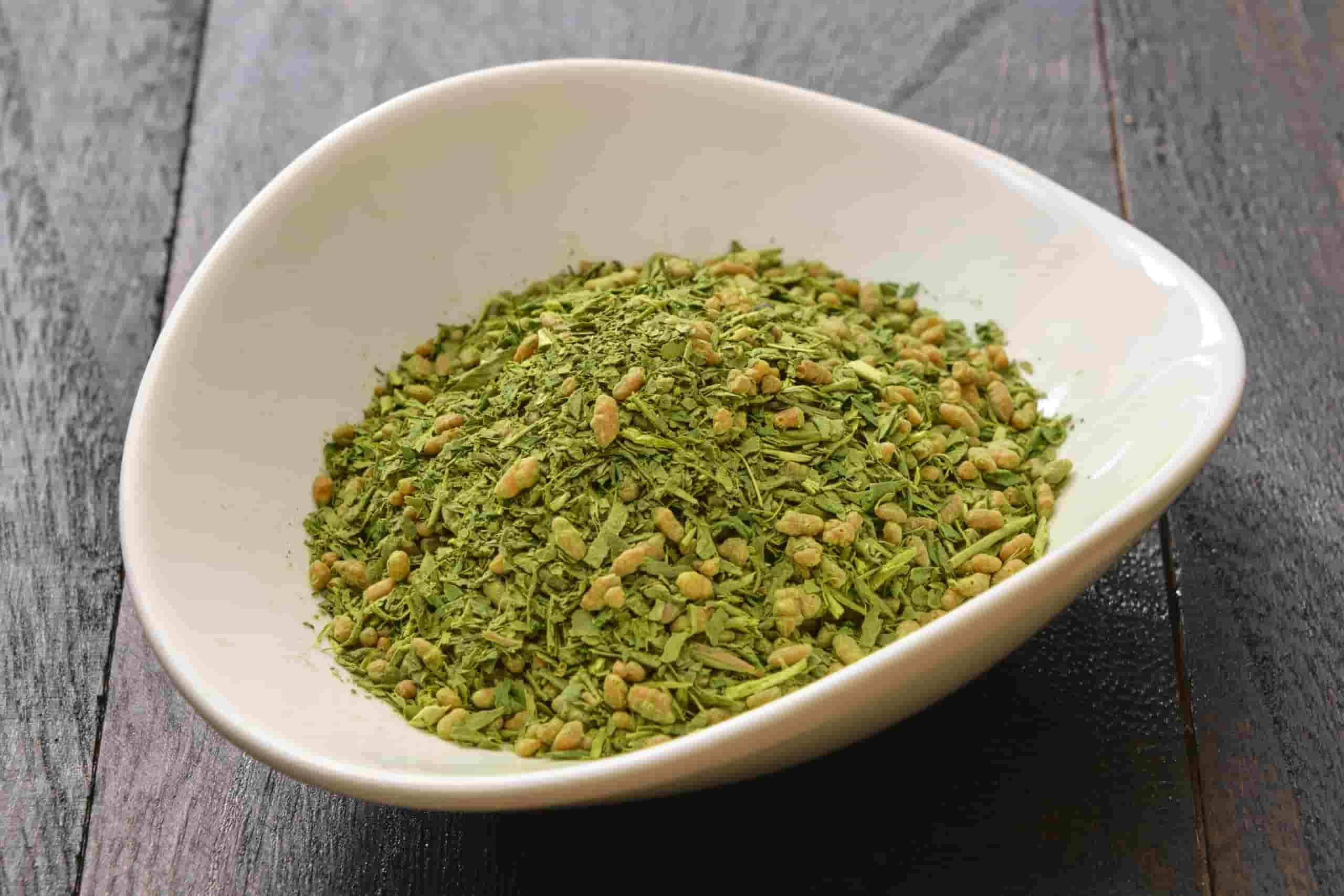
Green tea is the obvious partner, since a little bitterness balances the bean paste. Roasted barley tea suits the season better, and it is what Chiba households actually pour in August. Coffee works surprisingly well with the sweet potato version.
Eat it the same day for the best aroma. Otherwise, steam it briefly to bring the texture back.
Where to Find Barappa Manju
Shops and Local Events
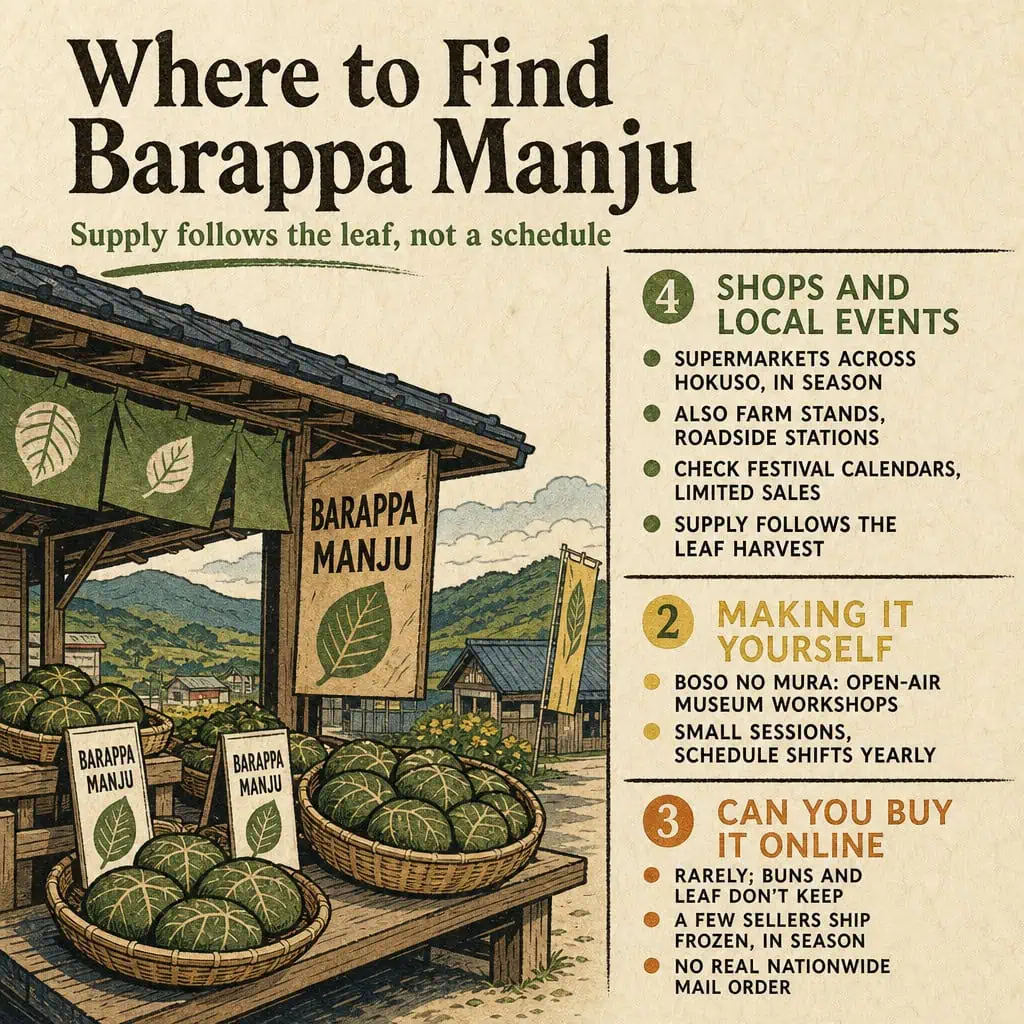
Supermarkets across the Hokuso area stock barappa manju in season, according to the Ministry of Agriculture, Forestry and Fisheries. Farm stands and roadside stations in the same region are worth checking too. Inzai City also reports limited sales at municipal events, so local festival calendars are a reasonable place to look.
Supply follows the leaf harvest rather than a fixed schedule. Call ahead if you are making a special trip.
Making It Yourself in Chiba
Boso no Mura, the prefectural open-air museum in Sakae Town, has run barappa manju workshops in its reconstructed farmhouse. Sessions are small and the schedule shifts each year, so check the official program before traveling. Municipal food-culture events in the region occasionally offer something similar.
Can You Buy It Online?
Rarely, and that is the honest answer. The buns keep poorly, and the leaf loses its scent within a day or two. A few local producers ship frozen batches during the season, but nationwide mail order has never taken hold.
Allergens, Diet and Keeping It
Barappa manju contains wheat, so it is not gluten free. The traditional recipe uses no eggs and no dairy, which makes most homemade versions suitable for vegans. Commercial bakers sometimes add milk powder or fat, though, so check the label when you buy.
Storage is simple but unforgiving. Eat the buns on the day of steaming if you can, or freeze them and re-steam later. Refrigeration hardens the wheat skin quickly, therefore most households avoid it.
Why a Leaf-Wrapped Sweet Still Matters
Wrapping food in leaves is ancient and widespread. One ethnobotanical survey of wrapping leaves in China documented 57 plant species across 18 families, and it found that local knowledge consistently centered on three things: flavor, preservation and medicinal value. Before plastic and refrigeration, a leaf handled all three at once.
Laboratory work supports part of that. A 2012 study of Smilax china leaf extracts measured antioxidant activity and found inhibition of several foodborne bacteria, including Listeria monocytogenes. That does not prove a single leaf preserved anything meaningfully inside a steamer basket. Even so, it suggests the old practice was not purely decorative.
There is a cultural layer too. A sweet that depends on a wild plant ties a community to a specific landscape and a specific week of the year. Lose the woodland, and the recipe eventually follows. For wider context, see our guide to Japanese snacks and wagashi.
Conclusion
Barappa manju will not dazzle anyone, and it does not try to. It is a quiet, rustic sweet built from three cheap ingredients and one wild leaf. That is exactly why it repays attention, because it records how a farming region ate before supermarkets flattened the seasons.
If you are in northern Chiba between late June and August, look for it in supermarkets around Narita, Sakura, Inzai or Katori. Pair it with cold barley tea and find some shade. Our Chiba food overview covers what else to eat nearby, and the Kanto food guide puts the prefecture in context.
Barappa Manju FAQ
What is barappa manju made of?
It is made of wheat flour, sugar, baking powder, water and sweet azuki bean paste. Cooks steam each bun on a leaf of Smilax china. Sweet potato and pumpkin fillings also appear in traditional recipes. The dough contains no yeast, so it does not ferment.
Where does barappa manju come from?
It comes from the Hokuso area in northern Chiba Prefecture, roughly the region around Narita, Sakura, Inzai and Katori. Farming households made it after the June wheat harvest. Summer festivals, Obon and the niibashi harvest observance were the usual occasions. It is not an Okinawan or Amami sweet.
What is a barappa leaf, and do you eat it?
Barappa is the Chiba word for the leaf of Smilax china, a thorny climbing vine also called sarutoriibara. You peel the leaf off and throw it away rather than eating it. Its round, waxy surface stops the dough from sticking during steaming. It also leaves a faint green scent on the bun.
What does barappa manju taste like?
It tastes mildly sweet, with a plain wheat dough and bean paste carrying most of the flavor. Peeling the leaf releases a green, hay-like aroma that fades in a minute or two. The texture falls between a soft steamed bun and a light cake. Nothing about it is rich or heavy.
Is barappa manju the same as mochi?
No, because mochi relies on pounded glutinous rice and barappa manju uses wheat flour. That difference produces a crumbly, bready bite instead of a stretchy one. Kashiwa mochi and ibara mochi are the rice-based sweets it most resembles visually. The eating experience is quite different.
How does it differ from Okinawan muuchii?
Muuchii uses glutinous rice flour wrapped in shell ginger leaves, and Okinawan families eat it in winter. Barappa manju is a wheat bun from Chiba eaten in midsummer. Only the leaf-wrapping technique connects the two. The leaves come from unrelated plant families as well.
Is barappa manju vegan or gluten free?
It is definitely not gluten free, since wheat flour forms the entire base. The traditional recipe skips eggs and dairy, so most homemade versions are vegan-friendly. Commercial bakers occasionally add milk powder or fat, however. Check the label whenever you buy it in a shop.
Where can I try barappa manju?
Look in supermarkets, farm stands and roadside stations across northern Chiba during summer. Municipal events in Inzai and neighboring cities sometimes sell limited batches. Boso no Mura in Sakae Town has offered hands-on workshops in past years. Confirm dates directly, because availability changes annually.
References
- Source: Ministry of Agriculture, Forestry and Fisheries Website, Barappa Manju, Chiba Prefecture (Uchi no Kyodo Ryori), https://www.maff.go.jp/j/keikaku/syokubunka/k_ryouri/search_menu/menu/barappa_manjyuu_chiba.html (Surveyed: August 2026)
- Source: Ministry of Agriculture, Forestry and Fisheries Website, Our Regional Cuisines: Barappa Manju, https://www.maff.go.jp/e/policies/market/k_ryouri/search_menu/7164/index.html (Surveyed: August 2026)
- Chiba Prefectural Government, Chiba no Furusato Ryori: Barappa Manju (recipe and proportions), https://www.pref.chiba.lg.jp/ninaite/recipe/furusato/ryouri20.html (Surveyed: August 2026)
- Inzai City, Koho Inzai, “Rekishi no Shizuku” column on Barappa Manju and the Niibashi observance, https://mykoho.jp/article/122327/10286101/10346544 (Surveyed: August 2026)
- Chiba Prefectural Tourism Association, Afuri Shrine Annual Festival, Inzai, https://maruchiba.jp/sys/data/index/page/id/7325 (Surveyed: August 2026)
- Ministry of Land, Infrastructure, Transport and Tourism, Multilingual Commentary Database: Sarutori-ibara (China Root, Smilax china), https://www.mlit.go.jp/tagengo-db/R1-02540.html (Surveyed: August 2026)
- Hiroshima University Digital Museum, Smilax china (Sarutoriibara), classification and leaf use, https://www.digital-museum.hiroshima-u.ac.jp/~main/index.php/サルトリイバラ (Surveyed: August 2026)
- Kumamoto University Faculty of Pharmaceutical Sciences, Medicinal Plant Database: Smilax china L., https://www.pharm.kumamoto-u.ac.jp/yakusodb/detail/003495.php (Surveyed: August 2026)
- Seo, H.-K., Lee, J.-H., Kim, H.-S., Lee, C.-K., & Lee, S.-C. (2012). Antioxidant and antimicrobial activities of Smilax china L. leaf extracts. Food Science and Biotechnology, 21(6), 1723–1727. https://doi.org/10.1007/s10068-012-0229-4 (Surveyed: August 2026)
- Lin, F., Luo, B., Long, B., Song, Z., Yang, H., Yang, X., & Long, C. (2019). Plant leaves for wrapping zongzi in China: an ethnobotanical study. Journal of Ethnobiology and Ethnomedicine, 15, 63. https://doi.org/10.1186/s13002-019-0339-7 (Surveyed: August 2026)
Shop availability, event schedules and workshop programs change frequently. All such details were last checked in August 2026, and readers should confirm directly before traveling.
Related Articles
- Chiba Food: A Taste of the Coast and Countryside (Surveyed: August 2026)
- Kashiwa Mochi (Surveyed: August 2026)
- Sakura Mochi (Surveyed: August 2026)
- Anko Mochi (Surveyed: August 2026)
- Kaki Mochi (Surveyed: August 2026)
- Japanese Snacks Guide: Wagashi, Dagashi and Traditional Sweets (Surveyed: August 2026)
- Kanto Food Guide (Surveyed: August 2026)
- Japanese Sweets: Wagashi, Mochi and Traditional Desserts (Surveyed: August 2026)




Comments