




Japanese single malt is part of a much wider whisky world, alongside established traditions such as Scotch and Irish whiskey and newer or developing categories such as American and Australian single malt. This article compares Japanese single malt with four other established or emerging single-malt traditions: Scotch, Irish, American and Australian.
Japan’s modern whisky industry was shaped in the early 20th century by distillers who studied Scotch production and adapted what they learned to Japanese ingredients, equipment, climate and production practices. The result is not simply a copy of Scotch, but a style with its own distillery characters, cask choices and approach to whisky making.
What “single malt” actually means
In conventional whisky usage, a single malt is whisky made at a single distillery from malted barley. The exact legal or regulatory meaning varies between countries, however, and this is particularly important when comparing Japanese whisky with Scotch or American single malt.
Japan’s formal industry standard concerns the broader designation “Japanese whisky“, rather than creating a separate legal definition for “Japanese single malt”.
Under the voluntary labelling standard established by the Japan Spirits & Liqueurs Makers Association in 2021, Japanese whisky must use malted grains and water, be saccharified, fermented and distilled in Japan, mature in wooden casks of no more than 700 litres for at least three years in Japan, and be bottled in Japan at a minimum of 40% ABV. The standard was subject to a transitional period that ended in March 2024.
That distinction matters. The Japanese standard is an industry-administered voluntary standard, not national legislation equivalent to the Scotch Whisky Regulations or the US federal standard of identity for American Single Malt Whisky.
It also means that “Japanese single malt” should not automatically be treated as a separately defined legal category. The term can be understood in its conventional sense, but Japan’s formal standard regulates the broader geographical designation of Japanese whisky.
For readers wanting more background on how single malt is defined and how different whisky categories developed, a guide to Japanese whisky provides useful context.
The distilleries that shaped Japanese malt
Yamazaki, established by Suntory in 1923 near Kyoto and Osaka, is Japan’s oldest malt whisky distillery. Its whiskies are often associated with fruit, spice and layered cask character, while the distillery has become particularly well known for its use of Japanese mizunara oak.
Yoichi and Miyagikyo both belong to Nikka, founded by Masataka Taketsuru after his studies in Scotland. Yoichi, on the northern island of Hokkaido, is known for its traditional direct coal-fired still heating and for producing robust, sometimes smoky and maritime-leaning spirit.
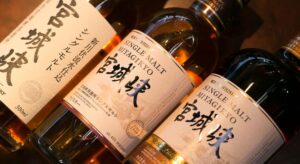
Miyagikyo, established in 1969 near Sendai, was selected for its water and surrounding environment. Its production is associated with lighter, fruitier and more delicate spirit styles.
The contrast between Yoichi and Miyagikyo is useful because it shows why national style alone cannot explain what is in the glass. Distillery design, fermentation, still shape, heating method, cask selection and maturation conditions all contribute to the final character.
Why Japanese single malt tastes the way it does

Japanese whisky is often associated with a combination of fruit, floral notes, spice, subtle smoke and carefully managed oak influence. But there is no single flavour profile that defines Japanese single malt.
Mizunara is one distinctive part of the story. Japanese oak is relatively porous and can be difficult to work with as a cask material. With extended maturation, mizunara can contribute aromas often compared with sandalwood, incense, coconut and spice, although its influence varies substantially according to the cask and maturation conditions.
Factors such as whether the cask is new or refill, the age and seasoning of the oak, cask size, toast or char level, maturation length and warehouse conditions can all affect the result. Mizunara is also only one of several cask types used by Japanese distilleries, alongside ex-bourbon, sherry and other wine-seasoned casks.
Climate can also influence maturation. Japan experiences substantial seasonal variation, and some maturation environments are considerably warmer or more humid than those traditionally associated with Scotch production. These conditions can affect evaporation, extraction and interaction between spirit and wood, potentially increasing the rate at which certain maturation characteristics develop.
That does not mean Japanese whisky universally “matures faster”, however. Fermentation, yeast, distillation cuts, still geometry, reflux, condenser design, cask history and warehouse conditions all play a role. Age is therefore only one part of understanding how mature a whisky tastes.
Production philosophy is another important difference. Historically, Japanese distilleries have often aimed to produce a broad range of spirit styles within their own production systems, particularly to supply their own blends. Different still shapes, fermentation regimes, yeasts and cask types can therefore create significant variation within one producer.
That internal diversity can also be seen in Japanese single malts, where the character of an individual distillery may be more useful to a drinker than the idea of one uniform “Japanese” flavour.
How the rules differ across five whisky traditions
The five traditions compared here do not have equivalent legal definitions. Some are governed by detailed statutory or regulatory standards, while others rely more heavily on voluntary industry standards or established trade usage.
Scotch
Single Malt Scotch Whisky has a detailed legal definition. It must be produced at a single distillery from water and malted barley, without other cereals, and distilled in batches using pot stills. Scotch Whisky must also be matured in Scotland in oak casks of no more than 700 litres for at least three years and bottled at a minimum of 40% ABV.
Irish whiskey
Irish whiskey is also governed by geographical and production requirements, including a minimum maturation period of three years. The broader Irish whiskey rules cover several styles, so the precise requirements depend on the category being discussed.
Japan
Under the voluntary Japanese whisky standard introduced by the Japan Spirits & Liqueurs Makers Association in 2021, qualifying Japanese whisky must be produced and matured in Japan, with at least three years’ maturation in wooden casks no larger than 700 litres and bottling in Japan at a minimum of 40% ABV.
Unlike the Scotch single-malt definition, the Japanese standard does not require batch distillation in copper pot stills. However, it applies to Japanese whisky generally rather than establishing a separate legal definition of Japanese single malt.
United States
American Single Malt Whisky now has a federal standard of identity. Effective from January 19, 2025, it must be made from a fermented mash of 100% malted barley; mashed, distilled and aged in the United States; distilled entirely at one US distillery; distilled at no more than 160 proof; and stored in oak containers with a maximum capacity of 700 litres. It must be bottled at no less than 80 proof, or 40% ABV. Caramel colouring is permitted when its use is disclosed on the label. There is no general minimum maturation period for the category, although the word “straight” requires at least two years of ageing.
Australia
Australia does not currently have a dedicated national definition of Australian single malt equivalent to the Scotch or American standards. Australian whisky is instead governed by broader spirits and excise requirements alongside industry practice.
There is, however, a two-year maturation requirement for whisky manufactured in Australia before it can be released from excise control. That is not the same thing as creating a dedicated Australian single-malt category.
The important point is that these five traditions should not be presented as though they operate under one common international rulebook. Their legal status and terminology differ considerably.
Where Japanese single malt sits in the wider whisky world

Japanese single malt makes more sense when viewed as part of a global category rather than as one of a fixed number of officially recognised whisky traditions.
Scotch provides an important historical reference point, particularly because of the influence of Scottish production techniques on early Japanese whisky. But Japanese distilleries have developed their own approaches to spirit production, blending and maturation.
A useful way to explore those differences is through a side-by-side tasting. Start with a Japanese single malt alongside a Scotch single malt, then compare aroma, texture, fruit character, oak influence, smoke and finish rather than trying to decide which country produces the “better” whisky.
A structured tasting method can help. Nose each whisky first, take a small sip, assess the palate and finish, then add a few drops of water and repeat the process. This makes differences in cask influence and distillery character easier to identify. For more detail, see this guide to tasting whisky.
Price is another practical consideration. Age-stated Japanese single malts can be expensive because international demand increased rapidly while older stocks were limited. That makes direct comparisons with similarly priced Scotch or American whisky difficult.
No-age-statement bottles can offer a more accessible introduction, while younger or newer Japanese distilleries provide another way to explore the country’s expanding whisky scene without relying solely on historic names.
The most useful question is therefore not whether Japanese single malt is better than Scotch, Irish, American or Australian whisky. It is what each production tradition, distillery and cask combination brings to the glass.
Frequently asked questions
Is Japanese whisky just a copy of Scotch?
No. Scotch production had a major influence on the foundations of Japanese whisky, particularly through Masataka Taketsuru’s studies in Scotland. Japanese producers subsequently developed their own approaches to fermentation, distillation, blending and maturation, using Japanese ingredients, production environments and cask types.
What is a good Japanese single malt to try first?
Miyagikyo can be a useful starting point for drinkers who prefer lighter, fruitier and more delicate whisky styles. Yoichi provides a contrasting experience, with a more robust character and a reputation for smoky and maritime notes.
There is no objectively best starting point, though. The better choice depends on whether you normally prefer floral, fruity, smoky, spicy or heavily oak-influenced whisky.
Does Japanese single malt have to be aged three years?
The Japanese whisky standard requires qualifying Japanese whisky to be matured in wooden casks in Japan for at least three years. It is important to describe this accurately: the standard governs the broader “Japanese whisky” designation and is a voluntary industry standard, rather than a separate statutory definition of Japanese single malt.
Why is Japanese single malt so expensive?
Some well-known Japanese single malts became highly sought after internationally while older stocks remained limited. That combination of demand and scarcity pushed prices particularly high for established age-stated expressions.
Price is not necessarily a direct measure of quality, however. Younger releases, no-age-statement whiskies and bottles from newer Japanese distilleries can provide a more practical way to explore the country’s whisky landscape.
How should you compare Japanese single malt with Scotch?
Taste them side by side rather than relying on national stereotypes. Compare the nose, texture, fruit and floral notes, smoke, oak influence and length of finish. Adding a few drops of water to each can also reveal different aromatic characteristics. The aim is not to identify a winner, but to understand how production choices and maturation create different styles.




Comments