





Maturibayashi watermelon is a large, sweet Japanese melon known for its crisp texture and rich flavor. It shows up every summer in Japanese markets, and people look forward to it all year. You may never have heard of it before. But one cold slice on a hot August afternoon changes that quickly.
This is not a casual fruit. The Maturibayashi watermelon comes from decades of careful Japanese plant breeding. The goal was to create something that truly delivers on every front: sweetness, texture, aroma, and appearance.
Basic Information: What Makes Maturibayashi Special?
The name “Maturibayashi” (祭ばやし) draws from the Japanese word for festival music. That cheerful origin fits the fruit perfectly. Eating it feels like a small celebration.
Hagiwara Farm, a seed company based in Nara Prefecture, developed the Maturibayashi series. The company has spent over a century as a pioneer in Japanese watermelon breeding. Their focus was always the same: push flavor and texture to their natural peak.
The Maturibayashi series now includes several sub-varieties. Each one targets a slightly different growing season or regional climate. The most well-known member is the Maturibayashi 777 watermelon.
Why Is Maturibayashi So Famous?
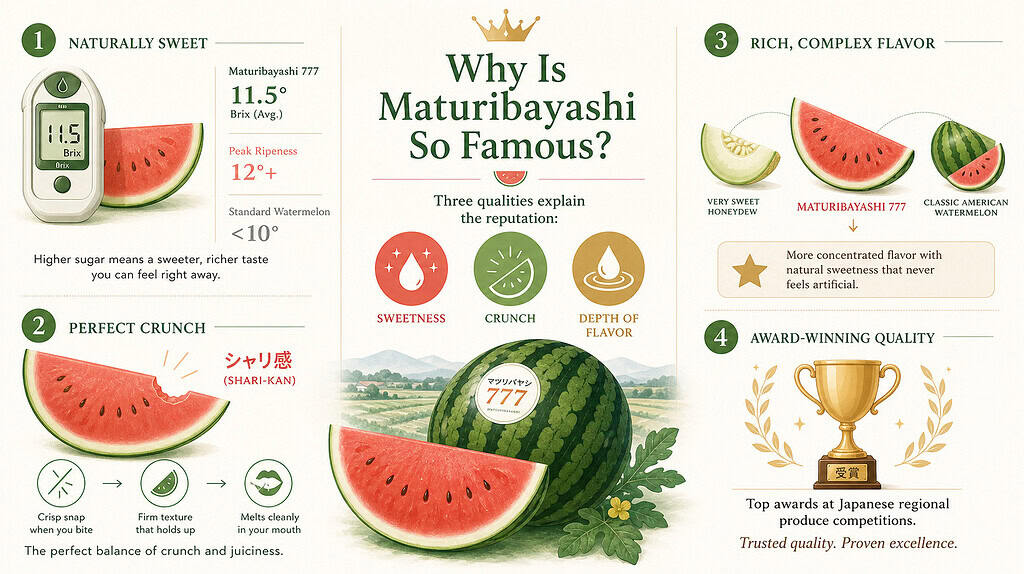
Three qualities explain the reputation: sweetness, crunch, and depth of flavor.
The average sugar content of Maturibayashi 777 sits around 11.5 degrees Brix. Some fruits reach 12 degrees or higher at peak ripeness. Most standard watermelons fall below 10 degrees. That difference shows immediately on your palate.
Japanese fruit fans use the term “shari-kan” (シャリ感) to describe the perfect crisp snap when you bite into watermelon flesh. Maturibayashi delivers that snap consistently. The texture is firm yet dissolves cleanly in your mouth.
The flavor also carries unusual depth. Think of it as something between a very sweet honeydew and a classic American watermelon, but more concentrated. That comparison surprises many people, because the sweetness never feels artificial or cloying.
It is also worth noting that Maturibayashi 777 won top awards at Japanese regional produce competitions. That recognition matters in a country where fruit quality standards are extremely high.
Maturibayashi Characteristics: Taste, Texture, and Appearance
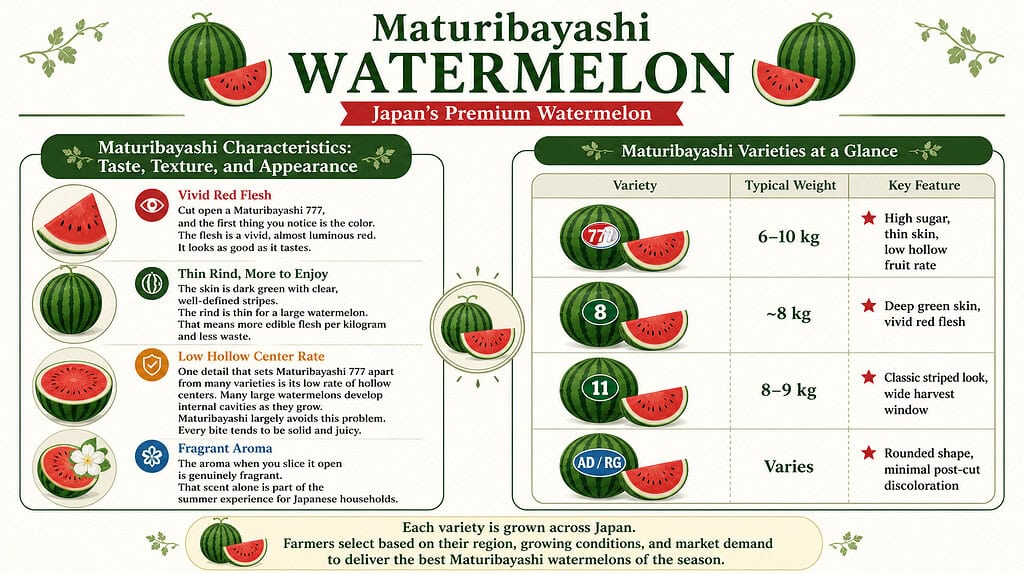
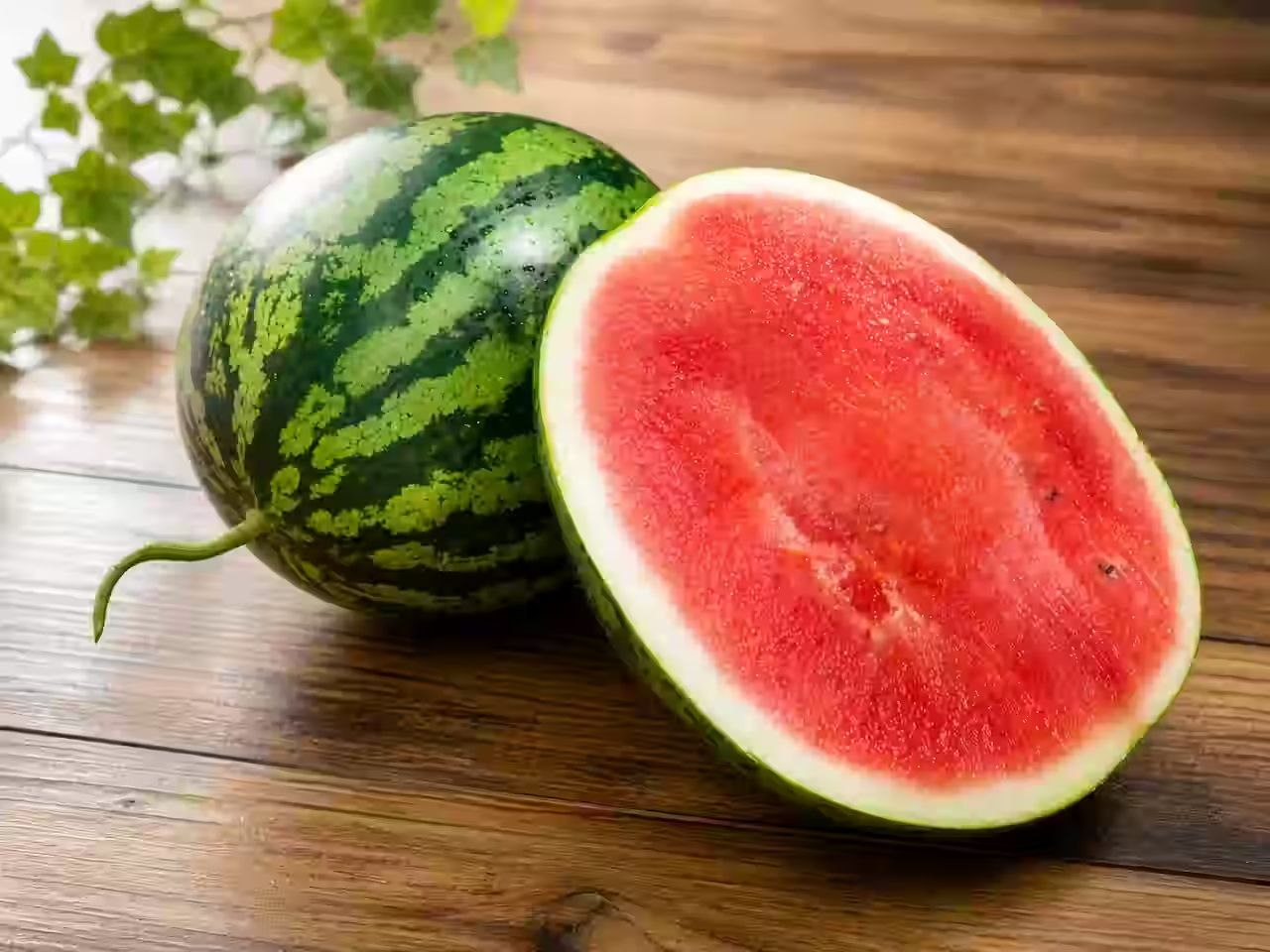
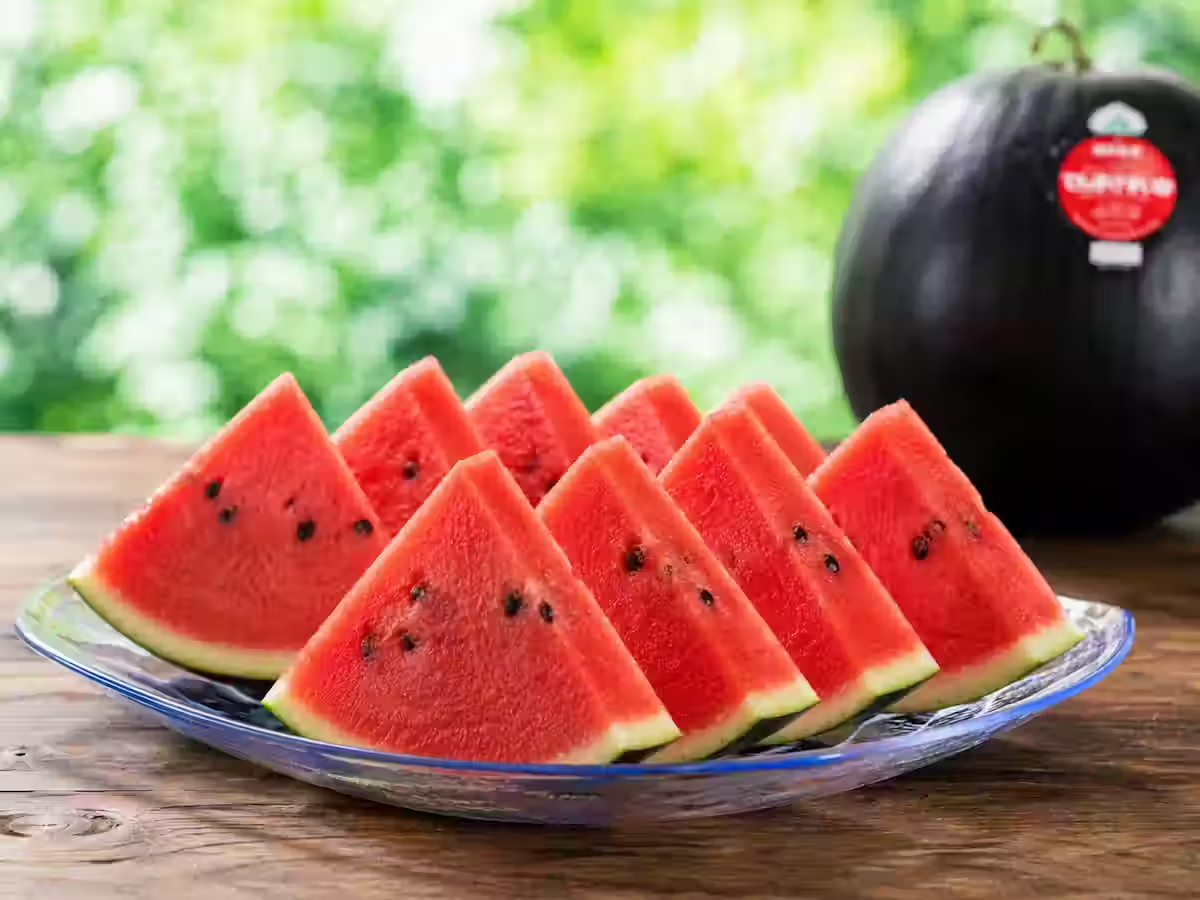
Cut open a Maturibayashi 777, and the first thing you notice is the color. The flesh is a vivid, almost luminous red. It looks as good as it tastes.
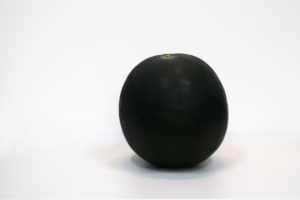
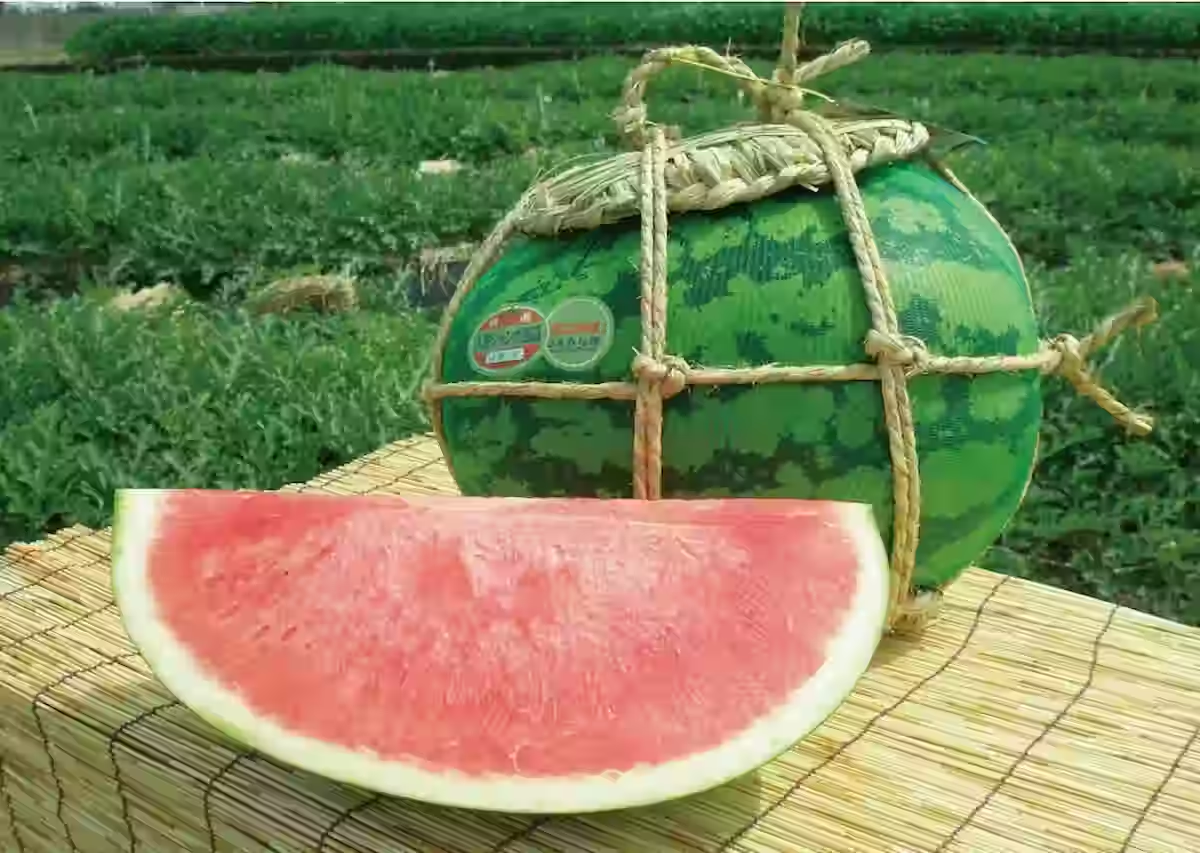
The skin is dark green with clear, well-defined stripes. The rind is thin for a large watermelon. That means more edible flesh per kilogram and less waste.
One detail that sets Maturibayashi 777 apart from many varieties is its low rate of hollow centers. Many large watermelons develop internal cavities as they grow. Maturibayashi largely avoids this problem. Every bite tends to be solid and juicy.
The aroma when you slice it open is genuinely fragrant. That scent alone is part of the summer experience for Japanese households.
Maturibayashi Varieties at a Glance
| Variety | Typical Weight | Key Feature |
|---|---|---|
| Maturibayashi 777 | 6–10 kg | High sugar, thin skin, low hollow fruit rate |
| Maturibayashi 8 | ~8 kg | Deep green skin, vivid red flesh |
| Maturibayashi 11 | 8–9 kg | Classic striped look, wide harvest window |
| Maturibayashi AD / RG | Varies | Rounded shape, minimal post-cut discoloration |
Each variety is grown across Japan. Farmers select based on their region, growing method, and target season. Consumers, however, tend to ask for Maturibayashi 777 by name.
The Summer Experience: How Japanese People Enjoy Maturibayashi
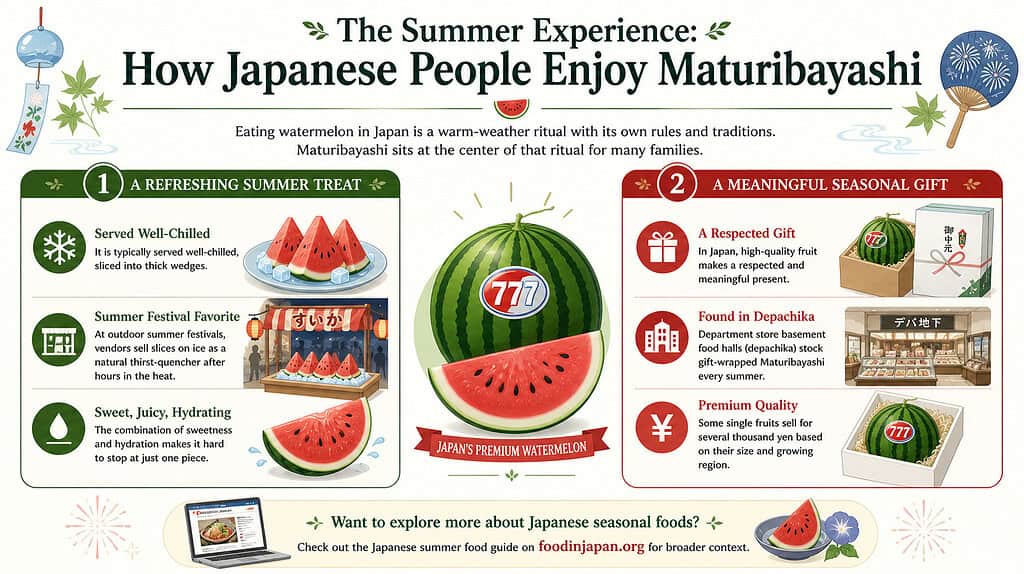
Eating watermelon in Japan is a warm-weather ritual with its own rules and traditions. Maturibayashi sits at the center of that ritual for many families.
It is typically served well-chilled, sliced into thick wedges. At outdoor summer festivals, vendors sell slices on ice as a natural thirst-quencher after hours in the heat. The combination of sweetness and hydration makes it hard to stop at just one piece.
Premium Maturibayashi watermelons also serve as seasonal gifts. In Japan, high-quality fruit makes a respected and meaningful present. Department store basement food halls (called depachika) stock gift-wrapped Maturibayashi every summer. Some single fruits sell for several thousand yen based on their size and growing region.
If you want to explore more about how seasonal fruit fits into Japanese food culture, check out the Japanese summer food guide on foodinjapan.org for broader context.
History and Origins of the Maturibayashi Watermelon
Japan’s relationship with watermelons goes back centuries. The fruit likely arrived from China around the Heian period (roughly the 10th century). By the Edo period, agricultural texts from the 1690s already described multiple watermelon varieties under cultivation across the country.
Serious modern breeding began in Nara Prefecture in the early 20th century. Organizations like the Nara Prefectural Agricultural Experiment Station started systematic improvement programs in the 1920s. Hagiwara Farm continued and expanded this tradition through the following decades.
The company’s mission was not just to grow bigger watermelons. It aimed to grow better ones. The Maturibayashi series emerged from that philosophy. The name itself reflects the celebration the breeders hoped the fruit would bring.
Today, Maturibayashi grows across many Japanese prefectures. Kumamoto, Yamagata, Chiba, and Niigata are among the main production areas. Kumamoto, in particular, produces highly regarded specimens. The region’s warm climate and skilled growers create ideal conditions for large, flavorful fruit.
For more on Japan’s regional produce traditions, the Japanese food by prefecture guide at foodinjapan.org offers a useful starting point.
Nutrition and Calories: Is Maturibayashi Watermelon Good for You?
Maturibayashi watermelon is about 90% water. That makes it an outstanding choice for summer hydration. A 100-gram serving contains roughly 37 kilocalories. It is one of the more guilt-free fruits available.
Key nutrients inside Maturibayashi watermelon include:
- Citrulline – an amino acid that supports healthy blood circulation
- Lycopene – an antioxidant associated with heart and cellular health
- Potassium – helps regulate blood pressure
- Vitamin C and beta-carotene – support immune function and skin health
Even the white rind close to the outer skin contains citrulline. Japanese cooks sometimes pickle or stir-fry the rind rather than discarding it. Nothing goes to waste.
How to Choose a Good Maturibayashi Watermelon
Picking the right one is both a skill and an instinct. A few reliable signals help.
Look for deep green skin with sharp, clearly defined stripes. The fruit should feel heavy relative to its size. Pick it up and assess the density before buying.
Tap the rind gently with your knuckle. A deep, slightly hollow sound suggests ripe flesh inside. A flat, dull thud can indicate over-ripeness.
Check the stem end. A small, dried, slightly curled tendril near the stem suggests the fruit ripened naturally on the vine. A fresh green stem sometimes means early harvesting.
The best time to eat Maturibayashi in Japan is from late April through July. That window marks the peak of sweetness and texture. After July, quality can vary depending on region and growing conditions.
Where Can You Buy Maturibayashi Watermelon?
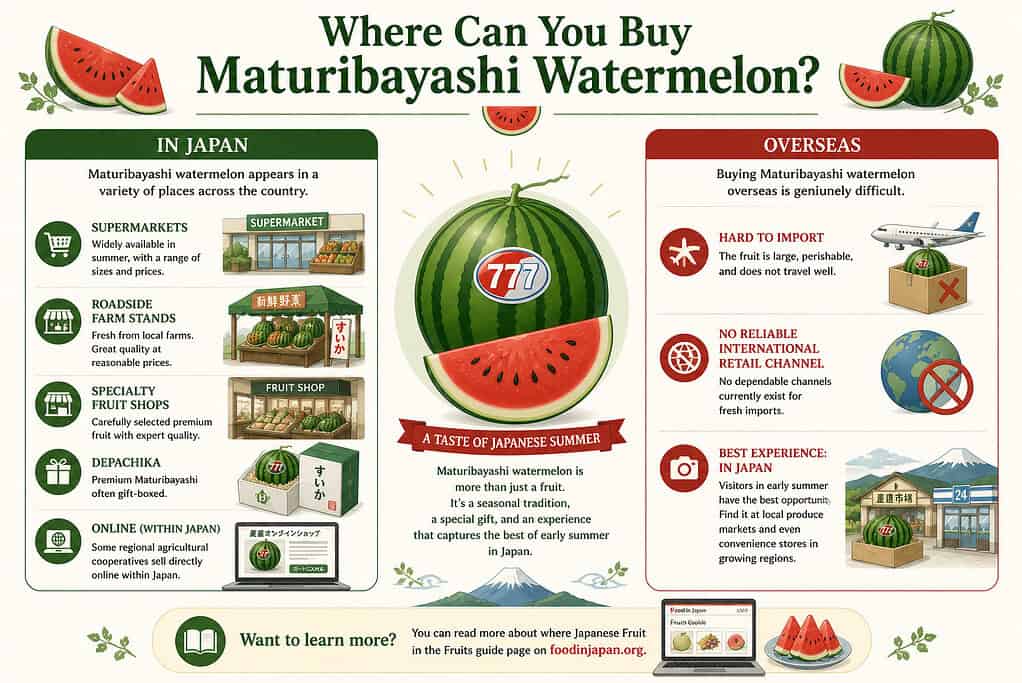
Inside Japan, Maturibayashi watermelon appears at supermarkets, roadside farm stands, and specialty fruit shops. Depachika carry premium versions, often gift-boxed. Some regional agricultural cooperatives also sell directly online within Japan.
Buying Maturibayashi watermelon overseas is genuinely difficult. The fruit is large, perishable, and does not travel well. No reliable international retail channel currently exists for fresh imports.
Visitors traveling to Japan in early summer have the best opportunity. Local produce markets and even convenience stores in growing regions sometimes carry it at accessible prices. The experience of trying it fresh in Japan is worth planning around.
You can read more about where Japanese Fruit in the Fruits guide page.
Maturibayashi Watermelon FAQ
What is Maturibayashi Watermelon?
It is a premium summer fruit from Japan. Farmers grow it to produce a large, perfectly round shape with dark green stripes. Food lovers know it for its incredibly crisp texture and intense sweetness.
Where does Maturibayashi Watermelon come from?
This premium variety originates from Japanese agricultural researchers. Dedicated farmers cultivate it today in major agricultural regions like Kumamoto, Chiba, and Niigata prefectures.
What does Maturibayashi Watermelon taste like?
It delivers a rich, refreshing, and deeply sweet flavor. The bright red flesh feels remarkably crisp and juicy. Diners often compare it to drinking cold, natural sugar water with a satisfying crunch.
Where can I eat Maturibayashi Watermelon in Japan?
You will find the best ones at upscale supermarkets and department stores all over Japan during the summer. High-end fruit parlors in Tokyo also slice and serve this refreshing treat in seasonal desserts.
How much does Maturibayashi Watermelon cost?
A whole fruit typically costs between 2,000 and 5,000 yen. Prices vary depending on the size, sugar content, and the specific farming region.
Is Maturibayashi Watermelon vegetarian or vegan friendly?
This natural crop contains absolutely no animal products. Vegans and vegetarians can safely enjoy this 100% plant-based summer fruit anywhere.
What are the main ingredients in Maturibayashi Watermelon desserts?
The main ingredients in seasonal fruit bowls include this fresh red flesh, mint leaves, and ice. The intensely sweet juice gives summer treats a distinctive cooling effect.
Can I eat Maturibayashi Watermelon at home?
Yes, you can easily enjoy it at home. Japanese grocery stores stock massive piles of them during July and August. Home cooks simply chill the whole fruit, slice it into thick wedges, and eat it fresh.
What is the difference between Maturibayashi Watermelon and regular watermelons?
The main difference involves the texture and the internal quality. This specific Japanese breed features a dense, highly crisp center without empty gaps, while regular varieties often develop mushy or hollow centers.
Is Maturibayashi Watermelon popular outside Japan?
It remains relatively rare outside Japan. You will rarely find this specific branded seed variety at grocery stores in North America or Europe. This premium crop successfully maintains its prestigious status completely within the Japanese domestic market.
References
- Hagiwara Farm, Official Maturibayashi Variety Page, suika-net.co.jp, accessed 2025: https://suika-net.co.jp/user_data/maturibayashi
- Sanchoku Prime, Matsuribayashi Watermelon Variety Profile (sugar content data: avg. 11.5°Brix; growing regions: Kumamoto, Yamagata, Chiba, Niigata), accessed 2025: https://sanchoku-prime.com/fruits-note/watermelon/matsuribayashi
- E-Taneya, Maturibayashi 777 Seed Product Page (weight range and flesh characteristics), accessed 2025: https://www.e-taneya.com/item/5905.html
- Mynavi Agriculture, Japanese Watermelon Varieties Overview (sugar data and variety comparison), 2024: https://agri.mynavi.jp/2024_09_04_278596/
- Kiyokawaya, Yamagata Watermelon Production Guide (annual production ~32,400 tons in Yamagata), 2025: https://www.kiyokawaya.com/yamagata/43497/
- Suika Club, History of Watermelon in Japan (Meiji-era breeding history and modern variety development), accessed 2025: https://suika-club.com/knowledge/history/
- Watermelon Growing Guide (suika-ikusekata.com), Maturibayashi Series Overview, accessed 2025: https://xn--m9jp5n2a9d8536b7pvb.com/スイカの品種/祭ばやしシリーズ.html




Comments