





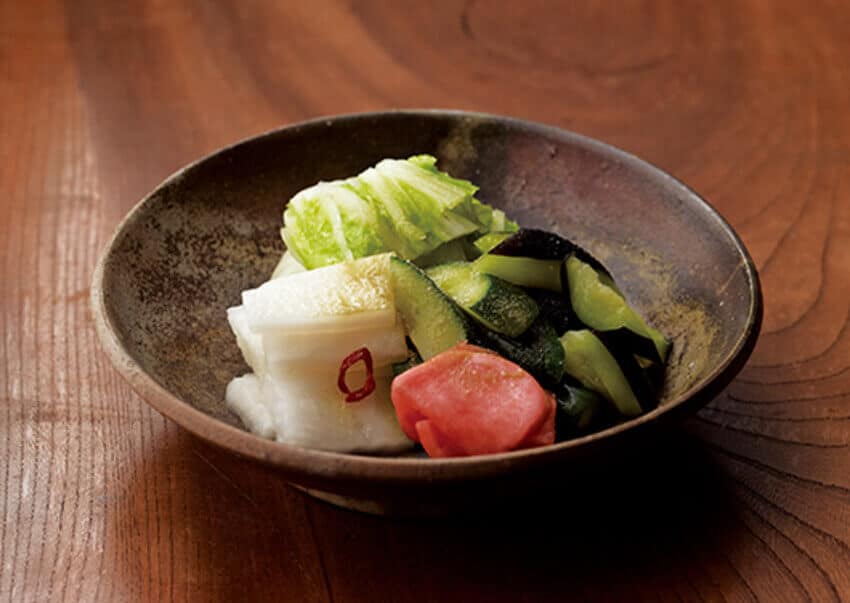
Asaduke (浅漬け) is Japan’s simplest pickle. Home cooks salt vegetables, wait a few hours, and serve them the same day. There is no fermentation, no special equipment, and no long wait. In fact, if you are curious about Japanese pickles but not sure where to start, this is the style most Japanese households make before dinner.
What Is Asaduke?
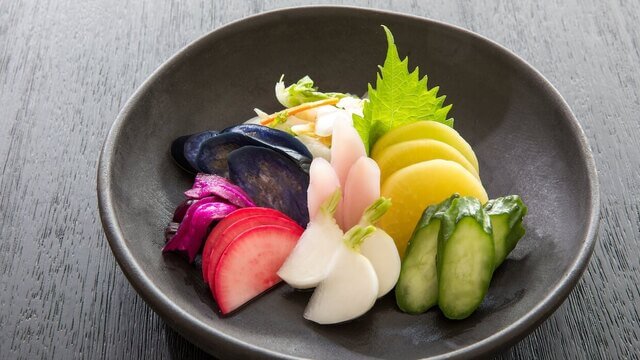
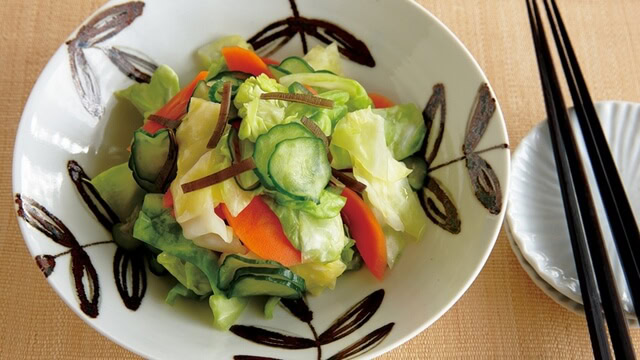
Asaduke is a sub-category of Japanese pickles (Tsukemono). The name literally means “shallow pickle.” In contrast to traditional pickles that ferment for days or weeks, asaduke soaks vegetables for only a few hours. As a result, salt draws moisture from the vegetables and softens them slightly, while the natural flavour stays fresh and clean.
People also call it asazuke, instant pickles, one-night pickles, or oshinko. The taste is mild and lightly salty. Moreover, there is no sour fermentation note, which makes asaduke one of the most approachable pickles for people new to Japanese food.
A Short History of Asaduke
Pickling in Japan goes back at least to the Nara period (710–794 CE). People preserved vegetables in salt and vinegar long before refrigeration existed. Back then, pickling was about survival, not flavour. Because of this, high-salt methods kept food edible for months.
By the Edo period (1603–1868), pickles became part of everyday culture. Households kept jars on hand at all times. Even so, most everyday pickles were still heavily salted. Lightly pickled preparations like asaduke existed; however, they were less common because they did not last long without cold storage.
Everything changed when refrigerators became standard in Japanese homes during the 1960s and 1970s. Suddenly, a pickle that lasted only a day or two in the fridge was perfectly practical. As a result, home cooks embraced asaduke because it was fast, fresh-tasting, and easy to adjust to personal preference. Today, it is one of the most common side dishes in a Japanese household.
Which Vegetables Work Best?
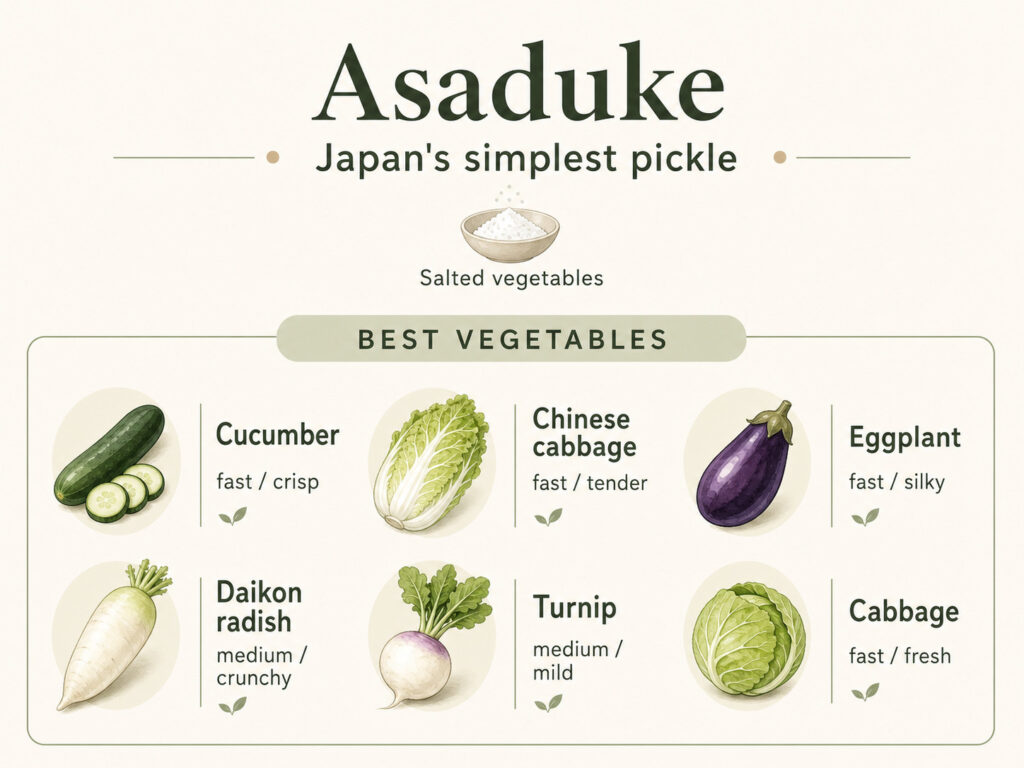
Almost any vegetable works, but some suit the short pickling time better than others. For example, cucumbers and eggplant are classic summer choices. Their relatively high water content means they absorb salt quickly and turn pleasantly soft within a few hours. Similarly, Chinese cabbage and regular cabbage pickle fast and stay crunchy. Daikon and turnips take a little longer but develop a satisfying firm bite.
Less common options include celery, okra, carrot, and even mild melons. For instance, in the Nishi-Harima area of Hyogo Prefecture, petchinguwa melon asaduke is a regional specialty. The point is that asaduke is flexible. Therefore, most home cooks use whatever vegetables are in season or left over in the fridge.
Popular Vegetables at a Glance
| Vegetable | Pickling time (rough guide) | Texture result |
| Cucumber | 30 min – 2 hours | Crisp, refreshing |
| Chinese cabbage | 1 – 3 hours | Tender, juicy |
| Eggplant | 1 – 3 hours | Soft, silky |
| Daikon radish | 2 – 4 hours | Firm, crunchy |
| Turnip | 2 – 4 hours | Crisp, mild |
| Cabbage | 1 – 2 hours | Crunchy, fresh |
Taste and Texture
The flavour of asaduke is subtle. Salt brings out the natural sweetness of the vegetable without covering it. In addition, there is no sour note and no fermented smell. The texture stays much closer to fresh than to a traditional pickle — crunchy vegetables remain crunchy, while soft vegetables turn just slightly tender.
Japanese people often serve asaduke as a palate cleanser alongside rice. It is cool, light, and clean-tasting, which makes it a natural contrast to rich dishes like teriyaki or karaage. For extra depth, some home cooks add kombu strips, yuzu peel, or dried chilli. Even then, the overall character stays mild.
How to Make Asaduke at Home
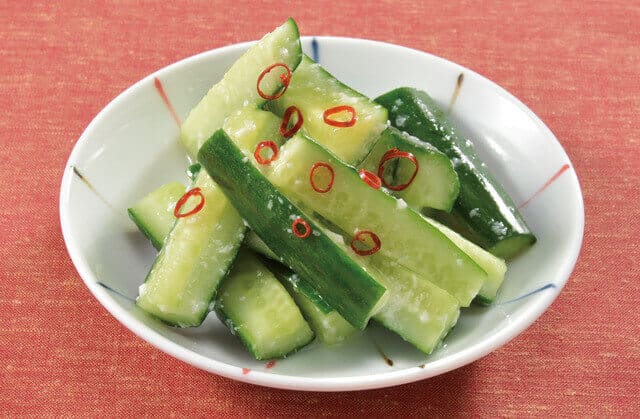
Making asaduke at home is straightforward. In fact, most households skip commercial pickle bases entirely and use only salt. The method below uses 500g of vegetables and 10g of salt, which gives a 2% salt ratio. That balance keeps the result pleasantly seasoned without becoming too salty, and you can scale the quantities up or down easily.
Ingredients
Ingredients (serves 2–3)
Vegetables of your choice: 500g
Salt: 10g (about 2 teaspoons)
Optional additions: a few strips of kombu kelp, dried chilli flakes, yuzu peel, or a splash of rice vinegar
Steps
First, wash the vegetables well and cut them into bite-sized pieces. Cucumbers work well sliced on the diagonal. Similarly, Chinese cabbage cuts nicely into 3–4 cm strips, and daikon suits thin quarter-rounds. Remove any tough stems or seeds as you go.
Next, place the cut vegetables in a zip bag or a bowl. Add 10g of salt (roughly 2% of the vegetable weight) and gently massage it in. At this stage, add your optional flavourings — a strip or two of kombu works especially well for a vegetarian or vegan version, since it adds natural umami without any fish-based dashi. Finally, seal the bag or press cling wrap directly onto the surface.
Then, refrigerate for at least 30 minutes for cucumbers, or 2–4 hours for firmer vegetables like daikon. Taste as you go — because the longer it sits, the saltier it becomes. Once done, squeeze out the excess liquid before serving. As a result, asaduke keeps well in the fridge for 1–2 days. After that, the texture softens too much and the saltiness intensifies, so it is best eaten fresh.
Nutritional Value and Health Benefits
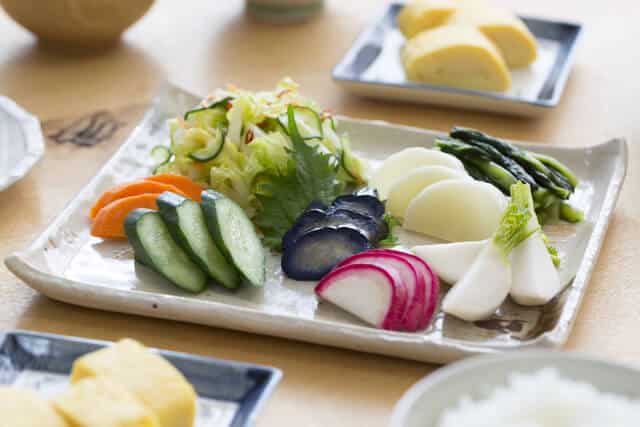
Because asaduke uses no heat, the vegetables retain most of their natural vitamins and minerals. That is one practical reason Japanese nutritionists often mention it as a good side dish. It is not a health food in any dramatic sense; however, it does add nutrients without much effort or cost.
- Vitamin C survives the short pickling time and supports immune function and skin health.
- Dietary fibre from cucumber, cabbage, and daikon helps digestion and gut health.
- Potassium helps the body regulate sodium levels, which is useful given the salt content of the pickle itself.
- Low in calories: most asaduke servings contain fewer than 20 calories per 50g portion.
One thing to watch, however, is overall salt intake. While asaduke uses far less salt than traditional pickles, eating large amounts every day adds up. Fortunately, squeezing out excess liquid before serving reduces the sodium content noticeably.
How Long Does Asaduke Keep?
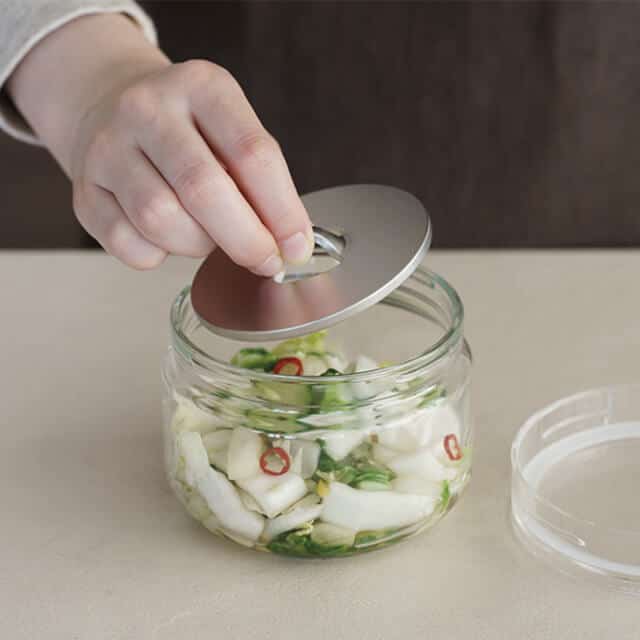
Store asaduke in an airtight container in the refrigerator. It stays at its best for 1–2 days. On day two, the vegetables soften further and pick up more salt. By day three, the texture deteriorates and the flavour becomes noticeably sharper. As a result, making smaller batches more often gives better results than making one large batch for the week.
Asaduke vs Other Japanese Pickles
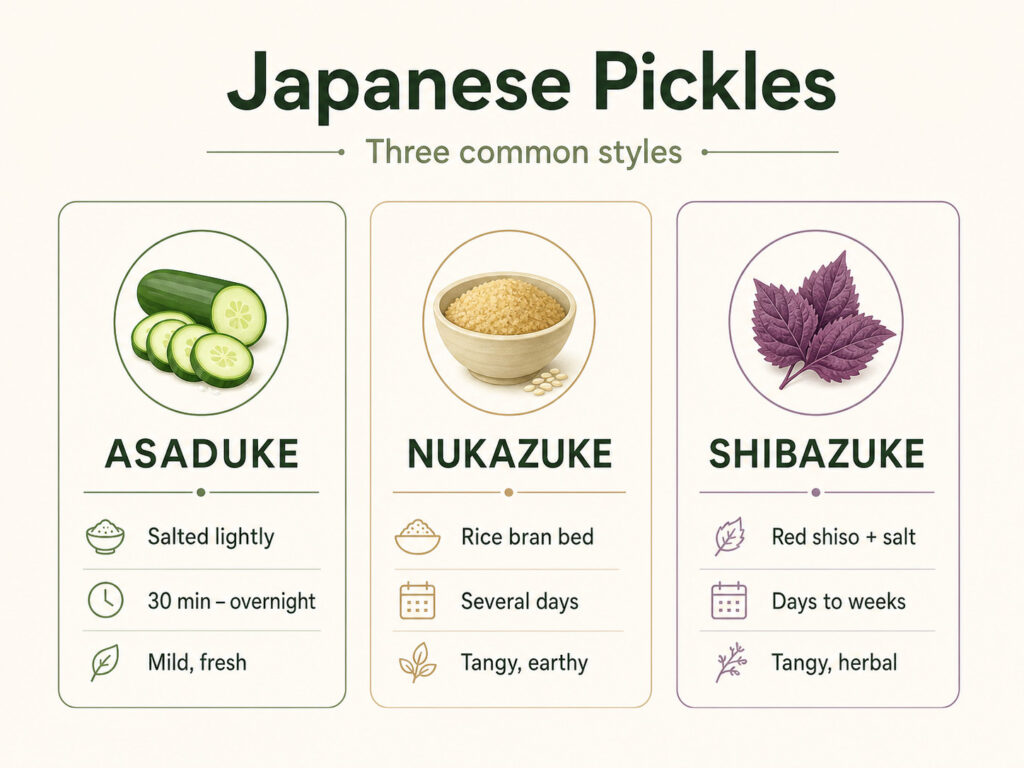
Asaduke is just one style within the broader world of Japanese pickles (Tsukemono). In fact, the differences between styles come down to method, time, and flavour. Here is a quick comparison of the three types visitors to Japan are most likely to encounter.
| Type | Method | Time needed | Flavour | Fermented? |
| Asaduke (浅漬け) | Salt or light seasoning | 30 min – overnight | Mild, fresh, lightly salty | No |
| Nukazuke (糠漬け) | Rice bran bed (nukadoko) | Several days | Tangy, complex, earthy | Yes |
| Shibazuke (柴漬け) | Red shiso and salt | Several days to weeks | Tangy, herbal, vibrant purple-red | Lactic acid fermentation |
Asaduke is the easiest entry point. By contrast, nukazuke rewards patience with a far richer flavour profile. Shibazuke, on the other hand, is Kyoto’s most famous pickle and one of the most visually distinctive in all of Japanese cuisine. Each style has its own character, and therefore many households keep more than one type going at the same time.
Summary
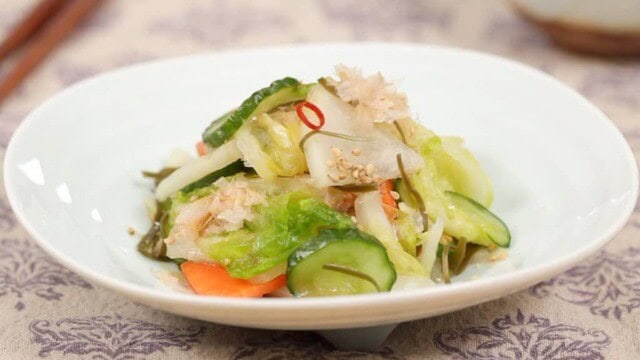
Overall, asaduke is one of the most practical dishes in Japanese home cooking. Many Japanese households prepare it the same evening they plan to eat it. In short, it takes minutes of active work, uses everyday vegetables, and adds freshness to any meal.
Interested in exploring more Japanese pickled dishes? Try Japanese pickles (Tsukemono) for a full overview, or read about Shibazuke and Nukazuke to see how fermented pickles differ from asaduke.
Asaduke FAQ
- What is the difference between asaduke and tsukemono?
-
Tsukemono is the general term for all Japanese pickles. Asaduke is a specific style within that category. The main difference is time: asaduke takes a few hours, while most other tsukemono styles take days, weeks, or longer. Asaduke also involves no fermentation, so the flavour stays mild and fresh rather than sour or complex. Think of tsukemono as the entire family and asaduke as the quickest, lightest member of it.
- Is asaduke high in salt?
-
Asaduke uses far less salt than traditional fermented pickles. A standard home recipe applies about 2% salt by weight, which means roughly 10g of salt per 500g of vegetables. That works out to a modest amount per serving when you consider that home cooks serve it in small portions alongside rice and other dishes. Squeezing excess liquid from the vegetables before serving reduces sodium further. Compared to heavily salted tsukemono like takuan or umeboshi, asaduke is a noticeably lighter option.
- Does asaduke contain any fermentation?
-
No. Asaduke relies entirely on salt to draw moisture from the vegetables and season them. No lactic acid bacteria are involved, so the vegetable sugars do not convert into acid. That means no sour smell and no probiotic benefit. It also means the shelf life is short — only 1–2 days in the refrigerator. If you want the probiotic properties that come with fermented Japanese pickles, nukazuke is the better choice.
- Can vegetarians and vegans eat asaduke?
-
Yes, easily. The basic recipe uses only vegetables and salt, which suits both vegetarian and vegan diets. Many home cooks add kombu (dried kelp) strips for extra umami depth, and kombu is also plant-based. The only thing to watch is whether a store-bought pickle base contains dashi made from fish or bonito. When making asaduke from scratch at home, keeping it fully plant-based requires no special adjustments.
- Why does salt make vegetables pickle so quickly?
-
Salt draws water out of vegetable cells through osmosis. As moisture leaves the cells, the salt and any added seasonings travel inward, flavouring the vegetable from the outside in. Because vegetables have relatively thin cell walls and a high water content, this process happens fast — often in 30 minutes to a few hours. Firmer vegetables like daikon have denser cell structures, so they take a little longer than softer ones like cucumber.
References
- Hatena Blog — Asaduke history and origins (Surveyed: June 2025)
- Wikipedia — Asazuke (Surveyed: June 2025)
- Wikipedia — Tsukemono (Surveyed: June 2025)
Related Articles
- Japanese Pickles (Tsukemono) (Surveyed: June 2025)
- Shibazuke (Surveyed: June 2025)
- Nukazuke (Nukaduke) (Surveyed: June 2025)



Comments