





Japan produces extraordinary fruit. The Konjiki Raou (金色羅皇) golden watermelon sits firmly in that exceptional category. Most people picture watermelons as red inside, with that familiar crunch and mild sweetness. This variety breaks that expectation in every possible way.
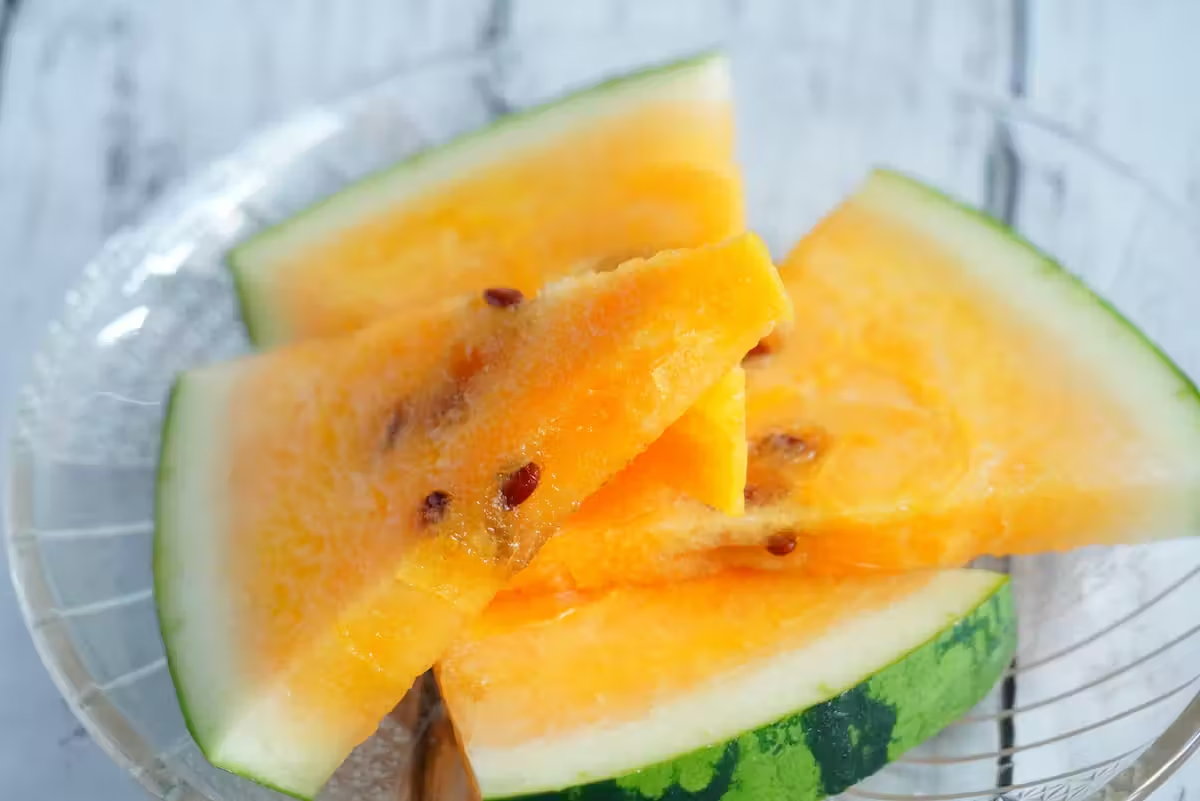
Cut one open and you find dense, amber-gold flesh that almost glows. The sight alone stops most people for a moment. Beyond the color, the sugar content regularly reaches 15 Brix or higher. For comparison, a standard commercial watermelon in Japan typically measures around 11 to 12 Brix. Some individual Konjiki Raou fruits have even exceeded 20 Brix. That level of sweetness is genuinely unusual for any watermelon, regardless of flesh color.
What is Konjiki Raou (金色羅皇)?
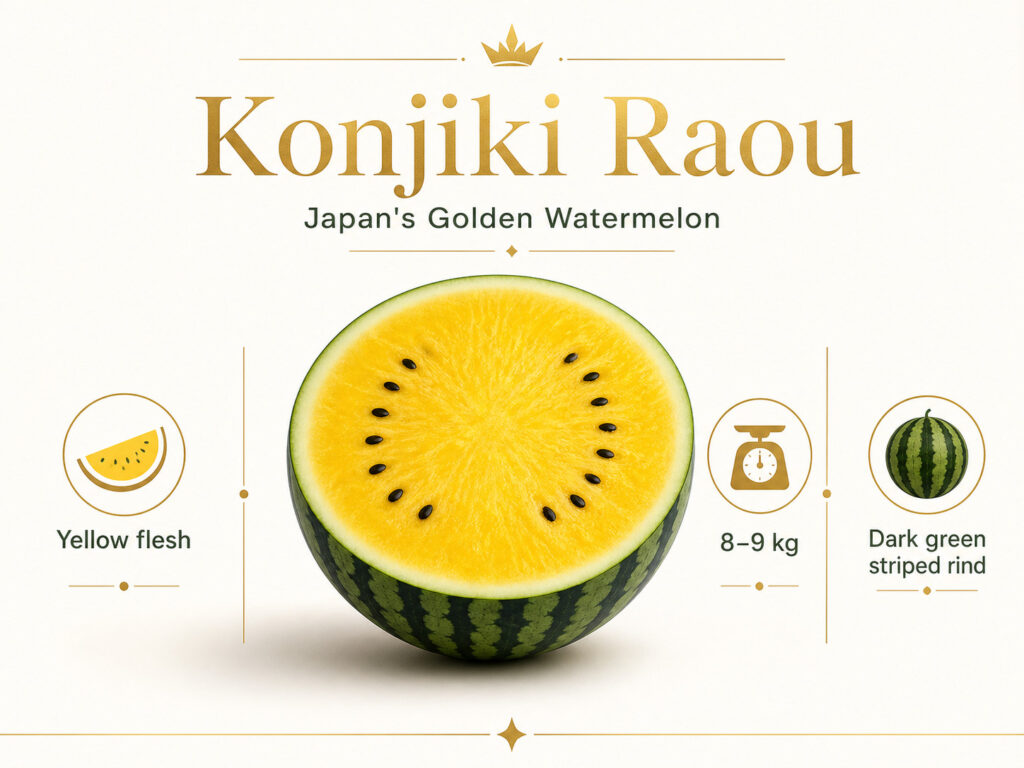
Konjiki Raou, also written 金色羅皇, is a premium Japanese yellow-fleshed watermelon developed by Nanto Seed Co., Ltd., a seed company based in Nara Prefecture. The name translates roughly as “golden-colored emperor,” and the fruit earns that title. It belongs to the large-ball variety, typically weighing 8 to 9 kilograms at maturity.
The outer rind is dark green with deeper green vertical stripes. Nothing about the exterior hints at the golden interior. That contrast between an ordinary-looking shell and the vibrant flesh inside is part of what makes slicing one feel like a small event. For people discovering Konjiki Raou for the first time, the first cut genuinely surprises.
This variety joins a growing collection of luxury Japanese fruits that combine visual impact with exceptional flavor. For context on how Japan approaches premium fruit more broadly, the Japanese fruit guide on Food in Japan covers the wider landscape.
Key Features at a Glance
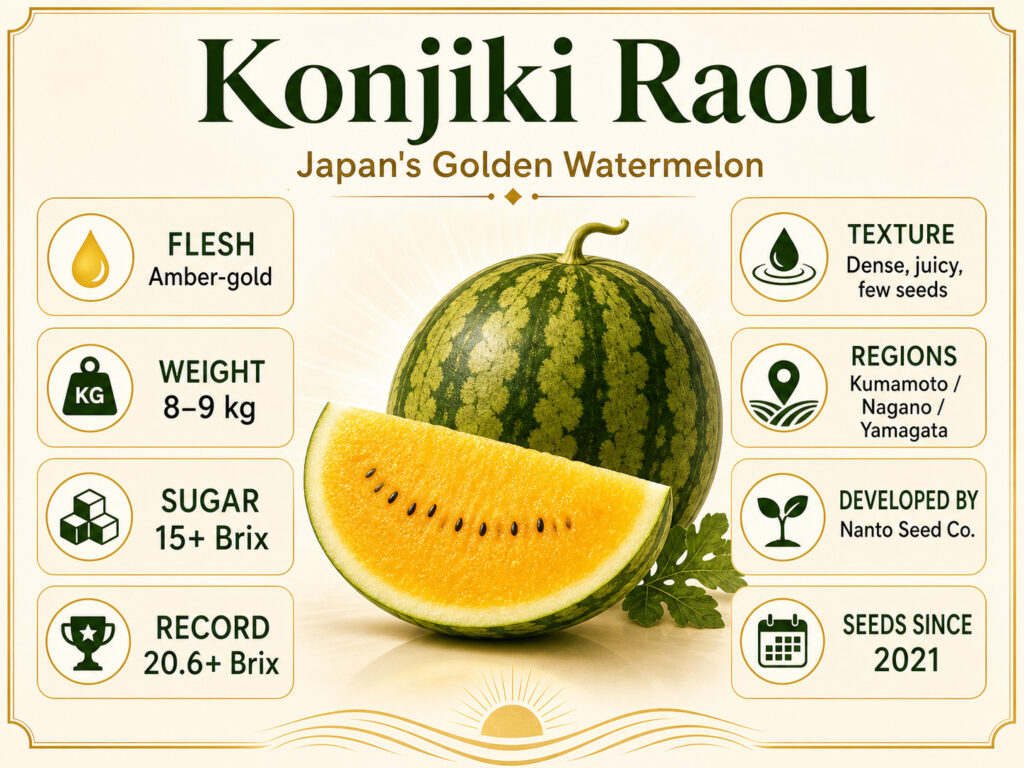
| Feature | Details |
|---|---|
| Japanese name | 金色羅皇 (Konjiki Raou) |
| Flesh color | Amber-gold (yellow-fleshed variety) |
| Average weight | 8 to 9 kg |
| Typical sugar content | 15 Brix or above |
| Record Brix (competition) | Over 20.6 Brix |
| Standard watermelon Brix | Approximately 11–12 Brix |
| Texture | Dense, firm, very juicy; few seeds |
| Main growing regions | Kumamoto, Nagano, Yamagata |
| Developer | Nanto Seed Co., Ltd. (Nara Prefecture) |
| Seeds available from | 2021 |
A Taste Unlike Any Other Watermelon
Eating a Konjiki Raou for the first time tends to surprise people. The sweetness arrives quickly and feels rich rather than thin or watery. Even more striking is the texture. The flesh is notably denser and firmer than most standard red watermelons, which gives each bite a more satisfying weight.
The typical watermelon fragrance is somewhat toned down in this variety. Some tasters find that a welcome change. Instead of a sharp, grassy aroma, the flavor itself takes over. The sweetness is concentrated and clean, without any sour edge. Moreover, very few seeds appear throughout the flesh, which adds considerably to the eating experience.
One account of a Kumamoto-grown 2L specimen tested the sugar content at the core at over 21 Brix. Even near the rind, the border region measured above 9 Brix. That consistency is genuinely notable. Many watermelons drop sharply in sweetness toward the edges. The Konjiki Raou, by contrast, holds its sweetness across a much larger portion of the fruit.
The Story Behind Konjiki Raou: Eight Years of Development
Nanto Seed Co., Ltd. spent eight years developing this variety. Their core goal throughout that process was straightforward but demanding: create a watermelon where taste and sweetness come before everything else. No compromise. Just flavor.
That commitment paid off. In 2020, Nanto Seed filed a Plant Variety Protection application for the Konjiki Raou. Commercial seed sales launched in 2021. By 2022, the variety had gained enough recognition for the company to organize the Konjiki Raou Grand Prix, a competition inviting growers across Japan to submit their harvest Brix readings.
The contest ran from May to August 2022. The record-breaking submission that year reached 20.6 Brix, a benchmark the variety is now associated with. Interestingly, some early high Brix readings came not from large commercial farms but from a staff member’s home garden at Nanto Seed. That employee recorded 15.8 Brix without professional growing conditions. The story adds a certain charm to the variety’s early reputation.
Before the Konjiki Raou, yellow-fleshed watermelons in Japan were often considered the sweeter-looking but lower-flavored option compared to red varieties. This variety changed that assumption. Some fruit industry observers now describe it as a genuinely “revolutionary watermelon,” and that description feels earned rather than promotional.
Where It Grows: Kumamoto, Nagano, and Yamagata
Kumamoto Prefecture leads watermelon production across Japan and forms the primary growing base for Konjiki Raou cultivation. Greenhouse farms in Kumamoto produce fruits available in shops from May to June. A second harvest window runs from October to December. That means Kumamoto alone provides two seasonal opportunities per year to find fresh Konjiki Raou.
Beyond Kumamoto, growers in Nagano and Yamagata cultivate the variety during summer months, typically from June through August. Both regions benefit from notable daily temperature swings between day and night, which concentrate sugars in fruit effectively. Yamagata in particular carries the informal title of Japan’s “Fruit Kingdom,” and for good reason. Those temperature variations help explain why watermelons from the region consistently score well in sweetness.
As seed availability has expanded, more farms across Japan have started growing the Konjiki Raou. The variety has also proven resilient in home garden settings, which has broadened interest beyond commercial agriculture.
Konjiki Raou as a Premium Japanese Fruit Gift
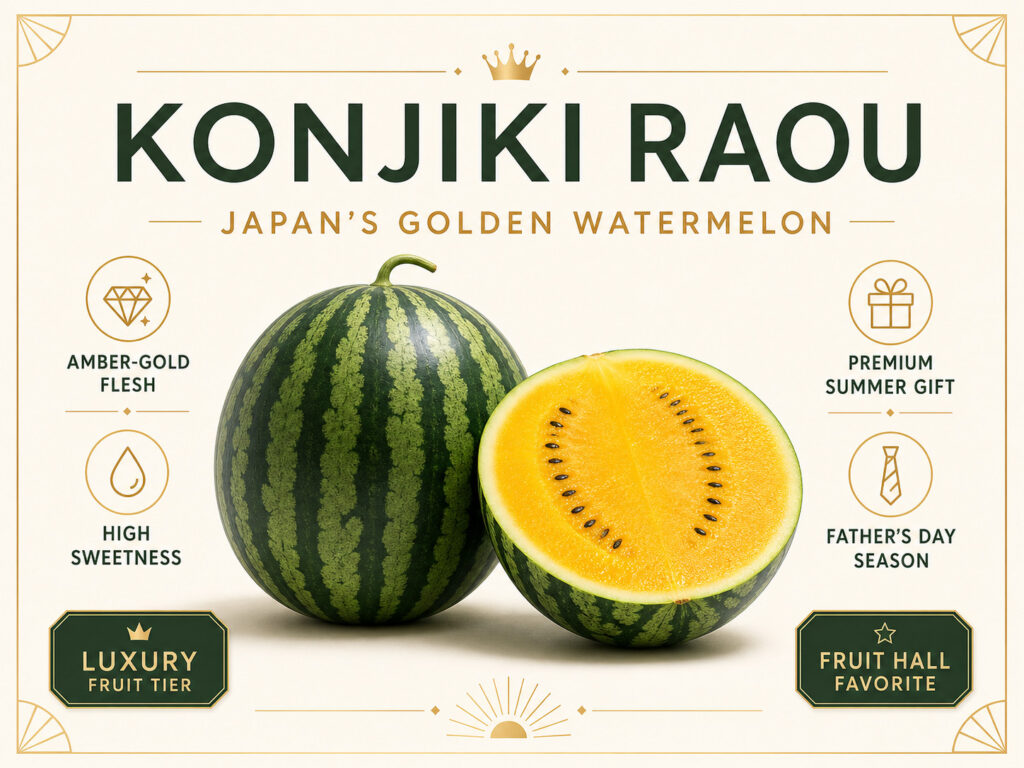
Japan has a deeply embedded culture of seasonal fruit gifting. Premium watermelons occupy a special place in summer gift-giving, particularly around Father’s Day in June. The Konjiki Raou fits this tradition almost perfectly.
When sliced open at a gathering, the amber-gold interior creates real visual impact. That moment, combined with the sweetness that follows, makes for a genuinely memorable gift. As a result, luxury fruit shops and high-end department store food halls now carry the Konjiki Raou during peak season. Some high-end restaurants also feature it on summer dessert menus.
Prices vary depending on size and origin, but expect to pay considerably more than for a standard supermarket watermelon. The Konjiki Raou occupies a similar cultural tier to other Japanese luxury fruits. The Densuke watermelon from Hokkaido, for instance, holds a comparable position in Japan’s premium fruit market. However, the Konjiki Raou stands apart as a yellow-fleshed option with an extraordinarily high sugar ceiling. The Yuubari melon is another useful comparison point for understanding how Japan values sweetness, presentation, and regional identity in premium fruit.
Konjiki Raou vs. Other Watermelons
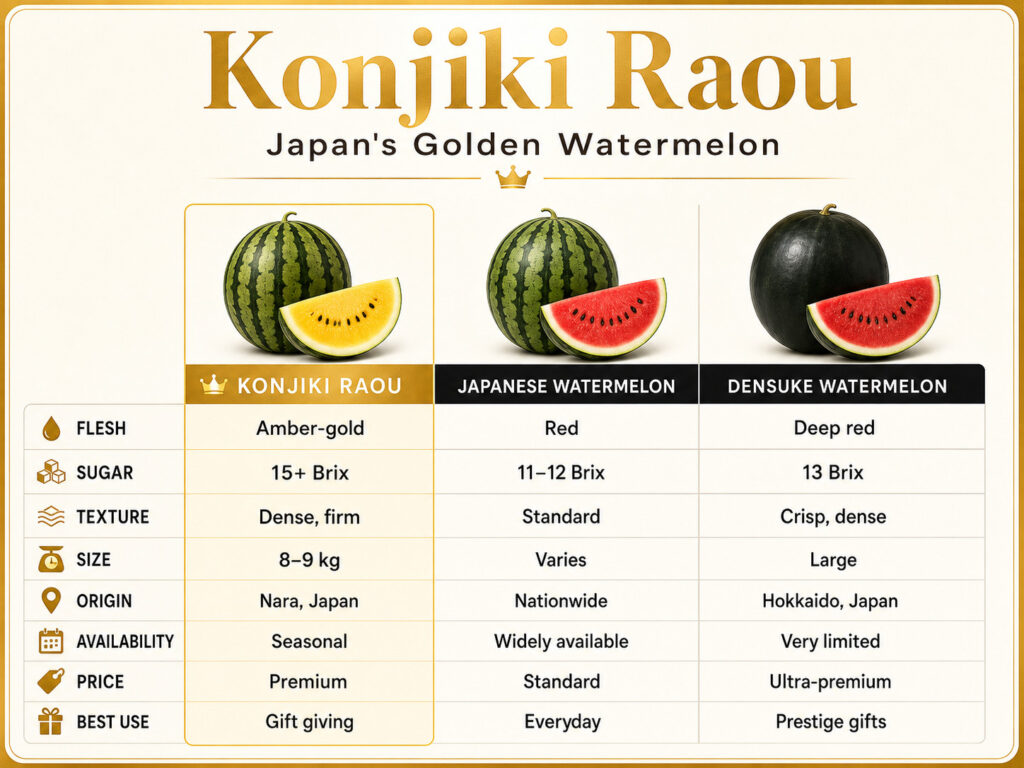
The table below places the Konjiki Raou alongside a standard Japanese watermelon and the Densuke variety, to give a clearer sense of where it stands.
| Konjiki Raou | Standard Japanese Watermelon | Densuke Watermelon | |
|---|---|---|---|
| Flesh color | Amber-gold (yellow) | Red | Deep red |
| Sugar content | 15+ Brix (up to 20.6+ Brix) | ~11–12 Brix | ~13 Brix |
| Texture | Dense, firm, few seeds | Standard | Crisp, dense |
| Size | 8–9 kg (large ball) | Varies | Large |
| Origin | Developed by Nanto Seed, Nara | Various nationwide | Toma, Hokkaido only |
| Availability | Seasonal, specialty shops | Nationwide supermarkets | Extremely limited |
| Price range | Premium | Standard | Ultra-premium |
| Best use | Gift-giving, special occasions | Everyday summer enjoyment | Gift-giving, prestige |
Final Thoughts
The Konjiki Raou (金色羅皇) is one of those rare agricultural achievements that actually lives up to its reputation. Eight years of development produced a watermelon that consistently delivers sugar levels most varieties cannot approach. The golden flesh, the firm juicy bite, and the minimal seeds all set it apart from conventional options.
Whether you seek it for personal tasting or as a thoughtful summer gift, the experience tends to shift how you think about watermelons afterward. Standard red watermelons might feel a little ordinary by comparison. That is perhaps the highest compliment a new variety can earn. For anyone interested in exploring more of Japan’s remarkable fruit culture, the Japanese fruit guide on Food in Japan is a worthwhile place to continue.
FAQ
What is Konjiki Raou (金色羅皇)?
Konjiki Raou is a premium Japanese yellow-fleshed watermelon developed by Nanto Seed Co., Ltd. of Nara Prefecture. Commercial seeds became available in 2021 after eight years of development. The name translates as “golden-colored emperor” and reflects the vivid amber-gold color of its flesh.
How sweet is the Konjiki Raou watermelon?
The sugar content typically reaches 15 Brix or above in well-grown specimens. Competition results have recorded over 20.6 Brix. Standard Japanese watermelons generally measure around 11 to 12 Brix, making the Konjiki Raou significantly sweeter by comparison.
Where is the Konjiki Raou grown in Japan?
Kumamoto, Nagano, and Yamagata are the main growing regions. Kumamoto greenhouse farms offer two harvest windows each year. Summer cultivation in Nagano and Yamagata runs from June through August.
When can I find Konjiki Raou for sale?
Kumamoto greenhouse crops appear in May to June and again from October to December. Other regional harvests cover June through August. Specialty fruit shops and select online retailers carry it during these windows, often in limited quantities.
Is Konjiki Raou a good gift choice?
Yes. The golden interior creates a striking visual impression when opened, which makes it well suited to Japanese gift culture. Luxury fruit shops and department store food halls stock it in premium packaging. It works particularly well as a Father’s Day or summer celebration gift.
How does Konjiki Raou differ from a standard red watermelon?
The flesh is golden rather than red. The sugar content is considerably higher. The texture is firmer and denser. Seeds are fewer. The flavor is concentrated and sweet without the typical grassy aroma. The price is also substantially higher, reflecting its premium positioning.
References
- Foodslink (foodslink.jp) – Konjiki Raou variety profile and tasting notes (Surveyed: June 2026)
- Agri-Match (agri-match.com) – Konjiki Raou flavor, price, and sourcing guide (Surveyed: June 2026)
- Entabe (entabe.com) – Cafe COMSA Konjiki Raou cake feature with sugar content reference (Surveyed: June 2026)
- Nanto Seed Co., Ltd. (nanto-seed.com) – Konjiki Raou official variety developer (Surveyed: June 2026)
- Sweetsvillage (shop.sweetsvillage.com) – Konjiki Raou sugar content and quality guide (Surveyed: June 2026)
- JapanCROPs (japancrops.com) – Watermelon prefecture production ranking 2024 (Surveyed: June 2026)
- Japan National Tourism Organization (japan.travel) – Yamagata fruit culture and temperature characteristics (Surveyed: June 2026)
Related Articles
- Japanese Fruit Guide (Surveyed: June 2026)
- Densuke Watermelon (でんすけすいか) (Surveyed: June 2026)
- Yuubari Melon (夕張メロン) (Surveyed: June 2026)




Comments