




Have you ever wondered what Hakodate soul food actually tastes like? Most visitors picture fresh squid or morning market seafood. But locals know a different craving entirely. It is warm, filling, and a little indulgent. It is called Shisuko rice.
シスコライス Shisuko rice is one of those dishes that feels personal. You will not find it on menus across Tokyo or Osaka. It belongs to Hakodate, and that exclusivity is part of its quiet power. Once you understand its story, skipping it feels almost wrong.
What Is Shisuko Rice?
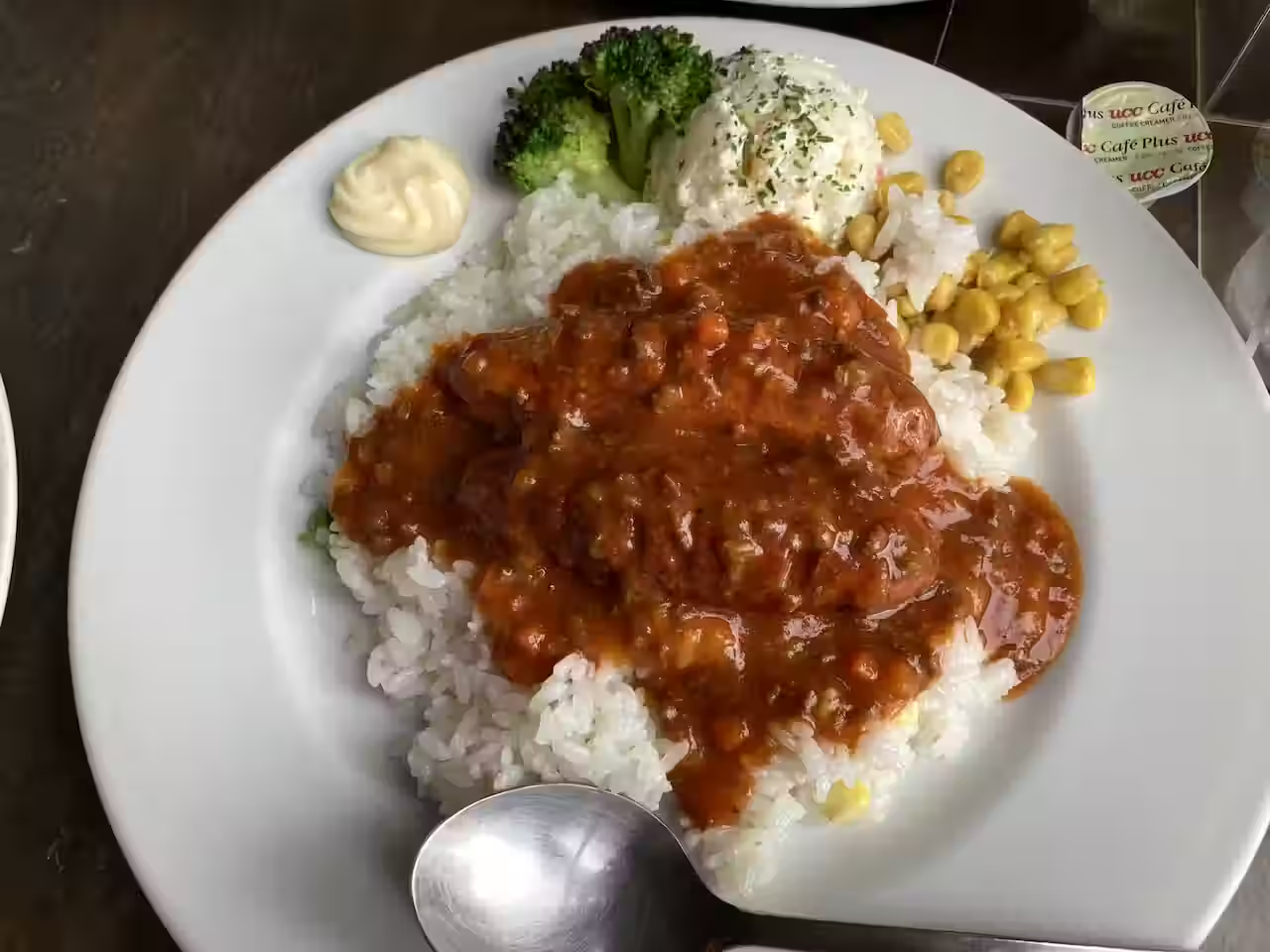
So, what is Shisuko rice, exactly? The dish is simple but deeply satisfying. A generous mound of buttery pilaf forms the base. On top, two thick grilled sausages are placed side by side. Then comes the centerpiece: a rich, hearty meat sauce poured generously over everything.
The combination sounds almost too straightforward. Yet somehow, it works. Butter rice with sausage creates a savory, slightly smoky foundation. The meat sauce binds it all together with depth and umami. Small portions of potato salad, corn, and broccoli keep the plate balanced.
This is not fine dining, and it never claimed to be. Shisuko rice is Japanese comfort food from Hakodate, unpretentious and honest.
The Story Behind the Name
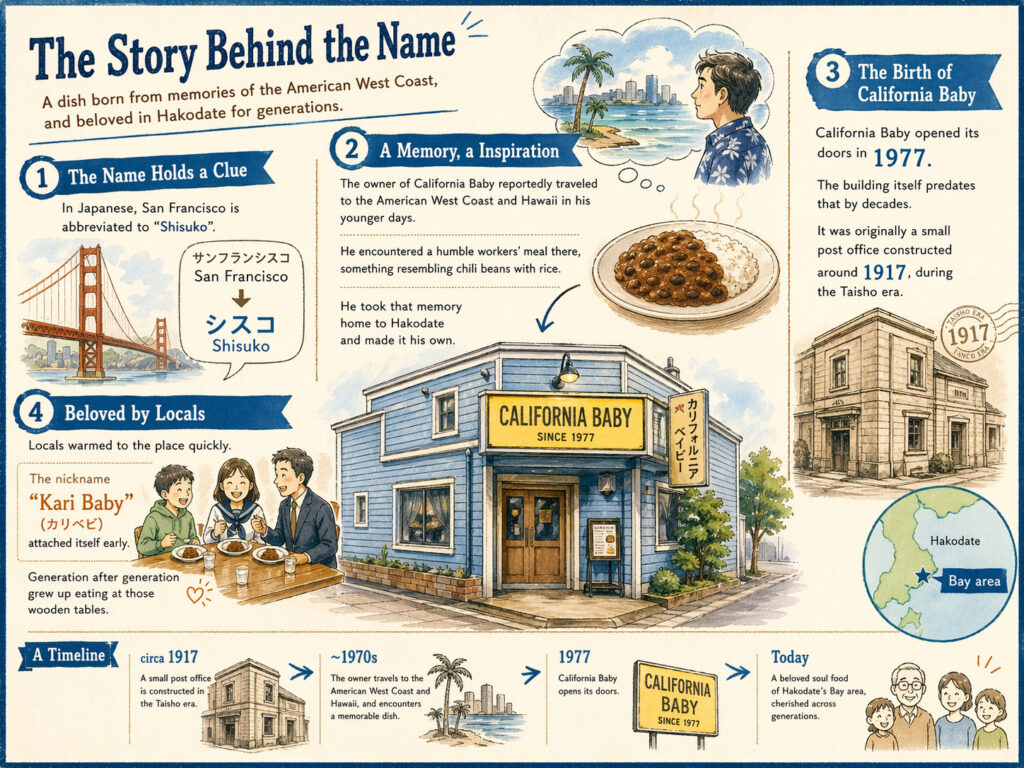
The name holds a clue. In Japanese, San Francisco is abbreviated to “Shisuko” (シスコ). The owner of California Baby, the restaurant that invented this dish, reportedly traveled to the American West Coast and Hawaii in his younger days. He encountered a humble workers’ meal there, something resembling chili beans with rice. He took that memory home to Hakodate and made it his own.
California Baby opened its doors in 1977. The building itself predates that by decades. It was originally a small post office constructed around 1917, during the Taisho era. The light blue facade and yellow signboard have since become fixtures of the Bay area Hakodate food scene.
Locals warmed to the place quickly. The nickname “Kari Baby” (カリベビ) attached itself early. Generation after generation grew up eating at those wooden tables.
Why Shisuko Rice Is Famous in Hakodate
Why is Shisuko rice so famous in Hakodate? The timing of its arrival mattered. California Baby opened in the late 1970s, when Hakodate was developing its own cafe culture. The dish was affordable, generous, and genuinely unlike anything else in town.
But timing alone does not explain four-plus decades of loyalty. Hakodate butter rice with sausage and meat sauce carries something harder to define. For many locals, it is a memory. People who grow up in Hakodate and later move away still make a point to stop in when they return. The plate holds their past.
Famous names reinforce the reputation. The rock band GLAY, which hails from Hakodate, has spoken warmly about California Baby more than once. Author Tsuji Hitonari included it in his writing. Former JUDY AND MARY vocalist YUKI is also a known regular. When artists tied to a city keep returning to one table, the food earns cultural weight.
Media coverage broadened that reach further. TBS television’s popular program “Bananaman no Sekkaku Gourmet” featured the restaurant in December 2017. Convenience store chain Lawson released a Shisuko rice product for the Hokkaido region in 2022. They did it again in 2024, in collaboration with the restaurant. That kind of commercial recognition is rare for a dish born in a single small restaurant.
What Does Shisuko Rice Taste Like?
What does Shisuko rice taste like? Many first-timers expect something exotic or complex. The reality is more grounded than that.
The butter pilaf is lightly seasoned and mildly rich. It does not overwhelm on its own. The grilled sausages bring a smoky, charred note. They are juicy without being heavy. Then the meat sauce arrives with genuine weight. Thick, savory, and slightly sweet, it sits somewhere between Japanese meat sauce and a Western Bolognese.
The overall impression is hearty and nostalgic. The Japanese would call this “B-grade gourmet,” meaning crowd-pleasing, generous, and free from pretense. A habanero sauce sits on every table. A few drops shift the experience entirely. Be warned though: it runs very hot. If you overdo it, the potato salad provides relief.
The portion is substantial. Many visitors underestimate it. Arriving hungry is strongly advised.
Where to Eat Shisuko Rice in Hakodate
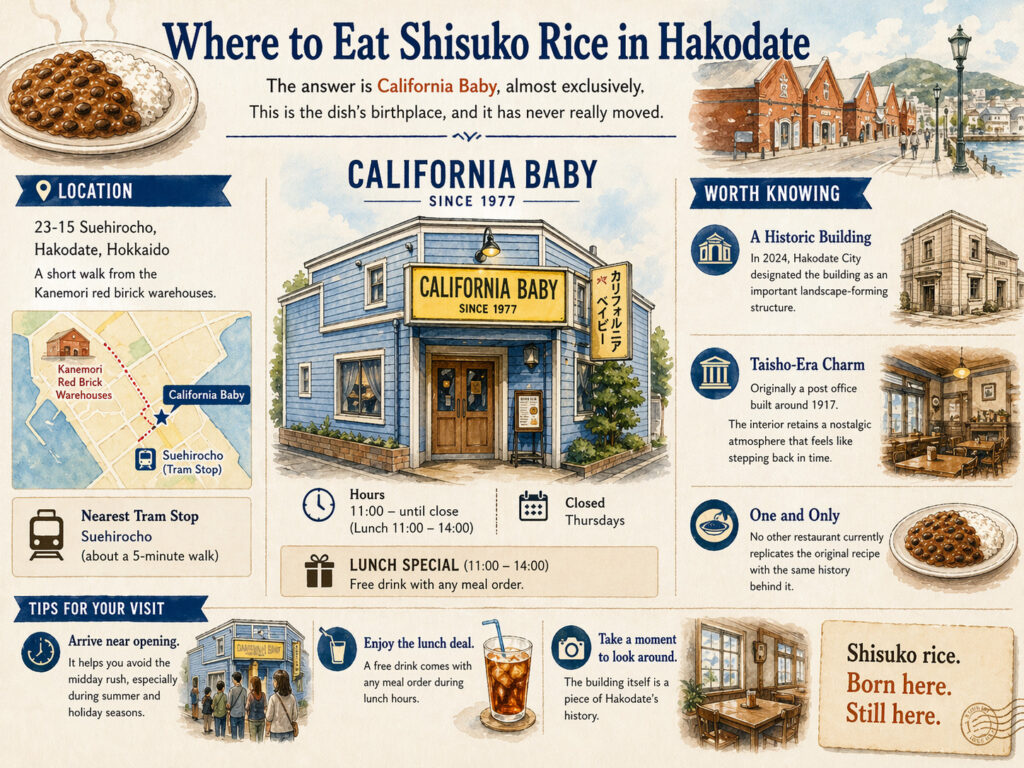
Where to eat Shisuko rice in Hakodate? The answer is California Baby, almost exclusively. This is the dish’s birthplace, and it has never really moved.
The restaurant sits at 23-15 Suehirocho in Hakodate, within easy walking distance of the Kanemori red brick warehouses. The nearest tram stop is Suehirocho, roughly five minutes on foot. The California Baby specialty is served daily from 11:00, closing on Thursdays.
Lunch hours, from 11:00 to 14:00, come with a free drink alongside any meal order. That small detail says something about the place. Arriving close to opening helps avoid the midday rush, particularly during summer and holiday travel seasons.
The building itself is worth a moment of attention. In 2024, Hakodate City officially designated it as an important landscape-forming structure. The Taisho-era post office architecture carries a weathered dignity. Walking inside feels like stepping back into a different decade, in the best possible way.
No other restaurant currently replicates the original recipe with the same history behind it.
A Dish That Fits Hakodate’s Broader Food Identity
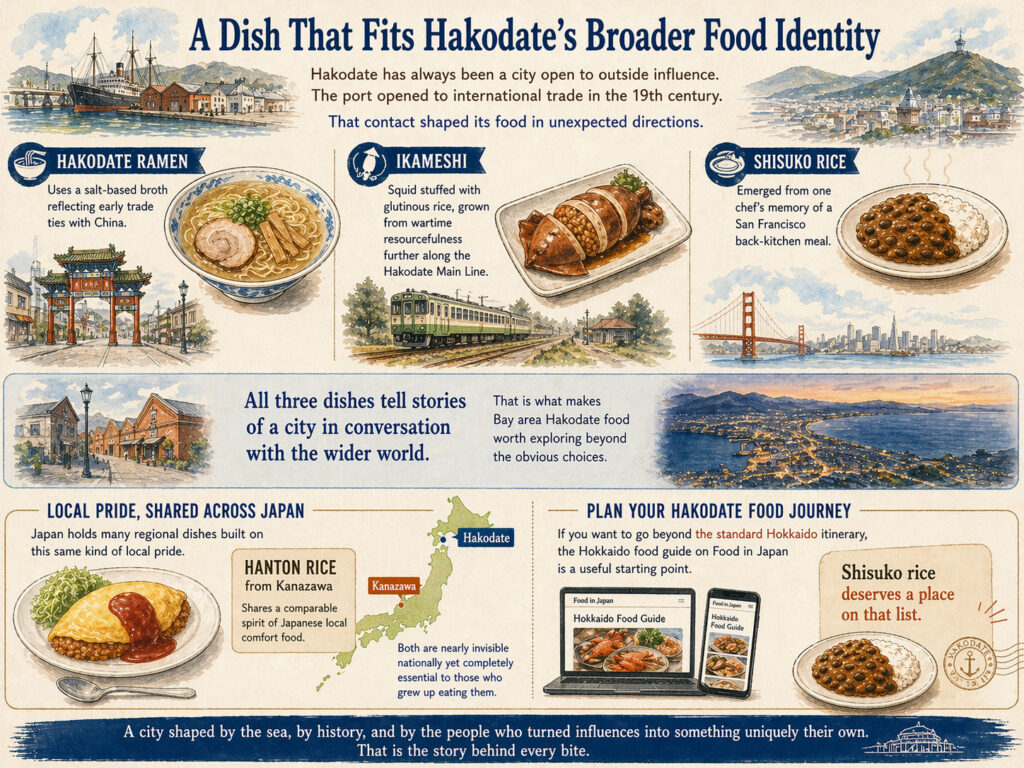
Hakodate has always been a city open to outside influence. The port opened to international trade in the 19th century. That contact shaped its food in unexpected directions.
Hakodate ramen uses a salt-based broth reflecting early trade ties with China. Ikameshi, squid stuffed with glutinous rice, grew from wartime resourcefulness further along the Hakodate Main Line. And Shisuko rice emerged from one chef’s memory of a San Francisco back-kitchen meal.
All three dishes tell stories of a city in conversation with the wider world. That is what makes Bay area Hakodate food worth exploring beyond the obvious choices.
Japan holds many regional dishes built on this same kind of local pride. Hanton Rice from Kanazawa shares a comparable spirit of Japanese local comfort food. Both are nearly invisible nationally yet completely essential to those who grew up eating them.
If you want to go beyond the standard Hokkaido itinerary, the Hokkaido food guide on Food in Japan is a useful starting point. Shisuko rice deserves a place on that list.
Nearly Fifty Years Later, Nothing Has Changed
California Baby has served this hearty rice plate for close to half a century. That is not nostalgia. That is a track record. The recipe has not been modernized. The setting has not been fancied up. The dish is exactly what it was in 1977.
In a city full of newer cafes and constantly rotating menus, that stubbornness has become a kind of strength. People trust the place because it has never tried to be something else.
There is something quietly admirable about that.
If you find yourself in Hakodate and want one meal that is not raw seafood, consider this one. Shisuko rice will not photograph dramatically. It will not trend on social media. But it might be the dish you remember longest, long after the squid is forgotten.
References
- Hakobura (Hakodate Official Tourism Information): https://www.hakobura.jp/spots/47
- California Baby, Wikipedia (Japanese): https://ja.wikipedia.org/wiki/%E3%82%AB%E3%83%AA%E3%83%95%E3%82%A9%E3%83%AB%E3%83%8B%E3%82%A2%E3%83%99%E3%82%A4%E3%83%93%E3%83%BC
- Hokkaido Labo – Shisuko Rice Feature: https://hokkaido-labo.com/area/hakodate/shiscorice
Cisco Rice FAQ
What is Cisco Rice?
Cisco Rice is a hearty soul food from Hokkaido. Chefs top hot buttered rice with grilled frankfurters and a rich meat sauce. Food lovers know it for its massive portion and nostalgic Western-style diner appeal.
Where does Cisco Rice come from?
Cisco Rice originates from Hakodate City. A local bay-area diner named California Baby created this heavy comfort food in the late 1970s.
What does Cisco Rice taste like?
Cisco Rice delivers a rich, buttery, and meaty flavor. The grilled sausages provide a satisfying, crispy snap. Diners often compare it to classic American diner chili over rice but with a unique Japanese twist.
Where can I eat Cisco Rice in Japan?
You will find authentic Cisco Rice exclusively in Hakodate City. The famous retro diner California Baby proudly serves this signature dish every day to hungry locals and tourists.
How much does Cisco Rice cost?
Cisco Rice typically costs between 800 and 1,000 yen per plate. The restaurant offers excellent value because the dish provides a massive volume of filling food.
Is Cisco Rice vegetarian or vegan friendly?
The traditional dish heavily features pork sausages and a ground beef meat sauce. Vegans and vegetarians cannot eat this specific meal, as the diner prepares everything with animal products and butter.
What are the main ingredients in Cisco Rice?
The main ingredients include buttered pilaf, frankfurter sausages, rich meat sauce, and potato salad. The savory meat sauce gives the dish its distinctive and highly addictive flavor.
Can I make Cisco Rice at home?
Yes, you can easily cook this meal at home. Home cooks simply plate hot buttered rice, add pan-fried sausages, and pour warm canned meat sauce over the top.
What is the difference between Cisco Rice and Omurice?
The main difference involves the toppings and the use of eggs. Cisco Rice features sausages and meat sauce over buttered rice without any eggs, while Omurice relies on ketchup rice wrapped in a fluffy yellow omelet.
Is Cisco Rice popular outside Japan?
Cisco Rice remains completely unknown outside Japan. You will never see it at Japanese restaurants abroad. This nostalgic comfort food successfully maintains its legendary status exclusively within Hakodate.



Comments