




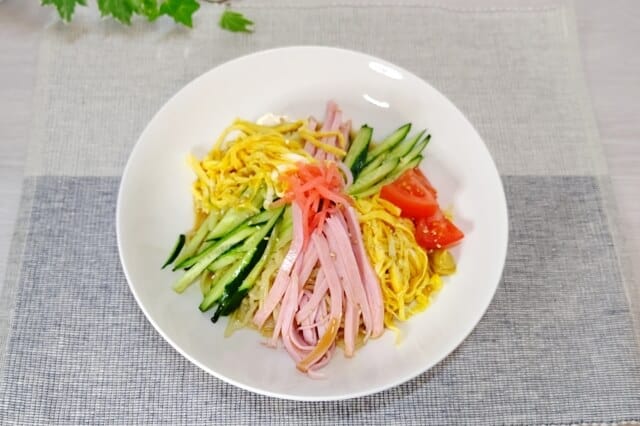
冷やし中華 Hiyashi chuka is Japan’s signature summer noodle dish. Chilled ramen noodles sit at the base, topped with a colorful arrangement of cucumber strips, thinly sliced egg, ham, and tomato, then drizzled with a cold soy-vinegar or sesame dressing. Despite the name meaning “chilled Chinese,” it is entirely a Japanese invention. If you have ever seen a sign in a Japanese restaurant window that reads “冷やし中華始めました” (hiyashi chuka has started), you already know the most important thing about it: the dish marks the arrival of summer.
What is Hiyashi Chuka?
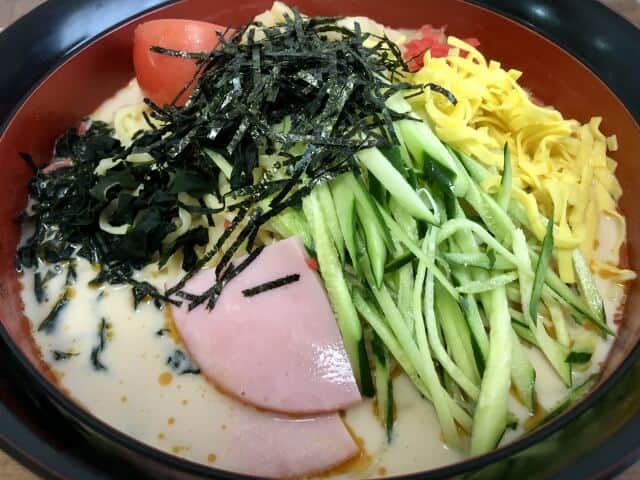
Hiyashi chuka (冷やし中華) is a chilled noodle dish made from ramen-style wheat noodles that have been boiled, rinsed in cold water, and served cold. The toppings are arranged in a radial or neat pattern across the noodles: shredded cucumber, thin strips of egg crepe (kinshi tamago), sliced ham or char siu roast pork, and tomato wedges are the classics. Red pickled ginger and sesame seeds often finish the dish. The dressing is poured over everything at the table.
It is available at ramen restaurants, Chinese-influenced diners, and convenience stores across Japan. From roughly June through September, it dominates summer lunch menus. Outside that window, many restaurants stop serving it entirely, which is part of what makes it feel special when the season arrives.
The Name Says Chinese. The Dish is Japanese.
This is the first thing worth clarifying, because the name causes genuine confusion. Hiyashi chuka translates as “chilled Chinese,” and the noodles used are styled after Chinese ramen. But the dish itself was created in Japan, for Japanese summers, by Japanese restaurant owners adapting Chinese noodle techniques to a local need.
The colorful radial presentation, the soy-vinegar dressing, the combination of toppings: none of these come from Chinese cuisine. They are distinctly Japanese in conception. When you see hiyashi chuka on a menu, you are looking at a Japanese summer dish that borrowed a name and a noodle from Chinese cooking, then built something entirely its own around them.
The Summer Announcement Sign: A Cultural Tradition
There is a seasonal ritual in Japan that many people associate with the arrival of summer more than any weather forecast. When a ramen shop or Chinese restaurant places a hand-written sign in the window reading “冷やし中華始めました” (hiyashi chuka has started), something shifts. Summer is officially here.
The sign has become a cultural cliché in the best sense. It appears in comedy sketches, manga, and advertising. It is referenced in conversations about the weather. Coming across it for the first time on a sweltering June afternoon, when the humidity is at its worst and hot soup feels impossible, is a genuinely welcome sight. The dish does not just respond to summer. It announces it.
Why Do Japanese Eat Hiyashi Chuka in Summer?
Japanese summers are intensely hot and humid. Appetite drops, and heavy, rich foods start to feel exhausting. Hot ramen, which is the default year-round, becomes difficult to want when the temperature is above 35 degrees Celsius and the air feels thick.
Hiyashi chuka solves this problem directly. The noodles are cold. The dressing has acidity from vinegar, which stimulates appetite. The toppings are light and crunchy. The whole bowl feels energizing rather than taxing. You can eat it quickly, feel satisfied, and not feel weighed down afterward. That combination of cooling effect and appetite stimulation through acidity is precisely why the dish became a summer institution rather than a year-round option.
The Structure of Hiyashi Chuka: Noodles, Toppings, and Sauce
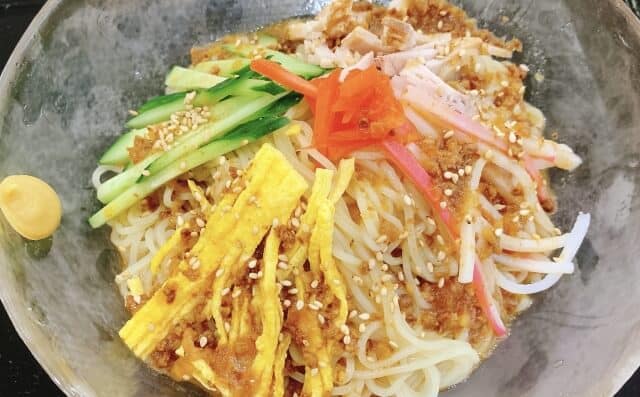
Understanding the three components makes the dish easier to appreciate and easier to make.
The Noodles
Standard ramen-style wheat noodles are used. They are boiled, then rinsed thoroughly under cold running water to remove surface starch and stop the cooking. This rinsing step is what gives the noodles their firm, slippery texture when cold. Using the same noodles hot would produce a completely different result. The cold temperature is structural, not just a preference.
The Toppings
The classic five are cucumber, kinshi tamago (thin egg crepe cut into strips), ham, tomato, and char siu or roasted pork. Cucumber is probably the most essential: the crisp, cool texture is a defining part of the eating experience. Kinshi tamago adds visual warmth and mild richness. Ham or char siu provides savory depth. Tomato adds acidity and color. Red pickled ginger appears in many versions as a sharp, bright counterpoint to the sweet dressing.
The toppings are arranged in a deliberate radial pattern, like the spokes of a wheel, with each ingredient occupying its own section of the bowl. This presentation is part of the dish’s identity. The visual appeal is intentional, not decorative. It is said that the radial arrangement at Tokyo’s Yosuko Saikan restaurant was inspired by the snow-capped peak of Mount Fuji.
The Sauce
This is where personal preference divides people clearly. There are two main types.
Soy-vinegar sauce (shoyu tare) combines soy sauce, rice vinegar, sugar, and sesame oil into a sharp, tangy, light dressing. It is the more popular choice across Japan: surveys consistently show around 55 to 60 percent of people prefer it. The acidity is bright and clean. It emphasizes the freshness of the toppings rather than adding richness.
Sesame sauce (goma dare) is richer and more complex. Ground sesame paste, soy sauce, vinegar, and sugar combine into a thick, nutty dressing that coats the noodles more fully. It is milder in acidity and more satisfying if you want something more substantial. Both work. Which you prefer depends on whether you want the dish to feel refreshing or filling.
The Origin of Hiyashi Chuka
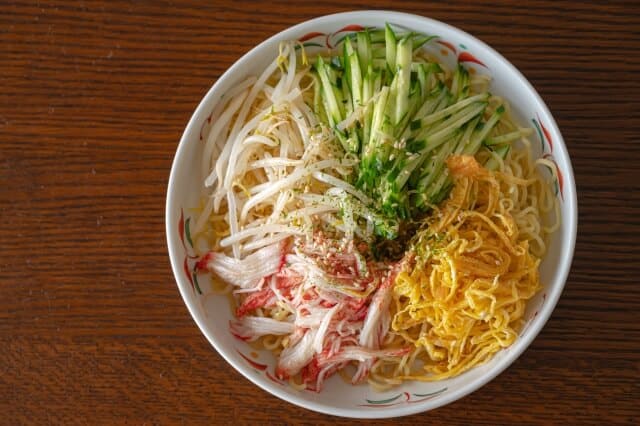
Two origin stories circulate, and both trace to the 1930s.
The more widely cited account places the dish’s creation in 1937 at Ryu-tei, a Chinese restaurant in Sendai City, Miyagi Prefecture. Summer business was slow at Chinese restaurants because people associated Chinese food with hot, heavy dishes unsuited to the heat. The owner responded by creating Ryan ban men (五色涼拌麺), a cold noodle dish with a soy sauce and vinegar broth. The toppings at the time included cabbage and carrots alongside the cucumbers and tomatoes that became standard later.
The second account credits Yosuko Saikan in Jimbocho, Tokyo, placing the creation slightly earlier in 1933. This version was influenced by Japanese cold soba and Shanghai-style cold noodle dishes. Importantly, this is the restaurant credited with establishing the radial topping arrangement that defines the dish’s visual style today.
Both accounts agree on the core motivation: giving Chinese restaurants a viable summer offering at a time when their menus had no answer to the heat. The dish succeeded, spread rapidly, and became embedded in Japanese summer food culture within a generation.
Hiyashi Chuka vs. Cold Noodles (Reimen): What’s the Difference?
This causes genuine confusion, particularly in western Japan where some people use the terms interchangeably. The dishes are related in concept but come from entirely different traditions.
How the Noodles and Broth Differ
Hiyashi chuka uses ramen-style wheat noodles with a soy-vinegar or sesame dressing, colorful vegetable toppings, and no broth. The noodles are dressed, not submerged. Reimen is a Korean-origin dish using chewy noodles made from buckwheat flour or starch, served in a cold broth. The soup is an integral part of reimen rather than an optional sauce.
Regional Naming Confusion
Despite these clear differences, the two are sometimes conflated in everyday speech. Calling hiyashi chuka “reimen” in Tokyo will cause confusion. In Kansai and further west, the usage is more relaxed and some people apply both terms loosely to any cold noodle dish. The dishes remain distinct regardless of regional naming habits.
Regional Variations: A Quick Reference
Worth noting are a few regional variations, though they sit closer to the margins than the heart of the dish.
In Hokkaido, hiyashi chuka is sometimes called “hiyashi ramen” and may include corn and butter as toppings, reflecting the region’s broader dairy and corn-forward food identity. In Hiroshima, olive oil-blended mustard appears as an optional condiment. In Nagano, wasabi-soy sauce is sometimes used as a regional accent. Sendai, as one of the dish’s claimed birthplaces, serves it year-round at some specialist restaurants and celebrates the original form with particular care. Yamagata uses a non-acidic soy sauce broth for a softer, rounder version called hiyashi ramen locally.
How to Make Hiyashi Chuka at Home
Ingredients (4 servings)
| Ingredient | Amount |
| Chinese ramen-style noodles | 400g |
| Chicken fillet or ham | 450g |
| Eggs | 4 |
| Cucumber | 2 medium |
| Green onion, finely sliced | 12g |
| Potato starch | 3g |
| Salt | 11g |
| Salad oil | 6g |
| Soy sauce | 56g |
| Rice vinegar | 45g |
| Sugar | 38g |
| Sesame oil | 10g |
| Red pickled ginger | 8g |
| Kneaded mustard (optional) | 4g |
Cooking Steps
Cook and prepare the protein
Place the chicken fillet in a saucepan and cover with water. Bring to a boil over high heat, then reduce to a low simmer for about 5 minutes, skimming any foam. Remove when the surface turns white and the interior is cooked through. Let it cool, then shred or slice thinly. If using ham, simply slice into thin strips.
Make the soy-vinegar dressing
Strain a cup of the chicken cooking liquid into a bowl. Add sugar while still warm and stir until fully dissolved. Add soy sauce, rice vinegar, and sesame oil. Mix well and refrigerate until cold. The dressing must be fully chilled before using, or it will warm the noodles.
Prepare the kinshi tamago (egg strips)
Beat the eggs with a pinch of salt and a small amount of potato starch dissolved in water. Heat a lightly oiled frying pan over medium heat. Pour in half the egg mixture and spread into a thin crepe. Cook for about 30 seconds, remove, and repeat. Stack the egg sheets and slice into thin strips. This is kinshi tamago and it adds visual warmth and mild richness to the bowl.
Cook and chill the noodles
Boil the noodles according to the package instructions. Drain immediately and rinse thoroughly under cold running water while rubbing the noodles to remove surface starch. This step is the most important one for texture. Do not skip it. Drain well and chill in the refrigerator if not using immediately.
Assemble and serve
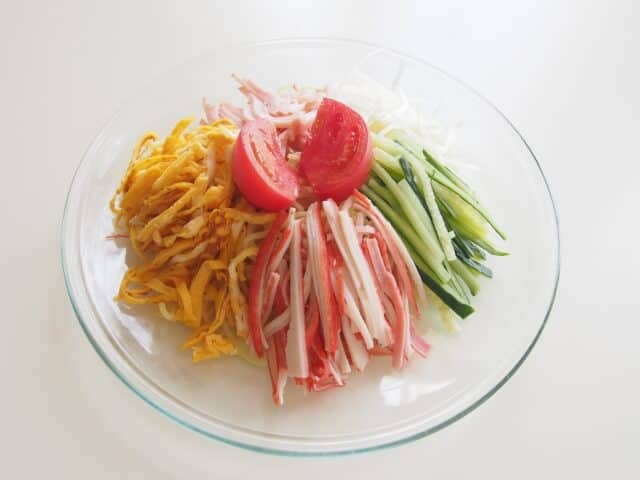
Divide the noodles into four portions and arrange in shallow bowls. Place the toppings in separate sections around the bowl in a radial pattern: cucumber strips, egg strips, chicken or ham, and tomato wedges. Add green onion and red pickled ginger. Pour the chilled dressing over just before eating. Serve with mustard on the side if desired.
Key tip: both the noodles and the dressing must be fully cold before assembling. Warm noodles or a room-temperature sauce will make the whole dish feel flat. Prepare everything in advance and keep it refrigerated until the moment of serving.
Where to Eat Hiyashi Chuka in Tokyo
Asahi (中華料理 あさひ) — Fourth-Generation Asakusa Classic
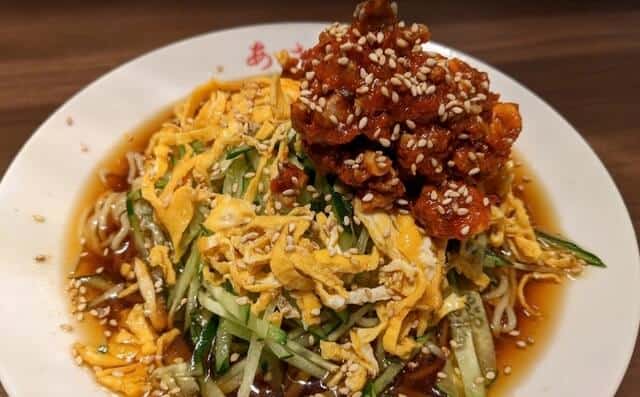
Located behind Asakusa Kannon temple, Asahi has been run by the same family for four generations. The hiyashi chuka here uses a base broth made from chicken and pork bones, with a soy sauce dressing that builds on that stock. The result is mild in acidity with a subtle sweetness and noticeable depth from the dashi. The noodles are thin, curly, and firm. It is a considered version of the dish that rewards attention.
Long Kou Jiu Jia (龍口酒家) — Medicinal Chinese Cuisine in Hatagaya
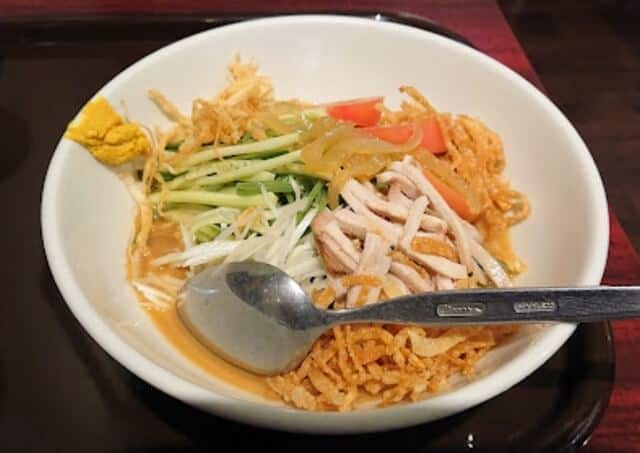
This Hatagaya restaurant focuses on Chinese cuisine with a medicinal food philosophy, using seasonal vegetables and ingredient combinations chosen for both flavor and balance. Their hiyashi chuka uses a tahini-soy base with soy sauce, vinegar, and sugar, plus a small amount of doubanjiang as a secret ingredient. The result is slightly richer and more complex than a standard soy-vinegar version, with a hint of heat.
Mintei (珉亭) — Year-Round Cold Noodles in Shimokitazawa
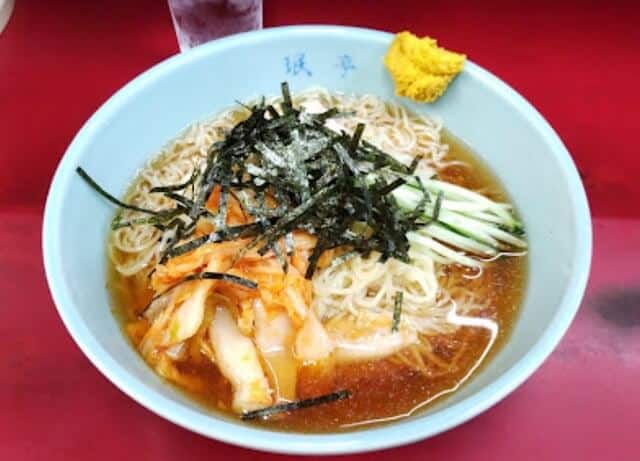
Mintei in Shimokitazawa is one of the few restaurants that serves hiyashi chuka year-round rather than only in summer. Their version uses a clear soy sauce dressing with a clean sweet-sour balance. Thin, firm noodles sit under homemade char siu made from pork shoulder, cucumber, lightly pickled kimchi, and chopped seaweed. The kimchi and seaweed are unusual additions that give the dish a distinctive edge you will not find at other restaurants.
Final Thoughts
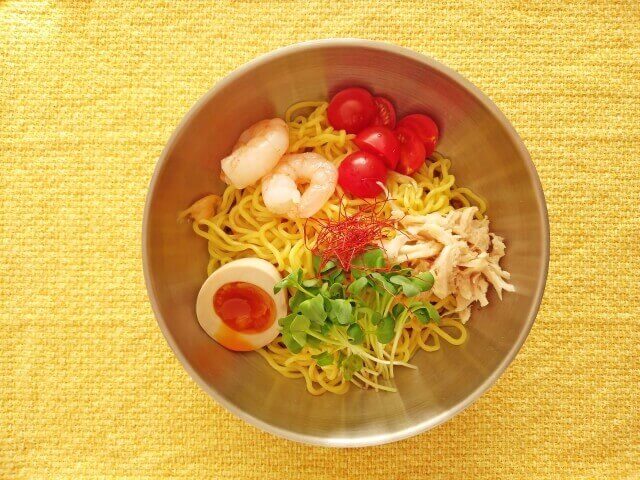
夏の麺料理 Japanese summer noodles have several good representatives, but 冷やし中華 Hiyashi chuka stands apart for the way it has embedded itself in Japanese seasonal culture. It is not just a cold noodle dish. It is a seasonal announcement, a convenience store staple, a home cooking recipe, and a restaurant specialty all at once. The fact that it was invented in Japan despite its name, and that it disappears from most menus in autumn, gives it a kind of seasonal rarity that makes it genuinely worth seeking out.
If you want to explore other Japanese cold noodle options, cold soba and cold udon are the closest relatives in terms of summer eating culture. And if ramen in general interests you, the wider ramen guide covers the hot versions in full detail.
Exploring Japanese summer noodles? Browse the full soba, udon, and ramen collections on Food in Japan.
Hiyashi Chuka FAQ
What is hiyashi chuka?
Hiyashi chuka (冷やし中華) is a Japanese cold noodle dish made from chilled ramen-style wheat noodles topped with colorful ingredients including shredded cucumber, thin egg strips, ham or char siu, and tomato, then drizzled with a cold soy-vinegar or sesame dressing. It is a Japanese invention served primarily during summer, typically from June through September.
Is hiyashi chuka Chinese or Japanese?
It is Japanese. Despite the name translating as “chilled Chinese,” the dish was invented in Japan in the 1930s. The noodles are styled after Chinese ramen, and the dish was created at Chinese-influenced restaurants in Sendai and Tokyo. But the colorful radial topping arrangement, the soy-vinegar dressing, and the summer season association are all distinctly Japanese innovations.
Why is hiyashi chuka eaten in summer?
Japanese summers are intensely hot and humid, and appetite tends to drop in the heat. Hiyashi chuka addresses this directly: the noodles are cold, the vinegar in the dressing stimulates appetite, and the light toppings are easy to eat. The acidic dressing is specifically effective at making food appealing when hot weather suppresses hunger. The dish was invented precisely to give people a reason to eat at Chinese restaurants during summer.
What sauce is used for hiyashi chuka?
There are two main sauce types. Soy-vinegar sauce (shoyu tare) combines soy sauce, rice vinegar, sugar, and sesame oil into a sharp, tangy, light dressing. About 55 to 60 percent of Japanese people prefer this style for its refreshing quality. Sesame sauce (goma dare) uses sesame paste, soy sauce, vinegar, and sugar for a richer, nuttier result with less acidity. Both are valid and the choice is personal.
What does hiyashi chuka taste like?
The overall flavor is tangy, sweet, and savory, with a cooling effect from the cold noodles and toppings. The soy-vinegar version tastes bright and refreshing, with acidity as the dominant note. The sesame version is richer and more mellow. The cucumbers add crunch, the egg strips add mild richness, and the char siu or ham adds savory depth. The combination is satisfying without being heavy.
How is hiyashi chuka different from regular ramen?
Regular ramen is served hot in a rich broth, with toppings submerged in the soup. Hiyashi chuka is served cold with no soup. The noodles sit dry or very lightly dressed rather than swimming in liquid. The toppings are arranged decoratively on top rather than mixed in. The eating experience is closer to a noodle salad than a soup dish.
What is the difference between hiyashi chuka and reimen (cold noodles)?
Hiyashi chuka uses wheat ramen noodles with a soy-vinegar or sesame dressing, no broth, and colorful vegetable toppings. Reimen is a Korean-origin dish using chewy noodles made from buckwheat or starch, served in a cold broth. The two dishes use different noodles, different bases, and different traditions. Some people in Kansai use the terms interchangeably, but they are distinct dishes.
Can I make hiyashi chuka at home?
Yes, and it is one of the more approachable Japanese noodle dishes to make at home. The key steps are rinsing the noodles thoroughly in cold water after boiling, preparing the dressing in advance and chilling it fully, and arranging the toppings in the traditional radial pattern before pouring the dressing over. Packaged hiyashi chuka kits including noodles and dressing packets are also sold at Japanese supermarkets.
When does the hiyashi chuka season start?
Most restaurants and convenience stores begin offering hiyashi chuka in June, though some start as early as late May when temperatures rise. The appearance of the sign “冷やし中華始めました” (hiyashi chuka has started) in restaurant windows is a cultural signal in Japan that summer has officially arrived. Most establishments stop serving it after September.
References
- Food in Japan — Original Hiyashi Chuka article
- Food in Japan — Ramen guide
- Food in Japan — Hiyashi Ramen (Yamagata)
- Asahi (中華あさひ) — 3-33-6 Asakusa, Taito-ku, Tokyo
- Long Kou Jiu Jia (龍口酒家) — 1-3-1 Hatagaya, Shibuya-ku, Tokyo
- Mintei (珉亭) — 2-8-8 Kitazawa, Setagaya-ku, Tokyo



Comments