




You have probably heard of okonomiyaki. But monjayaki? That one trips up a lot of first-time visitors to Japan. Both dishes involve a hot iron griddle, batter, and a group of people crowded around a table. Yet they taste, look, and feel completely different. This guide breaks it all down, from the batter to the eating style, so you can walk into any restaurant in Tokyo or Osaka and know exactly what you are ordering.
The Short Answer
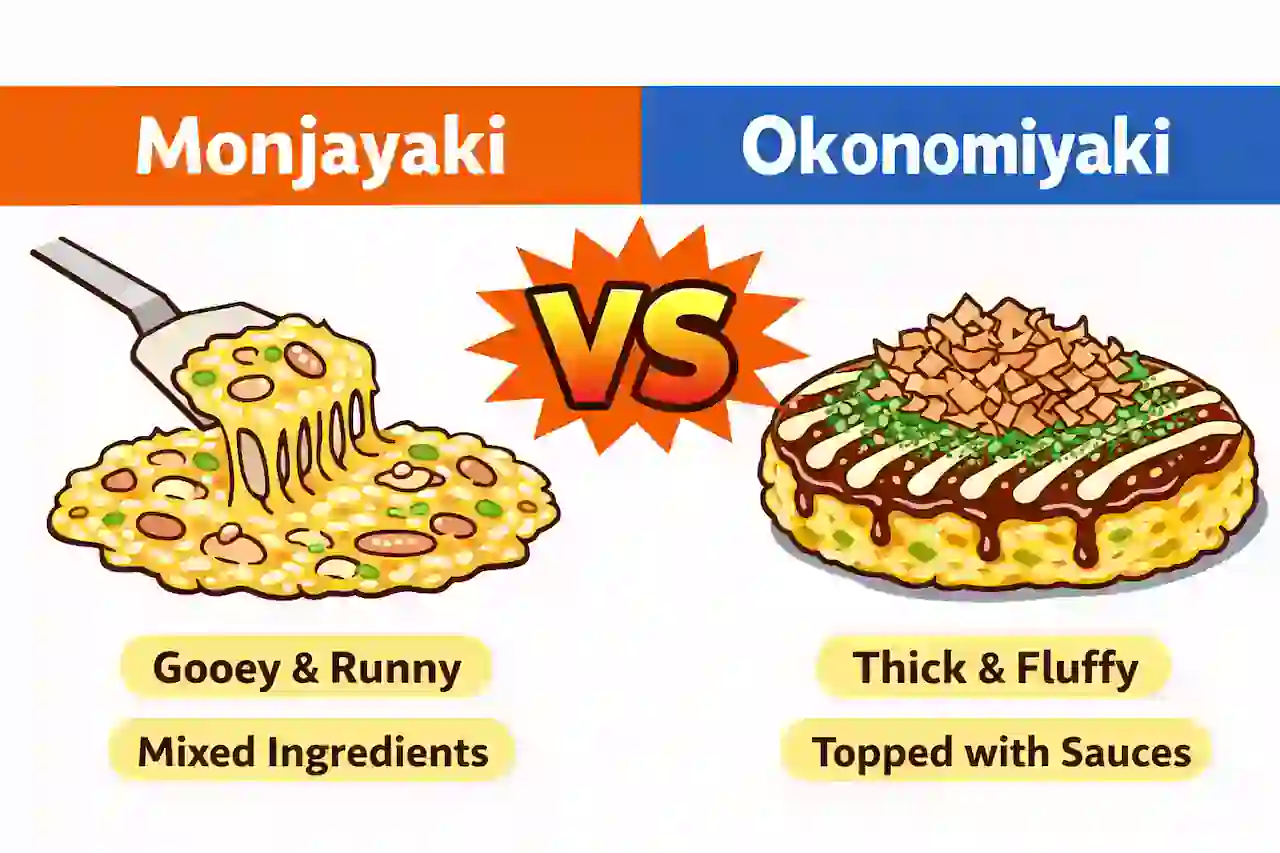
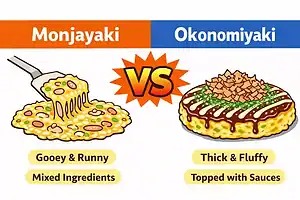
Not sure which is which? Here is a quick side-by-side comparison.
| Monjayaki | Okonomiyaki | |
|---|---|---|
| Texture | Runny, gooey, slightly crispy at the edges | Thick and fluffy, like a dense savory pancake |
| Batter | Mostly water or dashi broth, very little flour | Flour-heavy, often with mountain yam (nagaimo) and egg |
| Cooking style | Build a ring of ingredients, pour batter inside | Mix everything together and cook as one pancake |
| How to eat | Tiny metal spatula, directly from the grill | Chopsticks or fork, usually cut into pieces |
| Origin | Tokyo (Kanto region) | Osaka and Hiroshima (Kansai and Chugoku regions) |
| Calories (approx.) | Around 250 to 350 kcal per serving | Around 400 to 550 kcal per serving |
Still curious about the details? Good. Keep reading.
Batter and Ingredients
The batter is where everything starts. And the difference here is dramatic.
Monjayaki batter is almost liquid. It is made with dashi broth, a small amount of wheat flour, and Worcestershire sauce. When you look at it raw in the bowl, it genuinely resembles soup. The first time I saw it, I honestly thought the restaurant had made a mistake. It does not look like it will cook into anything solid. And technically, it never fully does.
Okonomiyaki is the opposite. The batter is thick. Most recipes use a generous amount of wheat flour, eggs, and grated nagaimo, which is a Japanese mountain yam. The yam creates that distinctive fluffy, almost airy texture. It holds its shape from the moment it hits the griddle.
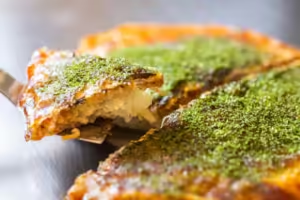
Both dishes rely heavily on cabbage, which is shredded and mixed throughout. Both also use a wide range of proteins. Pork belly, shrimp, squid, and scallops are common in each. Monjayaki sometimes adds unexpected ingredients like mochi (rice cake) or mentaiko (spicy cod roe). Modern versions in Tokyo also feature loads of melted cheese, which is a very popular combination.
Okonomiyaki goes even further with its fillings. Hiroshima-style versions layer yakisoba noodles right inside the pancake. It is a whole meal stacked into one dish.
The ingredient options for both are essentially endless. That flexibility is part of why they have stayed popular for so long.
Cooking Method
This is where monjayaki can feel a little overwhelming if it is your first time. Do not worry. It becomes intuitive quickly.
For monjayaki, you start by stir-frying the solid ingredients directly on the hot iron plate. Use the small spatula to move them around and cook them through. Once ready, push the ingredients into a ring shape. Think of it like building a small wall or a circular “moat.” Then pour the liquid batter carefully into the center of that ring. The ring of ingredients acts as a barrier and keeps the liquid from spreading out.
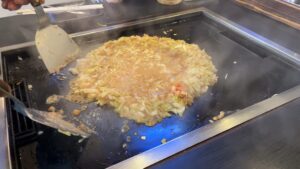
Then you wait. The batter begins to bubble. Once it is bubbling actively, you break the wall and mix everything together. Spread the mixture evenly across the grill. Let it sit. As it cooks, moisture evaporates and the batter thickens. A thin, crispy brown layer forms at the bottom. That layer is the reward.
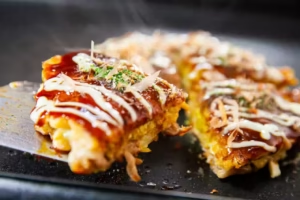
Okonomiyaki is far more straightforward. All the ingredients get mixed directly into the batter before cooking. You pour the mixture onto the hot griddle and shape it into a round, thick pancake. Flip it once halfway through cooking. Add toppings when it comes off the heat. That is really all there is to it.
Monjayaki requires more attention and a bit of patience. The process itself is part of the fun, especially when you are with a group.
For more detail on how monjayaki is made and served in its home city, the Monjayaki guide on Food in Japan covers the full recipe and cooking steps.
How to Eat
Eating monjayaki is unlike any other dish in Japan. There is no plate. There are no chopsticks. You use a small metal spatula called a “hagashi.” You scrape up small bites directly from the surface of the iron plate. The batter is still warm, gooey in the center, and slightly crispy at the edges.
As the dish sits on the heat, the bottom layer becomes darker and more firm. This thin, almost burnt crust is called “senbei.” Many regulars eat it last and consider it the best part. It is smoky, brittle, and deeply savory. Scraping it up with the tiny spatula is oddly satisfying.
Okonomiyaki is easier to approach. A chef or the staff at the restaurant will usually cut it into wedges at the table. You pick up pieces with chopsticks or a fork. Toppings go on before serving: a sweet-savory sauce, Japanese mayonnaise, dried bonito flakes that wave in the heat, and aonori (green seaweed powder).
One dish invites you to get a little messy and involved. The other delivers a cleaner, more predictable experience. Both are absolutely worth experiencing.
Origin and Culture
These two dishes come from opposite ends of Japan. That geography matters more than you might think.
Monjayaki traces its roots to downtown Tokyo. It likely developed during the Meiji era, around the late 19th century, as a cheap snack sold at “dagashiya.” These were small candy shops that catered mostly to children. Kids would use the gooey batter to draw letters on the griddle. That habit gave the dish its original name: “mojiyaki,” meaning “grilled letters.”
Today, the spiritual home of monjayaki is Tsukishima in Chuo Ward, Tokyo. The neighborhood has an entire street lined with monjayaki restaurants. Locals call it Monja Street, and it is a genuine must-visit spot for any food lover in the city.
Okonomiyaki belongs to western Japan. The two most celebrated versions come from Osaka and Hiroshima.
Kansai-style okonomiyaki from Osaka is the version most people think of. All the ingredients mix into the batter before hitting the grill. It is thick, eggy, and deeply comforting. In Osaka, it is everyday food, not a special occasion dish.
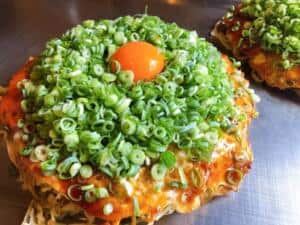
Hiroshima-style okonomiyaki is built differently. The cook layers each component separately on the griddle: batter first, then cabbage, then pork, then noodles, then egg. The result is taller, denser, and arguably more impressive to watch being made.
Both types of okonomiyaki are part of a broader Japanese culinary tradition centered on flour-based dishes. This tradition is known as “konamon,” a word that comes from Osaka dialect. If you want to understand how monjayaki, okonomiyaki, and related dishes fit into the bigger picture of Japanese street food culture, the konamon guide on Food in Japan is a great place to explore.
Calorie and Healthy Choices
Calories come up surprisingly often when travelers ask about these two dishes. Especially those visiting Japan for a few weeks and eating out every single day.
Monjayaki is the lighter option. A typical serving contains roughly 250 to 350 calories. The batter is mostly water, which means the calorie density is relatively low. Choosing seafood and vegetable toppings keeps the numbers down further. The cheese and mochi versions are noticeably richer, so if you are being careful, skip those additions.
Okonomiyaki carries more calories per serving. Expect somewhere between 400 and 550 calories for a standard portion. The denser batter, eggs, and protein-heavy fillings add up quickly. Hiroshima-style, with a full serving of noodles inside, can push even higher.
That said, neither dish is unhealthy in the way that deep-fried food often is. Both use iron plate cooking, which requires minimal oil compared to frying. Cabbage is the primary vegetable in both, and it is high in fiber and water content. By Japanese standards, these are reasonably balanced options.
If calorie management is a priority, monjayaki with seafood toppings is genuinely one of the better choices at a teppan restaurant. Just enjoy it slowly. It is too good to rush.
Which One Should You Try in Japan?
Honestly? Both. But if you are working with limited time or stomach space, here is how to decide.
Choose monjayaki if:
You love dining that feels like an event in itself. Sitting around a hot grill with friends, building something together, and eating straight from the surface with a tiny metal spatula—that’s your ideal evening. Rather than a heavy meal, something light, snackable, and easy to share over drinks is what you’re after. It also helps if you’re drawn to the nostalgic energy found in Tokyo’s older neighborhoods.
Choose okonomiyaki if:
A filling, satisfying meal is what you’re craving. When in Osaka or Hiroshima, it’s a great way to eat like a local. With its more structured preparation, the experience feels cleaner and more straightforward. Expect bold, umami-rich flavors that deliver a complete and hearty dish.
The ideal scenario is to try monjayaki in Tokyo, then make your way west and eat okonomiyaki in Osaka or Hiroshima. Each dish makes far more sense when you eat it in the city where it belongs. The atmosphere, the people cooking it, and even the ingredients feel different.
If you have never tried either and are landing in Tokyo first, start with monjayaki in Tsukishima. It is a neighborhood worth visiting on its own. The street food culture there is warm, unpretentious, and genuinely fun.
References
- Food in Japan: Monjayaki (もんじゃ焼き)
- Food in Japan: Kansai-style Okonomiyaki
- Food in Japan: Hiroshima-style Okonomiyaki
- Food in Japan: The World of Konamon
Comments