




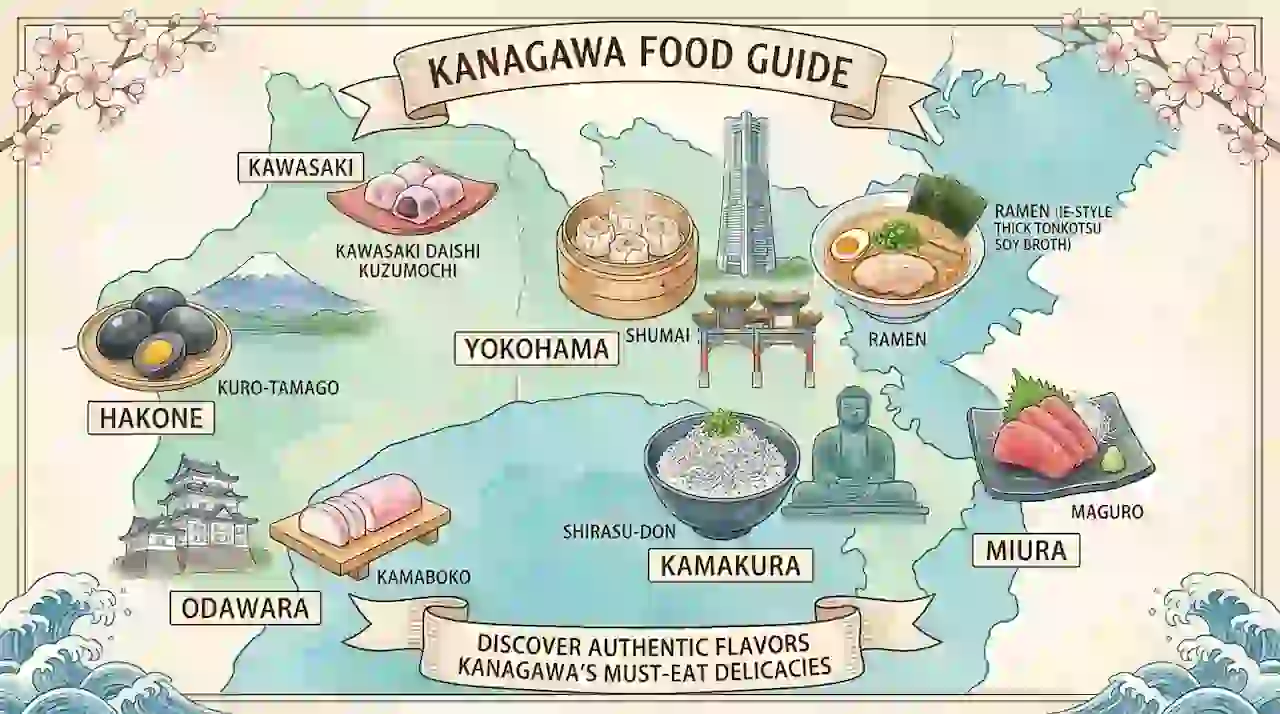
This Kanagawa food guide covers the dishes, cities, and food traditions that make this prefecture one of Japan’s most diverse and historically significant eating destinations. Kanagawa sits just south of Tokyo and is home to Japan’s second-largest city, Yokohama — a port that opened to the world in 1859 and permanently changed what Japan eats. From Yokohama’s Chinatown-influenced street food and the iekei ramen born on its streets, to Kamakura’s shirasu rice bowls and Yokosuka’s legendary navy curry, Kanagawa food tells the story of Japan’s encounter with the outside world.
Kanagawa’s food identity was shaped by a single event: the opening of Yokohama Port in 1859. For the first time, Japan had a major international trade gateway on its Pacific coast. Foreign settlers — Chinese, American, British, and European — brought their food cultures with them. Yokohama became the birthplace of dozens of dishes that are now considered quintessentially Japanese: Napolitan spaghetti, gyunabe beef hot pot, and the shumai dumpling all have their origins in this port city.
Three Coastlines, Three Food WorldsKanagawa faces three distinct bodies of water. Tokyo Bay to the east provides calm, sheltered fishing grounds. Sagami Bay to the south produces the shirasu whitebait that defines Kamakura and Enoshima cuisine. The Uraga Channel at the prefecture’s southwestern tip gave Yokosuka its maritime identity and naval curry heritage. Each coastline produces a different set of ingredients and a different food culture.
Ramen as Kanagawa’s SignatureKanagawa is one of Japan’s most important ramen prefectures. Iekei ramen — the thick tonkotsu-shoyu style with straight noodles, spinach, nori, and char siu — was born in Yokohama in 1974 and now has hundreds of dedicated restaurants across Japan. Sanmamen, the stir-fried vegetable ramen from Yokohama’s Chinatown, is another Kanagawa original with over 70 years of local history. Both styles emerged directly from the prefecture’s international port culture.
Kanagawa’s essential dishes range from Yokohama’s port-city fusion foods to the fresh seafood bowls of the Kamakura coastline.
Kanagawa’s food culture varies dramatically by city. Yokohama, Kamakura, and Yokosuka each have their own distinct culinary identity shaped by geography and history.
Sagami Bay produces some of Japan’s finest shirasu — the tiny, translucent whitebait that is the defining ingredient of Kanagawa coastal cuisine. Caught fresh each morning from spring through autumn, raw shirasu (nama shirasu) must be eaten the same day and can only be found near the coast. Kamakura and Enoshima are the best places in Japan to taste it at its freshest, typically served over rice as shirasu-don or in various creative preparations at local restaurants.
Sagami Bay SeafoodThe warm Kuroshio current meets cooler northern waters in Sagami Bay, creating exceptionally rich fishing grounds. Sea bream, yellowtail, horse mackerel, and turban shells are all caught in large quantities. Kamakura’s fishermen have supplied the city’s restaurants and temples with fresh seafood for over 800 years — a tradition that continues to shape what the city eats today.
Kanagawa VegetablesKanagawa has a long tradition of vegetable farming in the prefectural interior. Miura Peninsula produces cabbage, daikon, and watermelon of exceptional quality. Yamato City is famous for its spinach. These locally grown vegetables appear throughout Kanagawa’s restaurant culture and are featured prominently in iekei ramen, where spinach is one of the dish’s defining toppings.
Before Yokohama Port opened, Kanagawa was a quiet agricultural and fishing prefecture. Kamakura had been Japan’s first shogunate capital from 1185 to 1333, and the city’s Buddhist temples developed a refined vegetarian cuisine called shojin ryori that remains one of Japan’s most distinctive temple food traditions. Coastal villages along Sagami Bay fished for shirasu, sea bream, and octopus using the same methods that still define the region’s seafood identity today.
The Port Opening (1859) — A Food RevolutionThe opening of Yokohama Port to foreign trade in 1859 triggered the most dramatic transformation in Japanese food history. Within decades, beef eating — forbidden under Buddhist law for over a millennium — became normal in Yokohama. The gyunabe beef hot pot restaurant opened in 1862. Yokohama Chinatown, the largest in Japan, established the city’s Chinese culinary influence. Foreign chefs at the grand hotels created dishes like Napolitan spaghetti and seafood doria that are now considered classic Japanese foods.
Post-War — Ramen, Navy Curry, and National IconsAfter World War II, Kanagawa became the birthplace of some of Japan’s most beloved contemporary foods. Sanmamen was developed in Yokohama’s Chinatown around 1947 to feed hungry post-war workers. Yokosuka’s navy curry, originally developed for Japanese sailors in the Meiji era, was revived as a local identity food and is now promoted as one of Japan’s most distinctive regional curry styles. Iekei ramen was invented near Yokohama’s south in 1974 and went on to become one of the most replicated ramen styles in Japan.
Kanagawa Food Guide FAQ
What food is Kanagawa most famous for?
Kanagawa is most famous for iekei ramen, nama shirasu-don (raw whitebait rice bowl), Yokosuka navy curry, the Kiyoken shumai bento, and Napolitan spaghetti. Yokohama’s port history means the prefecture has more internationally influenced dishes than almost any other region in Japan.
What is iekei ramen?
Iekei ramen is a rich tonkotsu-shoyu ramen style born in Yokohama in 1974. It features a thick, creamy pork-soy broth, straight thick noodles, and classic toppings of spinach, nori (dried seaweed), and char siu pork. Diners can customize the richness, noodle firmness, and oil level. It is now one of Japan’s most widely replicated ramen styles.
What is nama shirasu-don and where should I eat it?
Nama shirasu-don is a bowl of rice topped with raw whitebait (shirasu) caught the same morning. It has an extremely short shelf life and can only be eaten near the coast. Kamakura and Enoshima are the best places in Japan to try it. It is only available on days when the boats go out, typically from spring through autumn.
What is Yokosuka navy curry?
Yokosuka navy curry is a reproduction of the curry recipe used by the Imperial Japanese Navy, traditionally served with rice and a glass of milk. The Japanese Navy adopted curry from British sailors in the late 19th century to prevent beriberi among sailors. Yokosuka City now promotes an official standard recipe, and dozens of local restaurants serve it.
What is the Kiyoken shumai bento?
The Kiyoken shumai bento is Japan’s most famous ekiben (station bento box). Sold at Yokohama Station and other locations since 1954, it contains steamed pork shumai dumplings, rice, fried chicken, tamagoyaki, kamaboko, and pickled vegetables in a traditional wooden box. It sells millions of units annually and is considered a symbol of Yokohama food culture.
What is sanmamen?
Sanmamen is a ramen dish originating in Yokohama’s Chinatown around 1947. It features a light shoyu or salt broth topped with stir-fried bean sprouts and seasonal vegetables in a thick sauce. Unlike iekei ramen, it has a lighter, cleaner flavor and is more associated with Yokohama’s Chinese culinary roots. It is unique to Kanagawa and rarely found elsewhere.
What is Napolitan and why was it invented in Yokohama?
Napolitan is spaghetti stir-fried with ketchup, onions, green peppers, and sausage. It was invented at the Hotel New Grand in Yokohama in the 1940s by head chef Shigetada Irie, who used ketchup as a substitute for tomato sauce after seeing US military personnel eating ketchup-dressed pasta. It spread across Japan and is now considered a classic Japanese comfort food (yoshoku).
What is gyunabe and how is it related to sukiyaki?
Gyunabe is Yokohama’s original beef hot pot — thinly sliced beef and vegetables simmered in miso or soy sauce broth. It was created in 1862 when the port opened and beef eating became acceptable. Gyunabe is the direct ancestor of sukiyaki: as the dish spread across Japan, the broth became sweeter and richer, evolving into the sukiyaki we know today.
Where is the best place to eat shirasu in Kanagawa?
Kamakura and Enoshima are the best places. Both towns sit directly above Sagami Bay’s shirasu fishing grounds. Numerous restaurants along the Kamakura coast and Enoshima’s main street serve shirasu-don, shirasu pizza, shirasu pasta, and shirasu toast. The Koshigoe fishing port area near Enoshima is particularly well known for its raw shirasu.
What is Yokohama Chinatown and why is it important for food?
Yokohama Chinatown (Chukagai) is the largest Chinatown in Japan, established after the port opened in 1859. It has over 600 restaurants and food shops and is the single most important factor in Kanagawa’s internationally influenced food culture. Shumai, sanmamen, and dozens of other dishes found across Japan today have their roots in this district.
What is shojin ryori and where can I eat it in Kanagawa?
Shojin ryori is traditional Japanese Buddhist temple cuisine — entirely plant-based, using seasonal vegetables, tofu, and grains without meat, fish, or strong-flavored vegetables. Kamakura’s major Zen temples, including Engakuji and Kencho-ji, have associated restaurants that serve authentic shojin ryori to visitors. It is one of the oldest and most refined food traditions in Kanagawa.
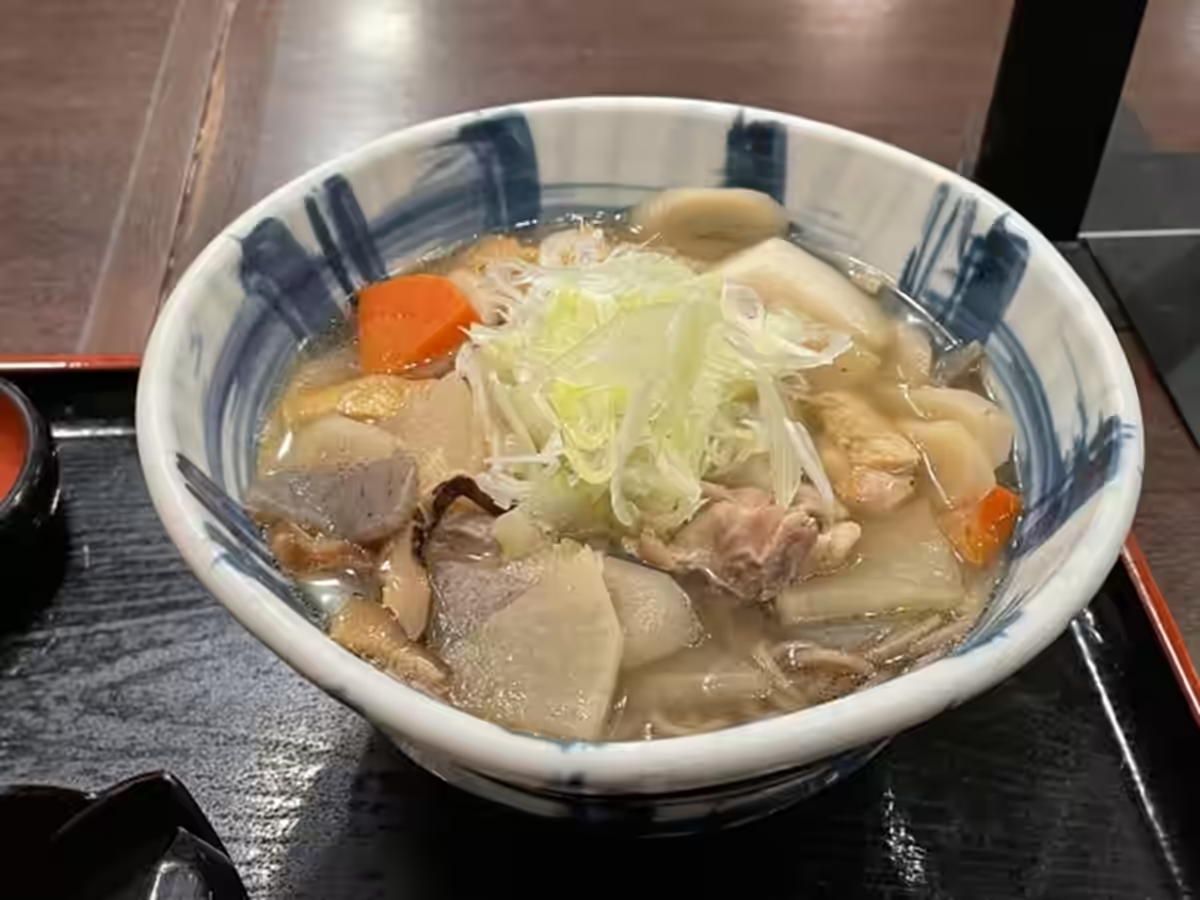
What is kenchinjiru?
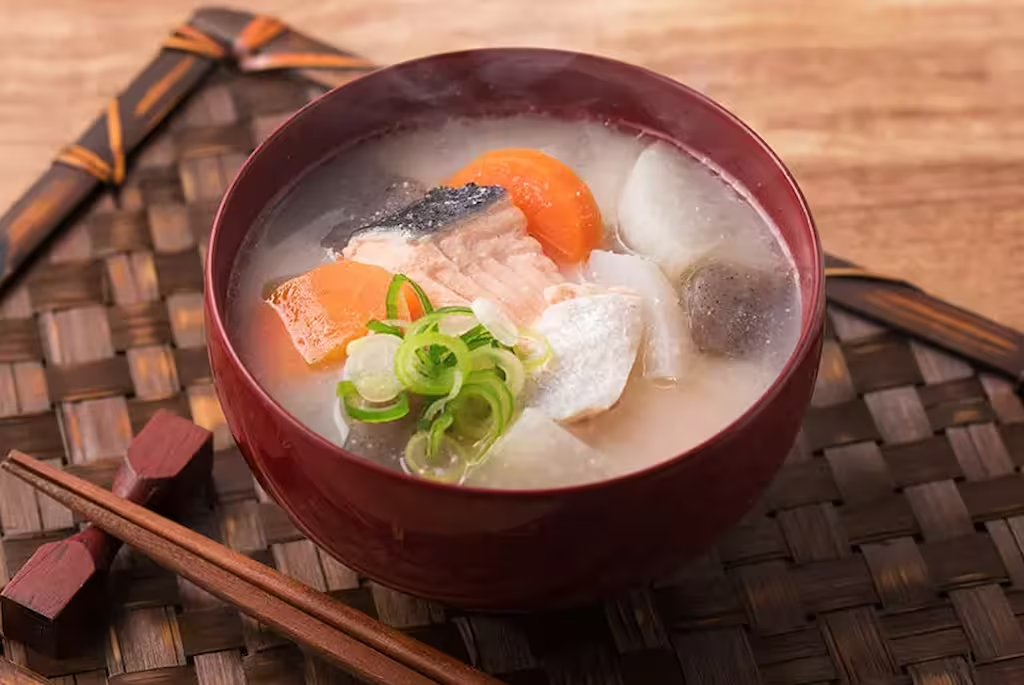
Kenchinjiru is a root vegetable soup made with tofu, daikon, carrots, burdock root, and konnyaku simmered in a clear dashi broth. It originated at Kencho-ji temple in Kamakura in the 13th century and is one of Japan’s most historically significant soup dishes. It is still served at the temple and at restaurants throughout Kamakura.
What are the best neighborhoods in Yokohama for food?
Yokohama Chinatown for dim sum and Chinese-influenced Japanese food; Kannai and Noge for yakitori, izakaya, and standing bars; Motomachi for old-school Western-influenced (yoshoku) restaurants; Isezakicho for sanmamen and traditional local dining; and Minato Mirai for waterfront restaurants with views of the bay.
What is herahera dango?
Herahera dango is a flat, paddle-shaped rice flour dumpling coated with sweet red bean paste (anko) from the Yokosuka area of Kanagawa. Made by mixing wheat or rice flour with water, flattening the dough into thin rounds, and boiling them before coating with anko. It is a rustic folk sweet recognized by the Japanese government as a traditional regional food heritage.
What is Odawara famous for in terms of food?
Odawara is famous for kamaboko — a processed fish cake made from white fish purée that is steamed, grilled, or fried. Odawara has been a major kamaboko production center since the Edo period due to its location on the old Tokaido highway and access to Sagami Bay seafood. Several long-established kamaboko shops along the castle town’s main street welcome visitors.
What is the kuro tamago of Hakone?
Kuro tamago (black eggs) are hard-boiled eggs cooked in the volcanic hot spring water of Owakudani crater in Hakone. The sulfur in the water turns the eggshells jet black while leaving the egg inside normal. Legend says eating one extends your life by seven years. They are sold only at Owakudani and are one of Japan’s most unusual regional food experiences.
Is Kanagawa food expensive?
Kanagawa offers every price point. A bowl of iekei ramen costs around ¥800–1,000. The Kiyoken shumai bento at Yokohama Station costs around ¥1,000. A nama shirasu-don at a Kamakura restaurant costs ¥1,200–1,800. High-end kaiseki and sushi restaurants in Yokohama’s Kannai district can cost ¥10,000 or more per person.
What drinks are paired with Kanagawa food?
Beer is the natural partner for Yokohama’s internationally influenced cuisine — the city has a thriving craft beer scene with multiple local breweries. Yokosuka navy curry is traditionally served with milk. Sake accompanies Kamakura temple cuisine and traditional Japanese dishes. Yokohama has a long coffee culture (kissaten) dating to the port era.
What is the difference between iekei ramen and tonkotsu ramen?
Pure tonkotsu ramen (like Fukuoka’s Hakata style) uses only pork bone broth, has thin straight noodles, and has a light white color. Iekei ramen adds soy sauce (shoyu) to the pork bone broth, giving it a darker color and saltier flavor. It also uses much thicker noodles and adds chicken oil for extra richness. The spinach and nori toppings are also unique to the iekei style.
What is seafood doria and where was it invented?
Seafood doria is a baked rice dish topped with béchamel sauce and seafood, similar to a French gratin. It was invented at the Hotel New Grand in Yokohama in the early 20th century by the same Swiss head chef who influenced other classic yoshoku dishes. The original recipe is still served at The Cafe in Hotel New Grand and is considered a landmark of Yokohama’s Western-Japanese culinary heritage.
Can I do a food tour in Yokohama?
Yes — Yokohama Chinatown, the Kannai area, and the Yokohama Ramen Museum are all excellent options. The Shin-Yokohama Ramen Museum, opened in 1994, houses eight ramen shops representing different regional Japanese styles in a retro-designed basement space. For street food, Chinatown’s main street has dozens of shops selling xiao long bao, steamed buns, and other Chinese snacks.
What is yoshoku and how does Kanagawa relate to it?
Yoshoku is the category of Western-style Japanese food that developed in port cities like Yokohama and Kobe from the Meiji period onwards. Dishes like Napolitan spaghetti, seafood doria, omurice (omelette rice), and hayashi rice were all created or popularized in Yokohama. The city is considered the birthplace of Japanese yoshoku culture.
What is the best season to visit Kanagawa for food?
Spring (March–May) for fresh nama shirasu and cherry blossom season in Kamakura. Summer for cold shirasu dishes and Enoshima seafood grills. Autumn (September–November) for new-harvest rice and the return of shirasu season. Winter for iekei ramen, gyunabe hot pot, and the cozy izakayas of Yokohama’s Noge district.
How do I get to Kamakura from Tokyo for food?
Kamakura is about 50 minutes from Tokyo’s Shinjuku Station on the JR Shonan-Shinjuku Line (direct), or about 55 minutes from Tokyo Station via Yokohama on the JR Yokosuka Line. The Enoden (Enoshima Electric Railway) runs along the coast from Kamakura to Enoshima, passing the best shirasu restaurants and seafood shops along the way.