




When most people picture Japanese breakfast, they imagine something quiet, balanced, and distinctly different from the bacon-and-eggs plates common in Western countries. That image is not entirely wrong — but it is also far from complete. Japanese breakfast is not just a meal. It is a window into how Japanese society values harmony, efficiency, and well-being, from the kitchen table to the convenience store counter to the hotel buffet. Understanding what Japanese people actually eat in the morning — and why — reveals something deeper about daily life in Japan.
Why Japanese Breakfast Looks “Light” but Feels Satisfying
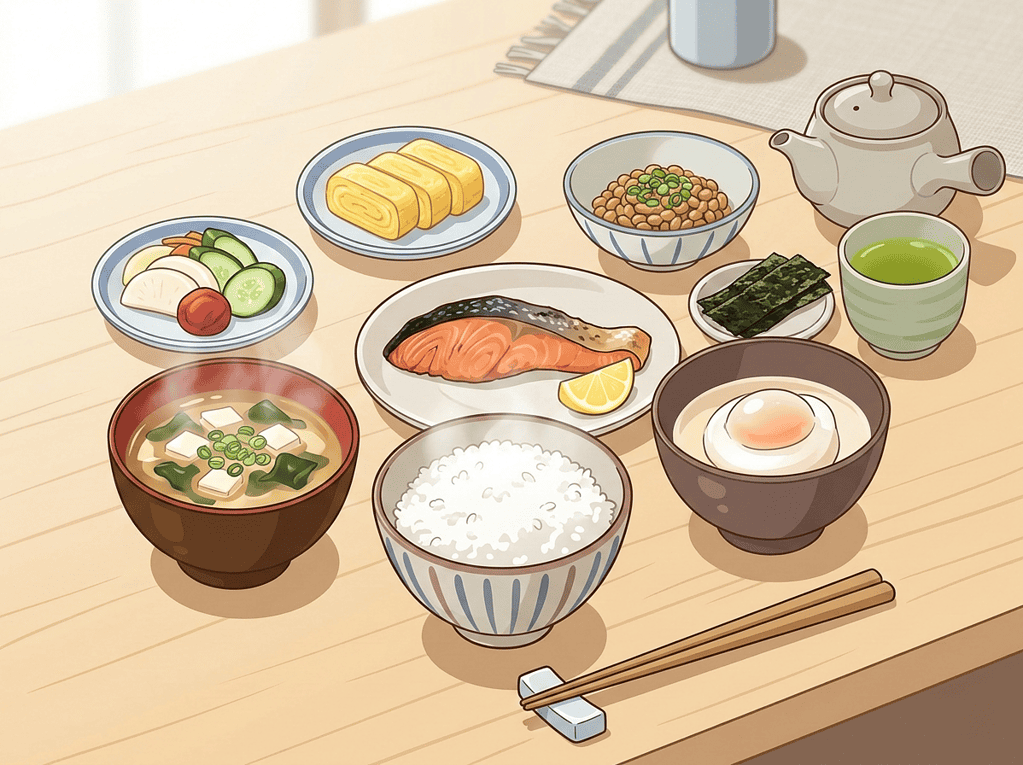
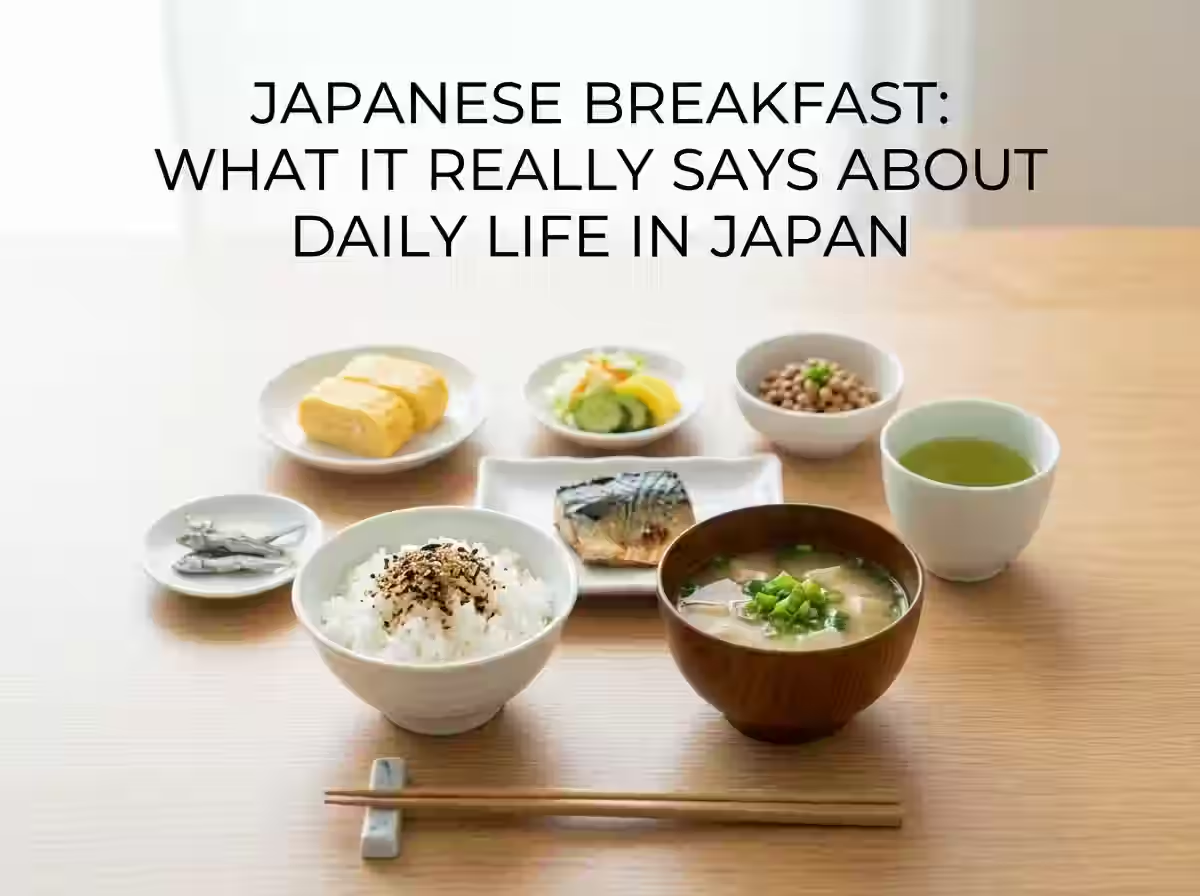
To someone raised on heavy Western breakfasts, a traditional Japanese morning meal can look surprisingly minimal at first glance. A small bowl of rice, a cup of miso soup, a piece of grilled fish, a few pickles — it hardly seems like enough to carry you through the morning. Yet people who eat this way consistently report feeling full, focused, and energized well into the afternoon. The secret lies not in quantity, but in the thoughtful combination of nutrients and flavors.
Typical Elements of a Traditional Japanese Breakfast
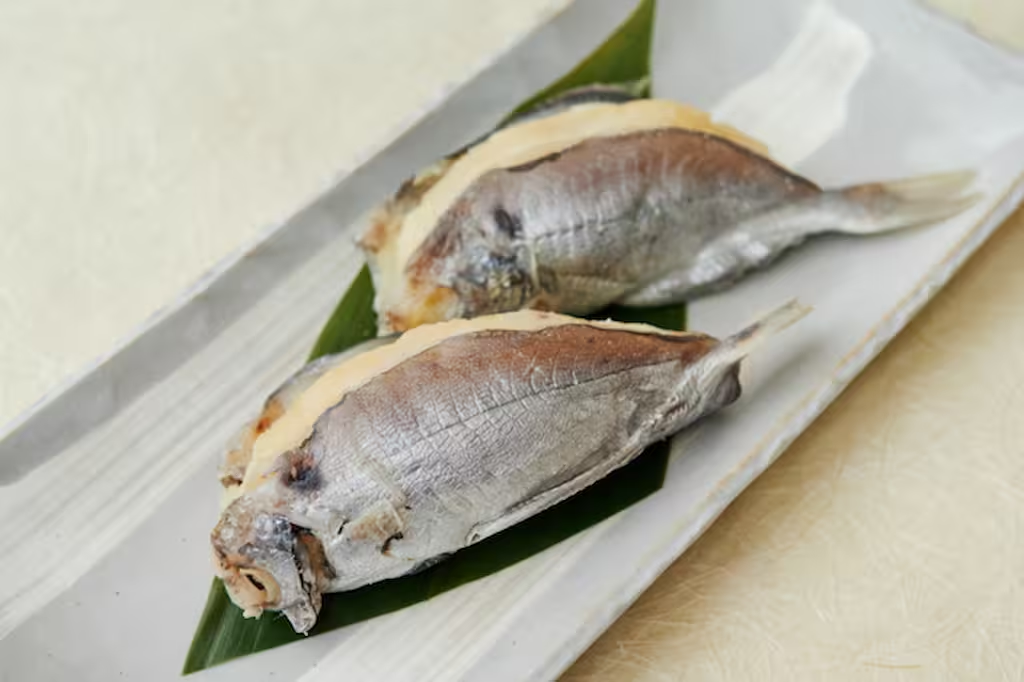
A traditional Japanese breakfast — known as asa gohan, which literally means “morning rice” — typically includes steamed white rice as its foundation. Alongside rice, miso soup (miso shiru) made with dashi broth, tofu, and green onions provides warmth and umami depth. Grilled fish, often salmon or mackerel (shioyaki), adds protein and healthy fats. Tsukemono, or Japanese pickles made from radish, cucumber, or plum, offer a sharp, cleansing contrast. Nori (dried seaweed), tamagoyaki (a rolled sweet omelette), natto (fermented soybeans), and a soft-boiled or raw egg are other common additions that vary by household and region.
Each element serves a purpose. Rice provides slow-burning carbohydrate energy. Miso soup delivers probiotics, minerals, and hydration. Fish contributes omega-3 fatty acids and lean protein. Pickles stimulate digestion. Together, these components form a compact but complete nutritional package.
The Idea of Balance in a Traditional Japanese Breakfast
Japanese cuisine is deeply influenced by the concept of ichiju sansai — “one soup, three sides.” This principle, rooted in Buddhist temple cooking and formalized during the Edo period, structures a meal around a bowl of rice, a soup, and three side dishes that offer contrasting flavors, textures, and cooking methods. Applied to breakfast, this framework encourages variety without excess. Nothing dominates the plate. Nothing is wasted. Every bite contributes something distinct.
This approach to meal balance is not a modern wellness trend in Japan — it is centuries old. And while not every Japanese household consciously follows ichiju sansai at breakfast today, the underlying logic of balance and proportion still shapes how morning meals are assembled, even informally.
Why Japanese Breakfast Can Be a Healthy Japanese Breakfast
From a nutritional standpoint, a traditional Japanese breakfast has a great deal going for it. The meal is generally low in saturated fat, high in fiber, rich in fermented foods that support gut health, and contains a broad spectrum of micronutrients from seaweed, fish, and vegetables. The sodium content in miso soup and pickles is worth watching, but overall, this style of breakfast aligns well with what nutrition science recommends for a healthy morning meal.
Japan’s exceptionally high life expectancy — consistently among the highest in the world — is not solely attributable to breakfast, of course, but dietary habits play a meaningful role. The emphasis on whole foods, fermented ingredients, fish over red meat, and modest portion sizes all contribute to a morning routine that supports long-term health.
Morning Routines in Japan: From Convenience Stores to Family Tables
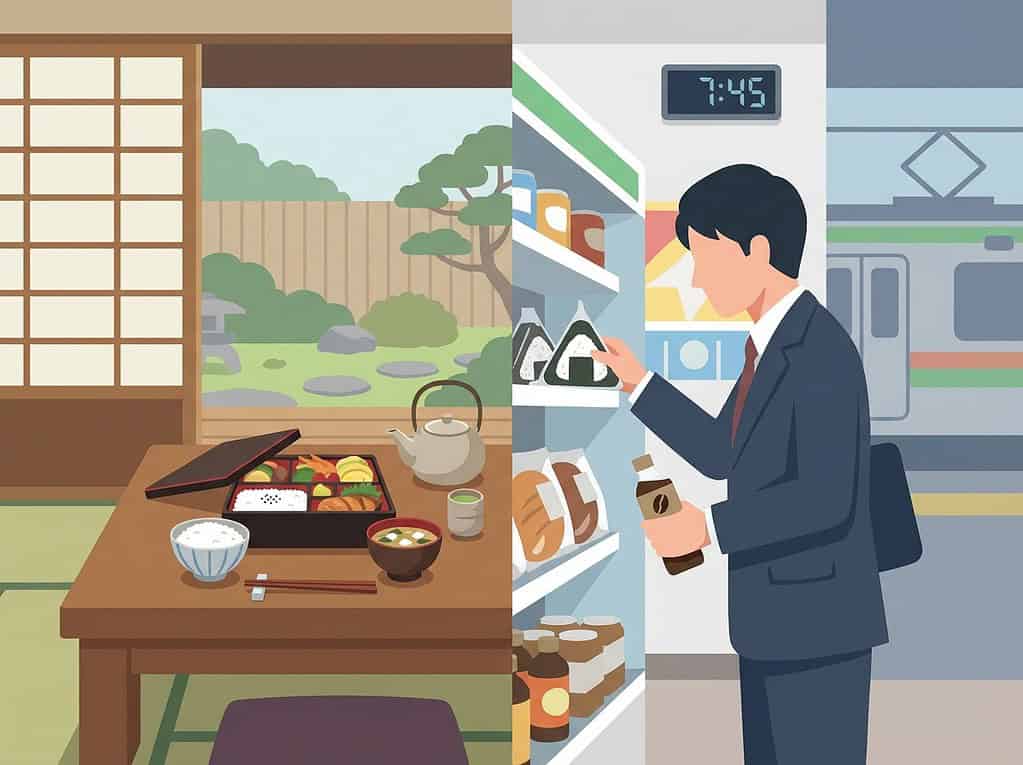
Japan is a country where tradition and hyper-modernity exist side by side — sometimes in the same morning. The elaborate traditional breakfast described above is real, but so is the salaryman rushing through a 7-Eleven at 7:45 a.m., grabbing an onigiri and a canned coffee before boarding a packed train. Japanese breakfast routine is not a single thing. It is a spectrum shaped by age, lifestyle, family structure, and the relentless pace of work culture.
Japanese Breakfast Routine on a Workday
On a typical weekday, Japanese breakfast routines are defined above all by time pressure. Workers, students, and parents often rise early but have very little morning leisure. A home breakfast, when it happens at all, tends to be simple: a bowl of rice with natto or a raw egg, tofu and miso soup, perhaps some leftover fish from the night before. Many households keep a rice cooker on a timer so that rice is ready the moment the family wakes up. Speed and simplicity are the priorities, even when eating at home.
For single-person households — a growing demographic in Japan’s major cities — the workday morning often involves no cooking at all. A convenience store stop, a vending machine coffee, or simply skipping breakfast entirely are all common. The morning ritual of a full ichiju sansai breakfast belongs more to weekends, older generations, and traditional households than to the urban young worker.
Convenience Store Breakfast: Onigiri, Sandwiches, and Coffee
Japan’s convenience stores — konbini, including chains like 7-Eleven, Lawson, and FamilyMart — are genuinely extraordinary institutions that play a central role in the country’s food culture. Their breakfast offerings go far beyond what most people in other countries would expect from a convenience store. Freshly made onigiri (rice balls wrapped in nori) come in dozens of fillings: salted salmon, pickled plum, tuna mayo, spicy cod roe. Egg salad sandwiches on pillowy white bread are legendary. Hot foods like steamed buns, oden (simmered vegetables and fish cakes), and even hot dog buns sit behind the counter.
For many urban Japanese, a convenience store breakfast is not a compromise — it is simply a practical, often delicious option that fits the rhythm of city life. The quality is high, the prices are reasonable, and the experience is frictionless. It reflects a distinctly Japanese approach to convenience: efficient but never careless about quality.
Weekend Brunch vs Weekday Rush
The gap between weekday and weekend breakfast in Japan is significant. On weekends, mornings slow down considerably. Families may prepare a fuller breakfast together, visit a local café for a morning set (a Japanese café staple that typically includes toast, a boiled egg, and a small salad), or simply eat more leisurely at home. Younger Japanese have embraced the Western-influenced café brunch culture enthusiastically, particularly in cities like Tokyo, Osaka, and Kyoto, where cafés serving elaborate pancakes, avocado toast, or elaborate egg dishes are enormously popular.
This contrast — the rushed weekday and the relaxed weekend — mirrors a broader tension in Japanese society between the demands of work culture and a genuine desire for rest and enjoyment. Breakfast is where that tension plays out every morning.
How Work Culture Shapes Japanese Breakfast Habits
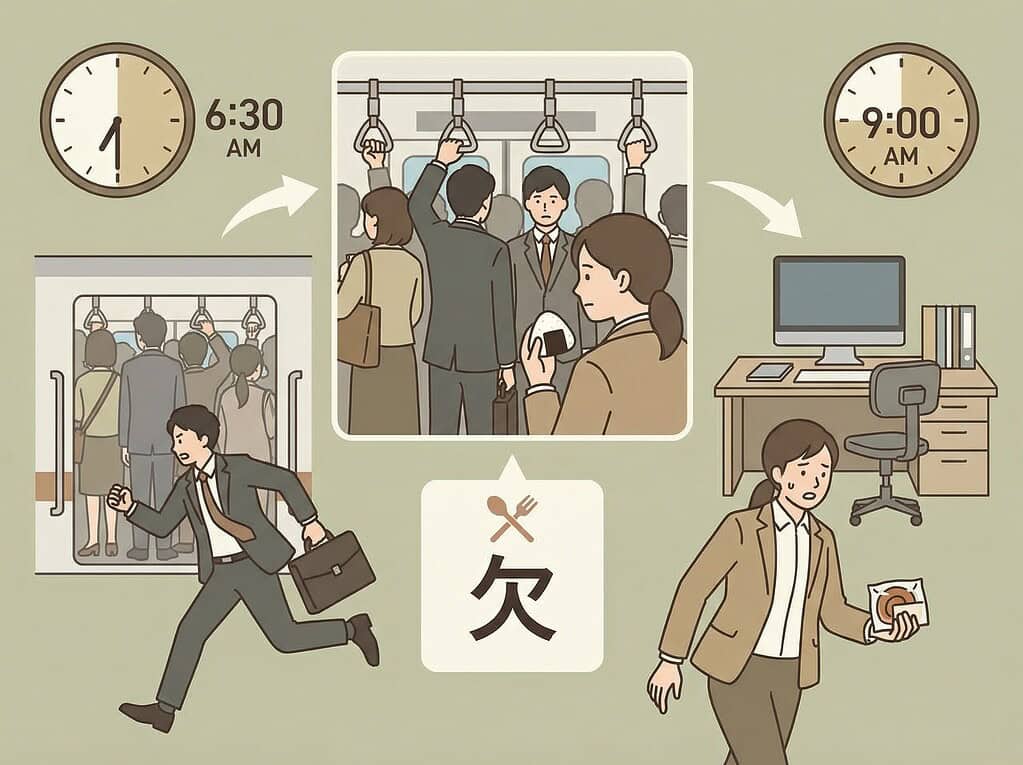
To understand Japanese breakfast, you have to understand Japanese work culture. Japan is a country where long working hours, extensive commutes, and strong social expectations around professional dedication have shaped not just how people spend their evenings, but how they start their mornings. Breakfast habits do not exist in a vacuum — they are deeply intertwined with the structures and pressures of working life.
Early Trains, Long Commutes, and Skipped Breakfast
Japan’s rail network is famously efficient and famously crowded. Millions of commuters board trains in the predawn or early morning hours, riding for anywhere from thirty minutes to well over an hour to reach their workplaces. With departure times often dictated by rigid train schedules rather than personal preference, many commuters sacrifice breakfast at home in favor of a few extra minutes of sleep or morning preparation.
Survey data from Japan’s Ministry of Health consistently shows that skipping breakfast — a habit termed choshoku kettai in Japanese — is more common among young adults and working-age men than any other demographic. The commute is one of the most commonly cited reasons. When you must be on the 6:42 train or wait another eighteen minutes, breakfast is often the first thing to go.
Office Workers Grabbing Breakfast On the Go
For those who do eat breakfast on workday mornings, on-the-go eating has become the norm rather than the exception. Japanese office workers are adept at the choreography of eating while commuting — or at least eating quickly before boarding or after arriving. Station kiosks, convenience stores near train exits, and bakeries positioned strategically along commuter routes do brisk morning business.
The options available have expanded significantly over the past two decades. Chain coffee shops like Doutor, Komeda’s Coffee, and the Japanese versions of Starbucks and McDonald’s have all developed morning menus designed for commuters. A coffee and a croissant, or an iced latte with a hot dog, might not be traditional — but it is fast, affordable, and available at hundreds of locations along any major commuter corridor.
Cafés and Fast Food as Backup Breakfast Options
Fast food breakfast in Japan deserves special mention. McDonald’s Japan introduced a breakfast menu decades ago, and it has been adapted thoughtfully for local tastes. Alongside egg muffins and hash browns, Japanese McDonald’s locations have served rice-based breakfast items including the Tomato and Shrimp Rice Burger, reflecting the enduring preference for rice even in a fast food context. Yoshinoya, the famous beef bowl chain, serves a breakfast gyudon (beef over rice) popular with morning workers. Matsuya offers similar options.
These choices illustrate something important about Japanese food culture: even when convenience demands fast food, the underlying preference for rice, protein, and savory flavors still surfaces. Western-style fast food breakfast has been adopted and adapted, not wholesale imported.
Hotel Breakfast Buffets vs Real Everyday Mornings
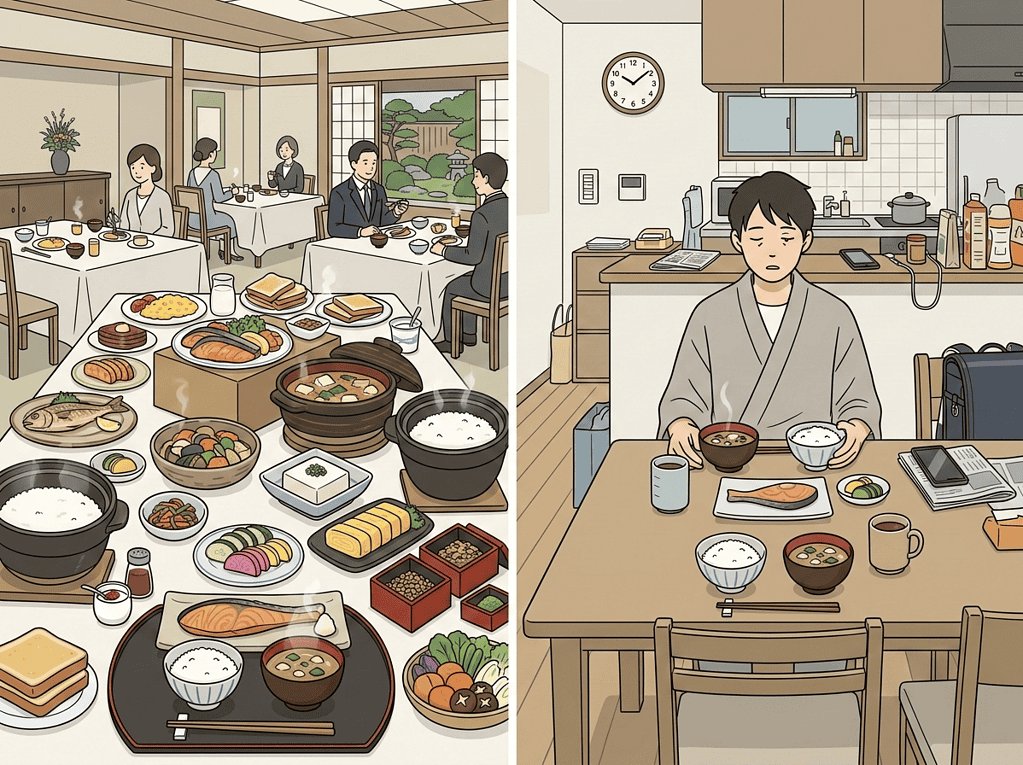
For most international visitors to Japan, their first experience of Japanese breakfast happens not in a home or convenience store, but in a hotel. And hotel breakfast in Japan is often genuinely spectacular — a carefully curated showcase of both traditional and Western options that can leave guests wondering why breakfast at home is so mediocre by comparison. But it is worth understanding what the hotel experience represents, and what it leaves out.
Japanese Breakfast at Hotel: What Tourists Usually See
A Japanese breakfast at a hotel — particularly at a ryokan (traditional inn) or a mid-to-upper-range business hotel — is a remarkable spread. At a ryokan, breakfast is typically a full traditional meal served at your table or in a common dining room: grilled fish, miso soup, rice, pickles, tofu, tamagoyaki, natto in small lacquer boxes, and seasonal local vegetables. Everything arrives beautifully presented, often in handcrafted pottery, at a precise temperature.
At business hotels, the breakfast buffet format allows guests to sample both Japanese and Western options side by side. You might fill one plate with rice, miso soup, and pickled vegetables, and another with scrambled eggs, toast, and yogurt. The variety is impressive, the quality is usually high, and the experience genuinely reflects the best of Japanese breakfast hospitality (omotenashi).
How Hotel Buffets Mix Western and Traditional Japanese Breakfast
The blending of Western and Japanese breakfast options at hotel buffets is not accidental. It reflects Japan’s long history of selective cultural adoption — a process sometimes called wakon yosai (Japanese spirit, Western knowledge) — applied even to the breakfast table. Hotels began offering Western breakfast items in the Meiji era to accommodate foreign guests, and over time these became a standard feature of Japanese hospitality, enjoyed by domestic guests as much as international visitors.
Today, the hotel breakfast buffet serves as a kind of culinary diplomacy. Japanese guests who might eat a simple rice and miso at home enjoy the luxury and variety of the buffet. Foreign guests discover Japanese breakfast staples in an accessible, curated environment. Both groups leave with a somewhat idealized picture of Japanese morning eating — one that is real, but not representative of everyday life.
What Travelers Might Miss About Everyday Home Breakfast
The gap between the hotel breakfast experience and the everyday Japanese home breakfast is significant. At home, breakfast is rarely elaborate. It is whatever can be assembled quickly from whatever is in the refrigerator. Leftover miso soup reheated. Rice from the cooker. A piece of fish that was grilled the night before. A raw egg cracked over hot rice with soy sauce (tamago kake gohan) — one of the most beloved and humble of Japanese breakfast traditions, utterly invisible in any hotel setting.
Travelers who stay in home-stays, Airbnbs, or visit Japanese friends are much more likely to see the real everyday Japanese breakfast: efficient, modest, built around whatever is available, and eaten quickly before a busy day begins. This version is less photogenic than the ryokan spread, but it is arguably more interesting for what it reveals about real daily life.
What You Can Learn from Japanese Breakfast for Your Own Routine
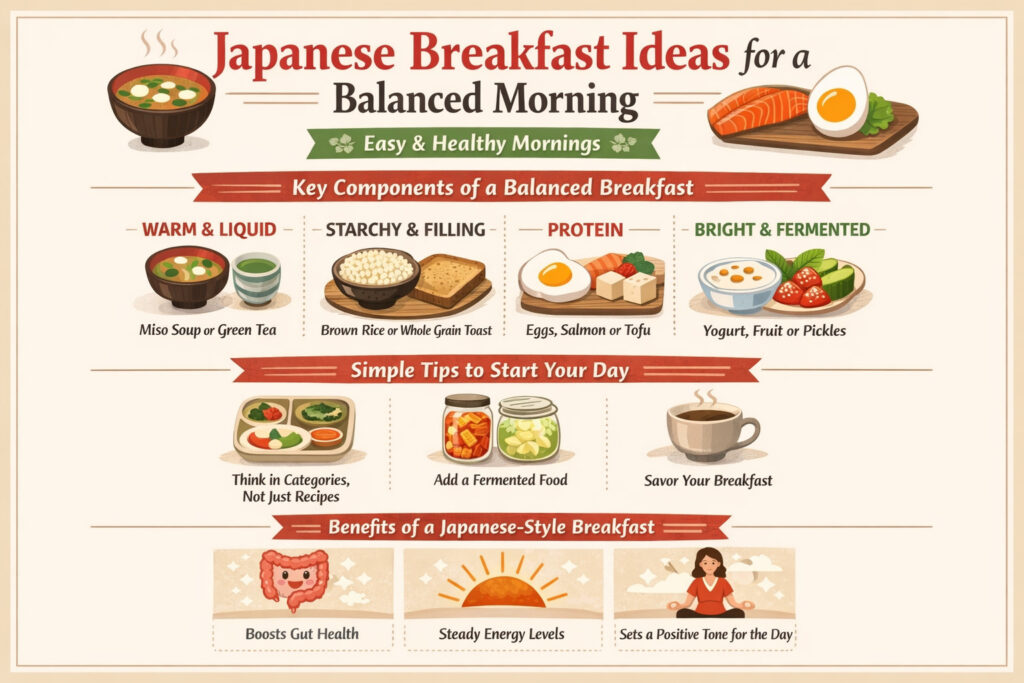
You do not need to move to Japan or find a Japanese grocery store to incorporate the best ideas from Japanese breakfast into your daily life. The underlying principles — balance, simplicity, variety, and attention to how food makes you feel — are universally applicable. What the Japanese breakfast tradition offers, at its core, is a different relationship with the morning meal: one defined by intentionality rather than habit or convenience.
Simple Ways to Build a More Balanced Morning Meal
The ichiju sansai framework does not require you to serve three distinct Japanese side dishes every morning. What it encourages is thinking about your breakfast in terms of categories rather than recipes: something warming and liquid (soup or tea), something starchy and filling (rice, oats, or whole-grain bread), something with protein (eggs, fish, beans, or tofu), and something with brightness and contrast (pickles, fresh fruit, or fermented food like yogurt or kimchi). Assembling these components — even in non-Japanese forms — produces a more complete and satisfying meal than most Western breakfasts.
Adding a fermented element to your morning routine is one of the highest-impact changes you can make. Miso, yogurt, kefir, kimchi, or even a good sourdough bread all contribute beneficial bacteria that support gut health and immune function. Japanese breakfast leans heavily on fermented foods not as a trend but as a tradition — and science has increasingly validated the wisdom behind that tradition.
Adapting Japanese Breakfast Ideas to an American Kitchen
Japanese breakfast vs American breakfast: the contrast is often stark, but the gap is more bridgeable than it appears. An American kitchen can produce a surprisingly Japanese-inspired breakfast with very accessible ingredients. Miso paste, increasingly available in mainstream grocery stores, can be stirred into hot water with a piece of tofu and some green onion in under two minutes. A poached egg or smoked salmon replaces grilled fish protein. Brown rice or quinoa substitutes for white rice if you prefer. Pickled vegetables — even store-bought dill pickles or sauerkraut — provide the digestive contrast that Japanese pickles supply in a traditional meal.
The most important adaptation is psychological rather than culinary: treating breakfast as a real meal that deserves some thought, rather than a nutritional afterthought bolted onto the beginning of the day. Japanese breakfast, at its best, reflects the idea that how you begin the morning matters — not just for energy, but for the quality of the day ahead.
Small Habit Changes Inspired by Japanese Breakfast Routine
The Japanese breakfast routine, even in its modern convenience-store form, contains habits worth borrowing. Eating something rather than nothing — even an onigiri grabbed on the way to the train — beats skipping breakfast entirely. Prioritizing savory over sweet in the morning means avoiding the blood sugar spike and crash that comes from pastries and sugar-laden cereals. Drinking miso soup or green tea in the morning provides hydration, warmth, and a moment of pause in an otherwise rushed routine.
Perhaps the most transferable lesson from Japanese breakfast culture is the willingness to eat the same reliable, simple thing every morning without boredom. In Japan, there is no cultural expectation that breakfast needs to be exciting or varied from day to day. A bowl of rice, a cup of miso soup, and a piece of fish is not a deprivation — it is a foundation. That steadiness, that trust in a simple and nourishing routine, might be the most valuable thing Japanese breakfast has to offer.
Whether you adopt the full traditional spread, incorporate a few Japanese ingredients into your existing routine, or simply approach your morning meal with a little more intentionality, the principles behind Japanese breakfast have something meaningful to offer. They are a reminder that the best morning meals are not the most elaborate — they are the ones that sustain you, in every sense of the word.
Conclusion
Japanese breakfast is not simply a meal — it is a reflection of values. Balance over excess. Quality over quantity. Consistency over novelty. Every version of the Japanese morning meal, from a carefully composed spread of rice, miso soup, and grilled fish to an onigiri grabbed at a konbini before the train, carries the same underlying logic: eat well, eat simply, and move forward with the day.
A healthy Japanese breakfast prioritizes whole foods, fermented ingredients, lean protein, and modest portions — a combination that supports sustained energy and long-term well-being. The contrast between Japanese and American breakfast is less about which is superior and more about what each reveals: different relationships with time, nourishment, and the meaning of a good morning. You do not need to transform your mornings overnight. Start small. Add a cup of miso soup. Try an onigiri instead of a pastry. Let the Japanese approach be a quiet prompt to slow down, if only for a few minutes, and treat the first meal of the day as something that matters — because it does.




Comments