




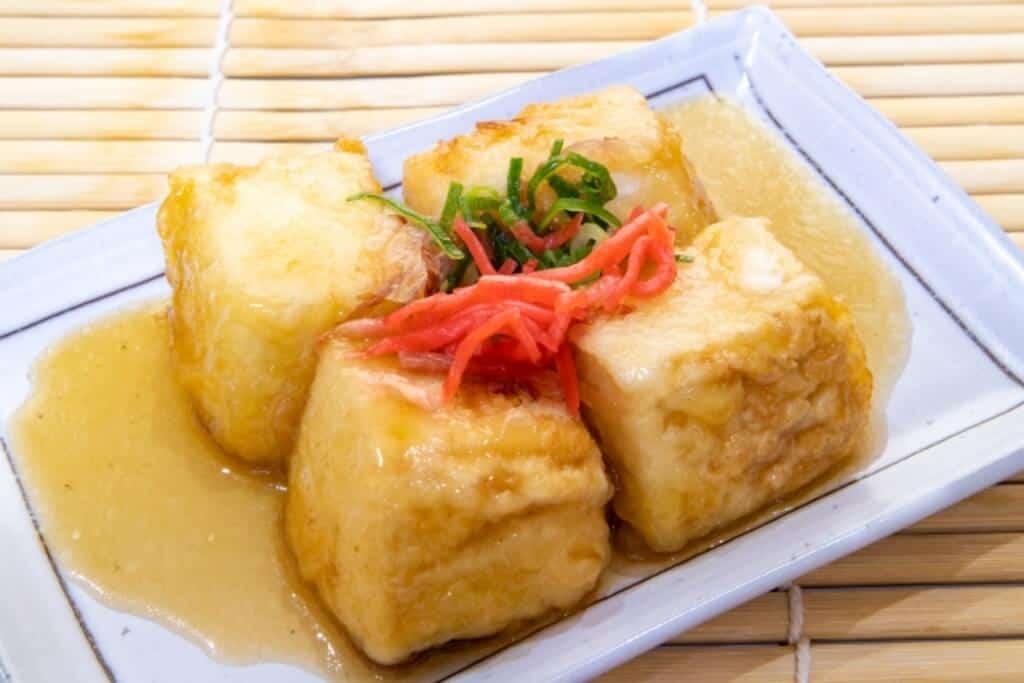
Order agedashi tofu at a Japanese izakaya and a small bowl arrives steaming. Inside sit pale cubes of deep-fried tofu in a shallow pool of dashi broth. The coating is thin and crisp for about a minute. Then it starts to drink the sauce, and that is when many people like it best.
This guide explains what the dish is, how it tastes, where the name may come from, and how to cook it at home. It also covers vegan adaptations, an air fryer method, nutrition estimates, and how to find it on menus in Japan.
What is agedashi tofu?
Agedashi tofu (揚げ出し豆腐), also called agedashi dofu in Japanese, is a Japanese tofu dish of lightly coated, deep-fried tofu served in a warm dashi-based sauce. Cooks dust drained tofu with potato starch (katakuriko), fry it until crisp, and finish it with garnishes such as grated daikon, ginger, and scallions.
- Ingredients: tofu, potato starch, oil, dashi, soy sauce, and mirin.
- Texture: a thin crisp shell that softens in the sauce, with a tender center that ranges from creamy to custardy, depending on the tofu.
- Serving: hot, in a small bowl, as an appetizer or side dish.
Here to cook? Jump to the agedashi tofu recipe.
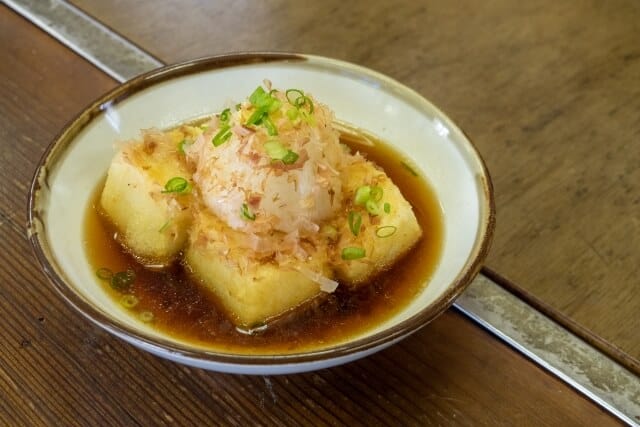
Quick facts
- Japanese name
- 揚げ出し豆腐 or 揚出し豆腐 (agedashi dofu)
- Type of dish
- Fried tofu appetizer, common at izakaya and in home cooking
- Coating
- Usually potato starch; some cooks use wheat flour
- Sauce
- Dashi seasoned with soy sauce and mirin
- Common garnishes
- Grated daikon, grated ginger, scallions, bonito flakes
- Vegan?
- Only when made with plant-based dashi and toppings
- Historical note
- Fried tofu dishes appear in an Osaka cookbook of 1782; the exact origin is unclear
What does agedashi tofu taste like?
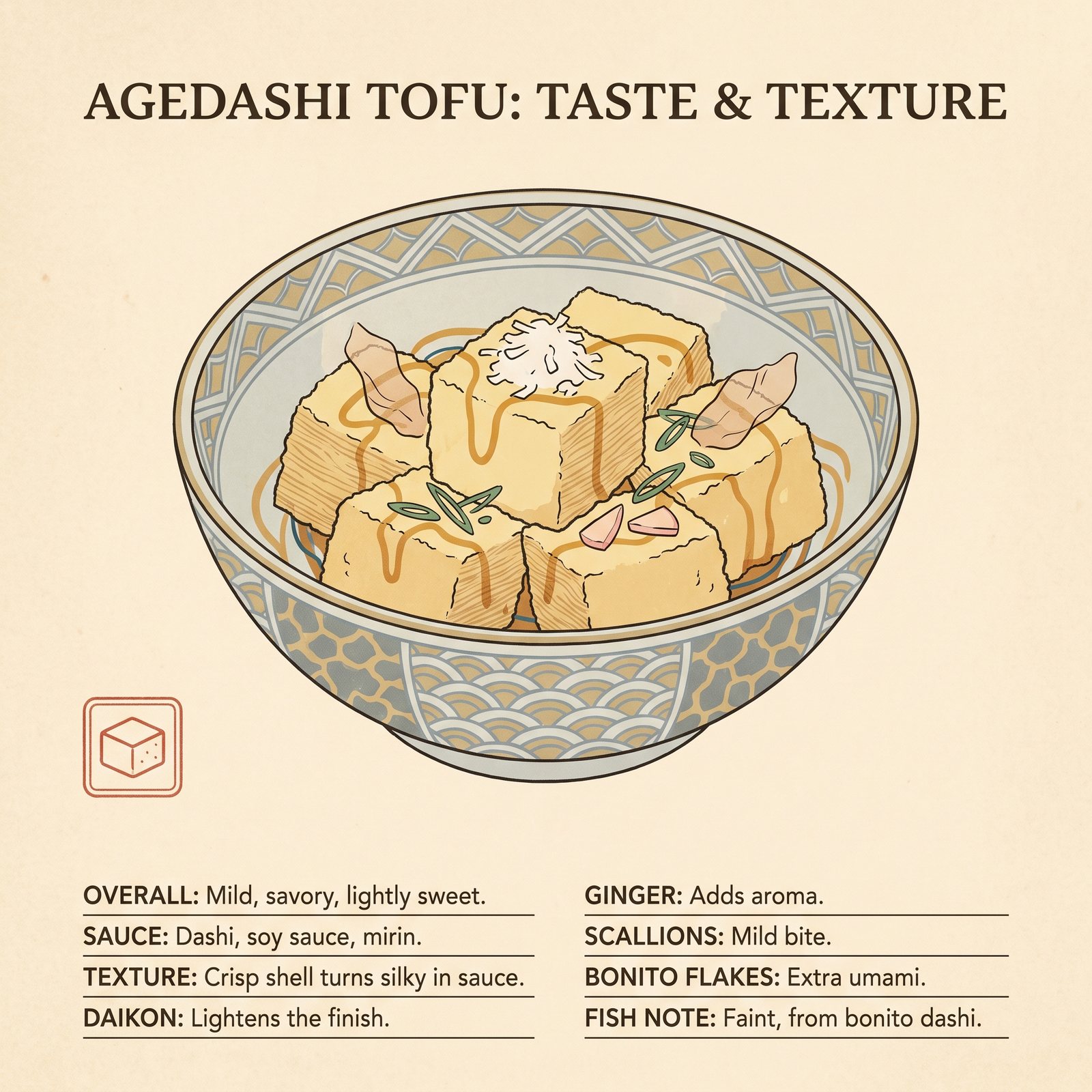
Agedashi tofu tastes mild, savory, and lightly sweet. The tofu itself is delicate, so most of the flavor comes from the sauce: aromatic dashi, salty soy sauce, and gentle sweetness from mirin. Because bonito often flavors the dashi, the dish can carry a faint fish note.
Texture is the real draw. At first, the shell is crisp. Within a minute or two, however, it absorbs sauce and turns silky, almost slippery. Is that a flaw? Not at all. Many people order the dish precisely for that soft, soaked stage.
Garnishes do specific jobs. Grated daikon lightens the finish, while ginger adds aroma. Scallions bring a mild bite, and bonito flakes add extra umami.
Name and history
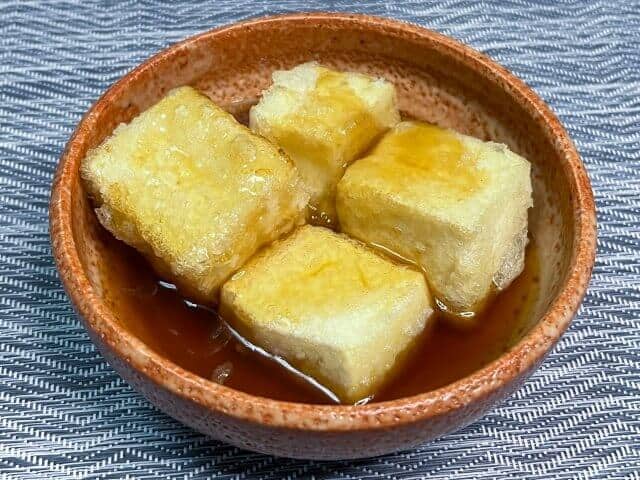
Where does the name come from?
Several explanations exist for the name. One theory connects it with serving freshly fried tofu in dashi, but the origin remains uncertain. The age element is generally understood as referring to ageru, meaning “to deep-fry.” The second half is less certain. Popular explanations connect it either with dashi stock or with the verb dasu, to serve. However, we found no authoritative etymological source confirming either interpretation.
Cooks also use the agedashi style for vegetables such as eggplant and daikon, although preparation methods vary.
What the Edo period sources show
The firmest date is 1782. In that year, an Osaka publisher issued Tofu Hyakuchin, a cookbook of one hundred tofu dishes. The publication shows that diverse tofu preparations were established by the late eighteenth century. It includes a preparation identified as “age tofu” (油煤とうふ), but surviving descriptions suggest it was closer to plain deep-fried tofu, or modern atsuage, than to starch-coated agedashi tofu. For that reason, it should not be treated as direct evidence that modern agedashi tofu existed in 1782.
What about the restaurant story? According to one unverified account, a restaurant called Agedashi in old Shitaya, near today’s Ueno in Tokyo, was known for the dish. We could not confirm that the restaurant gave the dish its name, so treat the tale with caution. In short, fried tofu is documented in the Edo period, while the precise origin of the modern dish is unclear.
Best tofu for agedashi tofu
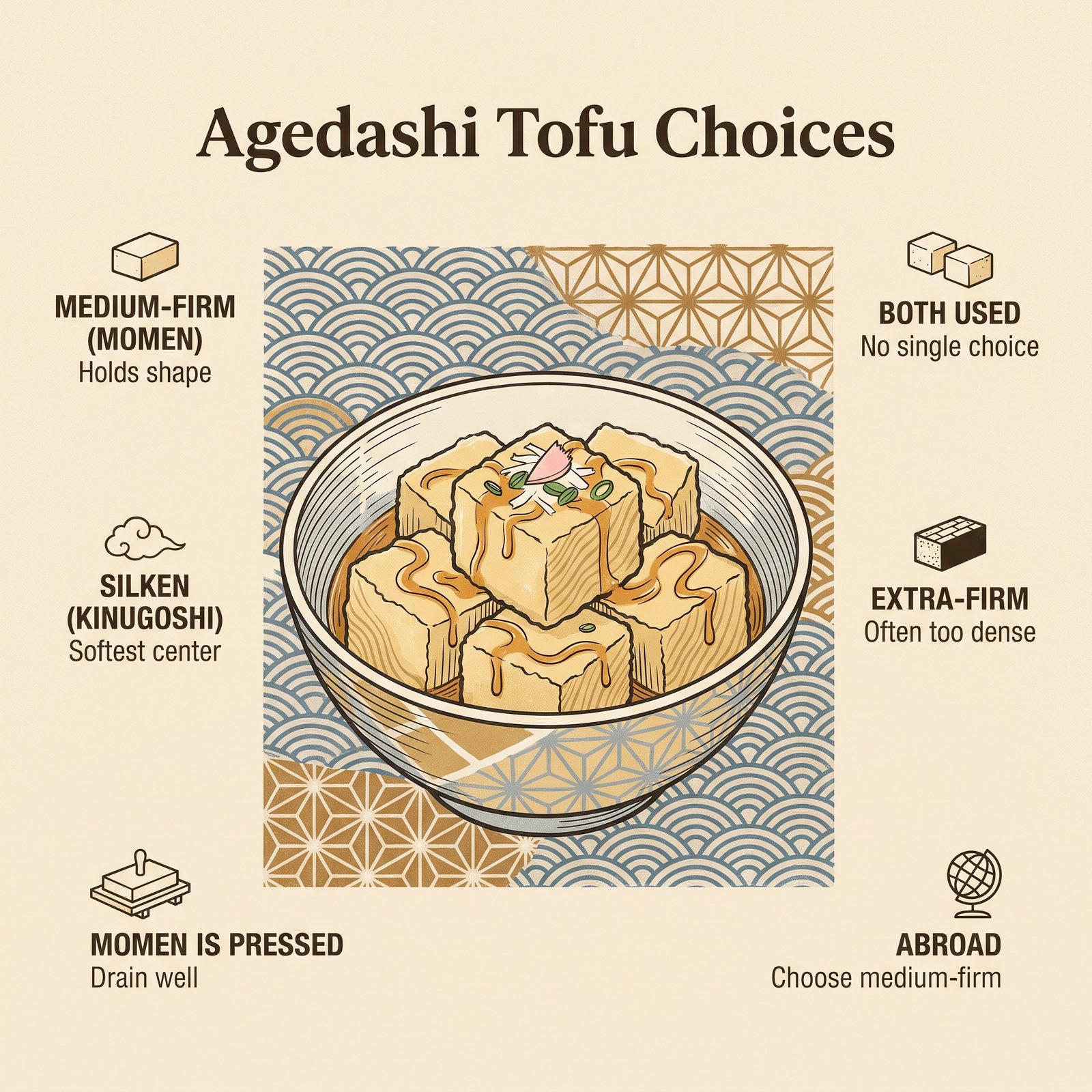
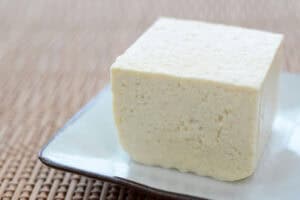
The best tofu for agedashi tofu is medium-firm tofu if you want easy handling, or silken tofu if you want the softest center. Japanese recipes use both momen and kinugoshi tofu, so neither is the single authentic choice.
Momen tofu is pressed during production, so it holds its shape in hot oil. Kinugoshi tofu, or silken tofu, sets without pressing. As a result, it is smoother but breaks more easily. Japan’s MEXT Food Composition Database lists momen tofu at 85.9 g of water per 100 g, which explains why draining matters.
Shopping outside Japan? Labels do not match perfectly. Look for medium-firm or momen-style tofu. Extra-firm blocks, in contrast, are often too dense to give a soft interior.
How to make agedashi tofu
To make agedashi tofu, drain the tofu, coat it thinly with potato starch, fry it briefly, and serve it in warm sauce. The short version looks like this.
- Wrap the tofu in kitchen paper and let it drain, then cut it into six pieces.
- Simmer the mirin briefly, then add dashi and soy sauce to make the sauce.
- Coat each piece with potato starch just before frying.
- Fry in batches at 160–170°C until the coating is set and crisp.
- Serve at once with warm sauce and garnishes.
Ingredients and equipment
Agedashi tofu (reference recipe)
Ingredients
- Medium-firm (momen) tofu: 350 g (about 12 oz)
- Potato starch (katakuriko): 3 to 4 tbsp
- Neutral oil, enough for a depth of 3–4 cm
- Dashi: 200 ml (¾ cup plus 1 tbsp)
- Mirin: 50 ml (3 tbsp plus 1 tsp)
- Japanese dark soy sauce (koikuchi): 50 ml (3 tbsp plus 1 tsp)
- Grated daikon: 2 to 3 tbsp, lightly drained
- Grated ginger: 1 tsp
- Scallions, thinly sliced: 1 tbsp
- Optional: shishito peppers, bonito flakes
Sauce ratio: dashi 4, mirin 1, soy sauce 1. This quantity makes more sauce than the tofu will absorb, so spoon only enough into each bowl to reach partway up the tofu. Usukuchi soy sauce keeps the sauce paler but is often saltier, so use slightly less and adjust to taste.
Equipment
- Kitchen paper
- Small saucepan
- Heavy-bottomed pot
- Thermometer
- Wire rack
- Slotted spoon or spider strainer
Rapeseed, rice bran, or plain vegetable oil all work, because they add little aroma. Total time is about 30 minutes.
Recipe status
This is a reference recipe built on the quantities in our earlier version and on standard Japanese home-cooking methods. Treat the times as guidance, since tofu brands and stoves differ.
Step 1: Drain and cut the tofu
Wrap the tofu in kitchen paper and rest it for 10 to 15 minutes. For silken tofu, allow 15 to 20 minutes and skip any heavy weight, because pressure cracks it. Afterward, cut the block into six pieces of roughly 4 to 5 cm. Finally, pat every side dry.
Why six? Small pieces fry quickly and provide more crisp coating in each bite. Larger pieces emphasize the tofu’s soft center.
Step 2: Make the agedashi tofu sauce
The sauce is a warm dashi-based sauce, or tentsuyu-style broth. First, bring the mirin to a brief boil in a small saucepan to reduce its raw alcoholic aroma. Then add the dashi and soy sauce and warm everything over low heat. Do not reduce it, since a long simmer makes the agedashi tofu sauce too salty. Keep it warm while you fry.
Step 3: Coat the tofu
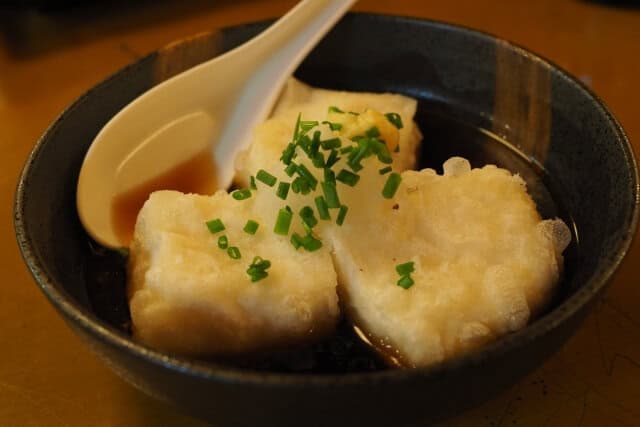
Coat each piece immediately before it goes into the oil. Starch that sits on wet tofu turns sticky, so timing matters here. Dust all sides thinly and evenly, then shake off the excess. Kikkoman’s cooking guide notes that potato starch clings well, browns little, and keeps the sauce clear.
Step 4: Fry in small batches
Heat the oil to 160–170°C (320–340°F). A thermometer gives the most reliable result. Without one, dip the dry tip of a wooden chopstick into the oil; a steady stream of small bubbles means the oil is approaching frying temperature. That is only an estimate, so reduce the heat if the coating browns quickly. Fry two or three pieces at a time, so the temperature does not fall sharply, and turn them once.
Fry until the coating looks set, crisp, and only lightly golden. A deep brown color is unnecessary and usually means overcooking. Next, lift the tofu onto a wire rack and let the excess oil drain briefly. If you have no rack, use kitchen paper, but move the pieces before steam softens the underside.
Step 5: Serve right away
Serve the freshly fried tofu in warm dashi sauce. The contrast makes it especially comforting in cold weather. To keep the top crisp a little longer, pour the sauce around the tofu instead of over it. Then add the daikon, ginger, and scallions.
No daikon or shishito where you live? Sliced scallions, grated ginger, shredded nori, shiso, or sesame seeds all stay close to the original spirit. At an izakaya, the dish is an appetizer. At home, however, it becomes a light meal with rice and miso soup.
Vegan, air fryer, and other variations
Vegan agedashi tofu
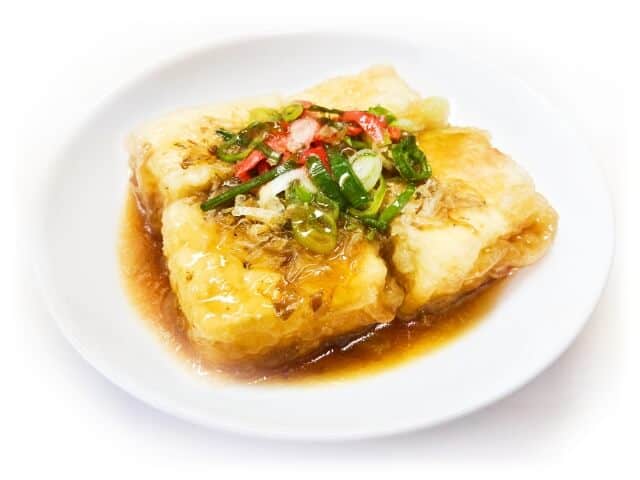
Is agedashi tofu vegan? Not by default. Standard dashi uses bonito, and many versions add bonito flakes on top. For vegan agedashi tofu, make the dashi from kombu and dried shiitake instead. Also skip the bonito flakes and use shredded nori, sliced shiitake, or white sesame. Our guide to Japanese vegetarian dishes explains why hidden fish stock is so common.
Gluten is a separate question. Most soy sauce contains wheat, so the dish qualifies as gluten-free only with wheat-free tamari or a certified gluten-free soy sauce.
Air fryer adaptation
Air fryer agedashi tofu is an adaptation rather than the classic method, and we have not tested it ourselves. As a starting point, preheat the air fryer to 190°C (375°F). Coat the drained tofu with starch, then spray it lightly with oil. Arrange the pieces with space between them and cook for about 10 to 15 minutes, turning them halfway through. Start checking early, since air fryer power and tofu size vary. The coating will look paler and less even than deep-fried tofu, but it still takes the sauce well.
Shallow-fry method
Prefer shallow frying? Pour oil to a depth of 1 to 1.5 cm and fry each face in turn. The crust comes out slightly thinner and less uniform. Turn the pieces gently, though, because corners break easily in shallow oil.
Modern variations
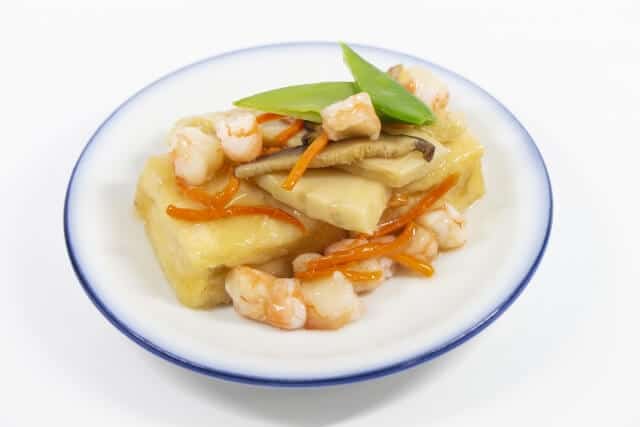
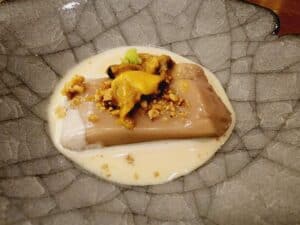
Some versions leave the traditional formula behind. A ponzu version swaps the warm dashi sauce for cold citrus soy sauce. Another variation uses a thick, glossy starch-thickened sauce inspired by Japanese-Chinese cooking, which changes the texture completely. Some cooks even fry the tofu with no coating at all. In Okinawa, some restaurants also serve fried jimami tofu, a peanut-and-starch specialty. It is not tofu in the soybean sense, but its creamy texture suits frying and savory sauces.
Make-ahead, storage, and reheating
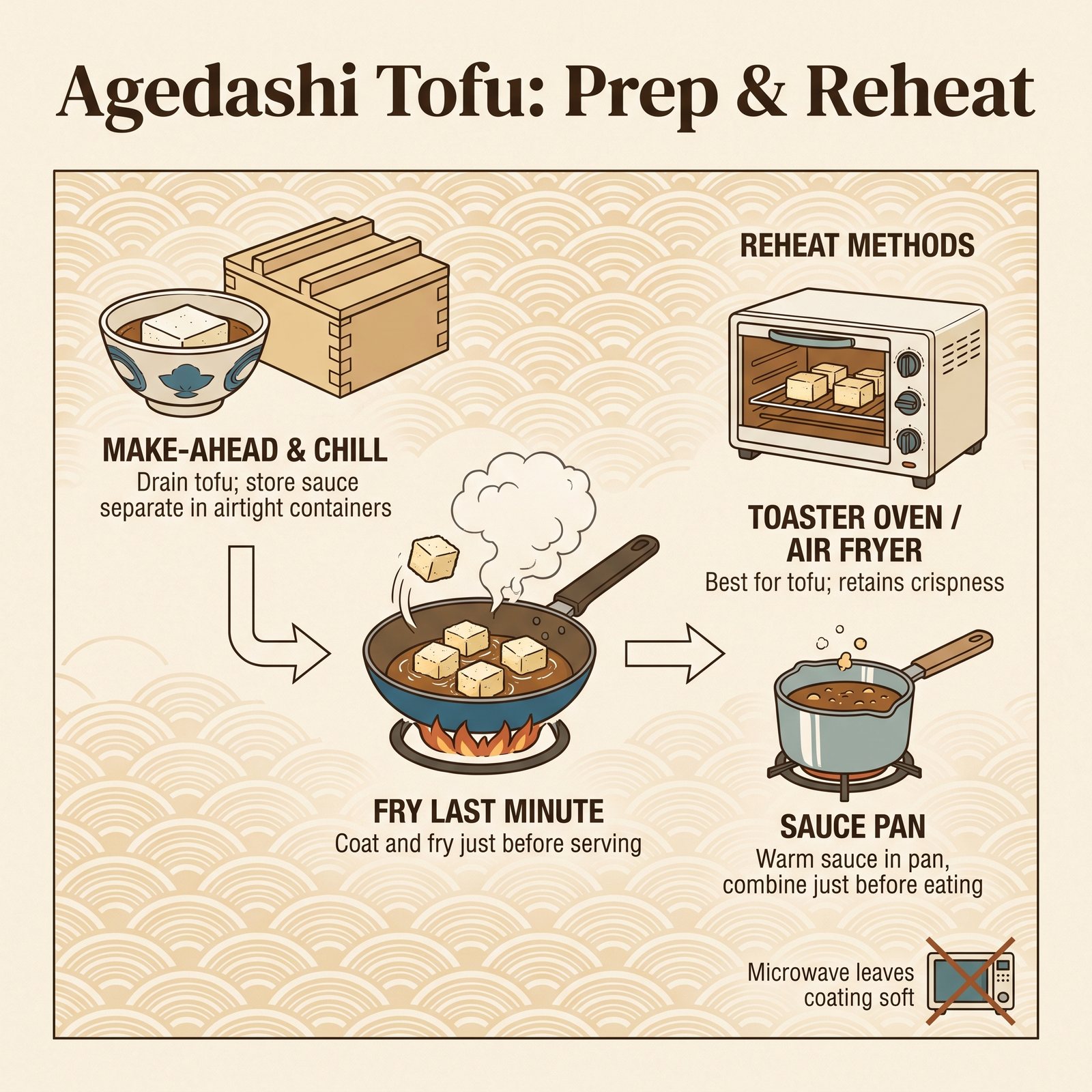
Agedashi tofu is best cooked and eaten at once, so only part of it suits advance work. You can drain the tofu and make the sauce ahead. Coating and frying, however, belong to the last few minutes before serving.
Refrigerate leftover tofu and sauce promptly in separate airtight containers. For the best texture, eat the tofu the next day, and follow local food-safety guidance for maximum refrigerated storage. Do not keep fried tofu that has sat at room temperature for a long time. To reheat, warm the tofu in a toaster oven or air fryer until the surface heats through. Meanwhile, warm the sauce in a pan and combine the two just before eating. A microwave alone leaves the coating soft.
Agedashi tofu calories and nutrition
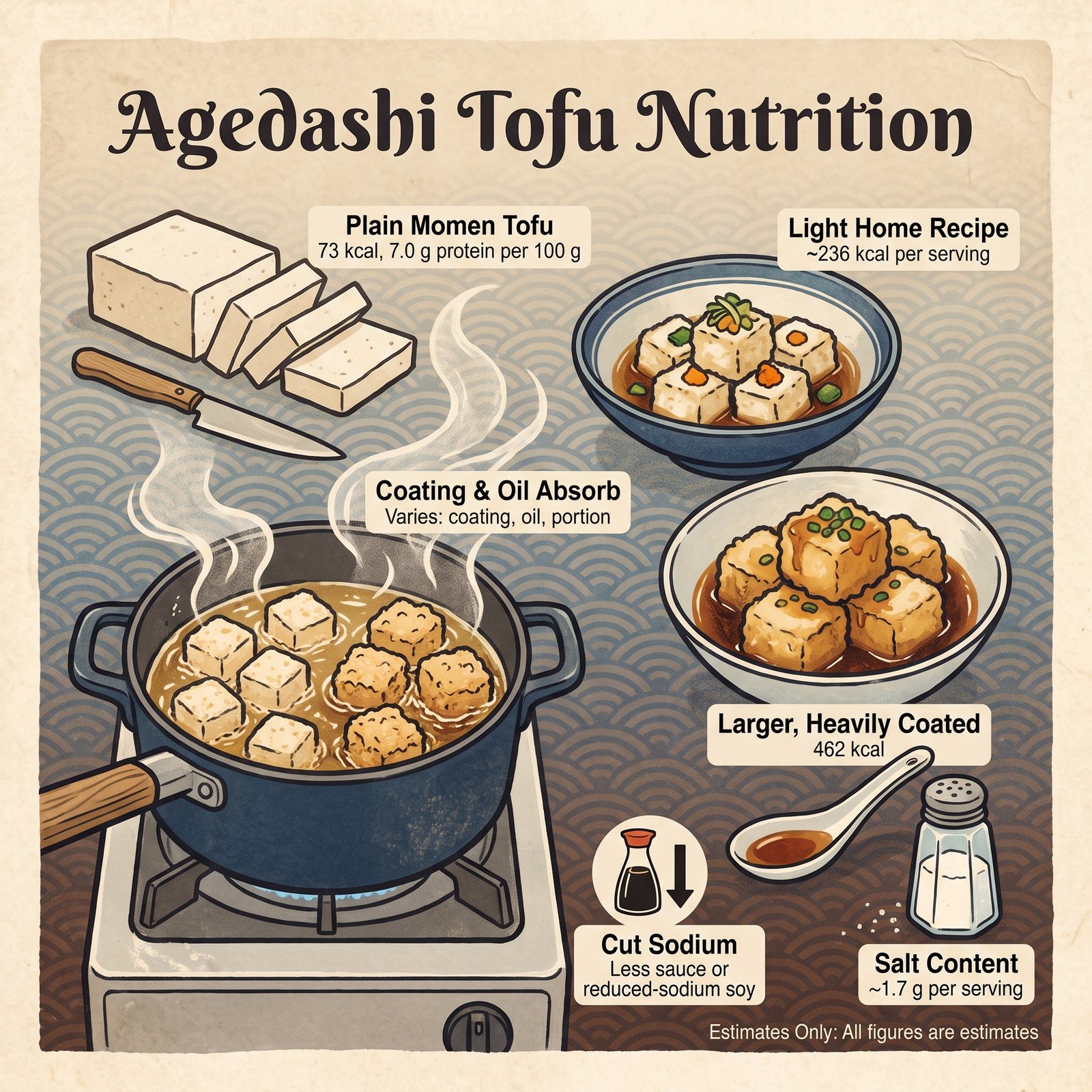
Agedashi tofu calories vary widely, because the starch, the oil absorbed, and the portion all change the total. Published Japanese recipes show the spread. One home-cooking site lists about 236 kcal per serving, while Kikkoman lists 462 kcal for a larger, more heavily coated portion. Plain momen tofu, by comparison, has 73 kcal and 7.0 g of protein per 100 g.
We have not calculated values for the recipe above, so treat any single figure as an estimate. Sodium intake also depends on how much sauce you consume. If you drink all of it, you take in far more salt than if you leave it. Kikkoman’s version, for instance, lists 1.7 g of salt per serving. To cut that, use reduced-sodium soy sauce or simply pour less sauce.
Agedashi tofu vs other tofu dishes
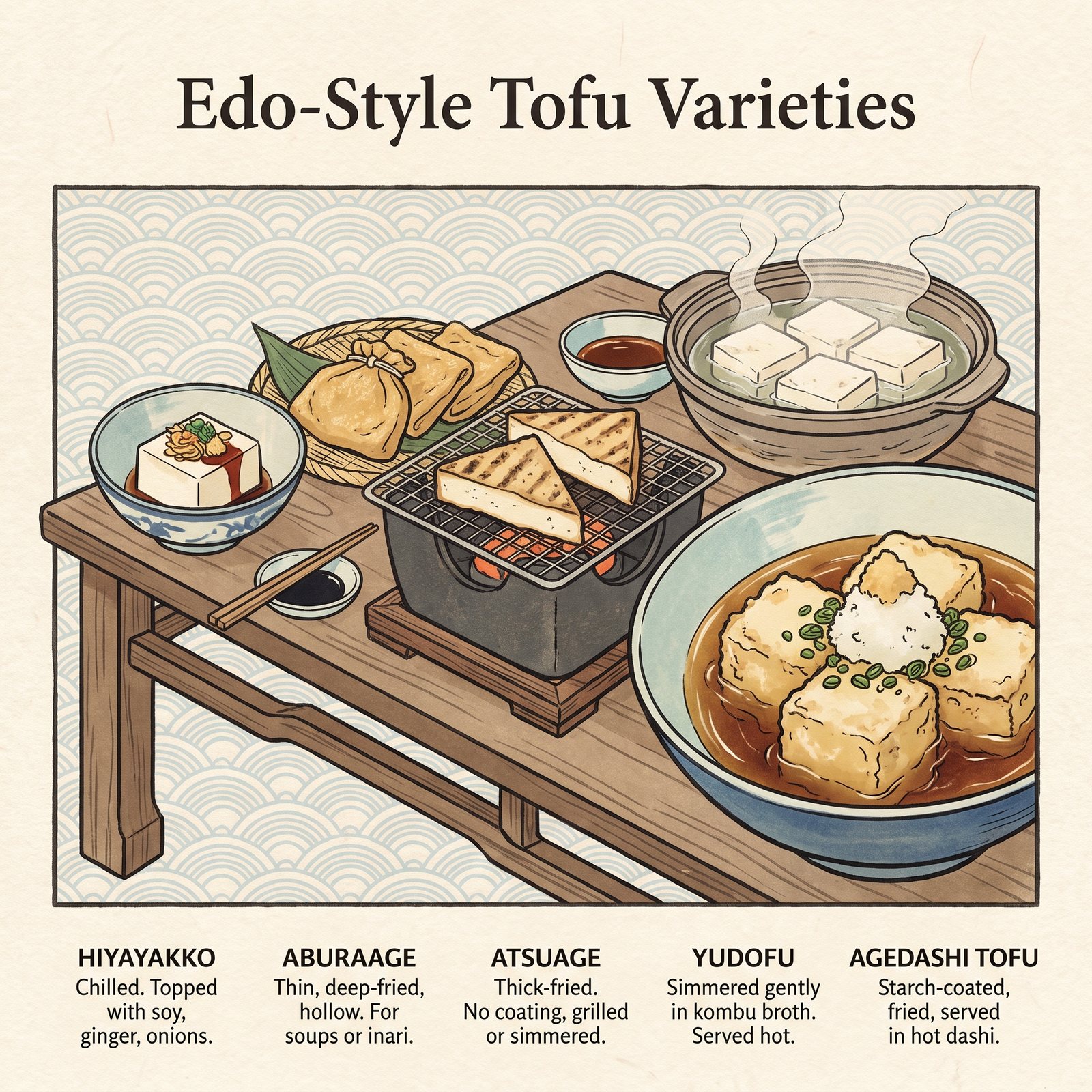
Agedashi tofu is a prepared dish, whereas some similar names refer to tofu products you buy and cook with. The table sorts out the common confusions.
| Name | Prepared dish or product | How it is made | Served |
|---|---|---|---|
| Agedashi tofu | Prepared dish | Starch-coated tofu, fried and sauced | Hot, in dashi sauce |
| Aburaage | Ingredient or product | Thin tofu slices fried until hollow | Used in soups, inari sushi, and udon |
| Atsuage | Ingredient or product | Thick tofu fried without coating | Grilled or simmered |
| Yudofu | Prepared dish | Tofu simmered gently in kombu broth | Hot, with dipping sauce |
| Hiyayakko | Prepared dish | Chilled tofu with toppings | Cold, with soy sauce |
Where to eat agedashi tofu in Japan
Agedashi tofu appears on the menus of many izakaya, as well as some teishoku and tofu specialty restaurants. Many people enjoy it as a warm appetizer, especially during cooler weather, although many izakaya serve it throughout the year.
Outside Japan, search map apps for “agedashi tofu” together with “Japanese restaurant” or “izakaya.” In Japan, the spellings 揚げ出し豆腐 and 揚出し豆腐 usually return more results. Many izakaya also list it simply under fried dishes, 揚げ物.
A regional example from an earlier edition
Garnishes change from shop to shop. The following example from our earlier edition shows how one izakaya in Takaoka, Toyama, presented the dish with grated condiments and scallions. We have not tasted it ourselves, so the note reflects the photograph and information retained from that edition. Menus and prices change, so confirm before you go.
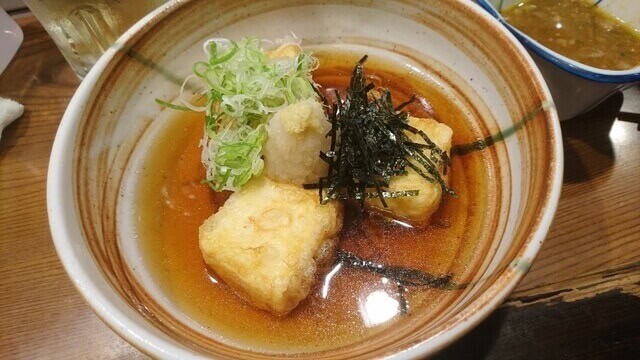
Izakaya Takamasa (居酒屋たかまさ)
- Toppings
- Scallions and grated condiments, recorded in 2022 as daikon and ginger
- Address
- 42 Suehirocho, Takaoka, Toyama; tel. 0766-24-5745
- Official information
- Izakaya Takamasa website
- Basis
- Address and phone confirmed from current listings; whether agedashi tofu is on the current menu is not re-verified
- Last checked
- October 2026
Agedashi tofu FAQ
Ingredients and substitutions
- Can I use cornstarch instead of potato starch?
-
Yes. Cornstarch works, but potato starch usually produces a lighter, more delicate shell, while cornstarch can feel slightly firmer. Wheat flour also works, although it browns more and clouds the sauce. Whichever you choose, keep the layer thin.
- Can I make the sauce without mirin?
-
Yes, although the flavor shifts. Mirin adds sweetness and a rounded finish. As a substitute, dissolve a little sugar in the dashi and soy sauce, then taste and adjust. Start small, since sugar is sweeter than mirin by volume.
Cooking problems
- Why does my coating fall off?
-
Usually, the tofu was still wet or the starch sat too long before frying. Dry every side well, coat at the last moment, and shake off the excess. Low oil temperature also loosens the coating, so fry in small batches.
- Why did the oil splatter when I added the tofu?
-
Surface moisture is the usual cause. Pat every side dry and keep the oil at 160–170°C. Because tofu contains a great deal of water, droplets on the surface can make hot oil spit. Lower each piece in gently with a slotted spoon.
- Can I prepare agedashi tofu ahead of time?
-
Only partly. Drain the tofu and make the sauce in advance, then keep both in the refrigerator. Coat and fry the tofu just before serving, because the shell softens within minutes. Reheated leftovers never regain the first crispness.
Conclusion
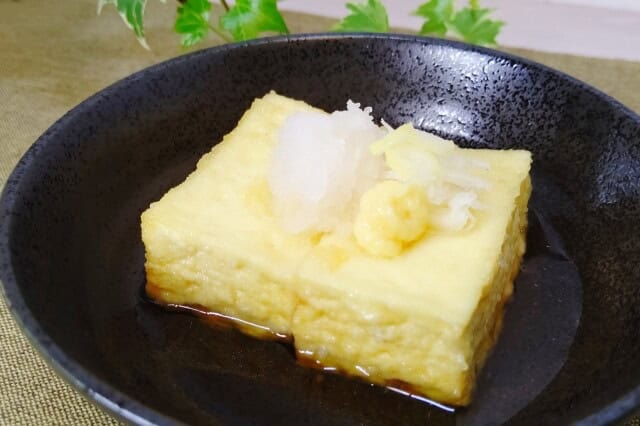
Agedashi tofu is simple: drained tofu, a thin coat of potato starch, a short fry, and a warm dashi sauce. Its charm lies in the minute when crisp turns to silky. The name’s origin is uncertain, but the technique is easy to learn and forgiving once the tofu is dry.
Want to go further? Learn how Japanese tofu varieties differ in our tofu guide. Alternatively, compare silken and firm tofu through the kinugoshi tofu and momen tofu pages before your next batch.
About this guide
- Originally published
- November 22, 2022
- Last verified
- October 4, 2026
- Researched and updated by
- Food in Japan editorial team
- Update note
- We replaced the single-origin name story with labeled theories, removed a section that contradicted the recipe by advising no coating, rebuilt the recipe with clearer quantities and steps, and reduced the restaurant listings to one dated regional example.
References
- Tohoku University Library, Kano Collection – Tofu Hyakuchin (豆腐百珍), Osaka: Fujiya Zenshichi, 1782, digitized copy (Accessed October 2026)
- Kikkoman – Basic Washoku: Agedashi tofu, method and reasons for each step (揚げ出し豆腐のレシピ・つくり方) (Accessed October 2026)
- Kikkoman Home Cooking – Agedashi tofu recipe with nutrition per serving (Accessed October 2026)
- Ajinomoto Park – Agedashi tofu recipe (揚げ出し豆腐) (Accessed October 2026)
- Delish Kitchen – Basic agedashi tofu with nutrition per serving (基本の揚げ出し豆腐) (Accessed October 2026)
- Ministry of Education, Culture, Sports, Science and Technology (MEXT) – Food Composition Database: momen tofu, food number 04032 (Accessed October 2026)
Related Articles
- Tofu (Surveyed: October 2026)
- Kinugoshi Tofu (Surveyed: October 2026)
- Momen Tofu (Surveyed: October 2026)
- Aburaage (Surveyed: October 2026)
- Yudofu (Surveyed: October 2026)
- Hiyayakko (Surveyed: October 2026)
- Goma Tofu (Surveyed: October 2026)
- Goya Chanpuru (Surveyed: October 2026)
- Japanese Vegetarian Dishes (Surveyed: October 2026)




Comments