



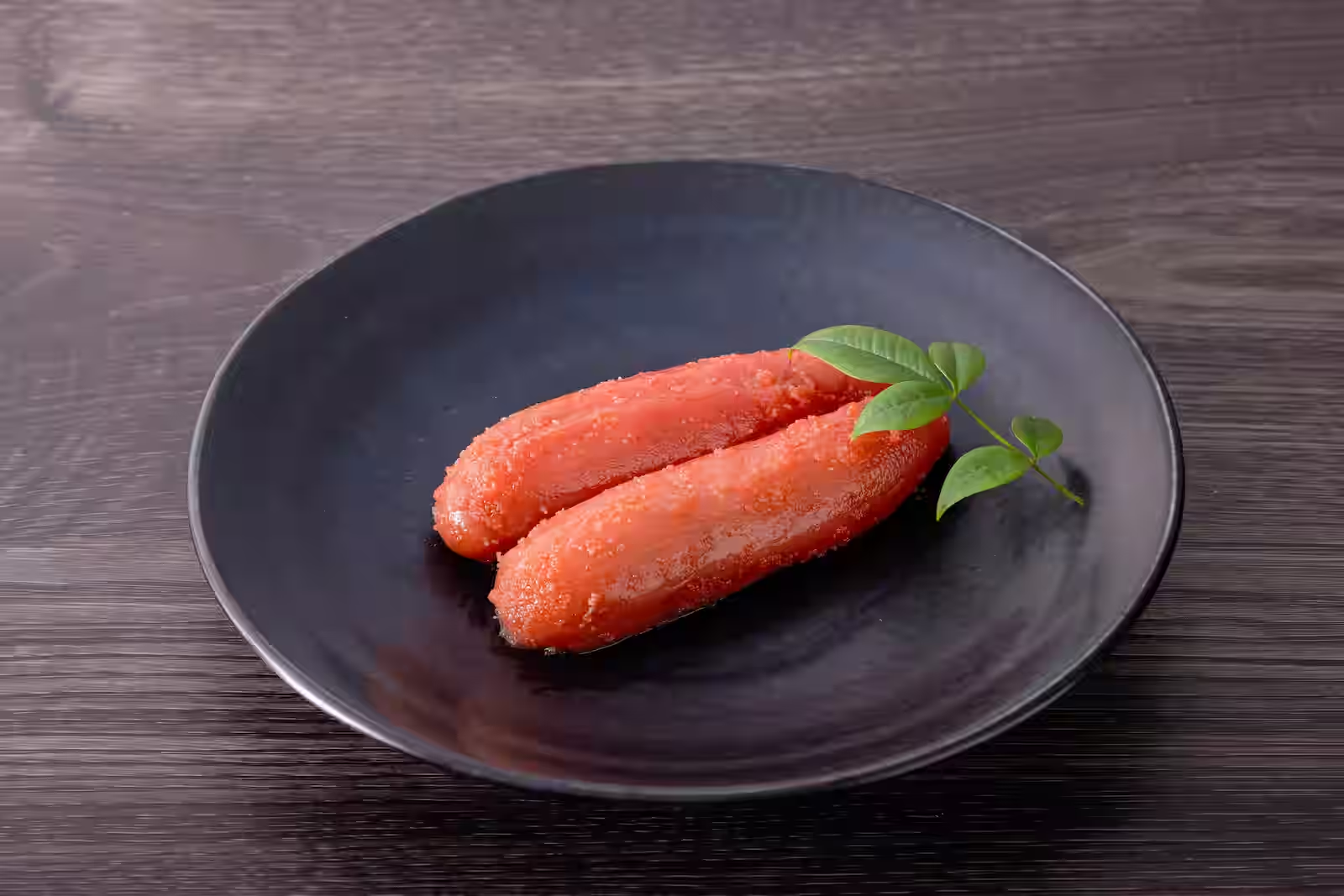
Karashi mentaiko is Fukuoka’s famous spicy pollock roe, and in Hakata it feels almost like part of daily life. Order breakfast anywhere in the city and a small pink lobe usually turns up beside the rice. Nobody explains it. You are simply expected to know.
Karashi mentaiko is Fukuoka’s famous spicy marinated pollock roe. Makers cure the roe with salt first. Then they steep it in a chili-based seasoning liquid, which may include dashi, sake, soy sauce, kombu, or yuzu. English menus often translate it as spicy cod roe. Locals eat it with rice, pasta, bread, and sake. This guide covers what it is, how it differs from tarako, how to eat it, and where to buy it.
- What it is: whole roe sacs of Alaska pollock, salted and marinated in a chili-based seasoning liquid.
- Where it comes from: Hakata in Fukuoka City, adapted from a Korean dish called myeongnanjeot.
- How locals eat it: raw over hot rice, folded into pasta, tucked inside onigiri, or grilled lightly with sake.
Karashi Mentaiko at a Glance
| Main ingredient | Alaska pollock roe |
| Flavour | Salty and briny, with chili heat and deep seafood umami |
| Texture | Fine and granular, popping softly between the teeth |
| Heat level | Mild to medium; brands sell mild, regular, and hot grades |
| Storage | Keep chilled or frozen, and follow the package instructions |
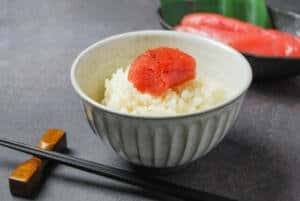
| Classic serving | Raw, sliced, on a bowl of hot white rice |
| Home region | Hakata, Fukuoka City, Kyushu |
What Is Karashi Mentaiko?
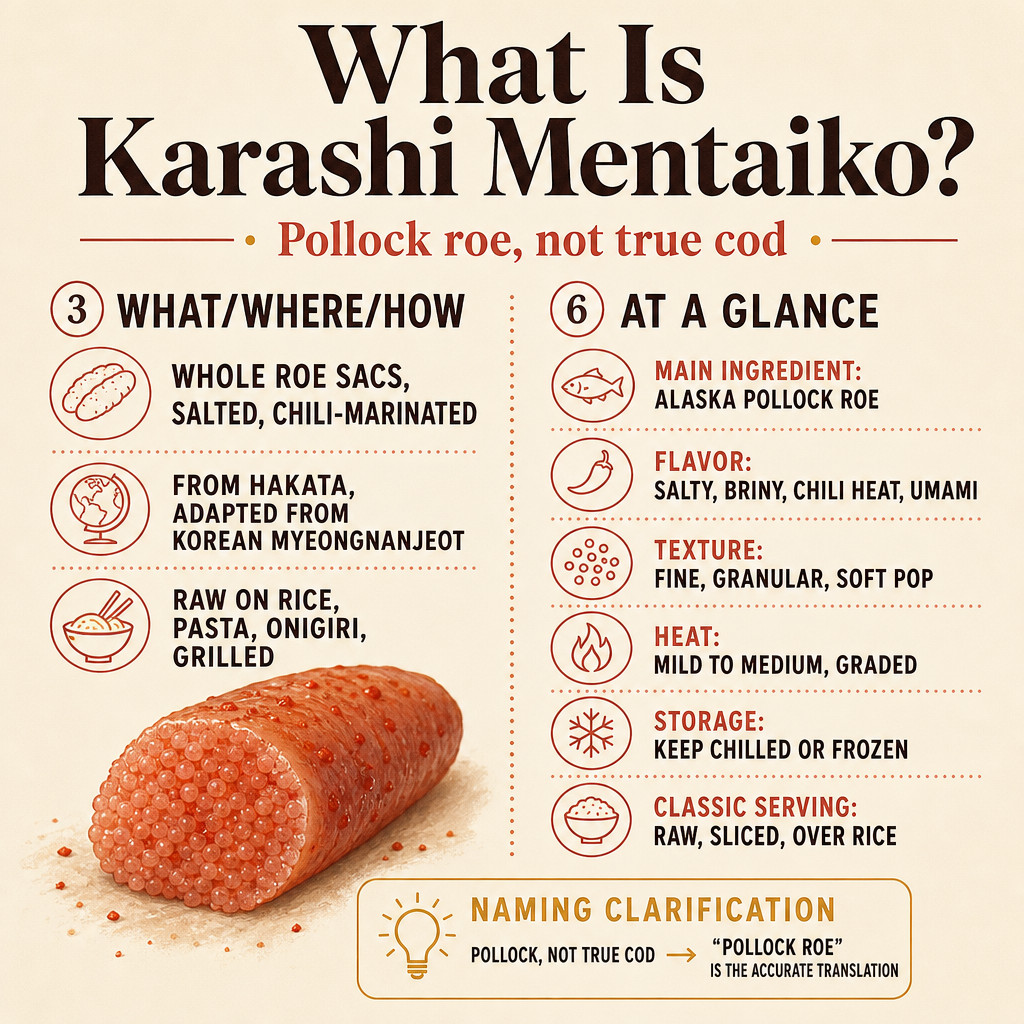
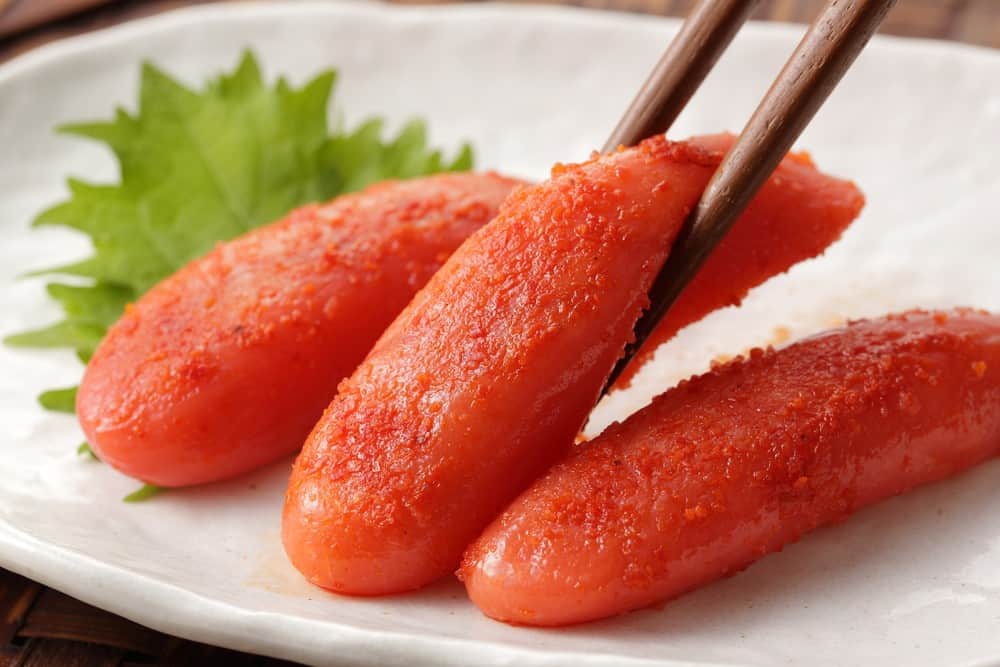
Karashi mentaiko is Fukuoka’s famous spicy marinated pollock roe. Makers cure whole roe sacs of Alaska pollock with salt, then steep them for days in a chili-based seasoning liquid. That mix varies by house, and it may include dashi, sake, soy sauce, kombu, or yuzu. The finished roe stays raw, so it keeps a soft, granular bite.
One point confuses first-timers. Alaska pollock belongs to the cod family, yet it is not the same fish as true cod. English menus translate it loosely as “spicy cod roe”, which works fine for ordering. On Japanese labels, though, karashi mentaiko normally refers specifically to seasoned Alaska pollock roe. That makes “pollock roe” the more accurate translation.
Commercial karashi mentaiko is cured and ready to eat. Even so, treat it like any chilled seafood product. Keep it cold, and pay attention to the date on the pack.
Where the Name Comes From
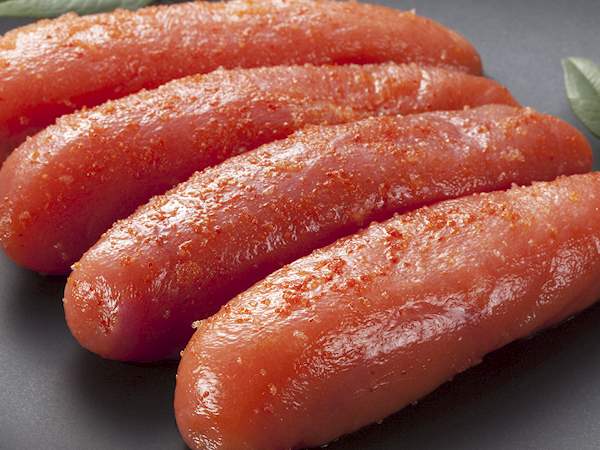
The Japanese spelling is 辛子明太子. Breaking it apart helps. “Karashi” signals chili heat, “mentai” is an old regional word for pollock, and “ko” means child, or in this case roe. Put together, the name simply says chili-seasoned pollock roe.
The word connects back to Korean, where myeongtae refers to pollock. Fukuoka’s long historical ties with the Korean Peninsula help explain why both the word and the food culture took root so naturally in Hakata.
Karashi Mentaiko vs Tarako
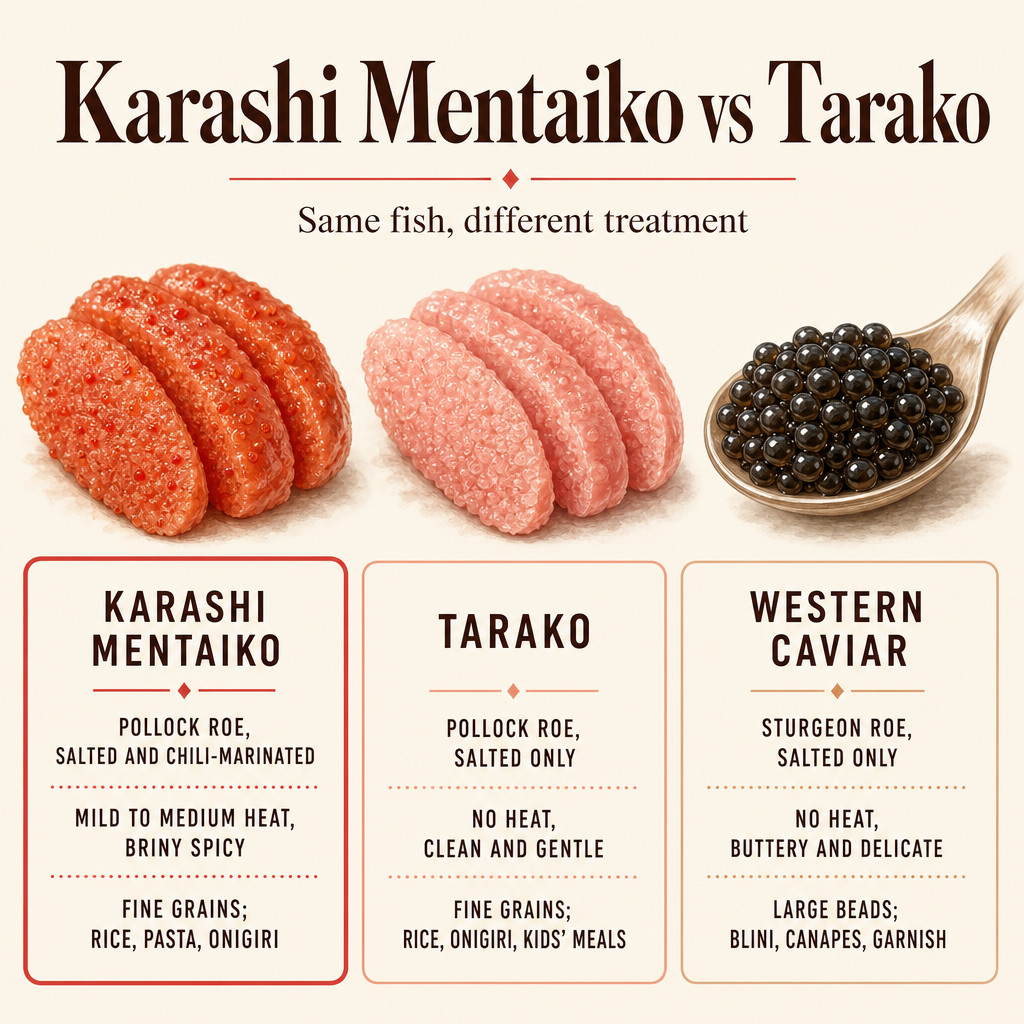
Shops in Fukuoka sell both, side by side, and travellers mix them up constantly. Tarako is salted roe. Karashi mentaiko is chili-seasoned roe. Same fish, different treatment.
| Category | Karashi Mentaiko | Tarako | Western Caviar |
|---|---|---|---|
| Source | Alaska pollock roe | Alaska pollock roe | Sturgeon roe |
| Seasoning | Salt plus chili marinade | Salt only | Salt only |
| Heat | Mild to medium chili | None | None |
| Taste | Briny, spicy, deeply savoury | Clean, salty, gentle | Buttery, delicate, marine |
| Texture | Fine grains inside a thin membrane | Fine grains inside a thin membrane | Large, separate beads |
| Typical use | Rice, pasta, onigiri, drinking snack | Rice, onigiri, children’s meals | Blini, canapés, garnish |
Families often keep both in the fridge. Children get the tarako, and adults take the spicy one. If you want the full breakdown, our guide will help you learn the difference between mentaiko and tarako in more detail.
What Does Karashi Mentaiko Taste Like?
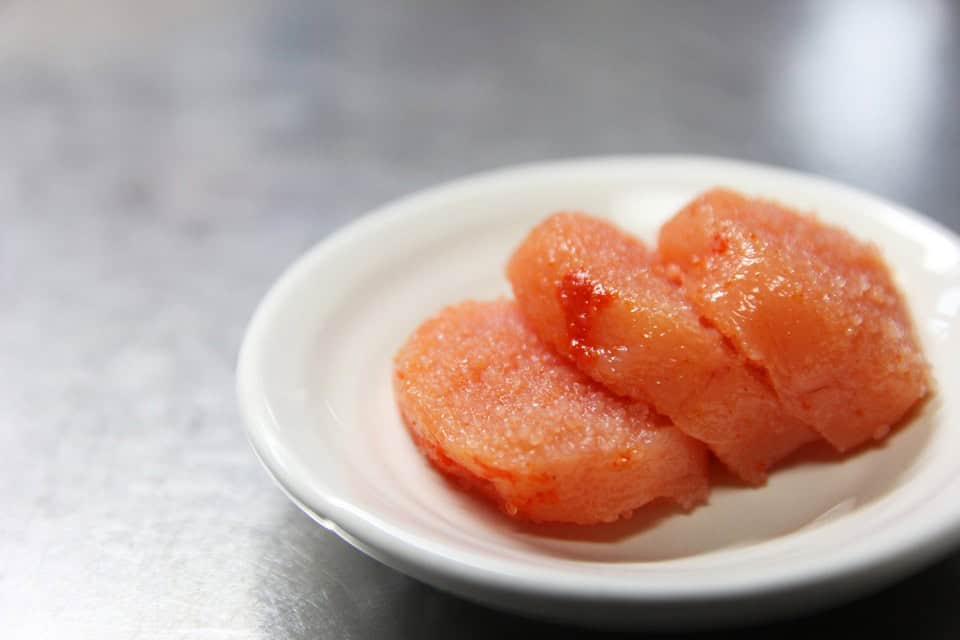
The first bite lands salty rather than spicy. Heat arrives a second later, and it usually stays gentle. Underneath sits a concentrated seafood depth, a little like anchovy paste in intensity, though cleaner and more granular.
Texture does half the work. Thousands of tiny grains sit inside a thin membrane, so each mouthful pops quietly rather than bursting. Honestly, the sensation takes a little getting used to. Plenty of visitors hesitate at first, then finish the whole lobe anyway.
Because the seasoning runs strong, portions stay small. One roe sac spread across a bowl of rice is plenty for one person. Eating it neat, straight from the pack, would overwhelm most palates.
If this is your first time, try a mild grade on hot rice before buying a large box. The warmth of the rice softens the saltiness and makes the chili feel rounder.
History in Fukuoka
From Busan to Nakasu
Toshio Kawahara grew up in Busan, where his family ran a trading business. He knew the local markets well, and one dish stayed with him: myeongnanjeot, a kimchi-style seasoned pollock roe sold as everyday household food.
After the war, he returned to postwar Hakata. In October 1948, he and his wife Chizuko opened a small grocery in Nakasu called Fukuya. He wanted one signature product, so he began trying to rebuild the flavour he remembered. Rather than pickling the roe in a chili paste, he developed his own method of steeping it in a seasoning liquid.
Fukuya put the first “aji no mentaiko” on sale on 10 January 1949, during the Toka Ebisu shrine festival. Fukuya and many mentaiko fans now mark January 10 as Mentaiko Day. Sales, however, went badly at first, and Kawahara reportedly spent close to a decade refining the taste.
Why the Recipe Spread So Fast
Word eventually got around, and queues formed at the Nakasu market. Other shopkeepers asked Kawahara to supply them wholesale. He refused, then offered something stranger instead. He would teach them how to make it themselves.
Friends urged him to file a patent. He never did. Anyone who asked received the method, which is why Fukuoka now holds so many rival makers rather than one dominant brand. That decision shaped the whole industry, and locals still bring it up with obvious pride.
National fame came later. When the Sanyo Shinkansen reached Hakata in 1975, travellers started carrying chilled boxes home. From there, karashi mentaiko grew into one of Hakata’s definitive souvenirs. Today it sits alongside Hakata Ramen as the city’s culinary signature.
How to Eat Karashi Mentaiko
- Serve a small piece. Half a roe sac per person is enough, since the seasoning is concentrated.
- Pair it with hot rice. Slice the lobe open, scrape the grains across the rice, and eat immediately.
- Then branch out. Add it to pasta, spread it on toast, or fold it into a rolled omelette.
Beyond that first bowl, Fukuoka uses it almost everywhere. Seven combinations show up again and again:
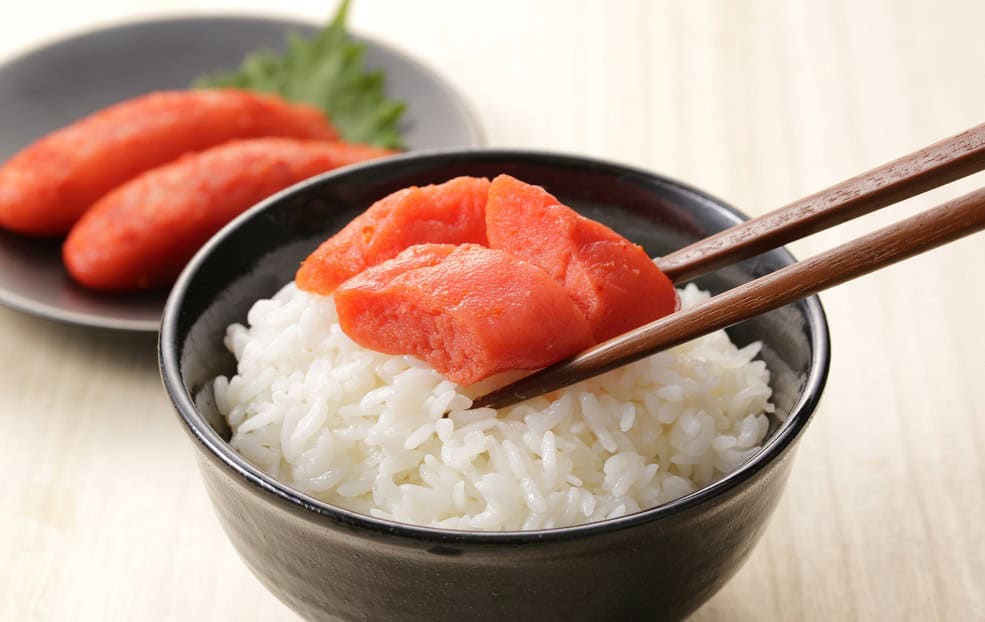
- With rice: the default. Some people add a raw egg or a sheet of nori.
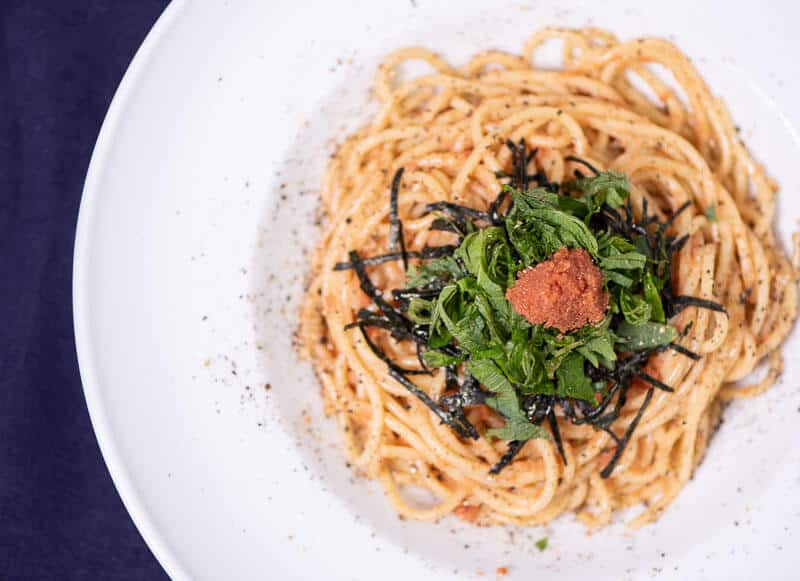
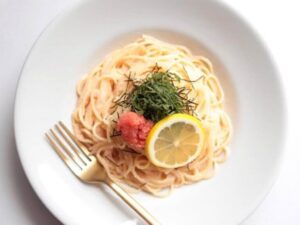
- Mentaiko pasta: butter, a little cream, shredded nori. See our mentaiko pasta recipe for the full method.
- Mentai France: a French roll split and filled with mentaiko butter, then baked. A Fukuoka bakery classic.
- Tamagoyaki: rolled into a Japanese omelette, where the heat softens noticeably.
- Potato with butter: jagabata topped with mentaiko, common at izakaya.
- Onigiri: tucked inside a rice ball, sold at every convenience store in Japan.
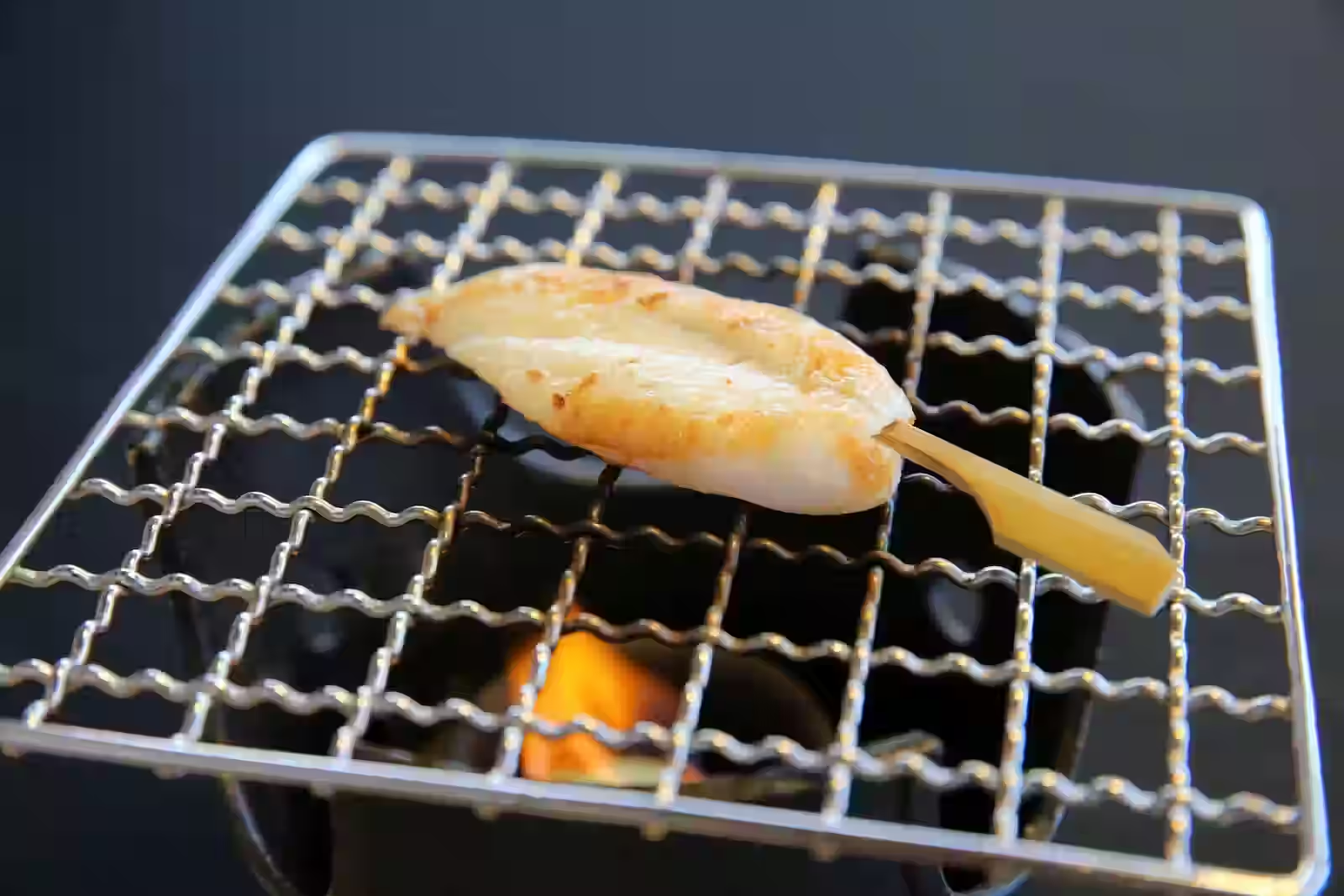
- Drinking snack: grilled briefly and served with sake or shochu.
Nutrition and Salt
Japan’s official food composition tables list karashi mentaiko at 121 kcal per 100 g, with 21 g of protein, 3.3 g of fat, and 5.6 g of salt equivalent. The salt figure matters more here than the calorie count. A single 25 g roe sac therefore delivers roughly 1.4 g of salt.
How to Choose Karashi Mentaiko
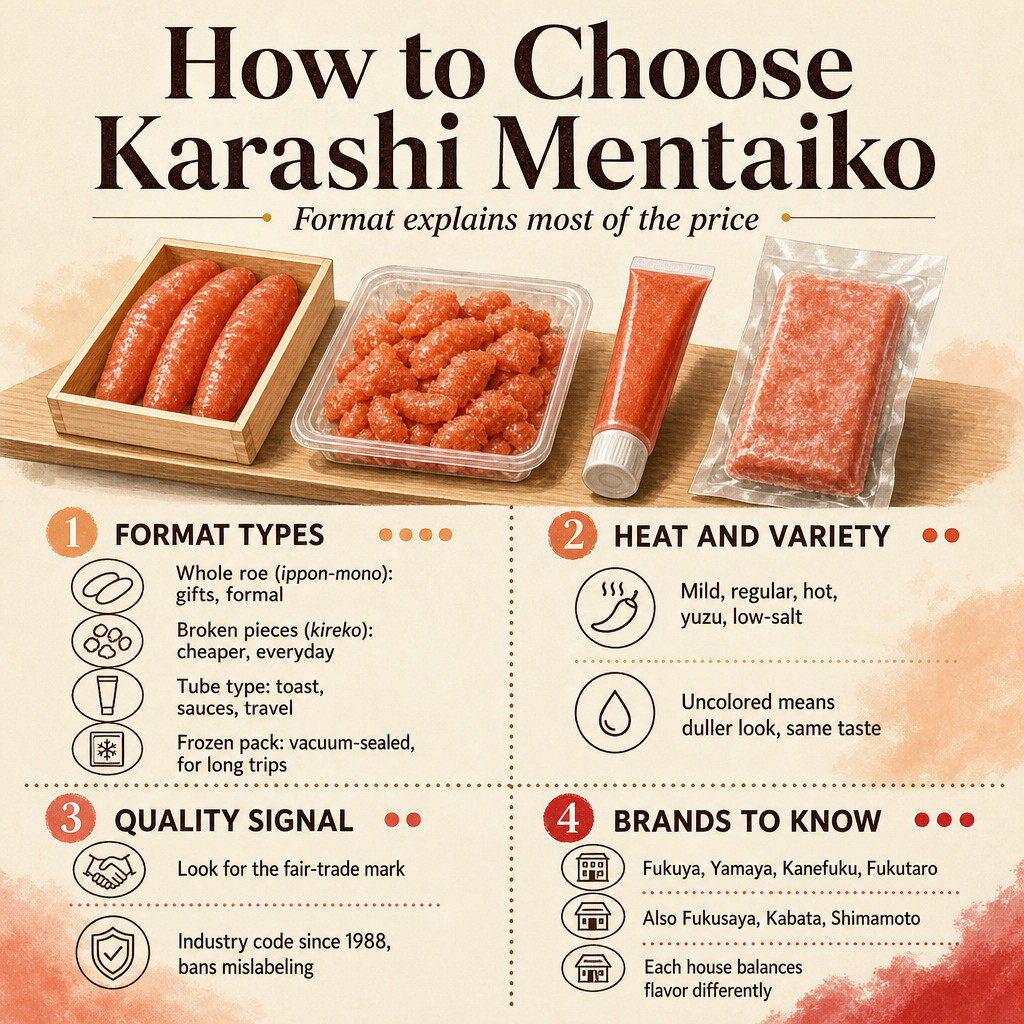
Shelves in Fukuoka can overwhelm you. Prices swing wildly, and the difference is not always obvious. Format explains most of it.
| Type | What it is | Best for |
|---|---|---|
| Whole roe (ippon-mono) | Intact sacs, graded by size and appearance | Gifts and formal souvenirs |
| Broken pieces (kireko) | Split or damaged sacs, same taste, lower price | Everyday cooking and pasta |
| Tube type | Loose grains in a squeezable tube | Toast, sauces, easy travel |
| Frozen pack | Vacuum-sealed and deep-frozen at the factory | Long journeys home |
Heat levels vary too. Most brands offer mild, regular, and hot, plus yuzu-flavoured and reduced-salt lines. Uncoloured versions look duller because they skip red colouring, though the flavour holds up perfectly well.
One useful signal exists on the packaging. Japan’s karashi mentaiko industry runs a fair competition code, approved back in 1988, which defines the product and bans misleading labels. Members display a small fair-trade mark, so look for it if you feel unsure.
Brand names help as well. Look for well-known Fukuoka makers such as Fukuya, Yamaya, Kanefuku, Fukutaro, Fukusaya, Kabata, and Shimamoto. Each house balances chili heat, dashi, yuzu, salt, and texture differently, so tasting before buying is genuinely worth the time.
Where to Buy Karashi Mentaiko in Fukuoka
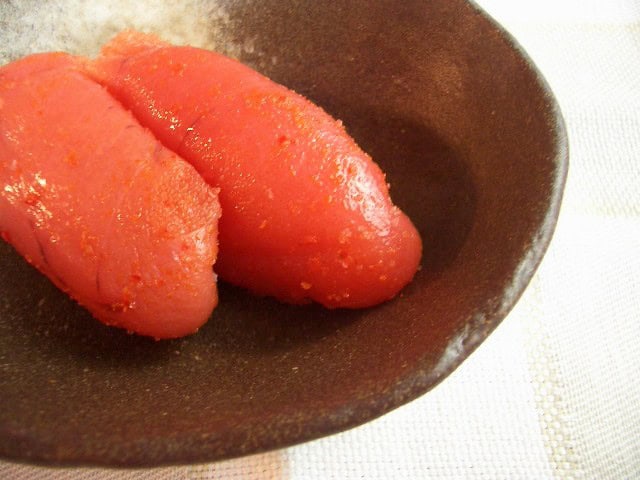
This Fukuoka specialty is easy to find at stations, airports, and local shops. If you visit Hakata Station, look for the chilled gift boxes near the souvenir floors rather than the general food halls. Staff usually let you taste before buying.
Fukuya Nakasu Main Store
The company that started it all still runs its flagship in Nakasu, near Kushida Shrine and Canal City Hakata. Staff will walk you through spice grades and colouring options, which makes it a sensible first stop. Some products appear only at this branch.
Stations, Airports, and Department Stores
Hakata Station carries almost every major brand, including Fukuya, Kanefuku, Yamaya, and Shimamoto. Fukuoka Airport stocks the same names in the departure area, which suits anyone flying out the same day. Department store food basements in Tenjin often run seasonal gift sets as well.
Supermarkets deserve a mention too. Chilled sections sell smaller everyday packs at far lower prices, and the quality is perfectly good. Locals buy their own mentaiko there, not at the souvenir counters.
Storage and Souvenir Tips
Chilled mentaiko keeps for several days in the fridge, though makers usually recommend eating it within about a week. Freezing extends that to two or three months. After opening, wrap each piece separately and finish it quickly, because the raw roe does not keep well.
Travelling home needs a little planning. Shops sell insulated bags and frozen vacuum packs designed for flights, so ask at the counter. Import rules on animal products differ by country, however, and some destinations restrict seafood. Check your destination’s regulations before you buy a large gift box.
Simple Mentaiko Rice Bowl
- Fill a bowl with about 200 g of freshly cooked white rice. Warm rice matters, since it softens the roe.
- Slit one roe sac lengthwise with a knife. Scrape the grains out over the rice, then discard the membrane if you prefer.
- Top with shredded nori and a few drops of soy sauce. Add a raw or soft-boiled egg for a richer bowl.
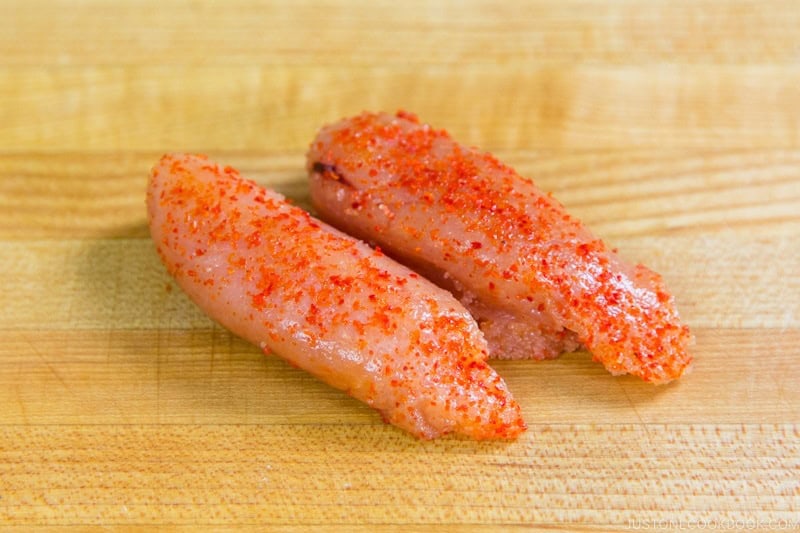
For pasta, toss hot spaghetti with butter, one chopped roe sac, and a spoonful of the pasta water. Keep the heat off, because cooking the roe hard turns it grainy and dry.
Conclusion
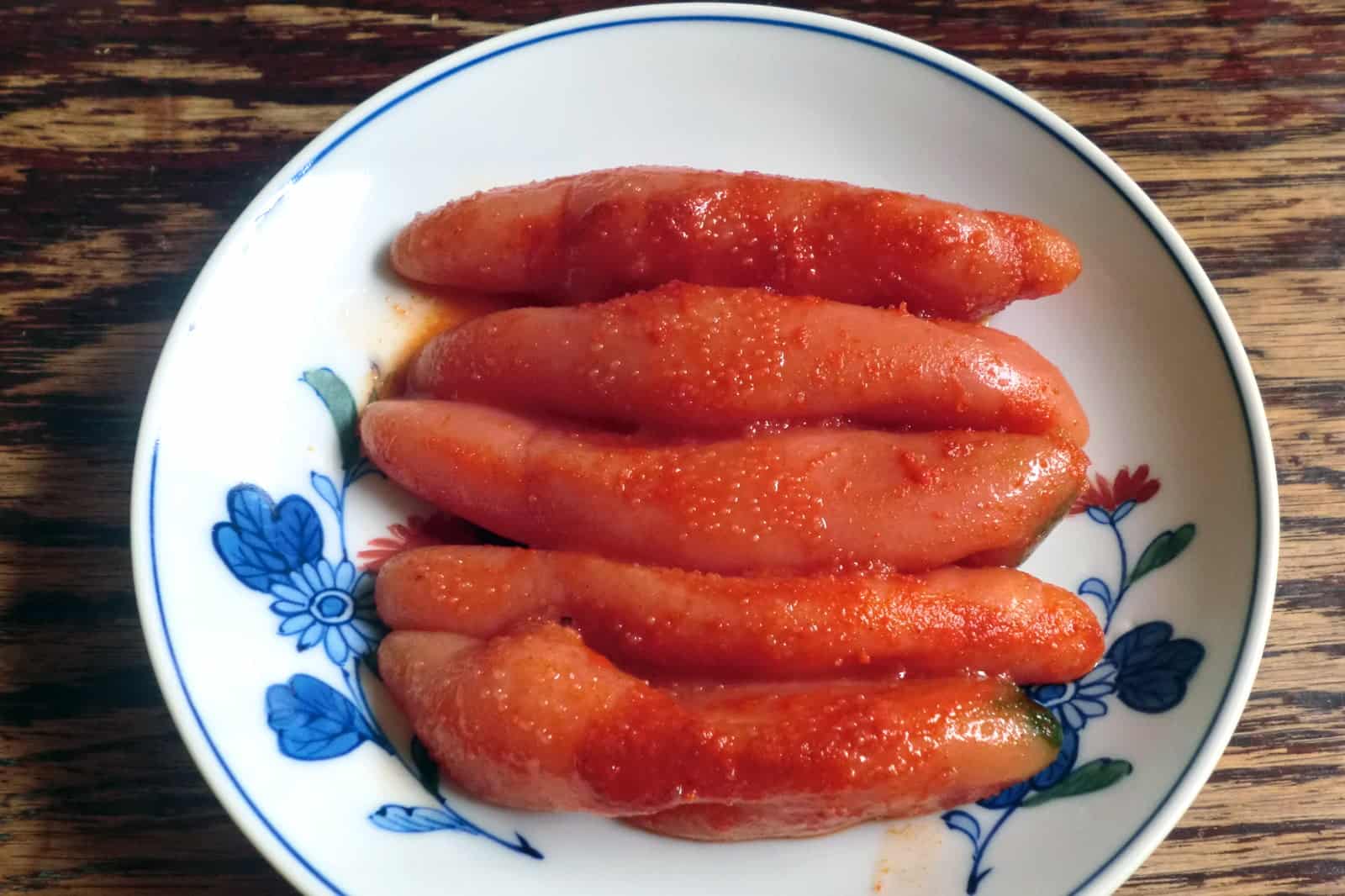
Karashi mentaiko shows Fukuoka’s bold seafood flavour. It tastes salty, spicy, and rich in umami, yet it works as a seasoning rather than a centrepiece. One small lobe can carry an entire meal.
Try it with rice first, then compare different brands at Hakata Station or Fukuoka Airport. Ask for a mild grade if chili worries you, and buy the broken pieces if you plan to cook with it. Once you have the hang of it, explore more of Fukuoka’s local food while you are in the city.
Karashi Mentaiko FAQ
What is karashi mentaiko?
It is spicy marinated pollock roe from Fukuoka. Makers salt whole roe sacs of Alaska pollock, then steep them in a chili-based seasoning liquid for several days. The result tastes salty, mildly spicy, and full of seafood umami. Most people eat it over hot white rice.
Is karashi mentaiko raw?
Yes, the standard product is raw, cured rather than cooked. Salt and the marinade preserve it instead of heat. Because of that, keep it chilled and eat it within a few days of opening. Grilling it briefly is fine if raw seafood makes you uneasy.
How spicy is it?
Less spicy than most people expect. Saltiness dominates, and the chili sits in the background as a warm finish. Brands sell mild, regular, and hot grades, so you can pick your level. Start with mild if you are unsure, then trade up.
What is the difference between mentaiko and tarako?
Both come from the same fish, but the seasoning differs. Producers cure tarako with salt alone, which keeps it clean and mild. Karashi mentaiko goes through an extra chili marinade that adds heat and depth. Shops in Fukuoka stock both, usually right next to each other.
How do you eat karashi mentaiko?
Slice one sac open and scrape the grains over hot rice. That remains the classic method in Fukuoka. Beyond that, cooks fold it into pasta, spread it on buttered bread, roll it into omelettes, and serve it grilled with sake. Keep portions small, since the seasoning is strong.
Can I bring karashi mentaiko home as a souvenir?
Often yes, though it depends on where you are travelling. Shops sell frozen vacuum packs and insulated bags made for flights, so ask staff for the travel-friendly version. Rules on importing animal products vary widely by country. Check your destination’s regulations before buying a large gift box.
Is karashi mentaiko high in salt?
Yes, fairly. Japan’s official composition tables put it at 5.6 g of salt per 100 g, so a single 25 g sac carries roughly 1.4 g. Treat it as a seasoning and keep servings small. Reduced-salt versions exist if you eat it often.
References
- Fukuya – The Fukuya Story (Surveyed: August 2026)
- Ministry of Education, Culture, Sports, Science and Technology – Food Composition Database (Karashi-mentaiko, item 10204) (Surveyed: August 2026)
- Fukuya – January 10 Is Mentaiko Day (Surveyed: August 2026)
- National Fair Trade Council for Karashi Mentaiko Foods – About the Fair Competition Code (Surveyed: August 2026)
- Japan Fair Trade Council – Fair Competition Code on Labelling of Karashi Mentaiko Foods (PDF) (Surveyed: August 2026)
- Fukuya – Nakasu Main Store Information (Surveyed: August 2026)
- Yamaya Communications – What Fish Does Mentaiko Come From (Surveyed: August 2026)
- Tarako Shokudo (Fukuya Group) – The Origin of Karashi Mentaiko (Surveyed: August 2026)




Comments