


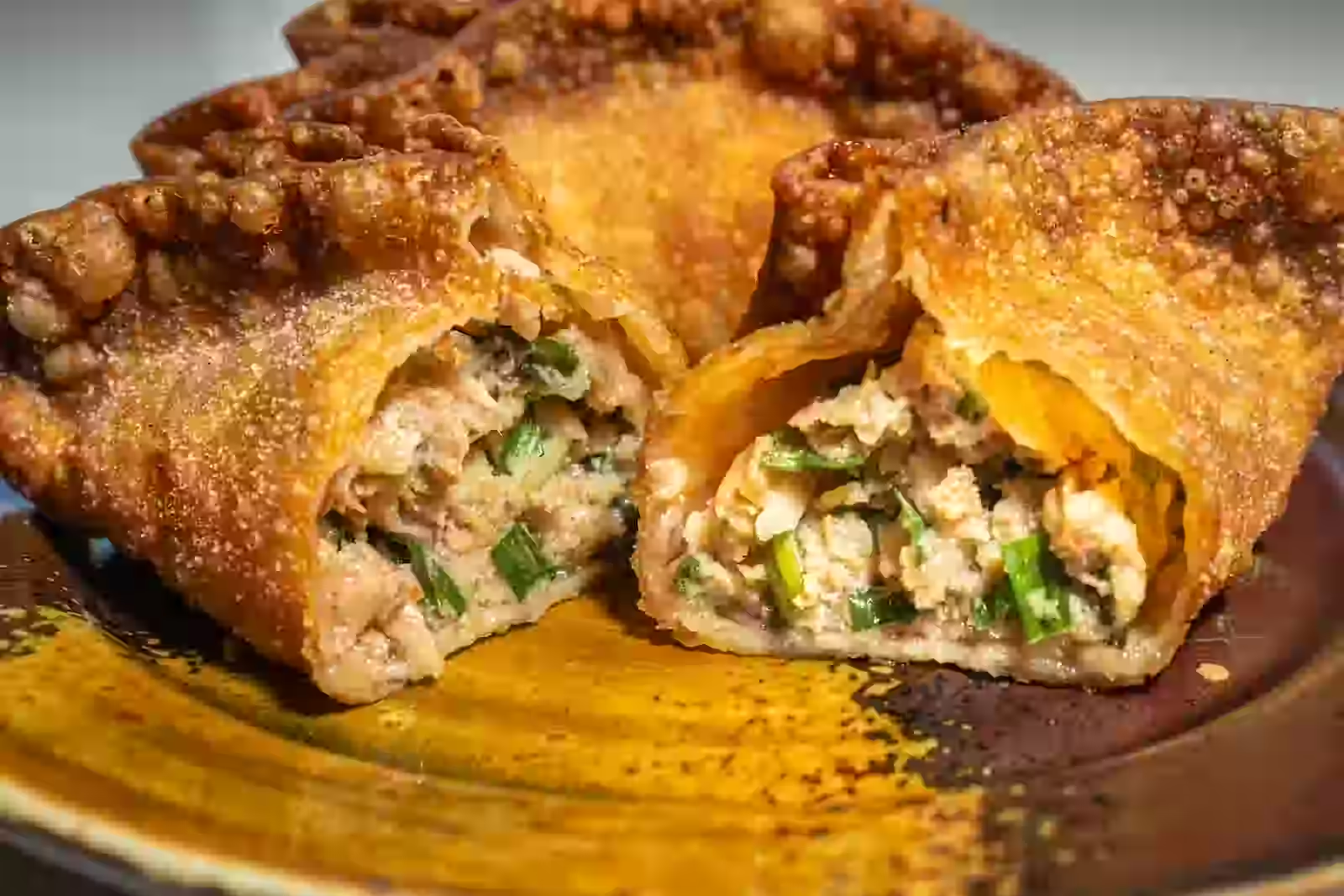

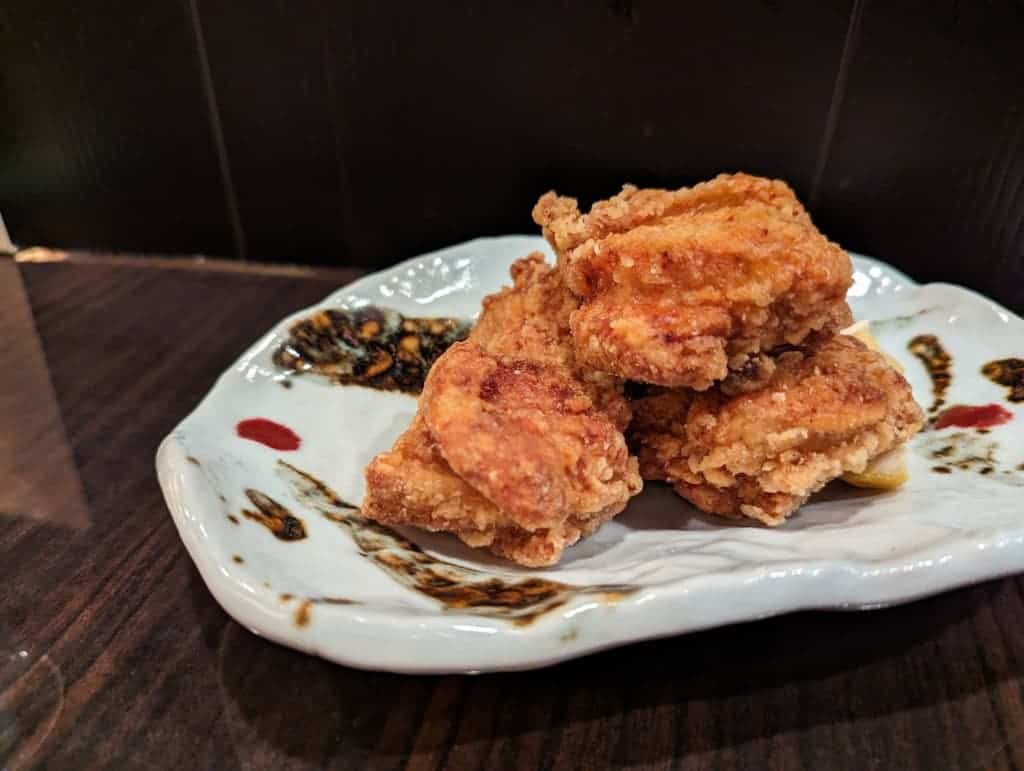
Walk past a convenience store hot counter in the evening, and the smell reaches you first. Golden pieces of chicken sit under a warm lamp, waiting. Karaage (唐揚げ) is Japanese fried chicken made by marinating bite-sized chicken, coating it with potato starch or flour, and deep-frying it until crisp. Strictly speaking, the word names a frying method. Outside Japan, however, it almost always means soy-marinated Japanese fried chicken.
This guide explains what karaage is and how it differs from Western fried chicken. After that, it covers the history, a home recipe, crispiness tips, regional styles, prices, and where to eat it. Nakatsu, a small city in Oita Prefecture on the island of Kyushu, gets its own section, because it has a serious claim on the dish.
What Is Karaage?
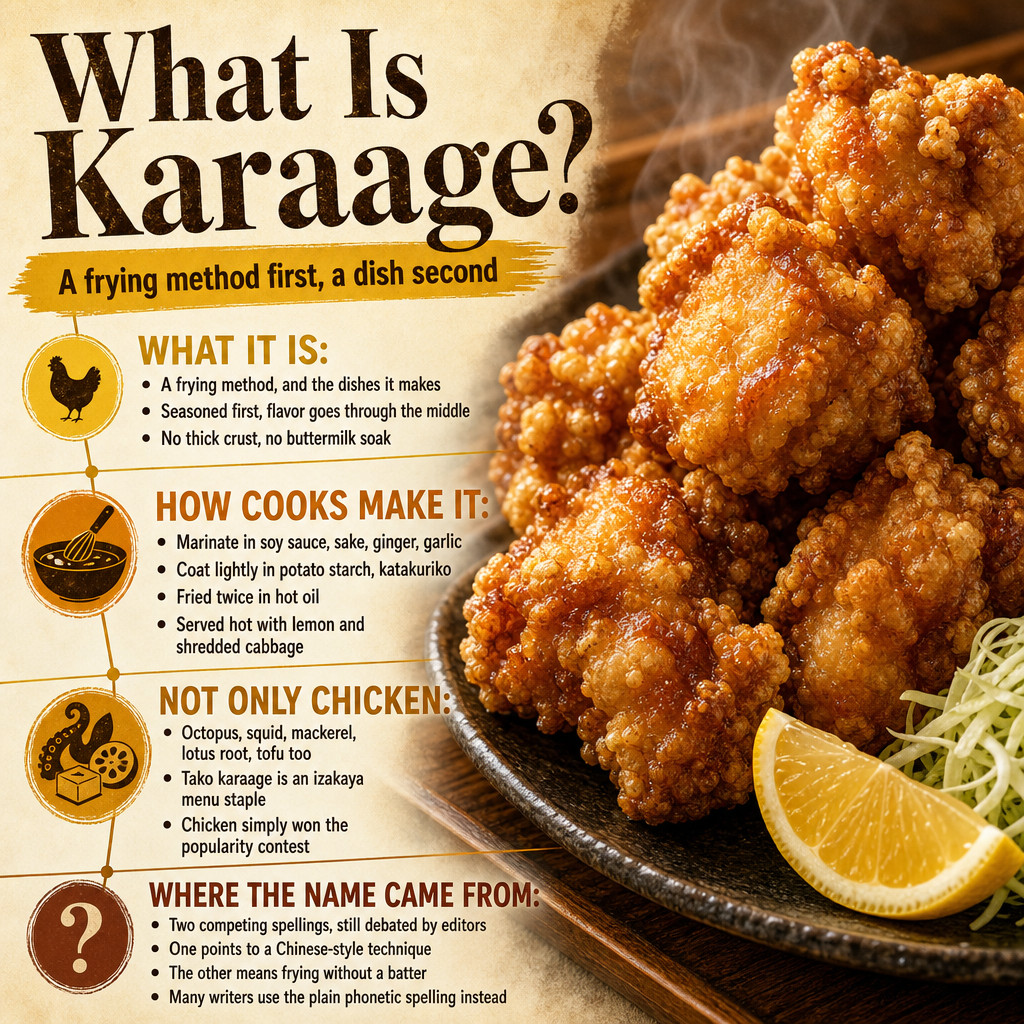
Karaage (唐揚げ) describes both a Japanese frying technique and the family of dishes it produces. Cooks season the meat first, dust it lightly with starch or flour, then lower it into hot oil. Because the seasoning sits inside the meat, Japanese fried chicken tastes savoury right through the middle. There is no thick crust and no buttermilk soak.
In one line: karaage is a Japanese frying method, but outside Japan it usually means soy-marinated Japanese fried chicken, coated in potato starch and fried until crisp.
How Cooks Make It
The method has four moves. First, cooks marinate bite-sized pieces in soy sauce, sake, ginger, and often garlic. Next, they coat the pieces lightly with flour or potato starch, which Japanese kitchens call katakuriko. Then they fry them in hot oil, usually twice. Finally, they drain the chicken and serve it straight away, often with lemon and shredded cabbage.
Karaage Is Not Only Chicken
Many people think karaage means fried chicken. However, the word can also describe fried fish, vegetables, or other meats. Octopus is the classic example, and tako karaage appears on izakaya menus across the country. Squid, horse mackerel, lotus root, and tofu all work the same way. In short, the chicken version simply won the popularity contest.
Where the Name Came From
The word carries two possible kanji. 唐揚げ uses the character for Tang China, which points to a Chinese-style technique. 空揚げ uses the character for “empty”, meaning frying without a batter. Older Japanese texts record the spelling 空揚, although sources disagree about the earliest use.
Japanese names often used “tou” or “kara” for foods and techniques linked to China. Publishers still disagree about which kanji to print, so many simply write からあげ in kana. Honestly, the argument matters more to editors than to anyone holding a hot paper bag.
Karaage vs Western Fried Chicken
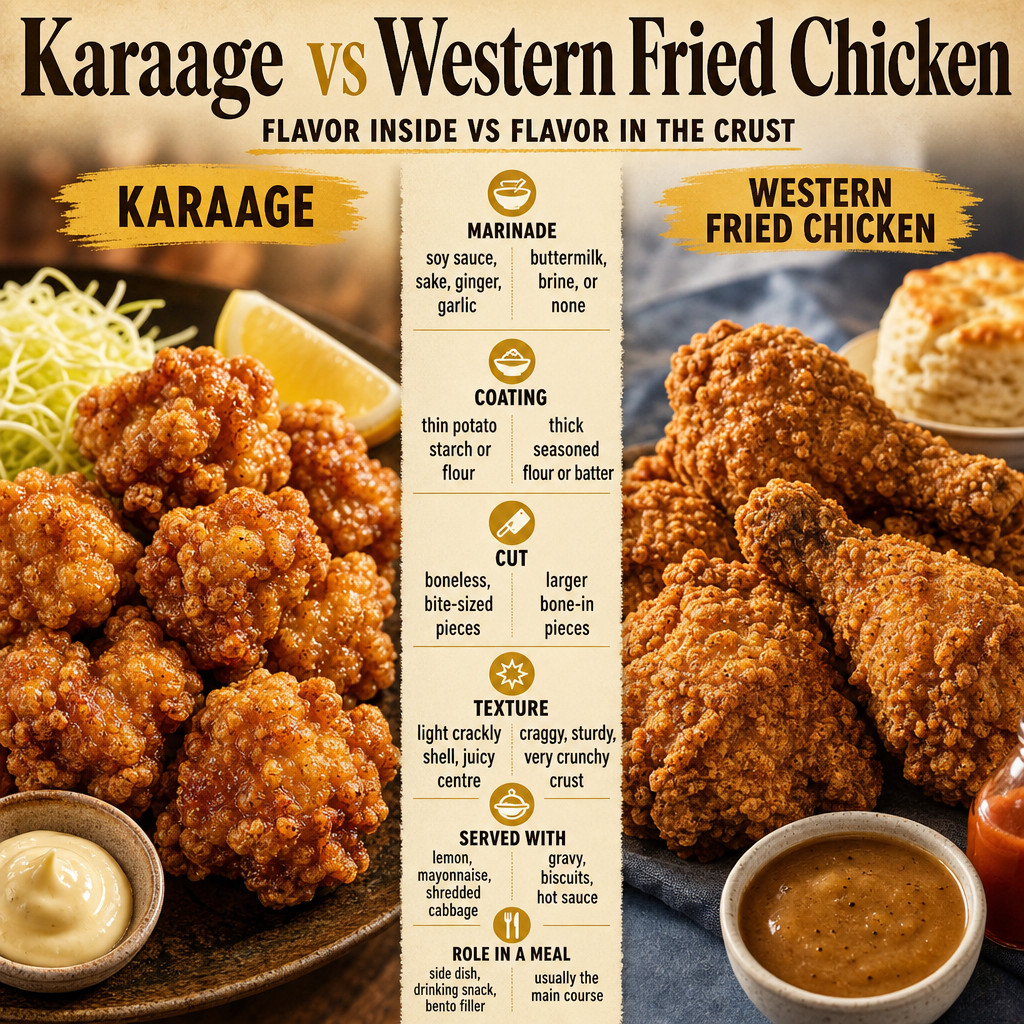
Both dishes fry chicken, yet they aim at completely different textures. Karaage puts the flavour inside the meat, while American-style fried chicken puts it in the crust. That single difference explains almost everything else on the plate.
| Point | Karaage | Western fried chicken |
|---|---|---|
| Marinade | Soy sauce, sake, ginger, garlic | Buttermilk, brine, or none at all |
| Coating | Thin potato starch or flour | Thick seasoned flour or batter |
| Cut | Boneless, bite-sized pieces | Larger bone-in pieces |
| Texture | Light crackly shell, juicy centre | Craggy, sturdy, very crunchy crust |
| Served with | Lemon, mayonnaise, shredded cabbage | Gravy, biscuits, hot sauce |
| Role in a meal | Side dish, drinking snack, bento filler | Usually the main course |
Because the pieces stay small, karaage cooks quickly and cools well. As a result, it fits neatly into a bento lunchbox the next morning. Western fried chicken, by contrast, rarely tastes right at room temperature.
A Short History of Karaage
From Temple Cooking to Restaurant Menus
Frying reached Japan long before karaage did. Fucha cuisine, a Chinese-influenced Buddhist temple style, used oil in ways that ordinary kitchens rarely did. During the Edo period the technique spread slowly, since cooking oil stayed expensive. Chicken, meanwhile, was still uncommon in everyday meals.
1930s Restaurants
Chinese-style restaurants helped popularize chicken karaage in the 1930s. A frequently cited account credits Mikasa Kaikan, a restaurant in Tokyo’s Ginza district, with adding an inexpensive fried chicken dish in 1932 to rescue a struggling business. Customers reportedly took to it at once. Other restaurants copied the idea, and the name travelled with it.
Broiler Chicken Changes Everything
The bigger shift arrived after the war. Imported broiler breeds grew faster and larger than Japanese native chickens. Because of that, chicken finally became affordable. Government support for poultry farming pushed prices lower still, and karaage moved out of restaurants and into home kitchens.
Oita, Usa, and Nakatsu
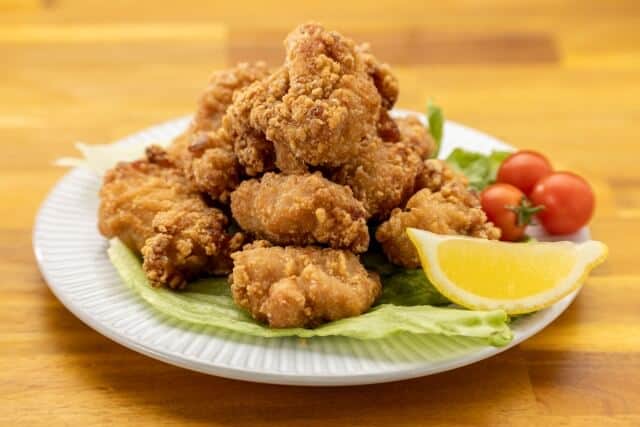
Two neighbouring cities in Oita Prefecture, on the island of Kyushu in southwestern Japan, turned this dish into a local identity. Local accounts trace boneless karaage to Chinese restaurants in Usa during the post-war decades. Takeaway shops followed in nearby Nakatsu, where customers ordered by weight rather than by the piece. Later, local shops formed the Seichi Nakatsu Karaage Association to promote the style together.
Nakatsu now calls itself the sacred ground of karaage, and the city publishes an official map of its specialist shops. Oita City, meanwhile, ranks among the highest in Japan for chicken consumption. That figure comes from the Ministry of Agriculture, Forestry and Fisheries, citing national household survey data.
Karaage Today
The Japan Karaage Association runs an annual national competition, the Karaage Grand Prix. Voting falls to certified fans called Karaagenist, who first pass a written test on the dish. That may sound like a gimmick. Still, the association keeps a public record of shops and regional styles, which makes it a genuinely useful starting point.
Key Ingredients for Karaage
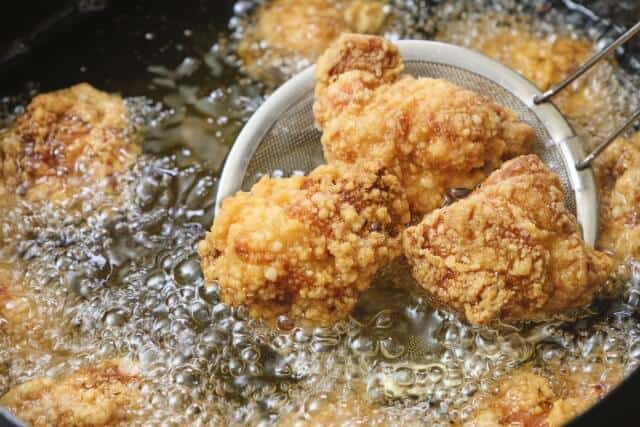
- Chicken thigh: juicy and forgiving, so it remains the standard choice.
- Soy sauce: the backbone of the marinade, salty and deeply savoury.
- Sake: softens the meat and clears away any raw poultry smell.
- Ginger: fresh juice beats powder, so grate a knob yourself.
- Garlic: optional, although most izakaya versions include it.
- Potato starch (katakuriko): the coating behind that light, crackly shell.
- Frying oil: something neutral, such as canola or rice bran.
- Lemon: not merely a garnish, since acidity cuts through the fat.
| Ingredients of Karaage for 2 persons | Measurements |
|---|---|
| Chicken thigh | 300-400g (about 11-14 oz) |
| Ginger | 10g (about 2 tsp, grated) |
| Katakuriko (potato starch) | 40g (about 4 tbsp) |
| Lemon | 10g (a wedge or two) |
| Frying oil | Enough for 3cm (1¼ inch) depth |
| Soy Sauce | 28g (about 2 tbsp) |
| Sake | 14g (about 1 tbsp) |
How to Make Karaage at Home
Five Steps From Bowl to Plate
Cut 300 to 400g of chicken thigh into 3-4cm pieces, roughly the size of a walnut. Add soy sauce, sake, and fresh ginger juice, then rub the seasoning in by hand. Rest the meat for 15 to 20 minutes, turning it two or three times. Longer is not better, because salt eventually draws juice out.
Drain most of the marinade, leaving roughly a spoonful in the bowl. Add three to four tablespoons of potato starch, then mix until the surface turns tacky. That little pool of liquid carries soy aroma into the coating. For a sturdier shell, use half flour and half starch.
Heat the oil to 160°C, then lower the pieces in gently. Fry for about 90 seconds to two minutes and lift everything out. The chicken should still look pale rather than golden. At this stage you are only cooking the inside.
Rest the pieces on a wire rack for two to three minutes. Carry-over heat finishes the centre while steam escapes. Skip this pause and the crust turns soggy later. A rack beats kitchen paper here, since air needs to move underneath.
Raise the oil to 180-190°C and return the chicken for 40 to 60 seconds. Listen for the bubbles growing smaller and the sound turning sharper. Drain briefly, then serve with lemon wedges. Cabbage on the side is traditional, and it genuinely helps.
How to Make Crispy Karaage
Crispness comes down to moisture leaving the coating while oil stays out of it. Japanese cookery-science research on deep frying examines exactly this balance, and the practical lessons are simple enough.
- Fry twice: 160°C (320°F) first for the inside, then 180-190°C (355-375°F) for the shell.
- Potato starch tends to fry lighter than wheat flour, so use it when you want a delicate crust.
- Pat the meat dry before coating, otherwise the starch turns pasty.
- Work in small batches, because a crowded pan drops the oil temperature fast.
- Rest on a wire rack, never in a covered bowl.
- Eat within ten minutes, honestly. Crispness fades faster than anyone admits.
What Does Karaage Taste Like?
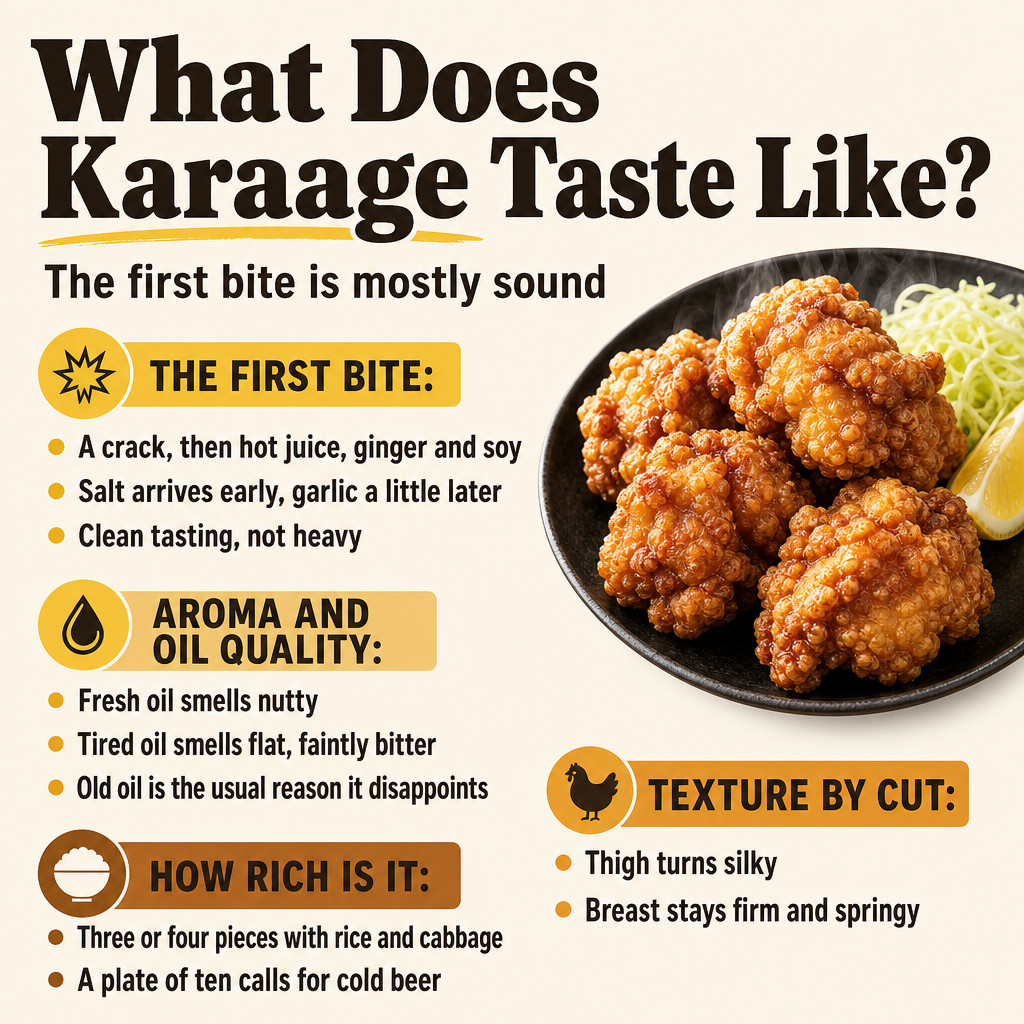
The first bite is mostly sound. The shell cracks, then gives way to hot juice and a wave of ginger and soy. Salt arrives early, garlic slightly later. Underneath all that, the chicken tastes surprisingly clean rather than heavy.
Aroma matters as much as flavour here. Fresh oil smells nutty, while tired oil smells flat and faintly bitter. I have eaten karaage that looked perfect yet tasted dull, and old oil was almost always the reason. Texture shifts with the cut too: thigh turns silky, whereas breast stays firm and springy.
Is it rich? A little, yes. Three or four pieces with rice and cabbage feels right to me, although a plate of ten with cold beer is a different sort of evening.
Karaage Chicken Thigh or Breast?
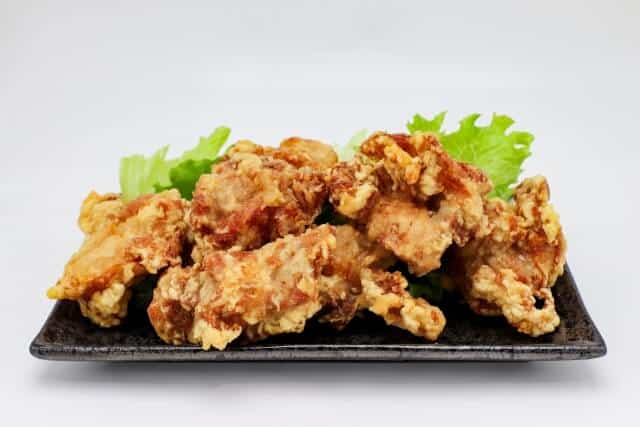
Thigh meat (momo)
Thigh, called momo on Japanese menus, is the default at home and in most shops. Its fat melts during frying, so the meat stays juicy even after it cools. Skin-on thigh gives the crispiest result, although it also eats richer. Cut each piece with a mix of lean meat and fat for an even bite.
Breast meat (mune)
Breast, listed as mune, costs less and tastes noticeably lighter. Because it holds little fat, it dries out quickly past the right moment. Sake in the marinade and a shorter second fry both help. Many Nakatsu shops sell a mixed portion, which is the easiest way to compare the two.
Wings and cartilage
Wings carry gelatin and skin, so they fry into something sticky and rich. Shops usually season them harder, with pepper or chilli. Cartilage, called nankotsu, delivers a crunchy, gritty texture instead. Both suit beer far better than rice.
Types of Karaage Coating
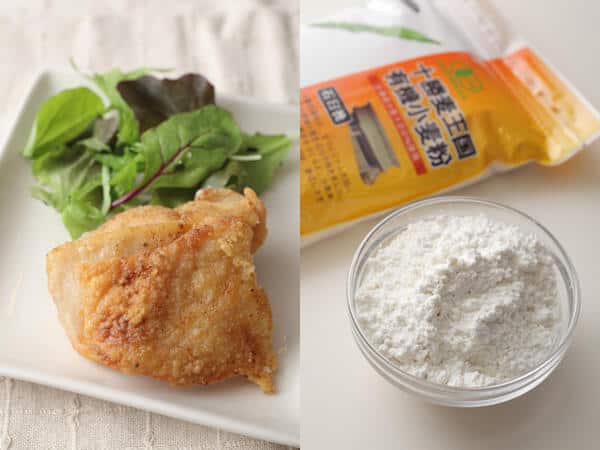
Wheat flour
Flour clings well and fries into a thin, savoury crust. Straight from the oil it turns crisp, yet it softens as it cools. Mixing flour with an equal weight of potato starch gives a good middle ground. That blend also survives a lunchbox.
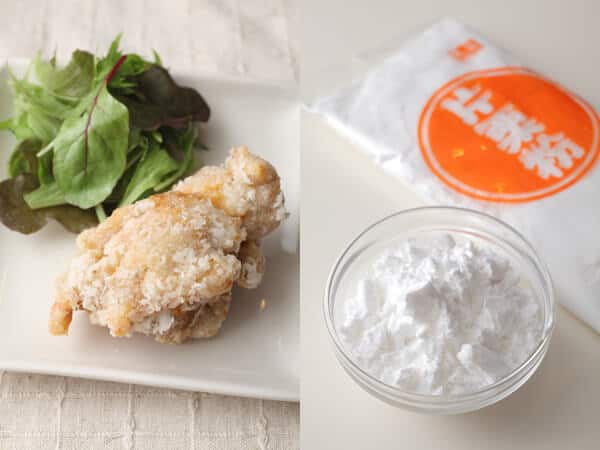
Potato starch
This one has coarser grains, so it stays pale after frying. A heavy coating gives a rugged, wild crunch, while a light dusting turns delicate. The finish feels lighter than flour, and most tatsuta age recipes rely on it alone.
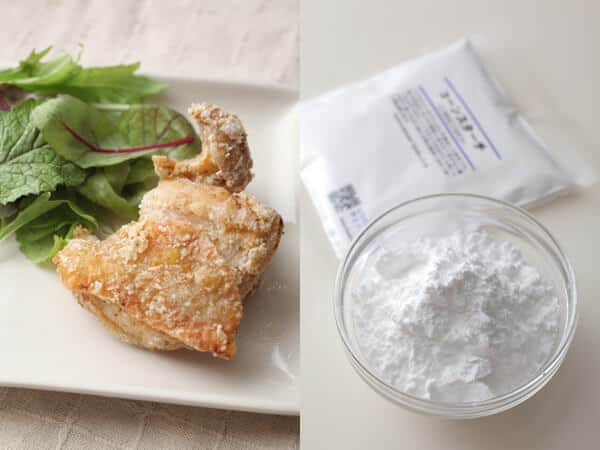
Cornstarch
Because the particles grind finer than potato starch, the coating sits thin. Oil drains off easily and the finish tastes refreshingly clean. Crispness resembles potato starch, though the shell feels lighter and browns more slowly.
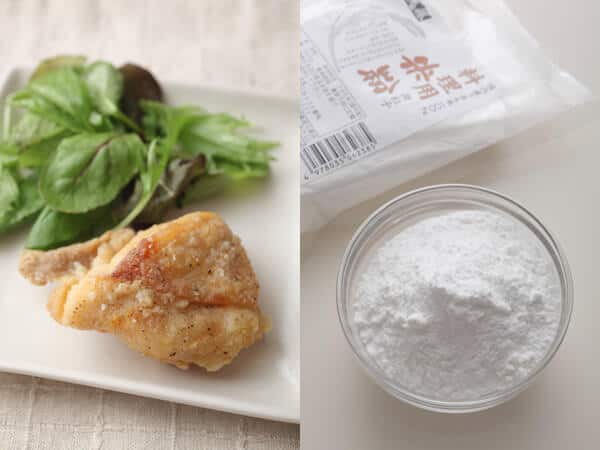
Rice flour
Among the four, this one gives the thinnest coating by far. It resists oil well, which keeps the result light and easy to eat. For anyone avoiding wheat, it is also the obvious pick, especially with tamari soy sauce.
Regional Fried Chicken Styles in Japan
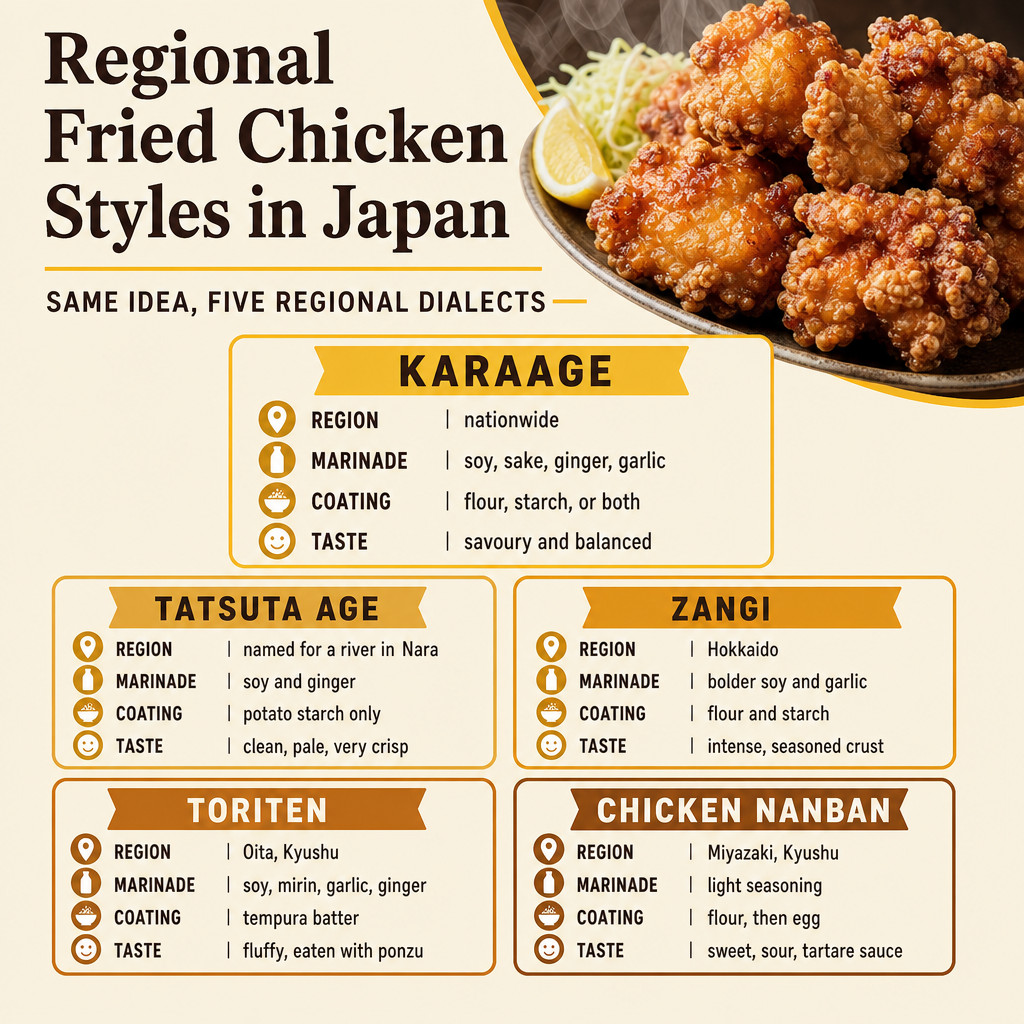
Japan fries chicken in several regional dialects. On the plate they look alike, yet the marinade and the coating separate them clearly.
| Dish | Region | Marinade | Coating | Taste |
|---|---|---|---|---|
| Karaage | Nationwide | Soy, sake, ginger, garlic | Flour, starch, or both | Savoury and balanced |
| Tatsuta age | Nationwide, named after a river in Nara | Soy and ginger | Potato starch only | Clean, pale, very crisp |
| Zangi | Hokkaido, northern Japan | Bolder soy and garlic | Flour and starch | Intense, seasoned crust |
| Toriten | Oita, on Kyushu | Soy, mirin, garlic, ginger | Tempura batter | Fluffy, eaten with ponzu |
| Chicken nanban | Miyazaki, on Kyushu | Light seasoning | Flour, then beaten egg | Sweet, sour, tartare sauce |
Karaage vs Tatsuta Age
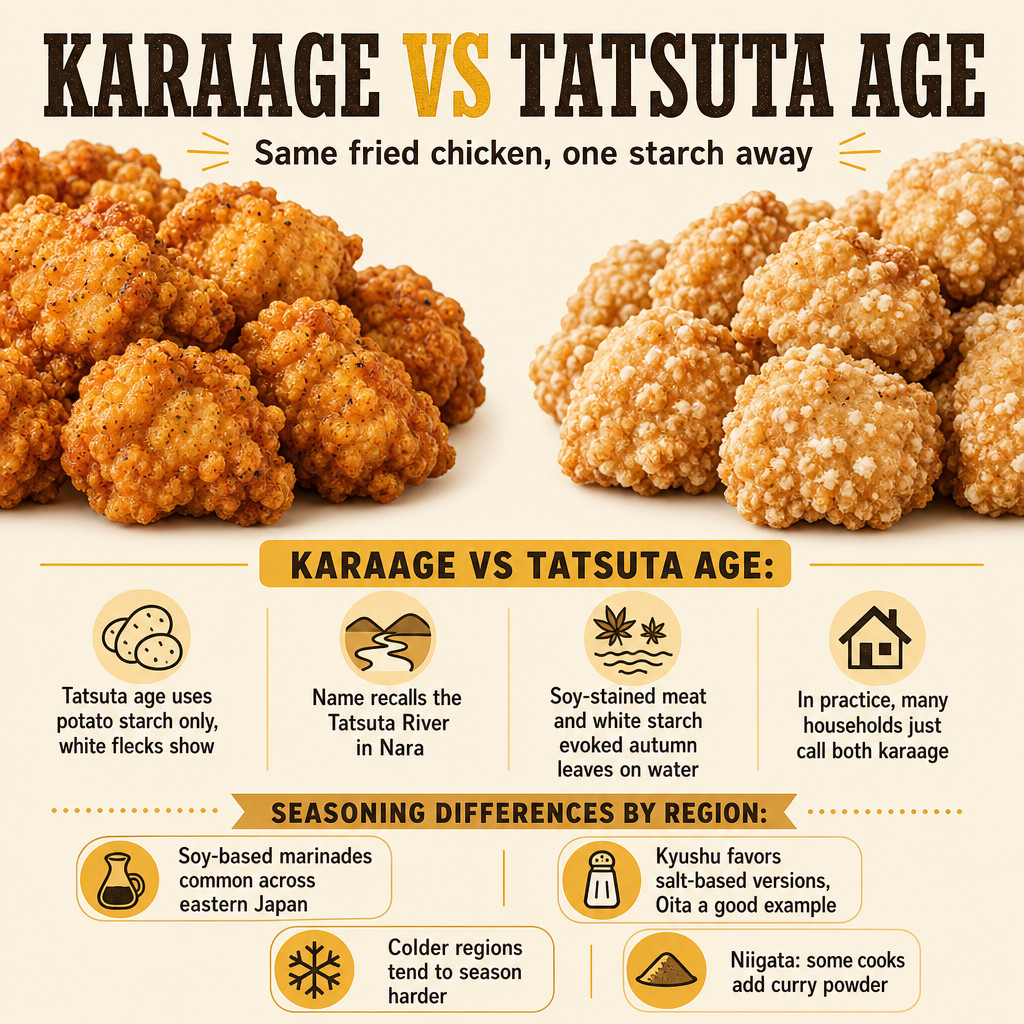
Karaage and Tatsutaage look similar because both are fried chicken dishes. However, the seasoning and coating are different. Tatsuta age uses potato starch alone, so white flecks stay visible after frying. The name points to the Tatsuta River in Nara, a place famous for autumn leaves drifting on pale water.
Soy-stained meat scattered with white starch apparently reminded someone of that view. In practice, though, plenty of households call both versions karaage and move on. Even in restaurants, the line blurs.
Seasoning Differences by Region
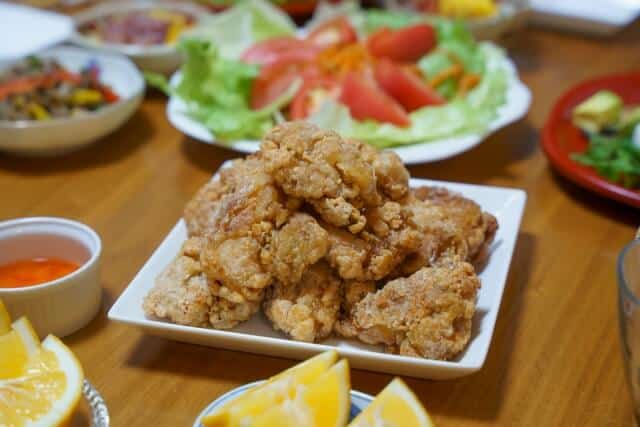
Soy-based marinades appear most often across eastern Japan. In Kyushu, meanwhile, salt-based versions keep a loyal following, and Oita is a good example. Colder regions tend to season harder, and some cooks in Niigata add curry powder. None of this counts as a rule, of course, since recipes stay a matter of house style.
Where to Eat Karaage in Japan
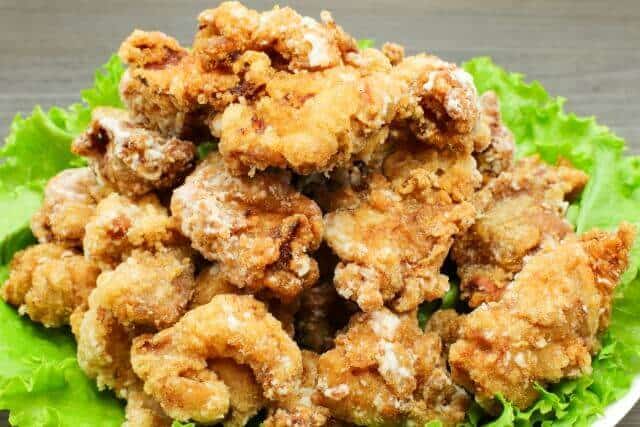
Karaage has no season. Shops sell it all year, at lunch, at dinner, and late at night, so you never need to plan around it. Five places cover almost every situation a traveller will meet.
Convenience stores
Every major chain sells hot karaage beside the register. Lawson, FamilyMart, and 7-Eleven each keep a house version, sold by the piece. Quality is better than it has any right to be at that price. Our convenience store food guide covers the rest of the hot counter.
Izakaya
An izakaya is a Japanese pub where small dishes arrive alongside drinks. Karaage usually comes hot with lemon and mayonnaise on the side. Order it early, since it pairs beautifully with the first beer. Portions run to five or seven pieces, which suits two or three people sharing.
Teishoku and bento shops
A teishoku is a set meal, so the plate arrives with rice, miso soup, and shredded cabbage. Bento shops pack the same chicken cold, and it holds up remarkably well until lunchtime. For a cheap sit-down lunch, this is usually the best value around.
Karaage specialty shops
Specialist takeaways, known as karaage senmonten, sell by weight rather than by portion. Staff fry to order, so expect a short wait. Most shops offer both soy and salt marinades, and asking for a mix is completely normal.
Nakatsu and Usa in Oita Prefecture
For the full pilgrimage, head to Nakatsu, roughly an hour by train from Kokura in northern Kyushu. Shops cluster within walking distance of the station and the old castle town. Order 100 to 200g per person, then eat it on a bench while it is still too hot to hold. Usa, next door, has an equally strong claim.
Where to Try Karaage in Tokyo
Gaburi Chicken (がブリチキン)
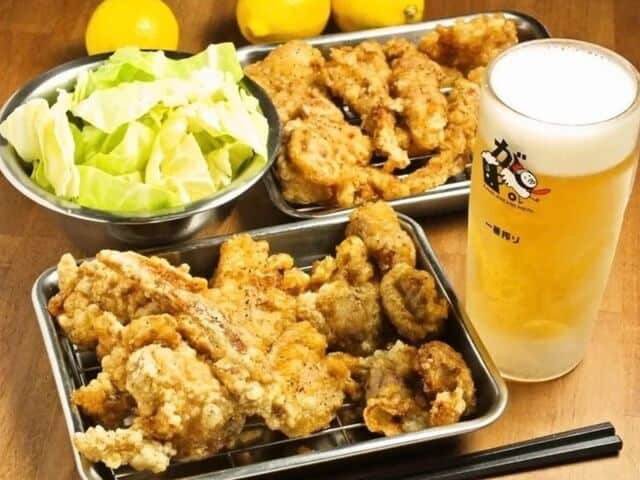
Gaburi Chicken in Takadanobaba started in Nagoya and specialises in fried chicken. Few places let you choose which cut you want, so it suits a first visit. The station sits a short walk away, which makes it easy for an early evening.
YUKARI (からあげ縁 浅草総本店)
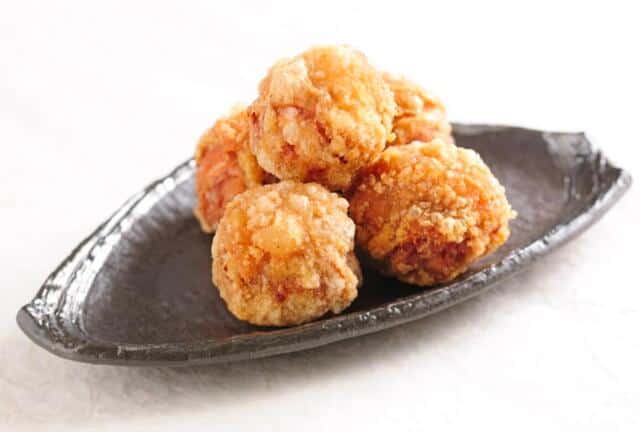
This Asakusa shop marinates its chicken for a full day in a sauce that skips garlic and ginger. Frying starts only after you order, so every piece arrives fresh. Seasonal flavours rotate through the year, and for anyone avoiding garlic it is the easy choice.
Oshu Iwai (奥州いわい)
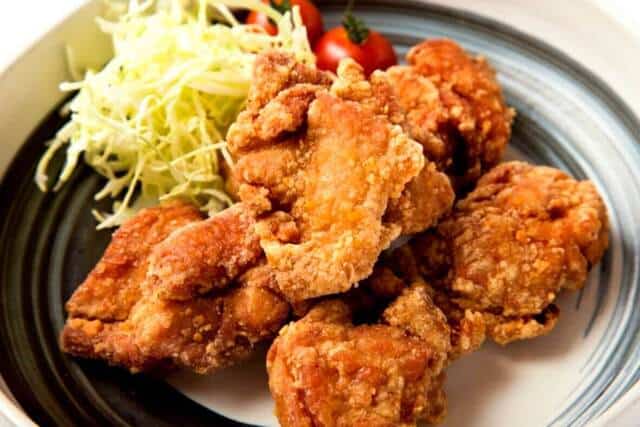
Oshu Iwai focuses on the bird itself, using chickens raised on a specified feed. The shop fries hot, then rests each piece in a garlic-free ginger sauce. As a result, the meat tastes cleaner than most. Go early, because the counter closes once it sells out.
Opening hours and menus change, so check each shop’s official website before you travel.
How Much Does Karaage Cost?
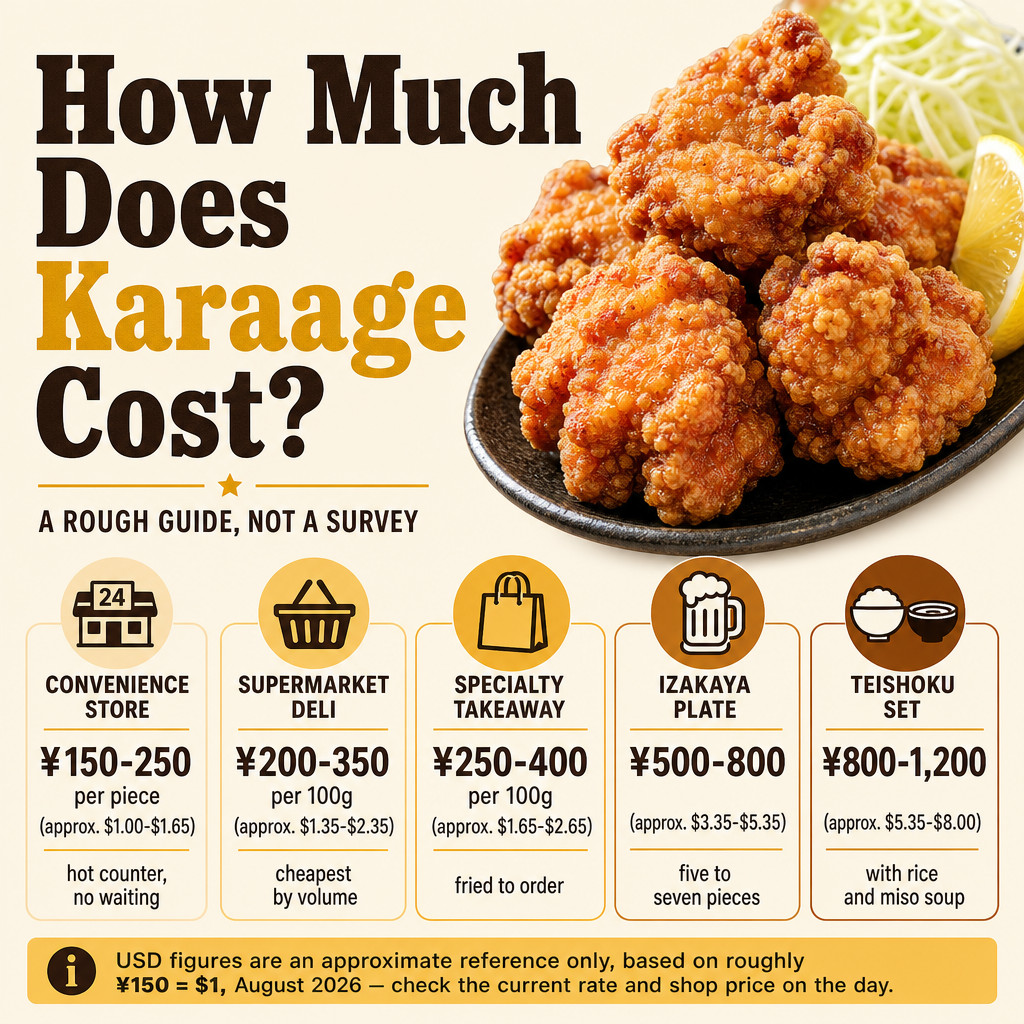
The table below gives general price ranges you can expect, not surveyed figures from named shops. Use it to budget, then check the actual price on the day.
| Where you buy it | Rough guide | Notes |
|---|---|---|
| Convenience store | Around ¥150-250 per piece | Hot counter, no waiting |
| Supermarket deli | Around ¥200-350 per 100g | Cheapest by volume |
| Specialty takeaway | Around ¥250-400 per 100g | Fried to order |
| Izakaya plate | Around ¥500-800 | Five to seven pieces |
| Teishoku set | Around ¥800-1,200 | With rice and miso soup |
Prices shift by city and by year, so treat these figures as a starting point only. In Nakatsu, shops quote by weight, yet regulars order a yen amount instead of grams. That habit confuses first-time visitors, myself included.
Vegetarian and Gluten-Free Karaage
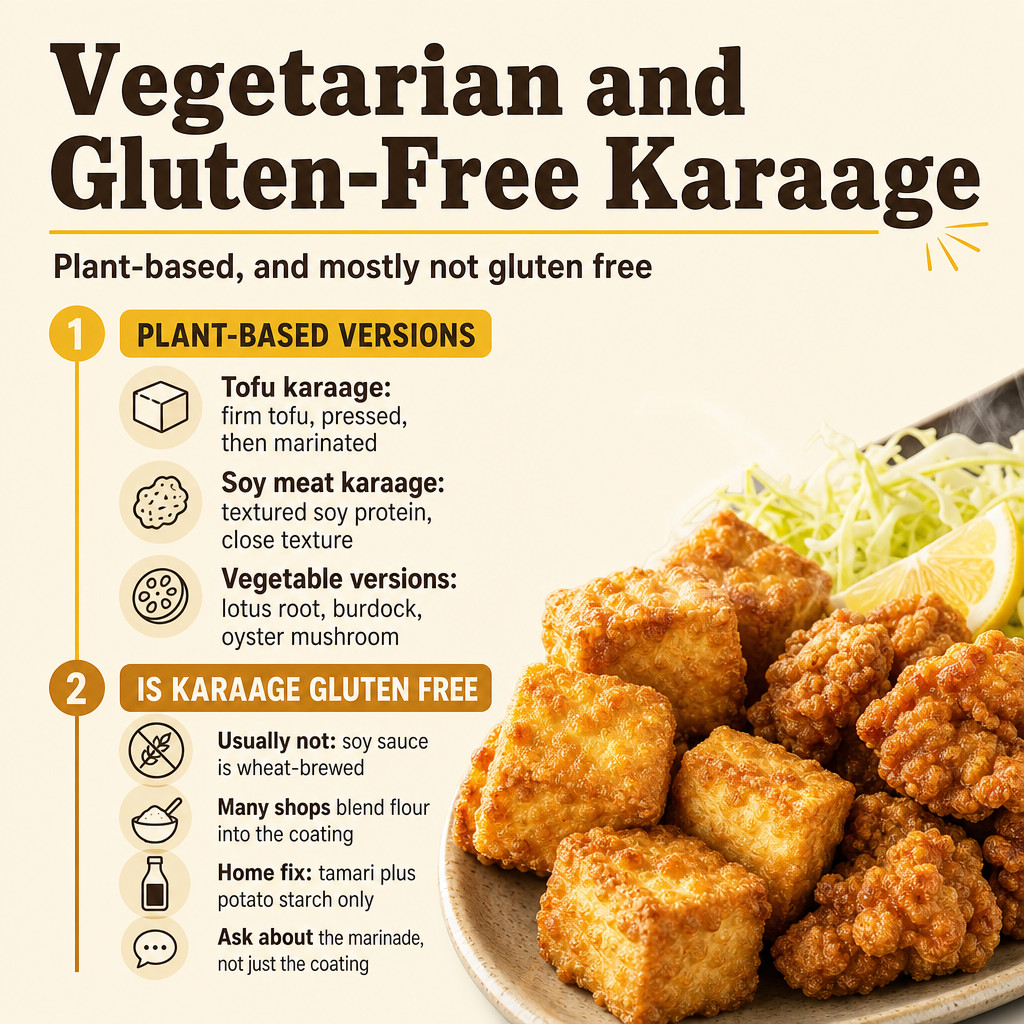
Plant-based versions
Tofu karaage uses firm tofu, pressed dry and then marinated like chicken. Soy meat karaage, made from textured soy protein, copies the texture closely and now sits in most supermarkets. Vegetable versions work too, especially with lotus root, burdock, or oyster mushrooms.
Is karaage gluten free?
Usually not, unfortunately. Standard Japanese soy sauce is brewed with wheat, and many shops blend flour into the coating. A home version avoids both problems: use tamari, a wheat-free soy sauce, together with potato starch only. In restaurants, ask about the marinade rather than the coating, since the sauce is the hidden issue.
How to Eat Karaage Like a Local
Lemon etiquette
Lemon arrives with the plate, and squeezing it feels automatic. On a shared plate, though, ask the table first. Some people dislike citrus on fried food, and the juice spreads everywhere. “Lemon kakete ii desu ka?” means “may I squeeze the lemon?”, and it takes two seconds.
Sauces and sides
Mayonnaise is common, especially around Kansai in western Japan. Shichimi, a seven-spice chilli blend, turns up alongside ponzu, a citrus-soy dipping sauce, and tartare sauce. Shredded cabbage is not decoration either, since it resets your palate between pieces.
Is karaage spicy?
Not usually. The base flavour leans on soy, ginger, and garlic rather than chilli. Some shops sell red or spicy versions with chilli powder, while garlic-heavy styles taste sharper without any real heat. If spice matters to you, ask before ordering.
Final Thoughts
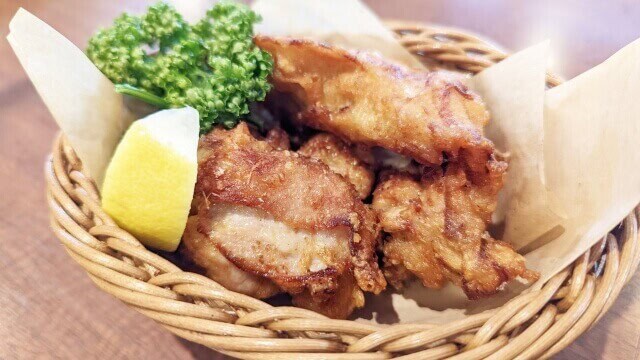
Karaage is simple food. Even so, its marinade, coating, and regional styles make it one of the most widely eaten fried dishes in Japan. Learn the two-stage fry, and everything else follows quickly.
If you are travelling, try a specialty shop first and order by weight, then compare it with a convenience store piece the next day. The gap between the two tells you more than any description can. After that, a regional style such as zangi or toriten makes an easy next stop.
Japan has plenty of other fried dishes worth your time, including Tempura, Tako Karaage, and Toriten.
Japanese Karaage FAQ
What is karaage?
Karaage is Japanese fried chicken made from marinated bite-sized pieces coated in starch or flour. Cooks season the meat with soy sauce, sake, and ginger before frying it. The word also names the frying method itself, so fish and vegetables qualify too.
How does it differ from Western fried chicken?
The flavour sits in the meat rather than the crust. Western recipes build a thick, seasoned batter, while this dish uses a thin starch coating instead. Pieces are also smaller and boneless, so they cook faster and travel better.
Is karaage gluten free?
Usually not, because standard soy sauce is brewed with wheat and many coatings mix in flour. At home you can swap tamari for soy sauce and use potato starch alone. In restaurants, ask about the marinade first, since that is the hidden source.
Should I order thigh or breast?
Thigh, listed as momo, gives the juiciest result and suits most people. Breast, or mune, tastes lighter and costs less, although it dries out quickly if overcooked. Specialty shops often sell a mixed portion, so you can try both at once.
Is karaage spicy?
Generally no, since the flavour comes from soy sauce, ginger, and garlic. Some shops offer red or spicy versions seasoned with chilli powder. Shichimi seven-spice on the side is another easy way to add heat yourself.
What is Nakatsu karaage?
Nakatsu is a city in Oita Prefecture, on Kyushu, with an unusual concentration of karaage specialty shops. Locals call it the sacred ground of the dish, and the city publishes an official map of the shops. Most sell by weight and fry to order.
Should I squeeze the lemon over a shared plate?
Ask the table first, because not everyone wants citrus on fried chicken. On a shared plate the juice spreads across every piece within seconds. When you eat alone, squeeze away freely.
Is it still good cold?
Yes, and that quality explains why it fills so many bento lunchboxes. A flour-based coating softens but keeps its flavour, while starch stays lighter. Reheat briefly in a toaster oven if you want the crunch back.
References
- Japan Karaage Association – About the association and the Karaagenist certification (Accessed August 2026)
- Japan Karaage Association – Karaage Grand Prix (Accessed August 2026)
- Seichi Nakatsu Karaage Association – About Nakatsu Karaage (Accessed August 2026)
- Nakatsu City, Oita Prefecture – Nakatsu Karaage Map (Accessed August 2026)
- Ministry of Agriculture, Forestry and Fisheries – Local Cuisines of Japan: Oita Prefecture (Accessed August 2026)
- Ministry of Agriculture, Forestry and Fisheries – Local Cuisines of Japan: Toriten, Oita (Accessed August 2026)
- J-STAGE, Journal of Cookery Science of Japan – Hamada S., Teaching Material Study: Deep-Frying, 27(4) (Accessed August 2026)
- J-STAGE, Japan Society of Cookery Science – Comparison of Oil Absorption in Deep-Fried Vegetables (Accessed August 2026)
Related Articles
- Tatsuta Age (竜田揚げ) (Accessed August 2026)
- Zangi (ザンギ) (Accessed August 2026)
- Toriten (とり天) (Accessed August 2026)
- Chicken Nanban (チキン南蛮) (Accessed August 2026)
- Tako Karaage (タコのから揚げ) (Accessed August 2026)
- Tempura (天ぷら) (Accessed August 2026)
- Bento (弁当) (Accessed August 2026)
- Japanese Convenience Store Food Guide (Accessed August 2026)



Comments